Podcast
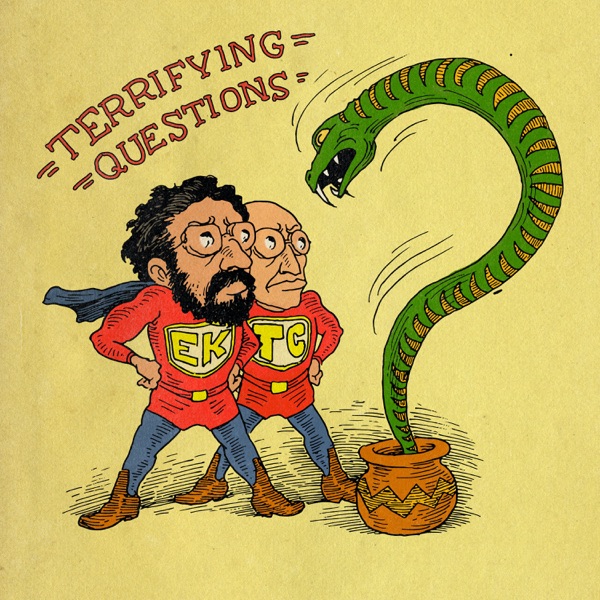
Terrifying Questions
Eric Kaplan, a comedy writer (Futurama, Big Bang Theory) and doctor of philosophy, and Taylor Carman (Barnard College, Columbia University), a philosophy professor specializing in phenomenology, existentialism, and hermeneutics, host a podcast that addresses unsettling questions concerning human existence and the order of things with the goal of finding a path to courage using comedy, imagination, and dialogue. Along the way they occasionally grapple with the deep uncanniness of being.
- Episodes
- 46
- Releases
- Every two weeks
- Typical length
- 55 min
- On air since
- 2023
- Latest episode
- 1 week ago
Episodes
46 episodes, newest first
-
45 min
51. Are There Important Things That Cannot Be Expressed?
Show notes
Can something meaningful lie beyond (or beneath) the expressive powers of language? Tune in this week to see if Eric and Taylor can (or can’t) shed some light on this unsettling question by putting words together to form sentences. Søren Kierkegaard, Ludwig Wittgenstein, Miller Williams, and Wallace Stevens make cameo appearances.
-
53 min
53. Should We Fear Death?
Show notes
Eric and Taylor talk about death and whether we ought be afraid of it. In this episode Taylor speaks partly from personal experience because a few years ago he had a mild brush with death. He did not die, however, which he and Eric agree was a good thing. They also agree that death is, if nothing else, uncanny.
-
56 min
50. Have We Forgotten Being?
Show notes
Have we forgotten what it means to be? Is the history of being a history of our becoming oblivious to it? Does being even have a history? Taylor and Eric discuss these terrible, wondrous, “rich and strange” subjects in anticipation of the publication of Taylor's forthcoming book, Heidegger and the History of Being.
-
54 min
49. Are We Insects or Angels or Both?
Show notes
Are we puny and wretched or divine and transcendent? Or are we both? According to the great French mathematician, inventor, and religious thinker Blaise Pascal (1623–1662), yes. This week Eric and Taylor contemplate Pascal's proto-existentialist account of the human condition and its possible relevance to Taoism, evolution, AI, language, and (maybe) the religious practices of elephants.
-
58 min
48. Was Nietzsche a Proto-Fascist?
Show notes
Was Nietzsche a fascist? Does liking Nietzsche make you a fascist? If the bully boy heralds of MAGA are present-day fascists, does that make them latter-day Nietzscheans? Join Eric and Taylor as they distinguish several varieties of chest-thumping, bluster, and skepticism about truth. And as Nietzsche himself said, “If this podcast episode does not kill you, it will make you stronger.”
-
59 min
47. Are We Always at War with Ourselves?
Show notes
Did you ever want something and not want it, or love somebody and also hate them? If you did, does that mean there are two different things inside you and they are having a war? Or are there three? This week Eric and Taylor look at the idea of internal conflict, internal peace, what it all means, and what if anything can be done about it. They also reply to two letters from nonimaginary listeners.
-
44 min
46. Are We Living in a Cave? (Part 2)
Show notes
Are we still living in a cave? In this sequel episode Eric and Taylor contemplate what might happen if you got out of Plato’s cave. Would the sun blind you? And if you tried to convince the other prisoners to escape, would they kill you? Also this week, replies to some letters from listeners.
-
1 hr 6 min
45. Will Intelligent Machines Destroy Us?
Episode 45
Show notes
Are computers becoming so supersmart that they might supersede all human intelligence and eat us for lunch? Or is the very idea of “machine intelligence” a sad blend of conceptual confusion, willful ignorance, magical thinking, and financial opportunism? If you’re not sure (and if you can’t get an LLM to give you a straight answer), have a listen and get back in touch with your humanity.
-
1 hr 1 min
44. Are We Living in a Cave? (Part 1)
Season 1, Episode 44
Show notes
Are ordinary experience and everyday life hopelessly benighted and delusional, a realm of shadows, full of sound and fury but signifying nothing? This week Eric and Taylor descend into the most famous four pages in the history of Western philosophy: Plato’s allegory of the cave. Tune in and overcome your fear of truth, wisdom, and the beautiful.
-
1 hr 11 min
Episode 40: Is Food Art?
Show notes
This week Julia Moskin, Pulitzer Prize winning food reporter for the New York Times, joins Eric and Taylor to ask whether food is (or can be) art, and how it manages to do that while also just being yummy. Should great food taste like nothing you’ve ever tasted before or should it taste like the best ever version of its ingredients? Is culinary quality subjective or objective? Why do critics write reviews? Tune in and find out.
-
54 min
Episode 38: Is Justice Possible?
Show notes
Some things are obviously horribly bad and wrong. Is it possible to make them right? Do some people deserve satisfaction while others deserve punishment or mercy? When juries deliver verdicts and judges impose sentences, are they speaking the truth or just fumbling in the dark and settling on the least bad outcome? This week Taylor and Eric reflect on the possibility, the impossibility, and the necessity of justice.
-
57 min
Episode 37: Is It Okay to Be Fat?
Show notes
Do we owe it to anyone (even ourselves) to be thin? Is being thin always healthier, sexier, better looking, or somehow more praiseworthy? Is it easier to be a great philosopher or to get into heaven if you’re thin? This week Eric and Taylor are joined by philosopher Kate Manne, whose new book examines diet culture and fatphobia. The truth, as it often does, might surprise you.
-
1 hr 2 min
Episode 36: Can You Succeed in the Music Business Without Selling Out?
Show notes
Does the lure of fame and fortune necessarily get in the way of making great music? Or is it okay to make some fun ear candy as a way of putting food on the table? This week Taylor and Eric chat about artistic integrity and the temptations of popularity and money with singer, songwriter, philosopher, violinist, and attorney at law, Andrew Choi – also known by musical nom de plume, St Lenox. As a bonus, find out how Bob Marley was inspired by the Banana Splits.
-
33 min
Episode 35: Can a Sound Look Like Something?
Show notes
Synesthesia! A weird thing experienced only by unusual people, or by ordinary people on unusual drugs, or – is it something everybody has all the time? Are very low musical notes literally “dark”? Can food sound like something, like hot peppers going “ping” on your tongue? Why does it make sense to call a fork a “zrickrick” and a pillow a “baobwab”? Or does it? In 1688 William Molyneux asked John Locke whether a blind person who regained her vision would be able to distinguish a square from a circle by sight. Locke said no. Leibniz said yes. Who was right? This week Eric and Taylor puzzle over Molyneux’s question and a variety of other related and unrelated matters to do with musical temperament, linear perspective, and octopuses.
-
38 min
Episode 34: Is Revenge Inevitable?
Show notes
Is revenge a dish best served cold, hot, or not at all? Should we all go on a revenge diet, or is it just too tasty? Could hitting back be so much fun that we can’t give it up? Or is the best revenge the serene feeling of being above revenge? Even if we know that vengeance inevitably leads to an endless cycle of vengeance, is it possible to get off the not-so-merry-go-round? How did Athena help the Furies become the Kindly Ones? Join Taylor and Eric as they confront the terrifying fact that human beings seem to be addicted to revenge.
-
55 min
Episode 33: Do Things Happen for a Reason?
Show notes
Things happen. Sometimes you find a $10 bill. Sometimes a bird craps on your head. Are these events just the meaningless result of previous events or is there a hidden purpose behind everything? Does God’s plan underlie the chaos of experience? Is the idea that something was “meant to be” (or not meant to be) comforting or crippling? And is the idea that everything is possible liberating or paralyzing? This week Helen De Cruz makes a record-breaking second appearance on the podcast to help Taylor and Eric think through the idea that we might be better off not believing in providence.
-
55 min
Episode 32: Is Almost Everyone a Failure?
Show notes
This week Taylor and Eric are joined by philosopher Kieran Setiya, author of Life Is Hard, which they agree it is. It’s especially hard if you think you’re doomed to failure. Are you? Not necessarily. But if you don’t worry about success and failure, are you just going to be swimming in a soup of nothing matters and who cares? Tune in and find out how and why we judge life projects, careers – and people themselves – as successes or failures. Should we be making these judgments? Would our lives be better if we didn’t?
-
55 min
Episode 31: Are We Always Just Acting?
Show notes
Is everything we do a kind of performance? Are we always reading from a script? And what makes bad acting bad? Do psychopaths make good actors? Do politicians make good psychopaths? And why do presidential candidates emphasize what they’re saying by pointing with their thumbs? Film and television actor Kevin Sussman joins Taylor and Eric to talk through these disturbing mysteries.
-
1 hr
Episode 30: Was the Woke Mind Virus Created by French Philosophers?
Show notes
Were poststructuralist, postmodern, postrespectable French philosophers like Michel Foucault the real masterminds behind identity politics, critical race theory, cultural appropriation, and pumpkin spice latte? Will civilization survive the rampant, unchecked questioning of grand narratives? Join Taylor and Eric as they unravel this bundle of phone cords and contemplate equality, freedom, civility and mutual respect, Foucault’s historical counternarratives, pronouns, green hair, nose rings, and the myth of trigger warnings.
-
1 hr 4 min
Episode 28: Is It Bad to Judge People?
Show notes
Being “judgmental” sounds like something bad, yet refraining from all moral judgment seems pathetic, and also impossible. So, what should we do? Can we be truly compassionate without also being capable of anger, resentment, and maybe some occasional Schadenfreude? This week Eric and Taylor are joined by actor, writer, and television producer Andy Richter, who will help them sort out when it’s okay and when it’s not okay to be, as Jesus of Nazareth said, “judgy.”
Philosophy lists
More Philosophy shows picked out from the charts







More in Philosophy
Placed highest on Apple Podcasts' Philosophy chart right now