Podcast
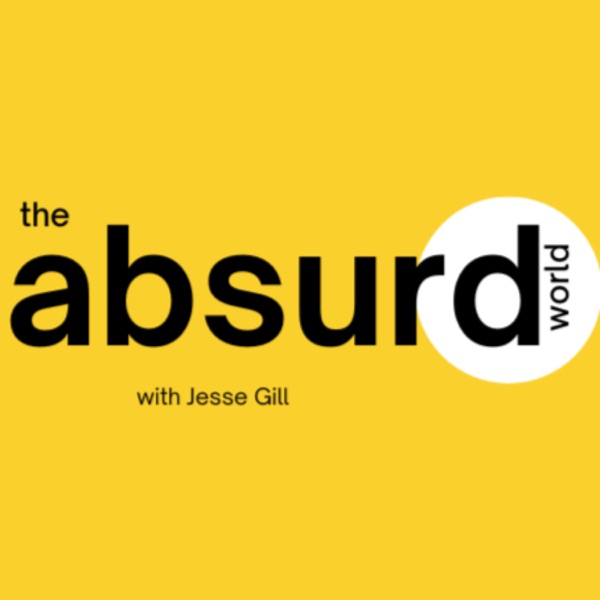
The Absurd World Podcast
The Absurd World is a podcast that dives headfirst into the chaos of existence, exploring life’s biggest (and weirdest) questions through the lens of existentialism, absurdity, and a healthy dose of humor. Hosted by existential psychotherapist Jesse Gill, LCSW, this show unpacks the meaning(lessness) of life, authenticity, and human nature—while also embracing the ridiculousness of it all. Whether you’re questioning reality, laughing at the void, or just trying to make sense of being alive, you’re in the right place. Because if life is absurd… we might as well have fun with it.
- Episodes
- 89
- Releases
- Weekly
- Typical length
- 31 min
- On air since
- 2025
- Latest episode
- 2 days ago
Episodes
89 episodes, newest first
-
51 min
Ep. 87 - Kafka Part 2: Am I Ever Really Safe?
Show notes
Many of us go through life believing that, at least to some degree, we are relatively safe from the dangers of the world. That no one is out to get us. That if something goes wrong, there are people and systems in place that will have our backs.
But what if that is not always true? What if, when things really go wrong, we are entirely alone in this world, left to fend for ourselves?
In this episode, the second in our series exploring the works of Franz Kafka, we dive into the horror of becoming the target of the very systems we were told existed to protect us. A kind of horror that may be lurking just beneath the surface of everyday life for far more of us than we would like to believe.
As we examine legal systems, government, our workplaces, insurance companies, and all the other institutions we depend on and try to place our faith in, we begin to ask a rather unsettling question: what happens when these systems simply do not care about us as much as we wish they did?
And perhaps even more frighteningly, what do we do when we become the next target?
-
36 min
Ep. 86 - HALLOWEEN SPECIAL
Show notes
It’s Halloween everyone!
And you know what that means...
A Halloween special episode!!!
This October, we are taking a look at what it means to create stories of horror, from the myths and legends to the folklore that so many of them are built upon. From the stories of the Americas designed to warn us against threats from all around and within, to the stories meant to change the way we understand nature, and all the way to the expression of the horrors of war, violence, and oppression, the scary stories we tell have often held a much deeper meaning than just ghosts and ghouls.
Join me as we explore why humans have always told stories about the things that terrify us, and what those stories might reveal about the world we live in, the things we fear, and ourselves.
Because sometimes, the monsters in our stories are not really monsters at all... And sometimes, they’re worse.
-
34 min
Ep. 85 - Kafka Part 1: Am I Only Worth What I Offer Others?
Show notes
If you were no longer able to work, do chores, support your friends and family, take care of others, or contribute to the world in some meaningful way... would you still be human?
Or would you be as useless as a bug?
This is the question we explore this week in the first episode of a series on the works and philosophy of the master of the absurd himself, German speaking Jewish writer Franz Kafka.
As we begin this series, we take a hard look at what it means to be useful, to contribute to society, and to provide something of value to the people around us. Is this really how we should measure our worth as human beings? And what happens when we can no longer fulfill the roles expected of us?
Along the way, we may discover that our own ideas about our worth are not the only ones that matter. Sometimes, the people around us have very different ideas about what makes us valuable... and whether we are worth anything at all.
-
31 min
Ep. 84 - Was I Made For This World?
Show notes
We wake up every morning. We go to work, attend school, take care of the household, and follow the routines we believe we need to maintain just to exist in this world. We try to make friends, build relationships, and find ways to add something meaningful to our lives.
These are the steps we are taught to follow to live a “normal” life, to be productive, and to be healthy. But what happens when we struggle to follow them? What if these routines do not fit us? What if they were never meant for us, or perhaps we were never meant for them?
In this weeks episode, we dive into the unsettling question of what it means to feel as though we were never made for the world we inhabit. What if the way society is structured simply does not fit the way we experience existence? With the guidance of French Algerian philosopher and writer Albert Camus, we explore what it really means to belong in this world, whether anyone truly does, and whether we are all just pretending that we do.
Perhaps the question is not whether we fit into the world, but whether we can recognize our place within its absurdity without pretending it makes sense.
-
36 min
Ep. 83 - Am I Being Selfish?
Show notes
If there is one question that comes up time and time again among those hesitant or concerned about the school of thought called existentialism, it is the fear that this way of thinking and living could lead to something terrible for those who embrace it: selfishness.
But is it really so easy to fall down a selfish rabbit hole? And does being selfish necessarily mean that we are aware of what we are doing?
In this weeks episode, we explore what it means to be selfish and just how complex the concept really is. Using a piece of religious and philosophical literature as a guide, we turn to Japanese author Shūsaku Endō for some tortured guidance as we dig into the complicated relationship between our actions, our intentions, and the stories we tell ourselves about them.
We may discover that our actions can hide behind our intentions, and that even our intentions can hide behind something far more powerful...
Fantasy.
-
32 min
Ep. 82 - Am I Responsible For My Feelings?
Show notes
How much control do we really have over ourselves and our inner worlds?
Sure, we can choose to take one action or another physically, but do we really control the things that drive those actions?
Do we actually have control over the internal reactions we call emotions?
In this weeks episode, we explore what it means to have a healthier relationship with our emotions and, in turn, feel more in control of our lives. With the help of existential therapist Viktor Frankl and Vietnamese Buddhist monk and prolific author Thich Nhat Hanh, we explore the ideas, theories, and practices behind emotional regulation.
We may discover that we do not need to be overwhelmed by our emotions or try to silence them. Instead, perhaps we should treat our emotions like a crying infant, meeting them with acknowledgement, understanding, patience, love, and peace.
-
37 min
Ep. 81 - Why Am I Alone?
Show notes
Are you alone?
Am I?
Are we all?
And is loneliness a fundamental part of being alive? Something forced upon us? Something we choose? Or something far more personal?
In this weeks episode, we dig into the experience of true loneliness: where it comes from, why it occurs, and what, if anything, we can do about it. With a jam packed exploration of the works of French existentialist Jean-Paul Sartre, Russian novelist Fyodor Dostoevsky, and Japanese novelist Osamu Dazai, we examine how much control we really have over our loneliness and how much responsibility we have to understand where it comes from.
We may discover that loneliness does not always originate in the world outside of us, but within ourselves, and that finding our place in a society we desperately want to belong to may require us to look inward first.
-
32 min
Ep. 80 - Can I Trust Philosophers?
Show notes
Are philosophers good people?
Do they actually live the kinds of lives they tell the rest of us to aspire to?
Or are they all talk and no action?
In this weeks episode, we take a hard look at the lives of some of our favorite philosophers and the ways they sometimes seemed to completely contradict their own teachings. With thinkers like Jean-Paul Sartre, Simone de Beauvoir, Michel Foucault, and Albert Camus on the chopping block, we ask whether we can still trust their ideas after discovering the flaws, contradictions, and troubling choices in the lives they lived.
With the gentle but clear guidance of American thinker and writer bell hooks, we confront a difficult question: what do we do when someone whose ideas have changed us turns out to be deeply flawed in ways that challenge everything we thought we knew about them?
Perhaps the person who gives us a powerful idea does not have to be the person we want to become.
-
29 min
Ep. 79 - Should I Be A Vegan?
Show notes
Do you like eating meat?
Is it delicious in every possible way?
Does it remind you of good times with family, friends, or traveling?
Same.
So why am I vegan? And why am I asking whether you should be?
In this weeks episode, I step away from the usual ethical and moral arguments surrounding veganism and animal consumption. Instead, we use the question of whether we should be vegan as a way to explore something much more personal: who we are, what we believe, and what happens when our choices force us to confront our own values.
With the help of thinkers like Jean-Paul Sartre and Peter Singer, we explore how a seemingly simple question like "Should I be vegan?" can become an opportunity for genuine self examination, regardless of where we ultimately land.
-
20 min
Ep. 78 - Should I Be A Patriot?
Show notes
Do I love my country?
If I do, does that make me toxic?
If I don't, does that make me a traitor?
Is there even a right answer anymore?
And what does it really mean to be a patriot today?
In this weeks episode, I explore what it means to love your country in a genuine and authentic way, and how patriotism can be expressed through action rather than blind loyalty. With the help of thinkers like Jonathan Haidt and Timothy Snyder, we take an honest look at the difference between patriotism and nationalism, and how each can either strengthen or weaken the societies we hope to build.
We may discover that we have misunderstood patriotism on a massive scale, and that this misunderstanding is shaping far more of our world than we realize.
-
31 min
Ep. 77 - Am I A Liberal?
Show notes
What does it mean to be liberal?
To follow liberal ideology?
To be left wing?
And what does it mean for me to call myself a liberal in the modern world, in the nation where I was born?
Surprisingly, that is a much more complicated question than it might seem.
In this weeks episode, I turn to several thinkers to try to understand what it actually means to be a liberal and whether it is an identity I want to claim for myself. With the help of philosophers like Isaiah Berlin and John Rawls, among others, we explore what liberalism was originally intended to be, what it has become, and whether it still reflects the values we hold today.
Perhaps the deeper and more frightening question is this: how do I know what my values and beliefs actually are if I don’t feel like I fit neatly anywhere?
-
25 min
Ep. 76 - Why Am I Bored?
Show notes
Why am I so bored all the time?
Why is nothing entertaining enough for me anymore?
Am I boring?
Are other people boring?
Have I simply become too accustomed to having endless entertainment at my fingertips?
Or is something else going on?
In this weeks episode, we take a long, hard look at boredom and what it actually means to us. With the help of German philosopher Martin Heidegger, along with a brief appearance from Korean philosopher Byung Chul Han, we explore the different ways boredom can take hold of our lives and what, if anything, we can do about it.
Perhaps we will discover that boredom is not something we should be running from, but something we desperately need to pay attention to... before our world passes us by.
-
32 min
Ep. 75 - Am I Living A Healthy Life?
Show notes
What does it mean to be healthy?
Really.
Not what the latest fad tells us. Not what we are constantly told we should be doing. And not even what the government says. What does it actually mean to live a healthy life?
In this episode, we stop and seriously ask how we know what is healthy for us in the first place. Is health really as straightforward and scientific as we tend to assume, or is there something deeper going on? With the help of voices from across history, including American journalist and author Michael Pollan, we take a closer look at what it means to pursue health and how we might actually achieve it.
And we might be surprised by just how far into the past we have to look for some of the answers.
-
20 min
Ep. 74 - Am I A Good Parent?
Show notes
Am I a bad parent?
Did I have bad parents?
Is there even such a thing as a good parent?
As a therapist, I am not sure there is a question I have heard more often or spent more time exploring. Throughout my career, clients have asked what it really means to be a bad parent, and whether anyone can truly be called a good one.
In this weeks episode, I dive into these questions with the help of British psychoanalyst Donald Winnicott and his groundbreaking idea of the "good enough" parent. Together, we explore what it actually means to parent well, why we so often hold ourselves to impossible standards, and why the qualities that matter most may not be the ones we expect.
Perhaps being a good enough parent really is... good enough.
-
30 min
Ep. 73 - Should I Have Kids?
Show notes
Should I have kids? Should you? Should anyone, for that matter?
Is anyone ever truly ready to become a parent? Do we really know why we want children? And if we do, how can we tell when we are actually ready?
In this weeks episode, I explore what it really means to have a child and the questions we should be asking before making one of the biggest decisions of our lives. With the help of thinkers like German psychoanalyst Erik Erikson and Jewish philosopher Martin Buber, we move beyond the practical concerns of parenting to ask what it truly means to welcome another human being into the world.
Perhaps being ready has less to do with having all the answers and more to do with understanding the responsibility of the question itself.
-
23 min
Ep. 72 - Could I Ever Understand Aliens?
Show notes
Do you ever wish aliens would just abduct you and take you on an adventure? A chance to leave behind the endless stress, conflict, and uncertainty of life on Earth? It sounds nice... but there is one small problem.
Would we even be able to communicate with them? Could they understand us, or we them? Is it possible that two intelligent beings could encounter one another and never truly know it? And what does any of this have to do with bats?
In this weeks episode, I explore the strange challenge of understanding minds that are fundamentally different from our own. With the help of philosopher Thomas Nagel and several other thinkers, we ask whether it is ever truly possible to know the inner world of another conscious being.
The answer may leave us feeling more isolated than we ever expected.
-
27 min
Ep. 71 - What Am I?
Show notes
What are we, really?
We are told we are human. But what does that actually mean? It seems like such a simple question, yet philosophers have wrestled with it for centuries.
This week, we dive into the existential question of what it truly means to be human and whether our understanding of ourselves has missed something important. Guided by thinkers such as Simone de Beauvoir, Hannah Arendt, and Ernest Becker we turn especially to ecologist and philosopher David Abram and his expansion of the work of French existential philosopher Maurice Merleau-Ponty.
Together, we ask not only what it means to be human, but whether we have forgotten how to be one.
-
35 min
Ep. 70 - Do I Exist?
Show notes
I exist. I am a human being who exists. I know this. I feel this. But how do I actually describe it? Do I list my traits? My personality? My qualities? Do these things really explain my existence, or am I something more than all of them?
In this weeks episode, I explore what it truly means to exist and how we might begin to understand ourselves beyond the labels we so often identify with. With the help of English existential psychotherapist Mick Cooper, alongside insights from Sartre, Jaspers, May, and others, we dive into the nature of human existence and discover that what we usually mean by "existence" is only the beginning.
Perhaps misunderstanding what it means to exist is also why we so often struggle to understand how to live.
-
28 min
Ep. 69 - Do I Actually Experience Time?
Show notes
There are many things we question on this podcast. We challenge assumptions, call out ideas we take for granted, and examine the concepts we think we understand. But surely there are some things so fundamental to our existence that they are beyond questioning...
Time, for example.
In this weeks episode, we turn to Italian theoretical physicist Carlo Rovelli, who argues that time is far less straightforward than it appears. As we explore the many ways humans experience, understand, and attempt to measure time, we begin to see that even our most basic assumptions about reality may not be as certain as we once believed.
Perhaps the hardest things to define are the very things we think we already know.
-
39 min
Ep. 68 - How Do I Live With OCD?
Show notes
You hear about it all the time. People claim to have it, joke about it, and reduce it to a collection of quirky habits. But for those who actually live with OCD, there is nothing funny about it.
So let us explore what it really is.
In this weeks episode, I introduce obsessive compulsive disorder and the deeply existential nature of this widely misunderstood condition. Together, we explore the neuroscience, daily experience, philosophy, and treatment of OCD, examining what it is actually like to live with a mind caught in cycles of doubt, fear, and uncertainty.
With the help of existential psychotherapist Viktor Frankl, we may discover that relief from suffering is not found through certainty, but through a fundamentally existential shift in how we relate to uncertainty itself.
Philosophy lists
More Philosophy shows picked out from the charts





More in Philosophy
Placed highest on Apple Podcasts' Philosophy chart right now