Podcast
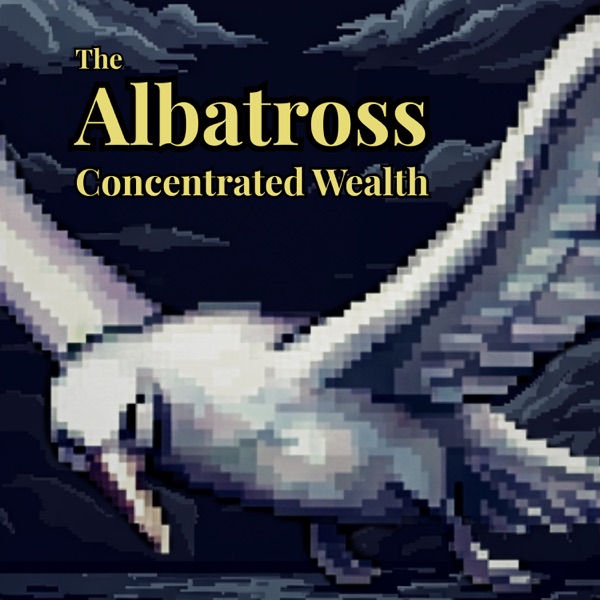
The Albatross
The Albatross is about managing concentrated wealth.
Each week, I interview an expert, and we discuss the risks of holding public and private single-asset positions and the numerous ways of exiting thoughtfully.
This includes tax-loss harvesting, hedging with options and variable prepaid forwards, exchange funds, qualified opportunity funds, numerous charitable strategies, estate planning vehicles, and several other solutions for private stock and other assets.
- Episodes
- 16
- Releases
- Twice a week
- Typical length
- 25 min
- On air since
- 2026
- Latest episode
- 4 days ago
Episodes
16 episodes, newest first
-
29 min
Former SpaceX engineer on divesting a windfall
Season 1, Episode 15
Show notes
Soon after SpaceX announced it would go public, a former company engineer, who wishes to remain anonymous, reached out to me on social media.
He was looking at an 8-figure outcome, and wanted to chat about modeling various divestment strategies.
Part of his decision was considering whether or not to work with a financial adviser. I asked him if I could record his thought process.
This episode is our discussion.
-
27 min
Charitable remainder trusts for divesting concentrated stock with Simone Devenny
Season 1, Episode 14
Show notes
Most people know about giving to charity for the tax deduction. They also know about giving appreciated stock to a donor-advised fund to take the deduction now and choose the recipient later. Some may even set up a private foundation.
But one of the most powerful giving vehicles is the charitable remainder trust (CRT), specifically its variant, the charitable remainder unitrust (CRUT), and, heck, its variant, the net income makeup charitable remainder unitrust (NIMCRUT).
Simone Devenny, J.D., Head of Private Wealth Strategies at Allworth Financial, joins the Albatross to talk about why, what, and how people give.
-
25 min
Trader funds and Treasury's Own Goal with Prof. Daniel Hemel
Season 1, Episode 13
Show notes
In 1988, Treasury issued a temporary regulation that persists to this day.
It allowed trader fund investors to escape the passive activity rules that would normally require hundreds of hours of material participation for any losses to offset nonpassive income.
NYU Prof. Daniel Hemel thinks Treasury should rescind the temporary 1988 regulation, making trader fund investors passive investors.
-
24 min
Box spreads could be taxed like ordinary income - NYU Prof. Daniel Hemel
Season 1, Episode 12
Show notes
Box spread ETFs attempt to replicate something like the Treasury bill return without the annual taxable income.
NYU Prof. Daniel Hemel thinks Treasury could use IRC §1258 to make investors treat their gains on sale as ordinary income (if industry challenges to new regulations fail).
-
34 min
Pt. 2 How to transfer BTC into an ETF with Teddy Fusaro and Cliff Cornell
Season 1, Episode 11
Show notes
Bitcoin can transfer in and out of a spot bitcoin ETF just like a gold bullion ETF.
There are details!
Thankfully Cliff Cornell (Bona Fide Wealth) and Teddy Fusaro (Bitwise Asset Management) walked me through it.
-
19 min
Pt. 1 Why transfer BTC into an ETF with Teddy Fusaro and Cliff Cornell
Season 1, Episode 10
Show notes
Bitcoin made many investors rich. Now, they're wondering how to hedge and monetize, and transfer to charities, non-financial spouses, and kids. Transferring to an ETF might help.
Part 1 of this 2-parter is a conversation with President of Bitwise Asset Management, Teddy Fusaro, and Bona Fide Wealth financial adviser, Cliff Cornell.
Part 1: Why transfer BTC into an ETF?
Part 2: How to transfer BTC into an ETF (mechanics, tax)
-
21 min
Landing the long/short plane with BlackRock's Taotao Cai
Season 1, Episode 9
Show notes
For tax-aware long/short strategies, some see the leverage as cost-effective, amplified exposure to the underlying manager, while others need to have a plan to land the plane, or to remove the leverage, thoughtfully and without making a costly risk or tax error.
BlackRock's Taotao Cai joins The Albatross to talk about end-to-end planning with long/short strategies.
He reminds us along the way that long/short is a powerful tool, but it is not the only tool.
-
33 min
IRS on "solid ground" going after suspicious §351 transactions - Bob Elwood and Ray Holst
Season 1, Episode 8
Show notes
Last week, Treasury released Notice 2026-62 and Rev. Rul. 2026-20 concerning IRC §351 transactions, nowadays popularly used to seed new exchange-traded funds (ETFs) in-kind.
Bob Elwood is the founder of Practus and he and his partners, including Ray Holst, have collectively structured more than 100 §351 transfers over the past several years.
In this episode, Bob and Ray talk about the difference between routine and aggressive planning using §351, and the nuances of some of the key words in the new revenue ruling.
Bob and Ray are tax attorneys, but they are not your tax attorneys. For specific and personalized guidance, hire tax counsel. This content is education only.
-
19 min
Too much tax alpha, too little diligence with Steve Curley
Season 1, Episode 7
Show notes
There's a flavor of financial adviser that understands how powerful tax alpha sounds to prospects and clients, but who hasn't thought too much about what could go wrong.
Steve Curley has seen this before with the hype around market timing strategies, private investments, crypto and now... tax alpha.
His point is NOT that these things are bad, only that they require increasing levels of diligence, and he cautions that some folks recommending these products simply haven't done the work.
-
11 min
Abusive §351 is dead, long live routine §351
Season 1, Episode 6
Show notes
For the last few years, the ETF industry has used Section 351 of the Internal Revenue Code to let investors seed new exchange traded funds with appreciated securities, mostly stocks and other ETFs, without recognizing the gains.
On Monday, September 28, 2026, Treasury and the IRS threw cold water on the most egregious uses of 351 with Notice 2026-62 and Revenue Ruling 2026-20.
While some folks are nervous about this, others are exuberant. In their minds, finally, Treausury has provided a little clarity around what routine usage of section 351 looks like.
The key thing is knowing the difference.
-
23 min
Exchange Fund Replication using Options with BlackRock's Eric Metz
Season 1, Episode 5
Show notes
Exchange fund replication is a hidden gem in the concentrated public stock de-risking toolkit.
Exchange fund replication is a 4-legged options trade that collars a single stock for risk management (2 options), and creates index-like exposure with a synthetic long position (another 2 options).
Eric Metz, CIO of SpiderRock, a BlackRock company joins The Albatross to explain how it works, why no one has heard of it despite its relative simplicity, and how it could pair nicely with other risk and tax management strategies like tax-aware long/short.
-
29 min
Covered Calls Are Not For Hedging With Roy Haya
Season 1, Episode 4
Show notes
Covered calls are in the single-stock management canon, but not because they meaningfully hedge risk.
Roy Haya, Partner and Head of Derivative Solutions at Fort Point Capital Partners, tells us covered call writing means income today, truncated upside, and often just a small premium for downside cushion. For some clients covered call writing is simply a disciplined way to exit a stock.
We talk about the straddle rules, structuring the call to reach Qualified Covered Call status so straddle loss deferral falls away, and why dividends might lose their preferential tax treatment. We close by considering how all of this applies to bitcoin.
-
23 min
The Cost of Holding a Concentrated Position with Antti Petajisto
Season 1, Episode 3
Show notes
Antti Petajisto and I talk about concentration drag resulting from the many, many, many public companies that go bust, and the tiny slice of the market that vastly outperforms. These two phenomena expand the chasm between a simple equal-weight fund and picking individual stocks, resulting in concentration drag, which Antti measures in his research.
-
27 min
Opportunity Zones Won't Save a Bad Deal, But Can Accelerate a Good One
Season 1, Episode 2
Show notes
The biggest criticism of Qualified Opportunity Funds is that the tax tail is wagging the dog so hard that investors completely lose sight of investment viability.
Nick Rosenthal, co-CEO of Griffin Capital Company, thinks that if investors do due diligence on QOFs as they would without the tax incentives, the program can be an important tool in the single-stock de-risking playbook.
-
33 min
Investing in Three Dimensions with Paul Bouchey
Season 1, Episode 1
Show notes
Paul Bouchey is the Editor of the Journal of Wealth Management, Managing Director of Applied Research at Morgan Stanley, and the former Chief Investment Officer at Parametric Portfolio Associates.
He tells us how Parametric went from active manager in the 1980s to $600 billion AUM passive powerhouse in the 2000s, about the new interest in taxable investment management driven by long/short strategies, and when long/short may and may not be the best solution.
-
2 min
A Good Problem Trailer
Season 1
Show notes
The Albatross is about navigating concentrated wealth.
Markets are at all-time highs, and founders, executives, early employees, and investors have become rich... but highly concentrated. Many are unable or unwilling to diversify.
Solutions exist: selling, hedging, tax-loss harvesting, partnerships, charitable strategies, and more.
Every week, Brent Sullivan speaks with experts on single-stock concentration, the risks of inaction, and exiting thoughtfully.
Investing lists
More Investing shows picked out from the charts







More in Investing
Placed highest on Apple Podcasts' Investing chart right now