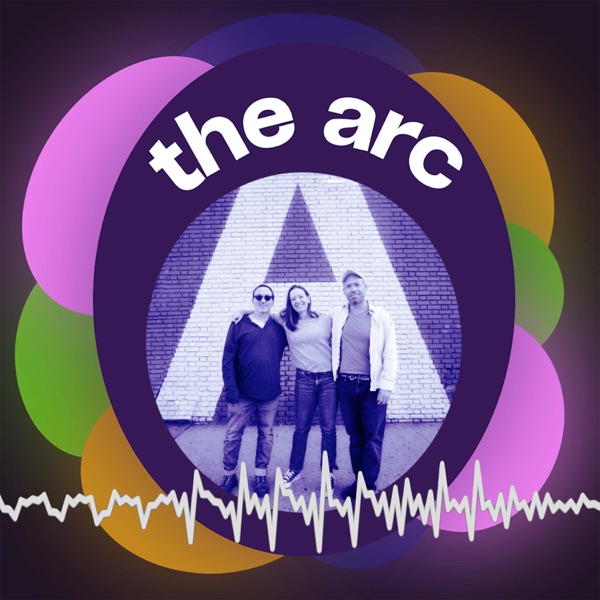
Podcast
the arc.fm
Join three very different storytellers with three very different personalities, as we bring each other stories to break apart and celebrate. In every episode, we're having the best time exploring what makes a story work, why it moves us, and why we can't stop talking about it. It's not analysis. It's not review. And it's something more than just a conversation about one of the things that makes life worth living... stories.
- Film Reviews chart
- #174
- Episodes
- 31
- Releases
- Every two weeks
- Typical length
- 44 min
- On air since
- 2025
- Latest episode
- 6 days ago
Episodes
31 episodes, newest first
-
49 min
Lydia Davis - We Read a One-Minute Short Story and Argue If It's a Story for 49 Minutes
Season 2, Episode 18
Show notes
Cole brings us one of the great living short story writers, and we argue whether her stories are stories at all, until Jaclynn gets the last word.
EPISODE SUMMARY
Cole makes the case for Lydia Davis, the MacArthur Fellow and Man Booker International Prize winner whose stories can run a single line. Robby read one and found it charming. Jaclynn has a Rothko theory for why she hasn't gotten Davis yet. We read a story aloud, hear Davis in interviews and readings, and fight about what the word "story" even means. You don't need to know her work first, and by the end Jaclynn has her answer.
New To The Show?
New episodes of The Arc arrive roughly once a month, but they are ephemeral beings that sometimes take longer. You're encouraged to start from the beginning with Episode 01: The Princess Bride.
A Long Summary
Cole has spent fifteen years assuming everyone knows Lydia Davis, so the episode opens with a test: had Robby or Jaclynn heard of her before he started talking about her? For Jaclynn, the answer is only through Cole, who gave her a book of Davis's stories as a Christmas present and brings her up whenever the baby shoes story or Fleabag comes up. Cole walks us through why his assumption made sense. Davis received a MacArthur Fellowship in 2003 and the Man Booker International Prize in 2013, and she is admired by writers, translators and readers around the world. He also admits that every time he mentions her, he learns how few people have actually read her.
From there, the conversation turns into how to approach art you don't get yet. Jaclynn offers her Rothko theory: she looked at a Rothko, thought she could paint a red square, then sat with it until she saw the complexity. Bonsai trees went the same way, from cute trees she grew up seeing at Kmart to something meditative once a man in Japan walked her through his collection without a shared language. Robby read the story Cole chose and found it charming, though he was more interested in why he was reading it than in the reading itself. Cole explains why he loves her: a story that holds a single moment, with just enough detail that every reader pictures a different hotel lounge. Along the way we hear Davis herself in interviews, including one with Tyler Cowen and one at a literary festival in Scandinavia, and reading two of her pieces aloud.
The argument underneath all of it is whether these pieces count as stories. Cole finds the story in the narrator's realization. Someone brings back the plot versus story distinction from our Women Talking episode. Someone compares a Davis piece to bubble gum, a burst of flavor and then it's over. Jaclynn has barely read Davis but is in no way against her, and she keeps asking the question out loud. Stay for the last few minutes: she gets the last word, and it's the line that shows she gets it.
WHAT WE DISCUSS
00:27 - IS LYDIA DAVIS FAMOUS? DID JACLYNN LIE?
Cole asks whether Robby and Jaclynn had heard of Lydia Davis before this episode. He explains why he assumed she was a household name in the literary world, citing her MacArthur Fellowship and her Man Booker International Prize, and Jaclynn admits the book he gave her is still unread.
07:00 - JACLYNN'S BRILLIANT ROTHKO THEORY
Jaclynn explains why she thinks Davis is like Rothko: it looks simple until you spend time with it. She believes in Davis and says she just doesn't get her yet.
08:42 - LYDIA DAVIS INTERVIEW WITH TYLER COWEN
A clip of Davis in conversation with Tyler Cowen, who introduces her as a short story writer, essayist and translator of Proust and Flaubert. She explains why she chose not to read secondary material before translating Proust.
09:50 - ROBBY READS THE STORY
Robby reads "Conversation in Hotel Lounge," a very short piece about two women overheard on a sofa.
10:57 - JACLYNN LEARNS ABOUT BONSAI TREES.. IN JAPAN
Jaclynn gives a second example of something she didn't understand at first: bonsai trees. She tells the story of living in Japan and being walked through a stranger's bonsai collection, with no shared language, and how that changed her mind.
13:44 - LYDIA DAVIS, INTERVIEW TWO
A short clip of Davis describing her novel, The End of the Story, which was built from fragments to mimic how a narrator remembers.
14:18 - REINDEER ANTLERS AS ART
We talk about how friends in art school changed one host's mind about contemporary art: anyone could make it, but the work is that they did, and that they can explain why.
16:25 - ROBBY NEW YORKER RESPONSER
Robby gives his honest read. He didn't hate it, found it charming, and thought it sounded like an anecdote from The New Yorker. We talk about how much work the reader does when a story gives you this little, and Cole explains the context he brought, including how Fleabag and the baby shoes story got him thinking about efficient writing.
22:28 - JACLYNN READS THE STORY
Jaclynn reads "Conversation in Hotel Lounge" again, and the room finds new things in it. Cole loves that every reading can place the lounge, the sofa and the women differently, and calls the piece a great outline: enough detail to picture it, enough room to imagine the rest.
26:51 - LYDIA DAVIS READS HER OWN WORK, "TWO SISTERS"
We hear Davis read "Two Sisters," a longer piece, in her own voice. Then we talk about why a strong reaction, even dislike, is a gift to an artist.
31:22 - PRETENTIOUS ALERT - SHIBBOLETH
Cole's theory is that knowing Davis works like a password, a shibboleth, among art students and literature readers. We explain the word, test it against Google Maps versus Apple Maps, and Cole lists the college towns where he has found fellow Davis readers. We also hear "Safe Love," a piece only a few lines long, and Cole says her stories are the shortest versions of salty dog tales.
39:45 - LYDIA DAVIS INTERVIEW IN SCANDANAVIA
Davis describes her own work for a festival audience, from a novel with no chapters to stories that are a line or two long. She says she calls them all stories to make it easier.
42:21 - WHERE LYDIA DAVIS GETS HER IDEAS FROM
Davis says that if you wait for a good idea, you just keep doubting yourself, and that forcing it can bring up very strange and interesting material.
44:17 - LYDIA DAVIS INTERVIEW ON IF HER STORIES ARE DOCUMENTARIES
Was the hotel lounge conversation real? We disagree about whether the piece is documentary or invented, then hear Davis explain that once she decides to write about a moment, she distances it from herself and shapes it until it is finished and no longer personal.
46:56 - WHAT IS ACTUALLY STORY?
The big question. We bring back plot versus story from our Women Talking episode, try bubble gum and Three's Company as analogies, and argue about whether a small change in the narrator's understanding is enough. Jaclynn gets the final word on the title.
CHAPTERS / TIMESTAMPS
00:27.792 IS LYDIA DAVIS FAMOUS? DID JACLYNN LIE?
07:00.667 JACLYNN'S BRILLIANT ROTHKO THEORY
08:42.292 LYDIA DAVIS INTERVIEW WITH TYLER COWEN
09:50.417 ROBBY READS THE STORY
10:57.709 JACLYNN LEARNS ABOUT BONSAI TREES.. IN JAPAN
13:44.834 LYDIA DAVIS, INTERVIEW TWO
14:18.334 REINDEER ANTLERS AS ART
16:25.751 ROBBY NEW YORKER RESPONSER
22:28.542 JACLYNN READS THE STORY
26:51.792 LYDIA DAVIS READS HER OWN WORK, "TWO SISTERS"
31:22.375 PRETENTIOUS ALERT - SHIBBOLETH
39:45.792 LYDIA DAVIS INTERVIEW IN SCANDANAVIA
42:21.584 WHERE LYDIA DAVIS GETS HER IDEAS FROM
44:17.709 LYDIA DAVIS INTERVIEW ON IF HER STORIES ARE DOCUMENTARIES
46:56.167 WHAT IS ACTUALLY STORY?
CREATIVES
• Lydia Davis, Author and Translator
As a translator, Davis is known for new English versions of Marcel Proust's Swann's Way (2003) and Gustave Flaubert's Madame Bovary (2010). She has also translated Maurice Blanchot, Michel Leiris, Michel Butor and Pierre Jean Jouve.
AWARDS
MacArthur Foundation
MacArthur Fellowship (2003): WIN
Man Booker International
Man Booker International Prize (2013): WIN
PEN America
PEN/Malamud Award for Excellence in the Short Story (2020): WIN
PEN/Hemingway Award, for Break It Down (1986): FINALIST
Other prizes and fellowships
Lannan Literary Award for Fiction (1998): WIN
Whiting Award for Fiction (1988): WIN
American Academy of Arts and Letters, Award of Merit Medal (2013): WIN
Guggenheim Fellowship: WIN
National Book Foundation
National Book Award for Fiction, for Varieties of Disturbance (2007): FINALIST
National Book Critics Circle
Essays One (2019): FINALIST
Honors
Chevalier de l'Ordre des Arts et des Lettres, France (1999)
Fellow, American Academy of Arts and Sciences (2005)
SOURCE MATERIAL
The pieces and books we talk about in this episode: "Conversation in Hotel Lounge" (read aloud twice), "Two Sisters" (read by Davis), "Safe Love," her novel The End of the Story (1995), and her essay collection Essays Two (2021). For a wide starting point, The Collected Stories of Lydia Davis (2009) gathers her short fiction through 2008, and Can't and Won't (2014) is a later collection.
FUN FACTS / PRODUCTION TRIVIA
• Davis grew up around writers. Her father, Robert Gorham Davis, was a critic and English professor, and her mother, Hope Hale Davis, was a short story writer and memoirist.
• Her first love was music. She studied piano and then violin before she became a writer.
• She spent second grade at a convent school in Graz, Austria.
• After Barnard College she lived in Ireland and France for nearly three years and worked as a translator for the film industry and art galleries before turning to literary translation.
• She has credited the prose poet Russell Edson's very short tales with freeing her to write however she wanted.
• In the Tyler Cowen clip in this episode, Davis says she chose not to read secondary material on Proust before translating him. The full interview also covers how to persuade an ant to leave your house.
• The New York Times named The Collected Stories of Lydia Davis one of the 100 best books of the 21st century. -
40 min
Hope (2026) - An Action Movie from Art House Film Director, Na Hong-jin
Season 2, Episode 17
Show notes
We went in bracing for a horror movie and got an art house director's monster epic, one we place in the DMZ in the 1990s, and we spend the episode working out how far our expectations were from what Na Hong-jin made.
EPISODE SUMMARY
Hope (2026) is Na Hong-jin's first film since The Wailing in 2016, starring Hwang Jung-min, Alicia Vikander, and Michael Fassbender. On The Arc (thearc.fm), we talk about going in expecting a horror movie and finding a long, mostly-chase monster film that adds new movies near the end. Jaclynn calls it three movies stitched together, Robby disavows the horror label, and we land on the idea that our expectations were off, because Na Hong-jin comes from art house films.
WHERE TO WATCH
Streaming availability starts Tuesday 10/13!
New To The Show?
New episodes of The Arc arrive roughly once a month, but they are ephemeral beings that sometimes take longer. You're encouraged to start from the beginning with Episode 01: The Princess Bride.
A Long Summary
Hope is Na Hong-jin's first film since The Wailing in 2016: a 156-minute South Korean film that premiered in competition at Cannes in May 2026 and opened in the US that September. It's reportedly the most expensive Korean film ever made, shot by Hong Kyung-pyo. A village police chief and his rookie deputy defend their town from a mysterious creature, and the creatures turn out to be aliens. From the director of The Chaser and The Yellow Sea, that premise caught us off guard. We showed up expecting horror, and Robby spends a good part of the episode disavowing that label, at one point in a full Southern accent, which detours us into British and Southern accents and some fun at Cole's scones.
Most of our conversation is the three of us working out what the plot was. Jaclynn's take is the sharpest: it's long, mostly a chase, and introduces two new movies near the end, so it feels like three movies stitched together. Her metaphor for the film is a highlight, so we'll let you find it: it involves a three-year-old half-sibling, a crayon, and an art thesis you have to present as if the monsters were always the plan. From there we debate whether a mystery counts as a plot, whether the alien chasing the child is its mother or a servant, why the sun seems to sit at noon, and whether a cat a driver swerves to avoid was real. One of us felt for the alien during a shot of it in obvious pain. Jaclynn also tells us about living in Asia and visiting the DMZ.
We also hear from Na Hong-jin, in translated Q&As (recorded in Los Angeles and Seoul). In the first, he describes a film that grew and grew, and talks about how Korea's small surface area shaped where this story could be set. A second clip, in the chapter "on the real story," comes later in the episode.
The turn comes when we talk about who made it. Knowing Na Hong-jin's art house background made us reconsider what we'd watched, and it leads to a question we keep circling: what's the contract with a movie like this? In the end, we expected a horror movie and got an art house director's monster epic. You don't need to have seen Hope to follow along. Dad will explain linear.
WHAT WE DISCUSS
00:34 - THE MANY (OR FEW?) PLOT(S) OF "HOPE"
Robby is asked to say what he thinks the plot of Hope is without bending to the will of Jaclynn, who sees three movies stitched together around one long chase. We go back and forth on whether a mystery without a clear hero's-journey structure still counts as a plot.
08:36 - THE PLOT OF HOPE (FROM THE ALIENS' PERSPECTIVE)
We try to untangle the alien backstory, including whether the alien chasing the child is its mother or a servant, and we don't fully agree. We compare the way the story spirals outward to a Sam Spade movie.
10:20 - WHEN WERE EACH OF US IN OR OUT
We each name the moment we felt pulled into or pushed out of the film. One of us nearly walked out when the third movie began, and we talk about whether viewers should be warned that the film keeps restarting with new movies.
11:13 - WHAT YOU SHOULD KNOW GOING TO "HOPE (2026)"
Some context before you go in: this is Na Hong-jin's first film in about ten years, it's reportedly the most expensive Korean film ever made, and we wonder whether he set out to make a blockbuster. We also marvel that the production built its sets on top of a real town.
16:02 - THE #1 THING WE WANT TO SAY ABOUT "HOPE (2026)"
We each give a short take on Hope, including a comparison to a jigsaw puzzle you assemble before noticing pieces are missing. Then we talk through how we'd critique it if a student had turned it in, and agree we'd put it more gently to a real student.
18:01 - JACLYNN'S AMAZING ANALOGY FOR "HOPE (2026)"
Jaclynn explains her mixed feelings with an extended analogy: a three-year-old half-sibling draws crayon monsters all over your art thesis, and you present it as if they were intentional. We then discuss what the contract is with a movie like this, and what viewers are owed.
22:53 - ON "FOCUS" IN STORYTELLING (EXPLAINED BY THE QUESTION 'HOW DO YOU EAT A SALAD?')
A conversation about focus in storytelling, explained through the question of how you eat a salad, and about how a story earns the audience's acceptance of its characters and plot. That leads into what we would ask the director.
37:23 - THE OVERALL FEELING OF "HOPE (2026)"
We poke fun at the chase's internal logic, from the time of day jumping around to the gas tank that never runs out, and we debate whether the cat a driver swerves to avoid was real and what that says about which lives are worth saving.
CHAPTERS / TIMESTAMPS
0:00 - COLD OPEN AND VERY SHORT TRAILER BECAUSE "HOPE" IS A KOREAN LANGUAGE ACTION FILM
0:34 - THE MANY (OR FEW?) PLOT(S) OF "HOPE"
3:21 - JACLYNN ON LIVING IN ASIA & VISITING THE DMZ BETWEEN North Korea and South Korea
4:58 - SET DESIGN
5:59 - SKETCH - CEO INTRODUCES THE DIRECTOR
7:22 - THE DIRECTOR SPEAKS
8:36 - THE PLOT OF HOPE (FROM THE ALIENS' PERSPECTIVE)
10:20 - WHEN WERE EACH OF US IN OR OUT
11:13 - WHAT YOU SHOULD KNOW GOING TO "HOPE (2026)"
12:12 - STORIES OF WALKING INTO FILM SETS ACCIDENTALLY
16:02 - THE #1 THING WE WANT TO SAY ABOUT "HOPE (2026)"
18:01 - JACLYNN'S AMAZING ANALOGY FOR "HOPE (2026)"
21:47 - THE DIRECTOR OF "HOPE (2026)" ON THE REAL STORY
22:53 - ON "FOCUS" IN STORYTELLING (EXPLAINED BY THE QUESTION 'HOW DO YOU EAT A SALAD?')
23:59 - WHAT WOULD WE SAY TO THE DIRECTOR OF "HOPE (2026)" IN AN INTERVIEW?
26:37 - MAKING FUN OF COLE'S SCONES
27:38 - WHEN DID EACH OF US CRY DURING "HOPE (2026)"
30:14 - THINGS JACLYNN LOVES IN VISUALS
34:14 - BEHIND THE SCENES THOUGHTS (ESPECIALLY THE CAR)
37:23 - THE OVERALL FEELING OF "HOPE (2026)"
RECOMMENDATIONS
If you want to keep going on this one, a couple of other stops are worth your time. The InSession Film Podcast devoted an episode to Hope, a good companion listen if you want more voices on the film: InSession Film Podcast: Review - Hope.
The Certified Forgotten podcast also dedicated an episode to the film, for another take on it: Certified Forgotten: 'Hope' Gets Uncertified.
RELATED ARC EPISODES
Or consider starting from the beginning: Episode 01: The Princess Bride is where we became friends.
SOUND DESIGN ATTRIBUTION
Sound design via Freesound.org and Envato.
Downloaded on October 8th, 2026
• S: Medium Crowd Clapping 5 by jentlemen | License: Creative Commons 0
• S:Light, slow uncomfortable clapping by TurboFool | License: Creative Commons 0
• S:Room Tone: McFarlin Auditorium by lakewoodsound | License: Creative Commons 0
• S:CRWDApls_Unenthusiastic Clapping_ShaneVincent_GSC24_BIN-AmbeoVR.wav by ShangusBurger | License: Creative Commons 0
• S:laugh_and_applause_2.wav by ondrosik | License: Creative Commons 0Downloaded on October 7th, 2026
• S:konfa.wav by monosfera | License: Creative Commons 0
• S:Generic Interior Walla by brunoboselli | License: Creative Commons 0
• S:applause-30-people-auditorium.wav by michaelbesaw | License: Creative Commons 0
• S:PA microphone feedback (2).wav by FreqMan | License: Attribution 4.0Downloaded on October 5th, 2026
• S:Forest, river, and birds by bagustris | License: Creative Commons 0
-
48 min
Field of Dreams - Making Grown Men Cry Since 1989
Season 2, Episode 16
Show notes
We argue that Field of Dreams isn't really about baseball or fathers so much as the elaborate lengths men will go to instead of just going to therapy, and it all starts with Robby who has cried through it on his birthday every year for more than thirty years.
EPISODE SUMMARY
We believe Field of Dreams isn't really about baseball, or farming, or even fathers and sons in the way you'd expect. It's about what men will do to avoid going to therapy. Robby has watched it on or near his birthday for more than thirty years and still cries every time. Jaclynn only saw it as a baby, so it's effectively new to her, and she didn't even know the famous line right. Our guests are Joe Connor (Mr. Sports Travel) and Patrick Fleming, and this one gets more emotional than a group of people talking about a cornfield has any right to. Patrick's late father, Mike Fleming, was a Triple-A umpire everyone expected to make the majors until he went home to Iowa at 23 to run the family printing company. That is Archie "Moonlight" Graham's story all over again: two men at the edge of the big leagues who gave it up for someone else.
WHERE TO WATCH
Streaming availability as of 2026-09-18.
• Netflix (streaming with subscription)
• Prime Video (rent or buy)
• Apple TV (rent or buy)
• Fandango At Home (rent or buy)New To The Show?
New episodes of The Arc arrive roughly once a week, but they are ephemeral beings that sometimes take longer; you're encouraged to start from the beginning with Episode 01: The Princess Bride.
A Long Summary
Field of Dreams is the 1989 movie where Kevin Costner hears a voice in his Iowa cornfield, plows under his crop to build a baseball diamond, and watches the ghosts of banned White Sox players walk out to play, including Shoeless Joe Jackson, and eventually his own late father, young again and asking for a catch. It is, on paper, a movie about baseball. It is also a movie about farming, and about kidnapping a reclusive author, and about a small-town doctor who gave up his one shot at the majors. None of that is what it's actually about, which is the thing Robby has known since he was 20 or 21 and cried, unexpectedly, the first time he saw it with a college friend who shared his birthday. He's watched it on or near his birthday almost every year since, more than thirty of them now, and he brought it here, which makes this his birthday movie and, fairly, makes him the star of it.
What we found is that Field of Dreams makes men cry, and it makes them cry at their keyboards: when we went looking for baseball experts to explain why the game matters, we got back dozens of very macho men writing in, choked up, needing to talk about this film. Two of them are here. Joe Connor has seen live sports in 176 countries and finished all 30 major-league parks the year his father died, in his memory. And Patrick Fleming, an Iowan and an indie musician, wrote Cole an email, read aloud in full, about his father Mike, a Triple-A umpire whose school booklet said "Mike will go all the way." Mike didn't. His own father died, and at 23 he went home to run the family printing company while every one of his umpire-school friends made the majors. Archie "Moonlight" Graham, in the movie, is that exact story: one at-bat away, then a small-town doctor for the rest of his life. Mike Fleming and Moonlight Graham lived the same life, and now the Little League fields Patrick grew up on are named Mike Fleming Field, his family's little field of dreams.
One of the hosts argues that the movie melts people because it lets a man have closure with a dead parent, and that closure only exists in fiction, which is what fiction is for. Another host pushes back that you don't even need the closure; you just need to watch someone you loved live out their happiest moment and get to stand in it with them. Somewhere in there we argue, at genuine length and without resolution, over whether James Earl Jones's character walks into the corn to die or to become a ghost or just to go look around and come back and write about it; one of us is very sure he's fine. We also take a hard look at what the movie asks of Costner's wife, at how much a very handsome man gets away with, at whether following your dream at all costs is exactly how we got where we are, and at the fact that the cars flooding in at the end were real Iowans answering a call on the radio, flicking their brights on and off so it would look like more of them. You do not have to have seen the film to follow any of it. But by about five minutes in, you'll want to have a catch.
WHAT WE DISCUSS
01:23 - WHO BROUGHT "FIELD OF DREAMS" AND WHY?
Robby brought this one, because it's his birthday movie. He has watched it on or near his birthday almost every year since he was 20 or 21. It started in college, watching with a friend named Mark, when Robby cried without warning at the "want to have a catch" moment. He was shocked by his own reaction. So he watched it again the next year, and the year after that.
07:55 - PATRICK'S EMAIL ABOUT HIS FATHER
Patrick Fleming reads us the email he sent Cole before the taping. His father, Mike, was a professional umpire everyone thought would go all the way to the majors. Then Mike's own father died suddenly, and at 23 he went home to Iowa to run the family printing company. Patrick draws the line straight to Moonlight Graham: two men at the edge of the big leagues who gave it up for someone else. Today, the Little League fields Patrick grew up on carry his dad's name.
20:57 - ROBBY READ LITERALLY ALL OF HIS NOTES ON FIELD OF DREAMS
Robby has seen this movie more than 40 times, and he brought notes. We let him read them, scene by scene: the three times Ray hears the voice, Ray's fear of turning into his own father, the PTA meeting over the Terence Mann book. It's not a review. It's a man showing us how much he loves a movie.
23:50 - ROBBY CRIES
And then Robby cries, right in the middle of the moment Ray's father shows up and the catch begins. We talk about what got to him, and about realizing your parents are their own people, which brings us right back to Patrick's dad.
28:41 - SONS MATCHING FATHERS
Patrick tells us his father never got a traditional retirement, because he worked until he died. But he got a version of the dream in his 20s, traveling to games with his umpire friends, and Patrick compares that to his own years touring as a musician at 30. Then we turn to the ending and that sudden line of cars headed for the ballfield. It doesn't quite make sense. It works anyway, because the movie tells us it will happen and asks us to go along.
33:48 - TERRENCE MANN IS A GHOST
We talk about how the film makes small, deliberate choices, including a long cross-country drive that bonds Ray and Terence Mann without showing us most of what they say. Then we get lost in a real argument: when Terence Mann walks into the cornfield, does he die, become a ghost, or just look around and come back? One of us is very sure he's fine. The rest of us aren't buying it.
41:06 - THIS MOVIE IS SO MIDWESTERN
Everyone in this movie meets the impossible with calm, polite understatement, and we decide that makes it very Midwestern. One of us shares a story about saying a blandly cheerful "oh, cool" to someone whose job was scooping eyeballs out of corpses, which proves the point. We wonder what else makes it feel so Midwestern, and land on its father and son heart.
43:23 - ARCHIE MOONLIGHT GRAHAM'S STORY WRAPS UP WITH PATRICK'S DAD
We come back around to Patrick's dad. His umpiring career was cut short, and a Little League field back home was renamed Mike Fleming Field in his honor. It's the other half of Moonlight Graham's story, and it leads us back to Ray and the catch he and his own father never had.
CHAPTERS / TIMESTAMPS
0:00 - COLD OPEN
1:23 - WHO BROUGHT "FIELD OF DREAMS" AND WHY?
2:27 - WHAT'S THE NUMBER ONE THING WE WANT TO SAY ABOUT "FIELD OF DREAMS"
5:17 - WHAT SHOULD YOU KNOW GOING INTO "FIELD OF DREAMS"
6:35 - A VERY FUNNY INTRODUCTION OF PATRICK
7:55 - PATRICK'S EMAIL ABOUT HIS FATHER
10:14 - WHEN WERE WE IN AND OUT OF "FIELD OF DREAMS"
13:42 - JOE HAS VISITED EVERY BASEBALL STADIUM IN THE US
20:57 - ROBBY READ LITERALLY ALL OF HIS NOTES ON FIELD OF DREAMS
23:50 - ROBBY CRIES
28:41 - SONS MATCHING FATHERS
30:42 - HOW THEY GOT THE TRAFFIC JAM IN "FIELD OF DREAMS" BEFORE CGI
33:48 - TERRENCE MANN IS A GHOST
41:06 - THIS MOVIE IS SO MIDWESTERN
43:23 - ARCHIE MOONLIGHT GRAHAM'S STORY WRAPS UP WITH PATRICK'S DAD
FUN FACTS / PRODUCTION TRIVIA
The corn grew almost too well, so when Costner first hears "If you build it, he will come," he had to walk onto a foot-high platform. [Source]
The famous line everyone quotes as "if you build it, they will come" is actually never said in the film, what it's actually saying is "If you build it, he will come."
The emotional final shot of an endless line of headlights heading toward the field wasn't a visual effect at all; the scene was filmed with the help of local Iowans, with thousands of Iowa residents lined up in their cars on the road to the farm, tuning into a local radio station for the director's instructions. To sell the illusion of a growing crowd, town residents drove up to the field with their headlights on, then drove away with their headlights off to make it look like more and more people kept arriving.
James Earl Jones almost turned down the role entirely, it was his wife who convinced him to accept the role of Terence Mann, though she warned him the long baseball speech would end up cut from the film, a speech that instead became one of the movie's most quoted moments.
The film's title wasn't the original plan. It was originally supposed to be titled "Shoeless Joe" like the novel, but that title tested poorly, with audiences thinking it referred to a hobo or that Costner was playing a homeless man, prompting Universal to switch it to "Field of Dreams" instead.
WHAT THEY DID NEXT
Phil Alden Robinson, who wrote and directed Field of Dreams, went on to write Sneakers and direct The Sum of All Fears, among other projects.
EXTERNAL RECOMMENDATIONS
If you want to keep digging into this one after the episode, a few other stops are worth your time. The Film Stories podcast's 200th episode actually landed an interview with writer/director Phil Alden Robinson himself, who candidly tells the story of how the film came together, the challenges they faced, and its legacy, a rare conversation since he doesn't do many interviews. For a more debate-driven take, the Best Film Ever podcast digs into how the film taps into themes of regret, reconciliation, and belief while also wrestling with whether it's overrated.
RELATED ARC EPISODES
New to The Arc? Start with Episode 01: The Princess Bride .
SOUND DESIGN ATTRIBUTION
Sound design via Freesound.org and Envato.
• S: tv_turn_on.mp3 by morgantj | License: Attribution 4.0
• S:Dragging baseball bat by anochrist | License: Creative Commons 0
• S:Soundwalk_IowaCity.wav by djangoman11 | License: Creative Commons 0
• S:230719 Screen Door, sliding open close, backyard, MixPre AT975r EM272s, Stratford by TRP | License: Creative Commons 0
• S:Jogging on dead grass.wav by Edelhanie | License: Attribution 4.0
• S:corn field 1123AM 220811_0490.wav by klankbeeld | License: Attribution 4.0
• S:[ MPooman ] Baseball Glove Sounds (High Quality) by MPooman | License: Creative Commons 0 -
1 hr 5 min
Fast & Furious Presents: Hobbs & Shaw - Fighting the Sun with an Actual Astronomer
Season 2, Episode 15
Show notes
Hobbs & Shaw has a climactic dawn battle that goes from pitch black to full daylight in about two minutes of screen time. Can the sun really rise that fast? We brought in actual scientist for an answer and a masterclass in using science for storytelling.
As always, we're more than a film review podcast, and this is the proof: a years-long movie argument between Cole and Jaclynn gets settled by an actual astronomer.
The Setup
Jaclynn has been saying for years that the sunrise in this scene is impossible, a jump cut from midnight to noon. Cole has spent just as long insisting she's wrong, and this episode is him finally bringing in reinforcements. As Cole puts it going in, "I don't think it's about the sunrise." It's Virgo season, and this is what a Virgo does with a grudge: proves it with data.
Meet the Astronomer
Zoe Learner Ponterio manages the Spacecraft Planetary Image Facility at Cornell, the Ivy League school where Carl Sagan spent 25 years as a professor of astronomy and which still runs a Carl Sagan Institute today. She got there after years on NASA's Mars Exploration Rovers science team, working the Spirit and Opportunity missions. She almost went to Harvard instead. Her reasoning: "I at one point just looked at the Harvard dean and said, do you have a Mars rover? He was like, no. I was like, well, I guess it's a no."
The Verdict
Zoe does the actual math: the fastest a sunrise can physically happen is at the equator on an equinox, and it clocks in around 128 seconds. At the poles, a sunrise can effectively last forever. Hobbs & Shaw is shot near the equator in Samoa, which gives the filmmakers real cover for a fast sunrise, just not one that stretches into full midday light the way the scene eventually does.
The closest thing to a ruling: Jaclynn walks the scene beat by beat, cut by cut, and catches herself mid-sentence, she'd been misreading one key shot for years, mentally borrowing the framing from an old TV show. Cole, smelling blood, sums her own argument back to her until she has to say the quiet part out loud. He gets his line for the record too, repeated three times for emphasis: "You were not wrong."
The Real Takeaway
Zoe uses science the same way the hosts use cameras and editing, as a tool for telling a story people care about. Her closing bit ties it back to the episode's own cold open: imagining what an alien visiting Earth would find remarkable about something we take for granted, in her case, the size and closeness of our moon. Her line lands the episode: "Every single film shoot should have an astronomer."
Around the Table
• Jaclynn goes in trying to prove Cole right instead of herself, and ends up seeing the sunrise shot differently for the first time in years.
• Robby never noticed the sped-up sunrise at all until Jaclynn pointed it out, and defends it from a pure craft angle: once the sun is up, the sun gets to be up.
• Cole sits on his own sunrise-shooting story from filming in the Galapagos until the very end of the debate, then finally uses it as backup.
• Zoe walks in to referee a movie argument and walks out making the case for why scientists and storytellers are sometimes doing the same job.Subscribe If You Like The Format
This is the first in an occasional series bringing in people from outside film, people who aren't filmmakers or critics, to look at a scene through their expertise.
Chapters
• 0:00 Cold Open
• 1:31 Introducing the Astronomer
• 4:05 The Problem With the Sunrise
• 5:14 Why the Astronomer Chose Cornell Over Harvard
• 8:04 Personal Nitpicks About Film Continuity
• 12:31 When Were We In or Out
• 16:01 What You Need to Know Going In
• 20:09 The Astronomer's Problem With the Moon in Movies
• 20:50 Sketch: All-Hands Stand-Up Moon Meeting
• 22:18 How to Tell if the Moon Is Right
• 25:25 The Shortest and Longest Sunrise, a Thought Experiment
• 29:50 The Number One Thing About the Climax
• 33:20 Filming Sunrise and Sunset at the Equator
• 37:06 Science in Film
• 41:30 What Is Science Fiction (Because Star Wars Isn't)
• 46:19 What Did We Learn
• 49:38 Going Beat by Beat Through the Sunrise
• 1:01:30 The Astronomer on StorytellingMore Hobbs & Shaw
This isn't our first brawl in this particular light. Back when we just talked about the movie like normal people, before a Cornell scientist got involved, we did an episode called: Hobbes & Shaw - Virgo Season Continues with a Story Told Almost Entirely in Visuals
-
1 hr 5 min
Amores Perros - A Maximalist Masterpiece That Does Not Mean "Love Dogs"
Season 2, Episode 14
Show notes
Did you know people HATE Alejandro González Iñárritu's films, walked out of Amores Perros during its Premiere, and stopped being friends with Cole because of it? And on that note: we dig into why a movie this technically towering is so hard to actually love.
EPISODE SUMMARY
Amores Perros (2000), starring Gael García Bernal and directed by Alejandro González Iñárritu, is Cole's birthday pick this season on The Arc (thearc.fm), and it does not go the way birthday picks are supposed to go. The film is a landmark of Mexican cinema, told in three interlocking stories connected by a single car crash — but we spend most of the episode arguing about whether its dog-as-metaphor structure is a stroke of genius or almost embarrassingly literal. Robby gets attached to the wrong story and never recovers, Jaclynn spends two years thinking the title meant "I Love Dogs," and Cole realizes live, on mic, that the film is basically about his parents.
WHERE TO WATCH
Streaming availability as of 2026-07-08 (GOOD LUCK//SORRY)
• Apple TV (rent or buy)
• Amazon Prime Video (rent or buy)
• Fandango at Home (rent or buy)
• Tubi (free streaming)New To The Show?
New episodes of The Arc arrive roughly once a week, but they are ephemeral beings that sometimes take longer — you're encouraged to start from the beginning with Episode 01: The Princess Bride.
A Long Summary
Amores Perros is Alejandro González Iñárritu's 2000 debut, three interlocking Mexico City stories bolted together by a single car crash — a dog-fighting kid trying to run away with his brother's wife, a supermodel whose lapdog vanishes under the floorboards of her new apartment, and El Chivo, an ex-guerrilla turned assassin with a pack of strays and a daughter he abandoned. It's the film that put Iñárritu, screenwriter Guillermo Arriaga, and cinematographer Rodrigo Prieto on the map, and, as Cole puts it, nearly every "raw, visceral, authentic" film made since has been speaking its language whether it knows it or not. You cannot legally stream or even buy it in the United States, which is how Cole ended up getting a library card specifically to check out a DVD, and how one very kind librarian stopped talking to him the moment she saw what he'd put on hold.
This is a birthday-film episode — each of us picks an all-time favorite to revisit, and this one is Cole's, which turns out to be the whole show. Robby found it electric and beautifully shot and was fully in until the story handed off to the second couple, at which point he got genuinely angry, a reaction he almost never has to movies. Jaclynn, who spent two years believing the title meant "I Love Dogs" because she's half Mexican and coasting on overconfidence, was out at the DVD menu and had to switch off her empathy to get through the dog violence at all. And then, somewhere in the third act — the dead father breaking into his daughter's apartment to frame a photo of himself over her bed, the assassin's whole arc — it stops being a movie about a movie and becomes Cole visibly split open, recognizing his own parents in the supermodel and the man who ruined himself caring for her. Watching a friend realize in real time that his favorite film is a diagnosis is not comfortable, and we don't pretend it is.
What we actually argue about is whether the dog-as-metaphor is too on the nose (each animal an externalized organ of its owner's suffering), whether it's just a less pop-culture-poisoned Pulp Fiction or something genuinely its own, and why nearly every shot sits at a strange, low, claustrophobic angle — Jaclynn's theory being that we're often at dog height, Cole's being that a frame taken from the eyeline of an average-height man has added nothing to anything, ever. There's a clip of Iñárritu himself in here talking about the banned bleach-bypass process that gave the film its milky, over-contrasted blue, and a running, affectionate grudge about how Cole's own best camerawork is quietly haunted by this movie's final shot. It ends where it began: Jaclynn asking Cole if he's okay. He isn't, and he'd like a good cry and a full night's sleep. We'd recommend the film, and we'd recommend not watching it alone.
WHAT WE DISCUSS
02:12 — Who Brought Amores Perros, and How Do You Describe Amores Perros?
We describe Amores Perros as a maximalist film that mirrors its director's personality, then joke about our shared "killjoy" horoscope sign before comparing how graphically each of our two birthday-film picks handles a dog's death — Robby's film only implies it happens offscreen while Cole's shows the animal's visible suffering in bloody, sound-designed detail — with Cole noting he can tell a long story about what he already knew about the film going in.
04:33 — Robby Actually Reviews The Film!
Robby explains that he watched Amores Perros for the first time because it's Cole's favorite movie, praises how watchable, energetic, and visually striking it is (especially its portrayal of Mexico City), admits the dog violence shocked him but argues it works as a meaningful metaphor for how the characters treat each other, and then Jaclynn teases Cole for being visibly moved before comparing the experience of rewatching a beloved film as an adult to realizing it exposes uncomfortable truths about the person who loves it.
08:46 — How Jaclynn Found Out The Film Showed Dog Fighting
Jaclynn tells a long personal story about how, based on a matching-hat gift from Cole and her mistaken belief that "Amores Perros" translates simply to "I Love Dogs," she spent two years thinking his favorite film was a sweet movie about dog ownership until a friend's horrified reaction clued her in that it actually involves extensive dogfighting and animal death, which leads the group into a discussion of why on-screen animal harm disturbs audiences more than human violence and how convincingly the film's dog-death scenes were faked.
23:19 — When Were You In or Out for Amores Perros?
Jaclynn explains she was "out" on Amores Perros before even watching it (after hearing about the animal deaths and half-jokingly citing writing "the DVD menu" in our shared notes doc as her breakout point), listing the elements she normally likes in a film that this one still didn't win her over with, while the others push back and single out the movie's closing shot as a standout, with one host arguing it visibly influenced Cole's own cinematography (comparing it to a shot he later used), which Cole first denies and then half-admits.
27:19 — Audiences Walked Out of the Film
We rib Cole for picking such an on-the-nose, stylistically maximalist favorite, then play a clip of Iñárritu describing how audiences actually walked out during screenings at Cannes and the New York Film Festival, before comparing our own entry points into his filmography (mostly starting with Birdman, which we disagree about) and debate whether Amores Perros is a weaker, more stylistically derivative cousin of Pulp Fiction.
29:06 — The Original Instagram Filter?
We (joined by a clip of director Alejandro González Iñárritu) discuss how the film's bleach-bypass color processing gave it a high-contrast, blue-tinted look we associate with early Instagram filters, then pivot into analyzing how tightly framed, claustrophobic shots (including ones apparently filmed from a dog's-eye perspective) reinforce the characters' trapped circumstances, before riffing into a personal tangent about hating photographs shot from generic average-adult-eye-level height.
41:03 — The Dogs Are a Metaphor.
We debate whether Amores Perros' dogs function as heavy-handed but effective metaphors for their owners' suffering (using the scorpion-and-frog fable to explain the "rehabilitated killer" dog), then Robby admits he lost investment when the film jumped between its three interlocking stories, while Jaclynn describes being annoyed by the film's self-conscious stylistic flourishes before deciding that "announcing itself" as a film can still be valid craft, and we praise the movie's gritty, lived-in production detail before Cole starts to argue, through tears he can't fully explain, that the film invented the modern raw, visceral style so many later films have chased.
58:06 — The Craziest Thing About The Story
We marvel incredulously at the film's Daniel storyline, arguing it makes no sense that a character would let a dog starve under his floorboards for days rather than immediately tearing them up to save it, one host suggests this is a deliberate Tell-Tale Heart-style literary allusion rather than a plot hole, and we then play a clip of Iñárritu explaining that the dog-under-the-floor detail was drawn from a real story a friend told him about an abandoned family whose floor had to be broken open after their dog died and started to smell.
CHAPTERS / TIMESTAMPS
0:00 - Can a Movie Ruin a Friendship? (natural: 0:23)
2:12 - Who Brought Amores Perros, and How Do You Describe Amores Perros?
4:33 - Robby Actually Reviews The Film!
7:15 - Amores Perros is NOT a Popular Film! Who Knew?!
8:46 - How Jaclynn Found Out The Film Showed Dog Fighting
17:06 - Dog Training
17:56 - Seeing Amores Perros 20 Years Ago
23:19 - When Were You In or Out for Amores Perros?
27:19 - Audiences Walked Out of the Film
29:06 - The Original Instagram Filter?
41:03 - The Dogs Are a Metaphor.
50:55 - NO ONE ON SET HAD EVER MADE A MOVIE
58:06 - The Craziest Thing About The Story
1:00:11 - FAVORITE LINES
FUN FACTS / PRODUCTION TRIVIA
During the fights, no dogs were actually hurt — the animals were simply playing, with their muzzles wrapped in near-invisible fishing line so they physically couldn't bite each other, and the "dead" or "dying" dogs seen on camera were heavily sedated under supervision from Mexico's SPCA. [Source]
To keep any single animal from being sedated too often, the crew actually used several different dogs standing in for what looks like one dog on screen, so that the same dog was not under sedation for more than half an hour and not more than once a day. [Source]
The film's signature look came from Iñárritu and Prieto testing a bleach-bypass film technique years earlier on advertising work, refining it specifically so he could one day use it on the debut feature he was already planning in his head. Iñárritu has said that from the beginning of his experimentation with bleach bypass, he was seeking to create an aesthetic that would capture the spirit of Mexico City. Despite how widely imitated that grainy, desaturated blue look became afterward, Iñárritu and Prieto used the method only once more themselves, for their follow-up feature, 21 Grams (2003). [Source]
The opening car crash that ties all three stories together wasn't a single simple setup — it was captured using nine cameras running at once, including two positioned on rooftops across the street and one hidden inside a trash can. [Source]
Assembling the film's three separate story strands into one coherent whole was such a challenge that it took Iñárritu seven months in the editing room to get the structure right. [Source]
EXTERNAL RECOMMENDATIONS
If you want to keep pulling on this thread, a few things are worth your time.
The MUBI Podcast devoted an episode to the film's 25th anniversary, where host Rico Gagliano cruises around Mexico City's sprawl to learn about the local movie industry's history and culture, with help from guests like Gael García Bernal and Eugenio Caballero — it's the rare piece that gets the story straight from the people who made it, including a companion conversation where Gagliano gets the origin story of Amores Perros straight from Iñárritu and cinematographer Rodrigo Prieto.
For the Spanish-speaking corner of the audience, Cine Aparte con Fernanda Solórzano revisited the film on its 25th anniversary rerelease, with Solórzano discussing why, 25 years later, it remains a cinematic and sensory experience that still fuels discussion. Solórzano's take carries extra weight since she's one of the two critics who wrote the liner notes for the Criterion release.
And on the page rather than in your ears, Juan Villoro's Criterion essay, "The Dogs That Heralded the Millennium", is the single best deep dive on the film's social context — Villoro traces how the movie captures the contradictions of its moment, with some characters aspiring to glamour while others struggle amid distressing poverty and social injustice, and unpacks the title itself, noting that in Spanish, amores perros refers to relationships that are cursed, impossible, and foolish, with perros functioning as an adjective meaning "stubborn" or "dogged," while the dogs themselves embody both the best and worst attributes of the human characters — which is basically the entire argument the show spent an hour making, laid out in a few pages.
RELATED ARC EPISODES
New to The Arc? Start with Episode 02: The Fantastic Four if you like Marvel movies — and want to hate us forever and tell your friends how lame we are.
SOUND DESIGN ATTRIBUTION
Sound design via Freesound.org and Envato.
-
55 min
Airplane! - The Greatest Comedy of All Time is Not a Mel Brooks Movie
Season 2, Episode 13
Show notes
This episode argues that Airplane isn't a joke machine bolted onto a plot but a plot that never once stops being played straight — the "clothing line" every single joke hangs from — and that's precisely why deadpan dramatic actors, not comedians, were the only people who could have made it work.
EPISODE SUMMARY
Is Airplane! (1980) actually the funniest movie ever made — and does it hold up? In this episode, three hosts break down the disaster-parody classic joke by joke, arguing that its real genius isn't the gags (though by their count there's a new one every 20 seconds) but the fact that it plays a completely straight, lifted-from-a-real-drama plot dead serious underneath all of them. They also dig into which of its dated jokes still land and which ones don't. You don't need to have seen the film to follow along — though you'll probably want to watch it after.
WHERE TO WATCH
Streaming availability as of 2026-07-04.
• Paramount+ (subscription)
• MGM+ (subscription)
• Peacock (Premium tiers)
• Kanopy (free with library card)
• Tubi (free with ads)
• Pluto TV / fuboTV (free with ads)
• Rent or buy: Amazon Prime Video, Apple TV, Fandango at Home, Google PlayThis one's not hiding from you — it's on basically every platform, free tier, paid tier, and rental storefront simultaneously, which feels appropriate for a movie built on the philosophy of throwing every joke technique at the wall at once. If you don't already have a library card for Kanopy, honestly, that's the real crime here — free is free, Shirley.
CTA
New episodes of The Arc arrive roughly once a week, but they are ephemeral beings that sometimes take longer — you're encouraged to start from the beginning because you do not have to have seen the film we're talking about to enjoy the episode — heck, sometimes some of us haven't even watched the film we're talking about.
Spotify (link needed)
Pocket Casts (link needed)
Start from Episode 01: The Princess Bride
EDITORIAL OPENER
Airplane! is the 1980 disaster-movie parody where a traumatized war pilot has to land a passenger jet after everyone in the cockpit gets food poisoning — and where, roughly every twenty seconds for eighty-eight minutes, someone tells a joke. It's the one with "Surely you can't be serious" / "I am serious, and don't call me Shirley." It's the one where the whole ridiculous machine works because the actors — Leslie Nielsen, Robert Stack, Lloyd Bridges, men who'd spent decades playing things dead straight — play it dead straight here too. The dramatic plot is real, and it never wobbles; the film just hangs joke after joke off it like a clothing line. Nearly every comedy that came after it, from Naked Gun to the Farrelly brothers to Family Guy, is standing on this movie's shoulders whether it knows it or not.
We watched it three in a room, laughing harder than usual, and did not fully agree about it — which turned out to be the point. Robby grew up quoting it off a friend's Betamax; it's a foundational text for him. Jaclynn thinks it's a genuine comedy masterclass and also didn't especially like it, because she wants a movie to take her somewhere darker than "here is a joke, here is another joke." Cole spent the entire episode confidently insisting it was a 1976 Mel Brooks film and a sequel to Blazing Saddles, which it is none of — a bit he committed to so thoroughly that when his own landlord (an MIT-and-Wharton-educated woman) correctly told him three guys from Wisconsin actually wrote it, he decided she must be wrong.
So somewhere between counting the jokes (a minimum of 264, we did the math), arguing about whether the film's uglier gags are punching at something or just punching, and Robby quoting himself quoting Seth Rogen on why comedy has to live a little outside of proper society, we ended up talking less about whether Airplane! is funny — it is — and more about what it actually takes to make something look this easy. Turns out it takes a lot, and turns out you can spend two hours finding that out and still keep looking at Dad for approval afterward.
WHAT WE DISCUSS
04:47 — Robby Actually Reviews The Film!
Robby, Cole, and Jaclynn drift from talk about how Robby's friend and his tough Michigan girlfriend will react to the podcast into a long tangent about Jaclynn's road trip through Detroit and the Upper Peninsula, then troubleshoot mic/recording noise issues with jokes about head-mounted mic gear, before circling back to note that Robby (with his friend Sean) grew up watching and quoting this movie constantly.
13:34 — DID JACLYNN NOT LIKE AIRPLANE???
Cole, Robby, and Jaclynn get sidetracked joking about casting Allison Williams in a hypothetical remake before untangling a mixed-up back-and-forth over who's supposed to answer the question of what they knew going into Airplane, eventually landing on Robby's take that the film works because its jokes grow directly out of a genuinely earnest story (which is what influenced comedians like Seth MacFarlane and Adam McKay), while Jaclynn admits she thought she'd seen the movie before but realizes she'd only ever caught its most famous clips.
17:24 — Airplane! is a remake? A parody? No?!?!
Jaclynn and Cole compare Airplane!'s serious plot to a "clothing line" that jokes hang on, estimate the film has at least 250 jokes (maybe closer to 480), and Jaclynn recalls specific gags she already knew before seeing the movie—like the inflatable autopilot and "don't call me Shirley"—which leads her into a tangent about how the nun/boy reading joke reminded her of the Australian comedy show Danger 5.
19:36 — It's a Dramatic Movie!
Cole and Robby recommend other spoof comedies like Danger 5 and Inspector Ike as similar in style, then Jaclynn brings up how Airplane's influence shows up in later memes, describing the recurring gif of a woman being repeatedly slapped harder each year as a joke about escalating chaos.
23:30 — Kareem Abdul-Jabbar Also Makes Fun of Cole
Robby, Cole, and Jaclynn go back and forth on their differing reactions to Airplane, with Jaclynn admitting she prefers darker, more emotionally complex stories over pure comedy while Robby and Cole push back and needle each other about it, before the three debate whether the film's uncomfortable jokes—especially a running pedophilia gag and moments of misogyny and racial humor—work as self-aware satire or just haven't aged well.
34:29 — Problematic? Not Sooo Much
Cole tells a story about his highly educated landlord insisting Airplane was written by three people from her Wisconsin hometown, which Cole wrongly took as confirmation of his mistaken belief that it's a Mel Brooks movie, and Robby and Jaclynn tease him for not questioning his own error and for dismissing her correct expertise, while also comparing the film's influence to later comedies like Hot Shots and The Naked Gun.
43:11 — Dad Explains Post-Modernism Bit
The three hosts riff on a shared bit of dialogue with lots of overlapping repetition, then veer into a tangent about Alex Jones and InfoWars being bought by The Onion, before settling into a discussion of whether each of them stayed awake through Airplane and how they personally rate it as a comedy versus a drama with jokes layered on top.
53:17 — The Meanest Joke Ever?
Cole, Robby, and Jaclynn go back and forth on whether a joke in the film still lands today, joking about the characters' Jewish identity, and Jaclynn says her real complaint about the "Air Israel beard" joke isn't that it's offensive but that it was shot too cheaply to do the joke justice, a point Cole then repeats back word for word.
CHAPTERS / TIMESTAMPS
0:00 - Can a Movie Ruin a Friendship? (natural: 0:23)
4:47 - Robby Actually Reviews The Film!
9:30 - FUNNIEST MOVIE EVER MADE
11:05 - WHAT JACLYNN KNEW GOING IN
13:34 - DID JACLYNN NOT LIKE AIRPLANE???
17:24 - Airplane! is a remake? A parody? No?!?!
19:36 - It's a Dramatic Movie!
20:46 - Unhinged Mel Brooks Bit
23:30 - Kareem Abdul-Jabbar Also Makes Fun of Cole
29:00 - Why Robby Loved The Film This Time Around
30:52 - When Was Cole In or Out?
34:29 - Problematic? Not Sooo Much
43:11 - Dad Explains Post-Modernism Bit
53:17 - The Meanest Joke Ever?
53:58 - Jaclynn Flies a Plane
CREATIVES
Directors (co-directed, also co-writers) — "ZAZ":
- David Zucker — also known for co-creating The Naked Gun franchise, and directing The Kentucky Fried Movie (1977), Ruthless People (1986), and BASEketball (1998).
- Jerry Zucker — went on to direct Ghost (1990) and First Knight (1995).
- Jim Abrahams — later co-created Top Secret! and the Naked Gun series with the Zuckers.
Screenwriters: Jim Abrahams, David Zucker, and Jerry Zucker, adapting Zero Hour! (1957), credited to Hall Bartlett and John C. Champion.
Producers:
- Jon Davison (Producer) — also RoboCop (1987), Starship Troopers (1997), The 6th Day (2000).
- Howard W. Koch (Executive Producer) — also The Manchurian Candidate (1962), The Odd Couple (1968), Ghost (1990).
Cinematographer: Joseph F. Biroc — won the Academy Award for Best Cinematography for The Towering Inferno (1974); also shot It's a Wonderful Life (1946) and Blazing Saddles (1974).
Composer: Elmer Bernstein — also The Ten Commandments, The Magnificent Seven, To Kill a Mockingbird, The Great Escape, Animal House (1978), Ghostbusters (1984).
CAST
• Robert Hays as Ted Striker — also Take This Job and Shove It (1981), Homeward Bound: The Incredible Journey (1993), Starman (1986-87).
• Julie Hagerty as Elaine Dickinson — also Lost in America (1985), What About Bob? (1991), Marriage Story (2019).
• Leslie Nielsen as Dr. Rumack — also the Naked Gun trilogy, Forbidden Planet (1956).
• Robert Stack as Captain Rex Kramer — also The Untouchables (TV), Unsolved Mysteries (host), The High and the Mighty (1954).
• Lloyd Bridges as Steve McCroskey — also Sea Hunt (TV).
• Peter Graves as Captain Clarence Oveur — also Mission: Impossible (TV), Stalag 17.
• Kareem Abdul-Jabbar as Roger Murdock — the co-pilot, playing a spoof of himself. At the time of filming, the L.A. Lakers legend was still mid-career when he signed on for the role.AWARDS
• WGA Award, Best Adapted Screenplay (1981) — WIN
• Golden Globe Award, Best Motion Picture – Musical or Comedy (1981) — NOMINATION
• BAFTA Award, Best Screenplay — NOMINATION
• National Film Registry (Library of Congress) — inducted 2010No Academy Award nominations or wins.
SOURCE MATERIAL
Airplane! is a parody based on the 1957 film Zero Hour!, from which it borrows the plot, central characters, and some dialogue nearly verbatim. Zero Hour! (1957) — Wikipedia
-
49 min
Back To The Future I - The Original, The Classic, The Most Perfect Movie Ever???
Season 2, Episode 12
Show notes
THE ARC'S TAKE
This episode argues that Back to the Future's whole plot is smuggled into the audience's lap before Marty's face even appears onscreen, you get literally the whole film encapsulated in one shot.
EPISODE SUMMARY
We revisit Back to the Future (1985) — and discover, mid-recording, that half the room has never actually seen it. Robby comes in ready to argue it's "the most perfect movie ever made," while Jaclynn realizes she'd spent years confusing it with a Huey Lewis jukebox musical. It's a close, funny look at why the film's opening ten minutes might be the tightest piece of screenwriting in blockbuster history — no prior viewing (or memory of viewing) required.
WHERE TO WATCH
Streaming availability as of 2026-07-04.
Sources conflict a bit on the exact home platform (some say Netflix, some Peacock, some neither), but rental/purchase options across Amazon, Apple TV, and others are consistently confirmed.
Where to watch:
- Rent or buy: Amazon Prime Video, Apple TV, Google Play, Fandango at Home, YouTube
New To The Show?
New episodes of The Arc arrive roughly once a week, but they are ephemeral beings that sometimes take longer — you're encouraged to start from the beginning because you do not have to have seen the film we're talking about to enjoy the episode — heck, sometimes some of us haven't even watched the film we're talking about.
Spotify (link needed)
Pocket Casts (link needed)
Start from Episode 01: The Princess Bride
EDITORIAL OPENER
Back to the Future (1985) is the one where a kid named Marty McFly accidentally rides Doc Brown's plutonium-powered DeLorean back to 1955, nearly erases himself from existence by getting between his teenage parents, and has to engineer them into falling in love before he fades out of the family photo. It's the movie Carl Sagan reportedly called the most accurate depiction of theoretical time travel he'd ever seen, and its opening two minutes — clocks ticking before you see anything, a coffee pot that never fills, dog food piling up, a skateboard rolling past the missing plutonium — quietly contain the entire film before a single face appears on screen. We spend a good while on exactly that sequence, because once you notice the burnt toast toasting itself over and over, you can't un-notice it.
Here's the thing this episode is actually about, though. We committed to watching the trilogy out of order — you can't watch Part II without first watching the original, so obviously we started with the original — and somewhere in the first two hours Jaclynn realized she had never actually seen this movie. She was certain she had. She'd talked about it at parties. She thought she and Cole had seen it together on Broadway (that was The Heart of Rock and Roll; different Huey Lewis entirely). Robby, meanwhile, has this film memorized across formats and cable-TV reruns and arrives with a prepared list of controversial takes and unilateral decisions about which franchises you're allowed to watch out of order — which is how the episode opens with Jaclynn sarcastically welcoming everyone to "Robby's solo podcast on Back to the Future."
So this is less a review than three people watching a beloved classic more seriously than anyone has in years — Robby cataloging every format he's seen it on, Jaclynn coming out of what she describes as an amnesia coma, and Dad bringing a movie he then admits he's never technically watched, right before delivering the Carl Sagan–was-a-Cornell-scientist fact he was clearly saving. If you've never seen Back to the Future, you'll leave knowing why its clockwork screenplay still holds up. If you've seen it a hundred times on cable, you may want to double-check that you actually have.
CREATIVES
• Robert Zemeckis — Director — also: Back to the Future (1985), Forrest Gump (1994), Who Framed Roger Rabbit (1988)
• Robert Zemeckis — Screenwriter — also: Back to the Future (1985), Romancing the Stone (1984), 1941 (1979)
• Bob Gale — Screenwriter — also: Back to the Future (1985), Back to the Future Part II (1989), Back to the Future Part III (1990)
• Bob Gale — Producer — also: Back to the Future (1985)
• Neil Canton — Producer — also: Back to the Future (1985), Back to the Future Part II (1989), Back to the Future Part III (1990)
• Steven Spielberg — Executive Producer — also: Back to the Future (1985), Who Framed Roger Rabbit (1988), Jurassic Park (1993)
• Kathleen Kennedy — Executive Producer — also: Back to the Future (1985)
• Frank Marshall — Executive Producer — also: Back to the Future (1985)
• Dean Cundey — Cinematographer — also: Back to the Future (1985), Romancing the Stone (1984), Jurassic Park (1993)
• Alan Silvestri — Composer — also: Back to the Future (1985), Forrest Gump (1994), Who Framed Roger Rabbit (1988)CAST
• Michael J. Fox — Marty McFly — also: Family Ties (1982), Back to the Future Part II (1989), Spin City (1996)
• Christopher Lloyd — Dr. Emmett "Doc" Brown — also: One Flew Over the Cuckoo's Nest (1975), Taxi (1978), Who Framed Roger Rabbit (1988)
• Lea Thompson — Lorraine Baines McFly — also: Red Dawn (1984), Howard the Duck (1986), Switched at Birth (2011)
• Crispin Glover — George McFly — also: Willard (2003), Charlie's Angels (2000), Alice in Wonderland (2010)
• Thomas F. Wilson — Biff Tannen — also: Back to the Future Part II (1989), Back to the Future Part III (1990), Freaks and Geeks (1999)
• Claudia Wells — Jennifer Parker — also: Back to the Future (1985)
• Marc McClure — Dave McFly — also: Superman (1978), Superman II (1980), Freaky Friday (1976)
• Wendie Jo Sperber — Linda McFly — also: Bosom Buddies (1980), Undercover Angel (1988)
• James Tolkan — Mr. Strickland — also: Top Gun (1986), WarGames (1983)
• George DiCenzo — Sam Baines — also: Murder, She Wrote (1984), Law & Order (1990), NYPD Blue (1993)
• Harry Waters Jr. — Marvin Berry — also: Back to the Future (1985)
• Billy Zane — Match — also: Titanic (1997), Dead Calm (1989)AWARDS
Back to the Future (1985) — Awards History
Academy Awards (Oscars)
- Best Sound Effects Editing — WIN At the 1986 Academy Awards, Back to the Future received one award for Best Sound Effects Editing (Charles L. Campbell and Robert Rutledge).
- Best Original Screenplay — NOMINATION Best Original Screenplay (Gale and Zemeckis)
- Best Sound (Mixing) — NOMINATION Best Sound (Bill Varney, B. Tennyson Sebastian II, Robert Thirlwell, and William B. Kaplan)
- Best Original Song ("The Power of Love") — NOMINATION Best Original Song ("The Power of Love")
Golden Globe Awards (43rd, 1986)
- Best Motion Picture – Musical or Comedy — NOMINATION
- Best Actor in a Motion Picture – Musical or Comedy (Michael J. Fox) — NOMINATION
- Best Screenplay — NOMINATION
- Best Original Song ("The Power of Love") — NOMINATION
Back to the Future received four nominations at the 43rd Golden Globe Awards, for Best Motion Picture (Musical or Comedy), Best Actor in a Motion Picture (Musical or Comedy) (Fox), Best Original Song ("The Power of Love"), and Best Screenplay (Gale and Zemeckis).
BAFTA Awards (39th, 1986)
- Best Film — NOMINATION
- Best Original Screenplay — NOMINATION
- Best Editing — NOMINATION
- Best Production Design — NOMINATION
- Best Special Visual Effects — NOMINATION
At the 39th British Academy Film Awards, Back to the Future received five nominations, including Best Film, Best Original Screenplay (Gale and Zemeckis), Best Visual Effects (Pike and Ralston), Best Production Design (Paull), and Best Editing (Schmidt and Keramidas).
Writers Guild of America Awards
- Best Original Screenplay — NOMINATION Writers Guild Awards (WGA) - Movies from 1985 · nom. Best Original Screenplay (Robert Zemeckis, Bob Gale)
National Board of Review
- Top Ten Films — WIN/RECOGNITION NBR (National Board of Review) - Awards for 1985 · nom. Top Ten Films
Saturn Awards (13th, Academy of Science Fiction, Fantasy & Horror Films)
- Best Science Fiction Film — WIN
- Best Actor (Michael J. Fox) — WIN
- Best Special Effects — WIN
- Best Director (Robert Zemeckis) — NOMINATION
- Best Supporting Actress (Lea Thompson) — NOMINATION
At the 13th Saturn Awards, the film won three awards: Best Science Fiction Film, Best Actor (Fox), and Best Special Effects (Pike).
Hugo Award
- Best Dramatic Presentation — WIN It also won the Hugo Award for Best Dramatic Presentation.
David di Donatello Awards (Italy)
- Best Foreign Screenplay — WIN
- Best Foreign Producer (Steven Spielberg) — WIN
Back to the Future performed well internationally: it won Best Foreign Producer (Spielberg) and Best Foreign Screenplay at the David di Donatello awards (Italy)
Japan Academy Prize
- Outstanding Foreign Language Film — WIN Outstanding Foreign Film from the Japan Academy
People's Choice Awards
- Favorite Motion Picture — WIN The film was also named Favorite Motion Picture at the 12th People's Choice Awards.
National Film Registry
- Selected for Preservation — HONOR (non-competitive) In 2007, the United States Library of Congress selected the film for preservation in the National Film Registry.
Note: The National Film Registry entry is a preservation honor, not a competitive award — included here for completeness since it's a notable ceremony/body you asked about, but it's not a "win" or "nomination" in the competitive sense.
FUN FACTS / PRODUCTION TRIVIA
Here are five confirmed, specific production trivia items about Back to the Future (1985) — the kind that change how you understand the film:
1. Eric Stoltz was fired six weeks into filming for being too good at drama.
This isn't just a casting footnote — it reveals how precisely calibrated the film's tone is. Stoltz played Marty as a method actor, insisting on being called "Marty" by the crew even off-camera, and at a table read he reportedly said, "Everybody's laughing, but it's not a comedy, it's a tragedy," adding "My whole family remembers a different history to what I do. It's really very sad." Zemeckis concluded the dramatic approach was actively ruining the film's comedic engine, and Zemeckis has since called firing Stoltz "the worst moment of my career." This directly validates the episode's "Eric Stoltz = overly serious actor" bit — it's rooted in a real, documented on-set clash over tone.
2. Fox was living a double life during the entire shoot.
After being recast, Fox was filming both Family Ties and Back to the Future at the same time — filming Family Ties in the morning, then heading to Back to the Future at night until 3 or 4 a.m. Fox himself later admitted the exhaustion bled into the performance: "I was running on adrenaline. I barely knew where I was and I didn't really know what I was doing. That served the film, because Marty's supposed to be disoriented."
3. The entire third act — plutonium heist and all — was a late rewrite; the original climax was a nuclear test site, not a lightning storm.
Marty and Doc originally had a completely different plan involving a break-in at a nuclear power plant to steal plutonium, rather than the lightning-bolt clock tower sequence. They even briefly considered writing in a nuclear explosion that would wipe out the surrounding city, an idea abandoned due to its massive cost. This means the now-iconic clock tower climax — which the podcast praises as foreshadowed from frame one — was a structural rewrite, not the original design.
4. The time machine wasn't always the DeLorean — it was originally a refrigerator.
Before writers Gale and Zemeckis decided to turn the time machine into a vehicle, they considered making it a refrigerator. Universal later tried to change the car anyway: Universal was offered $40,000 to change the time machine from a DeLorean to a Ford Mustang, which Gale flatly refused.
5. The film's title itself was almost sabotaged by the studio, and Spielberg personally intervened.
The original title was "Spaceman From Pluto," until producer Steven Spielberg stepped in and shut that down. The script's road to production was also brutal: the script for Back to the Future was rejected by studios 44 times, with Columbia calling it "too sweet," Universal saying "time travel movies don't make any money," and Disney calling it "too incestuous."
WHAT THEY DID NEXT
Since Back to the Future, Zemeckis and Gale haven't written another film together — Gale and Zemeckis haven't collaborated on any new material after the Future trilogy wrapped up, though they still work together on spinoff media, including the musical adaptation that debuted in the UK in 2020. Gale has been vocal that a fourth Back to the Future film isn't happening, instead pointing to the stage version: "We made three terrific movies and people kept asking for more Back to the Future. So we made Back to the Future: The Musical … We're taking it around the world."
Zemeckis, meanwhile, has kept directing solo. His most notable recent film is Here (2024), reuniting him with Tom Hanks and Robin Wright — a drama produced and directed by Zemeckis, co-written with Eric Roth from Richard McGuire's graphic novel, using a single locked-down camera shot across generations, with digital de-aging applied to the cast. It was the sixth collaboration between Zemeckis and Hanks. He's since moved on to a new project: Jennifer Lopez will star in Netflix's adaptation of "The Last Mrs. Parrish," with Zemeckis set to direct — a psychological thriller about a con-artist who targets a wealthy couple, infiltrating them by befriending the wife and seducing the husband.
Dive Deeper into Back to the Future
Here are a few resources for listeners who want to go deeper on Back to the Future (1985):
• (sub)Text: "Time and Taboo in Back to the Future" — A philosophy-and-literature podcast episode where Wes Alwan and Erin O'Luanaigh discuss the 1985 film and how securing the provisions for one's own future depends on two modes of confrontation, exploring life's big questions through a close reading of the film. It's a good pick for listeners who want a more philosophical, thematic take beyond the "perfectly written" craft angle this episode focuses on. (https://subtextpodcast.com/back-to-the-future-zemeckis-1985/)
• The Script Lab's plot-point breakdown of Back to the Future — A structural essay that walks through how the young Doc Brown of 1955 agrees to help Marty get back to 1985, and how Marty's disruption of the timeline causes his siblings to start vanishing from a photograph, useful for listeners who want a scene-by-scene companion to the episode's discussion of the film's tight plotting. (https://thescriptlab.com/screenplay/five-plot-point-breakdowns/1038-back-to-the-future-1985/)
• Arc Studio Blog's screenplay breakdown — This essay applies the "Save the Cat" beat-structure framework to the film, noting that the opening image is a ticking clock and a series of pendulums fixed at 5 minutes to 8 o'clock, symbolizing that we have the power to change our future at any moment — a nice complement to the episode's own extended breakdown of the film's clock-filled cold open. (https://www.arcstudiopro.com/blog/back-to-the-future-screenplay-breakdown)RELATED ARC EPISODES
New to The Arc? Start with Episode 02: The Fantastic Four if you like Marvel movies — and want to hate us forever and tell your friends how lame we are.
SOUND DESIGN ATTRIBUTION
Elevator 01.wav by LG | License: Attribution 4.0
elevator and dings by alex36917 | License: Attribution 4.0
Huh (disrespect) by soumen59 | License: Creative Commons 0
Thinking Music by GHRockotron3000 | License: Attribution 3.0
-
55 min
Fleabag - The Stage Play (2019): A Deep Dive Review and Analysis For People Who Have Watched Or Intend To Watch The TV Show
Season 2, Episode 11
Show notes
The real argument here is that the stage play and the TV show only look like the same story wearing two outfits, when they're actually two different animals entirely — one built to survive a guinea pig's murder in a way the other never could.
It's not quite "a very special episode," but something about this one feels much more personal, but also there is a Chekhov's Gun dance break so don't take it too seriously, please.
A filmed version of the Fleabag stage play was broadcast by the National Theatre UK and Amazon, but these days you have to search something like "Fleabag National Theatre Live (Phoebe Waller-Bridge 2019)" and read a little bit of very obvious Russian. For instance "Видео" means video.
EPISODE SUMMARY
Before it was a TV show, Fleabag was a one-woman play — and on this episode of The Arc, the hosts dig into why the two are actually different animals, not just different formats of the same story. That means a long, close look at the guinea pig's death, the bank manager framing device, and the character of Boo, plus the real backstory of how Phoebe Waller-Bridge and director Vicky Jones built the show from scratch. If you love Fleabag, or you've just always wondered what got cut for TV, this is the episode.
New To The Show?
New episodes of The Arc arrive roughly once a week, but they are ephemeral beings that sometimes take longer — you're encouraged to start from the beginning to get to know the show and find your new favorite film to pretend you've watched.
Spotify (link needed)
Pocket Casts (link needed)
Start from Episode 01: The Princess Bride
EDITORIAL OPENER
Fleabag exists in three forms, and this episode is about the friction between two of them: Phoebe Waller-Bridge's original one-woman stage play, where a woman sits in a chair and does not get up, and the BBC television series most people mean when they say the name. We spent this one on the stage show — the raw thing, the version where the guinea pig gets killed by human hands and the BBC would later say, no, that's not television. If you've only seen the show, you may not know Hillary the guinea pig ever died at all. Jaclynn, who watched the play three times from the second row (close enough, she'll tell you, to have reached out and touched Phoebe Waller-Bridge, and who chose those seats specifically to stare the performer down), forgets it happens every single time.
That forgetting turns out to be the whole argument. On stage there's no literal guinea pig — just Fleabag cradling a fistful of air until "the chattering stops, everything is quiet and she is safe" — so the killing stops being about a guinea pig almost immediately and becomes about grief nobody's processing, a friendship that's already dead, the last thing she loved. Cole makes the case that the guinea pig is a Chekhov's gun that has to go off, that in the play everything is dead and dead, and that on television, surrounded by a cafe wall of guinea pig photos, all you'd be left with is she killed an animal with her bare hands. The three of us don't fully agree — there's a running disagreement about whether Boo's death is a death or, as Cole puts it, "literary murder" — and the not-agreeing is the point.
Jaclynn found this whole thing by accident, going down a rabbit hole looking for a different show entirely, and watched season one hundreds of times through two bottles of Prosecco a night before she got sober in 2019 and finally saw the ending clearly; Robby, on record, spends a good stretch of this episode being deeply uncomfortable, which he insists is great. You don't need to have seen the play — you almost certainly haven't; it's the version that got mislabeled in 2013 as a show about porn's effect on modern women when it's really just a woman living her life, sometimes having sex, mostly grieving. Stay for the part where we forget how it ends, remember we went out afterward and got served ants, and then spend a full minute arguing about whether they were ants or Chipotle-marinated grasshoppers.
CREATIVES
• Phoebe Waller-Bridge — Screenwriter — also: Fleabag (2019), Killing Eve (2018), Crashing (2016)
• Phoebe Waller-Bridge — Producer — also: Fleabag (2019)
• Vicky Jones — Director — also: National Theatre Live: Fleabag (2019), Run (2020)
• Tony Grech-Smith — Director — also: National Theatre Live: Fleabag (2019)
• Megan Ellison — Producer — also: National Theatre Live: Fleabag (2019)
• Sue Naegle — Producer — also: National Theatre Live: Fleabag (2019)
• Dawn Davis — Producer — also: National Theatre Live: Fleabag (2019)
• Skye Optican — Producer — also: National Theatre Live: Fleabag (2019)
• Francesca Moody — Producer — also: National Theatre Live: Fleabag (2019)
• Kevin Emrick — Producer — also: National Theatre Live: Fleabag (2019)
• Isobel Waller-Bridge — Composer/Sound Designer — also: National Theatre Live: Fleabag (2019)CAST
• Phoebe Waller-Bridge — Fleabag — also: Fleabag (2016), Killing Eve (2018), Solo: A Star Wars Story (2018)
AWARDS
This episode is specifically about the stage play ("Fleabag: The Original Play"), not the TV series — so I'll focus on the play's own awards history, separate from the TV show's Emmy/BAFTA/Golden Globe wins (which belong to the television adaptation, a different work).
Here is the awards history for Fleabag: The Original Play (the stage show):
Awards & Nominations — Fleabag: The Original Play
• Scotsman Fringe First Award — WIN (2013)
• The Stage Award for Best Solo Performer — WIN (2013)
• Off West End Theatre Award ("Offie") for Most Promising New Playwright — WIN (2013)
• Off West End Theatre Award ("Offie") for Best Female Performance — WIN (2013)
• Critics' Circle Award for Most Promising Playwright — WIN (2013)
• Susan Smith Blackburn Prize — NOMINATION (Special Commendation)
• Laurence Olivier Award for Outstanding Achievement in an Affiliate Theatre — NOMINATION (2014)
• Evening Standard Award for Most Promising New Playwright — NOMINATION (Finalist)
• Lucille Lortel Award for Outstanding Solo Show — WIN (2019, off-Broadway/New York run)
• Drama Desk Award for Outstanding Solo Performance — NOMINATION (2019)
• Drama League Award, Distinguished Performance Award — WIN (2019)
• Theatre World Award for Outstanding Broadway or Off-Broadway Debut Performance — WIN (2019)
• Laurence Olivier Award for Best Actress — NOMINATION (2020, for the West End revival at Wyndham's Theatre)The play won the Scotsman Fringe First Award, was given a special commendation for the Susan Smith Blackburn Prize, and was nominated for the Olivier Award for Outstanding Achievement in an Affiliate Theatre in 2014, plus Best Entertainment or Comedy Play and Best Actress nominations at the 2020 Oliviers, alongside wins for The Stage Best Solo Performer, an Offie for Most Promising New Playwright, an Offie for Best Female Performance, the Critics' Circle Award for Most Promising Playwright, and the Lucille Lortel Award for Outstanding Solo Show during its 2019 New York run. Waller-Bridge landed a Best Actress nomination for the 2020 Olivier Awards for the show's return to the West End, and the New York transfer also brought nominations/wins including the Drama Desk Award for Outstanding Solo Performance, the Drama League's Distinguished Performance Award, the Theatre World Award for Outstanding Broadway or Off-Broadway Debut Performance, and an Evening Standard Award nomination for Most Promising Playwright.
Note: the play itself was not eligible for and did not receive Academy Award, BAFTA Film, Golden Globe, WGA, or DGA recognition — those bodies honor film/TV, not stage plays. The numerous Emmy, Golden Globe, and BAFTA TV wins associated with "Fleabag" belong to the separate television adaptation, not this original stage production.
FUN FACTS / PRODUCTION TRIVIA
the Kickstarter origins, BBC's refusal of the guinea pig scene, and the Fringe First award/interview details.Here's a set of confirmed, specific production trivia items about Fleabag: The Original Play:
• The BBC required the guinea pig to survive on TV — unlike the play, where Fleabag kills it. In the original stage version, Fleabag crushes her injured guinea pig Hilary to death by hand after "Tube Rodent" (called "Bus Rodent" in the TV version) kicks it, but when the BBC commissioned the series, one condition was that unlike the original stage play, the series couldn't kill off Hilary the guinea pig at the end, and Waller-Bridge admits this was probably a good call. [Source]
• The whole show began as a dare, not a planned project. Fleabag began as a dare: in 2012, Phoebe's friend the comedian Deborah Frances-White, now host of the Guilty Feminist podcast, was organising a stand-up night as part of the London Storytelling Festival, and challenged Phoebe to write a 10-minute piece. That kernel later grew into the full stage show. [Source]
• The production was crowdfunded and the team lived in cramped conditions to bring it to Edinburgh. For the 2013 Fringe run, "We fundraised with a Kickstarter, packed our bags, slept eight people in a two-bed flat and crossed our fingers that people would come to see what we had made," Waller-Bridge later recalled. The Kickstarter campaign itself was launched to raise £3,955 for the production of a Waller-Bridge-led one-woman show directed by Jones and performed at the Edinburgh Fringe Festival. (https://www.edfringe.com/about-us/news-and-blog/phoebe-waller-bridge-and-fleabag-at-the-fringe-10-years-on/, https://www.backstage.com/magazine/article/how-fleabag-got-made-70994/)
• The job-interview framing device from the play was replaced by a bank-loan interview in the TV show so the failing café could be saved rather than shuttered — the play follows the last three days leading up to the cafe closing, with a framing device of the newly unemployed Fleabag attending a job interview after this has happened, while in the series, the job interview was replaced with the loan application interview, allowing the cafe to be rescued after all, and extended into Series 2, where the cafe has actually become quite successful. [Source]
• Real guinea pigs were cast for the TV series based on their resemblance to celebrities. For the on-screen adaptation, Waller-Bridge talked about casting real guinea pigs for the TV adaptation of the play, which involved selecting the furry creatures based on their celebrity look-a-likes like Jennifer Lawrence and Emma Stone. [Source]WHAT THEY DID NEXT
Since Fleabag, Vicky Jones and Phoebe Waller-Bridge's paths have mostly diverged. Jones wrote and created the HBO series Run (2020), and before that wrote an episode of Killing Eve and script-edited the Fleabag TV adaptation — her most substantial post-Fleabag credit as a solo creator remains Run. Waller-Bridge, meanwhile, has stayed busy on screen and off: she appeared as Helena Shaw in Indiana Jones and the Dial of Destiny, released in June 2023, appeared in John Krasinski's fantasy film IF alongside Ryan Reynolds, and is narrating and producing a two-part octopus documentary titled Octopus!, set to premiere on Amazon Prime Video. She's also attached to write and executive produce a Tomb Raider series for Prime Video, though that project has had a bumpy road — she's writing all the episodes, with a co-showrunner and director now brought on to help steer it toward a start of filming.
Given the show's format (one film/work per episode), the most fitting, fully-confirmed standalone title is Indiana Jones and the Dial of Destiny.
Tease line: We haven't covered Indiana Jones and the Dial of Destiny yet — but we probably should.
FAMOUS QUOTES
Based on documented, named-source reviews of the Fleabag stage play, here are confirmed quotes from critics (not the cast/crew):
• "One of the great qualities of the writing in both this play and the subsequent TV series is the way it leads us into laughing at things that are quite shocking or reprehensible and then pulls the rug from under us" — theatre.reviews critic, Phoebe Waller-Bridge in Fleabag filmed live on stage – review [Source]
This critic called the play "a master class in constructing and writing a script," noting how it "leads us into laughing at things that are quite shocking or reprehensible and then" pulls back.
• "What centers Waller-Bridge's show is not only her razor-sharp wit, and her gift for narrative and comedic surprise, but also her performance" — Thom Geier, TheWrap [Source]
Thom Geier of TheWrap wrote that "What centers Waller-Bridge's show is not only her razor-sharp wit, and her gift for narrative and comedic surprise, but also her performance."
• "If this Fleabag sometimes feels a little like it's all happening in air quotes, it's still a brisk... clever, and indisputably engaging evening of theater" — Leah Greenblatt, Entertainment Weekly [Source]
Leah Greenblatt of Entertainment Weekly wrote, "If this Fleabag sometimes feels a little like it's all happening in air quotes, it's still a brisk (only 65 minutes!), clever, and indisputably engaging evening of theater, performed at a level of intimacy that most Phoebe Waller-Bridge fans - now legion - can only dream of in 2019."
• "In 2016 it was turned into a wildly successful and 'utterly riveting'" TV series — The Guardian, as quoted on Goodreads [Source]
The published edition of the play notes it "In 2016 it was turned into a wildly successful and 'utterly riveting' (Guardian) BBC television series."
EXTERNAL RECOMMENDATIONS
Here are a few resources that go deeper on this specific piece of work — the original one-woman Fleabag stage play and its relationship to the TV series:
• "Phoebe Waller-Bridge's Fleabag(s): direct address and narrative control from stage to small screen" (Journal of International Women's Studies, Bridgewater State University) — this academic essay explores how the TV series owes its mode of direct address to the original one-woman stage monologue, applying auteur theory to the show's use of direct address and its relationship to feminist content. Worth a read for listeners who want a scholarly deep-dive into why the fourth-wall-breaking device works the way it does across both formats.
• "This Scene in Phoebe Waller-Bridge's Original Play Never Made it Into 'Fleabag' (Thankfully)" (Collider) — this essay focuses specifically on the guinea pig's death as "the darkest omission from the one-woman show" and argues that Fleabag's escalating bad acts, including killing a guinea pig, mean she doesn't really earn a traditional happy ending, making it a good companion read to the episode's own extended discussion of that scene.
• "Fleabag: How The Original Stage Play Is Different To The TV Show (Is It Better?)" (Screen Rant) — this piece walks through the character-by-character differences between play and show, including a detailed look at the Joe character, whom Waller-Bridge describes as "a proper cockney geezer" with a "joy that slaps you in the face," an elderly, loyal cafe customer absent from the TV series, making it a solid companion piece for listeners curious about exactly which elements got cut or redistributed.RELATED ARC EPISODES
There will Consider starting from the beginning — Episode 01: The Princess Bride is where we became friends.
SOUND DESIGN ATTRIBUTION
Sound design via Freesound.org and Envato.
-
48 min
Freaky Friday (1976) - Reviewing A Film That AI Doesn't Even Know Exists (UPDATED)
Season 2, Episode 10
Show notes
Our argument is that Freaky Friday has "so much plot, no story" — and that its real, unplanned achievement isn't the mother-daughter reckoning it announces but the sibling truce it never bothers to take credit for.
EPISODE SUMMARY
On The Arc, three hosts finally watch the original 1976 Freaky Friday — the Barbara Harris and Jodie Foster body-swap comedy that started it all — to complete a franchise arc they'd accidentally done backwards. They dig into Jodie Foster filming this the same year as Taxi Driver, Barbara Harris's Second City roots, and why the film has "so much plot, no story." If you've ever wondered whether a candy-colored Disney comedy from 1976 has anything to say about feminism, nostalgia, or driving with your eyes closed, this is the episode.
WHERE TO WATCH
Streaming availability as of 2026-07-04.
1. Where to watch Freaky Friday (1976):
- Disney+ (streaming with subscription) — https://www.disneyplus.com/browse/entity-d2969b02-9276-4625-b718-1406382986b3
- Amazon Prime Video (rent or buy) — https://www.primevideo.com/detail/Freaky-Friday-1976/0OFN8X2HDOCSCFOU9UJRQ3XKFG
- Apple TV (rent or buy)
- Fandango at Home (rent or buy)
Confirmed via "Watch Freaky Friday with a subscription on Disney+, rent on Fandango at Home, or buy on Fandango at Home" and "Currently you are able to watch 'Freaky Friday' streaming on Disney Plus... It is also possible to buy 'Freaky Friday' on Amazon Video, Apple TV Store, Fandango At Home as download or rent it on Amazon Video, Apple TV Store, Fandango At Home online."
No surprises here — the original tucks in neatly on Disney+ right alongside its own sequels, which is honestly the least chaotic thing about this franchise's release history.
New To The Show?
New episodes of The Arc arrive roughly once a week, but they are ephemeral beings that sometimes take longer — you're encouraged to start from the beginning because you do not have to have seen the film we're talking about to enjoy the episode — heck, sometimes some of us haven't even watched the film we're talking about.
Spotify (link needed)
Pocket Casts (link needed)
Start from Episode 01: The Princess Bride
EDITORIAL OPENER
Freaky Friday (1976) is the Disney body-swap comedy where a mother and daughter — Barbara Harris and a very young Jodie Foster — wish, at the exact same moment, that they could switch places, and then do. It's the original: the movie that came before the Lindsay Lohan and Jamie Lee Curtis remake most people picture, before the musical, before Freakier Friday, based on a 1976 novel and, if you go looking, part of a much longer body-swap lineage that reaches back to a 1931 novel and an 1882 one before that. It's also the reason Jodie Foster wasn't Princess Leia — she was under contract to Disney to finish this and Candleshoe the same year she filmed Taxi Driver, which is either a delightful fun fact or the single most jarring double bill in her career, depending on how you feel about watching her play a luminous teenager and then refusing to believe it's the same actress.
We came to it out of order, on purpose — we'd already done the remakes and worked our way backward — and Jaclynn walked in ready to study it like an intellectual, hunting for depth of meaning and Freytag's Pyramid, before the movie gently informed her it was cotton candy that had told her exactly what it was up front. So this is the episode where we argue about whether a series of hijinks with no real arc counts as a story (Cole's verdict: one straight line, so much plot and no story), where Robby fell for the body doubles so completely he'll go to his grave insisting Barbara Harris did her own skateboarding, and where the whole thing detours — as these things do — through 1970s emergent feminism, a genuinely sharp "male chauvinist pig" monologue, the disquieting amount of the word "daddy," and a full accounting of why none of us will let Cole drive.
If you've never seen the film, none of that requires you to. If you have, we'd bet you've never watched it argued over by three improvisers who treat a Disney comedy with the same seriousness they'd bring to Lynch, land on the one genuinely tender thing it's actually doing — that the mother and daughter learn less about each other than about themselves — and then immediately ruin the moment. Jaclynn ironically loves it. Dad found the whole thing dumb and was, against his will, charmed anyway.
CREATIVES
• Gary Nelson — Director — also: Freaky Friday (1976), The Black Hole (1979), Washington: Behind Closed Doors (1977)
• Mary Rodgers — Screenwriter — also: Freaky Friday (1976)
• Ron Miller — Producer — also: Freaky Friday (1976), The Black Hole (1979), Pete's Dragon (1977)
• Tom Leetch — Producer — also: Freaky Friday (1976), The Watcher in the Woods (1980), Snowball Express (1972)
• Charles F. Wheeler — Cinematographer — also: Freaky Friday (1976)
• Johnny Mandel — Composer — also: Freaky Friday (1976)CAST
• Jodie Foster and Patsy Kelly info needed.Barbara Harris — Ellen Andrews — also: Nashville (1975), Family Plot (1976), A Thousand Clowns (1965)
• Jodie Foster — Annabel Andrews — also: Taxi Driver (1976), The Silence of the Lambs (1991), Contact (1997)
• John Astin — Mr. Andrews — also: The Addams Family (1964), West Side Story (1961), The Frighteners (1996)
• Patsy Kelly — Mrs. Schmauss — also: Rosemary's Baby (1968), Pigskin Parade (1936), The North Avenue Irregulars (1979)
• Dick Van Patten — Mr. Joffert — also: Eight Is Enough (1977)AWARDS
Awards History — Freaky Friday (1976)
### Golden Globe Awards (34th Golden Globe Awards, 1977)
- Best Actress in a Motion Picture – Musical or Comedy (Jodie Foster) — NOMINATION
- Best Actress in a Motion Picture – Musical or Comedy (Barbara Harris) — NOMINATION
- Best Original Song ("I'd Like to Be You for a Day") — NOMINATION
At the 34th Golden Globe Awards, it received three nominations: Best Actress – Comedy or Musical (for both Foster and Harris), and Best Original Song ("I'd Like to Be You for a Day").
### Academy Awards
The film received no nominations, though both Foster & Harris (and the Original Song "I'd Like to Be You for a Day") were nominated for Golden Globes, so it was relatively close to inclusion.
### Other Major Ceremonies (BAFTA, Writers Guild, Directors Guild, National Film Registry, major festivals)
No wins or nominations from these bodies turned up in the search results for this film.
Summary: Freaky Friday (1976)'s formal competitive awards recognition is limited essentially to its three Golden Globe nominations (two for Best Actress – Musical/Comedy, one for Best Original Song), with no wins and no Oscar or other major-ceremony recognition.
SOURCE MATERIAL
The 1976 Freaky Friday film is based on Mary Rodgers' 1972 novel of the same name, with the screenplay also written by Rodgers herself, telling the story of 13-year-old Annabel Andrews and her mother, Ellen, who switch bodies for a single day following an argument, leading to a series of comedic mishaps as each navigates the other's responsibilities.
Source novel: Freaky Friday by Mary Rodgers – Wikipedia
Bookshop.org search: https://bookshop.org/beta-search?keywords=Freaky%20Friday
FUN FACTS / PRODUCTION TRIVIA
• Jodie Foster was almost Princess Leia — but her Disney contract blocked it. Jodie Foster was offered the Princess Leia role in Star Wars: Episode IV around the time this movie was in development, when George Lucas wanted to make the character younger, but it was realized that Foster was still under contract to Disney. There may have been a way for Foster to get out of the contract, but her mother decided to honor it, so Foster completed the film as planned. [Source]
• Neither lead actress actually water-skied — the film's signature stunt was smoke and mirrors. Neither Barbara Harris nor Jodie Foster did any actual water skiing in the film; in both cases, these scenes were achieved with the use of professional water skiers in long shot on location, and cutaway shots of the actresses in front of a rear projection effect. However, Foster did play field hockey in the film herself. [Source])
• Foster shot this and Taxi Driver in the same year — a fact Disney's publicity conveniently ignored. She made Freaky Friday the same year that she made Taxi Driver, which the PR people at Buena Vista presumably did not mention. [Source]
• Debra Winger auditioned for the lead role that went to Foster. Debra Winger auditioned for the role of Annabel Andrews, which ultimately went to Jodie Foster. [Source])
• The film's police-car chase used genuine practical effects, not just camera tricks. The chases employed the skills of the Disney special effects people and are amazing: police cars are sliced in half, drive on two wheels, and change shapes as they race across footbridges and into the Los Angeles sewer system. [Source]WHAT THEY DID NEXT
Here's what turned up on their subsequent work:
Gary Nelson went on to direct Disney's "The Black Hole," a rousing sci-fi adventure, following Freaky Friday. He largely stayed in television afterward — directing many television movies, including Murder in Coweta County starring Johnny Cash and Andy Griffith — and in the '80s returned to television almost exclusively, working on law-enforcement shows such as "Lady Blue," "Boys in Blue," and "Revolver." Nelson passed away in 2022.
Mary Rodgers continued expanding the Freaky Friday universe with two book sequels — A Billion for Boris (1974), where Annabel and her friend discover a TV that tunes into future broadcasts, and Summer Switch (1982), where Annabel's brother and father swap bodies. She also wrote the Broadway hit Once Upon a Mattress, which made Carol Burnett a star, and later saw a 1996 revival starring Sarah Jessica Parker. Decades later, her original story kept generating new adaptations, including a 2003 cinema remake with a screenplay by Heather Hach and Leslie Dixon, followed by a 2025 sequel from Elyse Hollander and Jordan Weiss, both based on Rodgers' book.
---
FAMOUS QUOTES
Based on documented critic reviews found in my search, here are confirmable quotes from named critics discussing the 1976 Freaky Friday:
• "The problems resulting from the switch of identities are fairly predictable, but fun: This is one of the better recent Disney productions." — Roger Ebert, RogerEbert.com [Source]
• "Now Barbara Harris and Jodie Foster think to themselves in each other's voices and talk in their own, which is better than being either Dean Jones or a dog, but not much." — Roger Ebert, RogerEbert.com [Source]
• "Barbara Harris has always played a sort of absent-minded little girl lost. Jodie Foster, in films like 'Bugsy Malone' and 'Taxi Driver', has shown the level-headed maturity of a much older person. And so, when we see Harris as her daughter and Foster as her mother, we believe it, because in some undefinable way having nothing to do with chronological age, Jodie Foster IS older than Barbara Harris." — Roger Ebert, RogerEbert.com [Source]
• "Toward the end there are some amusing car-chase scenes. Elsewhere the humor is clotted by the feeling that the jokes are chasing the reactions, instead of the other way around." — Richard Eder, The New York Times (via Wikipedia summary, https://en.wikipedia.org/wiki/Freaky_Friday_(1976_film))
• "do a serviceable job with mediocre material" — Gene Siskel, Chicago Tribune [Source])
• "has the stuff of a stronger, more sophisticated film but has been processed to fit into the bland, synthetic Disney formula. Even so, both Miss Harris and Miss Foster make the most of their offbeat opportunity." — Kevin Thomas, Los Angeles Times [Source])
• "suffers from sluggish exposition, mediocre direction and a one-closeup-after-another method of composition advertising the film's eventual retirement to the Disney TV series, but it probably salvages things with juvenile audiences by finishing fast." — Gary Arnold, The Washington Post [Source])EXTERNAL RECOMMENDATIONS
Here are a few resources for listeners who want to dig deeper into Freaky Friday (1976):
• "Freaky Friday" – Book vs. Movie podcast (Frolic Podcast Network) — This episode pits Mary Rodgers' original novel against both the 1976 and 2003 film adaptations, and discusses the interesting life of author Mary Rogers, the casual racism in the story and how it differs from the various adaptations, and which version the hosts like best. It's a great companion listen since it dives into the source novel your hosts admitted they hadn't read.
• The Swapcast Podcast, Episode 5: "Freaky Friday (1976)" — A podcast entirely dedicated to body-swap movies, this episode covers the original film with a similarly irreverent tone, as the hosts check out the psychedelic switch in Disney's 1976 film, talking water skiing, gender politics, and worshipping at Jodie Foster's and Barbara Harris's feet — a fun match for listeners who enjoyed the "cotton candy" framing of your episode.
• TCM's article on Freaky Friday (1976) — This piece from Turner Classic Movies is worth a read for background context, including details on how Foster's loyalty to her Disney contract prevented her from accepting the role of Princess Leia in Star Wars, with George Lucas deciding to make Leia older once it was confirmed Foster wouldn't be cast, plus Barbara Harris's background as a founding member of The Second City improv troupe — both topics your hosts got excited about.RELATED ARC EPISODES
New to The Arc? Start with Episode 02: The Fantastic Four if you like Marvel movies — and want to hate us forever and tell your friends how lame we are.
SOUND DESIGN ATTRIBUTION
Sound design via Freesound.org and Envato.
-
39 min
Marty Supreme - Elegant Chaos
Season 2, Episode 8
Show notes
THE ARC'S TAKE
This episode asks whether Marty Supreme is Spielberg's version of Uncut Gems — sumptuous instead of feral, but just as committed to a hero who never actually becomes one — and finds a genuinely tragic American Dream story hiding inside all that Safdie chaos.
EPISODE SUMMARY
We tackle (backhand?) Marty Supreme, the Safdie brothers' Timothée Chalamet-led ping-pong biopic, and argue about whether its narcissistic, self-destructive protagonist actually earns his Best Original Screenplay nomination. It's a chaotic, funny, occasionally uncomfortable conversation covering Jewish identity, the American Dream gone wrong, and why one host had to stop watching halfway through and sleep on it. If you like Uncut Gems, awards-season debates, or just want to hear three friends disagree about whether a guy deserves redemption for holding a crying baby, this one's for you.
WHERE TO WATCH
Streaming availability as of 2026-07-05.
Confirmed current streaming/rental/purchase options for Marty Supreme:
• HBO Max (streaming with subscription)
• Amazon Prime Video (rent or buy)
• Apple TV (rent or buy)
• Fandango at Home (rent or buy)
• YouTube TV (streaming)The film's currently streaming on HBO Max Amazon Channel and YouTube TV, and can be bought or rented digitally on Apple TV Store, Fandango At Home, and Amazon Video.
For the podcast episode itself, worth noting: Marty Supreme currently sits at #40 on the JustWatch Daily Streaming Charts, having jumped 35 spots in a single day — a nice little coda for a movie whose entire thesis, per the hosts, is a guy clawing his way up a leaderboard against his own better judgment.
New To The Show?
New episodes of The Arc arrive roughly once a week, but they are ephemeral beings that sometimes take longer — you're encouraged to start from the beginning because you do not have to have seen the film we're talking about to enjoy the episode — heck, sometimes some of us haven't even watched the film we're talking about.
Spotify (link needed)
Pocket Casts (link needed)
Start from Episode 01: The Princess Bride
A Long Summary
Marty Supreme is the Safdie brothers' — well, Josh Safdie's, this time flying without his brother — chaotic, two-and-a-half-hour period piece about a table tennis hustler played by Timothée Chalamet, a man who wants one thing (to compete, to win, to matter) and destroys nearly everything in his path chasing it. It's loosely based on a real person, shot in the claustrophobic, tight-close-up style of a 1970s car chase even though the sets are enormous and the budget was clearly unlimited, and it earned a Best Original Screenplay nomination — a category, we'd argue, this exact kind of movie was invented for. If you've seen Uncut Gems, you already know the feeling: the propulsive dread, the awful protagonist you find yourself rooting for anyway. If you haven't, one of us hadn't either, and it shows.
What we actually spent the episode on is the gap between admiring a screenplay and enjoying the experience of sitting through it. Cole came in on the filmmaking itself — what a movie chooses to point its camera at, why every nameless "bartender number two" deserves a name, and how a line like "I'm Hitler's worst nightmare" is worth building a whole script around. Robby, who loved Uncut Gems, kept circling the thing the movie withholds: no hero's journey, no growth, a man propelled through the universe rather than steering it, holding a crying baby at the end without a shred of evidence he's changed. And Jaclynn — who paused the film halfway through, went to bed, and gave herself a twelve-hour palate cleanser before finishing it — declared it "the most safty of all safties," a claim she cheerfully admits she has no standing to make, having never finished a single Safdie film. Somewhere in there we also worked out that the climactic match, held in India in real life, was relocated to Japan and stocked with a David Mamet cameo purely, obviously, to torment Jaclynn personally. The Safdies have done so much for her.
So it's an argument about whether a movie can be exceptionally well-made and still leave you glad the popcorn's gone. We land in three different places on that and don't pretend to reconcile them, and along the way we get into the film's Jewishness — two of us are Jewish, both non-practicing — the discomfort of rooting for a repulsive man, the dog that starts smelly in a hotel and ends up driving the entire plot, and the eternal question of what a little kid would say if you asked them for four words to build this scene around. (Dog. Blood. Bathtub. Ping pong.)
CREATIVES
• Josh Safdie — Director; Screenwriter — also: Uncut Gems (2019), Good Time (2017), The Pleasure of Being Robbed (2008)
• Ronald Bronstein — Screenwriter; Producer; Editor — also: Uncut Gems (2019), Good Time (2017), Daddy Longlegs (2009)
• Eli Bush — Producer — also: Uncut Gems (2019), Licorice Pizza (2021), The Souvenir (2019)
• Anthony Katagas — Producer — also: 12 Years a Slave (2013), Uncut Gems (2019), Ad Astra (2019)
• Timothée Chalamet — Producer — also: Marty Supreme (2025)
• Darius Khondji — Cinematographer — also: Uncut Gems (2019), Se7en (1995), Midnight in Paris (2011)
• Daniel Lopatin — Composer — also: Uncut Gems (2019), Good Time (2017), The Curse (2023)CAST
• Timothée Chalamet — Marty Mauser — also: A Complete Unknown (2024), Dune (2021), Call Me by Your Name (2017)
• Gwyneth Paltrow — Kay Stone — also: Avengers: Endgame (2019), Shakespeare in Love (1998), Iron Man (2008)
• Odessa A'zion — Rachel Mizler — also: I Love L.A. (2025)
• Kevin O'Leary — Milton Rockwell — also: Shark Tank (2009)
• Tyler Okonma (Tyler, The Creator) — Wally — also: The Mindy Project (2015), Big Mouth (2017)
• Abel Ferrara — Ezra Mishkin — also: Bad Lieutenant (1992), King of New York (1990)
• Fran Drescher — Rebecca Mauser — also: The Nanny (1993), Saturday Night Fever (1977), This Is Spinal Tap (1984)
• David Mamet — Glenn Nordmann — also: Glengarry Glen Ross (1992), Beau Is Afraid (2023)
• Géza Röhrig — Béla Kletzki — also: Son of Saul (2015)
• Isaac Mizrahi — Merle — also: Sex and the City (1998), Gossip Girl (2007)
• Sandra Bernhard — Judy
• Emory Cohen — Ira Mizler
• Koto Kawaguchi — Koto Endo
• Penn Jillette — Hoff
• Pico Iyer — Ram Sethi
• John Catsimatidis — Christopher GalanisAWARDS
The film earned nine Oscar nominations for the 2026 awards, including best picture, and best actor for Timothee Chalamet. Josh Safdie is nominated for best director. Miyako Bellizzi of Marty Supreme earned the nomination for best costume design. Ronald Bronstein and Josh Safdie scored another nomination for best film editing. Additional nominations included Best Original Screenplay, Best Casting, Best Cinematography (Darius Khondji), and Best Production Design (Jack Fisk and Adam Willis). Despite this haul, the film was completely shut out, not winning a single one of its nine nominations at the 2026 Oscars.
• Best Picture — NOMINATION
• Best Director (Josh Safdie) — NOMINATION
• Best Actor (Timothée Chalamet) — NOMINATION
• Best Original Screenplay — NOMINATION
• Best Film Editing — NOMINATION
• Best Cinematography — NOMINATION
• Best Production Design — NOMINATION
• Best Costume Design — NOMINATION
• Best Casting — NOMINATIONGolden Globe Awards
Timothée Chalamet won the first Golden Globe of his career for playing a hustling ping-pong phenom in the frenetic comedy "Marty Supreme." The film also received nominations for Best Motion Picture — Musical or Comedy and Best Screenplay.
• Best Motion Picture, Musical or Comedy — NOMINATION
• Best Actor, Musical or Comedy (Timothée Chalamet) — WIN
• Best Screenplay — NOMINATIONBAFTA (British Academy Film Awards)
Josh Safdie's ping-pong caper Marty Supreme earned 11 BAFTA nods. These included Best Film, Best Director, Best Original Screenplay, Best Leading Actor, and Best Supporting Actress for Odessa A'zion.
• Best Film — NOMINATION
• Best Director (Josh Safdie) — NOMINATION
• Best Original Screenplay — NOMINATION
• Best Leading Actor (Timothée Chalamet) — NOMINATION
• Best Supporting Actress (Odessa A'zion) — NOMINATION
• (plus several additional technical/craft nominations, totaling 11)Critics' Choice Awards
The film received eight nominations at the 31st Critics' Choice Awards. These included Best Picture, Best Director, Best Casting/Ensemble, Best Original Screenplay, Best Editing, and Best Art Direction, with Timothée Chalamet recognized with the Best Actor award.
• Best Picture — NOMINATION
• Best Director (Josh Safdie) — NOMINATION
• Best Actor (Timothée Chalamet) — WIN
• Best Supporting Actress (Odessa A'zion) — NOMINATION
• Best Original Screenplay — NOMINATION
• Best Editing — NOMINATION
• Best Art Direction — NOMINATION
• Best Casting/Ensemble — NOMINATIONScreen Actors Guild (SAG) Awards
• Best Cast in a Motion Picture — NOMINATION
• Best Male Actor in a Leading Role (Timothée Chalamet) — NOMINATION
• Best Female Actor in a Supporting Role (Odessa A'zion) — NOMINATIONDirectors Guild of America (DGA)
• Outstanding Directorial Achievement in Feature Film (Josh Safdie) — NOMINATION
Producers Guild of America (PGA)
• Best Theatrical Motion Picture — NOMINATION
Writers Guild / Critics Groups
• New York Film Critics Circle: Best Screenplay — WIN
• Los Angeles Film Critics Association: Best Editing — WIN
• Los Angeles Film Critics Association: Best Lead Performance (Chalamet) — NOMINATION
• Boston Society of Film Critics: Best Ensemble — WIN
• National Board of Review: Top Ten Films of the Year (a non-competitive honor, noted for context)Overall, Marty Supreme was one of the most nominated films of the 2025–2026 awards season, but its major competitive wins were concentrated in acting recognition for Timothée Chalamet (Golden Globe, Critics' Choice) and screenplay/editing wins from critics' circles — it went winless at the Oscars despite nine nominations.
SOURCE MATERIAL
Marty Supreme is loosely inspired by the real-life table tennis champion Marty Reisman, with Josh Safdie developing the film after being given Reisman's 1974 memoir, The Money Player: The Confessions of America's Greatest Table Tennis Champion and Hustler, as Safdie and Bronstein began developing the film in 2018 after Safdie was given a copy of Reisman's 1974 memoir, The Money Player: The Confessions of America's Greatest Table Tennis Champion and Hustler. However, Safdie found inspiration in the memoir's story and, using it as a springboard, invented his own characters and conflicts, with the filmmakers making clear that Marty Supreme is not a biopic or direct adaptation.
FUN FACTS / PRODUCTION TRIVIA
"Marty Supreme" — Confirmed Production Trivia
Timothée Chalamet secretly trained in table tennis for six years before the film was even greenlit. He entered the world of professional table tennis and had to learn to convincingly portray a pro player, succeeding so well that he was able to film all the table tennis scenes himself, without the help of a stunt double. He kept it up covertly across totally unrelated productions — he secretly trained for years while working on projects like The French Dispatch, Wonka, and Dune: Part Two, even bringing a table into the desert during "Dune" filming and to an Airbnb near Saint-Tropez during Cannes for "The French Dispatch." [Source]
The film's makeup effects fooled a co-star in real life. Make-up artist Michael Fontaine applied pockmarks, freckles and nicks to Timothée Chalamet's face to give him a more weathered, street appearance — an effect so convincing that Gwyneth Paltrow thought it was real, privately suggesting he try micro-needling to fix his "acne scars." [Source]
Robert Pattinson has a hidden cameo added entirely in post-production. Robert Pattinson voices an off-screen British Open umpire, a cameo Josh Safdie got him to record during post-production. [Source]
A specific real match result was deliberately changed for the film — but not just the country. The film's climactic defeat is based on Marty Reisman's real 1952 loss, but he was defeated by a Japanese player at a world championship, though in real life, the tournament was in Mumbai, not London as the movie shows — and in the film Marty's subsequent quest is to get to Japan for a rematch, meaning the production relocated the "away" tournament location twice over from the true history. [Source]
The film's darkest "war story" scene is drawn from a real Holocaust survivor's account, but the filmmakers cut the most extreme detail. The honey-covered-body anecdote referenced by the Kletzki character is based on a real player named Alex Ehrlich, who was a Polish Jew who, prior to competing in London, had been a member of the French Resistance, and was imprisoned at Auschwitz, where on several occasions he was spared the gas chamber when a Nazi recognized him as a table tennis champion — a detail Safdie and Bronstein chose to leave out of the film entirely, keeping only the honey story itself.
SOUND DESIGN ATTRIBUTION
Sound design via Freesound.org and Envato.
-
43 min
Project Hail Mary - Is "Very, Very Different" from The Martian
Season 2, Episode 7
Show notes
THE ARC'S TAKE
This episode's argument is that Project Hail Mary only pretends to be hard sci-fi about a dying sun — strip away the spaceships and it's La La Land with an alien, and our real case is that the film's quiet radical move isn't the science, it's refusing to make the alien the villain.
EPISODE SUMMARY
We watch Project Hail Mary — Ryan Gosling's big-budget adaptation of Andy Weir's bestselling novel (from The Martian screenwriter Drew Goddard and the directing team behind The Lego Movie and 21 Jump Street) — and argue that despite the dying sun and one-way space mission, it's really "La La Land in space": a small, character-driven love story wrapped in a huge movie. Expect a close read of the alien sidekick Rocky (voiced by Meryl Streep), a debate over whether Gosling was miscast against the book's nerdier protagonist, and a real appreciation for a sci-fi film that, for once, doesn't make its aliens the enemy. No prior podcast knowledge, book-reading, or even movie-liking required — just come for the argument.
WHERE TO WATCH
Streaming availability as of 2026-07-05.
• Prime Video (streaming with subscription, as of July 3)
• MGM+ (streaming with subscription)
• Apple TV (rent or purchase)
• Fandango at Home (rent or purchase)The rollout here is a little bureaucratic for a movie about a guy racing to save the sun: Project Hail Mary premiered on Prime Video on July 3, a 105-day theatrical window, after hitting MGM+ first on June 18 as part of Amazon's traditional windows system moving from theaters to PVOD to the pay-one MGM+ window. So if you caught it on MGM+ two weeks ago, congrats on being an early adopter of "the obscure streaming service" — it's finally graduated to the app basically everyone already has.
New To The Show?
New episodes of The Arc arrive roughly once a week, but they are ephemeral beings that sometimes take longer — you're encouraged to start from the beginning because you do not have to have seen the film we're talking about to enjoy the episode — heck, sometimes some of us haven't even watched the film we're talking about.
Spotify (link needed)
Pocket Casts (link needed)
Start from Episode 01: The Princess Bride
A Long Summary
Project Hail Mary is Amazon MGM's adaptation of Andy Weir's novel — the guy who wrote The Martian — directed by the Lego Movie and 21 Jump Street team, shot by Greg Fraser, and starring Ryan Gosling, who acquired the rights before the book was even published because he and Weir share an agent. The premise: the sun is dimming, another ice age is coming, and Earth's only hope is a middle-school science teacher who wakes up alone on a spaceship twelve light-years from home with amnesia and, eventually, a rock-shaped alien named Rocky for company. It's a thousand-page novel that occurs mostly inside one man's head, compressed into a sub-three-hour buddy comedy — and against the odds, it works. Weir has gone on record calling this and The Martian "very, very different" stories. Two men stuck in space. Okay, Andy.
We came at this one sideways: Jaclynn brought it to the arc because she'd just been on a first double date with Robby's group of "normal, cool Americans who like cool movies" — the couple picked the film, Jaclynn played it cool and did the one thing no podcaster has ever done, which is not immediately mention she has a podcast. The through-line of our conversation is the argument between reading the book first or going in blind — Robby says know nothing, let the surprises land; Cole says for this one know everything, because the movie is doing more than you'll catch cold; Jaclynn splits the difference by reading fifty pages and then quitting, which we all somehow agreed was correct. Along the way you get Cole sitting arms-crossed judging it like it's Casablanca until the moment he gives up and worships at its feet, the Meryl Streep cameo that cost a fortune and was worth every cent, the puppeteer from Into the Woods' cow who voices Rocky, and a genuinely good point about how rare it is for an American film to make aliens a friend instead of a stand-in for whoever we've decided to be afraid of that decade.
We also got into the parts of the book the film smooths over — the non-consensual coma, the relativity that breaks Rocky's brain, the fact that a man with no family is a very convenient hero to throw at a suicide mission — and whether any of us would've gone back to Earth or stayed. Jaclynn's bringing the seven-pound dog. Robby's a better husband than the rest of us combined. And Dad, for the record, would absolutely not come get you, because one time Jaclynn took three days to reply to a message he sent from the top of an Alaskan glacier — she was in Russia, the time difference was wild, and she couldn't stop listening to Childish Gambino. Some grudges follow you twelve light-years.
CREATIVES
• Phil Lord — Director; Producer — also: The Lego Movie (2014), 21 Jump Street (2012), Spider-Man: Across the Spider-Verse (2023)
• Christopher Miller — Director; Producer — also: The Lego Movie (2014), 22 Jump Street (2014), Spider-Man: Across the Spider-Verse (2023)
• Drew Goddard — Screenwriter — also: The Martian (2015)
• Ryan Gosling — Producer — also: La La Land (2016), Barbie (2023), Blade Runner 2049 (2017)
• Amy Pascal — Producer — also: Spider-Man: No Way Home (2021), Little Women (2019)
• Aditya Sood — Producer — also: The Martian (2015)
• Rachel O'Connor — Producer — also: 22 Jump Street (2014)
• Greig Fraser — Cinematographer — also: Dune (2021), The Batman (2022), Rogue One: A Star Wars Story (2016)
• Daniel Pemberton — Composer — also: Spider-Man: Into the Spider-Verse (2018), Spider-Man: Across the Spider-Verse (2023)CAST
• Ryan Gosling — Ryland Grace — also: Blade Runner 2049 (2017), La La Land (2016), Drive (2011)
• Sandra Hüller — Eva Stratt — also: Anatomy of a Fall (2023), The Zone of Interest (2023), Toni Erdmann (2016)
• James Ortiz — Rocky (voice/performer) — also: Into the Woods (2014)
• Milana Vayntrub — Olesya Ilyukhina — also: Project Hail Mary (2026)
• Ken Leung — Yao — also: Project Hail Mary (2026)
• Lionel Boyce — Carl — also: Project Hail Mary (2026)
• Priya Kansara — Mary — also: Project Hail Mary (2026)SOURCE MATERIAL
The film Project Hail Mary is based on a 2021 hard science fiction novel by American writer Andy Weir that centers on science teacher and former biologist Ryland Grace, who wakes up aboard a spacecraft, afflicted with amnesia. You can find the novel here: https://www.penguinrandomhouse.com/books/611060/project-hail-mary-by-andy-weir/
Bookshop.org search link: https://bookshop.org/beta-search?keywords=Project%20Hail%20Mary
FUN FACTS / PRODUCTION TRIVIA
Here are five solid, confirmed production trivia items about Project Hail Mary:
1. The puppeteer voicing Rocky was never supposed to be the final voice.
Rocky was brought to life by theater puppeteer James Ortiz, who wasn't hired to voice Rocky but acted as the working voice on set so Gosling could have a scene partner speaking to him. He recited Rocky's dialogue for actor Ryan Gosling to play against, believing the lines would be replaced by a more famous actor, but directors Phil Lord and Christopher Miller kept his performance in the film. Ortiz is also the same artist who designed the Milky White cow puppet for the 2022 Broadway revival of Into the Woods. (https://www.hollywoodreporter.com/movies/movie-features/james-ortiz-project-hail-mary-rocky-interview-1236553879/, https://en.wikipedia.org/wiki/James_Ortiz)
2. Meryl Streep's cameo voice was a real, unpublicized favor.
During the scene where Grace tests translation voices for Rocky, one of the rejected options is genuinely Meryl Streep — producer Amy Pascal had done "The Post" and many, many movies with her, and after they asked, she said yes, and did many different versions of the line. Director Phil Lord admitted "You have never seen a group of filmmakers procrastinate longer" before working up the nerve to ask her. [Source]
3. The film's first assembly cut ran nearly four hours and was called "embarrassing" by other filmmakers.
Lord and Miller subjected some filmmaker friends of theirs to a three hour and 45-minute cut of the movie, which was embarrassing, and the feedback the directing duo got was unanimous: "Get it way shorter." Miller noted "You just don't know how the scenes are going to land with an audience... We thought everything was charming, but some of those charming things didn't land. It made it really easy to get it down to three hours." [Source]
4. Sandra Hüller's karaoke scene wasn't in the script at all — Gosling overheard her singing in real life.
Gosling explained: he just happened to hear Hüller singing to herself and became convinced that she needed to bring that talent to the movie — he'd heard her beautiful voice down the hallway on an aircraft carrier and asked if she could sing in the film. Hüller overcame her fear and tried to find a song overnight, finding a Harry Styles song, and tried to learn it overnight — the rights were secured and the scene shot the very next morning. (https://gizmodo.com/project-hail-mary-karaoke-scene-sandra-huller-ryan-gosling-2000738133, https://screenrant.com/project-hail-mary-karaoke-scene-improvised/)
5. The production largely avoided green screen, building a real practical spaceship set.
Director Phil Lord clarified: green screen is sometimes used in lieu of building sets or figuring out locations/lighting in advance, which can be noticeable if not done carefully, and is something they didn't want to do — they built the entire interior of the Hail Mary ship, with puppeteers working through a raised floor for Rocky's scenes, while wide space exteriors were handled digitally by ILM and Rocky was a seamless blend of puppetry and animation from Framestore. [Source]
WHAT THEY DID NEXT
Since Project Hail Mary (2026) is the episode subject, Phil Lord and Chris Miller's next confirmed project after it is a new whodunit adaptation.
Here's what's confirmed since Project Hail Mary:
Phil Lord (with longtime partner Chris Miller) is bringing a classic whodunnit to the big screen, according to IndieWire, specifically a "Murder, She Wrote" movie starring Jamie Lee Curtis, which has set a 2027 holiday release with The Hollywood Reporter.
Drew Goddard is heading into the Matrix franchise: in April 2024, a new "Matrix" movie was announced to be in the works, with Drew Goddard writing and directing, per The Hollywood Reporter. Goddard has been tapped to write and direct a new Matrix feature for Warner Bros., marking the first Matrix film not to directly involve creators Lana and Lilly Wachowski, though Lana Wachowski will serve as an executive producer.
We haven't covered The Matrix 5 yet — but we probably should.
FAMOUS QUOTES
Here they are:
• "One stellar Gosling + one arachnid-ish alien + one Hail Mary mission = lightning in a spaceship." — critic quote, Rotten Tomatoes consensus [Source]
• "While you can't help but marvel at the visuals and applaud the commitment of Gosling's endearing performance, what also makes Project Hail Mary so gosh darn lovable is that it imbues us with child-like wonder from scenes that pay homage to such classics as E.T., Flight of the Navigator and, yes, Rocky." — Randy Myers, The Mercury News (via Wikipedia, https://en.wikipedia.org/wiki/Project_Hail_Mary_(film))
• "Does it have many original ideas of its own? Perhaps not. But its greatest hits mixtape of other people's has been compiled with such flair – as well as a sound comprehension of why they worked so well the first time – that it's hard not to be swept up regardless." — Robbie Collin, The Telegraph (via Wikipedia, https://en.wikipedia.org/wiki/Project_Hail_Mary_(film))
• "At almost every turn, Project Hail Mary attempts to convince you that it is groundbreaking, innovative filmmaking." — Barry Hertz, The Globe and Mail (via Wikipedia, https://en.wikipedia.org/wiki/Project_Hail_Mary_(film))
• Owen Gleiberman at Variety was one of the few outright negative voices, calling it "not a very good movie" — Owen Gleiberman, Variety (via https://cinapse.co/project-hail-mary-reviews/)
• "I've known Phil Lord and Chris Miller for a very long time — I've been able to watch their careers from the very beginning; these gents have become giants, retaining their unique, humanistic, hilarious voice all along the way. Project Hail Mary is terrific. Go see this picture." — Scott M. Gimple, via Twitter/X (as reported by The Hollywood Reporter, https://www.hollywoodreporter.com/movies/movie-news/ryan-gosling-project-hail-mary-first-reactions-1236517129/)
• Regarding the directors screening an early cut: "Project Hail Mary Directors Screened a Nearly Four-Hour Cut to Other Filmmakers and Were Told to 'Get It Way Shorter': 'It Was Embarrassing'" — headline describing filmmaker feedback, Variety, reported by Zack Sharf (via Wikipedia citation, https://en.wikipedia.org/wiki/Project_Hail_Mary_(film))EXTERNAL RECOMMENDATIONS
Here are a few resources for listeners who want to go deeper on Project Hail Mary:
InSession Film Podcast — "Podcast Review: Project Hail Mary" (insessionfilm.com) — A dedicated movie-podcast episode discussing the film, with us noting they discuss Phil Lord and Chris Miller's film starring Ryan Gosling, offering both praise and some critical pushback — a good companion for listeners who want a more traditional film-critic take.
Hugonauts: The Best Sci-Fi Books of All Time — "Project Hail Mary: Book vs Movie" (Apple Podcasts) — This episode is especially useful for the book-to-film comparison angle, as it breaks down the movie version of Andy Weir's novel, comparing the film with the technical problem-solving of the original, and digs into which complex scientific explanations were streamlined for Hollywood pacing.
Rolling Stone — "How Ryan Gosling Ascends to Tom Hanks-Level Movie Stardom in 'Project Hail Mary'" (rollingstone.com) — Not a podcast, but a substantial essay/interview with directors Lord and Miller that directly addresses points raised in the episode, including their explanation for why they cut extra Earth-based relationships from the script: they tried to figure out what relationship Grace was leaving behind on Earth, but packing Earth with relationships that needed resolving wasn't what the book did — this is a story about someone who's lonely on Earth, makes a friend in space, and stays there. It's a great deep-dive for listeners curious about the adaptation choices the podcast hosts debated (especially the ending and Gosling's casting).
RELATED ARC EPISODES
ARC_HOBBES_SHAW — Both involve directors/franchises connected to the "Lego movie guys" lineage of action-comedy filmmaking (Hobbs & Shaw shares the same buddy-comedy-wrapped-in-a-blockbuster sensibility we explicitly compare Project Hail Mary to via 21/22 Jump Street).
New to The Arc? Start with Episode 02: The Fantastic Four if you like Marvel movies — and want to hate us forever and tell your friends how lame we are.
SOUND DESIGN ATTRIBUTION
Sound design via Freesound.org and Envato.
Pengun Random House interview with Andy Weir:
-
32 min
Sinners - The Scariest Thing In This Oscar-Winner Isn't The Vampires
Season 2, Episode 6
Show notes
THE ARC'S TAKE
This episode's whole argument boils down to Jaclynn'ss tagline, repeated like a confession — "this movie is smarter than me" — and we spend an hour proving that the vampires are the least scary thing in Sinners, since Coogler already gave the real monster a name: Mississippi.
EPISODE SUMMARY
We tackle Sinners, Ryan Coogler's Oscar-nominated vampire movie starring Michael B. Jordan in a dual role — and argue that the Jim Crow South it depicts is scarier than any bloodsucker in it. It's a horror movie, a heist movie, a Western, and a musical all executed "at a foundational level" before Coogler braids them together, and The Arc breaks down how a story about a juke joint becomes a full allegory for cultural exploitation, assimilation, and who gets to own the blues. No prior viewing required, but good luck not immediately renting it afterward.
WHERE TO WATCH
Streaming availability as of 2026-07-05.
• HBO Max (streaming with subscription)
• Amazon Prime Video (rent or buy)
• Apple TV (rent or buy)
• YouTube (rent or buy)
• Fandango at Home (rent or buy)The subscription option comes with an unusually thoughtful footnote for a horror blockbuster: HBO Max also has a Black American Sign Language version of the movie to stream, making it, per coverage of the release, the first-ever Black American Sign Language version of a major film. Worth knowing before you queue it up for the group.
New To The Show?
New episodes of The Arc arrive roughly once a week, but they are ephemeral beings that sometimes take longer — you're encouraged to start from the beginning because you do not have to have seen the film we're talking about to enjoy the episode — heck, sometimes some of us haven't even watched the film we're talking about.
Spotify (link needed)
Pocket Casts (link needed)
Start from Episode 01: The Princess Bride
A Long Summary
Sinners is Ryan Coogler's 1932 Mississippi vampire movie — twin brothers, both played by Michael B. Jordan, come back from Chicago to open a juke joint in a barn for one night, and then the vampires arrive. That's the setup, and it is also almost beside the point. The film works completely as a vampire movie you could watch without thinking twice about it; it also keeps opening up, on a second and third viewing, into something about white supremacy, appropriation, and what it means to turn a people's music — and a people themselves — into property to be bought and sold. Coogler pulls tropes from the Western, the heist, the musical, and horror and does each so cleanly that the film stops feeling like a mishmash and starts feeling like its own thing. Nominated for Best Original Screenplay, which is how it landed here: we set out to do something Oscar-centric, Robby has loved that category since high school, and — Cole's theory — Jaclynn had been looking for a reason to talk about Sinners for eleven months anyway. Not untrue.
What we kept circling is that the real horror isn't the vampires. Vampires have rules — sunlight, garlic, a stake — and the 1930s Jim Crow South does not. The chain gang, the cotton fields, the Klan that shows up at the very end after the supernatural threat is already dead: that's the part that stays with you, and the part that still felt true watching it in 2026. Robby walked out of the theater the first time saying he'd seen it all before, a well-made vampire movie he recognized — and the argument of the whole episode is what happens when you look again and realize it was an allegory the entire time. Jaclynn kept coming back to one line: this movie is smarter than me. She found her way into loving the two brothers through Annie, who humanizes them, and we spend real time on how the scene where Sammy plays and the music opens a door across the past, present, and future of Black music is doing the actual heavy lifting.
We are not the people to explain this film to you — Coogler and his cast and crew are, and honestly we'd rather just listen to him talk about it. What we can offer is three of us watching it more than once and disagreeing productively about it: whether "mishmash" or "tapestry" is the fairer word (Dad lobbies hard for tapestry; Jaclynn holds out because a tapestry is too neat), whether the ending should have stopped when it first seemed to, and why the bookend structure feels elegant here in a way it feels like a magic trick in Fleabag. You do not have to have seen Sinners to follow along — though if you haven't, do yourself a favor and don't read any further about it before you do. Then come back.
CREATIVES
• Ryan Coogler — Director — also: Sinners (2025), Black Panther (2018), Creed (2015)
• Ryan Coogler — Screenwriter — also: Sinners (2025), Black Panther (2018), Fruitvale Station (2013)
• Ryan Coogler — Producer — also: Sinners (2025)
• Zinzi Coogler — Producer — also: Sinners (2025)
• Sev Ohanian — Producer — also: Sinners (2025)
• Autumn Durald Arkapaw — Cinematographer — also: Sinners (2025), Loki (2021), Teen Spirit (2018)
• Ludwig Göransson — Composer — also: Sinners (2025), Black Panther (2018), Oppenheimer (2023)CAST
• Michael B. Jordan — Smoke / Stack — also: Creed (2015), Black Panther (2018), Fruitvale Station (2013)
• Hailee Steinfeld — Mary — also: True Grit (2010), Bumblebee (2018), Pitch Perfect 2 (2015)
• Miles Caton — Sammie "Preacher Boy" Moore — also: Sinners (2025)
• Jack O'Connell — Remmick — also: Unbroken (2014), '71 (2014), Skins (2007)
• Wunmi Mosaku — Annie — also: Loki (2021), Lovecraft Country (2020), Batman v Superman: Dawn of Justice (2016)
• Jayme Lawson — Pearline — also: The Woman King (2022), The Batman (2022), Farewell Amor (2020)
• Omar Benson Miller — Cornbread — also: Ballers (2015), 8 Mile (2002), CSI: Miami (2007)
• Delroy Lindo — Delta Slim — also: Da 5 Bloods (2020), Malcolm X (1992), Get Shorty (1995)
• Li Jun Li — Grace Chow — also: Babylon (2022), Minority Report (2002)
• Yao — Bo Chow — also: Sinners (2025)
• Lola Kirke — Joan — also: Mozart in the Jungle (2014), Gone Girl (2014)
• Buddy Guy — Old Sammie — also: Sinners (2025)
• Saul Williams — Jedidiah Moore — also: Slam (1998)AWARDS
Ryan Coogler) real awards history:
Academy Awards (98th, 2026)
Sinners garnered a record-breaking 16 nominations at the 98th Academy Awards, winning four: Best Actor (Jordan), Best Original Screenplay (Coogler), Best Cinematography (Autumn Durald Arkapaw, who became the first woman to win in the category), and Best Original Score (Göransson). Additional nominations included best picture; director; supporting actress (Wunmi Mosaku); actor in a supporting role (Delroy Lindo); casting; production design; costume design; film editing; makeup and hairstyling; sound; visual effects; and original song for "I Lied to You".
• Best Picture — NOMINATION
• Best Director (Ryan Coogler) — NOMINATION
• Best Actor (Michael B. Jordan) — WIN
• Best Supporting Actor (Delroy Lindo) — NOMINATION
• Best Supporting Actress (Wunmi Mosaku) — NOMINATION
• Best Original Screenplay (Ryan Coogler) — WIN
• Best Cinematography (Autumn Durald Arkapaw) — WIN
• Best Original Score (Ludwig Göransson) — WIN
• Best Original Song ("I Lied to You") — NOMINATION
• Best Casting — NOMINATION
• Best Production Design — NOMINATION
• Best Costume Design — NOMINATION
• Best Film Editing — NOMINATION
• Best Makeup and Hairstyling — NOMINATION
• Best Sound — NOMINATION
• Best Visual Effects — NOMINATIONBAFTA Awards (79th)
Sinners received thirteen nominations at the 79th British Academy Film Awards and won three awards at the ceremony (for Best Actress in a Supporting Role, Best Original Screenplay and Best Original Score), making it the film with the most nominations and wins for a film by a Black director in BAFTA history.
• Best Original Screenplay — WIN
• Best Supporting Actress (Wunmi Mosaku) — WIN
• Best Original Score — WIN
• 10 additional nominations across other categories — NOMINATIONGolden Globes (83rd)
At the Golden Globes, Sinners received Best Cinematic and Box Office Achievement and Best Original Score.
• Best Cinematic and Box Office Achievement — WIN
• Best Original Score — WINScreen Actors Guild (Actor Awards, 32nd)
• Outstanding Performance by a Cast in a Motion Picture — WIN
• Male Actor in a Leading Role (Michael B. Jordan) — WIN
• Female Actor in a Supporting Role (Wunmi Mosaku) — NOMINATION
• Male Actor in a Supporting Role (Miles Caton) — NOMINATION
• Stunt Ensemble in a Motion Picture — NOMINATIONWriters Guild of America
Sinners won in the WGA's Original Screenplay category, with writer-director Ryan Coogler topping a slate of nominees that included its fellow Oscar contender Marty Supreme.
• Best Original Screenplay — WIN
Directors Guild of America
The DGA announced that this year's five contenders are Paul Thomas Anderson for One Battle After Another, Ryan Coogler for Sinners, Guillermo del Toro for Frankenstein, Josh Safdie for Marty Supreme, and Chloé Zhao for Hamnet, marking Coogler's first-ever DGA nomination.
• Outstanding Directing – Feature Film (Ryan Coogler) — NOMINATION
Critics' Choice Awards (31st)
Sinners received 17 Critics' Choice Award nominations and won four, including Best Original Screenplay, Best Casting and Ensemble, Best Original Score, and Best Young Actor/Actress (Miles Caton).
• Best Original Screenplay — WIN
• Best Casting/Ensemble — WIN
• Best Original Score — WIN
• Best Young Actor/Actress (Miles Caton) — WIN
• Best Picture — NOMINATION
• Best Director — NOMINATION
• Best Actor (Michael B. Jordan) — NOMINATION
• Best Supporting Actress (Wunmi Mosaku) — NOMINATION
• Additional nominations across other technical categories — NOMINATIONNAACP Image Awards (57th)
Sinners received a historic 18 nominations and 13 wins at the 57th NAACP Image Awards, including the NAACP Image Award for Outstanding Motion Picture, with additional wins for director, lead actor, supporting actor (Delroy Lindo), supporting actress (Wunmi Mosaku), and breakthrough performance (Caton).
• Outstanding Motion Picture — WIN
• Outstanding Director — WIN
• Outstanding Actor (Michael B. Jordan) — WIN
• Outstanding SupportingFUN FACTS / PRODUCTION TRIVIA
Here are five surprising production facts about Sinners:
1. Ryan Coogler negotiated an unprecedented ownership deal with Warner Bros.
As part of getting the film made, Coogler negotiated a historic deal with Warner Bros., securing full ownership rights after 25 years, first-dollar gross participation, and final cut privileges, an arrangement that industry observers saw as a serious challenge to how studios traditionally do business. [Source]
2. The film's cinematographer made cinema history by combining two massive, rarely-used film formats that had never been paired before.
Autumn Durald Arkapaw shot Sinners on large format Kodak filmstock in 5-perf 65mm and 15-perf IMAX formats, including Kodak Ektachrome, which was specially manufactured in 65mm by Kodak for the production. She became the first female DP to shoot 65mm in IMAX format, and the first cinematographer to incorporate 65mm in its widest aspect ratio, Anamorphic Ultra Panavision 70 (2.76:1), and tallest aspect ratio, IMAX format (1.43:1), in the same production.
3. Coogler originally imagined the movie as a small, 16mm production — the opposite of what it became.
Despite the eventual scale, Coogler didn't originally conceive of "Sinners" in large format — the director first thought of the film as being a good fit for 16mm. The decision to go big only came after Warner Bros. asked if they'd considered a larger format, which sent Coogler down the path toward Ultra Panavision and IMAX.
4. A custom lens was built just for one specific dreamlike moment in the film.
Cinematographer Durald Arkapaw had Panavision's optical engineer create another custom lens for Sinners: a Petzval 80mm for the IMAX camera, which comes into play for a dreamlike moment with Smoke and Annie at the end of the film, described as having heavy blur and aberration at the edges.
5. The very first scene the production actually filmed was the film's final, decades-later epilogue.
Despite where it falls in the story, Coogler revealed their actual first production day was the post-credits scene when Michael B. Jordan comes in wearing a Coogi sweater and sits down with 80-year-old Sammy — meaning the movie's emotional coda was shot before anything else.
Bonus/related detail: The character of teenage musician Sammie was named as a tribute to a real person — James, the uncle whose death inspired the film, had married into Coogler's family by marrying Coogler's aunt Sammie, and the Sammie character in "Sinners" is named after her. [Source]
DEEP DIVE RECOMMENDATIONS
Here are a few resources listeners can turn to for a deeper dive on Sinners:
The New Yorker Radio Hour — "Ryan Coogler on 'Sinners,' His Epic Film About Race, Music..." In this segment, Coogler sat down with New Yorker staff writer Jelani Cobb to discuss the recurrent themes of history, faith, and race in his work, and how he refracted them through the lens of horror in "Sinners." Worth a listen for a rigorous, journalistic conversation about how Coogler channels real history into genre filmmaking.
Script Apart — Episode 155: "Sinners with Ryan Coogler" This spoiler-filled interview covers the conversations with his Uncle James and his Grandmother that helped inform this vampire period piece, and gets into the meaning of Sinners' dance sequence, in which Sammy summons the ghosts of Black musicians past and future — a great companion for listeners who want the screenwriting-craft angle behind the film's central allegory.
The Gothic Library — "Sinners: Vampires and the Jim Crow South" (essay) This piece argues that Sinners offers a moral through a racial lens rather than a religious one, with Remmick tempting Sammie and his friends by promising a utopia of racial equality within his vampire family, though true equality shouldn't mean surrendering one's individual identity — a smart complement to the episode's discussion of "the oppressed becoming oppressors" and the film's subversion of typical vampire-genre rules.
RELATED ARC EPISODES
ARC_FLEABAG_S02_EP_01 — The Sinners episode explicitly compares its bookend/opening structural device to the Fleabag Season 2 cold open (bloody nose, mystery woman), directly discussing that episode's technique as a point of comparison.
New to The Arc? Start with Episode 02: The Fantastic Four if you like Marvel movies — and want to hate us forever and tell your friends how lame we are.
ATTRIBUTION
Sound design via Freesound.org and Envato.
Below are links to full length interviews with the writer, himself, that the episode uses a few quotes from:
Hanna Flint - Ryan Coogler talks Sinners, Vampires, and Capitalism
On Film - with Kevin McCarthy - Autumn Durald Arkapaw talks Sinners, Cinematography, IMAX, and more.
-
52 min
Back To The Future II - Spring Forward Out Of Order Into 2015
Season 2, Episode 5
Show notes
THE ARC'S TAKE
In the grand tradition of this show, we watched this out of order in order to celebrate springing forward for Daylight Savings Time so true fans of "Back To The Future," please, be nice in the comments section because we have nothing but love for the genre (yes, "Back To The Future" is a genre unto itself).
We ask whether Back to the Future Part II is even a movie or just a very expensive, very confident first act — all hoverboards and fax machines standing in for the character work it never bothers to do.
EPISODE SUMMARY
On The Arc, three friends watch movies out of order on purpose — this time it's Back to the Future Part II, tackled cold with no rewatch of the original. The verdict: a technical marvel of practical effects and hoverboards that's all plot and no story, functioning less like a movie than an extended, very fun first act. Expect a genuine defense of fax machines, a rant about Jennifer getting treated like a piece of luggage, and an argument about whether wealth is really just a failure of imagination. You don't need to have seen either Back to the Future film to enjoy this one — though it helps.
WHERE TO WATCH
Streaming availability as of 2026-07-05.
• Peacock (streaming with subscription)
• Amazon Prime Video (rent or buy)
• Apple TV (rent or buy)
• Fandango at Home (rent or buy)All three trilogy entries live together on Peacock, which tracks — Back to the Future, Back to the Future Part II, and Back to the Future Part III are currently available to stream via Peacock, so anyone inspired to finally watch the movies in order has no excuse.
New To The Show?
New episodes of The Arc arrive roughly once a week, but they are ephemeral beings that sometimes take longer — you're encouraged to start from the beginning to get to know the show and find your new favorite film to pretend you've watched.
Spotify (link needed)
Pocket Casts (link needed)
Start from Episode 01: The Princess Bride
A Long Summary
Back to the Future Part II is the 1989 middle child of Robert Zemeckis's trilogy — the one that picks up in the exact garage where the first movie left off, launches Marty McFly into a 2015 of hoverboards and self-lacing shoes and, apparently, multiple household fax machines, then folds back on itself into the 1955 of the original film. It was a technical marvel when it arrived, and, watching it in 2025 — a year that has now come and gone without the flying cars — it's become a document of what 1989 hoped and feared: that Japan would economically eat America, that the future would just be the past with more faxes. We came to it the way we come to most things, which is to say backwards and out of order: this is a podcast that started Freakier Friday before Freaky Friday and watched a Marvel movie having seen no other Marvel movies, so of course we began Back to the Future with the second one and have no firm plans to ever watch the first.
What we actually spent the hour on is the gap between plot and story — the thing this movie has a genuine surplus of one and a real shortage of the other. Robby, who was fascinated and on high alert the whole time, kept circling how it's exposition, exposition, exposition until the last three minutes, when a single kite string floating silently down finally delivered the stakes the whole film had been withholding. Cole, who tried to research it as a Film and gave up by the second shot, had the most fun he's had watching a movie in ages and then landed the episode's best idea anyway: that wealth and jealousy and poverty are never absolute, they're measured against whatever your imagination can reach — the future McFlys have seventeen fax machines and a drive-by shooting on the same street. And Jaclynn watched the plot mechanics of two Martys stranded in the same timeline quietly break her brain, while also refusing to let the movie off the hook for how it treats Jennifer, whose unconscious body gets dumped on porches like a prop. We also spend real time on the parts that don't hold up — the Reagan-era anxieties and the ugly caricature of Marty's Japanese boss — without pretending they aren't there.
If you've seen this movie a dozen times and never questioned it, or you've never seen it and are wondering whether it's worth two hours, this is three friends taking a "silly" sequel seriously enough to find both the racism and the accidental philosophy in it — plus a genuine argument that Back to the Future Part II isn't a second act at all, it's act one of a story that doesn't pay off until the third film. Also Dad brags at length about renting a DeLorean for a Broadway musical that never got shot, learns that people get married inside them, and gets caught rolling his eyes at his own pun.
CREATIVES
• Robert Zemeckis — Director — also: Back to the Future (1985), Forrest Gump (1994), Who Framed Roger Rabbit (1988)
• Bob Gale — Screenwriter — also: Back to the Future (1985), Back to the Future Part III (1990), 1941 (1979)
• Bob Gale — Producer — also: Back to the Future (1985), Used Cars (1980)
• Neil Canton — Producer — also: Back to the Future (1985), The Witches of Eastwick (1987), The Adventures of Buckaroo Banzai (1984)
• Steven Spielberg — Executive Producer — also: Raiders of the Lost Ark (1981), E.T. the Extra-Terrestrial (1982), Jaws (1975)
• Kathleen Kennedy — Executive Producer — also: Poltergeist (1982), Raiders of the Lost Ark (1981), Indiana Jones and the Temple of Doom (1984)
• Frank Marshall — Executive Producer — also: Back to the Future (1985), Raiders of the Lost Ark (1981)
• Dean Cundey — Cinematographer — also: Back to the Future (1985), Who Framed Roger Rabbit (1988), Romancing the Stone (1984)
• Alan Silvestri — Composer — also: Back to the Future (1985), Back to the Future Part III (1990), Forrest Gump (1994)CAST
• Michael J. Fox — Marty McFly / Marty McFly Jr. / Marlene McFly — also: Back to the Future (1985), Family Ties (1982), Spin City (1996)
• Christopher Lloyd — Dr. Emmett "Doc" Brown — also: Back to the Future (1985), One Flew Over the Cuckoo's Nest (1975), Who Framed Roger Rabbit (1988)
• Lea Thompson — Lorraine Baines McFly / Lorraine Tannen — also: Back to the Future (1985), Red Dawn (1984), Howard the Duck (1986)
• Thomas F. Wilson — Biff Tannen / Griff Tannen — also: Back to the Future (1985), Back to the Future Part III (1990)
• Elisabeth Shue — Jennifer Parker — also: The Karate Kid (1984), Adventures in Babysitting (1987), Cocktail (1988)
• Jeffrey Weissman — George McFly — also: Back to the Future Part II (1989)
• Harry Waters Jr. — Marvin Berry — also: Back to the Future (1985)AWARDS
• Academy Awards (Oscars): Best Visual Effects — NOMINATION It was nominated in 1990 for an Academy Award for Best Visual Effects (John Bell, Steve Gawley, Michael Lantieri and Ken Ralston), but lost to The Abyss.
• BAFTA Awards: Best Special Visual Effects — WIN The film won the BAFTA Award for Best Special Visual Effects (Ken Ralston, Michael Lantieri, John Bell and Steve Gawley)- Saturn Awards (Academy of Science Fiction, Fantasy & Horror Films):
- Best Special Effects — WIN The film won the Saturn Award for Best Special Effects (for Ken Ralston, the special effects supervisor)
- Best Science Fiction Film — NOMINATION
- Best Costumes (Joanna Johnston) — NOMINATION
- Best Make-Up — NOMINATION
These last three Saturn nominations are drawn from the film's official awards record.
FUN FACTS / PRODUCTION TRIVIA
Here are five verified, surprising production trivia items about Back to the Future Part II:
Crispin Glover's absence sparked a landmark Hollywood lawsuit. When Crispin Glover declined to return as George McFly, the production reused old footage from the first film and had another actor, Jeffrey Weissman, play George with prosthetics and camera tricks, going so far as to hide his face by having him "wearing sunglasses, from the back, upside-down in an Ortho-lev harness, or out of focus in the background." Glover sued, and the suit led to new clauses in Screen Actors Guild agreements barring producers from reproducing another actor's likeness without permission — a case still cited today as a key precedent in personality rights for actors amid increasing use of special effects and digital techniques. [Source]
The film's opening scene is a shot-for-shot remake necessitated by a real-life family tragedy. Claudia Wells had planned to reprise her role as Jennifer, but she had to drop out to take care of her mother, who had recently been diagnosed with cancer. As a result, after casting Elisabeth Shue as a replacement, the producers re-shot the closing scenes of the first film for the beginning of Part II, in a nearly shot-for-shot match with the original. [Source]
A groundbreaking motion-control camera system let Michael J. Fox act opposite himself — and move the camera while doing it. For the scene with three Fox characters interacting, the effects house used one of its first forays into digital compositing along with the VistaGlide motion control camera system, which for the first time allowed a completely dynamic scene where the camera itself could move while an actor played multiple interacting characters. [Source]
The "future" hoverboards weren't hidden tech — they were simple props, and Zemeckis's joke about them backfired. In behind-the-scenes materials, Robert Zemeckis jokingly claimed the hoverboards used for filming were real and just hadn't been sold to the public over safety concerns, and because it was framed as a factual interview, most people missed the sarcasm and began calling toy stores asking for them to be released. In reality, the hoverboards were simply wooden props attached to the actors' feet, with the actors suspended by cables that were erased in post-production. (https://www.slideshare.net/slideshow/back-to-the-future-ii-trivia-quiz/54266336; https://tvtropes.org/pmwiki/pmwiki.php/Trivia/BackToTheFuturePartII)
The DeLorean was almost a refrigerator, and the climax nearly hinged on a nuclear blast instead of a lightning strike. Early drafts of the script had Marty harnessing the power of a nuclear bomb test explosion to return to the future, but the special effects required were too expensive to realistically pull off, leading the filmmakers to a forgotten courthouse set on the Universal backlot instead — which became the basis for the iconic clock tower climax. [Source]
WHAT THEY DID NEXT
Robert Zemeckis directed Here, a 2024 American drama produced and directed by Zemeckis, co-written with Eric Roth, based on the 2014 graphic novel by Richard McGuire. The film stars Tom Hanks, Robin Wright, Paul Bettany, and Kelly Reilly, with digital de-aging via generative AI used to have the cast portray their characters across decades. He's since moved on to directing the Netflix thriller "The Last Mrs. Parrish," starring Jennifer Lopez, with Netflix having landed the rights to Liv Constantine's best-selling book, about a con artist who targets a wealthy couple by befriending the wife and seducing the husband, only to discover the wife's life is more complicated than she imagined.
Bob Gale, meanwhile, has stayed close to home base — he co-wrote the book for Back to the Future: The Musical, which premiered at Manchester Opera House in February 2020 ahead of a Broadway production that opened August 3, 2023. He's also confirmed to be helping franchise star Michael J. Fox write a book about his experience making the trilogy, titled "Future Boy." As for a fourth film, Gale has been blunt: he said he replies "F*** you" when asked about 'Back to the Future 4.'
We haven't covered Here yet — but we probably should.
FAMOUS QUOTES
Based on documented reviews and critic writings, here are confirmed quotes from named critics (not the film's own cast/crew) about Back to the Future Part II:
• "Back to the Future Part II is all manic and wacky." — Pauline Kael, Scraps from the Loft [Source]
• "I've never seen another movie in such a hurry or with so much shouting." — Pauline Kael, Scraps from the Loft [Source]
• "But Future II—which is the middle film of a trilogy—smacks of the assembly line." — Pauline Kael, Scraps from the Loft [Source]
• Roger Ebert gave the film three out of four stars, criticizing it for lacking the "genuine power of the original" but praising it for its "zaniness" and "screwball jokes."
• Janet Maslin of The New York Times wrote that the film is "ready for bigger and better things" and later said that it "manages to be giddily and merrily mind-boggling, rather than confusing."
• Jonathan Rosenbaum of the Chicago Reader gave the film a negative review, criticizing Zemeckis and Gale for turning the characters into "strident geeks" and for making the frenetic action formulaic, and believed that it contained "rampant misogyny," because the character of Jennifer Parker "is knocked unconscious early on so she won't interfere with the little-boy games."
• Variety said, "[Director Robert] Zemeckis' fascination with having characters interact at different ages of their lives hurts it visually, and strains credibility past the breaking point, by forcing him to rely on some very cheesy makeup designs."EXTERNAL RECOMMENDATIONS
Here are a few resources listeners can check out for more on Back to the Future Part II:
Podcast Like It's 1989 — "Back to the Future Part II w/ Emily St. James" (Patreon episode, hosted by Kenny Neibart and Phil Iscove, released August 2, 2021). This episode brings on Vox writer Emily St. James as a guest, and we take the unique opportunity to view the movie in a vacuum, apart from the first and last entries in the series, discussing their nostalgia for the sequel, the relatively small scale of its setpieces, and how despite its imperfections it still feels like a perfect movie.
Box Office Pulp — "Back to the Future Part II Commentary Track" (released March 20, 2019, run time about 2 hours). This is a scene-specific audio commentary track meant to be played alongside the film, and it digs into the production history, the thought process behind breaking the story, why that story is kind of broken, the film's approach to future design, and Zemeckis' push to do things totally unique — good for listeners who want a deep, structural dive to pair directly with a rewatch.
Den of Geek — "Giving Back to the Future Part II Its Due" (essay by Simon Brew). This is a reappraisal essay that's useful counterpoint to the episode's critical take: it acknowledges that many critics have long argued Part II is the most muddled of the trilogy, and even notes that Zemeckis himself has admitted it's the film he's least happy with, given how quickly he had to edit it since Part II and Part III were shot back to back, while still making the case for its ambition — praising its sheer level of ambition, since Zemeckis and Gale had boxed themselves into a corner with the original film's cliffhanger ending, written without any real belief a sequel was coming.
RELATED ARC EPISODES
Back to the Future — This episode is the direct sequel discussion, explicitly building on and comparing itself throughout to our prior coverage of the original Back to the Future.
Or consider starting from the beginning — Episode 01: The Princess Bride is where we became friends.
SOUND DESIGN ATTRIBUTION
Sound design via Freesound.org and Envato.
-
37 min
Our Viral Instagram Reel - 30 Seconds That Strangers Love
Season 2, Episode 4
Show notes
Jaclynn made the most viral reel about our friendship, and Robby has never seen Instagram until now- this is a GREAT (all caps episode) about telling a story in less than thirty seconds. The view count is well over a million and shows no signs of stopping.
This reel is so popular that it is actively making near strangers ask questions and have very strong opinions about our personal lives, which is astounding because Cole is the most boring person on the planet. "Movie magic" can do anything.
Jaclynn is really fun though, so watch it for yourself here: https://www.instagram.com/reel/DR-C6OWieXl/
And it may sound like we're being overly self-effacing about it, but we're also all in awe of anyone who *can* tell impossibly short stories.
Cole made us watch and (deeply) analyze a vine for a whole episode, and we haven't finished editing them yet but we have episodes coming about Lydia Davis' effortlessly infuriating micro-fiction and Ernest Hemingway's "perfect" six-word short story, "Baby Shoes."
Sound Attribution: S: Beach Dance - EDM Dance Cinematic Party Eletro Chill Happy 120bpm Music - EQ Mastered.wav by szegvari | License: Creative Commons 0
-
51 min
The Straight Story - David Lynch's "Most Experimental" Film & The Only One He Didn't Write Himself
Season 2, Episode 3
Show notes
THE ARC'S TAKE
We argue that David Lynch made his most experimental film by removing every tool he usually relies on — no surrealism, no dread-tricks, just a man on a lawnmower — and dread showed up anyway, because it turns out the weirdness was never the trick, it was him.
EPISODE SUMMARY
Lynch is the master of the eery, absurd, surreal dream film, but he himself says that his most "experimental" film is "The Straight Story," a film that's ostensibly about a kind, elderly gentleman slowly riding his lawn mower across the country to see his brother. It is a G-rated Disney film about a real man who rode a lawnmower 300 miles to reconcile with his dying brother, and, according to Lynch himself, his most experimental movie ever made. The hosts unpack how a film with no surrealism, no non-linear tricks, and none of Lynch's usual chaos still manages to be the "Lynchiest" thing he's ever done, from a deer-crash scene that hooked all three of them instantly to the quiet horror lurking under its sweetness. If you've ever wondered what David Lynch looks like with all his usual tools taken away, this is the episode for you.
WHERE TO WATCH
Streaming availability as of 2026-07-05.
• Disney+ (streaming with subscription)
• The Criterion Channel (streaming with subscription)
• Apple TV (rent or buy)
• Amazon Prime Video (rent or buy)
• Fandango at Home (rent or buy)A Disney G-rated existential-horror movie sitting on Disney+ next to Marvel and Moana is exactly the kind of tonal joke the algorithm will never understand but Lynch absolutely intended — the deer lady is one row over from a talking raccoon.
New To The Show?
New episodes of The Arc arrive roughly once a week, but they are ephemeral beings that sometimes take longer — you're encouraged to start from the beginning to get to know the show and find your new favorite film to pretend you've watched.
Spotify (link needed)
Pocket Casts (link needed)
Start from Episode 01: The Princess Bride
A Long Summary
The Straight Story is the David Lynch film that Disney put its name on: a G-rated, true-to-life road movie about Alvin Straight, an elderly man in ill health who — no driver's license, legally blind, not much money — welds a trailer to his riding lawnmower and drives it over three hundred miles across Iowa and Wisconsin, at roughly three miles an hour, to make peace with the brother he hasn't spoken to in ten years. Lynch called it his most experimental film, which sounds like a joke until you sit with it: it's the one film he directed that he didn't write (the screenplay is Mary Sweeney's, his editor and producer of twenty years), it strips away every surreal tool he's known for, and what's left is somehow the most unmistakably him. Richard Farnsworth plays Alvin, and it's especially heartbreaking to learn afterward that he was carrying real cancer through the shoot and never disclosed it — a piece of information one of us admitted we wish we didn't have, because it blurs the line between what's performance and what's a man near the end of his life.
We came at this one from three different angles and, mercifully, three different opinions. Robby had seen every Lynch film except this one and was quietly hoping it would be the one that finally made him like Lynch — a genuinely funny confession to open with, and the tension the whole conversation pays off. Cole saw it in 35mm at some absurdly boutique Brooklyn screening and would very much like you to know that (Dad's regular life is just extremely artsy). And the moment that hooked all of us was the woman who's hit fourteen deer in seven weeks, standing over a fresh one in an open field with nowhere for a deer to have possibly come from, wailing where do they all come from — a line that, it turns out, is lifted straight from real life, which makes it the single most Lynchian thing in the movie. That scene became a whole bit; ask Robby, who mimed it at strangers on the subway.
What the conversation circles back to, and what we think earns the two hours, is one small true thing about the storytelling: Alvin doesn't change. He makes one choice decades before the film starts and one more to begin it, and every other beat flows from that — so the movie isn't about a man being transformed by the road. We're the ones who change, watching each person he meets slowly reveal what's at stake, until the reunion (his brother says only "sit down, Alvin," then looks up at the stars) lands as earned as anything you'll see. We also spend real time on Mary Sweeney, who wrote, edited, and produced this and edited most of Lynch's canon, and got a fraction of the flowers — because editing was once dismissed as unimportant, which is precisely why women so often did it. If you've heard the take that Lynch is always just messing with his audience, we'd push back on that here, on the record, and probably lose a few Lynch purists in the process. Sweet.
CREATIVES
• David Lynch — Director — also: Blue Velvet (1986), Mulholland Drive (2001), Twin Peaks (1990)
• Mary Sweeney — Screenwriter — also: Lost Highway (1997), Mulholland Drive (2001), Twin Peaks: Fire Walk with Me (1992)
• John Roach — Screenwriter — also: The Straight Story (1999)
• Mary Sweeney — Producer — also: Lost Highway (1997), Mulholland Drive (2001), Twin Peaks: Fire Walk with Me (1992)
• Neal Edelstein — Producer — also: Mulholland Drive (2001), The Ring (2002), Twin Peaks: Fire Walk with Me (1992)
• Freddie Francis — Cinematographer — also: The Elephant Man (1980), Glory (1989), Cape Fear (1991)
• Angelo Badalamenti — Composer — also: Blue Velvet (1986), Twin Peaks (1990), Mulholland Drive (2001)CAST
• Richard Farnsworth — Alvin Straight — also: The Grey Fox (1982), Misery (1990), Comes a Horseman (1978)
• Sissy Spacek — Rose Straight — also: Carrie (1976), Coal Miner's Daughter (1980), In the Bedroom (2001)
• Harry Dean Stanton — Lyle Straight — also: Paris, Texas (1984), Alien (1979), Repo Man (1984)AWARDS
• Best Actor (Richard Farnsworth) — NOMINATION
Golden Globes
• Best Actor in a Motion Picture, Drama (Richard Farnsworth) — NOMINATION
• Best Original Score (Angelo Badalamenti) — NOMINATIONCannes Film Festival
• Palme d'Or — NOMINATION
Independent Spirit Awards
Straight Story was nominated for four Independent Spirit Awards for Best Film, Best Director (Lynch), Best Actor (Farnsworth) and Best First Screenplay (John Roach & Mary Sweeney).
- Best Feature — NOMINATION
- Best Director (David Lynch) — NOMINATION
- Best Male Lead (Richard Farnsworth) — WIN
- Best First Screenplay (Mary Sweeney & John Roach) — NOMINATION
New York Film Critics Circle
Richard Farnsworth won Best Actor and Freddie Francis won best Cinematography for Straight Story in the New York Film Critics 1999 Awards.
- Best Actor (Richard Farnsworth) — WIN
- Best Cinematography (Freddie Francis) — WIN
British Independent Film Awards
Winner British Independent Film Award, Best Foreign Independent Film - English Language
- Best Foreign Independent Film (English Language) — WIN
European Film Awards
At the European Film Awards on Saturday, December 4 1999, The Straight Story won the Best non-European film award.
- Best Non-European Film (Screen International Award) — WIN
Chicago Film Critics Association
• Best Picture — NOMINATION
• Best Actor (Richard Farnsworth) — NOMINATION
• Best Director (David Lynch) — NOMINATIONLos Angeles Film Critics Association
• Best Actor (Richard Farnsworth) — NOMINATION
Golden Frog (Camerimage)
• Best Cinematography (Freddie Francis) — NOMINATION
Bodil Awards (Denmark)
2000 Winner Bodil, Best American Film
Guldbagge Awards (Sweden)
• Best Foreign Film — NOMINATION
San Diego Film Critics Society
David Lynch won the 1999 San Diego Film Critics Society Award for Best Director for Straight Story.
- Best Director (David Lynch) — WIN
The film received no nominations from BAFTA, the Writers Guild, or the Directors Guild, and was not selected for the National Film Registry.
SOURCE MATERIAL
The Straight Story is based on a true story: in 1994, 73-year-old Alvin Straight rode a lawnmower across roughly 250 miles of the American Midwest to visit his ailing brother, an event Mary Sweeney learned of through a New York Times article and adapted into the screenplay. More on the real Alvin Straight can be found here: https://en.wikipedia.org/wiki/Alvin_Straight
FUN FACTS / PRODUCTION TRIVIA
Here are confirmed, specific production trivia items about The Straight Story:
Richard Farnsworth was genuinely dying during the shoot, and his physical impairment on screen was real, not acted. He was terminally ill with bone cancer during the shooting of the film, which had caused the paralysis of his legs as shown in the film, and he took the role out of admiration for Alvin Straight, and astonished his co-workers with his tenacity during production. He nearly turned down the role because his cancer at the time caused him so much pain that he couldn't even walk, but when he learned he could use a walker since Alvin also used a walker, he gladly signed up. He died the following year, having kept his diagnosis secret through the Oscar campaign — his fiancée revealed that Farnsworth had kept all through the Oscar hoopla: He had been diagnosed several years ago with terminal cancer. [Source]
The entire film was shot in strict chronological order along the real Alvin Straight's actual route — an unusual and difficult approach for a production. The Straight Story was independently shot along the actual route taken by Straight, and all scenes were shot in chronological order in the autumn of 1998. Even Alvin's real house was used: Alvin Straight's real-life residence was used as his home in the film and Straight's neighbors in the film were his actual neighbors. [Source]
Cinematographer Freddie Francis came out of a long semi-retirement specifically to reunite with Lynch, and shot the whole film in just 23 days. This was the drama The Straight Story (1999), which was shot on location in Iowa in 23 days, and it turned out to be Francis' final feature film as a director of photography, a reunion with David Lynch. Notably, at 81 years old, he did stipulate a maximum 10-hour shooting day, and despite that constraint we still came in two or three days under schedule. Francis said that after their first conversation about the film, "With David Lynch, I was on the same wavelength after a few minutes' talk, and for the rest of the movie we never discussed the photography." [Source]
Mary Sweeney waited four years for the film rights to become available before she could get the movie made. Sweeney was so committed to getting the movie made that even though the rights were spoken for, she waited four years for them to become available again. She pursued the project because she thought it would tap into Lynch's emotional register, telling one interviewer: "David's films connect with audiences through his characters' struggles with darkness and confusion." [Source]
Editing the film moved Lynch to tears — a notable admission from a director known for emotional restraint. Discussing the cutting room process, Lynch said: "In the editing room I cried like mad." [Source]
WHAT THEY DID NEXT
Since The Straight Story (1999), David Lynch and Mary Sweeney went on to collaborate on two more major projects: Mulholland Drive, which retains a certain lyricality, and then Inland Empire, which feels like a different type of film entirely. On Mulholland Drive, Sweeney won the British Academy Award for Best Editing. She also produced Inland Empire alongside Lynch, though notably he edited that film alone without input from his then-wife Mary Sweeney, which she attributed to the lack of a real organized script to go by. Sweeney later stepped into directing herself, and in 2009 she wrote, directed, produced and edited her debut feature, Baraboo, which premiered at the Edinburgh Film Festival and won Best First Feature awards at the Galway Film Fleadh and the Wisconsin Film Festival. She also worked in television, serving as a consulting producer/writer on Matthew Weiner's anthology series The Romanoffs.
One-line take: We've already covered Mulholland Drive — check out that episode.
FAMOUS QUOTES
Based on documented reviews and interviews, here are quotes from critics and other filmmakers (not the cast/crew of the film itself) discussing The Straight Story:
• "You'd think it was a fantasy, this kindness of strangers, if the movie weren't based on a true story." — Roger Ebert, RogerEbert.com "You'd think it was a fantasy, this kindness of strangers, if the movie weren't based on a true story."
EXTERNAL RECOMMENDATIONS
Here are a few resources for listeners who want to dig deeper into The Straight Story:
"Deviate" podcast — Rolf Potts interviews John E. Roach (rolfpotts.com): This is a rare chance to hear directly from the film's co-writer; John E. Roach discusses the origins of The Straight Story, Midwest culture and sensibilities, age and the World War II generation, and writing the character of Alvin Straight — great for understanding the screenplay's roots before Lynch ever got involved.
"The Straight Shooter: Reassessing David Lynch's The Straight Story" — Senses of Cinema essay (sensesofcinema.com): A dense, post-Lynch-death critical reassessment that argues this quintessentially American movie embodies the Japanese principle of mono no aware, the pathos from having a taste of the transience of human existence — a good companion piece for the podcast's "existential horror" reading.
Disquiet.com essay by Marc Weidenbaum, originally written for The Wire (disquiet.com): A sound-design-focused analysis worth pairing with the episode's cinematography discussion, since it makes the case that Lynch's only other credit on the film besides directing is sound design, and the sound exudes his characteristic surreality by way of heightened mundanity — it dissects specific scenes like the bar sequence and the deer-crash sound with a level of technical detail the podcast doesn't get into.
RELATED ARC EPISODES
ARC_MULHOLLAND_DRIVE — Both are David Lynch films, and the digest explicitly credits editor Mary Sweeney (who also edited Mulholland Drive) as a key creative force underappreciated relative to Lynch's fame.
Or consider starting from the beginning — Episode 01: The Princess Bride is where we became friends.
SOUND DESIGN ATTRIBUTION
cinemato.wav by jlozano | License: Attribution 3.0
Starbucks barista saying 'Two Capuccinos...Espresso...'.wav by Halfofthesky | License: Attribution 4.0
Coffee Pour.wav by loganrando | License: Creative Commons 0
stove top coffee espresso.wav by Alex_hears_things | License: Creative Commons 0
-
26 min
Mulholland Drive - The Diner Scene - A Five Minute Intro To David Lynch And His Producer & Editor Mary Sweeney
Season 2, Episode 2
Show notes
Everything you need to know about David Lynch's style in five minutes! You really should watch the whole film eventually, but a five minute scene that appears fifteen minutes into David Lynch's masterpiece "Mulholland Drive" is all you really need.
That said, you really should also know about Lynch's producer, editor, and sometimes screenwriter of twenty years, Mary Sweeney!
Please, note: this scene is a little bit scary, but aren't almost all thing David Lynch?
LINKS TO FULL INTERVIEWS WITH MARY SWEENEY:
Director's Club - "Editor of Lost Highway"
The Third Story - Mary Sweeney Returns
DePaul University - David Lynch's Producer
CREATIVES:
Director & Writer: David Lynch
Producers: Neal Edelstein, Tony Krantz, Michael Polaire, Alain Sarde, and Mary Sweeney
Composer: Angelo Badalamenti
Cinematographer: Peter Deming
Editor: Mary Sweeney
Production Designer: Jack Fisk
Costume Designer: Amy Stofsky
CAST:
Naomi Watts as Betty Elms / Diane Selwyn
Laura Elena Harring as Rita / Camilla Rhodes
Justin Theroux as Adam Kesher
Ann Miller as Coco Lenoix
Mark Pellegrino as Joe
Robert Forster as Detective McKnight
Dan Hedaya as Vincenzo Castigliane
Monty Montgomery as The Cowboy
Lee Grant as Louise Bonner
Billy Ray Cyrus as Gene
Patrick Fischler as Dan
Melissa George as Camilla Rhodes
Michael J. Anderson as Mr. Roque
Rebekah Del Rio as Herself
Bonnie Aarons as The Bum
SOUND DESIGN ATTRIBUTION:
S:Cicadas_20200531-145928.mp3 by rabban625 | License: Creative Commons 0
-
49 min
Women Talking - Sarah Polley Makes Perfect, Difficult Films
Season 1, Episode 16
Show notes
Content & Trigger Warning: this episode discusses sexual assault in the film and in real life.
THE ARC'S TAKE
We argue that "Women Talking" only looks plotless if you're measuring plot by what happens on screen instead of what it costs to decide anything at all — and that the film's real subject isn't the assault but the coerced forgiveness that lets it keep happening.
EPISODE SUMMARY
Women Talking, Sarah Polley's quiet, devastating film about the women of a Mennonite colony who discover they've been drugged and assaulted by the men in their community — and who spend two days in a barn deciding whether to do nothing, stay and fight, or leave. Cole and Robby dig into the film's craft, its late-in-editing narration switch, and why "plotless" might be the wrong word for a story built entirely around the fact that Jaclynn didn't watch it — and the reasons behind that choice is essentially the episode — it is one of the more personal episodes The Arc has put out. Content warning: this film discusses sexual assault directly, both in the film and in real life.
WHERE TO WATCH
Streaming availability as of 2026-07-05.
• Prime Video (rent or purchase)
• Apple TV (rent or purchase)
• Tubi (streaming free with ads)
• Plex (rent)RSSStart from Episode 01: The Princess Bride
A Long Summary
Women Talking is Sarah Polley's 2022 adaptation of Miriam Toews' novel, and its premise is almost aggressively unpromising as cinema: the women of an isolated Mennonite colony, drugged and assaulted by the men of their own community, are given two days to decide whether to forgive their attackers, stay and fight, or leave. The men are away in town posting bail. The women gather in a hayloft. They talk. Roll credits. Cole, who brought the film to us, will tell you it has zero plot — "we gather in a barn, we talk, roll credits" — and he means that as the highest compliment, since he has a long-running and, per Robby, possibly incoherent theory that plot is just Mad Libs and story is the thing underneath it. The film looks like a Dorothea Lange photograph, it never once puts violence on screen, and it takes a decision most viewers assume is obvious and makes you sit inside how genuinely impossible it is — when you can't read or write, when leaving means forfeiting heaven, when forgiveness that's demanded of you starts to look a lot like permission.
What this episode became was not the tidy storytelling-craft conversation Cole had planned. He'd pitched it, by his own accounting, mostly to tee up nine reasons to praise and gently torment the two people he does this with — number nine being that Jaclynn gets "so effing excited about Sarah Polley" and had, at that point, never actually watched a Sarah Polley film. She still hadn't. Jaclynn tried to watch Women Talking several times and couldn't; her body wouldn't let her, and partway through the episode she says why, plainly and without flinching, in a way that reframes everything Cole thought he was assembling. So we ended up doing something closer to an experiment than a review: two of us who saw it walking a third of us — and you — through what it does and why it lands, while the person who couldn't watch it turns out to have the sharpest read in the room on forgiveness, complicity, and why people get so defensive about this movie in the first place. Robby, who watched it twice, is the one insisting there's a plot in here after all, and the argument the three of us have about that is the spine of the whole thing.
There is a content warning at the top for a reason — this episode discusses sexual assault, in the film and in real life. It is also, somehow, warm, and funny, and full of the kind of care that only shows up when people trust each other completely. Dad, as ever, brought something beautifully gift-wrapped and slightly impossible, and got called pretentious as fuck for his trouble, and was thanked for it sincerely by the end. If you found this looking for whether Women Talking is worth your time, or whether you can handle it, the honest three-way conversation we had about exactly that question is the reason to stay.
CREATIVES
• Sarah Polley — Director — also: Women Talking (2022), Away from Her (2006), Stories We Tell (2012)
• Sarah Polley — Screenwriter — also: Women Talking (2022), Away from Her (2006), Alias Grace (2017)
• Dede Gardner — Producer — also: Women Talking (2022), 12 Years a Slave (2013), Moonlight (2016)
• Jeremy Kleiner — Producer — also: Women Talking (2022), 12 Years a Slave (2013), Moonlight (2016)
• Frances McDormand — Producer — also: Women Talking (2022), Nomadland (2020)
• Luc Montpellier — Cinematographer — also: Women Talking (2022), Away from Her (2006), Take This Waltz (2011)
• Hildur Guðnadóttir — Composer — also: Women Talking (2022), Joker (2019), Chernobyl (2019)CAST
• Rooney Mara — Ona — also: Carol (2015), The Girl with the Dragon Tattoo (2011), Nightmare Alley (2021)
• Claire Foy — Salome — also: The Crown (2016), First Man (2018), The Girl in the Spider's Web (2018)
• Jessie Buckley — Mariche — also: Wild Rose (2018), The Lost Daughter (2021), Men (2022)
• Judith Ivey — Agata — also: Brighton Beach Memoirs (1986), Hello Again (2017)
• Ben Whishaw — August — also: Perfume: The Story of a Murderer (2006), Skyfall (2012), No Time to Die (2021)
• Sheila McCarthy — Greta — also: I've Heard the Mermaids Singing (1987), The Umbrella Academy (2019), The Broken Hearts Gallery (2020)
• Frances McDormand — Scarface Janz — also: Fargo (1996), Three Billboards Outside Ebbing, Missouri (2017), Nomadland (2020)
• Michelle McLeod — Mejal — also: Don't Talk to Irene (2018), My Spy (2020)
• Kate Hallett — Autje — also: Women Talking (2022)
• Liv McNeil — Neitje — also: Women Talking (2022)
• August Winter — Melvin/Nettie — also: Women Talking (2022)
• Emily Mitchell — Miep — also: Women Talking (2022)
• Vivien Endicott-Douglas — Clara — also: Women Talking (2022)
• Kira Guloien — Anna — also: Women Talking (2022)
• Shayla Brown — Helena — also: Women Talking (2022)AWARDS
Here's the film's real awards history:
• Academy Awards — Best Picture — NOMINATION
• Academy Awards — Best Adapted Screenplay — WIN (Sarah Polley) — at the 95th Academy Awards the film was nominated for Best Picture and Polley won the award for Best Adapted Screenplay
• Golden Globes — Best Screenplay — NOMINATION (Sarah Polley)
• Golden Globes — Best Original Score — NOMINATION (Hildur Guðnadóttir) — the film was also nominated for Best Screenplay and Best Original Score at the 80th Golden Globe Awards
• BAFTA — the film received no nominations; Sarah Polley had a notable response when one person suggested her film was snubbed by the BAFTA Film Awards
• Writers Guild of America Awards — Best Adapted Screenplay — WIN (Sarah Polley) — the film won Best Adapted Screenplay at the Critics' Choice Awards, Writers Guild of America Awards, and the Academy Awards
• Directors Guild of America — no nomination found for this film
• Screen Actors Guild Awards — Best Ensemble Cast — NOMINATION — the film was nominated for Best Ensemble Cast of a Motion Picture at the 29th Screen Actors Guild Awards
• Critics' Choice Awards — Best Picture — NOMINATION
• Critics' Choice Awards — Best Director — NOMINATION (Sarah Polley)
• Critics' Choice Awards — Best Acting Ensemble — NOMINATION
• Critics' Choice Awards — Best Score — NOMINATION (Hildur Guðnadóttir)
• Critics' Choice Awards — Best Adapted Screenplay — WIN (Sarah Polley) — 2023 Winner Critics Choice Award · Best Adapted Screenplay · Sarah Polley · 2023 Nominee Critics Choice Award · Best Acting Ensemble · 2023 Nominee Critics Choice Award · Best Score · Hildur Guðnadóttir · 2023 Nominee Critics Choice Award · Best Director · Sarah Polley · 2023 Nominee Critics Choice Award · Best Picture
• Independent Spirit Awards — Best Feature — NOMINATION
• Independent Spirit Awards — Best Director — NOMINATION (Sarah Polley)
• Independent Spirit Awards — Best Screenplay — NOMINATION (Sarah Polley)
• Independent Spirit Awards — Robert Altman Award (Best Ensemble) — WIN — 38 Independent Spirit Awards · nom. Best Feature · nom. Best Director (Sarah Polley) nom. Best Screenplay (Sarah Polley) winner · Robert Altman Award (Best Ensemble)
• Gotham Independent Film Awards — Outstanding Supporting Performance — NOMINATION (Ben Whishaw) — Gotham Independent Film Awards 2022 · nom. Outstanding Supporting Performance (Ben Whishaw)
• National Board of Review — Top Ten Films — WIN — it was named one of the top ten films of 2022 by the National Board of Review and the American Film Institute
• Los Angeles Film Critics Association — Best Supporting Performance — NOMINATION (Jessie Buckley) — Los Angeles Film Critics Awards (LAFCA 2022) nom. Best Supporting Performance (Jessie Buckley)
• Toronto International Film Festival — People's Choice Award — NOMINATION — Toronto International Film Festival (TIFF 2022) nom. People's Choice Award (Best Film)The film did not receive nominations from the Directors Guild of America or BAFTA, and was not selected for the National Film Registry.
SOURCE MATERIAL
Women Talking is adapted from Miriam Toews's 2018 novel of the same name, which she described as an imaginative response to real events—the drugging and rape of women over several years in the Manitoba Colony, a Mennonite community in Bolivia, a case that led to convictions of eight men in a Bolivian court in 2011.
Toews describes it as "an imagined response to real events," the gas-facilitated rapes that took place on the Manitoba Colony, a remote and isolated Mennonite community in Bolivia... In 2011, eight men were convicted in a Bolivian court, each one receiving a lengthy prison sentence.
Novel: https://en.wikipedia.org/wiki/Women_Talking_(novel)
Bookshop.org search: https://bookshop.org/beta-search?keywords=Women%20Talking
FUN FACTS / PRODUCTION TRIVIA
Sarah Polley's editor, Christopher Donaldson, has actually revealed just how last-minute the narrator switch was: the film was shot, scored, and voiced entirely with Ben Whishaw's August as narrator, and it wasn't until it was a risky change, and Polley hadn't yet completed her director's cut when they decided to switch narrators, so it was there in the edit that Hallett's character Autje, the sixteen-year-old daughter of Mariche, became the primary narrator. That meant Kate Hallett had to come back into the studio afterward, since Donaldson and Polley needed Hallett's voiceover, which wasn't in the original cut, so the actor was called to record her lines during the post-production process. [Source]
The scene most people remember as the film's opening — August teaching the boys along the fence — wasn't actually built to open the movie at all in the final cut; the scene where August teaches the young boys walking along the fence was originally meant to open the film, but Donaldson and Polley pushed it back. [Source]
The film's ghostly, near-monochrome look wasn't a digital filter slapped on afterward — cinematographer Luc Montpellier built it out of a real photography reference, since both Polley and Montpellier have mentioned the influence of Magnum photographer Larry Towell, who in the 1990s photographed nearly two dozen Mexican Mennonite communities, and Towell's photography book has been compared to Dorothea Lange's Dust Bowl work. [Source]
That look also came from an unusual lens choice: the crew shot with the large format Panavision DXL2 camera with Red Monstro sensor, equipped with Panavision UltraVista Anamorphic lenses to support an epic scope, which pushed the frame into an unusually wide, almost 70mm-style ratio — Montpellier was initially adamant about shooting in a conventional 2.40:1 ratio, but the camera and lenses package made him rethink this, and he and Polley both fell in love with 2.76:1. [Source]
Despite its rustic, outdoor feel, the barn debate that makes up most of the film wasn't shot on location at all — the most striking decision was to shoot most of the film in a studio, because with that amount of dialogue, the film taking place over 48 hours, and the cast going to dark places, Montpellier needed full control over the environment, since Polley's script called for scenes sometimes over ten pages long to play out at precise moments like sunrise, sunset, or dusk. [Source]
WHAT THEY DID NEXT
Since Sarah Polley wrote and directed Women Talking, her subsequent confirmed work centers on two things. She made a rare return to acting, playing a fictionalized version of herself in a 2025 episode of Seth Rogen's Apple TV+ series The Studio, a role she's said let her vent some directorial frustrations on camera. And she's now writing and directing an adaptation of Sylvia Plath's The Bell Jar, with Billie Eilish attached to make her feature acting debut in the lead role, for Focus Features.
We haven't covered The Bell Jar yet — but we probably should.
FAMOUS QUOTES
• "there is a sustained moral seriousness in Polley's work, a willingness to confront pain" — Peter Bradshaw, quoted via IMDb user reviews compiling critic commentary [Source]
• "a powerful act of nonviolent protest" — Peter Debruge, Variety, via Wikipedia [Source]
• "a movie that deliberately hovers between drama and parable" — Justin Chang, Los Angeles Times, via Wikipedia [Source]The film's broader critical reception was strong: the film received positive reviews from critics, who lauded Polley's screenplay and direction, the performances of the cast, and score, but it grossed just $9 million against a $20 million budget. On Rotten Tomatoes, the film holds an approval rating of 90%, based on 296 reviews, with an average rating of 8/10, with critics consensus reading that "While Women Talking sometimes forsakes entertaining drama in favor of simply getting its points across, its message is valuable -- and effectively delivered."
EXTERNAL RECOMMENDATIONS
For anyone who wants to keep pulling on the threads this episode raises, a few places worth going next:
NPR's Pop Culture Happy Hour, "Women Talking is exactly that — and so much more" — Linda Holmes, Aisha Harris, Barrie Hardymon, and Bedatri D. Choudhury dig into the same choice we here fixate on, arguing that keeping the violence off screen and only showing its aftermath is precisely what makes the film land emotionally rather than relying on graphic content. It's a tight, conversational companion piece that also connects the film to Polley's own essay collection about trauma, Run Towards the Danger.
Seventh Row's Sarah Polley episode (E132) — this one is worth a listen specifically because it disagrees. Where this episode's hosts are largely admiring, the Seventh Row team, joined by a CanLit scholar, argues the film doesn't work on several levels, pointing to the didactic screenplay, flat production design, and how the adaptation handles its source text — a useful counterweight if you want the case against the film's craft.
Dissent Magazine, "Sarah Polley's Act of Imagination" — a sharper critical essay that traces how the film's ending actually works as drama rather than message. It zeroes in on the Mariche subplot, noting how her facade of anger collapses under Ona's question about choice, and how the women come to recognize what they call a "misuse of forgiveness" — which speaks directly to the forgiveness debate this episode spends so much time on.
RELATED ARC EPISODES
New to The Arc? Start with Episode 02: The Fantastic Four if you like Marvel movies — and want to hate us forever and tell your friends how lame we are.
SOUND DESIGN ATTRIBUTION
S:drumroll_for_ceremony_long.mp3 by Heigh-hoo | License: Creative Commons 0
-
39 min
Carol - Happy Holidays & Happy New Year Because Two Women Are In Love and Two Guys Are Mad About It
Season 1, Episode 15
Show notes
THE ARC'S TAKE
We spend most of Carol braced for the tragic, closeted ending 1950s convention demands, so when Highsmith and Haynes hand the women the reins instead, it recasts everything we just watched as an argument that withholding psychology isn't distance — it's trust.
Carol takes place in the "liminal space" that floats between Christmas and the start of the new year, and it occupies the space held for best films ever made that didn't win and weren't even nominated for Best Picture at the Academy Awards... possibly because it is a classic story told in a slightly unconventional manner or because of the same conscious or unconscious prejudices that the characters in the story itself must live through. You can and should watch this film any (and arguably multiple) times per year: once for the holidays, once for the visual story, and once for every time you you want to feel like you're falling in love but it's complicated.
If you love the film already, then please, also listen to Subtextual's episode about "Carol"because they do an even longer breakdown and find it to be a warm Christmas hug and they're one of the best film review podcasts in general as well!
https://www.instagram.com/subtextualpod/
EPISODE SUMMARY
We watch Todd Haynes' Carol and find a movie so visually perfect it borders on distracting — gorgeous, glacial, and quietly radical for giving its women an ending where nobody has to hide. They dig into Patricia Highsmith's original pseudonymous novel, the 1950s photographers who shaped the film's look, and why an ending they expected to be tragic turned out to be the twist of the whole thing. No familiarity with the film required — just bring patience for a debate about gloves left behind "on purpose."
WHERE TO WATCH
Streaming availability as of 2026-07-05.
• Netflix (streaming with subscription)
• Amazon Prime Video (rent or purchase)
• Apple TV (rent or purchase)
• Fandango At Home (rent or purchase)Somehow the movie about repressed feelings and things left unsaid has landed on Netflix without anyone making a fuss about it — no farewell tour, no expiring-soon countdown clock, just sitting there in the queue like it's always been there. For a film so obsessed with what people don't announce out loud, that feels almost on brand.
New To The Show?
New episodes of The Arc arrive roughly once a week, but they are ephemeral beings that sometimes take longer — you're encouraged to start from the beginning with Episode 01: The Princess Bride.
A Long Summary
Carol (2015, directed by Todd Haynes) is a love story told in the liminal week between Christmas and New Year's — that no-man's-land of time when nobody quite knows what year it is or who they're supposed to be. Adapted from Patricia Highsmith's The Price of Salt, a novel she first published under a pseudonym and only put her own name to decades later, it follows Therese (Rooney Mara), a young shop girl who can't decide her own lunch, and Carol (Cate Blanchett), an upper-class New Jersey woman who is, in Jaclynn's words, gay as the day is long and about to lose custody of her daughter over it. Carol leaves her gloves behind at the department store — accidentally or on purpose, though we spend a good while settling firmly on on purpose, on purpose — and the whole thing unspools from there. It's a movie that was passed over entirely at the Oscars, which feels like either a coincidence or exactly the kind of quiet punishment the film itself is about.
What we actually spent the hour on is the strange trick at the center of it: this is a film where almost nothing is said out loud, where the characters announce they want to ask questions and then don't ask them, and yet none of us ever felt lost for a second. Robby came in ready to argue that the constant shifts in perspective stretched the story too thin — a Brechtian "you are watching something, not living it" — while Cole and Jaclynn pushed back that the whole structure is a con that pays off, a fake-out opening scene we all misread completely until the ending rewrote it into a genuine plot twist. Robby also, at some length, describes the movie he actually wanted (Sarah Paulson's Abby, a cigarette, and the drive home nobody filmed), which is a movie that does not exist. Somewhere in there Cole confesses to a war story about handing off a camera rig in shame after trying to shoot a wobbly B-cam himself, which is the closest this show gets to a director's commentary track.
The honest thing we keep circling is whether something being beautiful makes it interesting — because Carol is shot like Vivian Maier and Esther Bubley photographs come to life, every frame a still you'd hang on your wall, and two of us cheerfully admit we didn't much like either lead and mostly just wanted to stare at them and get to the sex scene. If you want a warm-Christmas-sweater reverence, that's not quite us; if you want three people taking a gorgeous movie apart to figure out how it knows so much while showing so little, and disagreeing honestly about whether that's a feat or a limitation, this is the conversation. As always, you don't need to have seen it — though about five minutes in, you'll want to.
CREATIVES
• Todd Haynes — Director — also: Far From Heaven (2002), I'm Not There (2007), Carol (2015)
• Phyllis Nagy — Screenwriter — also: Carol (2015), Mildred Pierce (2011)
• Elizabeth Karlsen — Producer — also: Carol (2015)
• Stephen Woolley — Producer — also: Carol (2015)
• Christine Vachon — Producer — also: Carol (2015), Far From Heaven (2002)
• Edward Lachman — Cinematographer — also: Far From Heaven (2002), I'm Not There (2007), Carol (2015)
• Carter Burwell — Composer — also: Carol (2015)CAST
• Cate Blanchett — Carol Aird — also: Blue Jasmine (2013), The Aviator (2004), Elizabeth (1998)
• Rooney Mara — Therese Belivet — also: The Girl with the Dragon Tattoo (2011), The Social Network (2010)
• Sarah Paulson — Abby Gerhard — also: American Horror Story (2011–), Ocean's 8 (2018)
• Kyle Chandler — Harge Aird — also: Friday Night Lights (2006–2011), Argo (2012), Zero Dark Thirty (2012)
• Jake Lacy — Richard Semco — also: The Office (2012–2013), The White Lotus (2021)
• John Magaro — Dannie McElroy — also: Not Fade Away (2012), First Cow (2019)
• Cory Michael Smith — Tommy Tucker — also: Gotham (2014–2019)
• Carrie Brownstein — Genevieve Cantrell — also: Portlandia (2011–2018)AWARDS
Here's Carol's awards history:
• Best Actress (Cate Blanchett) — NOMINATION
• Best Supporting Actress (Rooney Mara) — NOMINATION
• Best Adapted Screenplay (Phyllis Nagy) — NOMINATION
• Best Cinematography (Ed Lachman) — NOMINATION
• Best Original Score (Carter Burwell) — NOMINATION
• Best Costume Design (Sandy Powell) — NOMINATION(Carol received six Academy Award nominations, including Best Actress, Best Supporting Actress, Best Cinematography, and Best Adapted Screenplay.)
Golden Globes
- Best Motion Picture – Drama — NOMINATION
- Best Actress in a Motion Picture – Drama (Cate Blanchett) — NOMINATION
- Best Actress in a Motion Picture – Drama (Rooney Mara) — NOMINATION
- Best Director (Todd Haynes) — NOMINATION
- Best Original Score — NOMINATION
(It led the Golden Globe Award nominations with five, for Best Motion Picture – Drama, Best Actress for Blanchett and Mara, Best Director, and Best Original Score)
BAFTA Awards
- Best Film — NOMINATION
- Best Direction (Todd Haynes) — NOMINATION
- Best Leading Actress (Cate Blanchett) — NOMINATION
- Best Supporting Actress (Rooney Mara) — NOMINATION
- Best Adapted Screenplay (Phyllis Nagy) — NOMINATION
- Best Cinematography (Ed Lachman) — NOMINATION
- Best Production Design — NOMINATION
- Best Costume Design (Sandy Powell) — NOMINATION
- Best Makeup & Hair — NOMINATION
(Steven Spielberg's war drama Bridge of Spies and Todd Haynes' Carol led all nominees with nine nominations each, including nominations across Best Film, acting, screenplay, cinematography, production design, costume design, and makeup and hair categories.)
Cannes Film Festival (2015)
- Queer Palm — WIN
- Best Actress (Rooney Mara, tied with Emmanuelle Bercot) — WIN
(Best Actress: Rooney Mara for "Carol" and Emmanuelle Bercot for "Mon Roi" (Shared Prize); For its heartbreaking performances, stunning mise-en-scene, and overall mastery of craft we are proud to award CAROL with the Queer Palm... The film we've chosen to award is more than a movie, it's a moment in history. The first time a love story between two women was treated with the respect and significance of any other mainstream cinematic romance.)
Writers Guild of America (WGA)
- Best Adapted Screenplay (Phyllis Nagy) — NOMINATION
Independent Spirit Awards
- Best Feature — NOMINATION
- Best Director (Todd Haynes) — NOMINATION
- Best Female Lead (Cate Blanchett) — NOMINATION
- Best Female Lead (Rooney Mara) — NOMINATION
- Best Screenplay (Phyllis Nagy) — NOMINATION
- Best Cinematography (Ed Lachman) — WIN
Screen Actors Guild (SAG) Awards
- Outstanding Performance by a Female Actor in a Leading Role (Cate Blanchett) — NOMINATION
- Outstanding Performance by a Female Actor in a Supporting Role (Rooney Mara) — NOMINATION
Critics' Choice Awards
- Best Picture — NOMINATION
- Best Director — NOMINATION
- Best Actress — NOMINATION
- Best Supporting Actress — NOMINATION
- (plus additional nominations across craft categories)
New York Film Critics Circle
- Best Film — WIN
- Best Director (Todd Haynes) — WIN
- Best Screenplay (Phyllis Nagy) — WIN
- Best Cinematography (Ed Lachman) — WIN
Los Angeles Film Critics Association
- Best Music/Score — WIN
SOURCE MATERIAL
Carol is adapted from Patricia Highsmith's 1952 novel The Price of Salt (later republished under the title Carol), a 1952 romance novel by Patricia Highsmith, republished as Carol in 1990. You can read more about the novel here: https://en.wikipedia.org/wiki/The_Price_of_Salt
Bookshop.org search link: https://bookshop.org/beta-search?keywords=The%20Price%20of%20Salt
FUN FACTS / PRODUCTION TRIVIA
Ed Lachman fought hard for a texture most modern audiences would never consciously notice — he insisted on shooting Carol on Super 16mm rather than 35mm or digital because he felt "even 35mm negative is so grainless that it almost looks digital when you go through a DI," and wanted a grain structure that felt alive rather than "pixel-fixated" like digitally added grain. [Source]
The film's visual language wasn't drawn from other movies at all — Lachman and Haynes deliberately skipped cinematic references and instead built the look around a group of mostly female mid-century photojournalists, telling Indiewire "We looked at the time not through its cinema, but through its photographers that documented New York... mid-century photographers like Ruth Orkin, Ester Bubley, Helen Levitt and Vivian Maier." [Source]
Lachman's devotion to celluloid nearly cost him more than a stylistic choice — during production, he learned the New York Film Lab that processed the movie's negative was being shut down and its equipment scrapped, so he personally arranged to have roughly a quarter-million dollars of lab equipment hauled out and stored in his grip's warehouse rather than see it destroyed. [Source]
Rooney Mara initially turned down the role of Therese entirely. After making four films back-to-back and feeling burned out, she told The Hollywood Reporter she "didn't think I'd be good in it," and only came back around to the part once Haynes joined the project and she was in a different headspace. [Source]
FAMOUS QUOTES
• "The problem is that there is very little chemistry between the actresses, and Haynes and screenwriter Phyllis Nagy are far too studied in their depiction of passion." — Peter Rainer, quoted via Metacritic [Source]
• "The most impressive performance in the movie is given by Blanchett's elaborately coiffed, cast-iron hairdo." — Peter Rainer, quoted via Metacritic [Source]
• The Camerimage jury, awarding cinematographer Ed Lachman its top prize, called the film's look one of "aristocratic grace and elegance," noting its "delicate and precise exploration of emotion through color and light".
• Photographer and writer Teju Cole, discussing Saul Leiter's photography (a major visual reference point for the film), wrote that "the overriding emotion" in Leiter's work is "a stillness, tenderness, and grace that is at odds with the mad rush of New York street life."Dive Deeper into Carol
The Film Comment interview with Todd Haynes is essential reading for anyone who wants the director's own account of the film's visual language — Haynes walks through how he and Ed Lachman moved away from referencing other movies and instead built the look from 1950s photojournalism, citing photographers like Ruth Orkin, Helen Levitt, and Esther Bubley, plus the more recent rediscovery of Vivian Maier.
Variety's interview with cinematographer Edward Lachman digs even further into the craft side, including how he and Haynes deliberately avoided the Douglas Sirk melodrama references they'd used on Far From Heaven and instead looked at mid-century photojournalists, many of whom happened to be women, to shape the film's cultural and visual signifiers. Lachman also traces a lovely detail the podcast touches on — how Highsmith's original novel had Therese working as a set designer, and it was screenwriter Phyllis Nagy's idea to make her a photographer instead, letting her camera work carry her evolving subjectivity.
For listeners more interested in the Highsmith side of things than the filmmaking side, the Dead Ladies Show podcast ran an episode on Highsmith that connects directly to Carol's origins, noting that Highsmith wrote several books that redefined the thriller, including one of the few stories to give a lesbian couple a happy ending — The Price of Salt, adapted into the 2015 film starring Cate Blanchett and Rooney Mara. It's a good companion piece if you want the messier, real-life backstory behind the novel — the book was inspired by one of Highsmith's own obsessions with a woman, at a time when she herself was a closeted lesbian engaged to a man.
SOUND DESIGN ATTRIBUTION
Sound design via Freesound.org and Envato.
• S: Sfx_Cigarette_Int_Putting out Cigarette by Group39 | License: Creative Commons 0
• S:OSS Expiration cigarette by Blowtape | License: Creative Commons 0
• S:LightingAJoint.mp3 by shelbyshark | License: Creative Commons 0 -
31 min
The Muppet Christmas Carol - Scary Great
Season 1, Episode 14
Show notes
THE ARC'S TAKE
We argue Michael Caine playing Scrooge dead straight, like Shakespeare, is exactly why the Muppets around him are allowed to be so funny — and why this version, not the somber ones, earns its ending.
EPISODE SUMMARY
The Muppet Christmas Carol is, against all odds, one of the most emotionally sincere adaptations of Dickens ever put to film — and this week on The Arc, we figure out why. Michael Caine plays Scrooge dead straight, like he's doing Shakespeare, while Gonzo narrates as Charles Dickens and Beaker somehow steals the whole movie with a scarf. It's a conversation about villain origin stories, Dutch angles, and why letting the Muppets play it sincere makes the sad parts sadder and the redemption actually land. You don't need to have seen it since childhood, or ever, to enjoy this one.
WHERE TO WATCH
Streaming availability as of 2026-07-05.
• Disney+ (streaming with subscription)
• Amazon Prime Video (rent or buy)
• Apple TV (rent or buy)
• Fandango At Home (rent or buy)Here's the detail worth knowing before Robby cues this one up: Disney+ isn't just streaming the movie, it's quietly streaming two versions of it. The service added the "full-length version" of Brian Henson's 1992 film, though unlike some other new releases, it's not that easy to find. Even if you search for the title, you'll first land on the edited cut — you have to scroll down and click "Extras" to find the 89-minute full-length version. That's the one with "When Love Is Gone" back in it, the Belle breakup song the episode spends real time mourning. The song plays during Scrooge's scenes with the Ghost of Christmas Past and his fiancée Belle, and Disney originally cut it for being a bit too adult. So if we want the cut they actually wished existed, it's already sitting on their own Disney+ app, buried one tab deeper than default.
New To The Show?
New episodes of The Arc arrive roughly once a week, but they are ephemeral beings that sometimes take longer — you're encouraged to start from the beginning with Episode 01: The Princess Bride.
A Long Summary
The Muppet Christmas Carol (1992) is Michael Caine playing Ebenezer Scrooge with total, unblinking sincerity opposite a cast of felt puppets — Gonzo narrating as Charles Dickens, Kermit as Bob Cratchit, a tiny crutched Kermit-nephew as Tiny Tim — in a version of Dickens' story so faithful it lifts language verbatim while still finding room for a joke about business being "the American way," then correcting itself to "the British way." It's the movie a lot of people absorbed so young they stopped seeing it, which is exactly the thing we found so worth talking about: it tricks you into paying attention to the original again. Robby brought it because he loves the Muppets and because he'd rewatched it as an adult and been genuinely shocked at how good it is, and about ninety seconds in he tried to declare "end of podcast" on the grounds that there's no story reason — we just love the Muppets. That did not hold.
What we actually got into is why this Scrooge lands harder than the George C. Scott or Scrooged versions most of us grew up on. Caine, by his own account, plays the human rock the Muppets bounce off — the more real he is, the funnier and sadder everything around him gets — and the argument here is that he changes gradually, with each ghost, rather than only when confronted with his own grave. Jaclynn's point is that the usual "oh no, I die, better change" beat is narcissistic, and that this version earns something quieter: a man realizing he has an effect on people and belongs to the world. Cole, who came in assuming he'd seen this a thousand times and had not, gets the film's structure (three ghosts announced up front, and you still feel every beat), clocks the relentless Dutch angles, and learns mid-episode that the poignant, careful writer he'd been praising as "the Muppets" is, in fact, Gonzo. Along the way: the line "darkness was cheap and Scrooge liked it," a cut song called "When Love Is Gone" that most broadcast versions quietly remove, a serious case for Caine deserving a 1992 Oscar nomination (the field was Pacino, Denzel, Eastwood — we ran the math), and a scene where a child freezes under newspaper that the film refuses to soften.
Cole scared the dickens out of everyone, apologized, and did it again. Somewhere in there we all admitted we cried — Tiny Tim, the schoolroom, the red scarf Beaker hands over to a man who's clearly never been given anything in his life — and then wished aloud we could haunt every billionaire on Christmas Eve and wake up to a world full of generosity. If you searched this film hoping someone would take a puppet movie as seriously as it takes itself, that's the whole show.
CREATIVES
• Brian Henson — Director, Producer — also: Muppet Treasure Island (1996), The Happytime Murders (2018)
• Jerry Juhl — Screenwriter — also: The Great Muppet Caper (1981), The Muppets Take Manhattan (1984), Muppet Treasure Island (1996)
• Martin G. Baker — Producer — also: The Muppet Christmas Carol (1992)
• Frank Oz — Executive Producer — also: Little Shop of Horrors (1986), The Great Muppet Caper (1981), The Muppets Take Manhattan (1984)
• John Fenner — Cinematographer — also: The Muppet Christmas Carol (1992)
• Miles Goodman — Composer (Score) — also: Footloose (1984), Big (1988), Muppet Treasure Island (1996)
• Paul Williams — Composer (Songs) — also: The Muppet Movie (1979)CAST
• Michael Caine — Ebenezer Scrooge — also: The Dark Knight (2008), Hannah and Her Sisters (1986), Alfie (1966)
• Dave Goelz — Gonzo (as Charles Dickens) — also: The Muppet Movie (1979), The Great Muppet Caper (1981), Muppet Treasure Island (1996)
• Steve Whitmire — Kermit the Frog (as Bob Cratchit) / Rizzo the Rat / Beaker — also: Muppet Treasure Island (1996), Muppets from Space (1999), The Muppets (2011)
• Frank Oz — Miss Piggy (as Emily Cratchit) / Fozzie Bear (as Fozziwig) / Sam the Eagle / Animal — also: The Muppet Movie (1979), The Great Muppet Caper (1981), Muppets Take Manhattan (1984)
• Jerry Nelson — Ghost of Christmas Present / Statler / Robin the Frog (Tiny Tim) — also: The Muppet Movie (1979), The Dark Crystal (1982), Muppets Take Manhattan (1984)
• David Rudman — Bunsen Honeydew / Additional Muppet Performer — also: Muppet Treasure Island (1996), Muppets Most Wanted (2014), The Muppets (2011)
• Meredith Braun — Belle — also: The Muppet Christmas Carol (1992)
• Robin Weaver — Young Belle — also: The Muppet Christmas Carol (1992)
• Steven Mackintosh — Fred — also: The Muppet Christmas Carol (1992), Lock, Stock and Two Smoking Barrels (1998), Underworld (2003)AWARDS
• Grammy Award for Best Spoken Word Album for Children (soundtrack/story album) — NOMINATION
Beyond that, no Academy Award, Golden Globe, BAFTA, Writers Guild, Directors Guild, or National Film Registry recognition turned up in the film's awards record. The film's story album of the movie was nominated for a Grammy Award for Best Spoken Word Album for Children in 1994, but no wins or nominations from the major film ceremonies exist for this title.
SOURCE MATERIAL
The Muppet Christmas Carol is adapted from the 1843 novella A Christmas Carol by Charles Dickens, with the screenplay taking artistic license to suit the aesthetic of the Muppets while otherwise following Dickens' original story closely. You can find the original novella here: https://www.gutenberg.org/ebooks/46 and search for it on Bookshop.org here: https://bookshop.org/beta-search?keywords=A%20Christmas%20Carol
FUN FACTS / PRODUCTION TRIVIA
Michael Caine wasn't just serious on set — he actually didn't realize until halfway through filming that this was Brian Henson's directorial debut, an oversight that speaks to how confidently the 28-year-old Henson carried himself despite privately calling the shoot "completely terrifying" [Source] and admitting he'd begged other people to direct it instead [Source].
Before shooting began, Caine told Henson he intended to play the role completely straight — "I will never wink, I will never do anything Muppety" — treating it as if he were performing with the Royal Shakespeare Company rather than acting opposite puppets. [Source]
The film wasn't originally conceived as a serious drama at all — Henson and his team first planned it as a full-blown parody, with Robin the Frog cast as the Ghost of Christmas Past, Miss Piggy as a "bacchanalian" Ghost of Christmas Present, and Animal as the Ghost of Christmas Yet to Come, before realizing that approach undercut Dickens' actual voice. [Source]
The heartbreak ballad "When Love Is Gone" was cut from the theatrical release at the last minute at the request of Disney chairman Jeffrey Katzenberg, who thought it was too sad for children — and the original master recording was later lost entirely, only turning up again in 2020. (https://www.imdb.com/title/tt0104940/trivia/, https://www.mentalfloss.com/article/71757/14-things-you-might-not-know-about-muppet-christmas-carol)
Because Caine performed at full height while his puppeteer co-stars worked from platforms below, the crew had to physically rebuild the floor between takes — filling in the hole where puppeteers had been standing and cutting a new one on the other side for the next shot — which Caine said made it "the most difficult film" he'd ever worked on. [Source]
WHAT THEY DID NEXT
Jerry Juhl died of cancer on September 25, 2005, in San Francisco, at age 67. He kept writing for the Muppets right up through the years after A Christmas Carol — co-writing Muppet Treasure Island and then Muppets from Space — and stayed head writer of Fraggle Rock and The Jim Henson Hour in the years around that stretch, before semi-retiring to teach and coach community theater near his home in Mendocino County.
Brian Henson, meanwhile, kept working steadily. He directed Muppet Treasure Island in 1996, executive produced the Emmy-winning miniseries Gulliver's Travels, and went on to oversee shows like Farscape and Bear in the Big Blue House. In 2018 he directed The Happytime Murders, an R-rated puppet noir-comedy starring Melissa McCarthy, and more recently he served as an executive producer on the 2024 documentary Jim Henson: Idea Man.
We haven't covered The Happytime Murders yet — but we probably should.
FAMOUS QUOTES
• "Nobody had ever captured Dickens's prose – the wonderful way he described the scenes" — Brian Henson (quoted in an interview with The Guardian, via Far Out Magazine [Source])
• "Caine, who has always been able to fully become the characters he plays, delivers an unexpectedly strong performance" — Norman Wilner, The Toronto Star, cited in Wikipedia [Source]
• "could have done with a few more songs than it has" — Roger Ebert, Chicago Sun-Times, cited in Wikipedia [Source]
• "a work of genius on every level" — Anthony McGlynn, Screen Rant, cited in Wikipedia [Source]
• "among the most glorious of all Dickens adaptations" — The Guardian (2023), cited in Wikipedia [Source]
• "there wasn't great show of wit or tunefulness here" — Janet Maslin, The New York Times, cited in Wikipedia [Source]
• "a delightfully imaginative musical adaptation of Charles Dickens' classic tale" — Kathleen Carroll, New York Daily News, cited in Wikipedia [Source]Dive Deeper into The Muppet Christmas Carol
If you want to keep pulling this thread after the episode ends, a few things are worth your time.
Unspooled's episode on The Muppet Christmas Carol goes deep on the film's rocky theatrical run, noting the film limped into theaters and landed at number six for its opening weekend with just $5 million, crushed by Home Alone 2 and Disney's own Aladdin, along with the full backstory on how "When Love Is Gone" got cut for pacing reasons before fighting its way back into later home video releases.
The Half Past Ten essay "Holiday Spirit: The Magic of 'The Muppets Christmas Carol'" is a great companion piece if the Dutch-angle conversation hooked you — it walks through the film's cinematography and production design in detail, and includes director Brian Henson's own account of pitching the tone of the movie, including his explanation that the Muppets are famous for questioning the status quo and anti-establishment irreverence, so they pointed that at Charles Dickens.
SlashFilm's piece on Michael Caine's approach to the role is worth reading for the Caine angle specifically, built around his D23 panel comments where Henson recalled Caine telling him early on, "I think the only way I can play this is if I never react to anything as if they're Muppets," and that he'd play it "like I'm playing opposite the Royal Shakespeare Company."
RELATED ARC EPISODES
New to The Arc? Start with Episode 02: The Fantastic Four if you like Marvel movies — and want to hate us forever and tell your friends how lame we are.
SOUND DESIGN ATTRIBUTION
Sound design via Freesound.org and Envato.
-
18 min
"The" GameCube Vine - The Perfect Six Second Story
Season 1, Episode 13
Show notes
We put a six-second Vine of a guy falling outside a 7-Eleven up against Hemingway's baby shoes and argue the getting-up is the whole story — the difference between a joke and a hero's journey is one extra beat of dignity.
EPISODE SUMMARY
This week on The Arc, we throw out the usual movie-review format entirely and spend an episode dissecting a six-second Vine — the one with the glitching GameCube logo and a guy falling outside a 7-Eleven. What starts as a joke turns into a genuine argument about why this clip is a perfect piece of storytelling, complete with Hemingway, Lydia Davis, and a Greek chorus acting exercise nobody asked for. If you've ever wondered how much narrative you can pack into six seconds, this one's for you.
WHERE TO WATCH
Woe to all who took Vine for granted, and watch the Vine we discuss here.
Because as Jaclynn says, in this episode "we didn't know what we had."
In this episode we look back and break apart what Cole would argue was the best Vine of all time, "The" GameCube Vine.
What we consider the best is baked into the start of the episode (and it plays twice on purpose), but a compilation of all of the rest can be found here.
If aliens arrive to rummage through our digital bones, let them see this creativity so that they might know what it is to be human.
New To The Show?
New episodes of The Arc arrive roughly once a week, but they are ephemeral beings that sometimes take longer — you're encouraged to start from the beginning with Episode 01: The Princess Bride.
Or since you liked "The" GameCube Vine, try Freaky Friday (1976) — another slice of comedy that ages into pure nostalgia, same way that one Vine somehow still gets us.
A Long Summary
Vine was a social app that lived and died on a single constraint: six seconds, looping, no more. It's gone now — folded, absorbed, outlasted by TikTok and YouTube and everything else that figured out how to get monetized by an algorithm. Cole brought us one specific Vine to sit with for a whole episode, promising it would be the most relatable, lowbrow thing he'd ever made us watch. It is neither of those things, which is the joke. What actually happens is this: the GameCube startup logo begins its little purple cube-snake assembly, hiccups partway through the way a real GameCube does, and cuts hard to a man tripping in front of a 7-Eleven and dropping his Big Gulp. Then he starts to get up. Then it loops.
That last detail is the whole thing, and Robby is the one who names it — the getting up is what turns a man falling down into a story rather than a joke at a stranger's expense. From there we end up somewhere none of us planned: Robby describing an exercise he did studying theater in Italy, the verticality of a Greek chorus, a person shouting a line to the gods and being shoved back to the ground and rising and being shoved again, which is apparently also what's happening to a guy and his Big Gulp outside a 7-Eleven. Jaclynn quotes Hemingway's "For sale, baby shoes never worn" at Cole, as she reportedly does often, and Cole finally has an excuse to talk about Lydia Davis. Somewhere in here we make fun of Cole for scratching his neck beard like a pretentious Italian theater student, and Cole insists it isn't pretentious if you mean it in your heart.
If you came here looking for a straight explanation of what a Vine is, you now have one, and you can leave. What you'd be leaving is the more interesting question underneath it — whether the shortest possible story is a lesser form or just a harder one, and what it means that a whole medium built entirely around telling stories in six seconds couldn't survive while the ones built around holding your attention did fine. Cole says short-form storytelling has been quietly killed while long-form has never been healthier, cites the four-hour Brutalist without a trace of irony, and Robby brings up Laurence Olivier walking behind his own camera in a Shakespeare film to show you he knows it's a camera. It's the same argument, really: a thing made perfectly for the medium it's on, and the small talent it takes to see that and pull it off. We spend an entire episode proving you can take six seconds of a man and his soda as seriously as anything else, right up until Robby has to go and we throw him out the door.
FUN FACTS / PRODUCTION TRIVIA
Vine's founders actually spent weeks testing different clip lengths — including ten, nine, and five seconds — before landing on six. [Source]
The looping playback that makes a fall-and-recovery clip like this one feel like a complete arc wasn't part of the original plan — it was a fix for a problem the founders noticed almost by accident. "The next thing that we noticed was that the videos start quickly but they also end very quickly and that felt anti-climactic," said Hoffmann. "It didn't feel right." That's when the founders added a loop. [Source]
The recording mechanism itself was built for exactly the kind of stop-motion or matched-cut editing we point out in the copycat Vines — to record, users held their finger on the screen and took it off to pause. The ability to quickly pause and resume filming allowed users to easily record stop-motion animation. [Source]
The very first Vine ever posted wasn't a comedy bit at all — Dick Costolo, the then-CEO of Twitter, created the first Vine. It was a video of someone preparing steak tartare at a French restaurant in NYC called Les Halles. [Source]
Dive Deeper into "The" GameCube Vine
Vine: Six Seconds That Changed the World (Global Player / all major podcast apps) — this eight-part documentary series, hosted by Benedict Townsend, digs into the genius, chaos and betrayal behind Vine's rise and its sudden collapse, and features exclusive interviews with Vine's co-founder Rus Yusupov, prominent Vine creators, and the Twitter executives who ran the meeting that signaled the app's unraveling — worthwhile if you want the real backstory on why a medium built entirely around six-second storytelling could rise and vanish so fast.
Know Your Meme's entry on Gamecube Intro Remixes — a reference page tracing the video meme based on the Nintendo GameCube startup screen, useful as a quick primer if you want to see how widely that specific visual gag got remixed beyond the fall-and-recovery format the episode focuses on.
RELATED ARC EPISODES
We also covered Freaky Friday (1976) — another slice that ages into pure nostalgia, same way that one Vine somehow still gets us.
New to The Arc? Start with Episode 02: The Fantastic Four if you like Marvel movies — and want to hate us forever and tell your friends how lame we are.
SOUND DESIGN ATTRIBUTION
CRWDReac_Crowd Groan In Disagreement by ShangusBurger | License: Creative Commons 0
sitting in a desk chair.wav by nickrave | License: Attribution 4.0
Office Chair.wav by AndreaBezuidenhout | License: Attribution NonCommercial 4.0
Indoor adult murmur, large group.wav by SpliceSound | License: Creative Commons 0
Rolling Office Chair by SduggySounds | License: Creative Commons 0
Boo 3 surprised.wav by jayfrosting | License: Creative Commons 0
Ambience Empty Office Hallway (Stereo) by Sheyvan | License: Creative Commons 0
tokyo narita.wav by milton. | License: Attribution NonCommercial 3.0
Elevate with BossaNossa: Hypnotic Minimal Synth Track by kjartan_abel | License: Attribution 4.0
ScratchingBeard.WAV by busymaxvictor | License: Creative Commons 0
Beard Scratching.wav by Wihan98 | License: Creative Commons 0
Film Reviews lists
More Film Reviews shows picked out from the charts

More in Film Reviews
Placed highest on Apple Podcasts' Film Reviews chart right now