Podcast
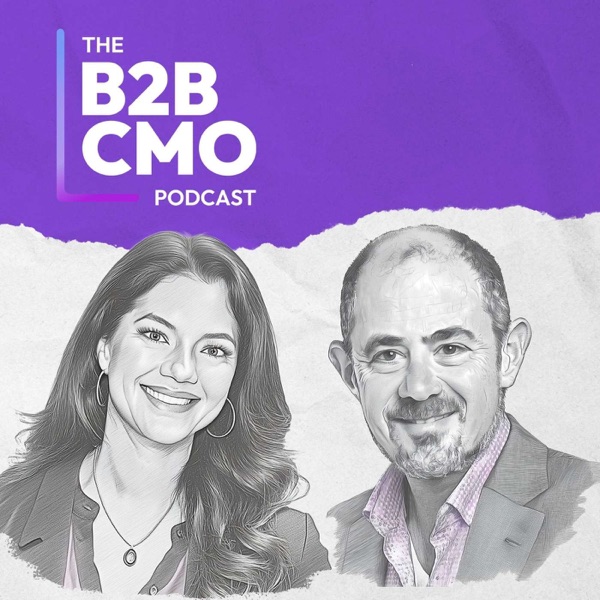
The B2B CMO Podcast with Jon Miller and Sydney Sloan
Welcome to The B2B CMO Podcast, a show for marketing executives who are redefining what it means to be a strategic leader. Join Jon Miller and Sydney Sloan every week as they talk with the very best Chief Marketing Officers who are navigating the modern marketing playbook and positioning themselves as strategic leaders.
Each episode, we unpack what it really takes to lead through complexity, earn trust at the strategy table, and shape the future of growth.
We’re building the community, research, and frameworks CMOs need to reclaim their strategic role and drive sustainable growth.
For more marketing leadership resources, visit [b2bcmoproject.com](http://b2bcmoproject.com/).
- Episodes
- 25
- Releases
- Weekly
- Typical length
- 38 min
- On air since
- 2026
- Latest episode
- 2 days ago
Episodes
25 episodes, newest first
-
35 min
The Business Hat Every CMO Needs in the Boardroom with Jessica Shapiro, CMO at LiveRamp
Episode 24
Show notes
Jessica Shapiro is the Chief Marketing Officer of LiveRamp, where she has led the company into the data collaboration category since joining in 2022. Before LiveRamp, she ran marketing at SAP Concur, held marketing leadership roles at Icertis, launched Starbucks VIA at Starbucks, and spent eight years at Microsoft.
In this episode, Jessica joins Sydney Sloan and Jon Miller to share how she earned the right to reposition the LiveRamp brand by fixing the demand waterfall first and cutting cost per opportunity in half. She explains what it takes for a new category to stick, and why she sees governance and agent autonomy as additive instead of in conflict.
Jessica also walks through the offsite where her whole team built their own AI agents, and how LiveRamp now brings one combined brand number to every board meeting.
Jump Into the Conversation
(00:00) Jessica’s path from pre-med to marketing
(03:51) Curiosity and perseverance as marketing superpowers
(05:36) Wearing the business hat as a strategic CMO
(07:29) Why the CRO relationship comes first
(09:11) Earning credibility before repositioning the brand
(13:03) Building the data collaboration category at LiveRamp
(16:56) Setting expectations for category creation with the board
(19:20) Balancing data governance with agent autonomy
(22:49) The ups and downs of LiveRamp’s AI transformation
(27:05) Measuring brand with a composite score
(29:15) What brand metrics to bring into the boardroom
(30:23) Gratitude, mentors, and key takeaways
Episode Takeaways
• Earn the brand conversation with pipeline first. When her CEO told her not to start with a repositioning, Jessica rebuilt the demand waterfall, put attribution on everything, and took cost per opportunity from $6,000 to $3,000. That credibility is what got her back to the brand.
• Build the category story from what customers actually say. Customer interviews showed people knew the LiveRamp name but each described the company differently, and that gap became the case for the data collaboration story.
• Tell one category story in different versions. Customers hear time savings and protection, and the board hears a bigger TAM. Every version has to ladder up to the same place.
• Treat governance as what lets agents move faster. Jessica sees autonomy and governance as additive. When the right data and governance are built in, agents have guardrails and can do their work with less friction.
• Give the board one brand number they can follow. LiveRamp blends share of voice, message pull-through, AI visibility, web traffic, and AEO/GEO into a single trend line, introduced as a spotlight topic and reported at every board meeting.Standout Quote
• “I feel like the CRO and CMO need to be locked at the hip. If we do not share the same goals and the same vision, everything falls apart.” — Jessica Shapiro
Guest Links
• LinkedIn: https://www.linkedin.com/in/jessicamshapiro/
• LiveRamp Website: https://liveramp.com/Mentioned in this Episode
• RampUp by LiveRamp: https://www.rampedup.us/
• Play Bigger: https://www.playbigger.com/
• Icertis: https://www.icertis.com/
• SAP Concur: https://www.concur.com/
• Brady Brewer: https://www.linkedin.com/in/brady-brewer-64a2034
• Elena Donio: https://www.linkedin.com/in/elenadonio/
• Scott Howe: https://www.linkedin.com/in/schowe/More from The B2B CMO Project
• Website: https://www.b2bcmoproject.com/
• LinkedIn: https://www.linkedin.com/company/b2bcmoproject/
• Jon Miller: https://www.linkedin.com/in/jonmiller2/
• Sydney Sloan: https://www.linkedin.com/in/sydsloan/
• More Episodes: https://www.b2bcmoproject.com/podcasts -
32 min
Building a Movement Instead of Chasing Demand with Katrina Wong, CMO at New Relic
Episode 23
Show notes
Katrina Wong is the Chief Marketing Officer of New Relic, the intelligent observability platform, where she has led brand, demand, and communications. Before taking on the CMO role, she started her career as a consultant at PwC. She later on became Divisional CMO and VP of Marketing at Twilio Segment and held marketing and go-to-market leadership roles at Hired, Zuora, Salesforce, and SAP.
In this episode, Katrina joins Sydney Sloan and Jon Miller to share how New Relic repositioned its category as intelligent observability and turned that into an AI story told chapter by chapter. She explains why she reports new business and post-sale pipeline separately in a consumption business, and why one marketing team owns both.
Katrina also walks through how her marketing engineering and AI team rebuilt reporting on Gemini, the 85 agents running competitive intel every morning, and what happened when an agency sent her team 200 variations to review.
Jump Into the Conversation
(00:00) Katrina’s path from consulting to marketing(05:21) Being a strategic CMO and redefining observability for AI
(09:13) Telling the AI story like chapters of a book
(11:48) How marketing proved AI modernization to the board
(14:18) Separating new business and post-sale pipeline
(16:21) Customer hackathons and the link between engagement and revenue
(18:01) Building a trusted BI layer with vibe coding
(20:53) Humans in the loop and the problem of too much AI content
(23:18) Gemini gems for sales and 85 daily competitive agents
(25:12) The pillars of a superhuman marketing team
(27:05) Gratitude, mentors, and key takeaways
Episode Takeaways
• Take a bold stance on your category before someone else sets it for you. New Relic repositioned observability as intelligent observability, was first to claim it, and Gartner recognized the company for its AI vision the following year.
• Tell your AI story in chapters. Chapter one explained why AI matters in observability. Chapter two named the problem: code volume growing beyond human scale. That led to the brand campaign, Welcome to the Superhuman Era.
• Measure pipeline the way your business makes money. In a consumption business, new business pipeline is a leading indicator, but revenue comes from usage. New Relic tracks both, and one marketing team owns both.
• Keep humans in the loop, even when AI can produce more. When an agentic agency sent back 200 variations, Katrina's team realized more output wasn't the answer if no one could review it.
• Remove the bottlenecks between marketing and the field. Gemini gems for competitive and value selling replaced last-minute Slack asks, and 85 daily agents now draft most competitive updates before a human fact-checks them.Standout Quote
• "Sometimes the move to be strategic is to take a bold stance and see if it pays off." – Katrina Wong
Guest Links
• LinkedIn: https://www.linkedin.com/in/katrinawong11/
• New Relic Website: https://newrelic.com/Mentioned in this Episode
• Zuora: https://www.zuora.com/
• Gartner:https://www.gartner.com/
• Klaviyo: https://www.klaviyo.com/
• Tien Tzuo: https://www.linkedin.com/in/tientzuo/
• Sue Barsamian: https://www.linkedin.com/in/suebarsamian/
• Carilu Dietrich: https://www.linkedin.com/in/carilu/
• Tom Hartman: https://www.linkedin.com/in/tom-hartman/
• Jennifer Covington: https://www.linkedin.com/in/covingtonjennifer/More from The B2B CMO Project
• Website: https://www.b2bcmoproject.com/
• LinkedIn: https://www.linkedin.com/company/b2bcmoproject/
• Jon Miller: https://www.linkedin.com/in/jonmiller2/
• Sydney Sloan: https://www.linkedin.com/in/sydsloan/
• More Episodes: https://www.b2bcmoproject.com/podcasts -
41 min
Snowflake’s CMO Reinvents Her Playbook Every Year. Here’s How.
Episode 22
Show notes
Denise Persson is the Chief Marketing Officer ofSnowflake, the AI Data Cloud company. With over 10 years in the role, one of the longest CMO tenures in enterprise tech, she has helped take Snowflake from roughly $1 million in revenue to more than $4 billion. She now leads a marketing team of about 700 people responsible for 40 to 50% of the company's growth, and this year marks her 30th in tech marketing.
Denise shares why a new CMO's first team is the leadership team, not the marketing org, and why she throws out her own playbook every year. She also walks through how Snowflake's brand team became its most AI-forward function, how her morning brief replaced waiting on dashboards, why Snowflake moved its SDRs back into sales, and why her team is already working next quarter's pipeline two quarters out. Denise shares the one thing she says builds brand trust above all else: consistency.
Jump Into the Conversation
(00:00) Welcoming Denise Persson, CMO of Snowflake
(01:56) From Commodore to 30 years in tech marketing
(05:52) Why the CMO's first team is the leadership team
(10:47) Throwing out the playbook every year
(14:49) Moving marketing from AI fluency to agentic workflows
(19:22) Growing 40 to 50% without adding headcount
(21:35) Replacing dashboards with a daily AI brief
(24:25) Why Snowflake moved SDRs back into sales
(25:59) Fixing a soft quarter two quarters out
(29:53) How AI adoption differs across regions
(32:02) Why consistency builds brand trust
(36:03) Closing gratitude and the leaders who see potential first
Episode Takeaways
• Treat the leadership team as your first team. Denise says the day you become CMO, you are a business leader. That means understanding finance, having empathy for the sales craft, partnering with product, and bringing data and customer proof, not opinion, when you push a point of view.
• Rebuild your playbook every year and hire for your gaps. Over 10 years at Snowflake, Denise has thrown out her playbook annually. Her survival tactic is self-awareness: know your strengths, then hire people with the superpowers you don't have.
• Move AI from individual experiments to your top three workflows. Snowflake's top marketing AI user sits on the brand team, which is now building an agentic workflow so regional marketers can self-serve campaign assets instead of waiting 5-10 days.
• Work pipeline two quarters out. There is no magic campaign that fixes a soft quarter in a long sales cycle. Denise's team uses signals to see a weak quarter six months early, then drills down to territories as small as eight reps to find what's in the red.
• Build brand trust through consistency. Denise points to McDonald's and Coke as proof that trust comes from never delivering surprises. Her challenge now: keeping the brand consistent when anyone in the company can generate their own branded content.Standout Quote
• "When you get that CMO role, you need to understand that that’s the day you are a business leader." — Denise Persson
Guest Links
• LinkedIn: https://www.linkedin.com/in/denisepersson/
• Snowflake Website: https://www.snowflake.com/Mentioned in this Episode
• The Five Dysfunctions of a Team by Patrick Lencioni: https://www.tablegroup.com/topics-and-resources/teamwork-5-dysfunctions/
• Frank Slootman: http://linkedin.com/in/frankslootman
• Maria Pergolino: https://www.linkedin.com/in/mariapergolino/
• Latané Conant: https://www.linkedin.com/in/latane-conant/
• Demandbase: https://www.demandbase.com/More from The B2B CMO Project
• Website: https://www.b2bcmoproject.com/
• LinkedIn: https://www.linkedin.com/company/b2bcmoproject/
• Jon Miller: https://www.linkedin.com/in/jonmiller2/
• Sydney Sloan: https://www.linkedin.com/in/sydsloan/
• More Episodes: https://www.b2bcmoproject.com/podcasts -
28 min
Leading the Market Through AI Disruption with Demandbase CMO Rachel Truair
Episode 21
Show notes
Rachel Truair is the Chief Marketing Officer of Demandbase, the pipeline engine for AI go-to-market trusted by some of the world's leading B2B enterprise brands. Rachel joined Demandbase in January 2026 after more than two decades in B2B marketing leadership, including CMO roles at Simpro Group and Cart.com and senior roles at Adobe, Confluent, Oracle, and 3M.
In this episode, Rachel chats with Sydney Sloan to look at AI disruption from the customer's side of the table. She shares what Labs by Demandbase is seeing in ChatGPT-referred traffic to B2B websites, why the real opportunity sits with the 95% of buyers who aren't in market yet, and why she may be the first Demandbase CMO to actually run her team on Demandbase. Rachel also makes the case that software should prove its own ROI, and explains how thinking like an investor helps CMOs split their AI bets into separate efficiency and growth stories for the board.
This episode is part of a partnership between The B2B CMO Project and Demandbase, the pipeline engine for AI go-to-market.
Episode Takeaways
• Assume your buyers are researching somewhere you can't see. Labs by Demandbase found a roughly 300% increase in ChatGPT-referred traffic to B2B websites over the last year, which means a big share of discovery now happens before a prospect ever lands on your owned properties.
• Get the data foundation right before you scale anything with AI. Rachel's version: you avoid running off a cliff by standing on a flat surface. If your data isn't unified and you don't know which signals actually matter, AI just helps you scale the wrong things faster.
• Market to the 95%, not just the 5%. When everyone has access to the same in-market data, the advantage goes to the teams that use signals, buying groups, and context to reach buyers before they start an evaluation.
• Point AI at the spreadsheets, not the storytelling. Rachel saw AI-generated creative fall flat, and believes the better use is taking reporting, attribution debates, and campaign friction off marketing's plate so teams have more time for creative work.
• Bring AI to the board as an investor would. Rachel splits her AI initiatives into an efficiency story (time savings, headcount savings, program spend) and a growth story (pipeline and revenue), measures each on its own terms, and reinvests savings from one into the other.Standout Quote
• "The work that marketing does that's really valuable is the creative, it is the content, it is the storytelling. It's the reason we all got into this to begin with." — Rachel Truair
Guest Links
LinkedIn: https://www.linkedin.com/in/racheltruair/
Demandbase Website: https://www.demandbase.com/
Mentioned in this Episode
Mojo by Demandbase: https://trymojo.ai
Labs by Demandbase: https://www.demandbase.com/resources/labs/
The Prompt, Rachel Truair's podcast: https://podcasts.apple.com/us/podcast/the-prompt/id1372690438
Kelvin Gee, Forrester: https://www.linkedin.com/in/kelvingee
Forrester:https://www.forrester.com/
More from The B2B CMO Project
Website: https://www.b2bcmoproject.com/
LinkedIn: https://www.linkedin.com/company/b2bcmoproject/
Jon Miller: https://www.linkedin.com/in/jonmiller2/
Sydney Sloan: https://www.linkedin.com/in/sydsloan/
More Episodes: https://www.b2bcmoproject.com/podcasts
-
38 min
Turning Customer Pain Into Strategic Marketing with Cindy Zhou, CMO at Imprivata
Episode 20
Show notes
Cindy Zhou is the Chief Marketing Officer of Imprivata, the simple and secure access management platform used by roughly 90% of U.S. hospitals. Before Imprivata, Cindy built her CMO track record at KnowBe4, LogRhythm, and in senior marketing roles at IBM and Verizon, making this her fourth cybersecurity company as a marketing leader.
Cindy chats with Jon Miller and Sydney Sloan about her new role to unpack how she built her 30-60-100-day plan, why she believes CMOs need to operate as business executives first, and why she has already told her team to stop talking about MQLs. Cindy also walks through how she prioritizes with her CEO and CRO, why she is tying her customer marketing team's KPIs to retention and churn instead of lead volume, and how KnowBe4's InfoSec team tried to break her first AI SDR before she would let it near a real customer.
Jump Into the Conversation
(00:00) Welcoming Cindy Zhou, CMO of Imprivata
(02:31) How Cindy went from product management to marketing
(07:49) What it means to be a strategic CMO
(10:05) What she brought from past roles into Imprivata's C-suite
(11:36) Seeing the market beyond industry silos
(14:17) How to earn the strategic CMO seat
(19:51) Moving beyond MQLs and tying priorities to strategic metrics
(22:12) Investing in retention and customer marketing
(27:41) How to build brand in an AI-disintermediated world
(29:48) AI SDRs and AI teammates, governance, and human-in-the-loop
(32:01) Closing gratitude, mentors and board members who shaped her career
Episode Takeaways
• Treat marketing as a business-executive function, not a departmental one. When Cindy evaluates a new opportunity, she starts with market dynamics and the financials (NRR, GRR, growth rate) before she gets to a marketing plan, because 'chief market officer' only works as a title if you actually understand the market.
• Look past the vertical to find the universal pain underneath it. Imprivata's brand is deeply rooted in healthcare, but Cindy makes the case for expanding into manufacturing and public safety by pointing to a pain point every industry shares: nobody wants to deal with passwords. She backs this up with real customer stories, like a casino cage worker locked out of a login for 45 minutes, to show how the same root problem shows up everywhere, just wearing a different industry's clothes.
• Use your CEO's and CRO's own words to build your first 90 days. Cindy's tip for new CMOs: go back and listen to the sales kickoff keynote, then build your plan around the problems leadership already said out loud they want solved. Parroting it back makes the plan easier to align on.
• Replace MQLs with metrics tied to retention and growth. Cindy has moved her customer marketing team's KPIs away from lead volume and toward NRR, GRR, and churn signals, arguing that in a private-equity-backed business, those numbers matter more to the board than marketing-sourced pipeline.
• Stress-test AI SDRs before they ever talk to a real customer. At KnowBe4, Cindy had her InfoSec team try to break the AI SDR with off-topic and legal questions before launch, and the program is still built to route uncertain questions to a live human rather than risk a wrong answer.Standout Quote
• "We’re business executives first, that’s the way to really think about it. We just happen to have responsibility over marketing.” — Cindy Zhou
Guest Links
• LinkedIn: https://www.linkedin.com/in/cindyzhou/
• Imprivata Website:https://www.imprivata.com/Mentioned in this Episode
• Mark Logan: https://www.linkedin.com/in/mark-logan-894977/
• Betsy Atkins: https://www.linkedin.com/in/betsy-atkins-a36b114/
• Shanti Atkins: https://www.linkedin.com/in/shanti-atkins-602b493/
• Brian Jack: https://www.linkedin.com/in/privacy-policy/
• Penn Entertainment: https://www.pennentertainment.comMore from The B2B CMO Project
Website: https://www.b2bcmoproject.com/
LinkedIn: https://www.linkedin.com/company/b2bcmoproject/
Jon Miller: https://www.linkedin.com/in/jonmiller2/
Sydney Sloan: https://www.linkedin.com/in/sydsloan/
More Episodes: https://www.b2bcmoproject.com/podcasts
-
21 min
Why Your Marketing Org Chart Is Already Obsolete with Dom Colasante, Founder of 2X
Episode 19
Show notes
Most CMOs are trying to solve an operating model problem with a job posting. Dom Colasante is the founder of 2X, and he has spent the better part of a decade helping B2B companies run marketing, sales, and customer success as one system. Following 2X's acquisition of KnownWell, he is betting the company on what he calls the human agentic go-to-market model. This model involves expert teams and AI agents fused so tightly you cannot tell which is which.
In this rapid-fire conversation, Dom joins Sydney Sloan to explain why asking the same people to own both strategy and execution suboptimizes both, how to sort every piece of go-to-market work into three buckets, and why the single most common mistake he sees right now is a CMO hoping one expensive hire will rewire the whole function.
This episode is part of a partnership between The B2B CMO Project and 2X.
Jump Into the Conversation:
(00:00) Why 2X is betting on human agentic go-to-market
(01:57) Why the go-to-market org chart is finally breaking down
(02:36) What happens when one team owns both strategy and execution
(05:46) Inside the human agentic operating model and the KnownWell acquisition
(07:52) Why every workflow should have both human and AI in it
(09:22) Door one versus door two and why growth beats efficiency
(12:13) The three buckets of go-to-market work
(15:14) Where to start and the honest talent conversation
(17:46) The mistake CMOs are making with the single go-to-market engineer
Key Takeaways
• One team owning both strategy and execution suboptimizes both. Strategy shrinks to what that team can personally execute, and execution never gets the full best practice treatment because the same people are busy thinking. Dom's fix is specialization of labor, with the two groups still on one team and the integration point on collaboration rather than day-to-day work.
• Once you split them, the marketing, sales, and CS silos stop mattering as much. Execution across all three is largely the same motion, and so is strategy across all three. Find a buyer, activate a buyer, or get a buyer to love the product more. That is what makes the converged org chart workable.
• Deconstruct the work into three buckets before you touch the org chart. To succeed, you need to divide your work into three different categories: what you must be the best in the world at, what you delegate to a partner to execute using best practices, and what you automate through systems. The work you personally own should account for only 10% to 20% of your total workload, and mastering that critical slice is what creates leverage and drives the success of everything else.
• The efficiency framing is the wrong ask. Given a choice between halving cost for the same output and holding cost while doubling output, Dom's read is that nearly every CEO takes the second door. Pitch the human agentic model as a growth argument, not a cost argument.
• An agentic operating model is a discipline, not a person. Hiring one go-to-market engineer runs a six-month search, produces someone who needs a team around them, and often ends in turnover a year later with the goal unmet. The same $250K buys tech, partners, expertise, and projects together.Standout Quote
• "When the same group of people, the same individuals, the same department is doing both strategy and execution at the same time, it sub-optimizes both." - Dom Colasante
Guest Links
• LinkedIn: https://www.linkedin.com/in/domeniccolasante/
• 2X website: https://2x.com/Mentioned in This Episode
• KnownWell (acquired by 2X): https://knownwell.com/
• Lisa Cole: https://www.linkedin.com/in/lisacole01/More from The B2B CMO Project
Website: https://www.b2bcmoproject.com/
LinkedIn: https://www.linkedin.com/company/b2bcmoproject/
Jon Miller: https://www.linkedin.com/in/jonmiller2/
Sydney Sloan: https://www.linkedin.com/in/sydsloan/
More Episodes: https://www.b2bcmoproject.com/podcasts
-
16 min
Rebuilding Marketing Automation for the AI Era with Jon Miller, Founder of Marketo and Phave
Episode 18
Show notes
Jon Miller is the co-founder of Marketo, where he helped invent the marketing automation category and take the company public. He later co-founded Engagio, which was acquired by Demandbase, where he served as CMO. He's now the founder and CEO of Phave, an AI-native marketing automation platform built to replace the very category he created.
In this partner episode, Sydney talks to Jon about what's actually broken in the marketing automation playbook he wrote fifteen years ago. They look at why B2B buying committees now make most of their decision before a seller ever gets involved, what real personalization looks like when it's built on AI context instead of more content, and how his customers are migrating off legacy platforms like Marketo without flipping a switch overnight.
Jump Into the Conversation
(00:00) Why the marketing automation playbook Jon built doesn't work anymore
(02:08) The blind spots baked into legacy marketing automation systems
(04:10) The assumption in "marketing automation" that has to go
(05:04) Real personalization starts with context, not more content
(07:47) Moving from industry-level segmentation to person-level context
(09:05) Why speed became marketing's biggest constraint
(10:18) Replacing the Marketo "high priest" with a CMO who can build campaigns directly
(12:19) How Phave customers migrate off Marketo without flipping a switch overnight
(14:07) Using AI agents to make platform migration painless
Episode Takeaways
• Retire the marketing automation model built for a linear funnel. Jon argues the core assumption baked into platforms like Marketo (capture the lead, score it, nurture it, hand it to sales) breaks down against buying committees of 6 to 16 people who've made most of their decision before anyone raises a hand.
• Real personalization is about timing and offer, not content polish. Getting the right offer in front of the right person at the right time is roughly 80% of the job. Personalizing the actual content is the last 20%, and AI should be used to reason the first, not just generate more of the second.
• Treat platform migration as a trust dial rather than a cliff-edge switch. Jon's team avoids forcing an all-or-nothing cutover by letting customers transition at their own pace. Moving off Marketo, users can continue running campaigns the traditional way, go fully autonomous, or land anywhere in between based on their comfort level.
• AI should remove operational bottlenecks, not replace marketing judgment. Freeing CMOs from needing a dedicated platform specialist to translate every campaign idea gives marketers back the time for the creative, human work AI still can't do.Standout Quote
• "It's ironic, almost, that AI is actually going to make our marketing more human, not less." — Jon Miller
Guest Links
LinkedIn:https://www.linkedin.com/in/jonmiller2/
More from The B2B CMO Project
Website: https://www.b2bcmoproject.com/
LinkedIn: https://www.linkedin.com/company/b2bcmoproject/
Jon Miller: https://www.linkedin.com/in/jonmiller2/
Sydney Sloan: https://www.linkedin.com/in/sydsloan/
More Episodes: https://www.b2bcmoproject.com/podcasts
-
43 min
Build Marketing Around Proof, Not Pitches with Lena Waters
Episode 17
Show notes
Lena Waters is a marketing executive and advisor who specializes in the inflection point where product-led growth meets enterprise scale. She has built and led global marketing teams across growth, demand, and brand at companies including Grammarly, DocuSign, Responses, and Lookout, and most recently served as CMO at Notion. Across those roles, she's operated both enterprise and product-led growth motions and developed a point of view on how the two can reinforce each other rather than compete.
Lena joins Jon Miller and Sydney Sloan to share her controversial take: stop trying to persuade your buyers and start giving them proof instead. In this episode, she breaks down why she'd rather put a marketing dollar into product experience than a brand campaign, and how that thinking took her from DocuSign to Grammarly to running go-to-market at Notion.
Lena walks through how she merged product-led growth with enterprise sales without treating them as competing motions, why she thinks MQLs are measuring the wrong thing, and the three blunt questions every CMO should ask their CEO before taking the job. We also get into why she thinks the AI-native marketing team problem isn't a talent problem at all.
Jump Into the Conversation:
(00:00) Where PLG meets enterprise scale
(01:40) The CMO who resisted becoming a CMO
(03:51) Selling the pony: An origin story in positioning
(07:54) What "strategic" actually means in the AI era
(10:06) Repositioning Notion from note-taking to context platform
(12:44) MQL vs. MQA and letting the data kill the old metric
(15:00) When brand spend is just rented attention
(20:47) Community compounds, awareness evaporates
(23:14) How Notion measured a narrative change
(25:51) Three questions every CMO should ask their CEO
(33:13) The AI-native team is a permissions problem, not a talent problem
(36:24)Why speed beats consensus
Key Takeaways
• Replace persuasion with proof. Lena argues that much of traditional B2B marketing has been designed to persuade prospects before they have meaningful experience with the product. MQLs often measure whether someone consumed a whitepaper, webinar, guide, or event and then translate that behavior into assumed buying intent. Product experience provides a different signal: someone has used the product, experienced its impact, and potentially built a dependency on it. The strategic question becomes how much value you can let customers experience before asking them to buy.
• PLG and enterprise don't have to be competing motions. Lena's experience owning both enterprise and product-led targets changed how she thought about growth. Individual product users can build durable brand affinity, while small teams and developers can become a front door to the enterprise pipeline. She doesn't argue that every company needs a traditional PLG model. Instead, she asks how wide a company can open its front door—through a free experience, API access, a usage-based tier, hands-on proof of concept, or another way for customers to experience value before the contract.
• Build brand assets that compound. Lena distinguishes between attention that disappears when spending stops and evidence that keeps working for the company. Community, original research, customer advocacy, and the stories customers tell about a product can create value long after the initial investment. Rather than asking a CFO to simply “fund brand,” her approach is to show how those assets keep returning value and use a combination of quantitative and anecdotal evidence to demonstrate whether the company's narrative is actually changing.
• AI-native marketing starts with permission, not the org chart. Lena pushes back on the idea that AI transformation is primarily a talent problem. Before debating new roles or hiring more generalists, she asks whether marketers actually have access to the CRM and product data they need to execute. She also argues for moving away from teams organized around individual channels and toward one shared department outcome. AI can dramatically increase production, but that advantage disappears if the company keeps the same slow approval structures around the work.Standout Quote
• “If you can help somebody experience the product before they buy and they already know what you are before they arrive, then the funnel stops doing the persuading that we've been trying to do all this time. And the product and your company reputation do it first.” — Lena Waters
Guest Links
• LinkedIn:https://www.linkedin.com/in/lenawaters/
Mentioned in this Episode
• Scott Olrich: https://www.linkedin.com/in/scottolrich/
More from The B2B CMO Project
• Website:https://www.b2bcmoproject.com/
• LinkedIn:https://www.linkedin.com/company/b2bcmoproject/
• Jon Miller:https://www.linkedin.com/in/jonmiller2/
• Sydney Sloan:https://www.linkedin.com/in/sydsloan/
• More Episodes:https://www.b2bcmoproject.com/podcast -
16 min
Inside G2's 2026 Buyer Behavior Report with Alexandra London, CMO of G2
Episode 16
Show notes
Alexandra London is the Chief Marketing Officer atG2, the world's largest and most trusted data source in B2B software, serving more than 200 million annual software buyers. She joined G2 to lead marketing into the AI era, building growth engines designed for acceleration, accountability, and long-term value creation.
Alexandra joins Sydney Sloan to unpack the findings ofG2's 2026 Buyer Behavior Report: The Evaluation Maze: how 82% of buyers have sourced a software recommendation from an AI chatbot, what separates getting cited from winning the answer, and why 49% of buyers had a CFO veto a software purchase that had already been approved.
This episode is part of a partnership between The B2B CMO Project and G2.
Jump Into the Conversation:
(00:00) Meet Alexandra London
(01:28) Why the Buyer Behavior Report matters to CMOs
(03:57) The new research timeline only takes hours instead of weeks
(05:20) How to win the answer, not just get cited
(06:02) Marketing to the human and the agent at the same time
(08:57) The new data point: 49% of CFOs vetoed an approved purchase
(10:27) Why nobody wants to sign a three-year deal anymore
(12:27) Token maxing and bringing the CFO along the journey
Episode Takeaways
• The shortlist is now built before you know the buyer exists. 82% of buyers sourced a software recommendation from an AI chatbot in the last 24 months, and review sites and AI chatbots are now the top sources influencing which vendors make that shortlist. Research that used to take weeks to months is now happening in hours.
• Getting cited is not the same as winning the answer. Being mentioned is table stakes. What matters is whether your brand is the recommendation the buyer acts on, and whether your own content is what shaped how the model describes you.
• Your content has two readers now, and one of them recrawls every 90 days. The models recrawl, re-understand, and repopulate on roughly a 90-day cycle, which means stale content quietly becomes a stale answer. Open your site and content to be crawled, and run an AEO tool that benchmarks prompts, citations and performance at scale rather than treating it as a one-time optimization pass.
• Awareness is not the finish line, evaluation is the bottleneck. Discovery compressed, evaluation did not. Buyers still have to compare and validate, and they need first-party comparison content alongside third-party reviews to build the internal business case they are the ones defending.
• 49% of buyers had a CFO veto a purchase that was already approved. CFOs are scrutinizing tooling ROI, watching AI consumption costs, and pushing back on multi-year contracts. If the CFO is not your financial buyer, add them to the buying group anyway through late-stage brand and paid social, so they recognize your name before the contract reaches their desk.Standout Quote
• "Now you have to speak to both the human and the agent, because they're both crawling and they're both understanding your site and pulling data in real time." — Alexandra London
Guest Links
• LinkedIn:https://www.linkedin.com/in/alexandralondon/
• G2 Website:https://www.g2.com/Mentioned in this Episode
• G2 2026 Buyer Behavior Report, The Evaluation Maze:https://sell.g2.com/2026-buyer-behavior-report
• G2's announcement of the report findings:https://company.g2.com/news/buyer-behavior-2026
• G2's acquisition of Capterra, Software Advice and GetApp from Gartner:https://www.prnewswire.com/news-releases/g2-to-acquire-capterra-software-advice-and-getapp-from-gartner-302673901.html
• Kim Storin:https://www.linkedin.com/in/kimberlystorin/More from The B2B CMO Project
Website: https://www.b2bcmoproject.com/
LinkedIn: https://www.linkedin.com/company/b2bcmoproject/
Jon Miller: https://www.linkedin.com/in/jonmiller2/
Sydney Sloan: https://www.linkedin.com/in/sydsloan/
More Episodes: https://www.b2bcmoproject.com/podcasts
-
36 min
Define the Message and the Roadmap Follows with Jamie Domenici, CMO of Klaviyo
Episode 15
Show notes
Jamie Domenici is the Chief Marketing Officer at Klaviyo, the autonomous B2C CRM. Since joining in 2023, Jamie has guided the company through its IPO and championed Klaviyo's repositioning from ESP to the CRM built specifically for B2C brands, earning recognition as a category leader in Adweek's AI Power 50. She previously served as CMO at GoTo, leading the company's rebrand from LogMeIn, and spent a decade at Salesforce in marketing and customer success leadership.
Jamie joins co-hosts Jon Miller and Sydney Sloan to talk about what B2B marketers can learn from B2C's obsession with owning a number and personalizing at scale, how she rebuilt Klaviyo's category story starting from a single bad billboard, and why she's turning content editors into content engineers as AI reshapes her team.
(00:00) Meet Jamie Domenici, CMO of Klaviyo
(02:16) From aspiring politician to marketing ops to CMO
(05:40) Why a CMO's closest partners are sales and product
(08:28) Own a number, and what else B2B can steal from B2C
(11:56) Bringing a point of view to the CEO's keynote
(14:14) The IPO test, can your message fit on a t-shirt
(16:27) The bad billboard that started a category
(18:45) You know a category landed when customers say it back
(19:51) Selling brand to a board that doesn't care about brand
(22:04) AEO becomes its own line item next to SEO
(25:47) Content editors become content engineers
(31:36) Invisible AI and what comes after autonomousEpisode Takeaways
Customer proximity drives strategy. Stay close to customers consistently, not just at major milestones. Ongoing conversations helped Klaviyo understand what customers actually needed, sharpen the narrative around where the company was headed, and make a much bigger strategic call about the category it wanted to own.
Marketing should position where you’re going, not just where you are. Marketing shouldn’t simply describe the company as it exists today, sometimes the job is to define the category you believe the company can grow into before the market defines it for you. Klaviyo took that risk by moving beyond the ESP label and claiming the B2C CRM position before the product fully caught up. That clearer, bigger story gave the market something to understand and pushed the product roadmap and organization to align behind the vision.
AI should become invisible in the workflow. The next phase of AI will be less about adding another tool marketers have to actively use and more about embedding AI directly into how the work gets done. The goal is for AI to operate within the workflow without becoming visible to the customer.
Own a number. Marketers should have clear accountability to a business outcome, whether that’s growth, pipeline, or another measurable target. Owning a number isn’t just about proving marketing’s value, it changes how marketing operates as a strategic part of the business.
Standout Quote
“Sometimes you touch so many things that it feels like you don't own anything, but in fact, you're the glue that brings it all together.” - Jamie DomeniciGuest Links
LinkedIn:https://www.linkedin.com/in/jdomenici/Klaviyo Website:https://www.klaviyo.com/Mentioned in this Episode
Betty Hung: https://www.linkedin.com/in/betty-hung-b19ba0a0/
Stephanie Buscemi: https://www.linkedin.com/in/stephaniebuscemi/
Thimaya Subaiya: https://www.linkedin.com/in/thimaya/
Sara Varni: https://www.linkedin.com/in/saravarnibright/
Shannon Duffy: https://www.linkedin.com/in/shannonduffy/
Sarah Franklin: https://www.linkedin.com/in/sarahfranklin/
Emma Chalwin: https://www.linkedin.com/in/emmachalwin/More from The B2B CMO Project
Website: https://www.b2bcmoproject.com/
Jon Miller: https://www.linkedin.com/in/jonmiller2/
Sydney Sloan: https://www.linkedin.com/in/sydsloan/
More Episodes: https://www.b2bcmoproject.com/podcasts -
15 min
Quick Fire Advice to Uplevel Your AEO with Guy Yalif, Chief Evangelist of Webflow
Episode 14
Show notes
Guy Yalif is the Chief Evangelist at Webflow, the agentic web marketing platform helping developers, designers, and marketers build and optimize sites for both human visitors and AI answer engines. Before Webflow, Guy co-founded and served as CEO of Intellimize, a machine learning personalization company Webflow acquired, and spent more than two decades at the intersection of ad tech, martech, and CMO leadership at companies including Yahoo and Twitter. Guy now leads Webflow's AEO practice and talks with hundreds of CMOs every quarter.
This episode is part of a partnership between The B2B CMO Project and Webflow. Guy joins Sydney Sloan to unpack the data behind one of the most urgent shifts in B2B marketing: why 69% of B2B buyers have already chosen a vendor based on what an LLM recommended, what's actually different about optimizing for AI answer engines versus classic SEO, and the specific technical moves that got six of Webflow's product pages more than half of the company's new AI citations in two weeks.
Episode Takeaways
• Word-of-mouth's replacement is arriving faster than most CMOs are tracking. Buyers have long used peer recommendations as the fastest, most trusted way to build a vendor shortlist. LLMs are now filling that role, faster and available all the time, and 69% of B2B buyers have already picked a vendor because of what one recommended.
• Most brands are barely visible inside their own category's AI answers. Across a maturity assessment of roughly two thousand company sites, the average mention rate was just 16%, the link-back rate was 6%, and share of voice against competitors was only 15%. Even when a brand does get mentioned, only about a quarter of the answer reflects its actual positioning.
• Structure, not volume, is the highest-leverage AEO fix available right now. Webflow added FAQ blocks and schema markup to six of its highest-traffic product pages. Within two weeks, those six pages, out of a quarter million on the site, accounted for more than half of all the new AI citations Webflow earned.
• AEO needs an engineer and a marketer in the same room, which is exactly why most teams don't do it. Schema markup is metadata a machine can read that a human can't see, and building it well takes technical and marketing expertise together. That's a structural gap, not a knowledge gap.
• The AEO team is not the SEO team, it’s a broader mandate. Content responsibility sits with product marketing, technical work touches engineering, authority touches brand and PR, and measurement covers analytics. Good AEO looks like SEO with cross-functional buy-in that reaches the board, not a specialized side project run by one agency.“We as CMOs have been using word-of-mouth as the fastest, most trustworthy source of how to tackle a new problem, think about a new space, or come up with a vendor shortlist. And while the LLMs don't equal the trust you and I have, for example, they are faster, and they're available all the time.” — Guy Yalif
Guest Links
• LinkedIn:https://www.linkedin.com/in/gyalif/
• Webflow Website:https://webflow.com/Mentioned in this Episode
• Vivian Hoang:https://www.linkedin.com/in/vivianhoang/
More from The B2B CMO Project
• Website:https://www.b2bcmoproject.com/
• LinkedIn:https://www.linkedin.com/company/b2bcmoproject/
• Jon Miller:https://www.linkedin.com/in/jonmiller2/
• Sydney Sloan:https://www.linkedin.com/in/sydsloan/
• More Episodes:https://www.b2bcmoproject.com/podcasts -
43 min
How to Justify Brand Spend in the Dark Funnel with Kimberly Storin
Episode 13
Show notes
Kimberly Storin is the CMO at Zoom, the AI-first work platform for human connection. Kimberly leads Zoom’s brand, communications, product marketing, enterprise marketing, and regional marketing teams. Previously, she was Chief Marketing and Communications Officer at Zayo, and also spent time as a consultant with Deloitte.
Kimberly joins Sydney Sloan to discuss how to build your brand in the era of the dark funnel, how to fight for end-user mental availability, and why B2B marketers need to leverage some of the key learnings from B2C marketing around creative.
Episode Takeaways
• Kimberly's B2B brand-building framework has four components: Be Found, Be Present, Be Believed, and Be Preferred. This model helps sales leaders, GMs, and the CEO understand why 75% of GTM effort must happen before a buyer ever raises their hand, since B2B buying now happens almost entirely in the "dark funnel."
• Vet leadership's view of strategy before accepting a CMO role, not after. For example, Kimberly Storin talked to 50 customers and presented a hypothesis-level 30/60/90 day plan before accepting the Zoom CMO job, using the board's reaction as a litmus test for whether they'd actually let her bring market insights to the table. When evaluating new roles, treat the interview process as a strategy audit, not just a culture check.
• Fight for communications to sit inside marketing's remit. Organizations that treat communications as a strategic lever of marketing rather than a separate function, because it lets the CMO shape narrative at both the corporate and go-to-market level. Marketing leaders should push to consolidate brand, comms, and demand under one strategic view rather than let them fragment across silos.Standout Quote
• “I believe that owning that narrative and really understanding marketing as a reputation driver as well as a brand and pipeline driver is the right strategic view.” - Kimberly Storin
Guest Links
• LinkedIn: https://www.linkedin.com/in/kimberlystorin/
• Zoom Website: https://www.zoom.com/More from The B2B CMO Project
• Website: https://www.b2bcmoproject.com/
• LinkedIn: https://www.linkedin.com/company/b2bcmoproject/
• Jon Miller: https://www.linkedin.com/in/jonmiller2/
• Sydney Sloan: https://www.linkedin.com/in/sydsloan/
• More Episodes: https://www.b2bcmoproject.com/podcasts -
48 min
Building the Case for Brand as a New CMO with Latané Conant
Episode 12
Show notes
Latané Conant is the Chief Market Officer of Parloa, AI agents that turn customer conversations into lasting loyalty. Prior to Parloa, she led both global sales and marketing teams in both CMO and CRO roles at 6Sense, Appirio, and Ariba. She wrote the book No Forms. No Spam. No Cold Calls. Latané joins co-hosts Jon Miller and Sydney Sloan to discuss how being a sales leader can make you a more empathetic marketing leader, why benchmarking and research are key to building the business case to invest in marketing, and what you can do as a marketing leader to upskill your team and attain outsized results.
Episode Takeaways
• Win the stage, not the deal. Marketing leaders should map their specific sales process stage-by-stage and ask "what needs to happen to win this stage," rather than focusing only on closing. By treating each stage as its own objective, it lets marketing provide targeted "air cover" instead of generic support, at the right time.
• Pre-socialize big asks individually before the board meeting. Rather than pitching a major brand investment cold, secure CEO or CFO support first, then bring specific, but not overly prescriptive, pillars to the board. Bring enough detail to justify the spend without inviting a free-for-all of opinions on every channel or influencer choice.
• Formalize AI accountability with quarterly benchmarking. Centralize AI enablement function so you can benchmark every function's AI usage each quarter, and have team members report progress against what's "possible" in their QBRs. This creates structured pressure to actually adopt AI tools rather than treating them as optional.
• Redesign org growth curves around AI leverage, not headcount. Rather than rebuilding a large functional team from scratch, instead hire one senior leader per function with the expectation they operate with heavy AI assistance. Output can now scale without linear headcount growth.Standout Quote
• “ I don't believe in making small plans.” - Latané Conant
Guest Links
• LinkedIn: https://www.linkedin.com/in/latane-conant/
• Parloa Website: https://www.parloa.com/More from The B2B CMO Project
• Website: https://www.b2bcmoproject.com/
• LinkedIn: https://www.linkedin.com/company/b2bcmoproject/
• Jon Miller: https://www.linkedin.com/in/jonmiller2/
• Sydney Sloan: https://www.linkedin.com/in/sydsloan/
• More Episodes: https://www.b2bcmoproject.com/podcasts -
40 min
AI Won't Save Bad Marketing, Creativity Will, with Kyle Lacy
Episode 11
Show notes
Kyle Lacy is the Chief Marketing Officer at Docebo, an AI-First LMS for Enterprise Learning & Skills. Kyle led global content marketing at ExactTarget before its acquisition by Salesforce, helped build Lessonly from the early days through its $300 million acquisition by Seismic, and went on to serve as CMO of Jellyfish. Kyle joins co-hosts Jon Miller and Sydney Sloan to discuss why AI can’t replace human creativity in marketing, why modern CMOs need to think about their personal brands, and why sales and marketing really don’t belong under each other.
Episode Takeaways
• Keep marketing and sales as separate organizations unless you have an exceptional CRO. Folding marketing into sales often strips out the creative and brand elements marketing exists to deliver, since sales is mostly science while marketing involves taste and creativity.
• Collect concrete "surprise and delight" stories as evidence for marketing's non-pipeline value. These proof points resonate with executives even though they can't be attributed in a pipeline report. Marketers should proactively document these moments (LinkedIn buzz, unsolicited CEO/investor mentions) as a standing evidence file, not something they scramble to recall in a budget meeting.
• Match your AI investment to workflow automation, not wholesale system, team, or function replacement. For example, Docebo's tech stack "doesn't look that much different" than before AI, the big changes are in automating existing manual workflows like lead routing and content production, and they hired a dedicated AI operations role specifically for marketing rather than relying solely on a central AI team.Standout Quote
• “ When everybody has the same tools, your only competitive advantage is you're human.” - Kyle Lacy
Guest Links
• LinkedIn: https://www.linkedin.com/in/kylelacy/
• Docebo Website: https://www.docebo.com/More from The B2B CMO Project
• Website: https://www.b2bcmoproject.com/
• LinkedIn: https://www.linkedin.com/company/b2bcmoproject/
• Jon Miller: https://www.linkedin.com/in/jonmiller2/
• Sydney Sloan: https://www.linkedin.com/in/sydsloan/
• More Episodes: https://www.b2bcmoproject.com/podcasts -
46 min
Pipeline Gives Permission to Invest Big on Brand with Jennifer Johnson
Episode 10
Show notes
Jennifer “JJ” Johnson is the Chief Marketing Officer at CrowdStrike, the Agentic Security Platform; unified and built to secure the AI revolution. Jennifer has been a CMO for more than a decade, leading global marketing strategy and execution, and building high-performance teams for some of the fastest-growing and most trusted brands in cybersecurity. Before joining CrowdStrike, she led both Amplitude and Tenable to successful IPOs as their CMO, along with leading Coverity to a successful acquisition.
Jennifer joins Co-Hosts Jon Miller and Sydney Sloan to discuss how to build an AI transformation center of excellence in-house, why focusing on pipeline gives CMOs permission to invest in big picture brand strategy, and the operating timeline methods of the clock and the stopwatch.
Episode Takeaways
• Leaders with consulting DNA, not just marketing chops, make great candidates for driving AI transformation. For example, Jennifer brought in someone from Boston Consulting Group's Go-To-Market practice specifically because she needed change-management expertise, not just tool knowledge. Peers should look for candidates who understand both marketing function and structured process transformation; the technology piece is the easy part.
• Tackle AI transformation one workflow at a time, end-to-end. Rather than boiling the ocean across every marketing function, pick one process, execute it completely, build a playbook, and then repeat.
• Treat "pipeline is permission" as the operating principle for earning strategic latitude. Consistently hitting core pipeline numbers is what earns a CMO credibility to pursue brand investments, category creation, or other "non-trivial" bets. Successful execution funds strategic ambition, not the reverse.
• Build brand budgets in parallel with demand, never as an afterthought. Brand and demand leaders should each build their own plans and asks independently; demand should never get "first pick" of budget with brand receiving leftovers, which leads to underinvestment in brand.
• Balance "calendar" moments with a "stopwatch" rapid-offense capability. Predictable moments (product releases, major conferences) anchor planning, but CrowdStrike also runs a rapid-response content engine reacting to real-time market signals and competitor moves; treating both cadences as complementary, not competing, priorities.Standout Quote
• “ I think every CMO needs to have someone in their leadership team that is accountable for driving AI transformation.” - Jennifer Johnson
Guest Links
• LinkedIn: https://www.linkedin.com/in/jjcmo/
• CrowdStrike Website: https://www.crowdstrike.com/en-us/More from The B2B CMO Project
• Website: https://www.b2bcmoproject.com/
• LinkedIn: https://www.linkedin.com/company/b2bcmoproject/
• Jon Miller: https://www.linkedin.com/in/jonmiller2/
• Sydney Sloan: https://www.linkedin.com/in/sydsloan/
• More Episodes: https://www.b2bcmoproject.com/podcasts -
39 min
“Write for Humans, Optimize for Agents” with Chris Koehler
Episode 9
Show notes
Chris Koehler is the Chief Marketing Officer of Twilio, the platform for conversations in the AI era. Chris has over 25 years of experience in leading marketing, sales, and product teams across companies like Adobe, Box, and E-Trade. Lately, he's been chasing a question Jon Miller happens to care a lot about: what happens to discovery, to personalization, and to the CMO's mandate itself in the age of AI.
Chris joins Jon to discuss his four-pillar framework for strategic marketing, how his marketing team is approaching the seismic shift from SEO to AEO, and why the future of GTM belongs to teams bold enough to reimagine their workflows entirely, not just optimize them.
Episode Takeaways
• Eliminate marketing jargon such as MQLs, SQLs, or marketing-qualified pipeline from executive and board communications. Focus on speaking in terms of revenue, profitability, and growth coverage. CMOs should translate all reporting to C-suite language and save marketing metrics for internal scorecards, where they belong.
• CMOs need to own the revenue number alongside the CRO. If sales misses the revenue target, that's marketing’s fault too. Marketing teams shouldn’t blame sales or product; instead, frame marketing as a co-owner of pipeline and revenue. GTM leaders should build formal shared accountability structures with their CRO rather than treating revenue as someone else's problem.
• Treat AEO (Answer Engine Optimization) as a company-wide imperative, not solely a content team task. AEO isn't just an extension of SEO, it requires every team to rethink how content is structured, formatted, and prioritized for both human readers and AI agents. GTM leaders should run a company-wide AEO education session to get ahead of executives sending panicked "we're not showing up in ChatGPT" messages.
• Pipeline is the path, not the destination; so stop celebrating it as a win. Delineate clearly between pipeline (a means) and revenue (the goal), and frame everything through the lens of revenue outcomes.
• Write for humans and optimize for agents. AI agents are not a new persona, they act on behalf of humans, so the content you create still needs to serve human intent, just formatted and structured for how AI models surface and cite information.Standout Quote
• “ At the end of the day, we're selling to humans, and it's relationships and building trust. So let's have some fun with that.” - Chris Koehler
Guest Links
• LinkedIn: https://www.linkedin.com/in/ckoehler/
• Twilio Website: https://www.twilio.com/en-usMentioned in this Episode
• Stephanie Carullo: https://www.linkedin.com/in/stephaniecarullo/
More from The B2B CMO Project
• Website: https://www.b2bcmoproject.com/
• LinkedIn: https://www.linkedin.com/company/b2bcmoproject/
• Jon Miller: https://www.linkedin.com/in/jonmiller2/
• Sydney Sloan: https://www.linkedin.com/in/sydsloan/
• More Episodes: https://www.b2bcmoproject.com/podcasts -
42 min
Leading Marketing Change at a 140-Year-Old Enterprise with Chris Bontempo
Episode 8
Show notes
Chris Bontempo is the Chief Marketing Officer of Johnson Controls, a global leader in thermal management, mission-critical building systems, energy efficiency, and decarbonization. Prior to joining Johnson Controls, Chris worked his way up at IBM from an Analyst to become the Chief Marketing Officer, IBM Americas. He’s especially passionate about how AI changes the marketing operating model and how marketing can own market intelligence to shape strategy.
Chris joins Jon Miller to discuss the exact frameworks he uses to win C-suite trust, defend the marketing budget with the CFO, and turn agentic AI into a genuine competitive advantage.
Episode Takeaways
• Marketing must own the "voice of the customer" function, not just demand gen. back into the company, and being an energy supplier to the ecosystem. Representing the voice of the customer back into the business is what earns marketing a seat at the strategic C-suite table.
• CMOs should focus on the real business conversations, it's whether marketing, sales, product, and services collectively drove a revenue outcome. CMOs need enough financial acumen to defend budget in "secured revenue" terms with the CFO, not lead-volume terms.
• Accept a certain amount of chaos as the price of AI experimentation. 100% success means you aren't taking enough risks. If every AI pilot succeeds, they aren't pushing hard enough. Leaders should explicitly normalize this with their teams so people aren't punished or discouraged when early AI pilots fail.
• Shift the unit of work from "the tool" to "the workflow," using agentic frameworks to orchestrate multiple tools. Move away from evaluating individual platforms and instead map full processes and let agents determine which tools to invoke. Pair marketing AI engineering talent directly with field marketers, sellers, and service teams to rapidly prototype these workflows together.Standout Quote
• “ You have to be able to hang with your CFO in the conversation around secured revenue.” - Chris Bontempo
Guest Links
• LinkedIn: https://www.linkedin.com/in/chris-bontempo/
• Johnson Controls Website: https://www.johnsoncontrols.com/More from The B2B CMO Project
• Website: https://www.b2bcmoproject.com/
• LinkedIn: https://www.linkedin.com/company/b2bcmoproject/
• Jon Miller: https://www.linkedin.com/in/jonmiller2/
• Sydney Sloan: https://www.linkedin.com/in/sydsloan/
• More Episodes: https://www.b2bcmoproject.com/podcasts -
36 min
Building Your AEO Strategy to Win the AI Citation with Amy Cook
Episode 7
Show notes
Amy Cook is the Co-Founder & CMO of Fullcast, the Go-to-Market Cloud built for RevOps leaders by RevOps leaders. Over Amy’s career, she’s led multiple companies through successful acquisitions as a CMO at companies such as Simplus, PathologyWatch, and nClouds. Amy joins Jon Miller and Sydney Sloan to discuss why she ditched MQLs for pipeline-first metrics, turned radical transparency with her CRO into a trust-building strategy, and used AI tools to reposition her brand for the AI answer-engine era.
Episode Takeaways
• Get as close to revenue as possible. Marketers should actively pursue ownership of pipeline reporting, customer-facing work, and even partnerships/alliances rather than staying siloed in brand and demand gen. This proximity to revenue is the single biggest lever for earning a strategic seat at the table.
• Treat individual LinkedIn thought leadership as brand infrastructure for AI answer engines. AI answer engines cite individual LinkedIn profiles far more than company brand pages, so CMOs have an "obligation" to become visible thought leaders themselves and to push their C-suite to do the same. Teams should also prioritize presence on YouTube and Reddit, since both are heavily cited by answer engines.
• Treat AEO (Answer Engine Optimization) like the early days of SEO, meaning fast-moving and testable. Google's newly released AEO optimization guidelines (bullet points, short sentences, structured answers) are fundamentally similar to classic SEO/outline writing.Standout Quote
• “ This is our time as marketers to become like the most valued and most trusted person on the C-suite” - Amy Cook
Guest Links
• LinkedIn: https://www.linkedin.com/in/amyosmondcook/
• Fullcast Website: https://www.fullcast.com/More from The B2B CMO Project
• Website: https://www.b2bcmoproject.com/
• LinkedIn: https://www.linkedin.com/company/b2bcmoproject/
• Jon Miller: https://www.linkedin.com/in/jonmiller2/
• Sydney Sloan: https://www.linkedin.com/in/sydsloan/
• More Episodes: https://www.b2bcmoproject.com/podcasts -
33 min
How to Embed AI into Your Marketing Team with Wendy White
Episode 6
Show notes
Wendy White is the Chief Marketing and Partner Officer at Daxko, where she leads marketing and partnerships for the platform that's powering the member management and operations engine behind so much of the fitness industry. Wendy has been a CMO for a number of companies and held globe-spanning marketing leadership roles at giants like Microsoft and Intel. Wendy joins Jon Miller and Sydney Sloan to discuss how to lead an organizational AI transformation, what it means for a CMO to lead as a business-first executive, and why a new brand measurement matrix is needed for an era where LLMs, not search engines, are where buyers do their research.
Episode Takeaways
• CMOs should position themselves as business executives first, and functional leaders second. Strategic CMOs actively weigh in on customer success strategy, sales org structure, and software procurement, which are all outside the traditional CMO scope. The modern CMO who earns a durable seat at the table does so by demonstrating strategic fluency across the entire business, not just owning the marketing lane.
• Treat AI adoption as a cultural mandate, not just a tooling decision. This means changing job descriptions, updating career ladders to include behavioral AI capabilities, and making it explicit company-wide that AI is not a choice. Leaders who treat AI as optional will fall behind those who structurally embed it into how people are hired, evaluated, and promoted.
• The "follow the sun" model, combined with AI, creates a continuous marketing execution engine. For example, Wendy's team has roughly half of its FTE headcount in India, with AI tools trained on brand guidelines, Gong calls, and campaigns. The result: Wendy wakes up to approval requests, not project kickoffs. This compresses execution timelines dramatically and is replicable for any GTM team willing to invest in AI-enabling offshore talent.
• After years of decline, PR is becoming a top priority again for marketers, specifically because LLMs are trained heavily on authoritative published content. Getting your company cited in industry and trade press is no longer just a brand play; it directly influences how AI systems describe and recommend your product. GTM teams should re-evaluate PR investment through this lens immediately.
• Brand measurement must be rebuilt for the AI era. Wendy introduced a new brand matrix that includes AI-driven sentiment monitoring (Reddit, G2), direct referral traffic as a brand signal, earned media share, and LLM citation share. CMOs should proactively introduce these metrics before the board asks why brand spend isn't measurable.Standout Quote
• “What a modern CMO needs to do is to be really deeply integrated into the overall market and business strategy of the company. Don't sit back and wait for it to be about like, what's the next trade show?” - Wendy White
Guest Links
• LinkedIn: https://www.linkedin.com/in/wendywwhite/
• Daxko Website: https://www.daxko.com/Mentioned in this Episode
• Guillaume "𝑮" Cabane: https://www.linkedin.com/in/cabane/
• Matt Heinz: https://www.linkedin.com/in/mattheinz/More from The B2B CMO Project
• Website: https://www.b2bcmoproject.com/
• LinkedIn: https://www.linkedin.com/company/b2bcmoproject/
• Jon Miller: https://www.linkedin.com/in/jonmiller2/
• Sydney Sloan: https://www.linkedin.com/in/sydsloan/
• More Episodes: https://www.b2bcmoproject.com/podcasts -
38 min
The 5 New Imperatives for B2B CMOs with Jon Miller & Sydney Sloan
Episode 5
Show notes
In this special episode, Sydney Sloan and Jon Miller break down the most important findings for marketing leaders from The B2B CMO Project’s new research report. The findings in this report draw on recorded interviews with more than 50 B2B CMOs at companies including Zoom, Salesforce, Nutanix, Snowflake, PagerDuty, and Sprout Social. Their goal: give CMOs the clearest possible picture of what has stopped working, what the best leaders and operators are doing differently, and exactly what to do about it. Sydney and Jon cover why the old B2B marketing playbook is broken and the five imperatives for modern marketing leaders to succeed.
Episode Takeaways
• Why the Old B2B Marketing Playbook is Broken: The MQL-driven, content-to-lead-nurture model worked for a generation, but the data now shows it's actively undermining marketing's credibility in the C-suite.
• Imperative 1 - Earn Your Seat by Becoming a Business Executive First: CMOs need to think of their C-Suite peers as their primary team and provide them with the voice of the customer, especially when that means surfacing problems before they’re apparent to others.
• Imperative 2 - Prove Marketing’s Value in the Language of the Board: When CMOs report in marketing language, they get treated as a tactical marketing function. When reporting to the board and peers, the best CMOs lead with business outcomes first and treat marketing metrics as internal diagnostics.
• Imperative 3 - Invest in Brand as a Strategic Economic Asset: Getting CFO buy-in on brand is very hard when marketers talk about awareness. Instead, connect brand strength to measurable business outcomes: lower customer acquisition cost, higher win rates, shorter sales cycles, and better pricing power. When marketers speak the language of finance, brand stops being a debate and starts being a priority.
• Imperative 4 - Lead Marketing Through AI Disruption: Buyers are beginning their research, discovery, and evaluation in LLMs like ChatGPT, Claude, and Gemini, not just search engines. Adopt metrics like citation share and share of answer to measure how often your company and products surface in AI-generated responses, and build your content strategy around winning those placements.
• Imperative 5 - Build the Organization and Capabilities for the Next Decade: Everyone is figuring out the AI-era at the same time, meaning those who actively engage with peer communities and share learnings will move faster.Standout Quotes
• “ The CMO role is too hard these days to do it alone, so let's do it together.” - Jon Miller
• “ We want to look at owning the customer voice, that is my favorite part of being a CMO.” - Sydney SloanChapters
• 00:00 Introduction & Overview of The B2B CMO Project Research Study
• 06:25 Why The Classic B2B Marketing Playbook Stopped Working and How CMOs are Moving Forward
• 09:39 1. The Credibility Gap is the Real problem for CMOs
• 14:43 2. The Metrics Problem & How to Prove Marketing's Value in the Language of the Board
• 19:49 3. Brand is a Strategic Investment
• 25:03 4. Leading Marketing Through AI Disruption
• 30:46 5. Build the Marketing Organization & Capabilites for the Next DecadeMentioned in this Episode
• The B2B CMO Project Research Report: https://www.b2bcmoproject.com/research
• B2B CMO Survey: https://interviews.g2.com/research/d4aa5130-d54f-4606-800d-ffb8696f71baMore from The B2B CMO Project
• Website: https://www.b2bcmoproject.com/
• Jon Miller: https://www.linkedin.com/in/jonmiller2/
• Sydney Sloan: https://www.linkedin.com/in/sydsloan/
• More Episodes: https://www.b2bcmoproject.com/podcasts
Marketing lists
More Marketing shows picked out from the charts








More in Marketing
Placed highest on Apple Podcasts' Marketing chart right now