Podcast
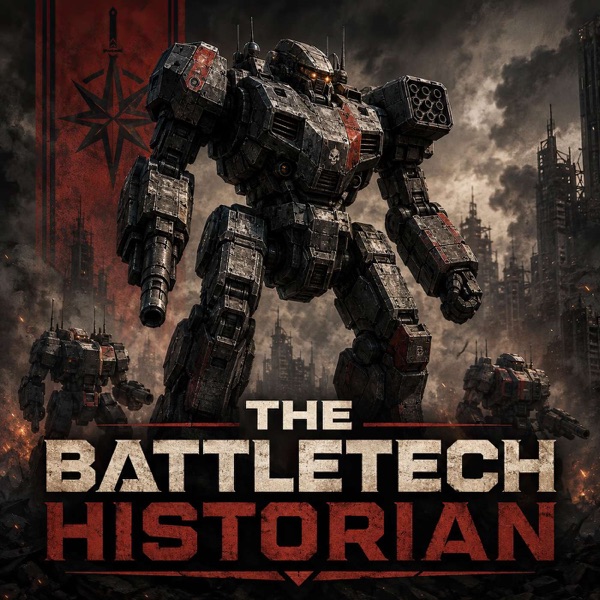
The BattleTech Historian: A Complete History of the BattleTech Universe
The BattleTech Historian is a ten-season, 250-episode journey through the complete history of the BattleTech universe. Hosted by military historian Dr. Jason Edwards, the series explores the rise and fall of the Star League, the Succession Wars, the Clan Invasion, the Jihad, the Dark Age, and the birth of the ilClan—along with the Great Houses, mercenary commands, legendary MechWarriors, and BattleMechs that shaped the Human Sphere.
Designed for both longtime fans and newcomers, each episode transforms decades of complex lore into an accessible, engaging story grounded in politics, technology, military strategy, and the human cost of endless war. Whether you want to understand the factions, follow the timeline, or discover why machines like the Atlas, Marauder, and Timber Wolf became icons, *The BattleTech Historian* is your guide to one of science fiction’s richest and most enduring settings.
- Episodes
- 251
- Releases
- Daily
- Typical length
- 23 min
- On air since
- 2026
- Latest episode
- 2 months ago
Episodes
251 episodes, from the first
-
3 min
The Complete History of BattleTech Starts Here Trailer
Show notes
Step into the BattleTech universe, where interstellar empires rise and fall, mercenary armies fight for survival, and towering BattleMechs decide the fate of entire worlds. This trailer introduces the history, factions, technology, legendary warriors, and centuries of conflict that make BattleTech one of science fiction’s richest military settings.
Whether you are a longtime fan or entering the Inner Sphere for the first time, The BattleTech Historian will guide you through the complete story—from the birth of the first BattleMech and the fall of the Star League to the Succession Wars, the Clan Invasion, the Dark Age, and the rise of the ilClan. Listen to the trailer, begin the journey, and explore more at imaginedbattlefield.com.
Season 1
-
24 min
Welcome to the Inner Sphere: What Is BattleTech?
Episode 1
Show notes
BattleTech is a sweeping military science-fiction setting in which humanity has spread across thousands of inhabited worlds but remains divided by distance, politics, and dynastic ambition. At its center are BattleMechs—towering war machines piloted by elite MechWarriors—but the larger story also includes noble houses, mercenary commands, Clan invaders, interstellar corporations, religious movements, and ordinary people trying to survive centuries of war. This opening episode introduces the Inner Sphere, the Periphery, Terra, and the basic historical forces that shaped the 31st and 32nd centuries. It also explains why BattleTech is more than a story about giant robots: its conflicts turn on logistics, succession, culture, technology, loyalty, and the consequences of political collapse. Whether you arrived through tabletop gaming, novels, MechWarrior video games, or painted miniatures, this is the foundation for understanding the entire universe. Visit ImaginedBattlefield.com for more military and science fiction.
-
22 min
BattleTech and MechWarrior: Same Universe, Different Doorways
Episode 2
Show notes
BattleTech and MechWarrior describe the same fictional universe, but they often introduce it from different angles. BattleTech is the broad setting and the name most closely associated with the original tabletop war game, where players command BattleMechs, vehicles, infantry, aerospace forces, and entire campaigns. MechWarrior focuses more directly on the people inside the machines, especially through role-playing games and video games that place the player in a cockpit, a mercenary company, or a warrior’s personal career. This episode explains how the two labels overlap, why longtime fans sometimes use them differently, and how novels, sourcebooks, miniatures, computer games, and role-playing systems fit together. It also shows why no doorway is the “wrong” one: each format reveals a different scale of the same history, from a single duel between pilots to wars that redraw the map of humanity. Visit ImaginedBattlefield.com for more military and science fiction.
-
23 min
What Is a BattleMech?
Episode 3
Show notes
A BattleMech is a heavily armored combat walker built around a fusion engine, artificial muscle called myomer, a reinforced internal structure, and a cockpit controlled by a trained MechWarrior. Most stand roughly humanoid or animal-like in form, but their true importance lies in their combination of mobility, protection, firepower, and adaptability across difficult terrain. This episode breaks down the essential parts of a ’Mech, including armor, heat sinks, gyros, sensors, weapon systems, ammunition, and the vulnerable components hidden beneath the outer plating. It also explains the major weight classes, the difference between specialized and general-purpose designs, and why a BattleMech is neither an invincible robot nor simply a tank with legs. Maintenance demands, pilot skill, terrain, logistics, and combined-arms support all determine whether one becomes a battlefield legend or an expensive wreck awaiting salvage. Visit ImaginedBattlefield.com for more military and science fiction.
-
24 min
Who Is a MechWarrior?
Episode 4
Show notes
A MechWarrior is more than a pilot with access to a giant machine. Operating a BattleMech requires technical training, physical endurance, spatial awareness, and the ability to manage weapons, heat, movement, sensors, and balance while under fire. This episode examines who becomes a MechWarrior across the Inner Sphere and Clan worlds, from hereditary nobles and academy graduates to mercenaries, militia pilots, bondsmen, and warriors raised in Clan sibkos. It explores the neurohelmet’s role, the social prestige attached to BattleMech service, and the sharp differences between professional soldiers, feudal retainers, gladiators, raiders, and independent operators. Some MechWarriors inherit ancient family machines; others earn a cockpit through survival, wealth, political favor, or battlefield promotion. Their reputations can shape regiments and dynasties, but even celebrated aces remain dependent on technicians, transport crews, intelligence, and supply. Visit ImaginedBattlefield.com for more military and science fiction.
-
23 min
Why Giant Robots Still Rule the Battlefield
Episode 5
Show notes
BattleMechs dominate BattleTech warfare not because every other weapon is obsolete, but because they combine capabilities that commanders value across wildly different worlds. A ’Mech can cross broken ground, climb steep slopes, wade through water, survive punishment, and mount enough varied weaponry to fight at several ranges. Its fusion engine reduces dependence on conventional fuel, while armor and repairable components make a recovered machine valuable for generations. This episode examines the military, economic, and cultural reasons giant robots remain central to the battlefield. It also challenges the myth that ’Mechs fight alone: tanks can carry heavier firepower for their cost, infantry can seize terrain, aerospace forces can control the sky, and artillery can destroy targets far beyond visual range. BattleMechs rule because they are flexible, durable, politically prestigious, and often decisive—not because combined arms stopped mattering. Visit ImaginedBattlefield.com for more military and science fiction.
-
23 min
The Inner Sphere: Humanity’s Fractured Heart
Episode 6
Show notes
The Inner Sphere is the densely settled region of human space surrounding Terra, but it is not a unified civilization. It contains rival successor states, smaller powers, independent worlds, disputed borders, and cultures separated by centuries of migration and imperfect communication. This episode maps the political and geographic heart of BattleTech, explaining how interstellar distance shapes government, trade, warfare, and identity. A capital may issue orders across hundreds of light-years, yet those instructions still depend on JumpShips, HPG stations, local nobles, and officials who must interpret policy far from central authority. The result is a patchwork of advanced industrial centers, agricultural worlds, military frontiers, isolated communities, and planets still recovering from old wars. Understanding the Inner Sphere means understanding why humanity can share technology and history while remaining deeply fragmented—and why even a small border world can become the center of a major campaign. Visit ImaginedBattlefield.com for more military and science fiction.
-
24 min
The Great Houses: Five Dynasties, Endless War
Episode 7
Show notes
Five dynasties dominate the traditional politics of the Inner Sphere: House Davion of the Federated Suns, House Steiner of the Lyran Commonwealth, House Kurita of the Draconis Combine, House Liao of the Capellan Confederation, and House Marik of the Free Worlds League. Each claims legitimacy, commands vast military resources, and rules a realm containing many cultures that cannot be reduced to a single stereotype. This episode introduces the origins, governing traditions, strategic fears, and rivalries of the Great Houses. It explains how marriage, succession, personal ambition, border geography, and inherited grievances can matter as much as battlefield strength. The episode also distinguishes ruling families from the billions of people living under them, whose experiences vary by planet, class, and historical period. Together, the Great Houses turned the collapse of the Star League into centuries of competition—and made dynastic politics one of BattleTech’s most enduring engines of war. Visit ImaginedBattlefield.com for more military and science fiction.
-
23 min
The Clans: The Exiles Who Came Back
Episode 8
Show notes
The Clans began as descendants of Aleksandr Kerensky’s Star League Defense Force, which abandoned the Inner Sphere after the collapse of the Star League. In distant exile, Nicholas Kerensky reshaped the survivors into a rigid warrior society organized around castes, genetic legacies, ritualized Trials, and reverence for an idealized past. Centuries later, Clan armies returned with advanced OmniMechs, battle armor, superior weapons, and a mission that threatened every major Inner Sphere power. This episode introduces Clan history, culture, military organization, and the ideological split between Wardens and Crusaders. It explains concepts such as trueborn and freeborn status, Bloodnames, zellbrigen, bondsmen, and the drive to capture Terra. The Clans are neither a single united faction nor merely technologically superior invaders; they are competing societies whose traditions produce discipline, brilliance, contradiction, and catastrophic misjudgment. Visit ImaginedBattlefield.com for more military and science fiction.
-
24 min
Mercenaries: Soldiers for Hire in a Permanent War
Episode 9
Show notes
Mercenaries are woven into every level of BattleTech warfare, from a single lance protecting a frontier settlement to famous regiments capable of influencing interstellar politics. They fight for C-bills, land, equipment, survival, ideology, revenge, or simply the chance to keep their commands together for another contract. This episode explains how mercenary service works, including negotiations, transport costs, employer support, salvage rights, command responsibility, and the ever-present risk of betrayal. It also examines the institutions created to register contracts and restrain abuses, as well as the limits of those protections when powerful states ignore the rules. Some mercenary units become respected professional armies; others are pirates with paperwork. Most live between those extremes, balancing loyalty against financial reality. Their independence makes them unpredictable, but it also allows them to preserve traditions, take politically sensitive missions, and become legends larger than the governments that hired them. Visit ImaginedBattlefield.com for more military and science fiction.
-
24 min
ComStar: The Organization That Controlled Interstellar Communication
Episode 10
Show notes
ComStar inherited the interstellar communications network after the fall of the Star League and transformed that practical responsibility into extraordinary political power. By operating the Hyperpulse Generator system, ComStar could transmit messages between distant worlds far faster than ships could carry them. Publicly, the organization presented itself as neutral, essential, and separate from the rivalries of the Great Houses. Behind that image stood a secretive hierarchy, a quasi-religious view of technology, hidden military forces, and leaders willing to manipulate events to preserve ComStar’s influence. This episode traces how control of communication became control of information, diplomacy, finance, and war. It also introduces Terra’s role in ComStar power, the organization’s intervention in the Clan Invasion, and the internal schism that produced the Word of Blake. ComStar proves that in an interstellar civilization, the people who carry the message can shape the history it describes. Visit ImaginedBattlefield.com for more military and science fiction.
-
24 min
The Periphery: Life Beyond the Great Houses
Episode 11
Show notes
The Periphery lies beyond the traditional borders of the Great Houses, but it is not an empty ring of pirates and forgotten colonies. It includes established states such as the Taurian Concordat, Magistracy of Canopus, and Outworlds Alliance, along with smaller realms, independent worlds, frontier communities, and regions where central authority is weak or contested. This episode explores why people settled beyond the Inner Sphere, how distance encouraged distinctive political cultures, and why Periphery societies often view the major powers with justified suspicion. It examines trade, defense, technological inequality, local identity, and the long memory of conquest during the Star League’s Reunification War. The Periphery can offer autonomy and opportunity, but also isolation, limited infrastructure, and vulnerability to raiders or stronger neighbors. Far from being merely the edge of the map, it repeatedly produces movements, alliances, resources, and conflicts that reshape the wider Human Sphere. Visit ImaginedBattlefield.com for more military and science fiction.
-
22 min
Terra: The Prize at the Center of Everything
Episode 12
Show notes
Terra is humanity’s birthplace and the most symbolically powerful world in BattleTech. Empires have claimed legitimacy through possession of it, armies have crossed interstellar space to liberate or conquer it, and entire ideologies have treated control of Terra as proof of a right to lead humanity. This episode follows the planet from the Terran Alliance and Terran Hegemony through the Star League, the Amaris Civil War, ComStar, the Word of Blake, the Republic of the Sphere, and the struggle that produced the ilClan. It explains why Terra matters beyond sentiment: the world sits at the center of historic institutions, industrial capacity, communications, and strategic routes. Yet each new ruler inherits the same problem—holding Terra does not automatically unite the Human Sphere. The planet is both a capital and a prize, a source of memory and a magnet for wars fought in the name of restoring what humanity lost. Visit ImaginedBattlefield.com for more military and science fiction.
-
23 min
JumpShips, DropShips, and the Reality of Interstellar Travel
Episode 13
Show notes
Interstellar travel in BattleTech is powerful, expensive, and constrained by physics and infrastructure. JumpShips use the Kearny-Fuchida drive to cross up to roughly thirty light-years in an instant, but they normally operate from distant jump points and must recharge before jumping again. DropShips carry passengers, cargo, troops, and BattleMechs between planets and waiting JumpShips, turning every invasion into a carefully timed chain of transfers. This episode explains standard jump points, pirate points, solar sails, recharge stations, transit times, and the difference between strategic movement across star systems and ordinary flight within one. These limitations shape commerce and war: commanders must secure transport, predict routes, protect vulnerable ships, and accept that reinforcements may be weeks away. BattleTech’s interstellar empires are vast, but they are never frictionless. The practical realities of travel keep distant worlds partly autonomous and make logistics as important as firepower. Visit ImaginedBattlefield.com for more military and science fiction.
-
24 min
HPGs: How Messages Cross the Stars
Episode 14
Show notes
Hyperpulse Generators, or HPGs, allow messages to cross interstellar distances without waiting for a courier ship, making them the nervous system of the Human Sphere. For centuries, ComStar operated the network, routing diplomatic orders, military reports, commercial traffic, and personal communications through stations whose importance far exceeded their physical size. This episode explains what HPG communication can and cannot do, why messages are prioritized and costly, and how access to the network creates political leverage. It also examines the difference between rapid transmission and instant conversation: information still moves through relays, institutions, and bureaucracies, and remote worlds may receive news late or incompletely. The collapse of much of the network on Gray Monday demonstrates how dependent interstellar civilization had become on a system few people truly understood. When the messages stop, economies fracture, governments lose control, rumors become strategy, and isolated worlds must decide their own futures. Visit ImaginedBattlefield.com for more military and science fiction.
-
24 min
Lostech: Why the Future Forgot Its Own Technology
Episode 15
Show notes
Lostech is the name given to advanced knowledge and equipment that survived from earlier eras but became difficult or impossible to reproduce after the Succession Wars devastated industry, universities, archives, and skilled labor. It can mean a rare Star League weapon, a functioning factory, a forgotten data core, or even a manufacturing technique preserved on only a handful of worlds. This episode explains how technological decline happened, why it was uneven, and how scarcity shaped warfare in the 31st century. It also follows the recovery of old knowledge through caches, exploration, ComStar archives, and discoveries such as the Helm Memory Core, which helped drive a broad technological renaissance. Lostech is not magic, and the past was never uniformly superior; many recovered systems require specialized parts, trained technicians, and industrial networks. Its real power lies in what it represents: military advantage, economic independence, and the possibility of rebuilding what centuries of war destroyed. Visit ImaginedBattlefield.com for more military and science fiction.
-
23 min
Salvage: The Economy Behind Every Battlefield
Episode 16
Show notes
In BattleTech, a victory can be financially disastrous if the winning force cannot recover what remains on the field. Salvage provides replacement armor, weapons, ammunition, spare parts, vehicles, and sometimes entire BattleMechs worth more than the contract that caused the battle. This episode examines how salvage rights are negotiated, how recovery crews secure damaged machines, and why ownership becomes contentious when allies, employers, mercenaries, and local governments all claim the same wreckage. It also explains the difference between capturing equipment and making it operational: a shattered ’Mech may require months of labor, unavailable components, or a donor machine stripped for parts. For mercenary commands, salvage can mean expansion or bankruptcy; for states, it can preserve rare technology and deny resources to an enemy. The battlefield therefore remains economically active long after the shooting stops, as technicians and quartermasters decide which pieces of destruction can become tomorrow’s fighting force. Visit ImaginedBattlefield.com for more military and science fiction.
-
24 min
Lances, Companies, Regiments, Stars, and Galaxies
Episode 17
Show notes
BattleTech armies use unit names that reveal both military scale and cultural identity. In most Inner Sphere forces, four BattleMechs commonly form a lance, three lances form a company, several companies form a battalion, and multiple battalions form a regiment, although real organizations vary by state, mission, and historical period. Clan forces use a different structure: five Points usually form a Star, Stars combine into Binaries or Trinaries, and larger formations become Clusters and Galaxies. This episode explains those building blocks and shows how a “Point” changes meaning depending on whether it contains a BattleMech, aerospace fighters, vehicles, infantry, or battle armor. It also examines command roles, attached support units, understrength formations, and why paper organization rarely survives contact with casualties and logistics. Learning these terms makes sourcebooks, novels, campaign reports, and tabletop scenarios easier to follow while revealing how different societies imagine command and battlefield order. Visit ImaginedBattlefield.com for more military and science fiction.
-
22 min
Lasers, Autocannons, Missiles, and PPCs
Episode 18
Show notes
BattleMech weapons fall into several broad families, each with distinct advantages, limitations, and tactical roles. Lasers offer dependable energy fire without ammunition but add heat. Autocannons hurl physical shells in different calibers, trading weight and ammunition capacity for immediate striking power. Long- and short-range missiles can saturate distant targets, seek vulnerable armor, or deliver specialized munitions, while Particle Projection Cannons fire powerful energy discharges that can threaten heavily armored opponents. This episode introduces how range brackets, heat, weight, ammunition, minimum range, accuracy, and damage concentration shape weapon choices. It also explains why no single system is best in every situation: a devastating close-range loadout may be helpless during an approach, while a long-range platform can fail when trapped in confined terrain. BattleTech combat is built around managing these tradeoffs, combining weapons into a coherent battlefield role, and knowing when a machine’s design encourages the wrong fight. Visit ImaginedBattlefield.com for more military and science fiction.
-
23 min
Heat, Armor, Ammunition, and Why ’Mechs Explode
Episode 19
Show notes
A BattleMech survives by balancing three unforgiving systems: armor, heat, and ammunition. Armor absorbs damage until attacks reach the internal structure, where engines, gyros, weapons, actuators, and other critical components can be destroyed. Heat builds whenever a ’Mech moves aggressively or fires energy-intensive weapons, forcing the pilot to choose between maximum firepower and the risk of impaired movement, shutdown, or ammunition detonation. Ammunition makes ballistic and missile weapons effective, but every stored round can become an internal threat once armor is breached. This episode explains heat sinks, armor allocation, critical hits, torso destruction, CASE protection, and the reason some machines appear to explode spectacularly after a single penetrating strike. The result is a combat system where damage is more than a shrinking pool of points. Every hit changes what the pilot can risk, which weapons remain useful, and whether retreat is still possible. Visit ImaginedBattlefield.com for more military and science fiction.
Science Fiction lists
More Science Fiction shows picked out from the charts











More in Science Fiction
Placed highest on Apple Podcasts' Science Fiction chart right now