Podcast
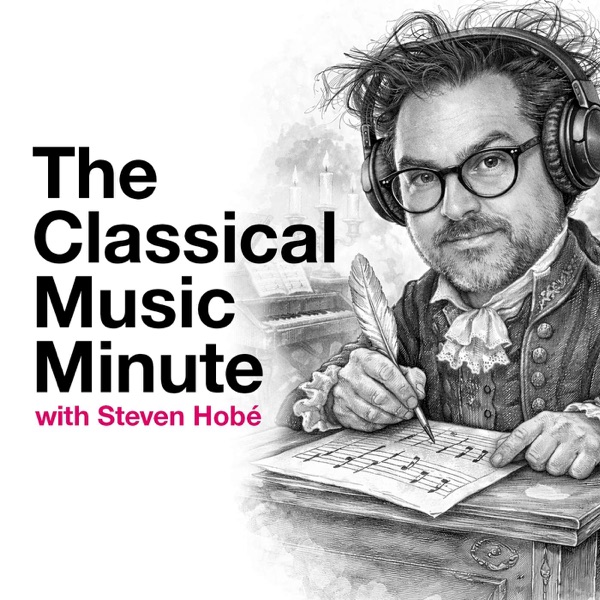
The Classical Music Minute
The Classical Music Minute is a short, engaging classical music podcast that explores the stories, composers, and curious traditions behind the world’s greatest music.
Ever wondered who the Florentine Camerata were? Where the conductor’s baton came from? Or what the difference is between opera buffa and opera seria?
Hosted by Canadian composer and storyteller Steven Hobé, each episode offers a quick and entertaining journey through classical music history, uncovering fascinating facts about composers, famous works, opera, orchestras, and musical traditions.
Whether you’re a lifelong music lover or simply curious about classical music, hop around music history with Steven—one musical minute at a time.
- Music History chart
- #195
- Episodes
- 300
- Releases
- Weekly
- Typical length
- 1 min
- On air since
- 2021
- Latest episode
- 1 day ago
Episodes
300 episodes, newest first
-
1 min
When the Rules Were Broken: Music in the 20th Century | The Classical Music Minute
Season 6, Episode 299
Show notes
Tonality was challenged, rhythm reinvented, and technology introduced entirely new sounds. During the 20th century, classical music expanded in more directions than ever before.
Your support helps bring more musical stories to life!
👉 Support The Classical Music Minute ☕ Why not buy me a coffee? 🤓
Love classical music? There's more to discover.
Join me on Substack at The Classical Music Minute. Or download the Classical Minute app for iPhone.
-
1 min
When Music Became Personal: The Romantic Era | The Classical Music Minute
Season 6, Episode 298
Show notes
Bigger orchestras, richer harmonies, virtuoso performers, and a new emphasis on personal expression transformed music during the Romantic era.
Love classical music? There's more to discover.
You can read the companion article and subscribe on Substack at The Classical Music Minute. And for a brand-new narrated classical music story every day, download the Classical Minute app for iPhone.
I've also published two beautifully illustrated coffee table books featuring stories from the world of classical music. You can find both on Amazon by searching for The Classical Music Minute.
-
1 min
The Age of Elegance and Order: The Classical Era | The Classical Music Minute
Season 6, Episode 297
Show notes
Clear melodies, balanced forms, and the rise of the symphony helped define the Classical era. It was the age of Haydn and Mozart—and of a young Beethoven beginning to push music in a new direction.
Love classical music? There's more to discover.
If you enjoyed this episode, you can read the companion article and subscribe on Substack at The Classical Music Minute. And for a brand-new narrated classical music story every day, download the Classical Minute app for iPhone.
Until next time, I'm Steven Hobé. Thanks for listening to The Classical Music Minute.
-
1 min
When Music Became Dramatic: The Baroque Era | The Classical Music Minute
Season 6, Episode 296
Show notes
Opera was born, instrumental music flourished, and major and minor keys became central to Western music. The Baroque era gave us some of classical music’s most enduring forms—and some of its greatest composers.
Love classical music? There's more to discover.
If you enjoyed this episode, you can read the companion article and subscribe on Substack at The Classical Music Minute. And for a brand-new narrated classical music story every day, download the Classical Minute app for iPhone.
Until next time, I'm Steven Hobé. Thanks for listening to The Classical Music Minute.
-
24 min
Mozart's Search for Independence | In Their Own Words, Part One
Season 6, Episode 295
Show notes
What was Mozart really like when the concert halls fell silent and he sat down to write to his family?
In Their Own Words is a special series from The Classical Music Minute that explores the lives of history’s great composers through their personal correspondence. Combining historical context with dramatized readings of their letters, the series takes us beyond the familiar portraits of musical genius to encounter the people behind the music—their ambitions, frustrations, relationships, disappointments and triumphs.
In Part One, we meet Wolfgang Amadeus Mozart in Mannheim in 1777.
At twenty-one, Mozart is no longer the celebrated child prodigy touring the courts of Europe. He is a young professional composer searching for something much harder to find: a secure position that will give him recognition, financial stability and greater control over his own future.
Through two letters written to his father, Leopold, we hear Mozart in his own words—enthusiastic about Mannheim’s extraordinary musical world, wonderfully candid in his opinions, increasingly frustrated by his father’s concerns, and determined to establish a career on his own terms.
Behind it all lies a larger question that would follow Mozart throughout his life: how could a composer achieve artistic independence in a world still dominated by aristocratic patronage?
This is Mozart before Vienna, before The Marriage of Figaro, Don Giovanni and The Magic Flute—a twenty-one-year-old musician who has no idea what the future holds.
About the letters: The correspondence featured in this episode is drawn from the nineteenth-century English translation by Lady Grace Wallace, published in 1866 and available through Project Gutenberg. Selected passages have been omitted for length and narrative flow, while the wording of the passages presented has been preserved. The letters are presented as dramatized readings.
Love classical music? There's more to discover.
If you enjoyed this episode, you can read the companion article and subscribe on Substack at The Classical Music Minute. And for a brand-new narrated classical music story every day, download the Classical Minute app for iPhone.
Until next time, I'm Steven Hobé. Thanks for listening to The Classical Music Minute.
-
1 min
Music Reborn: The Renaissance Era | The Classical Music Minute
Season 6, Episode 294
Show notes
Polyphony flourished, madrigals filled courts and homes, and printing helped music travel across Europe. In just two centuries, the Renaissance transformed how Western music was composed, performed, and shared.
Love classical music? There's more to discover.
If you enjoyed this episode, you can read the companion article and subscribe on Substack at The Classical Music Minute. And for a brand-new narrated classical music story every day, download the Classical Minute app for iPhone.
Until next time, I'm Steven Hobé. Thanks for listening to The Classical Music Minute.
-
1 min
How Did Medieval Music Shape the Western Tradition? | The Classical Music Minute
Season 6, Episode 293
Show notes
From Gregorian chant to polyphony, the Medieval era saw some of Western music’s most important developments—including the growth of musical notation and increasingly complex composition.
Love classical music? There's more to discover.
If you enjoyed this episode, you can read the companion article and subscribe on Substack at The Classical Music Minute. And for a brand-new narrated classical music story every day, download the Classical Minute app for iPhone.
Until next time, I'm Steven Hobé. Thanks for listening to The Classical Music Minute.
-
1 min
Why Did Baroque Arias Repeat Themselves? The Da Capo Aria | The Classical Music Minute
Season 6, Episode 292
Show notes
Why would an opera aria finish—and then send the singer straight back to the beginning? Discover the da capo aria, a Baroque form that turned repetition into an opportunity for singers to improvise, ornament, and show off their artistry—all in just sixty seconds.
Love classical music? There's more to discover.
If you enjoyed this episode, you can read the companion article and subscribe on Substack at The Classical Music Minute. And for a brand-new narrated classical music story every day, download the Classical Minute app for iPhone.
Until next time, I'm Steven Hobé. Thanks for listening to The Classical Music Minute.
-
1 min
Before the Blues, There Was John Dowland | The Classical Music Minute
Season 6, Episode 291
Show notes
Sad songs were popular long before modern playlists. Meet John Dowland, the Elizabethan composer and virtuoso lutenist who transformed melancholy into some of the most hauntingly beautiful music of his age—all in just sixty seconds.
Love classical music? There's more to discover.
If you enjoyed this episode, you can read the companion article and subscribe on Substack at The Classical Music Minute. And for a brand-new narrated classical music story every day, download the Classical Minute app for iPhone.
Until next time, I'm Steven Hobé. Thanks for listening to The Classical Music Minute.
-
1 min
What Were the Apollonian Principles in Stravinsky’s Music? | The Classical Music Minute
Season 6, Episode 290
Show notes
Stravinsky wasn't always the revolutionary behind The Rite of Spring. Discover how the ancient Greek ideal of Apollo—order, clarity, balance, and restraint—helped shape his Neoclassical music and a very different side of his creativity, all in just sixty seconds.
Love classical music? There's more to discover.
If you enjoyed this episode, you can read the companion article and subscribe on Substack at The Classical Music Minute. And for a brand-new narrated classical music story every day, download the Classical Minute app for iPhone.
Until next time, I'm Steven Hobé. Thanks for listening to The Classical Music Minute.
-
1 min
What Were Rescue Operas? | The Classical Music Minute
Season 6, Episode 289
Show notes
Prisoners, secret identities, political oppression—and a daring rescue just in time. Discover how the revolutionary spirit of Europe inspired the rescue opera, a dramatic genre that gave us works such as Beethoven’s Fidelio—all in just sixty seconds.
Love classical music? There's more to discover.
If you enjoyed this episode, you can read the companion article and subscribe on Substack at The Classical Music Minute. And for a brand-new narrated classical music story every day, download the Classical Minute app for iPhone.
Until next time, I'm Steven Hobé. Thanks for listening to The Classical Music Minute.
-
1 min
What Is the Circle of Fifths? | The Classical Music Minute
Season 6, Episode 288
Show notes
It looks like a musical clock, but the Circle of Fifths is actually a map of how musical keys relate to one another. Discover how this ingenious diagram helps explain key signatures, harmony, and even how composers move from one key to another—all in just sixty seconds.
Love classical music? There's more to discover.
If you enjoyed this episode, you can read the companion article and subscribe on Substack at The Classical Music Minute. And for a brand-new narrated classical music story every day, download the Classical Minute app for iPhone.
Until next time, I'm Steven Hobé. Thanks for listening to The Classical Music Minute.
-
1 min
Why Can a Piano Play in Every Key? The Secret of Equal Temperament | The Classical Music Minute
Season 6, Episode 287
Show notes
What if making music sound in tune actually requires making it slightly out of tune? Discover the ingenious compromise of equal temperament and how dividing the octave into twelve equal parts allows musicians to play freely in every key—all in just sixty seconds.
Love classical music? There's more to discover.
If you enjoyed this episode, you can read the companion article and subscribe on Substack at The Classical Music Minute. And for a brand-new narrated classical music story every day, download the Classical Minute app for iPhone.
Until next time, I'm Steven Hobé. Thanks for listening to The Classical Music Minute.
-
1 min
What Were Goethe's Rules for Actors? | The Classical Music Minute
Season 6, Episode 286
Show notes
Long before modern acting schools, Johann Wolfgang von Goethe wrote a remarkable guide for performers. Discover why his advice on clarity, discipline, and natural expression still resonates with actors today—all in just sixty seconds.
Love classical music? There's more to discover.
If you enjoyed this episode, you can read the companion article and subscribe on Substack at The Classical Music Minute. And for a brand-new narrated classical music story every day, download the Classical Minute app for iPhone.
Until next time, I'm Steven Hobé. Thanks for listening to The Classical Music Minute.
-
1 min
How Did We Start Writing Music? | The Classical Music Minute
Season 6, Episode 285
Show notes
Music wasn't always written down. Discover how a medieval monk named Guido of Arezzo helped revolutionize music with a system of notation that still shapes the way musicians read and perform music today—all in just sixty seconds.
Love classical music? There's more to discover.
If you enjoyed this episode, you can read the companion article and subscribe on Substack at The Classical Music Minute. And for a brand-new narrated classical music story every day, download the Classical Minute app for iPhone.
Until next time, I'm Steven Hobé. Thanks for listening to The Classical Music Minute.
-
1 min
What Happened to Classical Music in the Early 20th Century? | The Classical Music Minute
Season 6, Episode 284
Show notes
The early twentieth century was a time of enormous musical change. Discover how composers responded to a changing world by breaking traditions, experimenting with new sounds, and redefining what classical music could become—all in just sixty seconds.
Love classical music? There's more to discover.
If you enjoyed this episode, you can read the companion article and subscribe on Substack at The Classical Music Minute. And for a brand-new narrated classical music story every day, download the Classical Minute app for iPhone.
Until next time, I'm Steven Hobé. Thanks for listening to The Classical Music Minute.
-
1 min
Drama Meets Music with Monteverdi | The Classical Music Minute
Season 6, Episode 283
Show notes
Opera didn't appear overnight. Meet Claudio Monteverdi, the composer who transformed music into powerful drama and helped create one of the world's greatest art forms. In just sixty seconds, discover why he's often called the father of opera.
Love classical music? There's more to discover.
If you enjoyed this episode, you can read the companion article and subscribe on Substack at The Classical Music Minute. And for a brand-new narrated classical music story every day, download the Classical Minute app for iPhone.
Until next time, I'm Steven Hobé. Thanks for listening to The Classical Music Minute.
-
1 min
Who Was the First Female Composer? (That We Know Of…) | The Classical Music Minute
Season 6, Episode 282
Show notes
Let's travel back more than 1,100 years to meet Kassia of Constantinople, the earliest known female composer whose music still survives today. In just sixty seconds, I'll introduce you to this extraordinary Byzantine abbess, poet, and composer whose works are still sung today.
Love classical music? There's more to discover.
If you enjoyed this episode, you can read the companion article and subscribe on Substack at The Classical Music Minute. And for a brand-new narrated classical music story every day, download the Classical Minute app for iPhone.
Until next time, I'm Steven Hobé. Thanks for listening to The Classical Music Minute.
-
1 min
Who Was the First Great Composer? | The Classical Music Minute
Season 6, Episode 281
Show notes
Join me as I introduce you to Pérotin, one of the earliest known composers whose music still survives today. In just sixty seconds, you'll discover how this remarkable medieval composer helped shape the future of Western classical music
Love classical music? There's more to discover.
If you enjoyed this episode, you can read the companion article and subscribe on Substack at The Classical Music Minute. And for a brand-new narrated classical music story every day, download the Classical Minute app for iPhone.
Until next time, I'm Steven Hobé. Thanks for listening to The Classical Music Minute.
-
1 min
Why Is Wagner So Controversial? | The Classical Music Minute
Season 6, Episode 280
Show notes
Why does Richard Wagner remain one of the most debated figures in classical music?
In this episode of The Classical Music Minute, we explore the complex legacy of the German composer whose operas revolutionized music drama while also generating lasting controversy.
Wagner's artistic influence was profound. His innovations in harmony, orchestration, and storytelling shaped the future of opera and inspired countless composers.
At the same time, Wagner published antisemitic writings that remain deeply troubling. His music was later embraced by the Nazi regime, creating historical associations that continue to spark discussion and debate.
Today, Wagner's legacy raises important questions about how we evaluate great works of art when their creators held objectionable views.
In just sixty seconds, discover why Richard Wagner remains both celebrated and controversial.
Love classical music? There's more to discover.
If you enjoyed this episode, you can read the companion article and subscribe on Substack at The Classical Music Minute. And for a brand-new narrated classical music story every day, download the Classical Minute app for iPhone.
Until next time, I'm Steven Hobé. Thanks for listening to The Classical Music Minute.
On these lists
The Classical Music Minute is one of the shows picked out on this list



More in Music History
Placed highest on Apple Podcasts' Music History chart right now