Podcast
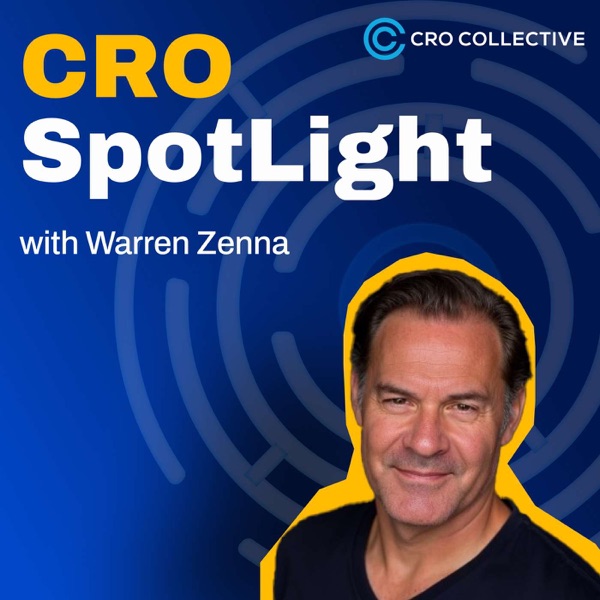
The CRO Spotlight Podcast
The CRO Spotlight Podcast examines the CRO role from both sides — the companies that hire them and the leaders who take the seat. Host Warren Zenna, founder of CRO Collective and author of “What Chief Revenue Officers Actually Do,” brings diagnostic frameworks and pattern recognition from working both sides of the equation to every conversation.
- On air since
- 2022
- Episodes
- 114
- Releases · typical length
- Every two weeks · 57 min
- Latest episode
- 5 days ago
Chart history since Oct 26
| Now | Chart | Peak | Since Oct 26 |
|---|---|---|---|
| 177 New | Management Arrived Nov 20 | #165 |
Episodes
114 episodes, newest first
-
1 hr 8 min
What the Biggest CRO Study Ever Revealed About the Role with Tony Morales
Show notes
In this episode of the CRO Spotlight podcast, Warren Zenna sits down with Tony Morales, Chairman of M2 Growth, a global executive search and leadership advisory firm that places board members and C-suite executives. Tony shares what his team learned from one of the largest studies ever done on the chief revenue officer role, and why the data backs up the idea that a CRO is a systems level leader and not just another name for a head of sales.
Tony walks through the four CRO archetypes his team identified and explains why adoption of the role has climbed so quickly in recent years. He also shares the finding that surprised him most. The most common path into the CRO seat at large companies isn’t sales leadership but general management with full P&L ownership, which he links to CEOs wanting someone who thinks like they do and can coordinate across functions.
The conversation then turns to why CRO hires fail. Tony talks about companies using the chief title as currency to attract talent, the gap between a strong resume and a real fit, and why most executives end up leaving for behavioral reasons. He explains how a written, prioritized scorecard agreed on by the CEO and board before any interviews leads to better placements, and how he gets leaders to make the trade-offs they’d rather avoid.
Tony and Warren also look at where the role is headed. They discuss how AI and transformation are showing up on CRO scorecards, whether the CRO survives as org charts flatten, and how company stage and ownership type change what the job needs. Tony closes with advice for sitting CROs, which is to prepare for the role as if preparing to be CEO and to learn to see the business the way the CEO does every day.
-
36 min
Why Your New CRO Is Not a Magician with Derek Sather
Show notes
In this episode of the CRO Spotlight podcast, Warren Zenna welcomes Derek Sather, former CRO of Winning by Design, in his first appearance as co-host. Warren recalls pitching Derek at a CRO summit and getting little more than a polite brush-off, and how a chance reunion a year later turned into a partnership at the CRO Collective. Derek shares his own version of that meeting and why the CRO seat is harder than most boards realize.
At the center of this conversation is the gap between what companies expect from a new CRO and what the job actually requires. Derek challenges the myth of the hero who walks into a burning building and fixes everything without a dip in results. In his view, expectations have to be reset before the offer is signed, and a company on its fourth CRO in five years usually has an organizational problem rather than a talent one.
Derek draws on six years at Winning by Design, where he watched strong playbooks vanish within months of a leadership change. His conclusion is simple. The best playbook is the one that gets used, and change only holds when the CEO owns it and frontline managers reinforce it every day. Warren adds why so many leaders shop for quick tools ahead of a board meeting when what they need is a different way of operating.
The two also look at how AI will reshape the seller’s role, with Derek predicting it will fade into the system of record and leave human relationships as the true differentiator. Warren explains why candidates under pressure talk themselves past obvious red flags, and why speed, not uncertainty, is what unsettles revenue leaders. A thoughtful opening to a new format for CROs, aspiring CROs, and the CEOs who hire them.
-
49 min
AI Sales Coaches & the Death of the Garage-Built Chatbot with Sriharsha Guduguntla
Show notes
In this episode of the CRO Spotlight podcast, Warren Zenna sits down with Sriharsha Guduguntla, Co-CEO and Co-Founder at Hyperbound, the AI sales coaching platform that rides along with reps from pre-call prep through the debrief after. Sai walks through the moment a room of CROs couldn’t believe two engineers with zero sales background had already landed real customers, and how that one conversation turned into the product Hyperbound is today.
The real meat of this one is the why. Sai explains that call data and CRM data only tell you what happened on a deal, never why a rep rewrote an email or changed their approach, and that gap is exactly where most AI tools fall apart. He breaks down how Hyperbound is building a context layer that interrogates reps on their own decisions so the system actually learns from top performers instead of just transcribing them.
Warren and Sai go deep on where this is all headed, including the uncomfortable possibility that if AI gets good enough to run the deal itself, there may be no need for a human buyer either. They also talk candidly about the fear showing up in parts of the country far from the Bay Area bubble, and why Sai thinks the panic isn’t really about the unknown, it’s about how fast everything is moving right now.
Sai also gets into the unglamorous work behind Hyperbound’s growth, from cold emailing a sales coach fifteen times before getting a reply to building a following on channels nobody told them to use. Warren and Sai swap stories about customers who don’t even want a demo anymore, they just want a point of view, and why the founders who win are the ones who do the work nobody’s watching and keep doing it.
-
1 hr 13 min
How Useful Is AI-Generated Marketing Content, Really? with Jamie Garverick
Show notes
In this episode of the CRO Spotlight podcast, Warren sits down with Jamie Garverick, CRO at Typeface, the native AI marketing platform that helps enterprise CMOs create on-brand content, personalize it at scale, and orchestrate it across channels. Jamie traces a career built on enterprise sales, from a graduate training program to leading a move to the cloud, and explains why hiring the right people makes every job easier.
Jamie breaks down how Typeface really goes to market: long enterprise cycles aimed at CMOs willing to drive transformation across siloed ad, email, and social teams. His take on agencies is refreshingly balanced. Humans will always be needed for the big creative idea, but AI is the right fit for variations and personalization. And some of his best-fit customers are companies that tried to build it themselves and discovered how hard that is.
Jamie shares how he spotted anonymous website traffic, tracked down a former colleague on LinkedIn, and watched a single conversation grow into a customer relationship and, eventually, an acquisition. Warren and Jamie also debate whether marketing should report to the CRO, with Jamie explaining how demand generation lands on his desk during CMO turnover and why the finger-pointing between sales and marketing has to stop.
Jamie closes with practical advice for aspiring and first-time CROs: understand the role, be sure you truly want it, and find a mentor. For CEOs hiring one, he looks for a record of overachievement, resilience, deep trust with the CEO, and a RevOps mindset built on repeatable systems rather than cowboy selling. A candid listen for revenue leaders navigating AI, marketing alignment, and the realities of the CRO seat.
-
55 min
Invisible Operations and the Transparency Mandate with Rob Wilk
Show notes
In this episode of the CRO Spotlight podcast, Warren Zenna hosts Rob Wilk, CRO at Yahoo, to dismantle the illusion that elite salespeople automatically make competent revenue leaders. Wilk exposes why the relentless, deal-closing mentality that gets reps promoted is the exact same trait that derails them in the C-suite. The conversation strips away the glamour of the title to reveal the granular, often unsexy reality of true orchestration.
A recurring failure point for modern CROs is the stubborn refusal to drop the functional sales ego. Instead of reverting to pitching when deals stall, Wilk argues that true leadership requires building invisible operational machinery. He emphasizes that a chief revenue officer acts as an environmentalist, architecting frictionless systems where cross-functional teams succeed naturally without the bottleneck of a single superstar contributor.
The dialogue shifts into the unvarnished truth about board dynamics and managing expectations. Wilk outlines his fundamental rule for survival: absolute transparency, even when the immediate data looks terrible. He explains why manufacturing forced optimism to placate a board only accelerates a leader’s exit. Instead, securing trust means delivering grounded, realistic assessments while proving you possess the competence to fix systemic gaps.
Looking ahead, the two dissect the inevitability of automation collapsing bloated media purchasing stacks. Wilk insists that as AI removes operational friction, human capital must pivot entirely toward strategic relationship building. This episode provides an actionable blueprint for executives aiming to transition from narrow individual contributors into resilient, systems-oriented operators who outlast short-term pressures.
Management lists
More Management shows picked out from the charts