Podcast
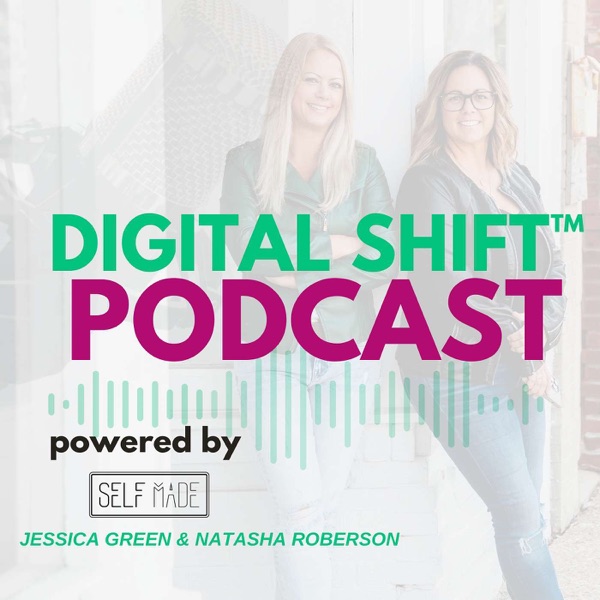
The Digital Shift™
Get to know the powerhouse duo behind The Digital Shift™! With decades of experience scaling businesses and a no-nonsense approach to strategy, Jessica and Natasha live to see entrepreneurs take control of their growth. From tech tips to confidence-building, these two bring the inspiration and insights you need to make things happen.
- Marketing chart
- #136
- Episodes
- 100
- Releases
- Weekly
- Typical length
- 24 min
- On air since
- 2024
- Latest episode
- 5 days ago
Episodes
100 episodes, newest first
-
57 min
Podcast Episode 100 - 4 Years, 100 Episodes — What It Actually Took to Build Tech Savvy School
Season 1, Episode 100
Show notes
🎙️ Episode Summary
Four years ago this month, Jess started this company with a name, a vision, and no idea what it was going to take. For Episode 100, there's no guest and no build. Just the two of us asking each other the questions we'd been saving, about the pay cuts, the hardest people decisions, and the moments one of us wanted to quit.
We walk through the three turns that got us here: the platform years, a year and a half of done-for-you work we never planned to sell, and the sharp right about a year ago that put Tech Savvy School at the center of everything. We also own up to the episode where we swore off challenges forever, and how challenges became the biggest win in company history.
🧠 What You'll Learn
• What Jess and Natasha each brought from their past businesses, and what they still had to figure out from scratch
• Why Jess called Natasha about a year in, and what happens when two business partners are wired completely differently
• What we believed our business was in 2023, and why the platform turned out not to be the thing
• What a year and a half of done-for-you work gave us, and what it cost us
• The sharp right: letting go of staff, taking massive pay cuts, and going all in on teaching
• How AI went from something we taught to part of how we run
• Why we're doing the 5-day challenge we said we'd never do again🛠️ The Runway: Four Years, Three Turns
PHASE 1: THE PLATFORM YEARS
We sold a platform subscription and tried to be everything inside it. We beat our heads against that wall for a long time before we saw the platform wasn't the business.
✅ WIN: Permission to question whether the thing you're selling is the business you're building.PHASE 2: THE LEFT TURN
Done-for-you clients fell in our lap before we had the business figured out, and for a year and a half we built other people's machines.
✅ WIN: A clear way to spot when the money landing in your lap is pulling you off course.PHASE 3: THE SHARP RIGHT
About a year ago we let go of staff, took massive pay cuts, and went all in on teaching women to scale with tech. Memberships grew on their own, and it finally locked.
✅ WIN: A real picture of what it costs to commit to the right direction, and what it looks like when it starts working.💬 Quote of the Episode
"The business you start is never the business you end up building. That's not failure. That's the work."🔥 Ready to Build It, With Us?
The 5 Day AI-Powered GoHighLevel Challenge is live on Zoom, 2:00 to 3:30 PM ET daily, inside your own account. Audit it, structure it, automate it, build it, scale it, with both of us on the screen. Tickets start at $47 for General Admission and $97 for VIP. Platinum ($197) includes a live audit of your account, small-group hot seats, and time with us until 4:30 PM ET.
🚀 Ready to Build a Business That Runs Smarter?
Stop guessing, simplify your tech, and start building systems that help your business grow.
🔥 Join Our 5-Day Challenge — Build better systems with step-by-step guidance.
https://www.self-made.biz/challenge⚙️ Explore The Hub — Your CRM, funnels, automations, and follow-up in one place.
https://www.self-made.biz/thehub🧠 Free GHL Made Simple™ Workshop — Learn how to make your tech work for you.
https://www.self-made.biz/workshop🤝 Book a Discovery Call — Get clarity on your next steps.
https://www.self-made.biz/discoverycall✨ Less hustle. Better systems. Real growth.
Follow us on IG 👉 @techsavvymentors
-
25 min
Podcast Episode 99 - The Black Friday Funnel You Should Be Building Right Now — A 5-Week GHL Countdown
Season 1, Episode 99
Show notes
🚀 Episode Summary
Black Friday is five weeks away. Most business owners will throw together a discount code at the last minute, blast it to their list, and hope. That's not a strategy. That's a fire sale.
In this episode, Natasha lays out a 5-week countdown build inside GoHighLevel — one piece per week — so your entire Black Friday and Cyber Monday campaign is built, scheduled, and automated before November starts.
From the waitlist page to the post-purchase upsell, every piece connects. By the time everyone else is scrambling, you're watching your dashboard.
If you sell anything online and you want Black Friday to feel like a system instead of a scramble, this episode is your build plan.
🧠 What You'll Learn
• How to structure a Black Friday offer that's more than a discount (bundles, bonuses, early-access pricing)
• How to build a waitlist page in GHL that collects early-access contacts while you build the rest
• The 3-email warm-up sequence that primes your list before the offer drops
• The sales page structure and purchase workflow that tags, confirms, and removes buyers from promo
• A 6-touch, 4-day launch sequence from Wednesday early access through Cyber Monday final SMS
• The post-purchase upsell sequence that deepens the relationship and creates your next sale
• How to close the campaign clean so your GHL account stays organized for January
📅 The 5-Week Black Friday Countdown
Week 1: Lock the Offer and Build the Waitlist Page
Decide the offer (bundle, bonus, or early-access pricing), build a simple waitlist opt-in in GHL, and start seeding it in your content this week.
WIN: A locked offer, a live waitlist page, and a tagged pipeline stage collecting early-access contacts.
Week 2: Build the Warm-Up Sequence
Write and schedule a 3-email sequence that primes your list: the problem email, the proof email, and the announcement email. All scheduled before November.
WIN: A 3-email warm-up sequence, written and scheduled, that primes your list before the offer drops.
Week 3: Build the Sales Page and Cart Workflow
Build the sales page in draft (headline, bullets, testimonials, price, FAQ) and the purchase workflow that tags, confirms, removes from promo, and routes buyers.
WIN: A complete sales page in draft and a purchase workflow ready to go before November starts.
Week 4: Build the Launch Sequence
Write and schedule the 6-touch, 4-day campaign: Wednesday early access, Black Friday open, Saturday testimonial, Sunday FAQ, Cyber Monday last chance, and the final SMS 3 hours before close.
WIN: A 6-touch launch sequence, written and scheduled, with early access for waitlist contacts and a final SMS closer.
Week 5: Build the Post-Purchase Upsell and Campaign Close
Build a 3-touch post-purchase sequence (welcome, check-in, upsell) and close the campaign clean: swap the sales page, remove BFCM tags, and categorize non-buyers for January follow-up.
WIN: A post-purchase upsell that creates your next sale, plus a clean campaign close.
💬 Quote of the Episode
"The best Black Friday offer in the world doesn't sell itself. A system sells it."
🔥 Ready to Build It — With Us?
If you're thinking "I need to build this but I don't want to do it alone" — that's what the challenge is for. Join now and use what we build inside your Black Friday campaign.
Five days. We build together. You walk away with a working automation.
👉 Save your challenge seat: https://challenge.techsavvymentors.com/
🎓 Free Go High Level Made Simple™ workshop: https://workshop.techsavvymentors.com/
📞 Book a call with our team: https://info.techsavvymentors.com/discovery🚀 Ready to Build a Business That Runs Smarter?
Stop guessing, simplify your tech, and start building systems that help your business grow.
🔥 Join Our 5-Day Challenge — Build better systems with step-by-step guidance.
https://www.self-made.biz/challenge⚙️ Explore The Hub — Your CRM, funnels, automations, and follow-up in one place.
https://www.self-made.biz/thehub🧠 Free GHL Made Simple™ Workshop — Learn how to make your tech work for you.
https://www.self-made.biz/workshop🤝 Book a Discovery Call — Get clarity on your next steps.
https://www.self-made.biz/discoverycall✨ Less hustle. Better systems. Real growth.
Follow us on IG 👉 @techsavvymentors
-
20 min
Podcast Episode 98 - The 3-Phase Framework Behind Every Challenge, Workshop, and Launch We Run
Season 1, Episode 98
Show notes
🎙️ Episode Summary
Most GHL builds stall because the pages go up before anyone decides what the finished system is supposed to do. On a Monday coaching call this week, someone asked Jess what tool she uses to map a project before touching GHL, and her answer wasn't a tool at all.
It's the three-phase process behind every challenge, workshop, launch, and client funnel Tech Savvy Mentors runs. Wave the magic wand first, whiteboard every piece second, and let AI build the plan third. Jess walks through each phase, shares the numbers from the first major challenge built this way, and closes with the story of a student who ran the same free weekly class for months before it caught.
🧠 What You'll Learn
• Why every build starts with a magic-wand outcome, and how to describe it before you worry about how to build it
• Why Jess maps on a whiteboard or a sheet of paper instead of Canva or Miro
• The questions to answer for every piece of a funnel, from traffic source to reminder count
• The exact prompt Jess gives ChatGPT or Claude to turn a whiteboard photo into an ordered build checklist
• How to lay that checklist against a 30, 60, or 90-day timeline
• The five optimization rules for running a weekly presentation, including why you change only one thing a week
• How a student went from months without a sale to two live sales on her workshop, without raising her ad spend🛠️ The 3-Phase Framework
PHASE 1: WAVE THE MAGIC WAND
Describe exactly what the build looks like once it's fully working, before you think about how to build it. The email gets captured, the text goes out, the link gets clicked, and seven days later she's on a consult call.✅ WIN: You know the destination, so you can work backward and name every piece it takes to get there.
PHASE 2: WHITEBOARD EVERY SPOKE ON THE WHEEL
Brain dump every page, automation, email, and text onto a whiteboard, an easel pad, or a sheet of paper. Messy is fine. This is the complete map, not the pretty version.✅ WIN: Every moving part is out of your head and somewhere you can see it.
PHASE 3: HAND IT TO AI AND GET YOUR TIMELINE
Take a photo of the whiteboard and give it to ChatGPT or Claude with your dream outcome. Ask for every automation, every funnel page, and every piece as a checklist on a 30, 60, or 90-day timeline.✅ WIN: You build from an ordered plan instead of starting from scratch on the next launch.
💬 Quote of the Episode
"You cannot automate a plan that was never actually drawn out."🔥 Ready to Build It, With Us?
The 5 Day AI-Powered GoHighLevel Challenge runs live on Zoom. We help you name your magic-wand outcome and map every piece live in your own account, and Platinum ticket holders get a live audit of their account and hot seat time with Jess and Natasha.
👉 Save your challenge seat: https://challenge.techsavvymentors.com/
🎓 Free Go High Level Made Simple™ workshop: https://workshop.techsavvymentors.com/
📞 Book a call with our team: https://info.techsavvymentors.com/discovery/
🚀 Ready to Build a Business That Runs Smarter?
Stop guessing, simplify your tech, and start building systems that help your business grow.
🔥 Join Our 5-Day Challenge — Build better systems with step-by-step guidance.
https://www.self-made.biz/challenge⚙️ Explore The Hub — Your CRM, funnels, automations, and follow-up in one place.
https://www.self-made.biz/thehub🧠 Free GHL Made Simple™ Workshop — Learn how to make your tech work for you.
https://www.self-made.biz/workshop🤝 Book a Discovery Call — Get clarity on your next steps.
https://www.self-made.biz/discoverycall✨ Less hustle. Better systems. Real growth.
Follow us on IG 👉 @techsavvymentors
-
22 min
Podcast Episode 97 - Episode 97: The 3-Step Testimonial Machine That Collects Social Proof on Autopilot (Built in GoHighLevel)
Season 1, Episode 97
Show notes
🚀 Episode Summary
Your best clients are saying incredible things about you. On calls. In DMs. Inside your community. And none of it is ending up where it needs to be.
In this episode, Natasha builds a complete testimonial collection and deployment system inside GoHighLevel. Three steps: trigger the ask at exactly the right emotional moment, capture responses through a guided form that does the heavy lifting, and deploy the proof across five points in your buyer's journey.
No chasing clients for reviews. No awkward follow-up emails. The system runs and the proof collects itself.
If you have happy clients and an empty testimonials section, this episode is for you.
🧠 What You'll Learn
• The three trigger points where clients are most likely to say yes to a testimonial request
• Why asking at the end of a program is the worst time to ask (and when to ask instead)
• The 5-question guided form that captures structured, usable testimonials without the client figuring out what to say
• How Question 3 ("What surprised you the most?") consistently produces the most authentic, shareable line
• The GHL workflow that auto-tags, notifies you, thanks the client, and routes video volunteers into a separate pipeline
• Five deployment points mapped to five moments in your buyer's decision
• How to build a Testimonial Status custom field that gives you a dashboard view of your entire proof pipeline⚡ The 3-Step Testimonial Machine
Step 1: The Ask — Timing and Triggers
Build three automated trigger points in GHL: the first win, the midpoint check-in, and the completion celebration. Each one fires at the moment the client's emotion is highest, not weeks later when they've moved on.
WIN: Three automated trigger points that ask for testimonials at exactly the right emotional moment.
Step 2: The Capture — Form, Format, and Flow
Build a guided 5-question form that does the thinking for your client: the before, the result, the surprise, the advice to fence-sitters, and the video opt-in. A workflow tags, notifies, thanks, and routes video volunteers automatically.
WIN: A structured capture system that produces usable testimonials and routes video volunteers into a separate pipeline.
Step 3: The Deploy — Put the Proof Where It Sells
Map each testimonial question to the five places buyers are deciding: sales page, nurture emails, social content, challenge registration page, and discovery call booking page. Build a custom field to track your entire proof pipeline at a glance.
WIN: Five deployment points mapped to five buyer moments, with a tracking system so you always know where your proof pipeline stands.
💬 Quote of the Episode
"The businesses that look like they have the most testimonials are not the businesses with the most happy clients. They're the businesses with the best collection system."
🔥 Ready to Build It — With Us?
If this episode made you think "I need this but I want someone next to me while I build it" — that's what the challenge is for.
Five days. We build together. You walk away with a working automation, not a PDF you'll never open.
👉 Grab your challenge ticket:
https://challenge.techsavvymentors.com
Share this episode with a business owner who has happy clients and zero testimonials on her sales page. She needs to hear this.
🚀 Ready to Build a Business That Runs Smarter?
Stop guessing, simplify your tech, and start building systems that help your business grow.
🔥 Join Our 5-Day Challenge — Build better systems with step-by-step guidance.
https://www.self-made.biz/challenge⚙️ Explore The Hub — Your CRM, funnels, automations, and follow-up in one place.
https://www.self-made.biz/thehub🧠 Free GHL Made Simple™ Workshop — Learn how to make your tech work for you.
https://www.self-made.biz/workshop🤝 Book a Discovery Call — Get clarity on your next steps.
https://www.self-made.biz/discoverycall✨ Less hustle. Better systems. Real growth.
Follow us on IG 👉 @techsavvymentors
-
13 min
Podcast Episode 96 - Your Funnel Isn't Broken — Your First Yes Is
Season 1, Episode 96
Show notes
🚀 Episode Summary
Sales slow down, leads go quiet, and the instinct is always the same. Rebuild the funnel. Fix the tech. Blame the ad account.
In this episode, Jess breaks down why that diagnosis is almost always wrong. She walks through the 1966 psychology study behind the "small yes" effect, the four signs your first ask is too big before it ever reaches your real offer, and a real Self-Made student's launch that proves the first step was never supposed to be impressive, only easy.
No funnel rebuild. No new tech stack. Just a smaller, easier first ask.
If your leads go quiet after the first touch, this episode is for you.
🧠 What You'll Learn
• Why "my funnel is broken" is almost always the wrong diagnosis
• The four signs your first ask is too big, not your funnel or your tech
• The real 1966 Freedman and Fraser study behind the small yes effect, and the jump from 17% to 76% compliance that proves it
• Why saying yes to something small changes how a stranger sees themselves, not just how they see you
• The real story behind a Self-Made student's first free Sunday class, and why a handful of signups was actually the win
• The 3-checkpoint audit for testing whether your first ask is actually small enough
• Why changing your tech stack again won't fix an ask that's still too big⚡ The First-Yes Audit: 3 Checkpoints
Checkpoint 1: Is Your First Ask Small Enough?
Could a total stranger say yes in under thirty seconds, without stopping to think it over? If it takes a decision, it's a second offer, not a first step.
WIN: A first ask so small and specific that a stranger can say yes without hesitating.Checkpoint 2: Does It Change How They See Themselves?
After saying yes, does someone feel like they took action, even a small one? That shift in self-perception, not the ad copy or the countdown timer, is what carries a person to the next yes.
WIN: A first yes that makes someone see themselves as already in motion.Checkpoint 3: Does It Point Somewhere?
Is there an obvious next small step waiting right after the first yes, or does the sequence just stop? A first yes with nowhere to go is a dead end, not a funnel.
WIN: A clear, obvious next step waiting the moment someone says yes.💬 Quote of the Episode
"You don't have a funnel problem. You have a first-yes problem wearing a funnel costume."
🔥 Ready to Find Your First Yes, With Us?
If this episode made you realize your first ask has been too big this whole time, that's exactly why we built the 5-Day Tech Chaos Cleanup Challenge.
Five days. We help you map the real first yes in your business, the same shift that turned one student's free Sunday class into real momentum, instead of rebuilding your funnel for a fifth time this year.
👉 Grab your seat: https://www.self-made.biz/challenge
Share this episode with a woman in business who keeps blaming her funnel. She needs the real diagnosis.
🚀 Ready to Build a Business That Runs Smarter?
Stop guessing, simplify your tech, and start building systems that help your business grow.
🔥 Join Our 5-Day Challenge — Build better systems with step-by-step guidance.
https://www.self-made.biz/challenge⚙️ Explore The Hub — Your CRM, funnels, automations, and follow-up in one place.
https://www.self-made.biz/thehub🧠 Free GHL Made Simple™ Workshop — Learn how to make your tech work for you.
https://www.self-made.biz/workshop🤝 Book a Discovery Call — Get clarity on your next steps.
https://www.self-made.biz/discoverycall✨ Less hustle. Better systems. Real growth.
Follow us on IG 👉 @techsavvymentors
-
29 min
Podcast Episode 95 - Reactivate Your Dead Leads — The 'Free Money' Campaign Sitting in Your Database
Season 1, Episode 95
Show notes
🚀 Episode Summary
Right now, sitting inside your GoHighLevel account, there is a list of people who already raised their hand and told you they were interested. Then life happened, follow-up fell off, and they went quiet.
Most business owners write those leads off. In this episode, Natasha walks you through the exact 3-phase reactivation campaign she uses to wake those leads up, re-qualify them, and route them back into your active pipeline — all built inside GHL.
No new ad spend. No new content. Just a system that puts the leads you already paid for back to work.
If you have contacts sitting in your account collecting dust, this episode is for you.
🧠 What You'll Learn
• How to build a Smart List in GHL that isolates every cold lead in your account
• The difference between a dead record and a dormant lead — and why it matters for deliverability
• The 5-touch, 14-day reactivation sequence that re-opens conversations without selling
• Why the "permission to leave" message consistently gets the highest reply rate
• How to set up a GHL workflow that auto-routes replies into a pipeline stage and pings your team
• The tagging system that lets you run a second campaign to non-responders 90 days later
• Why new leads are expensive and reactivated leads are almost free⚡ The 3-Phase Reactivation Build
Phase 1: Segment Your Cold List
Build a Smart List filtered by last activity (60–90 days of silence), clean out bounced emails and unreachable contacts, and tag the segment for tracking. This is how you find the opportunity hiding in your database.
WIN: A clean, tagged segment of every cold lead in your account, ready for the sequence.
Phase 2: The 5-Touch Reactivation Sequence
Five touchpoints over 14 days — a check-in, a value drop, a story, a soft direct ask, and an honest close. Each message is designed to re-open a conversation, not push a sale. The sequence builds trust before it builds a pipeline.
WIN: A 14-day sequence that re-opens conversations and funnels warm replies into your active pipeline.
Phase 3: Sort and Route
Set up a GHL workflow that fires when someone replies: remove them from the sequence, move them to a "Re-engaged" pipeline stage, and send an internal notification for human follow-up within 24 hours. Non-responders get tagged for a second campaign in 90 days.
WIN: Every reply is auto-routed, every non-reply is categorized. No lead falls through the cracks a second time.
💬 Quote of the Episode
"You are paying to fill a bucket that has holes in it. No amount of new traffic fixes a leaking bucket."
🔥 Ready to Build It — With Us?
If this episode made you think "I need to build this but I want someone next to me while I do it" — that's what the challenge is for.
Five days. We build together. You walk away with a working automation, not a PDF you'll never open.
👉 Grab your challenge ticket: www.self-made.biz/challenge
Share this episode with a woman in business who has leads collecting dust. She needs to hear this.
🚀 Ready to Build a Business That Runs Smarter?
Stop guessing, simplify your tech, and start building systems that help your business grow.
🔥 Join Our 5-Day Challenge — Build better systems with step-by-step guidance.
https://www.self-made.biz/challenge⚙️ Explore The Hub — Your CRM, funnels, automations, and follow-up in one place.
https://www.self-made.biz/thehub🧠 Free GHL Made Simple™ Workshop — Learn how to make your tech work for you.
https://www.self-made.biz/workshop🤝 Book a Discovery Call — Get clarity on your next steps.
https://www.self-made.biz/discoverycall✨ Less hustle. Better systems. Real growth.
Follow us on IG 👉 @techsavvymentors
-
18 min
Podcast Episode 94 - The Lead Magnet Nobody Downloads (And the One They Can't Resist)
Season 1, Episode 94
Show notes
🚀 Episode Summary
There's a folder on your computer right now with a lead magnet in it. Half finished, or already live and quietly, embarrassingly, not working.
In this episode of The Digital Shift™, Jessica Green breaks down why most lead magnets don't fail because they're ugly. They fail because nobody actually wants what's inside them, and that's not a design problem. It's an offer clarity problem showing up in the wrong place first.
This is not a pep talk about believing in your freebie. This is the exact audit Jessica runs against a real student's lead magnet, live on a coaching call, so you can run it against yours tonight.
🧠 What You'll Learn
• Why a vague lead magnet is really an offer clarity problem in disguise
• The difference between a lead magnet that's a preview of your paid offer and one that's just content
• Why a fifty page whitepaper can convert under two percent while a rough two page checklist pulls eighteen
• The three question audit that tells you if your lead magnet is actually working
• What's converting right now (quizzes, calculators, tight checklists) and what's quietly dying (the generic ebook)
• Why your lead magnet is the first plank of the bridge, not the whole bridge, and what happens when you skip straight to the big offer
• The exact moment a Tech Savvy School student realized she didn't need more expertise, she needed a reframe🔍 The Lead Magnet Audit — 3 Checkpoints
Jessica walks through the exact audit to run against your own lead magnet:
Checkpoint 1 | Is it specific enough?
Does it name one exact person and one exact outcome, not a whole category? "For coaches" fails. "For coaches who are fully booked but still not profitable" passes.
Checkpoint 2 | Is it fast enough?
Can it be experienced in under ten minutes, with a real, felt result? If it takes forty five minutes, it's a course you're giving away, not a lead magnet.
Checkpoint 3 | Does it point somewhere?
Can you finish the sentence, "after this, they'll want to buy ___, because ___"? And is there a real next plank, not a straight leap to your biggest offer?
Skip any one of these, and you don't have a lead magnet. You have content with no destination.
💬 Quote of the Episode
"Vague is safe, and safe doesn't convert."
🎯 Your One Action Tonight
Open the folder. Pull up your current lead magnet, or the one you've been meaning to build, and run it against the three checkpoints. Specific person, one outcome, under ten minutes, and a clear next step after it. Fix whichever checkpoint it fails first.
And if you want to rebuild it live with support:
👉 Save your seat at the TSS Open House, September 17th at 7PM EST: https://techsavvyschool.com/open-house
Can't make it that night? Join the 5-Day Tech Clean Up Challenge, September 29th through October 3rd at 2PM EST: https://www.self-made.biz/challenge-1
🚀 Ready to Build a Business That Runs Smarter?
Stop guessing, simplify your tech, and start building systems that help your business grow.
🔥 Join Our 5-Day Challenge — Build better systems with step-by-step guidance.
https://www.self-made.biz/challenge⚙️ Explore The Hub — Your CRM, funnels, automations, and follow-up in one place.
https://www.self-made.biz/thehub🧠 Free GHL Made Simple™ Workshop — Learn how to make your tech work for you.
https://www.self-made.biz/workshop🤝 Book a Discovery Call — Get clarity on your next steps.
https://www.self-made.biz/discoverycall✨ Less hustle. Better systems. Real growth.
Follow us on IG 👉 @techsavvymentors
-
24 min
Podcast Episode 93 - The Client Spreadsheet Has to Go: Moving Your Clients Into a CRM in One Afternoon
Season 1, Episode 93
Show notes
🚀 Episode Summary
There is a tab open in your browser right now that you never fully close.
The spreadsheet. The client names in column A. The payment dates in column C. The sticky note with the payment plan written in pen. The follow-up you remembered at 11pm on a Tuesday.
In this episode of The Digital Shift™, Natasha Roberson walks through the exact one-afternoon build that moves your client list out of a spreadsheet and into GoHighLevel — with four clean fields, a real pipeline, and two automations that eliminate the two biggest manual pain points in your client management.
This is not a lecture about why systems matter. This is the build, walked through end to end, timed so you know it's real.
🧠 What You'll Learn
• The exact moment a spreadsheet stops being a system and starts being a liability
• The four things every client record actually needs — and why everything else is noise
• How to export, clean, and import your existing client list into GoHighLevel in under 20 minutes
• How to build a pipeline with stages named after what you actually do, not sales jargon
• The two automations to build first — and why these two eliminate the most common manual pain points
• The two mistakes that stall most people before they ever move a client in
• What week one looks like when the system is running — concrete, not aspirational🏗 The One-Afternoon Build — 6 Steps
Natasha walks through the full build in order, with realistic timing for each step:
Step 1 | Export and clean the spreadsheet (15 min)
Delete every column you haven't looked at in 30 days. Keep name, contact info, source, payment, and one notes field. That's the import file.
Step 2 | Import into GoHighLevel with one tag per source (20 min)
Add a source column before importing. Every contact gets tagged on the way in. Now you can see which channel produces clients without asking yourself to remember.
Step 3 | Build the pipeline — stages named after what you do (30 min)
Not "Lead, Prospect, Opportunity." Name the stages after your real process. Four stages is right for most service businesses. Build for the path 90% of clients take.
Step 4 | Drag every current client into a stage (30 min)
This is the step people skip. Don't. The pipeline becomes a CRM the moment you place the first client in a stage and the visual shows you who's where.
Step 5 | Build two automations only (45 min)
The welcome — fires when a client moves into active stage. The follow-up reminder — puts a task in your list so the date stops living in your head. Two automations. That's it for now.
Step 6 | Close the spreadsheet. Actually close it.
Not archive it. Close the tab. The transition happens the moment you stop going back.
💬 Quote of the Episode
"Week one doesn't feel like a transformation. It feels like a Tuesday that just went the way it was supposed to go. Quietly. Without you having to carry it."
🎯 Your One Action Tonight
Open your spreadsheet. Pick the four columns that match the four things: who they are, where they are, what they've paid, what happens next.
That's it for tonight. The import can wait until the afternoon. The decision about which four columns to keep can happen right now.
And if you want to do the full build with support:
👉 Join the 5-Day Challenge:
https://www.self-made.biz/challenge-1🚀 Ready to Build a Business That Runs Smarter?
Stop guessing, simplify your tech, and start building systems that help your business grow.
🔥 Join Our 5-Day Challenge — Build better systems with step-by-step guidance.
https://www.self-made.biz/challenge⚙️ Explore The Hub — Your CRM, funnels, automations, and follow-up in one place.
https://www.self-made.biz/thehub🧠 Free GHL Made Simple™ Workshop — Learn how to make your tech work for you.
https://www.self-made.biz/workshop🤝 Book a Discovery Call — Get clarity on your next steps.
https://www.self-made.biz/discoverycall✨ Less hustle. Better systems. Real growth.
Follow us on IG 👉 @techsavvymentors
-
28 min
Podcast Episode 92 - The Real Reason You Keep Saying 'I Can't Afford It' (When You Know You Need It)
Season 1, Episode 92
Show notes
🚀 Episode Summary
Eighty-six women applied for a full scholarship to Self Made Hub this year. Ten got in, a thousand dollars already taken off the investment. Some of them still said no.
In this episode of The Digital Shift™, Jessica Green breaks down what "I can't afford it" is doing underneath, in a sales conversation, in your own head, in the moment right before you almost book the call and close the tab instead. She walks through the $100,000 she's invested in her own business over the last twelve months, the research behind why an investment feels twice as expensive as it is, and the free tool that turns "I'm not sure it's worth it" into a real number you can hold.
This is not a pep talk about mindset. This is the math, the receipts, and five moves you can make today if you're done waiting for the timing to feel right.
🧠 What You'll Learn
• What "I can't afford it" is saying underneath, and how to tell a real cash constraint apart from fear dressed in financial language
• The loss aversion research that explains why a $3,000 investment can feel like $6,000 in your head
• The five investments Jessica made in the last twelve months, totaling over $100,000, and what each one built
• Why entrepreneurs who invest in mentorship grow revenue at 3.5x the rate of those who go it alone, per Harvard Business School research
• How the free Leak Calculator shows you exactly how much revenue is leaking out of your business every month
• The three systems that decide whether a lead becomes a client or quietly disappears
• Five specific moves to make today if you're ready to stop waiting on the timing🔥 Five Moves If You're Ready to Stop Waiting
Jessica closes the episode with five concrete moves, not a mindset shift you're supposed to feel your way into.
Move 1 | Name the real objection Ask if you'd take the investment for free right now. If yes, the money was never the issue.
Move 2 | Run the Leak Calculator Head to techsavvymentors.com/leak-calculator and put in your offer price and lead volume. See your real monthly leak.
Move 3 | Start with the 5-Day Challenge If the calculator shows a leak, the 5-Day Tech Chaos Cleanup Challenge is where you start fixing it, live, with the team.
Move 4 | Calculate the real cost of waiting Take your monthly leak number and multiply it by twelve. That's what another year of the same thing costs you.
Move 5 | Book the call and stop going it alone Implementation beats information every time. Book a call at https://www.self-made.biz/discoverycall and get a mentor in your corner.
💬 Quote of the Episode
"The investment you keep saying you can't afford is almost always cheaper than the leak you can't see."
🎯 Your One Action Tonight
Go to https://techsavvyschool.com/leak-calculator and put in your real numbers before you do anything else tonight. Your offer price, your monthly lead volume, and an honest answer to the three system questions.
That's it for tonight. The number it gives you is the one worth sitting with.
And if you're ready to fix what it shows you:
👉 👉 Join the 5-Day Challenge:
https://www.self-made.biz/challenge-1👉 Book a call: https://www.self-made.biz/discoverycall
🚀 Ready to Build a Business That Runs Smarter?
Stop guessing, simplify your tech, and start building systems that help your business grow.
🔥 Join Our 5-Day Challenge — Build better systems with step-by-step guidance.
https://www.self-made.biz/challenge⚙️ Explore The Hub — Your CRM, funnels, automations, and follow-up in one place.
https://www.self-made.biz/thehub🧠 Free GHL Made Simple™ Workshop — Learn how to make your tech work for you.
https://www.self-made.biz/workshop🤝 Book a Discovery Call — Get clarity on your next steps.
https://www.self-made.biz/discoverycall✨ Less hustle. Better systems. Real growth.
Follow us on IG 👉 @techsavvymentors
-
24 min
Podcast Episode 91 - The 5-Email Welcome Sequence Every Coach Should Steal (Built in GoHighLevel)
Season 1, Episode 91
Show notes
🚀 Episode Summary
Someone opted into your lead magnet and then heard nothing from you for a week. That’s not a marketing strategy. That’s a missed opportunity running on repeat.
In this episode, Natasha walks through the exact 5-email welcome sequence every coach and service provider needs the moment a new lead enters their world. Each email has one job, a specific send time, and a clear purpose in the buyer journey.
She breaks down every email in order: the delivery (immediate), the introduction (24 hours), the quick win (Day 3), the proof (Day 5), and the invitation (Day 7). Then she shows how to build the entire thing as a GoHighLevel automation in about an hour.
Warm leads convert at 12 to 24 percent. That window closes fast. This episode is the system that catches them while they’re still listening.
A free companion worksheet is available in the show notes so you can draft your own sequence while you listen.
🧠 What You’ll Learn
• Why warm leads convert at 12–24% and how fast that window closes if you don’t follow up within 24–48 hours
• The one job each of the 5 emails has (and what to never include in Email 1)
• How to write a 150-word introduction email that earns trust without telling your whole life story
• The Quick Win email formula: one item, 10 minutes, one result she can feel
• How to use a single testimonial with a real name and real number to do the selling for you
• Why you should never apologize for making the offer in Email 5
• How to build the full 5-email automation inside GoHighLevel in about an hour
• Why your welcome sequence is the first impression your business makes when you’re not in the room⚡ The 5-Email Build
Build 1: Email 1 (The Delivery) + Email 2 (The Introduction)
Email 1 sends immediately and has one job: deliver what she asked for. No pitch. No autobiography. The download link is the first thing she sees. Email 2 sends 24 hours later with one specific moment that shows why you do what you do. 150 words max. Ends with a reply invite because replies are the highest-intent signal in email marketing.
WIN: She has the thing she asked for AND a reason to keep opening your emails.
Build 2: Email 3 (The Quick Win) + Email 4 (The Proof)
Email 3 sends Day 3 with one actionable win she can get in 10 minutes or less. Pick one item from the lead magnet and walk her through it. Email 4 sends Day 5 with one testimonial, one name, one specific number. Josie Kocsis: 30 registrants, 53% show-up rate, 25% conversion on her first wellness challenge. Coach Fryer: $4,000/month saved by consolidating 14 tools into one. Specificity is signal. Vague claims are noise.
WIN: She’s gotten a result from you AND seen proof that this works for someone like her.
Build 3: Email 5 (The Invitation) + The GHL Automation
Email 5 sends Day 7. One offer. One link. No apologies. You’ve earned the right to say “here’s how we can work together.” Then: the full GHL workflow. Trigger on opt-in. Wait steps between each email. Tags on open, click, and reply. About an hour to build. Runs for every lead from that point forward.
WIN: She has a complete 5-email automation that nurtures every lead without her lifting a finger.
💬 Quote of the Episode
“Your welcome sequence is the first impression your business makes when you’re not in the room. It’s the only automation that runs at the exact moment someone is warmest. That moment doesn’t come back.”
🔥 Ready to Build It — With Us?
The welcome sequence is one automation. Inside the 5-Day Challenge, we build systems like this live. You watch us set it up. Then you build yours. Five days. Real automations. Real mentorship. You walk away with a working system.
👉 Join the 5-Day Challenge:
https://www.self-made.biz/challenge
Want to join the workshop:https://www.self-made.biz/challenge 👉 www.self-made.biz/workshop
📋 Grab the Free Companion Worksheet:
https://ww.self-made.biz/welcome-series-download
📞 Book a Discovery Call:
https://www.self-made.biz/discoverycall
🚀 Ready to Build a Business That Runs Smarter?
Stop guessing, simplify your tech, and start building systems that help your business grow.
🔥 Join Our 5-Day Challenge — Build better systems with step-by-step guidance.
https://www.self-made.biz/challenge⚙️ Explore The Hub — Your CRM, funnels, automations, and follow-up in one place.
https://www.self-made.biz/thehub🧠 Free GHL Made Simple™ Workshop — Learn how to make your tech work for you.
https://www.self-made.biz/workshop🤝 Book a Discovery Call — Get clarity on your next steps.
https://www.self-made.biz/discoverycall✨ Less hustle. Better systems. Real growth.
Follow us on IG 👉 @techsavvymentors
-
24 min
Podcast Episode 90 - The Expert Trap: You're Good Enough to Get Paid, You're Not Built to Survive It (Yet)
Season 1, Episode 90
Show notes
Being great at what you do can get you customers. Building the right business underneath your expertise is what allows you to keep serving them when growth arrives.
🚀 Episode Summary
You’re incredible at your craft.
Someone finally asks you to teach it.
So you build the curriculum, pick a price, create the offer, and launch.
But there’s a problem:
Being good enough to get paid doesn’t automatically mean you’ve built a business that can survive getting paid.
In this episode of The Digital Shift™, Jessica Green breaks down The Expert Trap—what happens when your expertise grows faster than the business infrastructure underneath it.
It’s like picking out paint before anyone checks whether the foundation can hold the weight.
Jess walks through the three checkpoints that separate a sustainable business from a hobby with a price tag:
Is it actually wanted?
Does the math work?
Can you consistently deliver it?
You’ll also hear how two real students, Jenny and Theresa, hit different versions of this wall—and what changed when they stopped treating the symptoms and started rebuilding the business underneath them.
Plus, Jess breaks down Self Made’s own first challenge:
45 registered.
28 showed up live.
6 purchased.Not viral.
Profitable.
Because the math was considered as part of the business—not treated as an afterthought.
🧠 What You'll Learn
• The five signs you may still be operating a hobby instead of a sustainable business
• Why an idea needs real-world demand before you build everything around it
• Why curriculum shouldn’t automatically come before validation
• What to calculate before choosing your price
• How delivery time and support requirements affect profitability
• Why undercharging can create a business that becomes harder to sustain as it succeeds
• What happened when Jenny looked beyond the launch and calculated the long-term economics of her offer
• How Theresa’s onboarding breakdown affected the client experience
• The four-part system Jess is building to create a more structured customer journey for Theresa
• Why a smaller launch can still be a meaningful win when the economics work
• How to evaluate your own business using three simple checkpoints⚠️ Checkpoint 1 | Is It Even a Business Yet?
Before you spend weeks building curriculum, automations, funnels, and assets, look for evidence that people actually want the result.
Jess gives five signs you may still be operating in hobby territory:
Nobody has asked for it unprompted.
You can’t explain the result in one sentence.
You built the curriculum before you had a buyer.
You chose the price because it “felt right.”
You’re afraid to ask someone to pay for it.
Your expertise can be real while the offer still needs validation.
As Jess puts it:
“An idea in your head is a rumor until someone pays you for it.”
The win at this checkpoint isn’t having everything figured out.
It’s knowing what needs to be validated before you build more.
💰 Checkpoint 2 | Does the Math Work?
Jenny had her curriculum mapped.
She had her price.
She was ready to launch.
But she hadn’t fully calculated what happened after the sale.
How much time would delivery require?
How much support would each customer need?
What would it cost to fulfill the offer?
Could the model work month after month?
Could it handle more customers without consuming all of her capacity?
When Jess and Jenny worked through the numbers, the original structure didn’t work the way Jenny thought it did.
So they rebuilt the pricing and packaging.
That’s the difference between asking:
“What feels like the right price?”
and:
“What does this business need to charge for this model to actually work?”
Because getting more customers doesn’t help if every additional sale creates an unsustainable amount of work.
⚙️ Checkpoint 3 | Can You Actually Deliver It?
Theresa had something many entrepreneurs spend years trying to create:
Real demand.
Years of word of mouth proved people wanted what she offered.
But demand exposed another problem.
There wasn’t enough structure underneath the customer journey.
When part of her onboarding system failed, important client emails and calls didn’t happen when they were supposed to.
And that wasn’t simply a tech inconvenience.
It affected trust.
Jess is helping Theresa build a clearer system around the demand she already has:
1. A free weekly live event
A consistent place for potential customers to experience her expertise.
2. A low-ticket entry offer
A simple first step for people who are ready to go further.
3. An upsell
A clear next opportunity for customers who want additional support.
4. An automated nurture sequence
Follow-up that educates and pre-qualifies potential customers before they ever reach a sales conversation.
The goal is bigger than fixing one workflow.
It’s creating a customer journey that can support the business as it grows.
📊 Why 45 Registrations Can Be a Win
Self Made’s first challenge had:
45 registrations.
28 live attendees.
6 purchases.
It wasn’t a massive viral launch.
It didn’t need to be.
Those six purchases represented roughly 13% of total registrants and about 21% of live attendees.
The lesson isn’t that you need enormous numbers.
It’s that you need to understand your numbers.
Traffic.
Attendance.
Conversion.
Price.
Delivery costs.
Capacity.
Profitability.
A business doesn’t need to look huge from the outside to work.
It needs economics and systems that make sense on the inside.
💬 Quote of the Episode
“You cannot charge your way out of a business you never mathed out.”
🎯 Your One Action
Take your main offer and run it through the three checkpoints:
1. Is it wanted?
What evidence do you have that people will actually pay for this result?2. Does the math work?
After delivery time, support, tools, acquisition, and other costs, does the offer still make sense?3. Can you deliver it?
If twice as many people purchased next month, could your current systems maintain the experience?Find your weakest checkpoint.
Fix that before you build the next thing.
If you want real eyes on your offer, numbers, and systems so you can see which checkpoint needs attention, join us for the 5-Day Challenge.
👉 Join the 5-Day Challenge:
https://www.self-made.biz/challenge🚀 Ready to Build This For Real? Here’s How We Can Help
⚙️ Want Your Business in One Place?
The Hub
Bring your funnels, email, SMS, automations, CRM, and follow-up together in one connected system that can support the business behind your expertise.
👉 https://www.self-made.biz/thehub🧠 Want to See How It Works?
Free GHL Made Simple™ Workshop
See how GoHighLevel works without the overwhelm and learn how your customer journey and backend systems can work together.
👉 https://www.self-made.biz/workshop🤝 Not Sure What You Need?
Book a Discovery Call
Talk with the team about your offer, your current systems, and which part of the business needs strengthening before you scale it.
👉 https://www.self-made.biz/discoverycall✨ Start where you are. Systems create momentum.
🚀 Ready to Build a Business That Runs Smarter?
Stop guessing, simplify your tech, and start building systems that help your business grow.
🔥 Join Our 5-Day Challenge — Build better systems with step-by-step guidance.
https://www.self-made.biz/challenge⚙️ Explore The Hub — Your CRM, funnels, automations, and follow-up in one place.
https://www.self-made.biz/thehub🧠 Free GHL Made Simple™ Workshop — Learn how to make your tech work for you.
https://www.self-made.biz/workshop🤝 Book a Discovery Call — Get clarity on your next steps.
https://www.self-made.biz/discoverycall✨ Less hustle. Better systems. Real growth.
Follow us on IG 👉 @techsavvymentors
-
29 min
Podcast Episode 89 - The GoHighLevel Calendar & Booking Setup That Ends No-Shows for Good
Season 1, Episode 89
Show notes
A booked call isn’t the finish line. The system between booking and showing up is what protects the opportunity.
🚀 Episode Summary
Your calendar looks full.
Calls are booked.
Leads are interested.
And then the appointment time arrives…
No show.
In this episode of The Digital Shift™, Natasha Roberson gets under the hood of one of the quietest revenue leaks in a service business: the booking process.
Because getting someone to click “book” is only the beginning.
What happens between that click and the actual appointment can determine whether someone arrives prepared, forgets completely, or disappears without another conversation.
This isn’t a mindset episode.
It isn’t a marketing episode.
It’s a mechanics episode.
Natasha walks through the GoHighLevel calendar, reminder, pipeline, and recovery systems that turn a simple booking link into a connected customer journey.
The goal isn’t just more appointments on your calendar.
It’s creating a system designed to turn more booked appointments into real conversations.
🧠 What You'll Learn
• The booking setups that can quietly contribute to missed appointments
• How to configure your GoHighLevel calendar around the way you actually sell
• Why availability windows and buffer times matter
• How calendar syncing helps prevent scheduling conflicts
• How custom form questions can help pre-qualify leads before the call
• Why your confirmation page is an important part of the booking experience
• How to create a five-touch reminder and pre-call sequence
• How to move contacts through your pipeline automatically after they book
• How to create a recovery sequence for people who miss their appointment
• Why your booking system and CRM work better when they share the same customer data
• How to identify whether no-shows are creating a revenue leak in your business⚠️ The Real Problem: A Booking Isn't a System
A calendar link can schedule an appointment.
But that doesn’t mean you’ve built a booking system.
A complete system needs to answer:
What happens immediately after someone books?
What do they receive before the appointment?
Where are they tracked?
What happens if they show?
What happens if they don’t?
When those pieces are disconnected or manual, opportunities can quietly disappear.
The fix starts by connecting the entire journey.
📅 Build 1 | The Calendar Itself
Start with the calendar.
Inside GoHighLevel, Natasha walks through the foundational pieces:
Calendar type.
Availability windows.
Buffer times.
Calendar syncing.
Then look at the information you collect before someone books.
The right custom form questions can give you useful context before the conversation ever starts.
And don’t overlook what happens immediately after they schedule.
Instead of treating the confirmation page as a dead end, use it intentionally.
A short video, clear expectations, and simple instructions can reinforce the appointment and prepare the lead for what comes next.
The booking experience begins the moment they say yes to the call.
⚡ Build 2 | The Automation That Runs Without You
Once someone books, the follow-up shouldn’t depend on you remembering them.
Natasha walks through a five-touch sequence that can include:
1. Immediate confirmation
Confirm the appointment and make the next step clear.
2. SMS follow-up
Put the appointment somewhere the lead is likely to see it.
3. 24-hour reminder
Reconnect before the appointment and reinforce the commitment.
4. 2-hour reminder
Give them a timely reminder close to the call.
5. Pre-call content
Help them arrive informed, prepared, and ready for the conversation.
At the same time, the contact can move through your pipeline automatically.
No manual updating.
No relying on memory.
The system knows the appointment was booked and responds accordingly.
🔄 Don't Forget the No-Show Recovery
Even with a strong reminder system, some people will still miss appointments.
That shouldn’t automatically be the end of the lead.
Natasha walks through creating a simple recovery sequence designed to reopen the conversation and give that person a clear opportunity to reschedule.
The important shift is this:
A missed appointment should trigger a process—not disappear into your CRM.
🔗 Build 3 | One Connected System
Your booking tool knows someone scheduled.
Your CRM needs to know too.
Your follow-up system needs that information.
Your pipeline needs it.
And if those pieces are disconnected, you create manual work and opportunities for information to fall through the cracks.
That’s why bringing the calendar, contact record, pipeline, and automation together matters.
One customer. One journey. One connected system.
💰 Do the Math
A few missed appointments can feel insignificant week to week.
But look at the pattern over a month.
Then a quarter.
Then a year.
How many qualified conversations never happened?
How many missed appointments received no recovery follow-up?
How many opportunities simply disappeared because nobody had a system responsible for the next step?
You can’t improve a number you aren’t tracking.
Start by finding out what your no-show rate actually is.
💬 The Big Takeaway
A no-show problem isn’t always a sales problem.
It isn’t necessarily a lead-quality problem either.
Sometimes it’s simply a systems problem.
And systems can be fixed.
🎯 Your One Action
Pull your last 30 days of booked calls.
Look at every appointment and ask:
Did this person receive an immediate confirmation?
Did they receive automated reminders?
Did they know what to expect before the call?
If they missed it, did an automated recovery sequence begin?
Find the first missing piece.
That’s where you start.
If you want to build the systems behind your leads and client journey with the Self Made team, join us for the 5-Day Challenge.
👉 Join the 5-Day Challenge:
https://www.self-made.biz/challenge🚀 Ready to Build This For Real? Here’s How We Can Help
⚙️ Want Your Business in One Place?
The Hub
Bring your calendars, funnels, email, SMS, automations, CRM, and follow-up together in one connected system.
👉 https://www.self-made.biz/thehub🧠 Want to See How It Works?
Free GHL Made Simple™ Workshop
See how GoHighLevel works without the overwhelm and learn how your booking, CRM, and follow-up systems can work together.
👉 https://www.self-made.biz/workshop🤝 Not Sure What You Need?
Book a Discovery Call
Talk with the team about your current booking flow, where leads may be falling through the cracks, and what system you should fix first.
👉 https://www.self-made.biz/discoverycall✨ Start where you are. Systems create momentum.
🚀 Ready to Build a Business That Runs Smarter?
Stop guessing, simplify your tech, and start building systems that help your business grow.
🔥 Join Our 5-Day Challenge — Build better systems with step-by-step guidance.
https://www.self-made.biz/challenge⚙️ Explore The Hub — Your CRM, funnels, automations, and follow-up in one place.
https://www.self-made.biz/thehub🧠 Free GHL Made Simple™ Workshop — Learn how to make your tech work for you.
https://www.self-made.biz/workshop🤝 Book a Discovery Call — Get clarity on your next steps.
https://www.self-made.biz/discoverycall✨ Less hustle. Better systems. Real growth.
Follow us on IG 👉 @techsavvymentors
-
40 min
Podcast Episode 88 - Emergency Landing: Sometimes the Flight Plan Changes… Not the Destination
Season 1, Episode 88
Show notes
The route can change without changing where you’re going. Sometimes the most important thing you can do is adjust, stay steady, and keep moving.
🚀 Episode Summary
Nineteen hours.
Solo.
A soaked backpack.
A plane that lost power three times before takeoff.
And an emergency landing over Germany that Jessica Green will never forget.
In this episode of The Digital Shift™, Jessica takes you inside one of the scariest travel days of her life.
What was supposed to be a routine trip from Budapest to Kos, Greece turned into a mechanical failure, a 45-minute circle over German airspace to dump fuel, an emergency landing, and a terminal filled with announcements she couldn’t understand.
And she was navigating all of it alone.
But what Jessica learned that day didn’t stay on the runway.
It became a lesson in uncertainty, contingency planning, leadership, and staying committed to the destination when the original route stops working.
Because business rarely follows the exact flight plan you created.
Launches change.
Systems break.
Plans stop working.
Unexpected problems force you to reroute.
That doesn’t automatically mean you chose the wrong destination.
Sometimes the flight plan changes. The destination doesn’t.
🧠 What You'll Learn
• Why turbulence doesn’t automatically mean something is wrong
• How unexpected changes can test your ability to separate the plan from the goal
• Why contingency plans need to exist before the crisis happens
• The question Jessica uses when she doesn’t know the entire path forward
• Why you don’t always need the full answer to make the next good decision
• What calm leadership looks like when everyone around you is uncertain
• Why changing your approach isn’t the same as giving up
• How to recognize when it’s time to reroute instead of forcing the original plan
• Why strong businesses need systems that can keep working when circumstances change
• How to stay connected to the destination without becoming attached to one route✈️ Lesson 1: Turbulence Means You’re Flying
Turbulence is uncomfortable.
But turbulence alone doesn’t mean the plane is headed in the wrong direction.
Business can feel the same way.
A difficult month, an underperforming launch, a system that needs rebuilding, or a plan that suddenly changes can make you question everything.
But difficulty isn’t always evidence that you should stop.
Sometimes it’s simply part of moving.
The presence of turbulence doesn’t automatically mean the absence of progress.
🛟 Lesson 2: Build the Contingency Plan Before You Need It
The worst time to decide what happens during an emergency is when you’re already in one.
Your business needs contingency plans too.
What happens if a key team member becomes unavailable?
What happens if technology fails?
What happens if leads suddenly increase?
What happens if the launch doesn’t perform as expected?
What happens if you need to step away?
Strong systems aren’t only about making things faster when everything is going well.
They make the business more resilient when things don’t go according to plan.
🧭 Lesson 3: You Only Need the Next Decision
When everything changes at once, trying to solve the entire situation can create even more overwhelm.
Instead, ask:
What is the next decision I actually need to make?
Not the next ten.
Not every possible scenario.
Just the next one.
Make that decision.
Then make the next.
You don’t always need visibility into the entire route to continue moving toward the destination.
👩✈️ Lesson 4: Leadership Gets Tested in Uncertainty
Leadership is easy to talk about when the plan is working.
It becomes much more visible when it isn’t.
When people are confused, worried, or waiting for direction, leadership means staying grounded enough to assess what’s happening and decide what needs to happen next.
That doesn’t mean pretending everything is fine.
It means refusing to let panic make the decision for you.
The same is true inside your business.
Your team doesn’t need a leader who can predict every disruption.
They need one who can navigate when the unexpected happens.
🗺️ Lesson 5: Change the Flight Plan, Not the Destination
This is the lesson Jessica carried home.
You can change the route.
You can change the timeline.
You can change the strategy.
You can rebuild the system.
You can ask for help.
You can land somewhere you never planned to land and figure out what comes next.
None of that automatically means the destination has to change.
Sometimes adaptability is exactly what allows you to reach it.
💬 The Big Takeaway
If your business feels like it’s circling right now, don’t automatically assume you’re lost.
Ask:
Has the destination changed—or does the route simply need to?
There’s a difference between abandoning the goal and adjusting the way you reach it.
Your original plan is allowed to change.
Your destination can stay exactly where it is.
🎯 Your One Action
Choose one area of your business that currently feels like it’s “circling.”
Then write down:
The destination: What outcome are you actually trying to create?
The original flight plan: How did you expect to get there?
The new route: Knowing what you know now, what needs to change?
Don’t force an outdated plan simply because it was the original one.
Keep the destination. Adjust the route.
If you’re ready to build stronger systems so your business can keep moving even when the flight plan changes, join us for the 5-Day Challenge.
👉 Join the 5-Day Challenge:
https://www.self-made.biz/challenge🚀 Ready to Build This For Real? Here’s How We Can Help
⚙️ Want Your Business in One Place?
The Hub
Bring your funnels, email, SMS, automations, CRM, and follow-up together in one connected system—so your business has stronger infrastructure when plans change.
👉 https://www.self-made.biz/thehub🧠 Want to See How It Works?
Free GHL Made Simple™ Workshop
See how GoHighLevel works without the overwhelm and learn how your systems can work together.
👉 https://www.self-made.biz/workshop🤝 Not Sure What You Need?
Book a Discovery Call
Talk with the team about where your business is now, where you’re trying to go, and what systems could help support the next part of the journey.
👉 https://www.self-made.biz/discoverycall✨ Start where you are. Systems create momentum.
🚀 Ready to Build a Business That Runs Smarter?
Stop guessing, simplify your tech, and start building systems that help your business grow.
🔥 Join Our 5-Day Challenge — Build better systems with step-by-step guidance.
https://www.self-made.biz/challenge⚙️ Explore The Hub — Your CRM, funnels, automations, and follow-up in one place.
https://www.self-made.biz/thehub🧠 Free GHL Made Simple™ Workshop — Learn how to make your tech work for you.
https://www.self-made.biz/workshop🤝 Book a Discovery Call — Get clarity on your next steps.
https://www.self-made.biz/discoverycall✨ Less hustle. Better systems. Real growth.
Follow us on IG 👉 @techsavvymentors
-
17 min
Podcast Episode 87 - Fear Looks Like Procrastination in Your Business — Here's What It's Actually Costing You
Season 1, Episode 87
Show notes
You already know what needs to be built. The question is whether you’ll keep waiting to feel ready—or build the system that can start working for you today.
🚀 Episode Summary
You know what you need to build.
You’ve probably known for a while.
The follow-up automation that fires when a new lead comes in.
The message that starts the conversation.
The sequence that keeps that lead warm without relying on you to remember.
You’ve heard about it.
You’ve told yourself you’ll get to it.
Soon.
In this episode of The Digital Shift™, Natasha Roberson names what may actually be happening:
It’s not always a schedule problem.
It’s not always a tech problem.
Sometimes it’s fear wearing the clothes of procrastination.
Fear that you’ll build it wrong.
Fear that it won’t sound like you.
Fear that something will break.
Fear that you don’t understand the technology well enough yet.
And while you’re waiting to feel completely ready, leads are still entering your business—and some of them are leaving without consistent follow-up.
This episode bridges mindset directly into mechanics:
Name the fear. See the cost. Build the fix.
And Natasha gives you a simple five-step GHL workflow you can start building today.
🧠 What You'll Learn
• Why putting off your follow-up system may be about fear rather than time
• How delayed follow-up can quietly cost your business opportunities
• The three fears that keep entrepreneurs from building automation
• Why imperfect and working beats perfect and unbuilt
• A simple five-step GHL follow-up workflow
• How to write an automated message that still sounds like you
• Why your first message should start a conversation instead of immediately pitching
• How to use email to continue nurturing the lead
• Why testing the workflow on yourself matters before going live
• How one simple automation can remove follow-up from your mental to-do list⚠️ What Procrastination Is Actually Costing You
Every time a lead comes in and waits for you to notice, remember, and respond, the customer journey depends on your availability.
Maybe you’re with a client.
Maybe you’re with your family.
Maybe it’s after hours.
Maybe you simply miss the notification.
The problem isn’t that you don’t care about the lead.
The problem is that memory isn’t a system.
When follow-up is automated, your business doesn’t have to wait until you’re available to begin the conversation.
🧠 The Fear Behind the Delay
“What if I build it wrong?”
Build the simplest version first.
You don’t need a massive workflow with dozens of branches to begin.
Start with one trigger and a few intentional actions.
“What if it sounds robotic?”
Automation doesn’t have to mean generic.
Write the message the way you would actually text a real lead.
Keep it conversational.
Ask one useful question.
Let automation deliver your voice consistently.
“What if something breaks?”
That’s why you test.
Run yourself through the workflow before sending real leads into it.
Read the messages.
Check the timing.
Confirm the trigger.
Fix what needs fixing.
Then turn it on.
Done and tested beats perfect and permanently unfinished.
⚡ The 5-Step Build
Step 1 | Create the Workflow
Open GHL Workflows and create a new workflow.
Set the appropriate trigger for your lead journey, such as a form submission or new contact entering the process.
Keep the first version simple.
Step 2 | Send the First SMS
Add an SMS action.
Write one conversational message in your voice.
Don’t immediately dump your offer on them.
Ask one good question that makes it easy to respond.
Think:
Conversation first. Conversion later.
Step 3 | Add the Follow-Up Email
Add an email approximately 24 hours later.
Lead with value.
Continue the conversation.
Give them something useful rather than turning the message into another generic pitch.
Step 4 | Test It on Yourself
Submit your own form.
Become the lead.
Go through the exact experience someone else will receive.
Did the SMS arrive?
Did it sound like you?
Was the next step clear?
Did the email arrive when expected?
Adjust anything that feels confusing, robotic, or unnecessary.
Step 5 | Turn It On
This is the step that matters.
Publish it.
Activate it.
Let the system start doing the job you’ve been trying to remember manually.
You can improve it later.
It can’t produce results while it’s sitting unpublished.
💬 Quote of the Episode
“Fear isn't protecting you from doing it wrong. Fear is costing you real money while you wait to feel ready.”
🎯 Your One Action
Give yourself two focused hours.
Not to redesign your entire CRM.
Not to build the perfect automation ecosystem.
Not to watch another ten tutorials.
Build one working follow-up workflow.
Trigger → SMS → Wait → Email → Test → Activate
Then let the first version teach you what needs improving.
Because the goal today isn’t perfection.
The goal is to stop leaving the system unbuilt.
🔥 Ready to Build It With Us?
If you’ve been putting this exact system off, join us for the 5-Day Challenge.
Instead of another round of tutorials and guesswork, use five focused days to start building the GHL systems your business needs—with support along the way.
👉 Join the 5-Day Challenge:
https://www.self-made.biz/challenge🚀 Ready to Build This For Real? Here’s How We Can Help
⚙️ Want Your Business in One Place?
The Hub
Bring your funnels, email, SMS, automations, CRM, and follow-up together in one connected system.
👉 https://www.self-made.biz/thehub🧠 Want to See How It Works?
Free GHL Made Simple™ Workshop
See how GoHighLevel works without the overwhelm and learn how your systems can work together.
👉 https://www.self-made.biz/workshop🤝 Not Sure What You Need?
Book a Discovery Call
Talk with the team about what you’ve been putting off, where your follow-up is breaking down, and what your next step should be.
👉 https://www.self-made.biz/discoverycall✨ Start where you are. Systems create momentum.
🚀 Ready to Build a Business That Runs Smarter?
Stop guessing, simplify your tech, and start building systems that help your business grow.
🔥 Join Our 5-Day Challenge — Build better systems with step-by-step guidance.
https://www.self-made.biz/challenge⚙️ Explore The Hub — Your CRM, funnels, automations, and follow-up in one place.
https://www.self-made.biz/thehub🧠 Free GHL Made Simple™ Workshop — Learn how to make your tech work for you.
https://www.self-made.biz/workshop🤝 Book a Discovery Call — Get clarity on your next steps.
https://www.self-made.biz/discoverycall✨ Less hustle. Better systems. Real growth.
Follow us on IG 👉 @techsavvymentors
-
27 min
Podcast Episode 86 - Stop Building for Where You Are — Build for Where You Are Going
Season 1, Episode 86
Show notes
Growth gets harder when your business outgrows the systems underneath it. The next level requires infrastructure designed to hold what’s coming.
🚀 Episode Summary
What if the reason growth feels so hard right now has nothing to do with your offer, your marketing, or how hard you’re working?
What if the real problem is the container you’re trying to grow inside of?
In this episode of The Digital Shift™, Jessica Green breaks down one of the most expensive patterns entrepreneurs can fall into:
Building a business for where they are instead of where they’re going.
The systems are too small.
The technology was built for a simpler version of the business.
The team structure depends on the founder holding everything together.
Delivery works at today’s volume—but would buckle if sales doubled.
And every new level of growth adds more pressure to infrastructure that was never designed to carry it.
This isn’t a mindset episode.
It’s an infrastructure episode.
Jessica walks through the shift from operator to architect, the four areas of your business that need to be designed for scale, and a five-question audit that will show you exactly where your next build needs to happen.
Because the ceiling you keep hitting may not be your limit.
It may simply be the next system you haven’t upgraded yet.
🧠 What You'll Learn
• Why growing businesses eventually outgrow the systems that got them started
• The difference between a reactive business and an intentional one
• Why adding more growth to weak infrastructure creates more chaos
• How to recognize when you’re operating like an operator instead of an architect
• The four mechanical areas that need to support your next level
• How to evaluate whether your tech can handle significantly more volume
• Why team structure matters just as much as team size
• The difference between having delivery “under control” and having delivery built to scale
• Why financial visibility becomes more important as the business grows
• The five questions that expose where your infrastructure is most vulnerable
• How to choose the highest-leverage system to upgrade first🏗️ The Real Problem: You Built for Today
Most businesses are built reactively.
You get more leads, so you add another workaround.
You hire someone, so you create a process after they start.
You launch something new, so another workflow gets stacked onto the backend.
You grow, something breaks, and then you fix it.
That can work for a while.
But eventually, growth starts exposing every part of the business that was built only for the version you have today.
The question becomes:
If the growth I say I want arrived tomorrow, could my business actually hold it?
🧠 The Shift: Operator → Architect
The operator asks:
“What do I need to do today?”
The architect asks:
“What needs to exist so this works consistently without depending on me?”
That doesn’t mean you stop doing the work.
It means you begin designing the business instead of simply reacting to it.
An operator solves the same problem repeatedly.
An architect builds the system that keeps the problem from returning.
That shift becomes essential when the business starts growing faster than one person can personally manage.
⚙️ The 4 Areas to Build for Your Next Level
1 | Tech Infrastructure
Ask yourself:
Could my current setup handle 3x the leads, customers, and communication without me manually stepping in?
If increased volume would create more manual work, more disconnected tools, or more opportunities for things to break, the technology underneath the business may need to be upgraded before you increase traffic.
2 | Team Structure
More people don’t automatically create more capacity.
Your team needs clear ownership.
Clear outcomes.
Clear processes.
Ask:
If revenue doubled tomorrow, where would my team break first?
The answer points toward the next structural gap.
3 | Delivery Systems
A business can feel “under control” at the current volume and still be impossible to scale.
If every additional customer creates proportionally more manual work, delivery has a ceiling.
The goal is to build an experience that maintains its quality even as volume increases.
Scale should increase output without requiring the founder to personally multiply.
4 | Financial Architecture
Revenue alone doesn’t tell you whether the business is healthy.
As you grow, you need visibility into the numbers underneath it:
Margins.
Costs.
Recurring revenue.
Churn.
Acquisition.
Cash flow.
Offer performance.
Your financial systems should help you make decisions before a problem becomes obvious—not after.
📋 The 5-Question Next-Level Audit
Ask yourself these five questions:
1. If my leads tripled tomorrow, could my current systems handle them?
2. If my client volume doubled, could I maintain the same experience?
3. If the team grew, would everyone know exactly what they own?
4. If revenue doubled, could I clearly see where the money was going and what was actually profitable?
5. Could the business operate for a meaningful period of time without me personally holding every process together?
Every “no” is useful.
It isn’t a failure.
It’s a build signal.
Just like a structural engineer identifies where reinforcement is needed before adding another floor, your job is to identify what needs strengthening before adding more growth.
🎯 Where to Start
Don’t try to rebuild all four areas at once.
That usually creates another version of the same problem:
Too much.
Too fast.
No sequence.
Instead, ask:
If growth arrived tomorrow, which “no” on my audit would cost me the most?
Start there.
Upgrade the highest-leverage system first.
Then move to the next one.
You aren’t fixing a business that failed.
You’re building infrastructure for the business that’s coming.
💬 Quote of the Episode
“Reactive businesses survive. Intentional businesses scale. You get to choose which one you are building.”
And the line underneath the entire episode:
“The ceiling you keep hitting is not made of glass. It is made of systems you have not upgraded yet.”
🎯 Your One Action
Run the five-question audit today.
Don’t overthink it.
Answer each one honestly:
Leads. Clients. Team. Revenue. Founder dependence.
Then circle the first “no” that would create the biggest problem if your business suddenly grew.
That’s your next build.
If you’re ready to stop building only for today and start creating the systems your next level actually requires, join us for the 5-Day Challenge.
👉 Join the 5-Day Challenge:
https://www.self-made.biz/challenge🚀 Ready to Build This For Real? Here’s How We Can Help
⚙️ Want Your Business in One Place?
The Hub
Bring your funnels, email, SMS, automations, CRM, and follow-up together in one connected system built to support your growth.
👉 https://www.self-made.biz/thehub🧠 Want to See How It Works?
Free GHL Made Simple™ Workshop
See how GoHighLevel works without the overwhelm and learn how to build stronger infrastructure before growth exposes the gaps.
👉 https://www.self-made.biz/workshop🤝 Not Sure What You Need?
Book a Discovery Call
Talk with the team about where your current infrastructure may be limiting growth and which system should be upgraded first.
👉 www🚀 Ready to Build a Business That Runs Smarter?
Stop guessing, simplify your tech, and start building systems that help your business grow.
🔥 Join Our 5-Day Challenge — Build better systems with step-by-step guidance.
https://www.self-made.biz/challenge⚙️ Explore The Hub — Your CRM, funnels, automations, and follow-up in one place.
https://www.self-made.biz/thehub🧠 Free GHL Made Simple™ Workshop — Learn how to make your tech work for you.
https://www.self-made.biz/workshop🤝 Book a Discovery Call — Get clarity on your next steps.
https://www.self-made.biz/discoverycall✨ Less hustle. Better systems. Real growth.
Follow us on IG 👉 @techsavvymentors
-
20 min
Podcast Episode 85 - The Day Everything Changed: How Losing My Father at 20 Shaped Every Business Decision I've Ever Made
Season 1, Episode 85
Show notes
Sometimes the biggest business decisions don’t start with strategy. They start with the moment you realize life is too short to keep waiting.
🚀 Episode Summary
Natasha has never talked about this before.
Not in a training.
Not in a podcast episode.
Not in all the content she’s shared about betting on yourself, moving through uncertainty, and building a business without waiting for permission.
Until now.
In this episode of The Digital Shift™, Natasha shares the moment that changed how she would make decisions for the rest of her life.
At 20 years old, she lost her father unexpectedly.
What settled in during those weeks and months never really left—and it became part of the foundation behind every major pivot that followed.
This episode traces Natasha’s path through athletic training, physical therapy, personal training and wellness, network marketing, and eventually Self-Made.
But this time, you get to see the through-line.
The moves that looked risky from the outside.
The decisions that didn’t always make sense on paper.
The willingness to walk through a door before every detail was guaranteed.
It wasn’t recklessness.
It was someone who learned very young that tomorrow is not promised—and decided to build accordingly.
🧠 What You'll Hear
• The moment that changed how Natasha makes personal and professional decisions
• Why she stopped waiting for the “right time”
• The through-line connecting athletic training, physical therapy, wellness, network marketing, and Self-Made
• Why none of those chapters were wasted
• How fear can disguise itself as wisdom
• What more than 20 years of helping people rebuild taught Natasha about what she was really built to do
• Why every pivot added something that became useful later
• The faith-forward perspective behind Natasha’s approach to change, risk, and direction
• What it can look like to stop fighting a path you already know is pulling you forward📖 The Journey
The Moment | Age 20
An unexpected loss changed the way Natasha saw time.
Not in a dramatic, “quit everything tomorrow” way.
In a deeper way.
A realization that waiting forever for certainty has a cost too.
That moment became the beginning of a pattern:
When the direction became clear, she learned to move.
Chapter 1 | Athletic Training + Physical Therapy
This was the first path.
It was intentional.
It made sense.
And it taught Natasha how to help people rebuild.
But eventually, another direction started pulling.
Not because the path was wrong.
Because it had already given her what she needed for the next chapter.
Chapter 2 | Personal Training + Wellness
For years, Natasha helped people rebuild more than their bodies.
She helped rebuild confidence.
Belief.
Momentum.
The sense that change was possible.
Looking back, this chapter was training for the work she would eventually do with entrepreneurs.
Chapter 3 | Network Marketing
This was the chapter many people would have been afraid to step into.
Natasha stepped in.
She built a million-dollar business and learned lessons about duplication, leadership, systems, communication, and growth that would later become part of the foundation for Self-Made.
Again, what looked like a detour became preparation.
Chapter 4 | Self-Made
Self-Made wasn’t on the original map.
But neither were most of the chapters that made it possible.
By the time Natasha arrived here, she wasn’t starting from zero.
She was bringing every lesson, every skill, every failure, every rebuild, and every season with her.
That’s the part we often miss about our own path.
You may not understand why a chapter mattered while you’re living it.
Sometimes you only understand when the next chapter finally arrives.
💬 Quote of the Episode
“Fighting the direction is where the friction lives. And the friction is never worth it.”
🎯 Your One Action
Think about the decision you’ve been delaying.
Not the impulsive one.
The one that keeps coming back.
The one you keep talking yourself out of because the timing isn’t perfect, the plan isn’t complete, or you’re afraid of what happens if you choose differently.
Ask yourself:
Am I waiting because I need more information—or because I’m afraid to move?
You don’t have to have the next ten years figured out.
Sometimes you just need enough clarity for the next step.
And if part of that next step is building a business with stronger systems, more clarity, and less guesswork, join us for the 5-Day Challenge.
👉 Join the 5-Day Challenge:
https://www.self-made.biz/challenge🚀 Ready to Build This For Real? Here’s How We Can Help
⚙️ Want Your Business in One Place?
The Hub
Bring your funnels, email, SMS, automations, CRM, and follow-up together in one connected system.
👉 https://www.self-made.biz/thehub🧠 Want to See How It Works?
Free GHL Made Simple™ Workshop
See how GoHighLevel works without the overwhelm and learn how stronger systems can support the business you’re building next.
👉 https://www.self-made.biz/workshop🤝 Not Sure What You Need?
Book a Discovery Call
Talk with the team about where you are now, what you’re trying to build, and what your next step should be.
👉 https://www.self-made.biz/discoverycall✨ Start where you are. Systems create momentum.
🚀 Ready to Build a Business That Runs Smarter?
Stop guessing, simplify your tech, and start building systems that help your business grow.
🔥 Join Our 5-Day Challenge — Build better systems with step-by-step guidance.
https://www.self-made.biz/challenge⚙️ Explore The Hub — Your CRM, funnels, automations, and follow-up in one place.
https://www.self-made.biz/thehub🧠 Free GHL Made Simple™ Workshop — Learn how to make your tech work for you.
https://www.self-made.biz/workshop🤝 Book a Discovery Call — Get clarity on your next steps.
https://www.self-made.biz/discoverycall✨ Less hustle. Better systems. Real growth.
Follow us on IG 👉 @techsavvymentors
-
27 min
Podcast Episode 84 - The $47K Question: What Would You Do With That Time Back?
Season 1, Episode 84
Show notes
🚀 Episode Summary
What would you do if you got 336 hours back?
Not someday.
Not eventually.
This quarter.
In this episode of The Digital Shift™, Jessica Green starts with a question most entrepreneurs rarely stop long enough to answer—and then shows exactly why it matters.
Because 336 hours is not an abstract number.
That’s the equivalent of 42 eight-hour workdays.
Roughly two months of full-time work.
And it represents the amount of human labor Self Made was able to compress through AI and automation in just seven days—an estimated $47,000 in equivalent labor.
But this episode isn’t really about the $47K.
It’s about what becomes possible when repetitive work stops consuming the time you should be spending leading the business.
Jessica breaks down where those hours were hiding inside Self Made, where they may be hiding inside your business right now, and the three moves you can use to start getting them back.
Because the hours aren’t missing.
They’re sitting inside processes you haven’t automated yet.
🧠 What You'll Learn
• What 336 hours of recovered time actually looks like in real life
• Where the estimated $47,000 in equivalent labor came from
• How Self Made used AI across reporting, operations, data cleanup, and decision-making
• What happened when an AI Chief of Staff changed the way Jessica started her mornings
• Why repetitive work costs more than the hours it takes to complete
• The four areas where entrepreneurs may be losing the most time
• Why “under control” and “automated” are two very different things
• How faster lead follow-up can protect opportunities that would otherwise go cold
• Why onboarding should run consistently without requiring someone to recreate it every time
• How AI can reduce coordination work across a team
• The three moves Jessica recommends for finding your own version of the $47K⏱️ What 336 Hours Actually Looks Like
When you hear “336 hours,” it can sound like just another impressive number.
So put it into real terms.
42 eight-hour workdays.
Weeks of labor that would normally require someone sitting at a desk, gathering information, cleaning data, updating systems, or coordinating repetitive operational work.
Inside Self Made, that work included things like:
• Building a CEO dashboard
• Creating automated operational reporting
• Auditing 495 GoHighLevel accounts
• Cleaning 700+ tags
• Correcting revenue-tracking issues
• Automating repetitive operational processes
• Bringing important business information into clearer systemsThe bigger question isn’t just:
“How much work did AI complete?”
It’s:
“What became possible because that work was no longer taking up someone’s time?”
💰 The Real $47K Question
Manual work has an obvious cost.
The hours.
The payroll.
The time spent doing it.
But it also has a hidden cost.
The strategy you didn’t have time to build.
The relationship you didn’t nurture.
The offer you didn’t improve.
The numbers you didn’t review.
The decision you kept postponing.
The part of the business you keep saying you’ll get to “someday.”
That’s why recovering time is about more than productivity.
It creates capacity for higher-value work.
🔍 The 4 Places Your Time May Be Hiding
1 | Financial Reporting + Data Analysis
How much time do you spend finding the numbers before you can actually make a decision from them?
When reporting is manual, you’re constantly looking backward.
A connected dashboard changes the job from gathering the information to using the information.
2 | Lead Follow-Up + CRM Management
How many leads are sitting in your system waiting for someone to remember them?
Manual follow-up doesn’t just consume time.
It creates inconsistency.
A connected CRM and follow-up system can help make sure leads receive the next step without your team rebuilding the process every day.
3 | Client Onboarding + Delivery
Having onboarding “under control” is not the same as having onboarding systemized.
If every new customer requires someone to send the same email, copy the same information, create the same tasks, and explain the same next steps, the process may still depend heavily on manual work.
The goal is to create an experience that stays consistent even when the business gets busier.
4 | Team Management + Operations
A surprising amount of leadership time can disappear into coordination.
Checking status.
Gathering updates.
Moving information.
Reminding people.
Building reports.
Trying to figure out what happened yesterday before you can decide what should happen today.
When systems can surface that information automatically, leadership changes.
You stop spending the beginning of the day catching up and start using it to move forward.
🌅 What Becomes Possible
Imagine starting Tuesday morning and the information you need is already waiting.
The ops brief is ready.
Your leads are already moving through follow-up.
New clients are already inside their onboarding process.
Your team already knows what needs attention.
Instead of spending the first hour figuring out what happened, you spend your first thirty minutes thinking about what happens next.
That’s the shift.
From working inside every process to leading the business those processes support.
🛠️ How to Find Your $47K
Move 1 | Run a 5-Day Time Audit
For five days, track the work you repeat.
Every report.
Every manual follow-up.
Every copy-and-paste task.
Every reminder.
Every time you move information between systems.
Don’t judge the list yet.
Just capture it.
That list is where your time is hiding.
Move 2 | Rank by Impact
Don’t automate everything at once.
Look at the list and identify the process that is:
Highly repetitive.
Time-consuming.
Easy to define.
Important enough to matter.
Then go deep on that one process before moving to the next.
A clear path through one area is more valuable than ten half-built automations.
Move 3 | Compress the Learning Curve
You can figure out every system yourself.
But you’re also paying for that learning curve with time.
Getting the right implementation support can help you move from understanding what’s possible to actually building the infrastructure that makes it possible.
💬 Quote of the Episode
“The $47K question is not about money. It is about what becomes possible when the work is no longer on your plate.”
And the question underneath the entire episode:
“The hours are not missing. They are hiding inside processes you have not automated yet.”
🎯 Your One Action
For the next five workdays, keep a running list of anything you do more than once.
Then mark each item:
Human judgment required
or
Repeatable processDon’t try to automate the entire list.
Pick one high-impact repeatable process and start there.
If you’re ready to find where your time is hiding and start replacing repetitive work with systems that give you capacity back, join us for the 5-Day Challenge.
👉 Join the 5-Day Challenge:
https://www.self-made.biz/challenge🚀 Ready to Build This For Real? Here’s How We Can Help
⚙️ Want Your Business in One Place?
The Hub
Bring your funnels, email, SMS, automations, CRM, operations, and follow-up together in one connected system.
👉 www.self-made.biz/thehub🧠 Want to See How It Works?
Free GHL Made Simple™ Workshop
See how GoHighLevel works without the overwhelm and learn how connected systems can start removing repetitive work🚀 Ready to Build a Business That Runs Smarter?
Stop guessing, simplify your tech, and start building systems that help your business grow.
🔥 Join Our 5-Day Challenge — Build better systems with step-by-step guidance.
https://www.self-made.biz/challenge⚙️ Explore The Hub — Your CRM, funnels, automations, and follow-up in one place.
https://www.self-made.biz/thehub🧠 Free GHL Made Simple™ Workshop — Learn how to make your tech work for you.
https://www.self-made.biz/workshop🤝 Book a Discovery Call — Get clarity on your next steps.
https://www.self-made.biz/discoverycall✨ Less hustle. Better systems. Real growth.
Follow us on IG 👉 @techsavvymentors
-
19 min
Podcast Episode 83 - What I'd Build First If I Was Starting Over — Knowing What I Know About AI and GHL
Season 1, Episode 83
Show notes
GHL gets overwhelming when you build everything at once. The answer isn’t more features—it’s knowing exactly what to build first, second, and third.
🚀 Episode Summary
You just got GHL.
You log in and see contacts, pipelines, automations, funnels, calendars, workflows, AI tools—and immediately think:
Where do I even start?
In this episode of The Digital Shift™, Natasha Roberson shares the roadmap she wishes someone had handed her on Day 1.
What to build first.
What comes next.
And what you can ignore until the foundation is ready.
This episode is for the entrepreneur who just opened GHL for the first time—and the one who has had it for months but still isn’t confident everything was built in the right order.
Natasha walks through a simple 3-Build Roadmap covering your foundation, lead generation and follow-up, and client experience.
Because the goal isn’t to use every feature inside GHL.
The goal is to build the right systems in the right order so the platform can actually work for you.
🧠 What You'll Learn
• The mistake that can turn GHL into another source of chaos
• Why build order matters more than trying to use every feature
• What a clean GHL foundation actually needs
• How contacts, pipelines, tags, and custom fields work together
• Why your CRM should become the source of truth for your customer journey
• How to build a lead capture and follow-up engine that doesn’t depend on you
• Where AI can support faster response and lead qualification
• How behavior-based follow-up creates a more relevant customer journey
• Why your client experience needs systems too
• How onboarding and client check-ins can be supported with automation
• Why building the backend before you launch creates more confidence when growth arrives🏗️ The 3-Build Roadmap
Build 1 | Your Home Base
Start with the foundation.
Not the complicated funnel.
Not 15 workflows.
Not every AI feature you can find.
Build one reliable source of truth for your business.
That means:
Clean contact structure.
Pipeline stages that match your actual sales process.
Tags that have a clear purpose.
Custom fields that capture information you’ll actually use.
Everything else you build depends on this layer.
When your foundation is structured correctly, a new contact doesn’t simply land in a database.
Your system knows who they are, where they belong, and what should happen next.
Build 2 | Your Lead Capture and Follow-Up Engine
Once the foundation exists, build the front end.
Start simple:
One lead magnet.
Then create the system behind it.
A new lead enters.
The system responds.
Their activity can inform the follow-up they receive.
AI can support the initial conversation and qualification.
Warmer opportunities can be routed to you or your team when a human conversation makes sense.
Instead of relying on yourself to remember every follow-up, you’ve built a system designed to keep the journey moving.
WIN: You stop being the only follow-up mechanism in your business.
Build 3 | Your Client Experience System
The automation shouldn’t stop when someone buys.
Build the post-sale experience before you need it.
Natasha walks through creating an onboarding workflow that triggers when someone becomes a customer, along with systems for client check-ins, engagement monitoring, and milestone celebrations.
The repetitive pieces can happen consistently without requiring you to manually recreate the experience for every client.
WIN: You can step away from the business without the client experience disappearing with you.
That’s a different kind of scalability.
🤖 Where AI Fits
AI isn’t Build 1.
The foundation is Build 1.
Once the structure exists, AI can become a layer of leverage across the customer journey.
It can help support:
Faster lead response.
Lead qualification.
More relevant follow-up.
Customer communication.
Operational efficiency.
But AI needs a clear process to support.
Otherwise, you’re simply adding faster technology to an unclear system.
⚙️ Build the Backend Before You Need It
One of the hardest times to fix your systems is when your launch is already working.
Leads are coming in.
Customers are buying.
Your calendar is full.
And suddenly you’re trying to build infrastructure while simultaneously delivering the offer.
Building the backend first means growth has somewhere to go.
You’re not scrambling to create the system after the business starts demanding it.
💬 Quote of the Episode
“You don't need a big team. You don't need a huge budget. You don't need to be a tech person. You need a clear build order and the right platform to build it in.”
🎯 Your One Action
Open your GHL account and determine which of these three builds you’re actually on:
1. Home Base
2. Lead Capture + Follow-Up
3. Client ExperienceThen resist the urge to jump ahead.
If your contacts, pipeline, tags, and custom fields are messy, clean up Build 1 before adding another workflow.
If your foundation is clean but leads aren’t being followed up with consistently, focus on Build 2.
If your lead journey works but your client experience still depends on you remembering everything, it’s time for Build 3.
Build the next right thing—not everything.
If you’re ready to stop clicking around GHL hoping everything eventually connects and start building your systems in the right order, join us for the 5-Day Challenge.
👉 Join the 5-Day Challenge:
https://www.self-made.biz/challenge🚀 Ready to Build This For Real? Here’s How We Can Help
⚙️ Want Your Business in One Place?
The Hub
Bring your funnels, email, SMS, automations, CRM, and follow-up together in one connected system.
👉 https://www.self-made.biz/thehub🧠 Want to See How It Works?
Free GHL Made Simple™ Workshop
See how GoHighLevel works without the overwhelm and learn how to build your systems in an order that actually makes sense.
👉 https://www.self-made.biz/workshop🤝 Not Sure What You Need?
Book a Discovery Call
Talk with the team about what you’ve already built inside GHL, where the gaps are, and what your next step should be.
👉 https://www.self-made.biz/discoverycall✨ Start where you are. Systems create momentum.
🚀 Ready to Build a Business That Runs Smarter?
Stop guessing, simplify your tech, and start building systems that help your business grow.
🔥 Join Our 5-Day Challenge — Build better systems with step-by-step guidance.
https://www.self-made.biz/challenge⚙️ Explore The Hub — Your CRM, funnels, automations, and follow-up in one place.
https://www.self-made.biz/thehub🧠 Free GHL Made Simple™ Workshop — Learn how to make your tech work for you.
https://www.self-made.biz/workshop🤝 Book a Discovery Call — Get clarity on your next steps.
https://www.self-made.biz/discoverycall✨ Less hustle. Better systems. Real growth.
Follow us on IG 👉 @techsavvymentors
-
36 min
Podcast Episode 82 - What I Would Do If I Were Starting Over in 2026
Season 1, Episode 82
Show notes
If Jessica Green had to rebuild from zero with everything she knows now, she wouldn’t work harder—she’d build in the right order.
🚀 Episode Summary
What if you could skip years of expensive mistakes and go straight to what actually works?
In this episode of The Digital Shift™, Jessica Green stops talking about what she built and gets honest about what she would do differently if she were starting over in 2026.
What would the first 30 days look like?
What would she build first?
When would she hire?
And how would she approach the first $10K without creating a business that depends on constant hustle?
This isn’t a motivational episode.
It’s a sequence.
Jessica walks through the mistakes she would skip, the exact order she would build in, the first system she would prioritize, and how she would use AI from Day 1 instead of trying to retrofit it into a messy business later.
Because looking back, the problem wasn’t a lack of effort.
The problem was doing the right things in the wrong order.
🧠 What You'll Learn
• The four early-stage mistakes Jessica would avoid if she started again
• Why branding shouldn’t come before offer clarity
• Why building funnels before proving the conversion path creates unnecessary complexity
• Why Jessica wouldn’t try to figure out all the tech alone
• How data can help prevent emotional hiring, pricing, and marketing decisions
• Jessica’s week-by-week blueprint for the first 30 days
• Why she would build the CRM before driving traffic into a funnel
• The first system she would prioritize—and why it’s follow-up
• Who she would and wouldn’t hire first
• How she would approach the path to the first $10K
• Why conversations would come before creating more content
• How she would build AI into the infrastructure from Day 1
• Why speed only helps when the sequence is right🚫 The 4 Mistakes Jessica Would Skip
1 | Building the Wrong Things First
Branding before the offer was clear.
Funnels before there was a proven conversion path.
More infrastructure before the fundamentals were validated.
Starting over, Jessica would simplify.
Prove the offer and the path first. Then build around what works.
2 | Trying to Figure Out the Tech Alone
Doing everything yourself can feel cheaper in the beginning.
But the cost isn’t only money.
It’s time, delays, rebuilding, and energy spent solving problems someone else may already know how to solve.
Jessica would shorten that learning curve much earlier.
3 | Hiring From Desperation
Being overwhelmed isn’t automatically a signal that you need another employee.
Sometimes it means you need a better process.
Jessica would look at the data, determine the actual bottleneck, build the system first, and then hire when there’s a clearly defined role to own.
4 | Making Decisions Based on Feelings Instead of Numbers
Pricing.
Marketing.
Hiring.
Growth.
Jessica would bring data into those decisions much sooner instead of relying on how the business felt in a particular week.
📅 The First 30 Days—Week by Week
Week 1: Offer Clarity
Before the logo.
Before the funnel.
Before the complicated content plan.
Get clear on:
Who are you helping?
What problem are you solving?
What transformation are you selling?
Why should someone choose this offer?
Week 2: Build the Ability to Take Money
You don’t need an elaborate website before you can sell.
Jessica would create the simplest reliable path from:
Interested → Conversation → Decision → Payment
Then she’d start having conversations.
Week 3: Build the CRM Before the Funnel
Before sending more traffic into the business, create somewhere for those leads to go.
Build the CRM.
Know who the leads are.
Track what they’re doing.
Know what happens next.
Build the brain of the business before increasing the traffic coming into it.
Week 4: Build One Conversion Path
One landing page.
One offer.
One call to action.
One follow-up sequence.
That’s it.
Jessica wouldn’t keep adding more until that path was working.
⚙️ The First System Jessica Would Build
Not a content system.
Not an ads system.
A follow-up system.
A system designed to respond quickly, nurture warm leads over the following days, re-engage colder opportunities, and make sure someone receives follow-up after a call.
Because generating leads doesn’t matter if those leads disappear because nobody follows up.
You don’t just need more opportunities. You need a system that does something with the opportunities you already have.
💰 The Path to the First $10K
If Jessica were starting again, she would focus on four things:
Start with conversations before content.
Learn directly from the people you’re trying to serve before spending months guessing what they want.Price for the transformation, not the hours.
Build the offer around the outcome you help create rather than simply calculating time spent delivering it.Build systematic follow-up.
Don’t rely on memory to keep potential customers moving forward.Build with AI from Day 1.
Instead of adding AI after the business becomes complicated, consider where it can support research, operations, follow-up, analysis, and repetitive work from the beginning.👥 The First Hire
Jessica wouldn’t start by hiring a social media manager simply to create more content.
And she wouldn’t hire a VA just to absorb a random list of tasks.
She would first identify the operational bottleneck and hire someone who could own a clearly defined part of the backend when the business had the data, revenue, and systems to support that role.
Because the goal of hiring isn’t just:
“Get things off my plate.”
It’s:
“Create meaningful capacity for me to focus on the work only I can do.”
🧠 What Jessica Wishes She Knew Earlier
Three lessons would have changed the way she built from the beginning:
Speed without sequence is expensive.
Moving quickly in the wrong direction still creates work you may have to undo later.
The right mentor can dramatically shorten the learning curve.
You don’t need to personally make every mistake before learning the lesson.
Build technology into the business intentionally from the beginning.
Systems are easier to scale when they’re part of the foundation instead of something you add after chaos has already formed.
💬 Quote of the Episode
“I did not fail because I was not working hard enough. I was working in the wrong order.”
And the reminder for anyone building now:
“The version of me that started over with this knowledge would have hit every goal in half the time. That version can be you.”
🎯 Your One Action
Write down the next three things you’re planning to build, buy, launch, or hire for.
Then ask:
Are these actually in the right order?
Come back to the sequence:
Offer → Payment Path → CRM → Conversion Path → Follow-Up → Scale
Find the earliest piece that isn’t clear yet.
Start there before adding anything else.
If you’re ready to stop guessing what to build next and start putting the right foundations in place in the right order, join us for the 5-Day Challenge.
👉 Join the 5-Day Challenge:
https://www.self-made.biz/challenge🚀 Ready to Build This For Real? Here’s How We Can Help
⚙️ Want Your Business in One Place?
The Hub
Bring your funnels, email, SMS, automations, CRM, and follow-up together in one connected system—and build the infrastructure your business needs as it grows.
👉 https://www.self-made.biz/thehub🧠 Want to See How It Works?
Free GHL Made Simple™ Workshop
Se🚀 Ready to Build a Business That Runs Smarter?
Stop guessing, simplify your tech, and start building systems that help your business grow.
🔥 Join Our 5-Day Challenge — Build better systems with step-by-step guidance.
https://www.self-made.biz/challenge⚙️ Explore The Hub — Your CRM, funnels, automations, and follow-up in one place.
https://www.self-made.biz/thehub🧠 Free GHL Made Simple™ Workshop — Learn how to make your tech work for you.
https://www.self-made.biz/workshop🤝 Book a Discovery Call — Get clarity on your next steps.
https://www.self-made.biz/discoverycall✨ Less hustle. Better systems. Real growth.
Follow us on IG 👉 @techsavvymentors
-
20 min
Podcast Episode 81 - The Automation Stack That Replaced 3 Roles in My Business
Season 1, Episode 81
Show notes
Before you hire another person to fix the overwhelm, ask one question: Is this actually a people problem—or is it a systems problem?
🚀 Episode Summary
There was a season in Natasha Roberson’s business where she was doing everything.
Following up with leads.
Onboarding new clients.
Sending check-in messages.
Managing the backend.
She had a team—but she was still the bottleneck.
Because the systems weren’t there.
In this episode of The Digital Shift™, Natasha breaks down the automation stack she built inside GHL to take over work that previously required three different roles.
Not to cut people.
To free people from repetitive work so they could focus on the conversations, decisions, and relationships that actually require a human.
Natasha walks through the systems behind lead follow-up, client onboarding, and client success—and how GHL and AI can work together to make those processes faster, more consistent, and less dependent on someone remembering what happens next.
Because hiring another person into a broken process doesn’t automatically solve the problem.
Sometimes you don’t need another hire. You need a better system.
🧠 What You'll Learn
• The question Natasha asks before considering another hire
• How to distinguish a people problem from a systems problem
• How AI-powered speed-to-lead can respond to new inquiries quickly—even outside business hours
• What behavior-triggered nurture looks like inside GHL
• How AI can help qualify and route leads before a human steps in
• How to automate repetitive parts of client onboarding without making the experience feel impersonal
• Why delivering an early win can strengthen the onboarding experience
• How client behavior can help identify disengagement before it becomes cancellation
• How milestone tracking can support client success
• How to identify clients who may be ready for the next step
• Why referral requests should happen at the right moment in the customer journey
• What your team can focus on when systems handle repetitive operational work⚡ The 3 Roles the Automation Stack Replaced
1 | The Follow-Up Person
A lead comes in.
What happens next?
Instead of relying on someone to notice the notification, remember to respond, and manually continue the conversation, Natasha built a system designed to respond immediately.
The stack uses AI-powered speed-to-lead, behavior-triggered nurture, and an AI conversation layer to help qualify and route warmer opportunities to the team.
The system handles the repetitive steps.
Humans step in where human conversations matter most.
2 | The Onboarding Coordinator
The moment a payment clears, the customer experience begins.
Natasha built a GHL workflow designed to trigger immediately and guide each new client through a structured onboarding experience.
That includes a warm welcome, a quick win within the first 24 hours, and an onboarding sequence personalized around the client’s business type and goals.
Instead of manually recreating the onboarding experience for every new customer, the system creates consistency.
Automation handles the process. Your people create the relationship.
3 | The Client Success Manager
Client success shouldn’t depend entirely on someone noticing that a customer has gone quiet.
Natasha’s system uses behavior monitoring to help identify important moments throughout the client journey.
It can celebrate milestones.
Flag disengagement.
Identify clients who may be ready to ascend.
And trigger referral opportunities when a client is experiencing a high point in the relationship.
The goal isn’t to automate the relationship.
It’s to make sure your team knows when the relationship needs them.
⚙️ What Should Your Team Do Instead?
Automation isn’t about removing humans from the business.
It’s about removing repetitive work from their plates.
When your systems handle routine reminders, routing, tracking, follow-up, and administrative steps, your team has more capacity for the work technology can’t replace:
Strategy.
Leadership.
Problem-solving.
Creative thinking.
Relationship building.
That’s where your people create the most value.
💬 Quote of the Episode
“Is this a people problem or a systems problem? Because if it's a systems problem, a new hire just inherits the broken system. You're not solving anything—you're just giving the chaos a name.”
🎯 Your One Action
Before you make your next hire, list the repetitive tasks you want that person to take over.
Then ask:
Which of these tasks actually requires human judgment, and which ones simply require a consistent process?
Start with one repetitive process.
Map it.
Clean it up.
Then determine what can be automated and where a human genuinely needs to step in.
If you’re ready to stop hiring around broken processes and start building the systems that give you and your team more capacity, join us for the 5-Day Challenge.
👉 Join the 5-Day Challenge:
https://www.self-made.biz/challenge🚀 Ready to Build This For Real? Here’s How We Can Help
⚙️ Want Your Business in One Place?
The Hub
Bring your funnels, email, SMS, automations, CRM, onboarding, and follow-up together in one connected system.
👉 https://www.self-made.biz/thehub🧠 Want to See How It Works?
Free GHL Made Simple™ Workshop
See how GoHighLevel works without the overwhelm and learn how connected systems can reduce repetitive work across your business.
👉 https://www.self-made.biz/workshop🤝 Not Sure What You Need?
Book a Discovery Call
Talk with the team about what’s still happening manually, where your systems are creating bottlenecks, and what your next step should be.
👉 https://www.self-made.biz/discoverycall✨ Start where you are. Systems create momentum.
🚀 Ready to Build a Business That Runs Smarter?
Stop guessing, simplify your tech, and start building systems that help your business grow.
🔥 Join Our 5-Day Challenge — Build better systems with step-by-step guidance.
https://www.self-made.biz/challenge⚙️ Explore The Hub — Your CRM, funnels, automations, and follow-up in one place.
https://www.self-made.biz/thehub🧠 Free GHL Made Simple™ Workshop — Learn how to make your tech work for you.
https://www.self-made.biz/workshop🤝 Book a Discovery Call — Get clarity on your next steps.
https://www.self-made.biz/discoverycall✨ Less hustle. Better systems. Real growth.
Follow us on IG 👉 @techsavvymentors
On these lists
The Digital Shift™ is one of the shows picked out on this list


More in Marketing
Placed highest on Apple Podcasts' Marketing chart right now