Podcast
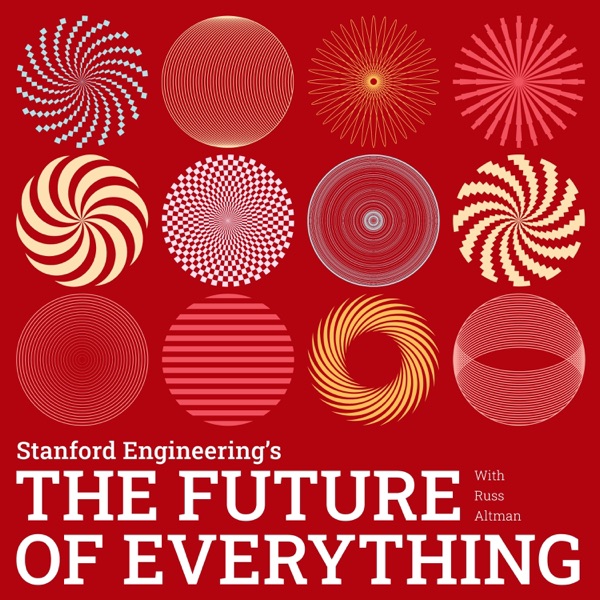
The Future of Everything
Host Russ Altman, a professor of bioengineering, genetics, and medicine at Stanford, is your guide to the latest science and engineering breakthroughs. Join Russ and his guests as they explore cutting-edge advances that are shaping the future of everything from AI to health and renewable energy.
Along the way, “The Future of Everything” delves into ethical implications to give listeners a well-rounded understanding of how new technologies and discoveries will impact society. Whether you’re a researcher, a student, or simply curious about what’s on the horizon, tune in to stay up-to-date on the latest developments that are transforming our world.
- Science chart
- #176
- Episodes
- 401
- Releases
- Weekly
- Typical length
- 34 min
- On air since
- 2017
- Latest episode
- 4 days ago
Episodes
401 episodes, newest first
-
36 min
The future of climate change beliefs
Show notes
In her research, Madalina Vlasceanu explores the psychology of sustainability. She’s keenly interested in how people form beliefs and what motivates them to action. Her research shows that the erosion of institutional trust is an intentional tactic and that climate polarization is manufactured by fossil fuel interests to drive disengagement. Vlasceanu offers evidence-based recommendations for turning despair into action. Concern for future generations is an effective strategy for generating policy support, she says, while restoring trust in institutions is key to action. Climate change is a collective problem and we must address it collectively, Vlasceanu tells host Russ Altman on this episode of Stanford Engineering’s The Future of Everything podcast.
Have a question for Russ? Send it our way in writing or via voice memo, and it might be featured on an upcoming episode. Please introduce yourself, let us know where you're listening from, and share your question. You can send questions to thefutureofeverything@stanford.edu.
Episode Reference Links:
• Stanford Profile: Madalina Vlasceanu
Connect With Us:
• Episode Transcripts >>>The Future of Everything Website
• Connect with Russ >>>Threads /Bluesky /Mastodon
• Connect with School of Engineering >>>Twitter/X /Instagram /LinkedIn /FacebookChapters:
(00:00:00) Introduction
Russ Altman introduces guest Madalina Vlasceanu, a professor of environmental social science and organizational behavior at Stanford University.
(00:01:50) Studying Climate Beliefs
How Vlasceanu moved from memory research to studying misinformation, belief formation, and climate action.
(00:03:33) Climate Misinformation and Disinformation
The large amount of false information shared both unintentionally and deliberately to mislead.
(00:05:35) The Polarization of Climate Beliefs
How climate change shifted from a relatively nonpartisan issue to one strongly shaped by political identity and elite influence.
(00:08:28) How Groups Shape Beliefs
Why people form beliefs not only through evidence and reasoning, but also through social cues, identity, and the desire to belong.
(00:10:02) Individual vs. Collective Climate Action
How climate solutions range from personal lifestyle changes to collective action and system-level change.
(00:11:25) Misjudging Climate Impact
Why people tend to overestimate low-impact actions like recycling and underestimate higher-impact choices.
(00:14:15) Correcting Climate Misperceptions
How simple information can help people better understand which climate actions have the greatest impact.
(00:15:51) Prediction and Learning
Why prediction errors can strengthen learning, memory, and belief updating.
(00:16:25) Algorithms, AI, and Climate Beliefs
How online systems can amplify misinformation and existing biases—and how better policy could potentially redirect them.
(00:18:13) AI’s Climate Impact
How AI affects the climate not only through data centers, but also by increasing efficiency across existing energy industries.
(00:21:42) Collective Action’s Impact
The difficulty of quantifying the impact and the power of collective action
(00:24:41) Motivating Civic Engagement
How contacting representatives, voting, joining organizations, and participating locally can influence climate policy.
(00:26:38) What Motivates Climate Action?
Large-scale studies compare interventions to identify which psychological strategies work best.
(00:31:07) Extreme Weather and Climate Beliefs
Why experiencing a natural disaster does not necessarily change climate beliefs unless people connect the event to climate change.
(00:33:27) Future In a Minute
Rapid-fire Q&A: collective action, democracy, and hope for the future.
(00:34:57) ConclusionConnect With Us:
Episode Transcripts >>> The Future of Everything Website
Connect with Russ >>> Threads / Bluesky / Mastodon
Connect with School of Engineering >>>Twitter/X / Instagram / LinkedIn / Facebook
Hosted by Simplecast, an AdsWizz company. See https://pcm.adswizz.com for information about our collection and use of personal data for advertising.
-
31 min
Best of: The future of fashion and dress codes
Show notes
New York Fashion Week wrapped up last month, but the questions it raises don't go away once the runways come down: why do clothes carry so much meaning, and who really gets to decide what "professional" looks like? Today we’re re-releasing a conversation I had with Stanford law professor Richard Ford, who's spent his career studying the surprising legal history behind our clothes — from laws in the Middle Ages that dictated what you could wear based on rank, to modern fights over workplace hairstyles and school dress codes. We get into how dress codes have shaped the fight for civil rights, and why so many workers in Silicon Valley wear the exact same fleece vest. Whether your closet is full of statement pieces or you’ve been wearing the same shirt on repeat all week, we hope you’ll take another listen to this interesting conversation.
Have a question for Russ? Send it our way in writing or via voice memo, and it might be featured on an upcoming episode. Please introduce yourself, let us know where you're listening from, and share your question. You can send questions to thefutureofeverything@stanford.edu.
Episode Reference Links:
• Stanford Profile: Rich Ford
Connect With Us:
• Episode Transcripts >>>The Future of Everything Website
• Connect with Russ >>>Threads /Bluesky /Mastodon
• Connect with School of Engineering >>>Twitter/X /Instagram /LinkedIn /FacebookChapters:
(00:00:00) Introduction
Russ Altman introduces this re-release with Richard Ford, a professor of law at Stanford University, on the history, meaning, and power of dress codes.
(00:02:12) Why Study Dress Codes?
How civil rights, constitutional law, workplace rules, and school policies led Ford to study fashion and dress codes.
(00:03:30) The Origins of Dress Codes
How fashion emerged in the late Middle Ages and sumptuary laws regulated clothing by social rank.
(00:05:09) Written and Unwritten Rules
How formal dress codes gave way to powerful social expectations about what people should wear.
(00:06:31) Fashion and Self-Expression
How people, especially young people, find ways to express themselves even within strict dress codes.
(00:08:04) The Great Masculine Renunciation
How men’s fashion shifted toward sober, practical clothing as political and social values changed.
(00:11:00) Dress Codes and Social Control
How rules about clothing can reinforce hierarchy while also inspiring resistance and social change.
(00:12:46) Hair as Fashion and Identity
How hairstyles have reflected class, professionalism, gender, and cultural identity across history.
(00:14:51) Dress Codes and Civil Rights
How clothing and hairstyles became tools of protest, respectability, and racial identity during the civil rights era.
(00:17:45) Clothing, Race, and Respect
How Ford’s father shaped his understanding of dress as a way to express self-respect and command respect from others.
(00:20:29) Reverse Snobbery
Why dressing down can sometimes signal higher status in academia, Silicon Valley, and other elite environments.
(00:22:18) Gender and Fashion
How clothing expectations have historically constrained women and reinforced ideas about gender.
(00:24:38) The Midtown Uniform
Why workers can converge on an unofficial uniform even after formal workplace dress codes disappear.
(00:25:54) The Case for Uniforms
How uniforms can reduce status competition while creating tension with self-expression.
(00:27:36) The Future of Dress Codes
Why self-expression through clothing is unlikely to disappear even as fashion becomes increasingly casual.
(00:28:41) Future In a Minute
Rapid-fire Q&A: fashion, young people, sustainability, equality, and the future.
(00:30:07) ConclusionConnect With Us:
Episode Transcripts >>> The Future of Everything Website
Connect with Russ >>> Threads / Bluesky / Mastodon
Connect with School of Engineering >>>Twitter/X / Instagram / LinkedIn / Facebook
Hosted by Simplecast, an AdsWizz company. See https://pcm.adswizz.com for information about our collection and use of personal data for advertising.
-
32 min
The future of social hierarchies
Show notes
Nir Halevy, an expert on organizational behavior, first grew interested in social hierarchies as a basketball fan. He now studies what makes for healthy workplaces. Organizational hierarchies can be beneficial, but can turn toxic. When people have power without status – control but little respect – conflict often follows. Halevy says that collaboration, not competition, is key to employee well-being. “If you care about freedom, seek cooperative environments. They will liberate you,” Halevy tells listeners – and host Russ Altman – on this episode of Stanford Engineering’s The Future of Everything podcast.
Have a question for Russ? Send it our way in writing or via voice memo, and it might be featured on an upcoming episode. Please introduce yourself, let us know where you're listening from, and share your question. You can send questions to thefutureofeverything@stanford.edu.
Episode Reference Links:
• Stanford Profile: Nir Halevy
• Learn more about Nir’s Book ‘Level Up’Connect With Us:
• Episode Transcripts >>>The Future of Everything Website
• Connect with Russ >>>Threads /Bluesky /Mastodon
• Connect with School of Engineering >>>Twitter/X /Instagram /LinkedIn /FacebookChapters:
(00:00:00) Introduction
Russ Altman introduces guest Nir Halevy, a professor of organizational behavior at Stanford Graduate School of Business, and the dynamics of power, status, and hierarchy.(00:03:42) Studying Social Influence
How Halevy became interested in the ways people gain influence in groups, teams, and organizations.(00:05:40) What Is a Hierarchy?
How formal and informal hierarchies emerge around power, status, achievement, and influence.(00:07:56) Why Hierarchies Are Sticky
The Positive and negative forces that contribute to the persistence of hierarchies(00:10:15) Navigating Hierarchies
How people lower in a hierarchy can influence others without resorting to manipulation or undermining colleagues.(00:13:01) Power vs. Status
Why having control over resources is different from being respected and admired.(00:14:36) The Danger of Power Without Status
How low status combined with power can fuel resentment, conflict, and abuse of authority.(00:16:39) Respect and Recognition
Why giving people dignity, appreciation, and status can matter as much as giving them more power.(00:20:03) Autonomy at Work
How cooperation and competition shape people’s sense of freedom and control in the workplace.(00:23:26) Secrets at Work
How workplace secrecy can increase stress and loneliness while also making work feel more meaningful and important.(00:25:30) Supporting People in Confidential Work
Why social support can help reduce the isolation that comes with confidential work.(00:26:12) Three Dimensions of Wellbeing
How happiness, interestingness, and meaningfulness can each shape the experience of work.(00:28:30) A Pluralistic Approach to Leadership
Why recognizing different ways people contribute can help leaders support status, value, and wellbeing.(00:29:54) Future In a Minute
Rapid-fire Q&A: cooperation, work-life balance, research partnerships, and hope for the future.(00:30:56) Conclusion
Connect With Us:
Episode Transcripts >>> The Future of Everything Website
Connect with Russ >>> Threads / Bluesky / Mastodon
Connect with School of Engineering >>>Twitter/X / Instagram / LinkedIn / Facebook
Hosted by Simplecast, an AdsWizz company. See https://pcm.adswizz.com for information about our collection and use of personal data for advertising.
-
35 min
Best of: The future of neuroscience
Show notes
Hi everyone, we had big news out of Stanford this week: Karl Deisseroth has won the 2026 Nobel Prize in Physiology or Medicine for discoveries leading to optogenetics, a technique that makes it possible to switch individual nerve cells on or off in the living brain. To celebrate, we're re-releasing a live conversation Russ had with Karl a few years ago. He's both a bioengineer and a practicing psychiatrist, and he tells me how he built a way to control brain cells with light, why the odds were stacked against it, and how it could open the door to better treatments for psychiatric disorders. We also talk about his book Projections and what it takes to turn a long-shot idea into a tool that changes neuroscience. Congratulations, Karl, on an honor so well deserved. Whether this is your first listen or your second, it's one worth hearing.
Have a question for Russ? Send it our way in writing or via voice memo, and it might be featured on an upcoming episode. Please introduce yourself, let us know where you're listening from, and share your question. You can send questions to thefutureofeverything@stanford.edu.
Episode Reference Links:
• Stanford Profile: Karl Deisseroth
• Learn more about Karl's Nobel Prize win
• Learn more about Optogenetics
• Reactions to Karl's Nobel WinConnect With Us:
• Episode Transcripts >>>The Future of Everything Website
• Connect with Russ >>>Threads /Bluesky /Mastodon
• Connect with School of Engineering >>>Twitter/X /Instagram /LinkedIn /FacebookChapters:
(00:00:00) Introduction
Russ Altman introduces Karl Deisseroth, a professor of bioengineering, psychiatry, and behavioral sciences at Stanford University.
(00:04:49) Technology and Discovery
Why Deisseroth sees technology development and basic neuroscience as inseparable.
(00:06:36) What Is Optogenetics?
How light can be used to precisely turn specific cells in the brain on or off.
(00:08:27) Turning an Idea into a Tool
The process that led to optogenetics
(00:10:57) Microbial Opsins
How light-sensitive proteins from microorganisms became the foundation for controlling neurons with light.
(00:14:11) Optogenetics in Humans
How optogenetics has already been used to restore limited vision, and what that suggests for future therapies.
(00:17:37) Psychiatry and the Lab
How Deisseroth’s work with patients shapes the scientific questions his lab pursues.
(00:21:48) The Most Pressing Questions in Neuroscience Today
Why identifying the brain’s many cell types became a central goal of the BRAIN Initiative.
(00:24:28) Correlation vs. Causality
Why understanding which neurons actually drive behavior requires more than simply observing brain activity.
(00:26:52) Controlling Brain Networks
How researchers are beginning to study and manipulate multiple brain regions with precise timing.
(00:28:19) The Need for Neuroscience Theory
Why better technology creates a growing need for theories that can guide which neural circuits to study.
(00:29:38) Writing Projections
Why Deisseroth wrote about the inner worlds of psychiatric patients alongside the science of the brain.
(00:32:59) Capturing Patients’ Inner Worlds
How feedback from people with psychiatric disorders shaped Deisseroth’s view of the book’s impact.
(00:34:26) ConclusionConnect With Us:
Episode Transcripts >>> The Future of Everything Website
Connect with Russ >>> Threads / Bluesky / Mastodon
Connect with School of Engineering >>>Twitter/X / Instagram / LinkedIn / Facebook
Hosted by Simplecast, an AdsWizz company. See https://pcm.adswizz.com for information about our collection and use of personal data for advertising.
-
36 min
The future of emotions
Show notes
Clinical psychologist James Gross is fascinated by what emotions are, and he champions emotional literacy – a deeper understanding of what makes each of us tick. In his research, Gross explores his “favorite topic,” emotion regulation, through the cognitive strategy of reappraisal to shift how we perceive and deal with unhelpful emotions. He talks about the Synergistic Mindsets intervention he co-developed, which is helping Gen Zers reframe their stress and regulate emotions. Emotions aren’t inherently bad, but we must separate the helpful from the harmful, Gross tells host Russ Altman on this episode of Stanford Engineering’s The Future of Everything podcast.
Have a question for Russ? Send it our way in writing or via voice memo, and it might be featured on an upcoming episode. Please introduce yourself, let us know where you're listening from, and share your question. You can send questions to thefutureofeverything@stanford.edu.
Episode Reference Links:
• Stanford Profile: James Gross
Connect With Us:
• Episode Transcripts >>>The Future of Everything Website
• Connect with Russ >>>Threads /Bluesky /Mastodon
• Connect with School of Engineering >>>Twitter/X /Instagram /LinkedIn /FacebookChapters:
(00:00:00) Introduction
Russ Altman introduces guest James Gross, a professor of psychology and philosophy at Stanford University, and the science of understanding and regulating emotions.(00:03:50) Why Study Emotions?
How Gross became interested in emotions and their role in shaping human behavior.(00:04:22) What Is an Emotion?
How scientists define emotions as coordinated responses to situations that matter to us.(00:06:00) Affect and Emotion
How affect differs from emotion, and why emotions may require more complex cognitive processing.(00:07:59) Emotional Clarity
How recognizing what we feel and where those feelings come from can help us understand our emotions.(00:09:53) Emotion Regulation
Why regulating emotions is less about suppressing them and more about deciding when they are helpful.(00:12:25) Strategies for Regulation
How different approaches to emotion regulation work—and why some are more effective than others.(00:13:30) How Emotions Are Generated
How situations, attention, expectations, and goals combine to produce emotional responses.(00:15:25) Reappraisal
How changing the way we interpret a situation can change the emotions it produces.(00:17:25) AI and Emotional Support
How large language models could potentially support people in reframing difficult experiences.(00:18:09) Emotions in Everyday Life
How emotion regulation research can support parents, teachers, patients, and healthcare providers.(00:20:53) Young People and Mental Health
How emotional clarity and regulation may help explain and address challenges facing younger generations.(00:24:40) Understanding the Sources of Stress
Why social media, isolation, economic pressures, and other factors can shape young people’s emotional lives.(00:26:15) Synergistic Mindsets
How changing beliefs about challenges and stress can produce healthier emotional and physiological responses.(00:29:30) What Makes You Tick?
How a Stanford course helps students examine the forces shaping their behavior, emotions, and decisions.(00:31:34) Emotional Intelligence
Why Gross sees value in emotion regulation while questioning whether “EQ” is scientifically established as a single intelligence.(00:32:57) Future In a Minute
Rapid-fire Q&A: emotions, passion, & affective science.(00:35:10) Conclusion
Connect With Us:
Episode Transcripts >>> The Future of Everything Website
Connect with Russ >>> Threads / Bluesky / Mastodon
Connect with School of Engineering >>>Twitter/X / Instagram / LinkedIn / Facebook
Hosted by Simplecast, an AdsWizz company. See https://pcm.adswizz.com for information about our collection and use of personal data for advertising.
-
32 min
Best of: The future of the innovation economy
Show notes
About a year ago, the Future of Everything team was in New York taping a special episode on the innovation economy in front of a live audience, and today we're re-releasing it. We sat down with computer scientist Fei-Fei Li and economists Susan Athey and Neale Mahoney to dig into how AI is reshaping creativity, jobs, education, and public policy, and where it might take us next. It's a wide-ranging, energetic conversation. Whether you're thinking about how AI might reshape your own work, or you're just curious where some of the smartest people in tech and economics think this is all headed, this one's a great listen.
Have a question for Russ? Send it our way in writing or via voice memo, and it might be featured on an upcoming episode. Please introduce yourself, let us know where you're listening from, and share your question. You can send questions to thefutureofeverything@stanford.edu.
Episode Reference Links:
• Stanford Profiles: Fei-Fei Li | Neale Mahoney | Susan Athey
Connect With Us:
• Episode Transcripts >>>The Future of Everything Website
• Connect with Russ >>>Threads /Bluesky /Mastodon
• Connect with School of Engineering >>>Twitter/X /Instagram /LinkedIn /FacebookChapters:
(00:00:00) Introduction
Russ Altman introduces this re-release of a live episode featuring Fei-Fei Li, Susan Athey, and Neale Mahoney on the future of the innovation economy.(00:00:45) Defining the Innovation Economy
How new ideas, technologies, and commercialization are reshaping economic growth.(00:02:13) AI as a General-Purpose Technology
What past technologies like electricity and personal computing can teach us about AI adoption.(00:03:23) The Bottlenecks to Adoption
Why digitization, software costs, training, and organizational change can slow the spread of new technology.(00:06:05) AI and the Labor Market
Why uncertainty about which jobs AI will disrupt makes social safety nets especially important.(00:08:04) Augmenting Human Work
Why Fei-Fei Li sees AI as a tool for enhancing human capabilities rather than simply replacing jobs.(00:11:17) Shaping Human-Centered Innovation
How innovation can be designed to complement human skills, creativity, and purpose.(00:12:21) Universities and AI Innovation
How universities can help develop human-centered technologies and lower barriers to adoption.(00:13:45) Government and the AI Transition
How public investment and policy could help workers adapt while expanding services like healthcare and childcare.(00:15:50) Rethinking Education
Why AI may force a fundamental rethink of what and how students learn.(00:17:18) Jobs, Adaptation, and Safety Nets
What history suggests about how economies adjust to technological disruption—and when policy intervention matters.(00:18:33) AI Regulation and Innovation
How policymakers might balance technological progress with appropriate guardrails.(00:21:57) Competition and Market Power
Why competition, open models, and the cost of AI access matter for innovation and economic opportunity.(00:24:57) Economic Optimism
Why confidence in the American economy has declined and what might help restore it.(00:26:40) Future In a Minute
Rapid-fire Q&A: hope for the future, education, robotics, AI accessibility, and the skills the panelists would learn next.(00:30:24) Conclusion
Connect With Us:
Episode Transcripts >>> The Future of Everything Website
Connect with Russ >>> Threads / Bluesky / Mastodon
Connect with School of Engineering >>>Twitter/X / Instagram / LinkedIn / Facebook
Hosted by Simplecast, an AdsWizz company. See https://pcm.adswizz.com for information about our collection and use of personal data for advertising.
-
26 min
Special episode: Think Fast, Talk Smart
Show notes
Hi everyone, it's your host Russ. As summer winds down and everyone heads into a new season, I wanted to share something a little different. Recently, I sat down with Matt Abrahams, host of the podcast Think Fast, Talk Smart and a lecturer at Stanford's Graduate School of Business. We traded seats and I took the guest chair while Matt interviewed me about the future of communication in the age of AI. We’re excited to re-run this episode today and whether you're writing a pitch, prepping for a tough conversation, or just curious how AI is changing the way we talk to each other, this one's a great listen.
Have a question for Russ? Send it our way in writing or via voice memo, and it might be featured on an upcoming episode. Please introduce yourself, let us know where you're listening from, and share your question. You can send questions to thefutureofeverything@stanford.edu.
Episode Reference Links:
• Stanford Profile: Russ Altman | Matt Abrahams
• Learn more about Think Fast Talk SmartConnect With Us:
• Episode Transcripts >>>The Future of Everything Website
• Connect with Russ >>>Threads /Bluesky /Mastodon
• Connect with School of Engineering >>>Twitter/X /Instagram /LinkedIn /FacebookChapters:
(00:00:00) Introduction
Russ Altman introduces this feed-drop episode from Think Fast, Talk Smart, where he joins Matt Abrahams to discuss communication in the age of AI.
(00:01:41) The Future of Communication
Why AI may amplify strong communication rather than replace authentic human messages.
(00:03:23) Using AI as a Communication Tool
How AI can help adjust language for different audiences, flag jargon, and improve clarity.
(00:04:00) AI as a Pre-Editor
How Russ uses large language models to critique and strengthen his writing before sharing it with colleagues.
(00:05:04) Structuring a Strong Proposal
How to align with your audience’s mission, define the problem, and clearly show the path forward.
(00:07:06) Making Complex Ideas Accessible
Why stories, analogies, and audience awareness help make technical information easier to understand.
(00:09:41) Preparing for Tough Moments
Why anticipating difficult concepts, questions, and conversations can make communication more effective.
(00:11:57) Asking Better Questions
Why specificity and strong follow-up questions can guide more meaningful conversations.
(00:12:51) Questions as Opportunities
How questions can communicate curiosity, engagement, and respect rather than criticism.
(00:15:01) Building Effective Teams
How shared goals, relationships, diversity, and clear roles support collaboration.
(00:17:55) Productive Conflict
How leaders can encourage rigorous disagreement without damaging trust.
(00:19:37) Finding People’s Passion
What hosting The Future of Everything taught Russ about understanding what motivates people.
(00:21:00) Looking to the Future
Why young people give Russ hope about what comes next.
(00:22:13) A Communicator to Admire
Why Russ credits his father with shaping his own approach to communication.
(00:23:06) Three Ingredients for Better Communication
Know your audience, be specific, and bring a sense of joy to the conversation.
(00:24:07) ConclusionConnect With Us:
Episode Transcripts >>> The Future of Everything Website
Connect with Russ >>> Threads / Bluesky / Mastodon
Connect with School of Engineering >>>Twitter/X / Instagram / LinkedIn / Facebook
Hosted by Simplecast, an AdsWizz company. See https://pcm.adswizz.com for information about our collection and use of personal data for advertising.
-
34 min
The future of gut health
Show notes
Microbiologist Justin Sonnenburg wants you to know that you – and all humans, really – are not alone. Inside each of us live uncountable bacteria without whom we could not survive. Nowhere is this symbiosis more vital, Sonnenburg says, than in the digestive tract – the gut – where trillions of bacterial collaborators help digest the foods that nourish us. Sonnenburg studies what makes this complex relationship work and how modern life is altering this important chemistry. He says the gut microbiome should be thought of as another organ. When it drifts out of balance, the effects ripple through our metabolism, our immune systems, and our nervous systems. Sonnenburg goes on to explain how dietary choices – like eating more fermented foods and fiber – can rebuild the microbiome, and why the field’s next frontier could help alleviate chronic disease. “It really is a full-body impact that our microbes are having,” Sonnenburg tells host Russ Altman on this episode of Stanford Engineering’s The Future of Everything podcast.
Have a question for Russ? Send it our way in writing or via voice memo, and it might be featured on an upcoming episode. Please introduce yourself, let us know where you're listening from, and share your question. You can send questions to thefutureofeverything@stanford.edu.
Episode Reference Links:
• Stanford Profile: Justin Sonnenburg
• Learn more about the Sonnenburg LabConnect With Us:
• Episode Transcripts >>>The Future of Everything Website
• Connect with Russ >>>Threads /Bluesky /Mastodon
• Connect with School of Engineering >>>Twitter/X /Instagram /LinkedIn /FacebookChapters:
(00:00:00) Introduction
Russ Altman introduces guest Justin Sonnenburg, a professor of microbiology and immunology at Stanford University.
(00:03:08) Path into Microbiome Research
How Sonnenburg became interested in the friendly microbes that live in and on the body.
(00:04:26) Bacteria as Partners
What are gut bacteria and how do they function in our bodies?
(00:06:23) Full-Body Effects
How gut microbes affect metabolism, immunity, and the brain.
(00:08:27) Industrialized Microbiomes
What does it mean that the gut microbiome has been “industrialized”?
(00:12:08) Feeding the Microbiome
Why is fiber important for gut health?
(00:15:59) Fiber Response
Study results from Stanford reflecting individual responses to fiber.
(00:17:14) Fermented Foods
How foods like yogurt, kimchi, sauerkraut, and kombucha can support microbiome diversity.
(00:20:36) Microbiome Therapeutics
How diet and microbial interventions could improve health.
(00:23:00) Food, Equity, and Access
Why microbiome health may require practical tools that work beyond major diet changes.
(00:24:02) Sharing Microbes
How social environments, diet, and exposure may influence the microbes people acquire.
(00:25:30) Precision Health
How the microbiome could help tune immunity, metabolism, and disease treatment.
(00:27:32) Women’s Health
Why reproductive health and women’s health are promising areas for microbiome research.
(00:28:33) Stanford Microbiome Research
How Stanford researchers are building interdisciplinary tools, tests, and therapies for microbiome science.
(00:30:36) Future In a Minute
Rapid-fire Q&A: microbiome health, daily decisions, and reversing Western disease trends.
(00:33:04) Conclusion
Connect With Us:
Episode Transcripts >>> The Future of Everything Website
Connect with Russ >>> Threads / Bluesky / Mastodon
Connect with School of Engineering >>>Twitter/X / Instagram / LinkedIn / Facebook
Hosted by Simplecast, an AdsWizz company. See https://pcm.adswizz.com for information about our collection and use of personal data for advertising.
-
31 min
Best of: The future of language learning
Show notes
As kids head back to school this month, we're re-releasing a conversation with cognitive scientist Michael Frank on the future of language learning. Michael studies the similarities and differences in how children and AI systems learn language. He’s working to understand what accounts for the “data gap” between how efficiently children learn language from relatively little input, compared to how much data AI systems need. His goal is to build better scientific models of human language acquisition and to inform how AI systems might learn in more human-like ways. Whether you’re parenting an infant or toddler who is learning to talk or you're simply curious about how language learning unfolds for people across languages and cultures, this one's a great listen.
Have a question for Russ? Send it our way in writing or via voice memo, and it might be featured on an upcoming episode. Please introduce yourself, let us know where you're listening from, and share your question. You can send questions to thefutureofeverything@stanford.edu.
Episode Reference Links:
• Stanford Profile: Michael Frank
Connect With Us:
• Episode Transcripts >>>The Future of Everything Website
• Connect with Russ >>>Threads /Bluesky /Mastodon
• Connect with School of Engineering >>>Twitter/X /Instagram /LinkedIn /FacebookChapters:
(00:00:00) Introduction
Russ Altman introduces this episode with Michael Frank, a professor of biology, psychology and linguistics at Stanford University.
(00:02:05) AI and Child Language Learning
How AI language learning and child language learning differ.
(00:05:23) WordBank and Big Data
How large language databases are helping researchers study child language development across cultures.
(00:08:04) Learning Across Languages
How children learn many different languages through broadly similar developmental processes.
(00:08:57) Babbling and Early Speech
How babies begin exploring the sounds and signs of their language.
(00:10:04) Multimodal Learning
How SAYCam & BabyView capture multimodal language learning
(00:13:12) Language as a Social Tool
How social cues help children break the code of language.
(00:15:12) Learning from Others
How children track uncertainty and seek help from social partners.
(00:18:05) ManyBabies
How a global research consortium studies child development across cultures and communities.
(00:20:11) Global Development Research
Why large-scale international collaboration is valuable but difficult to fund.
(00:21:36) Pragmatics
How children learn to infer meaning beyond the literal words people say.
(00:23:21) AI, Intent, and Common Sense
Why pragmatics matters for building AI systems that understand human intent.
(00:24:21) Reading to Children
Why books can support language learning through shared attention and rich social interaction.
(00:26:38) Early Language Exposure
Why it is never too early to interact with babies through language.
(00:27:53) Multilingual Children
How children can learn multiple languages with few negative consequences.
(00:30:35) Conclusion
Connect With Us:
Episode Transcripts >>> The Future of Everything Website
Connect with Russ >>> Threads / Bluesky / Mastodon
Connect with School of Engineering >>>Twitter/X / Instagram / LinkedIn / Facebook
Hosted by Simplecast, an AdsWizz company. See https://pcm.adswizz.com for information about our collection and use of personal data for advertising.
-
30 min
The future of cities
Show notes
Jackelyn Hwang is an expert on the social dynamics of cities. In one line of research, she combines AI and Google Street View to measure quality-of-life factors – such as trash, blight, new construction, and the pace of recovery from climate disasters – to analyze gentrification, racial equity, and overall resident well-being. Her work has shown, for instance, that predominantly Black neighborhoods are last and slowest to gentrify and that displaced Black residents often end up in worse neighborhoods. She recently worked with policymakers at the housing department of Oakland, California, on anti-displacement and anti-homelessness programs and is now working with policymakers across the Bay Area to strengthen neighborhoods. We are clearing a path to more stable communities for everyone, Hwang tells host Russ Altman on this episode of Stanford Engineering’s The Future of Everything podcast.
Have a question for Russ? Send it our way in writing or via voice memo, and it might be featured on an upcoming episode. Please introduce yourself, let us know where you're listening from, and share your question. You can send questions to thefutureofeverything@stanford.edu.
Episode Reference Links:
• Stanford Profile: Jackelyn Hwang
• Learn more about Jackie's work on housing instability in OaklandConnect With Us:
• Episode Transcripts >>>The Future of Everything Website
• Connect with Russ >>>Threads /Bluesky /Mastodon
• Connect with School of Engineering >>>Twitter/X /Instagram /LinkedIn /FacebookChapters:
(00:00:00) Introduction
Russ Altman introduces guest Jackie Hwang, a professor of sociology at Stanford University.
(00:02:53) Path into Urban Sociology
How Hwang’s experiences near Philadelphia shaped her interest in cities, inequality, and neighborhood change.
(00:04:56) The 21st-Century American City
How gentrification, immigration, crime, education, housing, and climate change are reshaping cities.
(00:08:03) Defining Gentrification
How sociologists understand gentrification as a class-based transformation of neighborhoods.
(00:10:02) Studying Gentrification
Why race, segregation, and neighborhood inequality complicate simple stories of urban renewal.
(00:11:50) Displacement and Instability
Why gentrification does not always increase moving rates, but still affects where people end up.
(00:14:48) Policy and Anti-Displacement
How Hwang’s research informs local policy, housing strategy, and homelessness prevention.
(00:18:10) Measuring Neighborhood Change
How technology can help researchers study changing neighborhoods at scale.
(00:18:55) Google Street View and Cities
How Street View opened new ways to observe gentrification and neighborhood conditions.
(00:20:36) Computer Vision for Urban Research
How AI and computer vision are being used to analyze neighborhood conditions.
(00:21:53) What Neighborhoods Reveal
How visible signs like trash, blight, vacant lots, and construction signal neighborhood change.
(00:23:10) Eye Tracking and Perception
How researchers study what people notice in neighborhoods and how those cues affect stress.
(00:24:09) Climate Change and Recovery
How disasters can widen neighborhood inequality through uneven rebuilding and abandonment.
(00:26:14) Neighborhoods and Wellbeing
How better measurements of neighborhood conditions could guide interventions for safer, more stable communities.
(00:28:00) Future In a Minute
Rapid-fire Q&A: affordable housing, neighborhood change, and better urban data.
(00:29:32) Conclusion
Connect With Us:
Episode Transcripts >>> The Future of Everything Website
Connect with Russ >>> Threads / Bluesky / Mastodon
Connect with School of Engineering >>>Twitter/X / Instagram / LinkedIn / Facebook
Hosted by Simplecast, an AdsWizz company. See https://pcm.adswizz.com for information about our collection and use of personal data for advertising.
-
30 min
Best of: The future of addiction
Show notes
Today, we're re-releasing my conversation with psychiatrist Anna Lembke on the future of addiction. Whether its substances, screens, or work itself, addiction in some form touches nearly all of our lives either directly or through someone we care about. Anna breaks down the dopamine mechanisms behind addiction of all kinds, from opioids to social media to, in her own case, romance novels, and shares what actually works in recovery, including exercise and structured abstinence. Whether you're thinking about screen habits, substance use, or just how to build healthier routines, this one's well worth another listen.
Have a question for Russ? Send it our way in writing or via voice memo, and it might be featured on an upcoming episode. Please introduce yourself, let us know where you're listening from, and share your question. You can send questions to thefutureofeverything@stanford.edu.
Episode Reference Links:
• Stanford Profile: Anna Lembke
Connect With Us:
• Episode Transcripts >>>The Future of Everything Website
• Connect with Russ >>>Threads /Bluesky /Mastodon
• Connect with School of Engineering >>>Twitter/X /Instagram /LinkedIn /FacebookChapters:
(00:00:00) Introduction
Russ Altman introduces Anna Lembke, a professor of psychiatry and behavioral sciences at Stanford University.
(00:01:52) Defining Addiction
Why addiction involves compulsive use despite harm, even when the behavior seems ordinary.
(00:03:31) Romance Novels and Harm
How Lembke’s own reading habit became a case study in subtle addiction.
(00:05:49) Dopamine and the Addicted Brain
What repeated dopamine spikes do to reward pathways and withdrawal symptoms.
(00:08:34) Seeing the Problem
How naming a compulsive habit can make it visible and open the door to change.
(00:10:34) Addiction Medicine Today
How the opioid epidemic changed medical training and addiction awareness.
(00:12:48) Russ Altman’s “Addictions”
Russ details his own dopamine habits for the audience.
(00:14:37) Exercise and Hormesis
Why movement, effort, and discomfort can help restore healthier dopamine patterns.
(00:17:22) Dopamine Fasting
The self-intervention Dr. Lembke used & her potential cross-addictions.
(00:21:22) Vulnerability to Addiction
Why genetic risk, family history, and drug of choice shape addiction vulnerability.
(00:22:53) The Opioid Epidemic
How prescription opioids, heroin, and fentanyl shaped three waves of crisis.
(00:24:51) Fentanyl and Overdose Risk
Why counterfeit pills and fentanyl exposure can be lethal even for new users.
(00:26:28) Treating Opioid Addiction
Why medications like methadone and buprenorphine help restore stability.
(00:28:17) The Future of Addiction
Why Lembke sees addiction as a long-term challenge across drugs, media, and food.
(00:29:22) Conclusion
Connect With Us:
Episode Transcripts >>> The Future of Everything Website
Connect with Russ >>> Threads / Bluesky / Mastodon
Connect with School of Engineering >>>Twitter/X / Instagram / LinkedIn / Facebook
Hosted by Simplecast, an AdsWizz company. See https://pcm.adswizz.com for information about our collection and use of personal data for advertising.
-
34 min
The future of neuroimaging
Show notes
Psychologist Russ Poldrack is a mind reader of sorts, but not in the traditional sense of the word. Instead, he makes movies of blood flow in the brain using functional MRI to draw insights into the function of specific regions of the brain to decipher how they control behavior. In one example, Poldrack has shown how people with obsessive-compulsive disorder have enhanced “salience networks” that turn on when surprising things happen. This finding could have “very profound” outcomes in diagnosis and treatment, Poldrack tells host Russ Altman in this wide-ranging exploration of the implications and the ethics of functional neuroimaging on Stanford Engineering’s The Future of Everything podcast.
Have a question for Russ? Send it our way in writing or via voice memo, and it might be featured on an upcoming episode. Please introduce yourself, let us know where you're listening from, and share your question. You can send questions to thefutureofeverything@stanford.edu.
Episode Reference Links:
• Stanford Profile: Russ Poldrack
• Poldrack Lab website: http://poldracklab.org/
• The MyConnectome project: https://www.myconnectome.org/
• Stanford Center for Open and Reproducible Science: https://datascience.stanford.edu/coresConnect With Us:
• Episode Transcripts >>>The Future of Everything Website
• Connect with Russ >>>Threads /Bluesky /Mastodon
• Connect with School of Engineering >>>Twitter/X /Instagram /LinkedIn /FacebookChapters:
(00:00:00) Introduction
Russ Altman introduces guest Russ Poldrack, a professor of psychology and of psychiatry and behavioral science at Stanford University.
(00:03:15) Path into Neuroimaging
How Poldrack moved from cognitive psychology into functional MRI research.
(00:04:18) Functional MRI
How MRI can be used to track brain activity.
(00:06:59) Mapping Brain Activity
How tasks and behaviors are linked to patterns of brain activation.
(00:08:02) Resting Functional MRI
How resting scans revealed large-scale brain networks.
(00:09:00) Brain Networks and Behavior
How the brain controls stopping, switching, and habits.
(00:10:34) Layers of Brain Organization
Why neuroimaging studies the brain across multiple scales.
(00:13:04) Individual Brain Differences
How shared brain networks vary across individuals.
(00:13:34) Scanning Himself
Why Poldrack repeatedly scanned his own brain.
(00:15:47) Mapping One Brain Deeply
How repeated scans revealed reliable individual brain patterns.
(00:18:59) Neuroimaging and Mental Health
How brain network differences may relate to depression and OCD.
(00:21:42) Reproducibility in Brain Imaging
How larger and deeper data sets improve reliability.
(00:24:51) Analytic Variability
Why the same data can produce different conclusions.
(00:26:39) Multiverse Analysis
How testing many analyses helps identify stable findings.
(00:27:55) Open Science
How data sharing and standards improve transparency.
(00:30:29) Privacy and Brain Data
How researchers protect participants when sharing neuroimaging data.
(00:32:17) Future In a Minute
Rapid-fire Q&A: neuroimaging, reproducibility, and AI in science.
(00:33:22) Conclusion
Connect With Us:
Episode Transcripts >>> The Future of Everything Website
Connect with Russ >>> Threads / Bluesky / Mastodon
Connect with School of Engineering >>>Twitter/X / Instagram / LinkedIn / Facebook
Hosted by Simplecast, an AdsWizz company. See https://pcm.adswizz.com for information about our collection and use of personal data for advertising.
-
37 min
The future of clinical bioethics
Show notes
Prior to becoming an anesthesiologist, Alyssa Burgarttrained in bioethics. She now counts herself among a growing number of certified clinical bioethicists who help doctors, nurses, patients, and their families handle ethically complex medical decisions at the bedside. Bioethicists are critical to care, Burgart argues, helping patients facing difficult choices to clarify personal values and weigh a complex array of risks and benefits, as well as emotions and familial, cultural, and religious norms. While much of her work is in pediatrics and maternal-fetal cases, she also studies how moral distress and moral injury impact clinicians, contributing to burnout among doctors and nurses. Having a strong ethical community brings resilience to these challenging environments, Burgart tells host Russ Altman in this episode of Stanford Engineering’s The Future of Everything podcast.
Have a question for Russ? Send it our way in writing or via voice memo, and it might be featured on an upcoming episode. Please introduce yourself, let us know where you're listening from, and share your question. You can send questions to thefutureofeverything@stanford.edu.
Episode Reference Links:
• Stanford Profile: Alyssa Burgart
Connect With Us:
• Episode Transcripts >>>The Future of Everything Website
• Connect with Russ >>>Threads /Bluesky /Mastodon
• Connect with School of Engineering >>>Twitter/X /Instagram /LinkedIn /FacebookChapters:
(00:00:00) Introduction
Russ Altman introduces guest Alyssa Burgart, a professor of anesthesiology and perioperative pain at Stanford University.
(00:03:16) Path into Bioethics & Anesthesiology
How Burgart became a bioethicist and then chose anesthesiology.
(00:05:18) What Bioethics Means
How bioethics helps connect medical decisions to values, risks, and benefits.
(00:07:03) Making Hard Decisions Manageable
How ethics consultation helps clinicians act with integrity.
(00:08:33) Ethics Consults
A detailed explanation of hospital ethics services
(00:12:23) Pediatric Ethics
Examples of Dr. Burgart’s work with children, families, and clinicians
(00:15:45) Culture, Faith, and Trust
Navigating cultural and religious differences as a bioethicist.
(00:17:57) Family Decision-Making
How ethics consultants help families and care teams honor a patient’s voice.
(00:21:55) Moral Injury
What is moral injury and how do clinicians specifically experience it?
(00:24:52) Institutional Betrayal
Why barriers like policies, laws, and denied approvals can create moral strain.
(00:26:37) Moral Distress
What is moral distress and how does it manifest itself in healthcare.
(00:28:28) Moral Residue
When clinicians experience repeated moral strain and cannot recover between incidents.
(00:29:33) Treating Moral Injury & Distress
Strategies for helping clinicians manage these parts of their work.
(00:33:54) Future In a Minute
Rapid-fire Q&A: clinical bioethics, human dignity, and moral resilience.
(00:36:15) Conclusion
Connect With Us:
Episode Transcripts >>> The Future of Everything Website
Connect with Russ >>> Threads / Bluesky / Mastodon
Connect with School of Engineering >>>Twitter/X / Instagram / LinkedIn / Facebook
Hosted by Simplecast, an AdsWizz company. See https://pcm.adswizz.com for information about our collection and use of personal data for advertising.
-
34 min
Best of: The future of AI and the law
Show notes
These days, AI is everywhere, and it’s increasingly hard to separate the gains from the slop. With that in mind, we're re-releasing my conversation with Stanford Law professor Daniel Ho on the future of AI and the law. When we look for applications where AI can deliver measurable benefit, the legal profession stands out, both for its potential gains in efficiency and equity, and for how much is at stake if we get it wrong. Dan's research — from using AI to identify racist property covenants buried in county deed records, to mapping obsolete regulations that waste thousands of hours of government time — shows what's possible when the technology is applied with rigor and purpose. If you’re curious about how AI can serve both justice and good governance, this one is well worth another listen.
Have a question for Russ? Send it our way in writing or via voice memo, and it might be featured on an upcoming episode. Please introduce yourself, let us know where you're listening from, and share your question. You can send questions to thefutureofeverything@stanford.edu.
Episode Reference Links:
• Stanford Profile: Dan Ho
Connect With Us:
• Episode Transcripts >>>The Future of Everything Website
• Connect with Russ >>>Threads /Bluesky /Mastodon
• Connect with School of Engineering >>>Twitter/X /Instagram /LinkedIn /FacebookChapters:
(00:00:00) Introduction
Russ Altman introduces guest Dan Ho, a professor of law, political science, and computer science at Stanford University.
(00:02:19) Path into Legal AI
How Ho’s background shaped his interest in law, and technology.
(00:03:35) What Lawyers Do
What makes law a complex domain for AI.
(00:05:28) Legal Hallucinations
When AI performs well and when it fails.
(00:07:52) Searching Legal Records in California
How AI can help identify outdated, harmful, or legally important material.
(00:10:28) Scaling Redaction
How a model accelerated a process that overwhelmed county recorder offices.
(00:13:04) Legal Reform at Scale
How AI has supported legal reform by scanning massive bodies of law.
(00:15:02) STARA & The City of San Francisco
How AI was used to go through San Francisco’s code and clean up reporting.
(00:20:53) Outdated Obligations
How “regulatory sludge” takes the time & resources of the public service
(00:25:02) Open vs. Closed AI
The differences and associated risks of the different AI systems.
(00:30:58) Legal Chatbots
Why legal chatbots are promising but risky.
(00:33:42) Conclusion
Connect With Us:
Episode Transcripts >>> The Future of Everything Website
Connect with Russ >>> Threads / Bluesky / Mastodon
Connect with School of Engineering >>>Twitter/X / Instagram / LinkedIn / Facebook
Hosted by Simplecast, an AdsWizz company. See https://pcm.adswizz.com for information about our collection and use of personal data for advertising.
-
34 min
The future of menopause
Show notes
Dr. Karen Adams, obstetrician/gynecologist and Farwell Family Director of the Stanford Program in Menopause and Healthy Aging, studies menopause and, perhaps more importantly, perimenopause – the critical years preceding it. During this time, hormone-related symptoms like mood instability, sleep disruption, hot flashes, and joint pain can be severe even though periods continue. Adams explains that perimenopausal symptoms are often misdiagnosed and improperly treated. She says hormonal therapies are safe and effective in perimenopause and menopause, and can even have heart and bone benefits. “Menopause is inevitable, but suffering is not,” Adams tells host Russ Altman on this episode of Stanford Engineering’s The Future of Everything podcast.
Have a question for Russ? Send it our way in writing or via voice memo, and it might be featured on an upcoming episode. Please introduce yourself, let us know where you're listening from, and share your question. You can send questions to thefutureofeverything@stanford.edu.
Episode Reference Links:
• Stanford Profile: Karen Adams
Connect With Us:
• Episode Transcripts >>>The Future of Everything Website
• Connect with Russ >>>Threads /Bluesky /Mastodon
• Connect with School of Engineering >>>Twitter/X /Instagram /LinkedIn /FacebookChapters:
(00:00:00) Introduction
Russ Altman introduces guest Karen Adams, a professor of obstetrics and gynecology at Stanford University.
(00:02:11) Path into Menopause Medicine
How Adams built one of the first clinical programs focused on women over 40.
(00:04:19) Menopause and Perimenopause
What menopause is and how the hormonal transition often begins years earlier.
(00:06:19) Beyond Hot Flashes
The wide range of symptoms that can appear during perimenopause.
(00:11:09) Pregnancy Risk During Perimenopause
Why contraception can still matter until a full year without a period.
(00:11:11) Unpredictable Symptoms
Why perimenopausal symptoms can be harder to recognize than PMS.
(00:13:37) Hormone Therapy
How treatment differs during perimenopause and after menopause.
(00:22:57) The Women’s Health Initiative
What the landmark hormone therapy study showed.
(00:27:53) Sexual Health and Vaginal Estrogen
Why local estrogen can safely treat genitourinary symptoms for many women.
(00:30:36) Future In a Minute
Rapid-fire Q&A: menopause care, women’s health, and better clinical support
(00:32:58) Conclusion
Connect With Us:
Episode Transcripts >>> The Future of Everything Website
Connect with Russ >>> Threads / Bluesky / Mastodon
Connect with School of Engineering >>>Twitter/X / Instagram / LinkedIn / Facebook
Hosted by Simplecast, an AdsWizz company. See https://pcm.adswizz.com for information about our collection and use of personal data for advertising.
-
33 min
The future of Parkinson’s disease
Show notes
Biochemist Suzanne Pfeffer is an expert on the molecular roots of Parkinson’s disease. Her work focuses on mutated proteins linked to Parkinson’s risk. She’s discovered, for instance, that drugs inhibiting one of the proteins can help neurons regrow primary cilia and stave off cell death, reversing disease progression. Since similar drugs are in clinical trials, her findings bring great hope for people with a subtype of Parkinson’s and hopefully can be linked to earlier detection through warning signs like REM sleep disruptions and loss of smell. “This is precision medicine,” Pfeffer tells host Russ Altman of the future of Parkinson’s disease on this episode of Stanford Engineering’s The Future of Everything podcast.
Have a question for Russ? Send it our way in writing or via voice memo, and it might be featured on an upcoming episode. Please introduce yourself, let us know where you're listening from, and share your question. You can send questions to thefutureofeverything@stanford.edu.
Episode Reference Links:
• Stanford Profile: Suzanne Pfeffer
Connect With Us:
• Episode Transcripts >>>The Future of Everything Website
• Connect with Russ >>>Threads /Bluesky /Mastodon
• Connect with School of Engineering >>>Twitter/X /Instagram /LinkedIn /FacebookChapters:
(00:00:00) Introduction
Russ Altman introduces guest Suzanne Pfeffer, a professor of biochemistry at Stanford University.
(00:03:25) Path into Parkinson’s Research
How Pfeffer’s protein work led to a life-changing work on Parkinson’s disease.
(00:05:28) Parkinson’s Primer
The various causes and the effects of the disease on the brain and body.
(00:10:26) Lewy Bodies and Dementia
How Lewy bodies, synuclein, and dementia relate to Parkinson’s disease.
(00:11:56) Molecular Trafficking
Pfeffer breaks down the effects of LRRK2 and GBA mutations in the brain.
(00:16:10) Early Disease Changes
Some of the early changes in the body and how they show up as symptomatically.
(00:20:04) Current Treatments
The limitations of symptom-focused treatments.
(00:21:46) Treating Earlier
Opportunities for slowing or reversing disease progression when detected earlier.
(00:22:32) Targeting LRRK2
Current research on disease treatment & trial challenges.
(00:27:33) The Value of Basic Science
Why curiosity-driven research can unexpectedly lead to disease breakthroughs.
(00:29:33) Future In a Minute
Rapid-fire Q&A: biomarkers, brain donation, and better Parkinson’s treatments.
(00:31:52) Conclusion
Connect With Us:
Episode Transcripts >>> The Future of Everything Website
Connect with Russ >>> Threads / Bluesky / Mastodon
Connect with School of Engineering >>>Twitter/X / Instagram / LinkedIn / Facebook
Hosted by Simplecast, an AdsWizz company. See https://pcm.adswizz.com for information about our collection and use of personal data for advertising.
-
38 min
The future of AI and the legal field
Show notes
Law professor Julian Nyarko has drawn attention for his studies using large language models to investigate and improve legal education and explore AI’s biases. He hopes AI can become a reliable, always-on legal learning and assistance tool to lower costs and expand access to legal services. In one recent study, he asked a group of law professors to evaluate written answers to student questions. Three-quarters of the time, the professors preferred AI-generated answers to those of their human colleagues. “AI is good at law,” Nyarko says, the challenge now is to use it most effectively, he tells host Russ Altman in this episode of Stanford Engineering’s The Future of Everything podcast.
Have a question for Russ? Send it our way in writing or via voice memo, and it might be featured on an upcoming episode. Please introduce yourself, let us know where you're listening from, and share your question. You can send questions to thefutureofeverything@stanford.edu.
Episode Reference Links:
• Stanford Profile:Julian Nyarko
Connect With Us:
• Episode Transcripts >>>The Future of Everything Website
• Connect with Russ >>>Threads /Bluesky /Mastodon
• Connect with School of Engineering >>>Twitter/X /Instagram /LinkedIn /FacebookChapters:
(00:00:00) Introduction
Russ Altman introduces guest Julian Nyarko, a professor of law at Stanford University.
(00:02:31) Path into AI and Law
How Nyarko’s early work led him to legal AI.
(00:05:03) Law, Economics, and Computation
How Nyarko’s training, methods, and self-taught coding shaped his research.
(00:07:23) Building the LIFT Lab
Why a law professor started a lab.
(00:09:06) Evaluating Legal AI
How AI raises fundamental questions about what counts as good lawyering.
(00:10:22) Improving Legal Services
Using AI to work faster, reduce errors, and make informed decisions.
(00:10:57) Rethinking Legal Education
How AI may change the way future lawyers learn
(00:11:51) AI in Office Hours
How AI answers law students’ questions compared with human professors.
(00:15:18) Surprising Results
Why AI answers were often preferred
(00:16:16) What the Study Shows
The findings support AI tutoring, but don’t prove AI improves learning.
(00:18:48) Limits of One-Shot Answers
Why real teaching often depends on dialogue, clarification, and productive struggle.
(00:20:59) AI for Social Science
How AI can become both an object of study and a tool.
(00:22:43) Research Agents
Using AI to test claims and make previously impossible research scalable.
(00:24:51) Agentic AI in the Lab
How Socratic dialogue with AI can sharpen research ideas.
(00:26:07) Fairness and Bias
How computational tools can be audited for bias and used to audit decision-making.
(00:27:29) Discrimination in Models
Exploring bias and how it can be reduced.
(00:30:16) Disparate Impact
How policies and systems disadvantage groups even without explicit intent.
(00:32:53) From Evidence to Policy
How Nyarko’s lab works with stakeholders to surface disparities.
(00:34:49) Future In a Minute
Rapid-fire Q&A: justice, talent, and the future of legal AI.
(00:36:57) Conclusion
Connect With Us:
Episode Transcripts >>> The Future of Everything Website
Connect with Russ >>> Threads / Bluesky / Mastodon
Connect with School of Engineering >>>Twitter/X / Instagram / LinkedIn / Facebook
Hosted by Simplecast, an AdsWizz company. See https://pcm.adswizz.com for information about our collection and use of personal data for advertising.
-
33 min
Best of: The future of wildfire management
Show notes
In the western United States and Canada, this time of year is the beginning of peak wildfire season, a reality that's become impossible to ignore. In light of this, we're re-releasing my conversation with energy and climate policy expert Michael Wara on the future of wildfire management. Michael walks us through how we got here, why fires are burning bigger and more frequently, and what a smarter, more proactive approach to managing our landscapes might look like. Whether you're in a fire-prone region or simply paying attention to the changing climate around you, this one is well worth another listen.
Have a question for Russ? Send it our way in writing or via voice memo, and it might be featured on an upcoming episode. Please introduce yourself, let us know where you're listening from, and share your question. You can send questions to thefutureofeverything@stanford.edu.
Episode Reference Links:
• Stanford Profile: Michael Wara
Connect With Us:
• Episode Transcripts >>> The Future of Everything Website
• Connect with Russ >>> Threads / Bluesky / Mastodon
• Connect with School of Engineering >>> Twitter/X / Instagram / LinkedIn / FacebookChapters:
(00:00:00) Introduction
Russ Altman introduces guest Michael Wara, a wildfire expert and professor of law at Stanford University.
(00:02:05) Journey to Wildfire Research
How Michael’s clean energy work led to wildfire research.
(00:03:36) Communities at the Frontlines
The community-level challenges and responsibilities in fire prevention.
(00:05:53) Shifting Community Perspectives
How awareness is rising but state efforts remain misaligned.
(00:08:17) Legacy Homes, Modern Risk
Why older homes pose a major risk and retrofitting is crucial.
(00:09:55) Utility-Led Safety Limitations
The significant but insufficient progress utilities have made.
(00:13:23) Targeting High-Risk Areas
How utilities now prioritize high-risk areas for safety upgrades.
(00:14:30) Insurance Industry Realities
Why insurers can't price risk without crashing markets.
(00:17:19) Urban Wildfires
How today's major fires in suburbs are mostly fueled by homes.
(00:22:12) The Climate Change Multiplier
The impact of atmospheric dryness and fuel moisture on fire risk.
(00:24:45) New Fire Regulations
Recent mandates that have been implemented to decrease fire risk.
(00:28:17) Rethinking Wildfire Communication
Why better messaging is key to changing homeowner behavior.
(00:31:52) Conclusion
Connect With Us:
Episode Transcripts >>> The Future of Everything Website
Connect with Russ >>> Threads / Bluesky / Mastodon
Connect with School of Engineering >>>Twitter/X / Instagram / LinkedIn / Facebook
Hosted by Simplecast, an AdsWizz company. See https://pcm.adswizz.com for information about our collection and use of personal data for advertising.
-
31 min
The future of storytelling for health
Show notes
“Stories … are powerful tools that can help us make sense of our lives,” says physician-scientist Maya Adam. She now combines visual storytelling and health education to create animations that go beyond the barriers of language and culture to convey important health messages. The subject matter ranges from vaccine acceptance and addiction to mental health and nutrition. These emotionally engaging narratives – often without a single spoken word – are more effective than traditional pamphlets and lectures, Adam says. Visual stories have the potential to achieve “near-universal understanding” that can support better health outcomes, she tells host Russ Altman on this episode of Stanford Engineering’s The Future of Everything podcast.
Have a question for Russ? Send it our way in writing or via voice memo, and it might be featured on an upcoming episode. Please introduce yourself, let us know where you're listening from, and share your question. You can send questions to thefutureofeverything@stanford.edu.
Episode Reference Links:
• Stanford Profile: Maya Adam
Connect With Us:
• Episode Transcripts >>> The Future of Everything Website
• Connect with Russ >>> Threads / Bluesky / Mastodon
• Connect with School of Engineering >>> Twitter/X / Instagram / LinkedIn / FacebookChapters:
(00:00:00) Introduction
Russ Altman introduces guest Maya Adam, a professor of pediatrics and infectious disease from Stanford University.
(00:03:43) From Ballet to Medicine
How Adam’s background shaped her approach to health education.
(00:05:02) Why Stories Work
Why lived experience makes evidence-based health recommendations more meaningful.
(00:06:17) The Story Creation Process
Adam’s techniques for creating effective scalable health stories on any topic
(00:09:20) Real World Stories
Adam shares some particularly challenging topics the team has created stories for
(00:11:10) Global Accessibility
Designing stories and characters that can resonate across cultures and contexts.
(00:12:38) Measuring Impact
Using technology to run trials to test and measure impact
(00:15:23) Iterating the Message
Adapting and changing approaches to create the most effective message
(00:17:53) AI and Storytelling
How AI is beginning to affect health communication and creative production.
(00:19:45) Testing Human vs. AI Art
A trial comparing responses to human-created and AI-generated health storytelling.
(00:25:42) Human-in-the-Loop AI
How AI may best support artists and clinicians by reducing burden rather than replacing
(00:27:43) Future In a Minute
Rapid-fire Q&A: stories, collaboration, media, and the future of health communication.
(00:29:44) Conclusion
Connect With Us:
Episode Transcripts >>> The Future of Everything Website
Connect with Russ >>> Threads / Bluesky / Mastodon
Connect with School of Engineering >>>Twitter/X / Instagram / LinkedIn / Facebook
Hosted by Simplecast, an AdsWizz company. See https://pcm.adswizz.com for information about our collection and use of personal data for advertising.
-
28 min
Best of: The future of exercise
Show notes
The World Cup is here, and while we watch some of the world's greatest athletes competing on a global stage, it's fascinating to consider what effect this intense activity may have on the human body. With that in mind, we're re-releasing our conversation with Stanford biochemist Jonathan Long on the future of exercise. Jonathan studies the chemistry of what happens inside your body when you move, and his findings are pointing toward some genuinely surprising possibilities — including treatments for obesity, diabetes, and even, someday, an exercise pill. If the athleticism on the pitch has you feeling inspired, this one is well worth another listen.
Have a question for Russ? Send it our way in writing or via voice memo, and it might be featured on an upcoming episode. Please introduce yourself, let us know where you're listening from, and share your question. You can send questions to thefutureofeverything@stanford.edu.
Episode Reference Links:
• Stanford Profile: Jonathan Long
Connect With Us:
• Episode Transcripts >>> The Future of Everything Website
• Connect with Russ >>> Threads / Bluesky / Mastodon
• Connect with School of Engineering >>> Twitter/X / Instagram / LinkedIn / FacebookChapters:
(00:00:00) Introduction
Russ Altman introduces guest Jonathan Long, a professor of pathology from Stanford University.
(00:02:02) Effective Weight Loss Drugs
The history and development of GLP-1 receptor agonists.
(00:04:04) Understanding Metabolism and Exercise
Why Long’s lab starts with molecules to understand metabolism and physical activity.
(00:05:10) Animal Models in Exercise Studies
The use of animal models in exercise studies and the discovery of Lac-Phe.
(00:06:47) Psychological Preparation for Exercise
The psychological aspects of exercise and the involvement of endocannabinoids in exercise motivation.
(00:09:00) Lac-Phe's Role and Mechanism
The role of Lac-Phe and its production in the gut.
(00:12:08) Differences in Exercise Response
Differences in exercise response between trained athletes and untrained individuals.
(00:12:57) Diabetes and Metabolic Diseases
The relationship between diabetes, exercise, and metabolic diseases.
(00:15:01) Lac-Phe as a Potential Therapeutic
The potential of Lac-Phe as a weight loss drug, and parallels to GLP-1 drug development.
(00:16:21) Importance of How Weight is Lost
Whether the method of weight loss matters, and the importance of preserving lean muscle mass.
(00:18:37) Exercise as Medicine
The concept of exercise as medicine, and defining physical activity at the same resolution as modern medicines.
(00:22:11) Metformin and Exercise Pathways
The unexpected connection between metformin and the Lac-Phe pathway.
(00:24:01) Prospects of an Exercise Pill
The future of an exercise pill, and the challenges associated with its development.
(00:27:05) Conclusion
Final thoughts on the future of exercise.
Connect With Us:
Episode Transcripts >>> The Future of Everything Website
Connect with Russ >>> Threads / Bluesky / Mastodon
Connect with School of Engineering >>>Twitter/X / Instagram / LinkedIn / Facebook
Hosted by Simplecast, an AdsWizz company. See https://pcm.adswizz.com for information about our collection and use of personal data for advertising.
Science lists
More Science shows picked out from the charts








More from Stanford
All Stanford podcasts
More in Science
Placed highest on Apple Podcasts' Science chart right now