Podcast
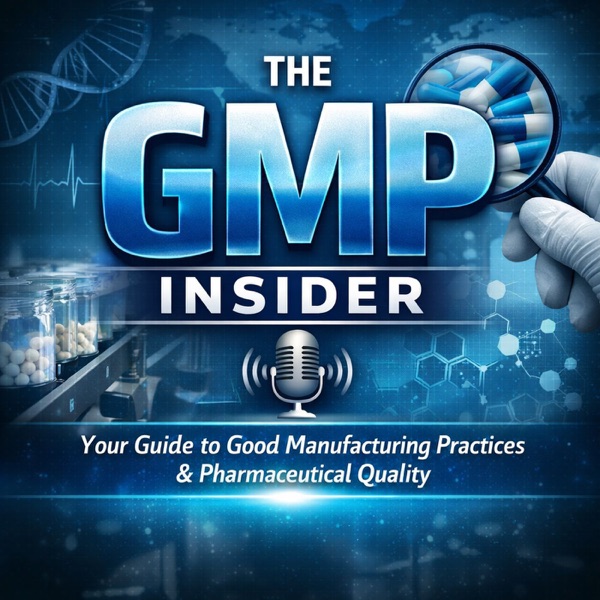
The GMP Insider
GMP Insider is your go-to podcast for practical insights into pharmaceutical quality, Good Manufacturing Practices (GMP), and regulatory compliance.
Designed for quality professionals, manufacturing teams, and pharma leaders, this show breaks down complex regulations into clear, real-world guidance. Each episode explores topics like audits, CAPA, data integrity, quality systems, validation, and global regulatory expectations — all with a focus on protecting patients and building strong quality cultures.
Whether you work in Quality Assurance, Quality Control, Manufacturing, or Regulatory Affairs, GMP Insider helps you stay compliant, confident, and ahead in an ever-evolving pharmaceutical industry.
New episodes deliver:
• GMP best practices
• Audit readiness strategies
• Real compliance case studies
• Industry trends and updates
• Expert tips from quality professionals
From batch to patient — quality is everything.
- Episodes
- 77
- Releases
- Twice a week
- Typical length
- 15 min
- On air since
- 2026
- Latest episode
- 1 day ago
Episodes
77 episodes, newest first
-
15 min
Deviation Investigation & Root Cause Analysis: 5 Whys Done Right
Episode 7
Show notes
Most deviation investigations fail not because teams pick the wrong tool, but because they stop asking why the moment the answer becomes uncomfortable — usually at "human error" and a retraining record. Marcus and Priya walk through a real investigation: containment and timeline reconstruction in the first hours, the 5 Whys worked step by step on evidence, where the tool breaks, the fishbone breadth check, and how root cause should dictate a CAPA with an effectiveness check that can actually fail.
• What a deviation is under 21 CFR 211.192 — and why investigation depth must match risk• The first hours: containment first, then timeline reconstruction from records, not memory• The 5 Whys done right: a precise problem statement, verified answers, and the system-level stopping rule• Where the 5 Whys breaks: single-lane tunnels, opinion chains, leading questions, and stopping at human error• Why human error is a starting point for questions, never a root cause• Checking the chain: fishbone categories, evidence tests, and documenting causes ruled out• From root cause to CAPA that works: extent of condition and a countable effectiveness criterion• What good investigators do differently — and why investigation quality is a leadership metric
New episodes every Monday and Wednesday — follow The GMP Insider so you never miss one.Connect with Tushar Arora on LinkedIn: https://www.linkedin.com/in/tushar-a-926382161Watch on YouTube: https://www.youtube.com/@TheGMPInsider
Produced with AI assistance. -
15 min
How to Respond to an FDA 483 (and Warning Letter) in 15 Working Days
Show notes
The inspection is over — and the second half of it has just started. Your written response to a Form FDA 483 is due within 15 working days, and FDA weighs it before deciding whether the matter ends there or escalates to a Warning Letter. Marcus and Priya lay out the full 15-day playbook: what a 483 is and is not, day-one triage and ownership, extent-of-condition review, root cause and CAPA discipline, evidence and timelines, the cold-read challenge review, and the five failures that sink responses again and again.
• What a Form FDA 483 is — and is not: inspectional observations, not a final agency determination• The 15-working-day clock: when it starts, and why a late response can arrive after the decision• Days 1–2: one response owner, every observation logged verbatim, containment and extent-of-condition• Days 3–7: real root cause, and separating correction, corrective action, preventive action, and effectiveness checks• Days 8–15: how to structure and write the response, tone, disagreement with evidence, and the cold-read review• Warning Letters: same discipline, higher stakes — responding to the pattern, not just the paragraphs• The five failures that sink responses: narrow fixes, human-error shortcuts, promise piles, defensive tone, missed commitments
New episodes every Monday and Wednesday — follow The GMP Insider so you never miss one.Connect with Tushar Arora on LinkedIn: https://www.linkedin.com/in/tushar-a-926382161Watch on YouTube: https://www.youtube.com/@TheGMPInsider
Produced with AI assistance. -
15 min
FDA Inspection Readiness 2026: The New Cross-System Inspection Model
Show notes
FDA doesn't inspect your quality systems in silos anymore. The new inspection model is hypothesis-driven: the investigator pulls one thread — a complaint, a repeat deviation — through CAPA, risk management, and design as a single connected system, and watches whether your story holds. Marcus and Priya break down what changed in 2026, why training records and binders no longer equal readiness, the inspection playbook from war room to escorts, and the daily habits that make a site genuinely ready.
• The 2026 shift: from subsystem inspections to hypothesis-driven, cross-system inspections• How the new inspection actually works — following one thread across the whole quality system• Why readiness is a daily habit, not a pre-inspection scramble• The inspection playbook: war room, back room, document retrieval, SME selection, escort discipline• Making complaints, CAPA, deviations, and risk tell one consistent story• What the investigator asks for first — and what it reveals• The QMSR-era shift: from procedures to effectiveness• The Monday-morning playbook: pull the thread before the investigator does
New episodes every Monday and Wednesday — follow The GMP Insider so you never miss one.Connect with Tushar Arora on LinkedIn: https://www.linkedin.com/in/tushar-a-926382161Watch on YouTube: https://www.youtube.com/@TheGMPInsider
Produced with AI assistance. -
14 min
Why FDA Rejects Your CAPA: 5 CAPA Effectiveness Failures Explained
Show notes
Nearly nine out of ten human-drug warning letters include at least one inadequate CAPA response. Your corrective action plan is the single most rejected document in FDA enforcement — and it's not for lack of effort. Marcus and Priya count down the five CAPA effectiveness failures that keep quality teams in warning-letter territory: fixing the event instead of the system, root causes that stop at human error, CAPAs closed with no proof they worked, CAPAs written to answer the 483 instead of fixing the system, and no trending — so the failure recurs.
• Why CAPA is the most rejected document in FDA enforcement• Failure one: corrective action with no preventive action — fixing the event, not the system• Failure two: root causes that stop at "human error"• Failure three: closing a CAPA with zero evidence the change worked• Failure four: CAPAs written to answer the 483 observation, not to fix the system• Failure five: no trending — the same failure recurs, and FDA cites recurrence• The Monday-morning CAPA playbook that survives an investigator
New episodes every Monday and Wednesday — follow The GMP Insider so you never miss one.Connect with Tushar Arora on LinkedIn: https://www.linkedin.com/in/tushar-a-926382161Watch on YouTube: https://www.youtube.com/@TheGMPInsider
Produced with AI assistance. -
15 min
OOS Investigation Explained: Phase 1 vs Phase 2 (21 CFR 211.192)
Show notes
An out-of-specification result lands on your desk — and one wrong decision in the next hour can manufacture the evidence for your own warning letter. Marcus and Priya break down the two-phase OOS investigation step by step: Phase 1, the laboratory investigation, and Phase 2, the full-scale investigation, under 21 CFR 211.192 — from the Barr Labs decision to the retest rules to what to do on Monday morning.
• Phase 1 vs Phase 2: what each phase covers and where the line is• The retest rules — when retesting is legitimate and when it's testing into compliance• Why "no assignable lab cause" is a finding, not a failure• What 21 CFR 211.192 actually requires, in plain language• The Monday-morning OOS playbook, in five steps
New episodes every Monday and Wednesday — follow The GMP Insider so you never miss one.Connect with Tushar Arora on LinkedIn: https://www.linkedin.com/in/tushar-a-926382161Watch on YouTube: https://www.youtube.com/@TheGMPInsider
Produced with AI assistance. -
15 min
ALCOA+ Explained: The 9 Data Integrity Principles FDA Actually Cites
Show notes
When an FDA investigator stops trusting your data, the inspection is over — because if the records can't be trusted, nothing built on them can be. Marcus and Priya break down all nine ALCOA+ principles — Attributable, Legible, Contemporaneous, Original, Accurate, Complete, Consistent, Enduring, Available — what investigators actually find when each one is missing, and the Monday-morning fixes that close most findings before they happen.
• The 9 ALCOA+ principles, explained in plain language• What investigators actually check first: audit trails, user access, backups, QA's real role• Why most data integrity 483s are discipline failures, not technology failures• The small-site objection steel-manned: where the money actually matters• The 4 moves a QA manager should make this week
New episodes every Monday and Wednesday — follow The GMP Insider so you never miss one.Connect with Tushar Arora on LinkedIn: https://www.linkedin.com/in/tushar-a-926382161Watch on YouTube: https://www.youtube.com/@TheGMPInsider
Produced with AI assistance. -
13 min
Top 10 FDA 483 Observations in 2026 (and How to Avoid Each One)
Show notes
Every year, FDA investigators write thousands of 483 observations — and almost every one was avoidable. Marcus and Priya count down the ten most-cited observations in drug manufacturing for 2026, what investigators are actually finding, and exactly how to keep your site off the list.
• The #1 most-cited observation — and why it explains the other nine• Data integrity: the fastest-growing citation cluster in 2026• Why "human error + retraining" keeps failing investigations• The one quality-unit decision that changes everything
New episodes every Monday and Wednesday — follow The GMP Insider so you never miss one.Connect with Tushar Arora on LinkedIn: https://www.linkedin.com/in/tushar-a-926382161Watch on YouTube: https://www.youtube.com/@TheGMPInsider
Produced with AI assistance. -
7 min
Quality Debt: The Hidden Liability Inside Pharmaceutical Quality Systems
Show notes
Every shortcut, deferred CAPA, and "we'll fix it later" is a loan — and quality debt charges interest. Repeat deviations, findings, and warning letters are just the payments coming due.
• What quality debt is and how it silently accumulates
• The interest payments: repeat deviations and FDA findings
• Paying it down without stopping the line
• Preventing new debt while clearing the old
New episodes every Monday and Wednesday — follow The GMP Insider so you never miss one.
Connect with Tushar Arora on LinkedIn: https://www.linkedin.com/in/tushar-a-926382161
Watch on YouTube: https://www.youtube.com/@TheGMPInsider
Produced with AI assistance.
-
16 min
The Hidden Cost of Poor Quality: The Business Impact Beyond Recalls
Show notes
Recalls make the headlines. But the real cost of poor quality never makes the press release — it hides in rework, investigations, remediation, and the launches that never happen.
• The costs nobody puts on the recall announcement
• Rework, investigations, and remediation: the real math
• How poor quality taxes every future product launch
• Making the business case for quality investment
New episodes every Monday and Wednesday — follow The GMP Insider so you never miss one.
Connect with Tushar Arora on LinkedIn: https://www.linkedin.com/in/tushar-a-926382161
Watch on YouTube: https://www.youtube.com/@TheGMPInsider
Produced with AI assistance.
-
11 min
Why CAPA Doesn't Fix Culture: Symptoms vs Systems
Show notes
Your CAPA system can be perfect on paper and still change nothing — because CAPAs fix symptoms, and culture is the system underneath.
• Why brilliant CAPAs die in broken cultures
• Symptoms vs systems: knowing which one you're treating
• What culture change actually requires from QA leaders
• Building a system where CAPAs stick
New episodes every Monday and Wednesday — follow The GMP Insider so you never miss one.
Connect with Tushar Arora on LinkedIn: https://www.linkedin.com/in/tushar-a-926382161
Watch on YouTube: https://www.youtube.com/@TheGMPInsider
Produced with AI assistance.
-
11 min
Compliance vs Effectiveness: Is Your Quality System Healthy?
Show notes
Compliant doesn't mean effective. Effective doesn't mean sustainable. Most quality systems are only one of the three — and leadership can't tell which.
• The three lenses every quality system needs
• Why compliance alone is a fragile victory
• Measuring effectiveness, not just activity
• Building a system that lasts beyond the next inspection
New episodes every Monday and Wednesday — follow The GMP Insider so you never miss one.
Connect with Tushar Arora on LinkedIn: https://www.linkedin.com/in/tushar-a-926382161
Watch on YouTube: https://www.youtube.com/@TheGMPInsider
Produced with AI assistance.
-
8 min
When a Green Dashboard Lies: Signals Your Metrics Miss
Show notes
Every metric green, every trend flat — and the system is rotting underneath. Dashboards don't lie on purpose. They lie by design.
• Why green metrics create dangerous comfort
• The quality signals dashboards systematically miss
• What to measure when the numbers look fine
• Leading beyond the dashboard
New episodes every Monday and Wednesday — follow The GMP Insider so you never miss one.
Connect with Tushar Arora on LinkedIn: https://www.linkedin.com/in/tushar-a-926382161
Watch on YouTube: https://www.youtube.com/@TheGMPInsider
Produced with AI assistance.
-
20 min
When Quality Has to Say NO: Tough QA Decisions in Pharma
Show notes
Saying no in QA is easy on paper and brutal in practice. This episode is about the decision nobody wants to make — and why making it is the job.
• Why "no" is a quality decision, not a career risk
• How great QA leaders frame rejection so it actually lands
• The difference between blocking progress and protecting patients
• Sleeping well after the hardest call of your career
New episodes every Monday and Wednesday — follow The GMP Insider so you never miss one.
Connect with Tushar Arora on LinkedIn: https://www.linkedin.com/in/tushar-a-926382161
Watch on YouTube: https://www.youtube.com/@TheGMPInsider
Produced with AI assistance.
-
45 min
AI Governance in Pharma: Ethics by Design for Quality Leaders
Show notes
AI governance in the pharmaceutical industry cannot begin after deployment.
By that point, critical decisions about data, accountability, human oversight, transparency, risk, and system behavior have already been embedded into the technology.
So the better question is:
What if ethics were designed into AI from the beginning?
In this episode of The GMP Insider, we explore the concept of Ethics by Design and why it could become a foundational pillar of responsible AI governance in pharmaceutical Quality.
Discussion topics include:
• Why AI governance must begin during system design
• Patient safety considerations when AI makes mistakes
• Transparency and understanding AI outputs
• Designing meaningful human oversight
• Data integrity and AI governance
• Identifying potential bias and unintended outcomes
• Defining accountability when AI contributes to decisions
• Managing AI and model changes throughout the lifecycle
• The evolving role of QA in AI governance
• Why policies alone may not be sufficient for complex AI systemsFor GxP and other regulated environments, responsible AI requires more than a policy describing how technology should be used.
Organizations need governance principles embedded into the design, validation, deployment, monitoring, and change management lifecycle.
The objective shouldn't be to create another compliance checklist.
It should be to build systems with appropriate ethical guardrails from the start.
Because as AI becomes more complex, governance must become more intentional.
Define accountability before deployment.
Design for human oversight.
Protect data integrity.
Monitor continuously.
Engineer trust from the beginning.
The central question for pharmaceutical AI should not simply be:
"Can we use this technology?"
It should also be:
"Can we govern it responsibly—and can we trust the way it was designed?"
You cannot govern complexity effectively if ethics is treated as an afterthought.
From batch to patient — quality is everything.
-
18 min
Big Pharma vs Small Pharma: Where Quality Culture Thrives
Show notes
What is it really like to work in Quality Assurance at a large pharmaceutical company compared with a smaller organization?
The answer goes far beyond company size.
In this episode of The GMP Insider, we explore how Big Pharma and Small Pharma can develop very different professional skills, experiences, and perspectives—and why Quality Culture often matters more than organizational scale.
Big Pharma can provide mature systems, specialized expertise, global standards, established governance, and the opportunity to learn how to operate within complex organizations.
Small Pharma can provide broader responsibilities, faster decision-making, greater visibility, cross-functional exposure, and opportunities to build Quality Systems from the ground up.
Neither is inherently better.
They simply develop different muscles.
In this episode, we discuss:
• The advantages of working in Big Pharma
• The professional opportunities available in Small Pharma
• Managing complexity versus creating change
• How organizational size affects decision-making
• The importance of leadership and Quality Culture
• Why speaking up and challenging respectfully matter
• How both environments can accelerate a QA professional's career
• What truly defines an exceptional Quality organizationThe best Quality culture isn't necessarily found in the company with the largest budget or the most sophisticated systems.
It's found where people are empowered to speak up, learn from failures, take ownership, support each other, and put patients first.
Big Pharma can teach you how to manage complexity.
Small Pharma can teach you how to create change.
The strongest professionals learn from both.
Company size may shape the system. Leadership and culture shape the experience.
From batch to patient — quality is everything.
-
19 min
The Human Side of Pharma Quality: Quality Is Love in Action
Show notes
What if the deepest meaning of Pharmaceutical Quality isn't compliance?
What if it's caring?
Every SOP written, every deviation investigated, every batch reviewed, and every quality decision made represents something bigger than a regulatory requirement.
It represents a person who cared enough to do the work right.
In this episode of The GMP Insider, we explore the human side of pharmaceutical quality and the purpose behind the systems, procedures, investigations, and decisions that protect patients every day.
Discussion Topics
• Why Quality is more than compliance
• The human purpose behind SOPs and Quality Systems
• Why investigations matter beyond simply closing deviations
• How batch review connects directly to patient safety
• Why challenging a decision can be an act of caring
• The invisible people behind every medicine
• How purpose can transform routine quality activities into meaningful workPatients may never know the names of the people who wrote the procedures, investigated the deviations, reviewed the data, or released their medicine.
They may never see the countless decisions made behind the scenes.
But they experience the result.
That is the quiet beauty of Pharmaceutical Quality.
Someone cared enough to protect a stranger.
Quality is caring expressed through action.
And perhaps that's why the work we do matters so much.
Quality happens behind the scenes.
Its impact is felt by every patient.
From batch to patient — quality is everything
-
18 min
QA Leadership: Making Difficult Quality Decisions with Confidence
Show notes
Some of the hardest decisions in Pharmaceutical Quality are not difficult because the answer is unclear.
They're difficult because the right answer isn't necessarily the popular one.
A Quality Leader may have to say no.
They may have to escalate an uncomfortable issue.
They may have to challenge production pressure.
They may have to make a decision that creates short-term frustration but protects long-term patient safety.
In this episode of The GMP Insider, we explore why great QA Leaders choose integrity over popularity and how difficult decisions shape trust, credibility, and Quality Culture.
Discussion Topics
• Why integrity is fundamental to Quality Leadership
• Making difficult decisions under operational pressure
• Choosing patient safety over popularity
• Building trust through consistent decision-making
• The difference between authority and leadership
• Why the best leaders make decisions they can defend
• How difficult decisions create lasting leadership credibilityThe strongest QA Leaders don't measure success by how many people agree with them.
They measure it by whether they made the right decision for the right reasons.
Because sometimes leadership means standing alone.
Sometimes it means saying no.
And sometimes it means making the decision that nobody wants today—but everyone will be grateful for tomorrow.
Popularity is temporary.
Integrity builds a legacy.
And when a Quality Leader knows they protected the patient, they can sleep well after even the most difficult decision.
From batch to patient — quality is everything
-
18 min
The Most Dangerous Day in Quality: When Questions Stop
Show notes
The most dangerous day in Pharmaceutical Quality isn't necessarily the day an inspector arrives.
It may be the day people stop asking questions.
A Quality System can appear completely compliant while a much deeper problem develops beneath the surface.
SOPs are followed.
CAPAs are closed.
Metrics are green.
Dashboards look perfect.But if people have stopped challenging assumptions, identifying risks, and asking whether processes still make sense, the organization may be losing one of its most important defenses: curiosity.
In this episode of The GMP Insider, we explore the relationship between questioning, psychological safety, Quality Culture, and patient safety.
Discussion topics include:
• Why silence can be a warning sign in Quality
• How curiosity helps identify hidden risks
• Why healthy Quality Cultures encourage questions
• The danger of confusing compliance with effectiveness
• How questions challenge organizational assumptions
• Why Quality Leaders should develop critical thinkers—not simply followers
• How one uncomfortable question can prevent a larger quality failureThe strongest Quality organizations aren't those where nobody challenges the process.
They are organizations where people feel empowered to say:
"Why are we doing it this way?"
"What are we missing?"
"What could go wrong?"
"Is there a better way?"
Because questions create awareness.
Awareness identifies risk.
Risk-based thinking strengthens systems.
And stronger systems protect patients.
Inspection day tests your Quality System.
Questions test whether your Quality Culture is still alive.
From batch to patient — quality is everything.
-
15 min
Beyond CAPA Closure: The QA Judgment That Gets You Promoted
Show notes
In Quality Assurance, we often measure success through activity.
How many CAPAs were closed?
How many deviations were completed?
How many investigations were approved?
Those metrics are important. But they don't tell the complete story of leadership.
In this episode of The GMP Insider, we explore a critical transition in every Quality Assurance career: the shift from being valued for execution to being trusted for judgment.
As QA professionals grow, the questions around them begin to change.
Instead of:
"How much work can you complete?"
The organization begins asking:
"Can we trust your judgment?"
This episode explores what it takes to become a trusted Quality Leader, including:
• Making decisions when information is incomplete
• Balancing compliance with science and risk
• Challenging decisions when production pressure is high
• Identifying the difference between activity and true effectiveness
• Choosing systemic solutions over quick fixes
• Building credibility through consistent decision-making
• Developing judgment that others trust during difficult situationsTechnical expertise helps you understand the system.
Execution helps you deliver results.
But trusted judgment is what prepares you for leadership.
Because eventually, your career is no longer defined by the number of records you close.
It is defined by the confidence people have in the decisions you make.
Your output may get you noticed.
Your judgment earns trust.
And trust is what turns a strong QA professional into a Quality Leader.
On these lists
The GMP Insider is one of the shows picked out on this list
More in Life Sciences
Placed highest on Apple Podcasts' Life Sciences chart right now