Podcast
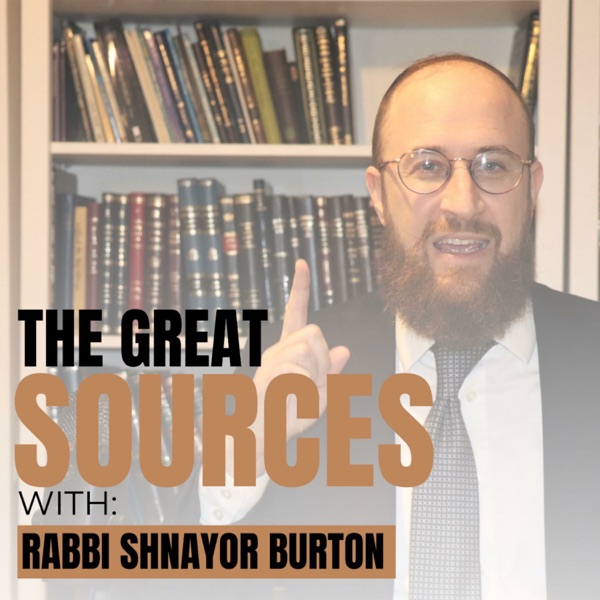
The Great Sources with Rabbi Shnayor Burton
To help support this podcast, please consider making a tax-deductible donation via Zelle to jacoblightsfoundation@gmail.com.
Lecture series in Jewish Philosophy.
What was the purpose of Creation? What is man's place in the world? What are prophecy and prayer about? What is the significance of Shabbos and the Promised Land?
Explore these fundamental questions of Judaism from their sources, and become familiar with the systems developed by the great Torah thinkers: R' Saadiah Gaon, R' Yehuda HaLevi, R' Bachya ibn Paquda, Rambam and the school of the Mekubalim.
- Episodes
- 242
- Releases
- Weekly
- Typical length
- 1 hr 2 min
- On air since
- 2020
- Latest episode
- 1 month ago
Episodes
242 episodes, newest first
-
1 hr 3 min
Understanding Truth or Receiving Torah: The Root of the Dispute between Rambam and the Kabbalists
-
37 min
S7, E20, The Guide of the Perplexed, the Closing Chapters, 04: Know, My Son — The Parable of the Parable's Interpretation Shnayor Burton Shnayor Burton 306 subscribers Analytics Edit video
Season 7, Episode 20
Show notes
1:00 The parable of the sultan and its two interpretations4:00 The alternative path to God that does not involve studying philosophy nor human perfection8:00 Rambam gives the interpretation of the parable and then declares that it is not a true interpretation10:30 Parables have interpretations that are not completely true12:30 Shlomo went from parable to parable, and likewise the Rambam14:45 The power of a parable lies in its appeal to the imagination and the body, which stands in tension with the interpretation of the parable18:00 The first interpretation of the parable is actually a parable for the deeper interpretation of the parable21:00 Can the first track lead to prophecy? Would it be called prophecy only equivocally with true prophecy achieved through the second track?24:00 The student requires a parable to motivate him, and he must take the path through the first interpretation, which is itself a parable27:30 Study of Torah is a lived parable, and only after appreciating its study for its own sake can a person appreciate it as a parable for something else30:30 Why Aristotle did not become a prophet31:00 The answer to the greatest contradiction between Mishneh Torah and the Guide, regarding the importance of studying halacha: its study is a living parable34:30 The key to resolving the contradiction within the Rambam himself is understanding parables
-
1 hr 12 min
S7, E19, The Guide of the Perplexed, the Closing Chapters, 03: Two Roads to the Inner Court of the King
Season 7, Episode 19
Show notes
0:00 The parable of the sultan in his palace9:30 The interpretation of the parable: the Torah track to reach knowledge of God12:45 The second meaning of the parable: the scientific track to reach knowledge of God20:25 The second meaning stands in tension with and contradicts the first27:00 Rambam wanted his student to learn things in their proper order31:00 How a person could reach certainty about divine matters without studying the propaedeutic sciences35:45 Some noble souls have God-given illumination attained not through a course of education but as a gift42:30 As a student of Rambam, R' Yosef needed a course of education 48:45 The meaning of the sultan is never interpreted; in III:52, the king is interpreted to mean the intellect54:15 God dwells in Reason, which is His Shechinah58:30 Rambam does not interpret the meaning of the sultan, since there is no parable for God1:01:01 "HaKadosh Baruch Hu" as a parable for the acquired intellect or the active intellect1:04:00 The Treatise of the Pool and the final chapters of the Guide; reason as king and conduit to God
-
1 hr 12 min
S7, E18, The Guide of the Perplexed, the Closing Chapters, 02: The Birth of a Nation Under Divine Providence
Show notes
00:45 The turn and the tension in III:51, and its parallel in III:54, about whether the service of God involves turning away from this world or engaging with it4:15 A new reason for all of the mitzvahs that runs counter to the reasons given earlier in the Guide16:15 The contradiction in III:54: Is the true perfection of man intellectual or practical?28:00 Why does Rambam think we cannot be like Avraham, Yitzchak, Yaakov and Moshe?40:30 Only the founders of the nation can be engaged with this world while remaining purely objective and focused on Hashem 54:30 The history of the Jewish Nation as the embodiment of Hashem's traits of Kindness, Justice and Righteousness, which are the hallmarks of Divine Providence57:00 The perfection of man as individual is knowledge; the perfection of man as a member of the Jewish Nation is engagement in lived Kindness, Justice and Righteousness1:01:00 "The unity of God in the world" – Kindness, Justice and Righteousness reflect God's unity in the dimension of the material world 1:05:00 Kindness, Justice and Righteousness for the collective correspond to intelligence for the individual
-
1 hr 17 min
S7, E17, The Guide of the Perplexed, the Closing Chapters, 01: The Perfect Life and the Perfect Death
Season 7, Episode 17
-
52 min
Should Judaism Go Universal?
Show notes
0:00 Has the time arrived for Judaism to cultivate a stance of ideological expansion?5:00 The divine decree of separation between Israel and the nations8:00 Is the role of Israel to teach other nations or to stand as a model?13:15 Why da'as Hashem includes all the nations17:30 Ideas that are privately held are not fully held19:50 To teach da'as Hashem requires not claiming the status of a teacher of da'as Hashem26:00 AI and globalized da'as31:00 Keeping Torah internal preserves its integrity40:45 If Israel would produce prophets, would the other nations come to study from them?43:00 Should Torah sages be challenged to justify how their study is relevant to the nations?48:45 Torah scholars in Israel should orient themselves toward the other nations; Torah scholars living among the nations should orient themselves toward Israel
-
1 hr 8 min
How Shlomo Read the Torah: Good, Evil, and the Heart of the Entire Tanach
Show notes
Guest shiur delivered at Kollel Bein Hamikraos in Yerushalayim
-
1 hr 14 min
The Door Moshe Closed: Nobody Can Be Moshe, Everyone Has to Listen to Him
Show notes
Torah is a transmission from someone who went where no one else could go and came back to tell us not to.
Moshe entered the source of all being and returned with a single mitzvah: stay outside. Everything else is commentary.
-
1 hr 2 min
The Three Oaths; guest shiur at Beis Medrash Meshivas Nefesh
-
35 min
Rambam's Secret Interpretation of "An Eye for an Eye"
Show notes
Rambam writes in the Guide, 3:41:The punishment meted out to anyone who has done wrong tosomebody else consists in general in his being given exactly the same treatment that he has given to somebody else. If he has injured the latter’s body, he shall be injured in his body… And he who has deprived someone of a member, shall be deprived of a similar member: “As he hath maimed a man, so shall it be rendered unto him” (Leviticus 24:20). You should not engage in cogitation concerning the fact that in such a case we punish by imposing a fine. For at present my purpose is to give reasons for the [biblical] texts and not for the pronouncements of the legal sciences. Withal I have an opinion concerning this provision of legal science, which should only be expressed by word of mouth.
What was the secret opinion Rambam held regarding this law?
-
1 min
S5, E63 Exodus, Exile and Redemption, Final Audio Message
Season 5, Episode 63
Show notes
Written essays are published bi-weekly here. Please subscribe!
-
1 hr 54 min
S10, E9 In Pursuit of Knowing Hashem: Why We Need the Torah and Why Freedom Is Impossible
Show notes
0:00 What is Judaism all about?2:00 Did the forefathers know the Name of Hashem or not?4:00 Exodus initiated two seemingly different things: knowledge of Hashem and freedom from bondage5:55 Where does the Torah fit into Exodus?9:00 "Nobody is free but for he who studies Torah" – how does the Torah make a person free?13:15 The prophets' opposition to sacrifices, in contradiction to the Torah18:45 Midrash is the insistence to read verses closely and exactly21:30 The focus of the prophets on da'as Hashem25:45 The response to "I am Hashem" is da'as Hashem29:30 Summary of the points made thus far32:00 Moshe asked to know Hashem, and his request was denied36:30 The contradiction between the Torah and the Prophets about whether Hashem can be seen38:30 Two meanings of "seeing" and two meanings of "knowing"43:00 A creature of super-human intelligence once visited earth and revealed that the totality of human knowledge is folly46:15 It's easy to see Hashem – but then you die48:00 Why sacrifices and da'as Hashem are mutually exclusive50:30 Why suicide is the root problem of philosophy1:02:00 Law is for those who don't have da'as Hashem1:13:00 Moshe thought that his mission was one of bringing da'as Hashem to the people, just like all the prophets1:18:45 Hashem told Moshe that the impossibility of da'as Hashem is also a fundamental component of the Torah1:20:30 The one who has da'as Hashem is truly free, since his mind is the mind of Hashem1:25:15 Judaism is fundamentally about freedom1:28:45 "They did not listen to Moshe because of shortness of spirit and because of hard labor" – they refused to embrace da'as Hashem1:31:30 You cannot understand anything about the Torah without realizing that there are two contradictory paths throughout the Torah1:33:30 Is it impossible to be completely free; human beings cannot allow themselves to be completely free1:36:30 In order to being thinking freely, there must be guardrails beyond which one wouldn't think1:41:45 How the Torah is a function of the servitude in Egypt1:43:30 True da'as Hashem is the hypothetical ideal 1:45:45 How the Torah supports the convincing illusion of da'as Hashem1:47:30 Many people make the mistake of trying to make the Torah make sense and have it replace da'as Hashem1:49:20 The stronger your da'as Hashem, the stronger your Torah needs to be
-
8 min
S5, E61 Exodus, Exile and Redemption, Sec. 5, Chapter 10: A Most Peculiar and Remarkable Gematria
Season 5, Episode 61
Show notes
"Exodus, Exile and Redemption" is a study of the profound significance of Judaism's history.
Written essays are published bi-weekly here. Please subscribe!
This series is made possible by the Jacob Lights Foundation. To support this and other ongoing foundation initiatives, please consider becoming a paid subscriber to the Substack newsletter or making a tax-deductible donation via Zelle to jacoblightsfoundation@gmail.com.
-
1 hr 8 min
How to Become a King: On Parables and Dominion
Show notes
A shiur on Mishlei as royal education: parable as a technology of rule; Shlomo and the language of animals; the snake as political challenger; and the stabilizing role of the god-fearing woman. How to govern without being governed by one’s own symbols.
-
1 hr 11 min
S10, E8 In Pursuit of Knowing Hashem: Why Do We Need the Torah?
Season 10, Episode 8
Show notes
In this conversation, Zev and I discuss what role the Torah plays in the pursuit of knowing Hashem
00:30 Why do we require the Torah for the pursuit of da'as Hashem?
9:00 Can a person achieve da'as Hashem without the Torah?
16:30 Is the Torah the exclusive method that brings to da'as Hashem?
18:00 What is the Torah and to what genre does it belong?
21:45 It is impossible to disentangle Jewish values from the Torah
30:30 The Torah's words, narratives and practices anchor a person in da'as Hashem
40:00 Does all da'as Hashem trace its roots to the Torah?
51:00 Torah as Law and its difference from the Prophets: https://www.ebay.com/itm/364132946794...
52:00 Da'as Hashem is absent from the Torah; Moshe is higher than the prophets by virtue of his recognition that Hashem is actually unknowable
53:30 The Law as guardrails against absolute freedom of thought
54:45 We cannot and will not contemplate infinity, and therefore we need the finitude of the Law
56:00 Paradoxically, restrictions allow for freedom of thought
1:00:00 The Jewish People is the greatest mitzvah
1:05:00 Summary of how the Torah serves da'as Hashem
-
9 min
S5, E60 Exodus, Exile and Redemption, Sec. 5, Chapter 9: Fear
Season 5, Episode 60
Show notes
"Exodus, Exile and Redemption" is a study of the profound significance of Judaism's history.
Written essays are published bi-weekly here. Please subscribe!
This series is made possible by the Jacob Lights Foundation. To support this and other ongoing foundation initiatives, please consider becoming a paid subscriber to the Substack newsletter or making a tax-deductible donation via Zelle to jacoblightsfoundation@gmail.com.
-
1 hr 9 min
How to Wage War for Peace: Mashiach and the Divine Name "Shalom"
Show notes
0:00 How to wage war for Hashem1:45 Rambam's treatment of the laws of Chanukah – a celebration of military victory – ends with the teaching that peace is the purpose of the whole Torah4:45 Why Jews can't be inspired to wage war8:15 The motivations of war11:45 People who believe in fighting tend to fight more effectively; why polytheists are the better warriors15:30 A person who believes that war will never be completely eradicated from the world will wage war with more conviction18:30 King David couldn't build the House of Hashem because he was a man of war20:25 Mashiach will wage war and also build the House of Hashem26:30 Before the war of Gog U'Magog, Eliyahu the Prophet will come to make peace in the world29:30 People are motivated to war because they value one thing more than any other thing; Hashem is not a thing, but rather the possibility of all things being harmonized32:45 Hashem will tell Mashiach to smash his enemies with a metal bat, and Mashiach will refuse and instead offer Shalom35:15 Mashiach can't fight for Hashem because Hashem is not a thing36:15 The word "Shalom" is the thing for which Mashiach is motivated to fight 37:45 Polytheists have things to which they are dedicated and committed; the Jews have words instead of things41:15 Jews care about nothing but words43:45 Why Hashem alone has a Bible and the other gods don't45:30 The Torah is a method of making something out of nothing47:15 "Davar" means both thing and "word"; "Shalom" is the ultimate word because it is not a thing52:30 By declaring the word "Shalom," a motivation for war is generated55:45 Why Eliyahu's teaching of "Shalom" will trigger the ultimate war59:45 Mashiach will wage war because he stands for peace1:01:45 What makes Hashem effective in this world is words1:05:00 Everything that Hashem does is for the good because of the people who say that everything that Hashem does is for the good 1:07:30 "Shalom Aleichem" is a verbal offer
-
6 min
S5, E59 Exodus, Exile and Redemption, Sec. 5, Chapter 8: The Inheritance of the Hidden
Season 5, Episode 59
Show notes
"Exodus, Exile and Redemption" is a study of the profound significance of Judaism's history.
Written essays are published bi-weekly here. Please subscribe!
This series is made possible by the Jacob Lights Foundation. To support this and other ongoing foundation initiatives, please consider becoming a paid subscriber to the Substack newsletter or making a tax-deductible donation via Zelle to jacoblightsfoundation@gmail.com.
-
9 min
S5, E58 Exodus, Exile and Redemption, Sec. 5, Chapter 7: In the Shadow of the Word
Season 5, Episode 58
Show notes
"Exodus, Exile and Redemption" is a study of the profound significance of Judaism's history.
Written essays are published bi-weekly here. Please subscribe!
This series is made possible by the Jacob Lights Foundation. To support this and other ongoing foundation initiatives, please consider becoming a paid subscriber to the Substack newsletter or making a tax-deductible donation via Zelle to jacoblightsfoundation@gmail.com.
-
1 hr 13 min
S10, E7 The New Knowledge of Hashem: From the Thousand-Year Providence to Prophecy 2.0
Season 10, Episode 7
Show notes
In this conversation, Zev and I discuss the 1000-year era of prophecy, how the perfectly righteous man bends the world to the perfect good, and the challenges of the new prophecy.1:45 Summary of the lecture "How to Reclaim Prophecy": • The New Knowledge of Hashem: How to Reclai...
6:00 Prophecy 1.0 is the guide to prophecy 2.08:20 Why we consider the era of prophecy to begin with the Exodus despite the great prophets who preceded it10:00 The one thousand years of Jewish history recorded in Tanach stand as the paradigm of Divine Providence, when nothing occurred that lay outside its order12:30 On public and private prophecy; why widespread public prophecy requires the Ark of the Covenant and the Mikdash20:00 How the perfectly righteous man bends God's will to what is good in his eyes26:15 Tefillah is the absolute commitment to what is right32:30 The perfectly righteous man is the one who cannot abide any evil38:30 Those who forgive some evil in themselves will forgive some imagined evil in God42:30 Are we living in prophetic times?44:15 Between the Rambam and R' Yehudah HaLevi48:00 How come the great books don't discuss the new prophecy?52:45 Would someone be able to do the original kind of prophecy today?1:01:45 Today, even the greatest righteous person will accept the impersonal laws of nature as being righteous1:07:00 The challenges of the new prophecy
Judaism lists
More Judaism shows picked out from the charts



More in Judaism
Placed highest on Apple Podcasts' Judaism chart right now