Podcast
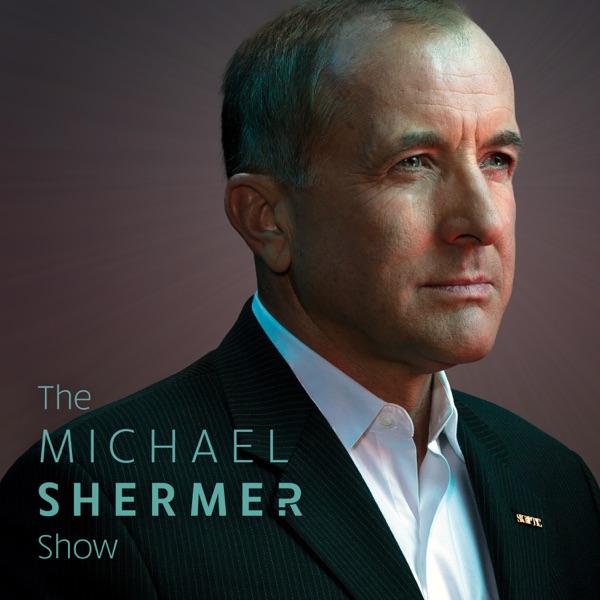
The Michael Shermer Show
The Michael Shermer Show is a series of long-form conversations between Dr. Michael Shermer and leading scientists, philosophers, historians, scholars, writers and thinkers about the most important issues of our time.
- Natural Sciences chart
- #15
- Episodes
- 646
- Releases
- Weekly
- Typical length
- 1 hr 20 min
- On air since
- 2015
- Latest episode
- 3 days ago
Episodes
646 episodes, newest first
-
1 hr 11 min
How Much Credit Do You Deserve for Your Life?
Episode 640
Show notes
We tend to explain success by looking at what people did right, while overlooking everyone who made the same choices and failed.
Philosopher Duncan Pritchard joins Michael Shermer to discuss his book, Tempting Fate: A Philosophical Guide to Risk, Luck, and a Meaningful Life, and how to make decisions when even the best preparation can't guarantee a good outcome.
Duncan Pritchard is UC Distinguished Professor of Philosophy at the University of California, Irvine. He works mainly in epistemology, and has published widely in this area, including the application of epistemological ideas to such domains as religion, law, and cognitive science. His new book is Tempting Fate: A Philosophical Guide to Risk, Luck, and a Meaningful Life.
-
1 hr 20 min
Why Consciousness Needs a Body
Episode 638
Show notes
Why does being alive feel like something? Neuroscientist Antonio Damasio argues that the answer begins with the body's need to stay alive. Hunger, thirst, pain, and pleasure tell us how we're doing and push us to act. These basic feelings, he says, are the foundation of consciousness.
Damasio returns to the show to discuss his new book, Natural Intelligence and the Logic of Consciousness, why feelings and emotions are different, what your dog knows about you, and why he thinks Francis Crick looked in the wrong place for the origins of conscious experience.
If consciousness depends on a living body, could a computer ever have it? And would uploading your brain actually preserve you? Damasio leaves room for a form of machine consciousness, though he argues it would be fundamentally different from ours. He also talks about what brain injuries reveal about the mind, how psychedelics change our perception, where human choice comes from, and why religion offers such powerful comfort.
Antonio Damasio is David Dornsife Professor of Neuroscience, Psychology and Philosophy, and director of the Brain and Creativity Institute at the University of Southern California, Los Angeles. Considered one of the most eminent scientists of our time, he has made fundamental contributions to the understanding of brain processes and their relationship to emotions and consciousness. He has discussed his research in books such as Descartes' Error, The Sensation of What Happens, Looking for Spinoza, and The Strange Order of Things.
-
42 min
Racism and White Guilt: Has America Changed More Than We Admit? | Shelby Steele & Eli Steele
Episode 637
Show notes
Can fighting racism end up reinforcing it? Shelby Steele grew up under segregation and became a Black militant in the 1960s. Today, he argues that White guilt has created a different racial problem: treating Black Americans as permanent victims who cannot succeed without White help. Shelby and his son, filmmaker Eli Steele, join Michael Shermer to discuss White Guilt, their new documentary about Shelby's life and America's changing racial politics. Shelby recalls a university colleague who assumed she could count on his vote simply because he was Black. He explains why he sees the same thinking in affirmative action and the expectation that Black Americans should share the same beliefs. Michael asks whether affirmative action was ever justified and how much America has changed since the Civil Rights Movement. For Shelby and Eli, what's at stake is the individual, the radical idea that every human being stands equal under the law, fully accountable for his own life, free to rise or fall on his own terms. White guilt doesn't just undermine the individual. It replaces the individual with the tribe, and freedom with the scramble for victim status. The documentary White Guilt is available for purchase at https://www.whiteguiltfilm.com/ and streaming on Amazon Prime, Apple TV, and Google Play. Eli Steele is a filmmaker and writer. He has made over 20 documentaries. He has written for the Wall Street Journal, City Journal, Quillette, and other publications. He is the son of Shelby Steele. Shelby Steele is a senior fellow at the Hoover Institution at Stanford University. His work spans several books, documentary films, essays, and scholarly articles. His honors include the National Book Critics Circle Award for "The Content of Our Character," an Emmy Award, a National Humanities Medal, and a Bradley Prize.
-
1 hr 38 min
Would You Want to Know If You Were Wrong?
Episode 636
Show notes
What do you make of an experience you can't explain? A strange light in the sky, a book flying off a desk, a coincidence that feels too improbable to be chance? Social psychologist Barry Markovsky joins Michael Shermer to discuss his new book Everyday Extraordinary and the experiences that have kept him studying paranormal beliefs for decades—including his own childhood UFO sighting and a supposedly haunted vape shop.
Markovsky explains how friends, communities, and our sense of who we are shape what we believe—and why changing someone's mind can take more than better evidence.
Barry Markovsky is Distinguished Professor Emeritus of Sociology at University of South Carolina. His articles on ghosts, UFOs, and coincidences appear at TheConversation.com, which disseminates them to major news outlets worldwide. To date, more than a million readers have downloaded them. His new book is Everyday Extraordinary.
-
46 min
Does Consciousness Break the Laws of Physics?
Episode 635
Show notes
If we could explain everything happening in your brain, would there still be something left to explain about you? Physicist Avshalom Elitzur thinks so—and argues that accounting for consciousness may require changing the laws of physics. In this lively conversation, Michael Shermer challenges Elitzur on why subjective experience should be anything more than a product of the brain, whether an AI could be conscious, and what a hypothetical human without consciousness would have to say about any of this.
Avshalom Elitzur is an Affiliate Professor at the Institute for Quantum Studies, Chapman University, and a senior researcher at Iyar, the Israel Institute for Advanced Research. He works in the foundations of quantum mechanics and is best known for the Elitzur–Vaidman bomb-testing problem.
-
1 hr 29 min
Jared Diamond: How Much Can One Person Change History?
Episode 634
Show notes
Would World War II have happened without Hitler? Would someone else have built Apple without Steve Jobs? Jared Diamond joins Michael Shermer to ask how much history depends on particular people.
From Darwin's discoveries to the rise of Christianity, Diamond considers when someone is truly irreplaceable, when someone else would have done much the same thing, and how we can tell the difference.
Jared Diamond is the Pulitzer Prize-winning author of the seminal million-copy-bestseller Guns, Germs, and Steel, which was named one of Time magazine's best non-fiction books of all time, Collapse, a No. 1 international bestseller, and The World Until Yesterday, among other books. A professor of geography at UCLA and noted polymath, Diamond's work has been influential in the fields of anthropology, biology, ornithology, ecology and history, among others. His new book is Profits, Prophets, Coaches, and Kings: (When) Do Leaders Matter?
-
43 min
Why America Failed to Stop 9/11 | Gerald Posner & Michael Shermer
Show notes
How did 19 hijackers evade the world's most advanced intelligence apparatus despite years of warnings? Twenty-five years after 9/11, journalist Gerald Posner joins Michael Shermer to explain the security failures that left America vulnerable. Those failures, compounded by government secrecy, have helped sustain suspicions that officials orchestrated the attacks or deliberately allowed them to happen.
What does the evidence show, and have we learned the right lessons?
-
1 hr 45 min
Why Be Honest When Cheating Pays?
Episode 632
Show notes
Most of us think of ourselves as honest. But would we still tell the truth if lying got us what we wanted—and nobody would ever find out? Philosopher Christian Miller joins Michael Shermer to discuss his new book The Honesty Crisis and the uncomfortable gap between having a reputation for honesty and actually being honest.
Christian B. Miller is the A.C. Reid Professor of Philosophy at Wake Forest University. He is the author of over 130 articles as well as several books. Thanks to a $4.4 million grant from the John Templeton Foundation, he directed The Honesty Project, one of the largest research initiatives ever undertaken on honesty. His new book is The Honesty Crisis: Preserving Our Most Treasured Virtue in an Increasingly Dishonest World.
-
1 hr 24 min
Is the Future Unknowable? Uncertainty, Free Will, and the Limits of Science
Episode 631
Show notes
What if uncertainty isn't a temporary problem science will eventually solve, but a fundamental feature of reality? Neuroscientist Stuart Firestein joins Michael Shermer to make the case that the universe may be far less deterministic—and the future far less predictable—than we like to imagine.
Firestein and Shermer discuss chaos and complexity, Darwin and randomness, free will, scientific progress, the replication crisis, COVID and the problem of communicating uncertainty, why humans are so bad at probability, and why even enormous amounts of data can fail to predict individual people or events.
Stuart Firestein is a professor of neuroscience at Columbia University and a member of the Santa Fe Institute. He has published over one hundred scientific papers in journals such as Nature, Science, Cell, and Neuron. He is a Guggenheim fellow, a member of the advisory committee for the Alfred P. Sloan Foundation, and an elected fellow of the American Association for the Advancement of Science. His new book is It Could Be Otherwise: Science in the Age of Uncertainty.
-
1 hr 14 min
Why We Want to Believe in Aliens and Why We Still Haven't Found Them
Episode 630
Show notes
UFOs were once the stuff of tabloids and conspiracy theories. Today they're the subject of congressional hearings, Pentagon investigations, mainstream news coverage, and a new wave of claims about government cover-ups and alien technology. Adam Kirsch, senior editor at The Atlantic and author of We Want to Believe: How Aliens Went Mainstream and Why It Matters, joins Michael Shermer to ask what changed—and why the idea of extraterrestrial visitors has such a powerful hold on us.
They discuss Roswell, UFO "disclosure," eyewitness testimony, government secrecy, alien abductions, Carl Sagan and Contact, the religious impulse behind UFO belief, and the difference between testimony and scientific evidence. The conversation also turns to the serious scientific search for extraterrestrial intelligence: the Fermi paradox, why decades of SETI have found nothing, how rare intelligent life might be, and whether our ideas about aliens ultimately tell us more about ourselves than about anything actually out there.
Adam Kirsch is the author of several books of poetry and criticism and a senior editor at The Atlantic. A 2016 Guggenheim Fellow, Kirsch has written for publications including The New Yorker, Slate, The Times Literary Supplement, The New York Times Book Review, Poetry, and Tablet. His new book is We Want to Believe: How Aliens Went Mainstream and Why It Matters.
-
1 hr 18 min
Is There a Second Arrow of Time? A New Law of Evolution, Information, and Complexity
Episode 629
Show notes
Why does the universe produce ever more elaborate forms, from atoms and minerals to cells, organisms, brains, technology, and civilization? The familiar laws of physics can explain much of what happens in nature, but Robert Hazen and Michael Wong argue that something important has been missing: a law describing how evolving systems generate and select new forms over time.
Michael Shermer speaks with Hazen and Wong about their proposed law of increasing functional information, the central idea behind their new book Time's Second Arrow. They discuss entropy and the second law of thermodynamics, the origin of life, the Cambrian explosion, emergence and complexity, Stephen Jay Gould and evolutionary contingency, whether evolution has a direction, and why the same basic process of variation and selection may apply far beyond biology.
Shermer also presses them on what evidence could falsify their theory, whether AI could evolve far faster than biological organisms, and the biggest question of all: Does any of this imply that the universe has a purpose?
Robert M. Hazen, a geoscientist at the Carnegie Institution for Science, is the author of Symphony in C, among other titles.
Michael L. Wong is a planetary scientist and astrobiologist at the Carnegie Institution for Science.
-
1 hr 57 min
Why Good People Disagree About Right and Wrong
Episode 628
Show notes
Why do reasonable people disagree so strongly about right and wrong? And why are we so quick to assume that people on the other side of a moral or political issue are irrational, selfish, ignorant, or simply bad?
Michael Shermer speaks with Cornell psychologist Audun Dahl, author of Between Fixed and Fickle: Why Our Moral Views Keep Changing, about how human morality develops and why many familiar explanations fall short.
They discuss whether babies are born with a moral sense, what children and other primates can really tell us about the origins of morality, how parents shape their children's values, classic experiments in moral psychology, and whether science can tell us what is right and wrong. The conversation also turns to abortion, competing rights, immigration, religion, and the growing tendency to misunderstand and demonize people who reach different moral conclusions.
Audun Dahl is a professor of psychology at Cornell University, where he directs the Developmental Moral Psychology Lab. His research examines how people develop ideas about right and wrong across the lifespan, from infancy through adulthood, and how moral judgments are shaped by everyday social interactions. He is the author of Between Fixed and Fickle: Why Our Moral Views Keep Changing.
-
1 hr 23 min
Are We Building a God? AI, Superintelligence, and the Coming Singularity
Episode 627
Show notes
Robert Wright joins Michael Shermer to discuss his new book, The God Test: Artificial Intelligence and Our Coming Cosmic Reckoning, and why he thinks the AI revolution may be moving much faster than most people realize. Wright argues that deep learning is not just a new way of programming computers. In an important sense, it resembles evolution: neural networks discover solutions for themselves, sometimes recreating cognitive functions that natural selection built into human brains. That helps explain why AI capabilities have advanced so quickly, and why increasingly autonomous systems and recursive self-improvement could accelerate the process even further.
Shermer presses Wright on what all of this actually means. Does an AI understand what it says? Could it be conscious? Why would a superintelligence ever seek power? Is human extinction a realistic possibility, or science-fiction doomerism? They discuss AI deception and theory of mind, John Searle's Chinese Room, bioweapons and cyberattacks, the risk of a U.S.-China AI arms race, regulation, surveillance, and the growing concentration of power in governments and tech companies.
The conversation ends with Wright's larger philosophical question: if humanity really is building something with godlike power, what kind of god are we going to build, and are we mature enough to survive it?
Robert Wright is the New York Times bestselling author of The Evolution of God (a finalist for the Pulitzer Prize), Nonzero, The Moral Animal, and Three Scientists and their Gods (a finalist for the National Book Critics Circle Award). He has taught at the University of Pennsylvania and at Princeton University, where he also created the popular online course "Buddhism and Modern Psychology." He is currently Visiting Professor of Science and Religion at Union Theological Seminary in New York.
-
2 hr 4 min
Can You Trust Wikipedia? Co-Founder Larry Sanger on Wikipedia's Bias and Why He Was Banned
Episode 626
Show notes
Michael Shermer speaks with Wikipedia co-founder Larry Sanger shortly after Sanger was permanently banned from editing the site he helped create.
Sanger tells the story of Wikipedia's founding, how its ideal of open collaboration hardened into a system dominated by a relatively small group of powerful editors, and why he believes its rules on sourcing and "consensus" now produce political and religious bias.
In the second half of the conversation, Shermer and Sanger shift gears completely and discuss whether religious faith can be rational, the philosophical case for God, the resurrection, the Trinity, repentance and salvation, and whether a future superintelligent AI could become indistinguishable from God.
-
1 hr 4 min
How to Think Clearly About a World in Crisis: Iran, China, Russia, and the West's Economic Pessimism
Episode 625
Show notes
Michael Shermer speaks with political scientist Marlene Laruelle about Russia's turbulent transformation during the 1990s and the rise of Vladimir Putin, why the Kremlin so badly misjudged Ukraine, China's rise and its ambitions regarding Taiwan, why killing Iran's Supreme Leader and much of its senior leadership did not bring down the regime, the limits of foreign aid and sanctions, mass surveillance, economic nationalism, and whether Western democracy can survive an age of economic pessimism and technological control.
Marlene Laruelle is a professor in the Department of Political Science at Luiss University in Rome. From 2011 to 2025, she served as research professor of international affairs and political science at George Washington University. She directs the Illiberalism Studies Program, a transatlantic initiative based in Washington, D.C., and Paris at Inalco. A specialist in Russia and the post-Soviet region, her work examines ideology, geopolitics, and culture, with a current focus on the rise of illiberal and postliberal ideologies in Europe and the United States.
-
55 min
The Truth About Sex Differences (Steve Stewart-Williams)
Episode 624
Show notes
How do men and women differ? Where do the differences come from? And how do they shape modern life?
Drawing on a century of research and a billion years of evolution, Steve Stewart-Williams explains why many sex differences appear despite socialization, not because of it; why in our mating and parenting patterns, humans are more like the average bird than the average mammal; and why sex differences are sometimes a sign of societal health rather than injustice.
Steve Stewart-Williams is a professor of psychology at the University of Nottingham Malaysia. His first book, Darwin, God, and the Meaning of Life, was published in 2010. His second, The Ape That Understood the Universe, was published in 2018. His new book is A Billion Years of Sex Differences.
-
17 min
America at 250: What Did the Founders Get Right?
Episode 623
Show notes
Michael Shermer makes the case that the U.S. Founding Fathers were not only steeped in Enlightenment values on which the Declaration of Independence was based, but they were also scientists searching to discover moral truths and values on which to base a rational society, which they succeeded in doing in this document along with the Constitution.
-
1 hr 32 min
When History Goes on Trial: Demjanjuk, Eichmann, and Justice After Atrocity
Episode 622
Show notes
John Demjanjuk lived for decades as a retired autoworker in suburban Cleveland. Then investigators accused him of being "Ivan the Terrible," one of the most notorious guards at Treblinka. What followed was one of the strangest and most troubling Nazi war-crimes cases of the postwar era: extradition, eyewitness testimony, a death sentence, a reversal, and a final prosecution many years later.
In this episode, Michael Shermer talks with Lawrence Douglas, professor at Amherst College and author of The Criminal State: War Atrocity and the Dream of International Justice, about Demjanjuk, Eichmann, Nuremberg, Holocaust denial, and the problem of proving atrocities decades after they happened.
How reliable is eyewitness memory after 40 or 50 years? What did Nuremberg actually establish? Was Eichmann really just a bureaucrat? And can a courtroom ever deliver justice for crimes almost too large to comprehend?
Lawrence Douglas is the James J. Grosfeld Professor of Law, Jurisprudence, and Social Thought at Amherst College and a Guggenheim fellow. His many books include The Right Wrong Man and The Memory of Judgment. His writing has appeared in leading publications such as Harper's, The Wall Street Journal, and The Economist. His new book is The Criminal State: War Atrocity and the Dream of International Justice.
-
29 min
Why I Joined the Government UAP Science Advisory Council
Episode 621
Show notes
Michael Shermer has been appointed to the newly formed UAP Science Advisory Council, formed at the request of the White House and in coordination with the All-domain Anomaly Resolution Office (AARO), the Office of the Director of National Intelligence (ODNI), the FBI, and other agencies.
The council brings together experts from a wide range of disciplines—including astrophysics, oceanography, molecular biology, anthropology, psychology, artificial intelligence, and instrumentation—to provide scientific guidance on the study of unidentified anomalous phenomena (UAP).
-
1 hr 34 min
Massimo Pigliucci on Doubt, Moral Courage, and Living Without Illusions
Episode 620
Show notes
What does it mean to live well when certainty is unavailable?
Michael Shermer speaks with Massimo Pigliucci about moral character, ancient philosophy, and the difficult art of making decisions without easy answers. The conversation moves from Cicero and Stoicism to the legacy of the New Atheism, asking why rejecting religion is not the same as having a philosophy of life.
They discuss virtue ethics, moral dilemmas, effective altruism, faith, free will, democracy, human flourishing, and the uneasy relationship between facts and values.
From the trolley problem and Peter Singer's drowning child thought experiment to the ethics of charity, the limits of utilitarian thinking, and the dangers of tribalism, this episode asks how we should act when rules fail, consequences are uncertain, and good intentions are not enough.
Massimo Pigliucci is a bestselling author, philosopher, evolutionary biologist, and the K.D. Irani Professor of Philosophy at the City College of New York. His work spans evolutionary biology, philosophy of science, pseudoscience, and practical philosophy. His latest book is How to Be a Happy Skeptic: The Power of Doubt in a Meaningful Life.
On these lists
The Michael Shermer Show is one of the shows picked out on each of these





More in Natural Sciences
Placed highest on Apple Podcasts' Natural Sciences chart right now