Podcast
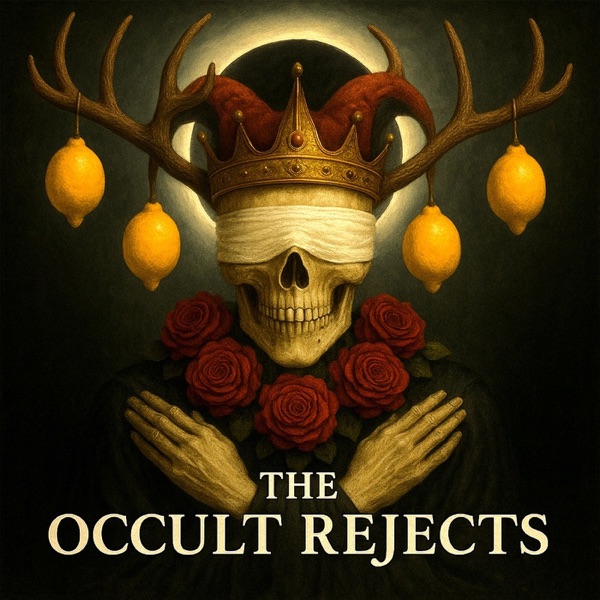
The Occult Rejects
Occultists, Rejects, and Mystics trying to educate others about magick and occultism so others can figure out who they are and the world around them.
- Episodes
- 988
- Releases
- Daily
- Typical length
- 1 hr 5 min
- On air since
- 2021
- Latest episode
- 1 day ago
Episodes
988 episodes, newest first
-
1 hr 2 min
The Mechanics of Magick: The Ecstatic Body Episode 3: From Humors to Hysteria
Show notes
Links For The Occult Rejects
https://linktr.ee/theoccultrejectsOccult Research Institute
https://www.occultresearchinstitute.org/Substack
https://substack.com/@theoccultrejects?r=7auau0&utm_campaign=profile&utm_medium=profile-pageCash App
https://cash.app/$theoccultrejectsVenmo
@TheOccultRejectsPatreon
https://www.patreon.com/TheOccultRejectsPrimary and Foundational Medical Texts
Avicenna. The Canon of Medicine of Avicenna. Translated by O. Cameron Gruner. London: Luzac & Company, 1930.
Breuer, Josef, and Sigmund Freud. Studies on Hysteria. Translated and edited by James Strachey, with Alix Strachey. New York: Basic Books, 1957. Originally published 1895.
Charcot, Jean-Martin. Leçons sur les maladies du système nerveux faites à la Salpêtrière. 3 vols. Paris: Adrien Delahaye and Émile Lecrosnier, 1872–1887.
Colombo, Realdo. De re anatomica. Venice: Nicolò Bevilacqua, 1559.
Descartes, René. The Passions of the Soul. Translated by Stephen H. Voss. Indianapolis: Hackett Publishing, 1989. Originally published 1649.
Descartes, René. Treatise of Man. Translated by Thomas Steele Hall. Cambridge, MA: Harvard University Press, 1972.
Falloppio, Gabriele. Observationes anatomicae. Venice, 1561.
Ficino, Marsilio. Three Books on Life. Translated by Carol V. Kaske and John R. Clark. Binghamton, NY: Medieval & Renaissance Texts & Studies, 1989.
Freud, Sigmund. Three Essays on the Theory of Sexuality. In The Standard Edition of the Complete Psychological Works of Sigmund Freud, vol. 7, translated and edited by James Strachey, 123–246. London: Hogarth Press, 1953. Originally published 1905.
Galvani, Luigi. Commentary on the Effects of Electricity on Muscular Motion. Translated by Robert Montraville Green. Cambridge, MA: Elizabeth Licht, 1953. Originally published 1791.
Haller, Albrecht von. “De partibus corporis humani sensilibus et irritabilibus.” Commentarii Societatis Regiae Scientiarum Gottingensis 2 (1753): 114–158.
Harvey, William. An Anatomical Disputation Concerning the Movement of the Heart and Blood in Living Creatures. Translated by Gweneth Whitteridge. Oxford: Blackwell Scientific Publications, 1976. Originally published 1628.
Janet, Pierre. L’Automatisme psychologique: Essai de psychologie expérimentale sur les formes inférieures de l’activité humaine. Paris: Félix Alcan, 1889.
Mesmer, Franz Anton. Mesmerism: A Translation of the Original Medical and Scientific Writings of F. A. Mesmer. Translated by George Bloch. Los Altos, CA: William Kaufmann, 1980.
Paracelsus. Selected Writings. Edited by Jolande Jacobi. Translated by Norbert Guterman. Princeton, NJ: Princeton University Press, 1951.
Vesalius, Andreas. The Fabric of the Human Body: An Annotated Translation of the 1543 and 1555 Editions of “De humani corporis fabrica libri septem.” Translated by Daniel H. Garrison and Malcolm H. Hast. 2 vols. Basel: Karger, 2014.
Medieval Islamic Medicine and Its Transmission
Burnett, Charles, and Danielle Jacquart, eds. Constantine the African and ʿAlī ibn al-ʿAbbās al-Maǧūsī: The Pantegni and Related Texts. Leiden: Brill, 1994.
Jacquart, Danielle, and Claude Thomasset. Sexuality and Medicine in the Middle Ages. Translated by Matthew Adamson. Princeton, NJ: Princeton University Press, 1988.
McGinnis, Jon, ed. Interpreting Avicenna: Critical Essays. Cambridge: Cambridge University Press, 2013.
McVaugh, Michael R. Medicine Before the Plague: Practitioners and Their Patients in the Crown of Aragon, 1285–1345. Cambridge: Cambridge University Press, 1993.
Pormann, Peter E., and Emilie Savage-Smith. Medieval Islamic Medicine. Edinburgh: Edinburgh University Press, 2007.
Siraisi, Nancy G. Avicenna in Renaissance Italy: The Canon and Medical Teaching in Italian Universities after 1500. Princeton, NJ: Princeton University Press, 1987.
Siraisi, Nancy G. Medieval and Early Renaissance Medicine: An Introduction to Knowledge and Practice. Chicago: University of Chicago Press, 1990.
Medieval and Early Modern Gender, Reproduction, and Sexuality
Green, Monica H. Making Women’s Medicine Masculine: The Rise of Male Authority in Pre-Modern Gynaecology. Oxford: Oxford University Press, 2008.
King, Helen. The Disease of Virgins: Green Sickness, Chlorosis, and the Problems of Puberty. London: Routledge, 2004.
Laqueur, Thomas. Making Sex: Body and Gender from the Greeks to Freud. Cambridge, MA: Harvard University Press, 1990.
Murray, Jacqueline. “The Law of Sin That Is in My Members: The Problem of Male Embodiment.” In Gender and Holiness: Men, Women and Saints in Late Medieval Europe, edited by Samantha J. E. Riches and Sarah Salih, 9–22. London: Routledge, 2002.
Park, Katharine. Secrets of Women: Gender, Generation, and the Origins of Human Dissection. New York: Zone Books, 2006.
Park, Katharine. “The Rediscovery of the Clitoris: French Medicine and the Tribade, 1570–1620.” In The Body in Parts: Fantasies of Corporeality in Early Modern Europe, edited by David Hillman and Carla Mazzio, 171–193. New York: Routledge, 1997.
Stolberg, Michael. “A Woman Down to Her Bones: The Anatomy of Sexual Difference in the Sixteenth and Early Seventeenth Centuries.” Isis 94, no. 2 (2003): 274–299.
Renaissance Anatomy, Circulation, and the Early Nervous Body
Cunningham, Andrew. The Anatomical Renaissance: The Resurrection of the Anatomical Projects of the Ancients. Aldershot, UK: Scolar Press, 1997.
French, Roger. William Harvey’s Natural Philosophy. Cambridge: Cambridge University Press, 1994.
Kusukawa, Sachiko. Picturing the Book of Nature: Image, Text, and Argument in Sixteenth-Century Human Anatomy and Medical Botany. Chicago: University of Chicago Press, 2012.
Martensen, Robert L. The Brain Takes Shape: An Early History. Oxford: Oxford University Press, 2004.
O’Malley, Charles Donald. Andreas Vesalius of Brussels, 1514–1564. Berkeley: University of California Press, 1964.
Pagel, Walter. William Harvey’s Biological Ideas: Selected Aspects and Historical Background. Basel: Karger, 1967.
Sawday, Jonathan. The Body Emblazoned: Dissection and the Human Body in Renaissance Culture. London: Routledge, 1995.
Wear, Andrew. Knowledge and Practice in English Medicine, 1550–1680. Cambridge: Cambridge University Press, 2000.
Descartes, Mind, Brain, and Mechanical Physiology
Clarke, Desmond M. Descartes: A Biography. Cambridge: Cambridge University Press, 2006.
Gaukroger, Stephen. Descartes: An Intellectual Biography. Oxford: Clarendon Press, 1995.
Lokhorst, Gert-Jan. “Descartes and the Pineal Gland.” Stanford Encyclopedia of Philosophy. Stanford University, revised 2024.
Sutton, John. Philosophy and Memory Traces: Descartes to Connectionism. Cambridge: Cambridge University Press, 1998.
Alchemy, Natural Magic, Imagination, and Occult Philosophy
Bruno, Giordano. Cause, Principle and Unity and Essays on Magic. Edited by Richard J. Blackwell and Robert de Lucca. Cambridge: Cambridge University Press, 1998.
Copenhaver, Brian P. “Scholastic Philosophy and Renaissance Magic in the De vita of Marsilio Ficino.” Renaissance Quarterly 37, no. 4 (1984): 523–554.
Hanegraaff, Wouter J. Esotericism and the Academy: Rejected Knowledge in Western Culture. Cambridge: Cambridge University Press, 2012.
Newman, William R. Promethean Ambitions: Alchemy and the Quest to Perfect Nature. Chicago: University of Chicago Press, 2004.
Pagel, Walter. Paracelsus: An Introduction to Philosophical Medicine in the Era of the Renaissance. 2nd ed. Basel: Karger, 1982.
Walker, D. P. Spiritual and Demonic Magic from Ficino to Campanella. London: Warburg Institute, 1958.
Yates, Frances A. Giordano Bruno and the Hermetic Tradition. Chicago: University of Chicago Press, 1964.
Irritability, Electricity, and the Development of Neurophysiology
Clarke, Edwin, and L. S. Jacyna. Nineteenth-Century Origins of Neuroscientific Concepts. Berkeley: University of California Press, 1987.
Finger, Stanley. Origins of Neuroscience: A History of Explorations into Brain Function. Oxford: Oxford University Press, 1994.
Piccolino, Marco. “Luigi Galvani and Animal Electricity: Two Centuries after the Foundation of Electrophysiology.” Trends in Neurosciences 20, no. 10 (1997): 443–448.
Steinke, Hubert. Irritating Experiments: Haller’s Concept and the European Controversy on Irritability and Sensibility, 1750–90. Amsterdam: Rodopi, 2005.
Mesmerism, Suggestion, and Altered States
Crabtree, Adam. From Mesmer to Freud: Magnetic Sleep and the Roots of Psychological Healing. New Haven, CT: Yale University Press, 1993.
Darnton, Robert. Mesmerism and the End of the Enlightenment in France. Cambridge, MA: Harvard University Press, 1968.
Ellenberger, Henri F. The Discovery of the Unconscious: The History and Evolution of Dynamic Psychiatry. New York: Basic Books, 1970.
Harrington, Anne. The Cure Within: A History of Mind–Body Medicine. New York: W. W. Norton, 2008.
Gauld, Alan. A History of Hypnotism. Cambridge: Cambridge University Press, 1992.
Hysteria, Charcot, Janet, and Freud
Bogousslavsky, Julien, ed. Following Charcot: A Forgotten History of Neurology and Psychiatry. Basel: Karger, 2011.
Goldstein, Jan. Console and Classify: The French Psychiatric Profession in the Nineteenth Century. Cambridge: Cambridge University Press, 1987.
Makari, George. Revolution in Mind: The Creation of Psychoanalysis. New York: Harper, 2008.
Micale, Mark S. Approaching Hysteria: Disease and Its Interpretations. Princeton, NJ: Princeton University Press, 1995.
Micale, Mark S. “Charcot and the Idea of Hysteria in the Male: Gender, Mental Science, and Medical Diagnosis in Late Nineteenth-CenturAlso want to remind people about the website, if you're into reading we have tons of information by multiple contributors, and we got t-shirts up on the site if you're interested. Fun fact, the art is all based on the eyeball.
-
2 hr 2 min
The Occult Rejects with David Beth
Show notes
Links For The Occult Rejects
https://linktr.ee/theoccultrejects
Occult Research Institute
https://www.occultresearchinstitute.org/
Substack
https://substack.com/@theoccultrejects?r=7auau0&utm_campaign=profile&utm_medium=profile-page
Cash App
https://cash.app/$theoccultrejects
Venmo
@TheOccultRejects
Patreon
https://www.patreon.com/TheOccultRejectsAlso want to remind people about the website, if you're into reading we have tons of information by multiple contributors, and we got t-shirts up on the site if you're interested. Fun fact, the art is all based on the eyeball.
-
39 min
The History of Baphomet Part 2: How Baphomet Became Satan: From Lévi’s Goat to the Modern Sigil
Show notes
Links For The Occult Rejects
https://linktr.ee/theoccultrejects
Occult Research Institute
https://www.occultresearchinstitute.org/
Substack
https://substack.com/@theoccultrejects?r=7auau0&utm_campaign=profile&utm_medium=profile-page
Cash App
https://cash.app/$theoccultrejects
Venmo
@TheOccultRejects
Patreon
https://www.patreon.com/TheOccultRejectsBIBLIOGRAPHY — EPISODE TWO
ÉLIPHAS LÉVI AND THE NINETEENTH-CENTURY FOUNDATION
Lévi, Éliphas. Dogme de la haute magie. First installments, Paris, 1854. Earliest publication context for Lévi’s Baphomet drawing.
Lévi, Éliphas. Dogme et Rituel de la Haute Magie. Paris, 1855–1856.
Lévi, Éliphas. Dogme et Rituel de la Haute Magie. 2nd, greatly expanded ed. Paris/London/New York: Germer Baillière, 1861.
Lévi, Éliphas. Transcendental Magic: Its Doctrine and Ritual. Translated by Arthur Edward Waite. London, 1896.
Strube, Julian. “The ‘Baphomet’ of Eliphas Lévi: Its Meaning and Historical Context.” Correspondences 4 (2016): 37–79.
Du Potet de Sennevoy, Jean. La magie dévoilée. Paris, 1852. Important to the spiritualistic-magnetic context from which Lévi developed his theory of the magical agent.
Khunrath, Heinrich. Amphitheatrum Sapientiae Aeternae. First edition, 1595; expanded later edition, 1609. Directly relevant because Lévi explicitly invoked Khunrath’s androgyne while explaining the mixed-sex anatomy of Baphomet.
Forshaw, Peter J. The Mage’s Images: Heinrich Khunrath in His Oratory and Laboratory. Leiden: Brill, 2025. Detailed modern analysis of Khunrath’s Adam Androgyne and Rebis imagery, including the 1595 Solve / Coagula detail.
Hesteau de Nuysement, Clovis. Traittez de l’harmonie et constitution généralle du vray sel, secret des philosophes, et de l’esprit universel du monde. The Hague: Théodore Maire, 1639. Relevant for another alchemical print identified by Strube among the visual influences surrounding Lévi’s Baphomet.
Ragon, Jean-Marie. Orthodoxie maçonnique, suivie de la Maçonnerie occulte et de l’initiation hermétique. Paris: E. Dentu, 1853. Important immediate precursor linking alchemical matter, the Goat of Mendes, Kabbalistic ideas, and “specific magnetism”; Lévi reviewed the work in the year before his Baphomet appeared.
Decker, Ronald, Thierry Depaulis, and Michael Dummett. A Wicked Pack of Cards: The Origins of the Occult Tarot. London: Duckworth, 1996. Useful background for Lévi’s use of the Tarot of Marseille and the Devil card.
Wilkinson, Richard H. The Complete Gods and Goddesses of Ancient Egypt. London: Thames & Hudson, 2003. Useful for distinguishing the ram deity Banebdjedet and the ancient religious context of Mendes from later European “Goat of Mendes” constructions.
THEOSOPHY AND EARLY RECEPTION
Blavatsky, Helena Petrovna. Isis Unveiled. 2 vols. New York: J. W. Bouton, 1877. Important for the early esoteric reception of Lévi, the Astral Light, and the wider nineteenth-century occult synthesis.
Waite, Arthur Edward. Translator’s introduction and notes to Lévi’s Transcendental Magic. London, 1896. Useful for the Anglophone reception and criticism of Lévi.
DE GUAITA, WIRTH, AND THE GOAT-PENTAGRAM
de Guaita, Stanislas. La Clef de la Magie Noire. Paris, 1897. Primary source for the famous inverted goat-headed pentagram with Leviathan, Samael, and Lilith.
Wirth, Oswald. Le Symbolisme hermétique dans ses rapports avec l’alchimie et la Franc-Maçonnerie. Paris: Librairie Initiatique, 1909.
Wirth, Oswald. La Franc-Maçonnerie rendue intelligible à ses adeptes: Le Livre du Compagnon. 3rd ed. Paris, 1924. Important for Wirth’s goat-pentagram and his discussion of inverted polarity.
Wirth, Oswald. Le Tarot des imagiers du Moyen Age. Paris: Le Symbolisme / Émile Nourry, 1927. Important for Wirth’s identification of the Devil card with the Baphomet of the Templars.
ALEISTER CROWLEY AND THELEMA
Crowley, Aleister. The Confessions of Aleister Crowley. Edited by John Symonds and Kenneth Grant. London: Jonathan Cape, 1969.
Crowley, Aleister. Liber XV: Ecclesiae Gnosticae Catholicae Canon Missae, commonly known as The Gnostic Mass.
Crowley, Aleister. The Book of Lies. London, 1913.
Crowley, Aleister. Magick in Theory and Practice and Magick: Liber ABA, Book 4. Various editions.
O.T.O. manifestos and institutional documents. Useful for the Order’s constructed genealogies linking modern initiation with Templar, Masonic, Rosicrucian, Gnostic, and related traditions.
MAURICE BESSY AND MODERN SATANISM
Bessy, Maurice. Histoire en 1000 Images de la Magie. Paris, 1961.
Bessy, Maurice. A Pictorial History of Magic and the Supernatural. English ed., 1964.
LaVey, Anton Szandor. The Satanic Bible. New York: Avon Books, 1969.
LaVey, Anton Szandor. The Satanic Rituals. New York: Avon Books, 1972.
Church of Satan. “The History of the Origin of the Sigil of Baphomet and its Use in the Church of Satan.” Institutional history tracing de Guaita, Wirth, Bessy, the LaVeyan sigil, and the organization’s 2026 revision. Use as a primary institutional source rather than an independent authority on medieval Templar history.
van Luijk, Ruben. Children of Lucifer: The Origins of Modern Religious Satanism. Oxford: Oxford University Press, 2016.
Introvigne, Massimo. Satanism: A Social History. Leiden: Brill, 2016.
THE SATANIC TEMPLE AND THE MODERN MONUMENT
The Satanic Temple. Official materials concerning the Baphomet Monument, its 2014 commission, 2015 unveiling, and religious-representation campaigns.
Cave et al. v. Jester, No. 4:18-cv-00342 (E.D. Ark.), Opinion and Order and Judgment filed 31 March 2026; related Eighth Circuit appeals docketed in 2026. Primary legal sources for the Arkansas litigation involving equal treatment and the Baphomet monument.
Laycock, Joseph P. Speak of the Devil: How The Satanic Temple Is Changing the Way We Talk about Religion. New York: Oxford University Press, 2020.
MODERN OCCULTISM, SATANISM, AND SYMBOLIC RECEPTION
Hanegraaff, Wouter J. Works on Western esotericism and modern occultism, useful for the methodological distinction between documented transmission and retrospective esoteric genealogy.
Goodrick-Clarke, Nicholas. Works on modern Western esotericism and occult revival movements.
Faxneld, Per. Studies on modern Satanism, esotericism, gender, and religious transgression.
Partner, Peter. The Knights Templar and Their Myth. Useful for understanding how later esoteric and conspiratorial traditions continued to reinterpret Templar history.Also want to remind people about the website, if you're into reading we have tons of information by multiple contributors, and we got t-shirts up on the site if you're interested. Fun fact, the art is all based on the eyeball.
-
42 min
The History of Baphomet Part 1: Before The Goat
Show notes
Links For The Occult Rejects
https://linktr.ee/theoccultrejects
Occult Research Institute
https://www.occultresearchinstitute.org/
Substack
https://substack.com/@theoccultrejects?r=7auau0&utm_campaign=profile&utm_medium=profile-page
Cash App
https://cash.app/$theoccultrejects
Venmo
@TheOccultRejects
Patreon
https://www.patreon.com/TheOccultRejectsPRIMARY AND MEDIEVAL SOURCES
Anselm of Ribemont. Letter concerning the First Crusade and Antioch, 1098. Important for the early form Baphometh and the Crusading context in which the word first appears.
Gavaudan. Senhors, per los nostres peccatz. Late twelfth-century Occitan crusading poem. Consult the critical text and commentary available through RIALTO, especially the occurrences of Bafometz in an explicitly Christian-Muslim polemical context.
Austorc d’Aorlhac. Ai Dieus, per qu’as facha tan gran maleza. Mid-thirteenth-century Occitan lament. RIALTO’s commentary identifies Bafomet as probably referring to Muhammad and discusses the deformation of Muhammad’s name.
Ramon Llull tradition / Occitan Doctrina pueril. Medieval Occitan material containing the heading De Bafomet, useful as part of the broader linguistic history of forms associated with Muhammad and Islam.
Michelet, Jules, ed. Le Procès des Templiers. Paris: Imprimerie Royale, 1841–1851. Major published collection of the French Templar proceedings and an important source for testimony involving heads, idols, Baffometi, Baphometi, and related accusations.
Clement V. Vox in excelso, 22 March 1312. Papal decree suppressing the Order of the Temple.
The Chinon Parchment, August 1308. Papal record concerning the interrogation, penitence, absolution, and reconciliation of senior Templar leaders.
MODERN SCHOLARSHIP ON THE TEMPLARS
Barber, Malcolm. The Trial of the Templars. 2nd ed. Cambridge: Cambridge University Press, 2006.
Barber, Malcolm. The New Knighthood: A History of the Order of the Temple. Cambridge: Cambridge University Press, 1994.
Demurger, Alain. The Last Templar: The Tragedy of Jacques de Molay, Last Grand Master of the Temple. London: Profile Books, 2009.
Demurger, Alain. The Knights Templar: A New History. Translated by Teresa Lavender Fagan. London: Profile Books, 2007.
Nicholson, Helen J. The Knights Templar: A New History. Stroud: Sutton Publishing, 2001.
Partner, Peter. The Knights Templar and Their Myth. Rochester, VT: Destiny Books, 1990.
Frale, Barbara. “The Chinon Chart: Papal Absolution to the Last Templar, Master Jacques de Molay.” Journal of Medieval History 30, no. 2 (2004).
Wright, Thomas. Narratives of Sorcery and Magic. London, 1851. A nineteenth-century secondary compilation preserving discussion of the Templar testimony involving “Baffomet,” “Baphomet,” “Yalla,” and “Mahomet”; useful as a reception source and pointer back toward the trial editions rather than as a substitute for the medieval records.
RENAISSANCE ALCHEMY AND THE PRE-LÉVI VISUAL LANGUAGE
Rosarium Philosophorum. Frankfurt, 1550. Important for the illustrated alchemical conjunction of solar and lunar, masculine and feminine principles and for the hermaphroditic imagery that predates Lévi by three centuries.
Khunrath, Heinrich. Amphitheatrum Sapientiae Aeternae. First edition, 1595; expanded later edition, 1609. Essential for the Adam Androgyne and the Alchemical Hermaphrodite or Rebis, including the paired Solve / Coagula language later recalled by Lévi.
Forshaw, Peter J. The Mage’s Images: Heinrich Khunrath in His Oratory and Laboratory. Leiden: Brill, 2025. Major modern study of Khunrath’s engravings; especially useful for the sequence of the 1595 circular images, the Rebis, and the detail explicitly catalogued as “Solve [et] Coagula.”
Hesteau de Nuysement, Clovis. Traittez de l’harmonie et constitution généralle du vray sel, secret des philosophes, et de l’esprit universel du monde. The Hague: Théodore Maire, 1639. The volume contains a print identified in modern scholarship as another visual source relevant to Lévi’s later synthesis.
Guazzo, Francesco Maria. Compendium Maleficarum. Milan, 1608. Useful for the broader early-modern demonological visual environment in which goat-headed and winged devil imagery circulated, without treating those images as earlier Baphomets.
TEMPLAR SURVIVAL MYTHS AND ESOTERIC REINTERPRETATION
Le Forestier, René. La Franc-maçonnerie templière et occultiste aux XVIIIe et XIXe siècles. Paris/Louvain: Aubier-Montaigne/Editions Nauwelaerts, 1970.
Nicolai, Christoph Friedrich. Versuch über die Beschuldigungen, welche dem Tempelherrenorden gemacht worden, und über dessen Geheimniß. Berlin, 1782.
Hammer-Purgstall, Joseph von. “Mysterium Baphometis Revelatum.” 1818.Also want to remind people about the website, if you're into reading we have tons of information by multiple contributors, and we got t-shirts up on the site if you're interested. Fun fact, the art is all based on the eyeball.
-
1 hr 8 min
Homunculus: The Occult History of Creating Artificial Life
Show notes
Links For The Occult Rejects
https://linktr.ee/theoccultrejectsOccult Research Institute
https://www.occultresearchinstitute.org/Substack
https://substack.com/@theoccultrejects?r=7auau0&utm_campaign=profile&utm_medium=profile-pageCash App
https://cash.app/$theoccultrejectsVenmo
@TheOccultRejectsPatreon
https://www.patreon.com/TheOccultRejectsBibliography
PRIMARY AND HISTORICAL SOURCES
Apollonius Rhodius. Argonautica. Especially Book IV for the story of Talos.
Aristotle. Generation of Animals.
Aristotle. History of Animals. Relevant to ancient theories of reproduction and spontaneous generation.
Babylonian Talmud. Sanhedrin 65b. Rava's creation of an artificial man and the encounter with Rabbi Zeira.
Besetzny, Emil, ed. Die Sphinx: Freimaurerisches Taschenbuch. Vienna: Rosner, 1873. Especially “Die wahrsagenden Geister des Brs. Joh. Ferd. Grafen von Kueffstein,” beginning around p. 111. This is an important early printed source for the later story of Kueffstein's alleged “prophesying spirits” or homunculi.
Hartmann, Franz. The Life of Philippus Theophrastus Bombast of Hohenheim, Known by the Name of Paracelsus, and the Substance of His Teachings. London: George Redway, 1887. Hartmann reproduces the Kueffstein story while explicitly tracing it to Besetzny's 1873 Sphinx and alleged Masonic manuscripts and Kammerer's diary.
Hartsoeker, Nicolaas. Essay de dioptrique. Paris: Jean Anisson, 1694. Contains Hartsoeker's famous speculative depiction of a miniature preformed organism associated with spermist preformationism.
Homer. Iliad. Book XVIII. Relevant passages include Hephaestus's intelligent golden attendants and his self-moving tripods.
Ovid. Metamorphoses. Book X. Pygmalion and the animation of the manufactured human form.
Pseudo-Paracelsus / Paracelsian tradition. De natura rerum. Particularly the section traditionally cited for the generation of the homunculus. Modern scholarship makes the authorship and textual history substantially more complicated than older occult editions suggest.
Sefer Yetzirah / Book of Formation. Various recensions and translations. Foundational for later Jewish mystical traditions involving creation through letters, numbers, and divine language.
ALCHEMY, HOMUNCULI, AND ARTIFICIAL LIFE
Newman, William R. Promethean Ambitions: Alchemy and the Quest to Perfect Nature. University of Chicago Press, 2004. Particularly Chapter 4, “Artificial Life and the Homunculus.” This is one of the most important scholarly sources for the entire episode and for the larger medieval/early-modern debate over art versus nature.
Newman, William R. “The Homunculus and the Mandrake: Art Aiding Nature versus Art Faking Nature.” In Genesis Redux: Essays in the History and Philosophy of Artificial Life. University of Chicago Press, 2007. Especially useful for the relationship between the Paracelsian homunculus, mandrake/Alraun traditions, and artificial generation.
Newman, William R. “Bad Chemistry: Basilisks and Women in Paracelsus and pseudo-Paracelsus.” Ambix 67, no. 1 (2020): 30–46. DOI: 10.1080/00026980.2020.1720341.
Gantenbein, Urs Leo. “Real or Fake? New Light on the Paracelsian De natura rerum.” Ambix 67, no. 1 (2020): 4–29. DOI: 10.1080/00026980.2020.1720339. Essential for the disputed authorship, multiple-author evidence, and the 1571 earliest presently identified manuscript of De natura rerum.
Hirai, Hiro. “Into the Forger's Library: The Genesis of De natura rerum in Publication History.” Early Science and Medicine 24 (2019): 485–503. Important for the pseudo-Paracelsian publication context surrounding the text.
Murase, Amadeo. “The Homunculus and the Paracelsian Liber de imaginibus.” Ambix 67, no. 1 (2020): 47–61. DOI: 10.1080/00026980.2020.1720359. Useful for showing that the biological bottle-creature was not the only homunculus concept found within the broader Paracelsian textual tradition.
THE LIBER VACCAE / BOOK OF THE COW
Saif, Liana. “The Cows and the Bees: Arabic Sources and Parallels for Pseudo-Plato's Liber Vaccae (Kitāb al-Nawāmīs).” Journal of the Warburg and Courtauld Institutes 79 (2016): 1–47. Essential for the Arabic context, surviving fragments, textual transmission, and artificial-generation experiments.
Van der Lugt, Maaike. “‘Abominable Mixtures’: The Liber vaccae in the Medieval West, or The Dangers and Attractions of Natural Magic.” Traditio (2016). Particularly valuable for the Western reception of the Liber Vaccae, its controversial operations, and medieval arguments over natural versus illicit magic.
Page, Sophie. Magic in the Cloister: Pious Motives, Illicit Interests, and Occult Approaches to the Medieval Universe. Especially the chapter “The Liber Vaccae: Magical Uses of Monstrous Creations.” Useful for manuscript culture and the practical reception of the text in medieval magical collections.
Anonymous / Pseudo-Plato. Kitāb al-Nawāmīs / Liber Vaccae / Liber institutionum activarum. Surviving Arabic fragments and Latin manuscript tradition. The work circulated under several titles and pseudonymous attributions.
JĀBIR, TAKWĪN, AND ISLAMIC ALCHEMY
Haq, Syed Nomanul. Names, Natures and Things: The Alchemist Jābir ibn Hayyān and His Kitāb al-Ahjār (Book of Stones). Boston Studies in the Philosophy and History of Science, vol. 158. Important for the Jabirian corpus, theories of qualities and balance, and the complicated question of Jabirian authorship.
Kraus, Paul. Jābir ibn Hayyān: Contribution à l'histoire des idées scientifiques dans l'Islam. 2 vols. Cairo, 1942–1943. Foundational scholarship behind the theory that much of the Jabirian corpus emerged from a later intellectual school rather than exclusively from a single eighth-century author.
O'Connor, Kathleen Malone. The Alchemical Creation of Life (Takwīn) and Other Concepts of Genesis in Medieval Islam. PhD dissertation, University of Pennsylvania, 1994. A major study devoted specifically to takwīn, artificial generation, and concepts of life and creation in medieval Islamic alchemical thought.
GOLEM AND JEWISH ARTIFICIAL-HUMAN TRADITIONS
Idel, Moshe. Golem: Jewish Magical and Mystical Traditions on the Artificial Anthropoid. Albany: State University of New York Press, 1990. The major scholarly study for the development of golem traditions, Sefer Yetzirah, ritual techniques, language, and artificial anthropoids in Jewish mysticism.
Babylonian Talmud. Sanhedrin 65b.
Sefer Yetzirah. Various editions and translations.
MANDRAKE / ALRAUN
Newman, William R. “The Homunculus and the Mandrake: Art Aiding Nature versus Art Faking Nature.” In Genesis Redux, 2007.
Dafni, Amots, et al. “The Rise and Fall of Mandrake in Medicine.” Journal of Ethnopharmacology (2022/2023). DOI: 10.1016/j.jep.2022.115874. Useful for the historical medical use of mandrake and its transition between medicine, folklore, and magical practice.
A Comprehensive Review on the Ethnopharmacology, Phytochemistry, Pharmacology, and Toxicology of the Mandragora Genus. Review covering traditional uses, atropine, scopolamine, other alkaloids, pharmacology, and toxicity.
Grynkiewicz, Grzegorz, and Marcin Gadzikowska. “Tropane Alkaloids: Chemistry, Pharmacology, Biosynthesis and Production.” Molecules 24 (2019). Useful background for the pharmacology of atropine, hyoscyamine, scopolamine, and related tropane alkaloids.
PREFORMATION AND THE SPERMATIC HOMUNCULUS
Hartsoeker, Nicolaas. Essay de dioptrique. Paris: Jean Anisson, 1694.
The surviving work is especially valuable because Hartsoeker's famous figure has repeatedly been misrepresented as an actual microscopic observation. The historical evidence instead supports it as a speculative illustration associated with spermist preformation theory, and Hartsoeker himself did not use “homunculus” as the name for the figure.
LITERARY ARTIFICIAL LIFE
Shelley, Mary Wollstonecraft. Frankenstein; or, The Modern Prometheus. London, 1818.
Goethe, Johann Wolfgang von. Faust: Part Two. Completed shortly before Goethe's death and published in 1832. Particularly the laboratory creation and subsequent journey of the Homunculus.
THE CORTICAL HOMUNCULUS
Penfield, Wilder, and Edwin Boldrey. “Somatic Motor and Sensory Representation in the Cerebral Cortex of Man as Studied by Electrical Stimulation.” Brain 60, no. 4 (1937): 389–443. DOI: 10.1093/brain/60.4.389. Foundational source behind the cortical motor and sensory maps later popularly represented as the cortical homunculus.
Penfield, Wilder, and Theodore Rasmussen. The Cerebral Cortex of Man: A Clinical Study of Localization of Function. New York: Macmillan, 1950. The source for the familiar separate sensory and motor homunculus illustrations arranged along brain cross-sections.
Catani, Marco. “A Little Man of Some Importance.” Brain 140, no. 11 (2017): 3055–3061. https://doi.org/10.1093/brain/awx270. An open-access historical reassessment of Penfield and Boldrey's 1937 paper and its 126 cases.
Gandhoke, Gurpreet S., et al. “Edwin Boldrey and Wilder Penfield's Homunculus: A Life Given by Mrs. Cantlie (In and Out of Realism).” World Neurosurgery 132 (2019): 377–388. https://pubmed.ncbi.nlm.nih.gov/31470165/. Examines the illustrator Hortense Cantlie, the difference between the 1937 and 1950 presentations, and the limitations of the maps.
Production visual note (not spoken): The script discusses, but the Word file does not reproduce, a cortical homunculus diagram. For a video episode, display a properly licensed and credited pair of sensory and motor maps when this chapter begins. A reusable redrawn source is available at https://commons.wikimedia.org/wiki/File:Homunculus-de.svg ; verify license/attribution for any selected version. To showAlso want to remind people about the website, if you're into reading we have tons of information by multiple contributors, and we got t-shirts up on the site if you're interested. Fun fact, the art is all based on the eyeball.
-
1 hr 3 min
Adrenochrome: The Chemical, The Scientists, and The Blood-Harvesting Legend
Show notes
Links For The Occult Rejects
https://linktr.ee/theoccultrejectsOccult Research Institute
https://www.occultresearchinstitute.org/Substack
https://substack.com/@theoccultrejects?r=7auau0&utm_campaign=profile&utm_medium=profile-pageCash App
https://cash.app/$theoccultrejectsVenmo
@TheOccultRejectsPatreon
https://www.patreon.com/TheOccultRejectsRESEARCH BIBLIOGRAPHY
I. CHEMISTRY, MEDICINE, AND EXPERIMENTS
1. Weinstein, S., and R. J. Manning. “Intermediate Oxidation Products of Epinephrine.” Proceedings of the Society for Experimental Biology and Medicine 32, no. 7 (1935): 1096–1097. doi:10.3181/00379727-32-7983P.
Link: https://doi.org/10.3181/00379727-32-7983P
Access/evidence: Publisher text available. Episode use: Early adrenaline oxidation; do not describe this as proven isolation of modern adrenochrome.
2. Green, David Ezra, and Derek Richter. “Adrenaline and Adrenochrome.” Biochemical Journal 31, no. 4 (1937): 596–616. doi:10.1042/bj0310596.
Link: https://pmc.ncbi.nlm.nih.gov/articles/PMC1266980/
Access/evidence: Full article accessible. Episode use: Foundational chemistry and historical nomenclature.
3. Osmond, Humphry, and John Smythies. “Schizophrenia: A New Approach.” Journal of Mental Science 98, no. 411 (1952): 309–315. doi:10.1192/bjp.98.411.309.
Link: https://pubmed.ncbi.nlm.nih.gov/14917992/
Access/evidence: Citation verified; full text not reviewed. Episode use: Original proposed biochemical hypothesis.
4. Hoffer, Abram, Humphry Osmond, and John Smythies. “Schizophrenia: A New Approach. II. Result of a Year’s Research.” Journal of Mental Science 100, no. 418 (1954): 29–45. doi:10.1192/bjp.100.418.29.
Link: https://pubmed.ncbi.nlm.nih.gov/13152519/
Access/evidence: Citation and publisher extract verified; full paper not reviewed. Episode use: Early follow-up research.
5. Hoffer, Abram. “Adrenochrome in Blood Plasma.” American Journal of Psychiatry 114, no. 8 (1958): 752–753. doi:10.1176/ajp.114.8.752.
Link: https://psychiatryonline.org/doi/10.1176/ajp.114.8.752
Access/evidence: Citation verified; full paper paywalled. Episode use: Hoffer’s claimed measurement, not an accepted consensus.
6. Szára, Stephen, Julius Axelrod, and Seymour Perlin. “Is Adrenochrome Present in the Blood?” American Journal of Psychiatry 115, no. 2 (1958): 162–163. doi:10.1176/ajp.115.2.162.
Link: https://psychiatryonline.org/doi/abs/10.1176/ajp.115.2.162
Access/evidence: Publisher abstract available. Episode use: Reports nondetection using the researchers’ method; a direct historical contrast with Hoffer.
7. Cohen, Gerald, Bernard Holland, and Marcel Goldenberg. “The Stability of Epinephrine and Arterenol (Norepinephrine) in Plasma and Serum: A Comparison of Normal and Schizophrenic Subjects.” AMA Archives of Neurology & Psychiatry 80, no. 4 (1958): 484–487. doi:10.1001/archneurpsyc.1958.02340100084020.
Link: https://jamanetwork.com/journals/archneurpsyc/article-abstract/652760
Access/evidence: Publisher abstract/introduction available. Episode use: A related but distinct experimental question about catecholamine behavior.
8. Heacock, R. A. “The Chemistry of Adrenochrome and Related Compounds.” Chemical Reviews 59, no. 2 (1959): 181–237. doi:10.1021/cr50026a001.
Link: https://pubs.acs.org/doi/10.1021/cr50026a001
Access/evidence: Bibliographic record and period text identified. Episode use: Comprehensive contemporary chemistry review.
9. Payza, A. N., and M. E. Mahon. “Spectrofluorometric Estimation of Adrenochrome in Human Plasma.” Analytical Chemistry 31, no. 7 (1959): 1170–1174. doi:10.1021/ac60151a028.
Link: https://pubs.acs.org/doi/10.1021/ac60151a028
Access/evidence: Citation verified; full paper paywalled. Episode use: Analytical-method dispute and measurement limitations.
10. Payza, A. N., and Margaret Mahon. “Modification of Spectrofluorometric Determination of Aminochromes in Human Plasma.” Analytical Chemistry 32, no. 1 (1960): 17–19. doi:10.1021/ac60157a005.
Link: https://pubs.acs.org/doi/10.1021/ac60157a005
Access/evidence: Citation verified; full paper not reviewed. Episode use: Follow-up modification to assays.
11. Grof, Stanislav, M. Vojtěchovský, V. Vítek, and S. Pranková. “Clinical and Experimental Study of Central Effects of Adrenochrome.” Journal of Neuropsychiatry 4 (1963): 33–50.
Link: https://pubmed.ncbi.nlm.nih.gov/14089791/
Access/evidence: PubMed bibliography verified; full study not reviewed. Episode use: Historical publication and experimental research context; no specific numerical outcomes in the final script pending original paper.
12. Throne, M. L., and C. W. Gowdey. “A Critical Review of Endogenous Psychotoxins as a Cause of Schizophrenia.” Canadian Psychiatric Association Journal 12 (1967). doi:10.1177/070674376701200209.
Link: https://journals.sagepub.com/doi/10.1177/070674376701200209
Access/evidence: Publisher entry located; full review not reviewed. Episode use: Period critique of the psychotoxin hypothesis.
II. SCOTTISH RITE, ROCKEFELLER, AND HISTORICAL CORRESPONDENCE
13. Scottish Rite Masonic Museum & Library. Melvin M. Johnson Records, Dementia Praecox Committee archival descriptions, including June 1952 proceedings (Box 65, Folder 15) and September 1952 proceedings (Box 71, Folder 4).
Link: https://srmml.libraryhost.com/subjects/1437?page=2
Access/evidence: ARCHIVE CATALOG ONLY; minutes not acquired. Episode use: The catalog documents a collection; it does not disclose the meeting’s contents.
14. McGill University Library, Osler Library/Penfield Fonds. Nolan D. C. Lewis correspondence to Wilder Penfield, July 17, 1935.
Link: https://digital.library.mcgill.ca/images/penfieldfonds/large/pen_a_n_16_1_item07.pdf
Access/evidence: Original archival file identified; page-image check needed. Episode use: Early committee/program affiliation, long before the adrenochrome hypothesis.
15. Hoffer, Abram. Published 1980 article discussing the Scottish Rite Dementia Praecox Committee and the claimed 1952 Waldorf Astoria presentation. Journal of Orthomolecular Psychiatry 9, no. 1 (1980), starting p. 2.
Link: https://orthomolecular.org/library/jom/1980/pdf/1980-v09n01-p002.pdf
Access/evidence: Later participant account; not contemporaneous minutes. Episode use: Use attribution such as “Hoffer recalled” for 1952 events.
16. Rockefeller Foundation. Annual Report, 1954, pp. 86 and 110.
Link: https://www.rockefellerfoundation.org/wp-content/uploads/Annual-Report-1954-1.pdf
Access/evidence: OFFICIAL REPORT; cited amounts remain pending page-image review. Episode use: Separate reported Hoffer travel assistance from University of Saskatchewan schizophrenia research funding.
17. Rockefeller Foundation. Annual Report, 1957, pp. 107–108.
Link: https://www.rockefellerfoundation.org/wp-content/uploads/Annual-Report-1957-2.pdf
Access/evidence: OFFICIAL REPORT; page-image recheck pending. Episode use: Later Saskatchewan research support and Hoffer’s program role.
18. University of Saskatchewan / Saskatchewan Archives and associated holdings. Abram Hoffer Fonds inventory, including experimental records and Rockefeller Foundation correspondence. Digitized finding aid hosted by Purdue University Libraries.
Link: https://collections.lib.purdue.edu/psychoactive/assets/pdfs/HofferInventory.pdf
Access/evidence: ARCHIVE FINDING AID ONLY; folders/experiments not acquired. Episode use: Research papers, cat-experiment slides, and grant correspondence require direct access.
19. Huxley, Aldous, and Humphry Osmond. Psychedelic Prophets: The Letters of Aldous Huxley and Humphry Osmond. Edited by Cynthia Carson Bisbee, Paul Bisbee, Erika Dyck, Patrick Farrell, James Sexton, and James W. Spisak. Montreal: McGill-Queen’s University Press, 2018.
Link: https://www.jstor.org/stable/j.ctv7r40jc
Access/evidence: Published correspondence identified; specific passages should be checked against edition. Episode use: Primary historical correspondence in an edited scholarly edition; includes discussion of related compounds and research support.
III. INTELLIGENCE DOCUMENTS, PATENTS, AND REGULATION
20. Dulles, Allen W. Memorandum on psychochemical research, December 3, 1955. Foreign Relations of the United States, 1950–1955, The Intelligence Community, document 244. U.S. Department of State.
Link: https://history.state.gov/historicaldocuments/frus1950-55Intel/d244
Access/evidence: OFFICIAL TEXT AVAILABLE. Episode use: Cold War psychochemical context; does not show CIA adrenochrome administration.
21. Central Intelligence Agency. “Report of Trip, 6–11 April 1955, to [Redacted].” Report dated April 11, 1955; MORI/document number 146122, 44 pages.
Link: https://www.cia.gov/readingroom/docs/REPORT%20OF%20TRIP%2C%206-11%20APRIL%201955%2C%20TO%20%28DELETED%29%5B12885865%5D.pdf
Access/evidence: INDEXED LEAD ONLY; full scan not obtained. Episode use: Indexed excerpt appears to mention adrenochrome; exact author, page, and full context are unverified.
22. Patterson v. United States litigation materials. Court-filed exhibit dated April 6, 2012, listing CIA/MKULTRA FOIA records, including MORI 146122.
Link: https://edgewoodtestvets.org/court-filed-documents/pdfs/20120406-405-Patterson-Dec-ISO-MTC-22-Ex-V.pdf
Access/evidence: COURT EXHIBIT/INDEX; does not include the entire 1955 report. Episode use: Independent record identifier, not proof of a CIA adrenochrome experiment.
23. United States Patent and Trademark Office. Adrenochrome Compositions, U.S. Patent 2,581,850, issued January 8, 1952.
Link: https://patents.google.com/patent/US2581850A/en
Access/evidence: PATENT TEXT AVAILABLE. EpAlso want to remind people about the website, if you're into reading we have tons of information by multiple contributors, and we got t-shirts up on the site if you're interested. Fun fact, the art is all based on the eyeball.
-
1 hr 4 min
WHO Sold Us Halloween? A History w/ Christian Kenny & Nick (Occult Rejects)
Show notes
Links For The Occult Rejects
https://linktr.ee/theoccultrejectsOccult Research Institute
https://www.occultresearchinstitute.org/Substack
https://substack.com/@theoccultrejects?r=7auau0&utm_campaign=profile&utm_medium=profile-pageCash App
https://cash.app/$theoccultrejectsVenmo
@TheOccultRejectsPatreon
https://www.patreon.com/TheOccultRejectsAlso want to remind people about the website, if you're into reading we have tons of information by multiple contributors, and we got t-shirts up on the site if you're interested. Fun fact, the art is all based on the eyeball.
-
55 min
The History of The Occult Hermaphrodite
Show notes
Links For The Occult Rejects
https://linktr.ee/theoccultrejects
Occult Research Institute
https://www.occultresearchinstitute.org/
Substack
https://substack.com/@theoccultrejects?r=7auau0&utm_campaign=profile&utm_medium=profile-page
Cash App
https://cash.app/$theoccultrejects
Venmo
@TheOccultRejects
Patreon
https://www.patreon.com/TheOccultRejectsBIBLIOGRAPHY
ANCIENT GREEK AND ROMAN SOURCES
Diodorus Siculus. Bibliotheca Historica (Library of History), Book IV. Especially the discussion of Hermaphroditus as the offspring of Hermes and Aphrodite and as possessing combined male and female characteristics.
Ovid. Metamorphoses, Book IV, especially the episode of Salmacis and Hermaphroditus.
Plato. Symposium, especially Aristophanes’ speech, 189d–193d, for the myth of primordial male, female, and androgynous human beings and their division by Zeus.
Theophrastus. Characters, especially the discussion of the “Superstitious Man,” traditionally connected with early evidence for Hermaphroditus.
Posidippus. Hermaphroditus. Surviving fragment/testimonia concerning the lost Hellenistic comedy.
Ajootian, Aileen. “The Only Happy Couple: Hermaphrodites and Gender.” In studies of ancient representations of Hermaphroditus and erotic sculpture. Useful for the Hellenistic and Roman iconographic tradition.
Brisson, Luc. Sexual Ambivalence: Androgyny and Hermaphroditism in Graeco-Roman Antiquity. Berkeley: University of California Press, 2002. Important for the broader ancient history of androgyny and hermaphroditism.
JEWISH, RABBINIC, AND KABBALISTIC SOURCES
Genesis Rabbah 8:1. Especially the teachings concerning Adam as androgynos and du-parzufim.
Babylonian Talmud. Berakhot 61a and Eruvin 18a. For related rabbinic discussions of the original human as double-sided or possessing two faces.
Philo of Alexandria. De Opificio Mundi (On the Creation). Relevant to earlier Jewish-Hellenistic speculation concerning primordial humanity and sexual differentiation.
Sefer ha-Bahir. For early medieval Kabbalistic material contributing to later gendered sefirotic symbolism.
The Zohar. Especially passages concerning masculine and feminine divine configurations, the Shekhinah, Tiferet, Adam, and supernal union.
Tishby, Isaiah. The Wisdom of the Zohar: An Anthology of Texts. 3 vols. Translated by David Goldstein. Oxford: Littman Library, 1989.
Scholem, Gershom. Major Trends in Jewish Mysticism. New York: Schocken Books.
Scholem, Gershom. On the Kabbalah and Its Symbolism. Translated by Ralph Manheim. New York: Schocken Books, 1965.
Idel, Moshe. Kabbalah: New Perspectives. New Haven: Yale University Press, 1988.
Wolfson, Elliot R. Circle in the Square: Studies in the Use of Gender in Kabbalistic Symbolism. Albany: State University of New York Press, 1995.
Wolfson, Elliot R. Through a Speculum That Shines: Vision and Imagination in Medieval Jewish Mysticism. Princeton: Princeton University Press, 1994.
Wolfson, Elliot R. Language, Eros, Being: Kabbalistic Hermeneutics and Poetic Imagination. New York: Fordham University Press, 2005.
Brown, Jeremy Phillip. “God as Androgyne in Medieval Kabbalah: Toward a History of the Doctrine.” Traditio 80 (2025). Particularly important for reassessing older claims concerning the antiquity of fully developed divine-androgyny doctrines within Provençal Kabbalah.
CHRISTIAN CABALA AND RENAISSANCE OCCULT PHILOSOPHY
Pico della Mirandola, Giovanni. Conclusiones Nongentae (900 Conclusions). 1486.
Reuchlin, Johannes. De Verbo Mirifico. 1494.
Reuchlin, Johannes. De Arte Cabalistica. 1517.
Agrippa, Heinrich Cornelius. De Occulta Philosophia Libri Tres (Three Books of Occult Philosophy). Complete edition, 1533.
Copenhaver, Brian P., ed. and trans. Hermetica: The Greek Corpus Hermeticum and the Latin Asclepius in a New English Translation. Cambridge: Cambridge University Press, 1992.
Forshaw, Peter J. Studies on the conjunction of Cabala, magic, and chymistry in early-modern European esotericism. Particularly useful for understanding the intellectual environment connecting Christian Cabala with alchemical and magical traditions.
MEDIEVAL AND EARLY-MODERN ALCHEMY — PRIMARY SOURCES
Aurora Consurgens. Medieval/early Renaissance alchemical manuscript tradition. Especially important for the development of sexual, generative, and composite alchemical imagery before the printed Rosarium Philosophorum.
Rosarium Philosophorum. In De Alchimia. Frankfurt, 1550. Essential for the sequence of Sol and Luna, the royal couple, conjunction, death, purification, regeneration, and hermaphroditic transformation.
Khunrath, Heinrich. Amphitheatrum Sapientiae Aeternae. Hamburg, 1595; expanded posthumous edition, Hanau, 1609. Especially the circular figures known as Adam Androgyne, Rebis or Alchemical Hermaphrodite, and the Oratory-Laboratory.
Chymical Wedding of Christian Rosenkreutz. Strasbourg, 1616.
Maier, Michael. Atalanta Fugiens. 1617/1618. Especially Emblem XXXVIII, “Rebis, ut Hermaphroditus,” explicitly connecting the Rebis with Hermaphroditus, Mercury, and Venus.
Pseudo-Basil Valentine. Azoth, or The Azoth of the Philosophers. Early seventeenth-century tradition. Especially the celebrated diagram centered on the hermaphroditic Rebis.
Paracelsus. Selected alchemical, medical, and natural-philosophical writings. Useful for the broader Paracelsian environment inherited by Khunrath and later Christian alchemists.
MODERN SCHOLARSHIP ON ALCHEMY
Abraham, Lyndy. A Dictionary of Alchemical Imagery. Cambridge: Cambridge University Press, 1998.
Forshaw, Peter J. The Mage’s Images: Heinrich Khunrath in His Oratory and Laboratory. 4 vols. Leiden: Brill, 2025. Particularly important for Khunrath’s Adam Androgyne, Rebis or Alchemical Hermaphrodite, the structure of the four Theosophical Figures, and the relationship between Cabala, magic, alchemy, oratory, and laboratory.
Moran, Bruce T. Distilling Knowledge: Alchemy, Chemistry, and the Scientific Revolution. Cambridge, MA: Harvard University Press, 2005.
Newman, William R. Promethean Ambitions: Alchemy and the Quest to Perfect Nature. Chicago: University of Chicago Press, 2004.
Newman, William R. Atoms and Alchemy: Chymistry and the Experimental Origins of the Scientific Revolution. Chicago: University of Chicago Press, 2006.
Newman, William R., and Lawrence M. Principe. “Alchemy vs. Chemistry: The Etymological Origins of a Historiographic Mistake.” Early Science and Medicine 3, no. 1 (1998): 32–65.
Principe, Lawrence M. The Secrets of Alchemy. Chicago: University of Chicago Press, 2013.
Principe, Lawrence M., ed. Chymists and Chymistry: Studies in the History of Alchemy and Early Modern Chemistry. Sagamore Beach, MA: Science History Publications, 2007.
Devun, Leah. The Shape of Sex: Nonbinary Gender from Genesis to the Renaissance. New York: Columbia University Press, 2021. Especially useful for medieval discussions of Adam, bodily sex, hermaphroditic figures, and alchemical imagery.
ÉLIPHAS LÉVI AND BAPHOMET
Lévi, Éliphas. Dogme et Rituel de la Haute Magie. 2 vols. Paris, 1854–1856.
Lévi, Éliphas. Transcendental Magic: Its Doctrine and Ritual. Translated by Arthur Edward Waite. London, 1896.
Lévi, Éliphas. The Doctrine and Ritual of High Magic: A New Translation. Translated by John Michael Greer and Mark Anthony Mikituk. New York: TarcherPerigee, 2017.
Churton, Tobias. Éliphas Lévi and the French Occult Revival. Rochester, VT: Inner Traditions, 2016.
GOLDEN DAWN
Regardie, Israel. The Golden Dawn. Multiple editions. Major published collection of Golden Dawn rituals, knowledge lectures, magical instructions, and Inner Order material.
Crowley, Aleister, ed. The Equinox, vol. I. London, 1909–1913. Relevant for Golden Dawn-derived ritual material published by Crowley, including the symbolism of equilibrium and the Neophyte ceremony.
Howe, Ellic. The Magicians of the Golden Dawn: A Documentary History of a Magical Order, 1887–1923. London: Routledge & Kegan Paul, 1972.
Gilbert, R. A. The Golden Dawn: Twilight of the Magicians. Wellingborough: Aquarian Press, 1983.
Gilbert, R. A. The Golden Dawn Companion. Wellingborough: Aquarian Press, 1986.
ALEISTER CROWLEY, THELEMA, AND THE O.T.O.
Crowley, Aleister. Liber AL vel Legis (The Book of the Law). 1904.
Crowley, Aleister. Liber XV: Ecclesiae Gnosticae Catholicae Canon Missae (The Gnostic Mass). Especially the Creed’s use of Chaos, Babalon, the Serpent and Lion, and Baphomet.
Crowley, Aleister. The Confessions of Aleister Crowley. Especially Chapter 85 for Crowley’s explicit discussion of adopting Baphomet as his O.T.O. motto.
Crowley, Aleister. Liber LII: Manifesto of the O.T.O.
Crowley, Aleister. Liber Agapé. Relevant to O.T.O. sexual-magical doctrine.
Crowley, Aleister. Liber Cheth vel Vallum Abiegni. Relevant to Babalon, dissolution, offering, and sexual-mystical symbolism.
Crowley, Aleister. The Book of Thoth. London, 1944.
Crowley, Aleister. Magick in Theory and Practice. Paris, 1929.
Bogdan, Henrik. Western Esotericism and Rituals of Initiation. Albany: State University of New York Press, 2007.
Bogdan, Henrik, and Martin P. Starr, eds. Aleister Crowley and Western Esotericism. Oxford: Oxford University Press, 2012.
Kaczynski, Richard. Perdurabo: The Life of Aleister Crowley. Revised and expanded edition. Berkeley: North Atlantic Books, 2010.
Urban, Hugh B. Magia Sexualis: Sex, Magic, and Liberation in Modern Western Esotericism. Berkeley: University of California Press, 2006.
JUNG AND THE PSYCHOLOGICAL REINTERPRETATION OF ALCHEMY
Jung, C. G. Psychology and Alchemy. Collected Works, vol. 12. Princeton: Princeton UniversiAlso want to remind people about the website, if you're into reading we have tons of information by multiple contributors, and we got t-shirts up on the site if you're interested. Fun fact, the art is all based on the eyeball.
-
59 min
Can Your Dreams Be Hacked? W/ Nick of The Occult Rejects
Show notes
Links For The Occult Rejects
https://linktr.ee/theoccultrejects
Occult Research Institute
https://www.occultresearchinstitute.org/
Substack
https://substack.com/@theoccultrejects?r=7auau0&utm_campaign=profile&utm_medium=profile-page
Cash App
https://cash.app/$theoccultrejects
Venmo
@TheOccultRejects
Patreon
https://www.patreon.com/TheOccultRejectsAlso want to remind people about the website, if you're into reading we have tons of information by multiple contributors, and we got t-shirts up on the site if you're interested. Fun fact, the art is all based on the eyeball.
-
1 hr 11 min
Beetlejuice and The Sacred Clown Part 2: History, Restriction, Misinterpretation, and a Deeper Connection
Show notes
Links For The Occult Rejects
https://linktr.ee/theoccultrejectsOccult Research Institute
https://www.occultresearchinstitute.org/Substack
https://substack.com/@theoccultrejects?r=7auau0&utm_campaign=profile&utm_medium=profile-pageCash App
https://cash.app/$theoccultrejectsVenmo
@TheOccultRejectsPatreon
https://www.patreon.com/TheOccultRejectsBIBLIOGRAPHY
Babcock, Barbara A., ed. The Reversible World: Symbolic Inversion in Art and Society. Ithaca, NY: Cornell University Press, 1978. This is one of the major theoretical works behind our discussion of symbolic inversion, reversal, reflexivity, and why societies sometimes institutionalize behavior that deliberately contradicts ordinary norms.
Black Elk [Nicholas Black Elk], as told through John G. Neihardt. Black Elk Speaks. Originally published 1932; complete annotated edition, Lincoln: University of Nebraska Press. Chapter 16, “Heyoka Ceremony,” is the important material for our comparison, particularly Black Elk’s explanation that Heyoka authority is connected with visions of the Thunder Beings and that sacred power is expressed through apparently foolish or reversed behavior. The modern Nebraska edition includes annotations by Lakota scholar Raymond J. DeMallie and additional contextual material.
Burke, Charles H. “Circular 1665: Indian Dancing.” Office of Indian Affairs, April 26, 1921; “Supplement to Circular No. 1665: Indian Dancing,” February 14, 1923; and “To All Indians,” February 24, 1923. Copies are preserved in the Indian Rights Association Papers, reel 40, D’Arcy McNickle Center for American Indian and Indigenous Studies, Newberry Library. These are the crucial primary federal documents behind our discussion of attempts to discourage, regulate, and suppress Native dances. Contemporary archival citations confirm the dates and repository.
Mathiowetz, Michael D. “The Keepers of Tradition: Clown Societies in the Casas Grandes and Puebloan Worlds.” KIVA: Journal of Southwestern Anthropology and History 91, no. 2 (2025). https://doi.org/10.1080/00231940.2025.2461803. This is the major new archaeological source in Part Two. Mathiowetz argues that clown societies existed within the Casas Grandes cultural world during the Medio Period, approximately AD 1200–1450, and may have influenced later Pueblo clown institutions; he also explores relationships with governance, Sun Youth, katsina ritualism, medicine societies, and agriculture.
Mathiowetz, Michael D. “The Sun Youth of the Casas Grandes Culture, Chihuahua, Mexico (AD 1200–1450).” KIVA 84, no. 3 (2018): 367–390. https://doi.org/10.1080/00231940.2018.1463685. This earlier article supplies much of the archaeological and iconographic background underlying Mathiowetz’s later clown-society argument, particularly his reconstruction of Sun Youth and the political-religious complexity of Paquimé.
National Gallery of Art. “Awa Tsireh: Two Kossa,” ca. 1925. Corcoran Collection, accession 2015.19.381. This is the primary museum record for the artwork we discuss throughout Part Two: two Kossa figures painted by San Ildefonso Pueblo artist Awa Tsireh during the period of the Pueblo dance controversy.
National Gallery of Art. “Expressing the Individual” and “Artists Who Expand Views of the Southwest.” These NGA interpretive resources are particularly valuable because they discuss Awa Tsireh’s repeated representation of Kossa, the possibility that his clown imagery responded to federal attempts to suppress Pueblo ceremonial life, and his practice of omitting or altering details to protect sacred Pueblo knowledge from non-Pueblo viewers.
National Museum of the American Indian, Smithsonian Institution. “Statement on Online Collections and Culturally Sensitive Collections.” This is the major contemporary museum source behind our section on restricted knowledge. NMAI explicitly states that it withholds culturally sensitive images and information when requested by authorized Native or Indigenous communities and can present records without publicly displaying the objects themselves.
National Museum of the American Indian. Koyemsi (Mud Head Clown) Mask, ca. 1966. A (Zuni), catalog no. 25/8935. This object was especially useful because NMAI identifies it as a ceremonial/ritual object and currently withholds its image, making it a concrete example of the principle that museum possession does not automatically make ceremonial material unrestricted public property.
National Park Service. “John Fire Lame Deer (Tahca Ushte).” NPS biographical resource. Useful as a supplementary source for the Heyoka comparison because the NPS explicitly identifies Lame Deer as a Heyoka, explains the association with dreams or visitations involving Thunder Beings, and distinguishes that sacred role from ordinary clowning.
Parsons, Elsie Clews. Hopi and Zuñi Ceremonialism. Memoirs of the American Anthropological Association, no. 39. American Anthropological Association, 1933. Used for the comparative discussion of Hopi and Zuni ceremonial organization, including katsina institutions, rain and weather-control functions, society structure, and Koyemshi within the larger ceremonial world.
Pueblo de Cochiti. “Visiting for Cultural Events.” Official Pueblo de Cochiti guidance. This should remain one of the most important contemporary sources in the entire two-part show because it comes directly from the Pueblo rather than from an anthropologist: Cochiti describes tribal dances as religious ceremonies rather than public performances, prohibits photography and recording during cultural events, and explicitly asks visitors not to press people for information.
Stevenson, Matilda Coxe. The Zuñi Indians: Their Mythology, Esoteric Fraternities, and Ceremonies. Twenty-Third Annual Report of the Bureau of American Ethnology, 1901–1902. Washington, DC: Government Printing Office, 1904. Used as an important historical ethnographic source for the placement of Ko’yemshi within the wider structure of Zuni ceremonial life; like other early ethnography in the episode, it is treated as a historical source rather than a complete statement of contemporary A religious doctrine.
Swentzell, Roxanne. Oral history interview by Mija Riedel, November 8–9, 2011. Archives of American Art, Smithsonian Institution. Used for Swentzell’s Indigenous explanation of Pueblo clown imagery, social reflection, difficult communication, and the clown’s capacity to reflect behaviors such as greed back toward the community.
Turner, Victor W. The Ritual Process: Structure and Anti-Structure. Chicago: Aldine Publishing Company, 1969; later editions by Routledge. This provides the comparative anthropological vocabulary we use near the end of Part Two—particularly liminality, communitas, structure, anti-structure, and rituals of status reversal. Turner was studying Ndembu ritual rather than Pueblo religion, which is exactly why we use his framework comparatively rather than presenting it as an Indigenous explanation of Koshare.
Wenger, Tisa. We Have a Religion: The 1920s Pueblo Indian Dance Controversy and American Religious Freedom. Chapel Hill: University of North Carolina Press, 2009. https://doi.org/10.5149/9780807894217_wenger. This is probably the single most important secondary source for Part Two. Wenger reconstructs the fight over Pueblo dances, missionary and federal accusations, Charles Burke and Indian Affairs, the political deployment of the category “religion,” Pueblo resistance, and the complicated consequences of defending Indigenous ceremonial traditions through Euro-American concepts of religious freedomAlso want to remind people about the website, if you're into reading we have tons of information by multiple contributors, and we got t-shirts up on the site if you're interested. Fun fact, the art is all based on the eyeball.
-
1 hr 5 min
Beetlejuice and The Sacred Clown Part 1: The Koshare and The Ritual of Breaking Every Rule
Show notes
Links For The Occult Rejects
https://linktr.ee/theoccultrejectsOccult Research Institute
https://www.occultresearchinstitute.org/Substack
https://substack.com/@theoccultrejects?r=7auau0&utm_campaign=profile&utm_medium=profile-pageCash App
https://cash.app/$theoccultrejectsVenmo
@TheOccultRejectsPatreon
https://www.patreon.com/TheOccultRejectsBIBLIOGRAPHY
Beals, Ralph L. Preliminary Report on the Ethnography of the Southwest. Berkeley, CA: U.S. Department of the Interior, National Park Service, Field Division of Education, 1935. This is one of the major historical comparative sources behind the sections on Pueblo ceremonial organization, clown societies, katsina dances, agriculture, rain ceremonialism, medicine societies, and policing functions.
Benedict, Ruth. Tales of the Cochiti Indians. Bureau of American Ethnology Bulletin 98. Washington, DC: U.S. Government Printing Office, 1931. This is the primary historical source for the Cochiti narratives we used, particularly “The Recovery of the Koshare” and the material concerning the recovery of the katsinas.
Howard, Courtney. “[Interview] Costume Designer Colleen Atwood Fashions Character Into Clothing in Beetlejuice Beetlejuice.” Fresh Fiction, September 19, 2024. Interview with Colleen Atwood discussing Aggie Guerard Rodgers’ work on the original film and Atwood’s statement that the original Beetlejuice appearance derived from a Tim Burton sketch centered on the striped suit.
Mathiowetz, Michael D. “The Keepers of Tradition: Clown Societies in the Casas Grandes and Puebloan Worlds.” KIVA: Journal of Southwestern Anthropology and History 91, no. 2 (2025): 147–179. https://doi.org/10.1080/00231940.2025.2461803. Particularly important for understanding Pueblo clown societies as institutions associated with governance, katsina ceremonialism, medicine societies, and the agricultural cycle, rather than merely as comic performers.
Parsons, Elsie Clews. Taos Pueblo. General Series in Anthropology 2. Menasha, WI: George Banta Publishing Company, 1936. Used as part of the historical ethnographic background concerning community sanctions, ridicule, Pueblo social organization, and ceremonial clowning.
Parsons, Elsie Clews, and Ralph L. Beals. “The Sacred Clowns of the Pueblo and Mayo-Yaqui Indians.” American Anthropologist 36, no. 4 (1934): 491–514. https://doi.org/10.1525/aa.1934.36.4.02a00020. One of the foundational comparative studies of Pueblo ceremonial clown traditions and particularly useful for demonstrating that the various clown societies should not be collapsed into one supposedly universal Native American figure.
Roediger, Virginia More. Ceremonial Costumes of the Pueblo Indians: Their Evolution, Fabrication, and Significance in the Prayer Drama. Berkeley: University of California Press, 1941; reprinted 1991. The principal historical source used for the detailed descriptions of black-and-white body striping, hair arrangements, cornhusk elements, clown behavior, mimicry, village gossip, and ceremonial appearance.
White, Leslie A. The Pueblo of Sia, New Mexico. Bureau of American Ethnology Bulletin 184. Washington, DC: U.S. Government Printing Office, 1962. Particularly important for the Sia/Zia material concerning Koshairi and Kwairina, ceremonial societies, katsina dances, corn-dance responsibilities, contrary behavior, doorkeepers, clowning, and disciplinary authority.
Wenger, Tisa. We Have a Religion: The 1920s Pueblo Indian Dance Controversy and American Religious Freedom. Chapel Hill: University of North Carolina Press, 2009. This is the major modern scholarly source behind our discussion of missionary accusations, alleged obscenity, Charles Burke, federal regulation of Pueblo dances, religious suppression, and the political struggle over whether Pueblo ceremonies would be recognized as “religion” under American religious-freedom discourse.
Swentzell, Roxanne. Oral history interview by Mija Riedel, November 8–9, 2011. Archives of American Art, Smithsonian Institution. The interview runs approximately four hours and thirty-seven minutes with a 120-page transcript. It is particularly valuable for Swentzell’s own discussion of clown imagery, the use of the clown as a means of speaking about difficult subjects, and works such as For Sale.
Godrèche, Dominique. “Speaking With Clay, Mud and Clowns: Pueblo Potter Roxanne Swentzell.” ICT News, November 26, 2013. This contains one of the most important Indigenous explanations used in Part One: Swentzell’s discussion of Koshares as figures who help maintain balance, communicate messages other community members cannot comfortably say, and reflect problematic behavior such as greed back at the person displaying it.
Pueblo de Cochiti. “Visiting for Cultural Events.” Official Pueblo de Cochiti visitor guidance. Important for our methodological distinction between publicly accessible information and restricted Pueblo ceremonial knowledge; Cochiti explicitly describes dances as religious ceremonies rather than public performances and identifies kivas and ceremonial rooms as sacred, restricted spaces.
Yestewa, Loretta. Seated Koshare Katsina Carving, ca. 1990. Gorman Museum of Native American Art, University of California, Davis. Cottonwood, yarn, corn husk, metal tacks, shell, and wool. The museum record identifies Yestewa as Tewa/Hopi Pueblo and describes the figure carrying watermelon and piki, providing one of the museum sources behind our discussion of food and Koshare imagery.
Yestewa, Cal. Koshare (Hano Clown) Kachina, 1980–1982. National Museum of the American Indian, Smithsonian Institution, catalog no. 25/5588. Cottonwood, paint, cornhusk, commercially tanned leather, and glass beads. Used as material-culture evidence for the continuing presence of cornhusk and black-and-white clown imagery in Pueblo artistic representation.Also want to remind people about the website, if you're into reading we have tons of information by multiple contributors, and we got t-shirts up on the site if you're interested. Fun fact, the art is all based on the eyeball.
-
1 hr 1 min
Flatliners II: TALES FROM THE DARK SIDE
Show notes
Links For The Occult Rejects
https://linktr.ee/theoccultrejectsOccult Research Institute
https://www.occultresearchinstitute.org/Substack
https://substack.com/@theoccultrejects?r=7auau0&utm_campaign=profile&utm_medium=profile-pageCash App
https://cash.app/$theoccultrejectsVenmo
@TheOccultRejectsPatreon
https://www.patreon.com/TheOccultRejectsAlso want to remind people about the website, if you're into reading we have tons of information by multiple contributors, and we got t-shirts up on the site if you're interested. Fun fact, the art is all based on the eyeball.
-
1 hr 38 min
Flatliners: Into The Undiscovered Country
Show notes
Links For The Occult Rejects
https://linktr.ee/theoccultrejectsOccult Research Institute
https://www.occultresearchinstitute.org/Substack
https://substack.com/@theoccultrejects?r=7auau0&utm_campaign=profile&utm_medium=profile-pageCash App
https://cash.app/$theoccultrejectsVenmo
@TheOccultRejectsPatreon
https://www.patreon.com/TheOccultRejectsBIBLIOGRAPHY
CARDIAC ARREST, RESUSCITATION, AND CONSCIOUSNESS
Dreier, Jens P., Sebastian Major, Brandon Foreman, et al. “Terminal Spreading Depolarization and Electrical Silence in Death of Human Cerebral Cortex.” Annals of Neurology 83, no. 2 (2018): 295–310. DOI: 10.1002/ana.25147.
Parnia, Sam, Ken Spearpoint, Gabriele de Vos, et al. “AWARE—AWAreness during REsuscitation—A Prospective Study.” Resuscitation 85, no. 12 (2014): 1799–1805. DOI: 10.1016/j.resuscitation.2014.09.004.
Parnia, Sam, Tara Keshavarz Shirazi, Jignesh Patel, et al. “AWAreness during REsuscitation—II: A Multi-Center Study of Consciousness and Awareness in Cardiac Arrest.” Resuscitation 191 (2023): 109903. DOI: 10.1016/j.resuscitation.2023.109903.
West, Rebecca L., Quentin Otto, Ian R. Drennan, Sarah Rudd, Bernd W. Böttiger, Sam Parnia, and Jasmeet Soar. “CPR-Related Cognitive Activity, Consciousness, Awareness and Recall, and Its Management: A Scoping Review.” Resuscitation Plus 10 (2022): 100241. DOI: 10.1016/j.resplu.2022.100241.
van Lommel, Pim, Ruud van Wees, Vincent Meyers, and Ingrid Elfferich. “Near-Death Experience in Survivors of Cardiac Arrest: A Prospective Study in the Netherlands.” The Lancet 358, no. 9298 (2001): 2039–2045. DOI: 10.1016/S0140-6736(01)07100-8.
Greyson, Bruce. “The Near-Death Experience Scale: Construction, Reliability, and Validity.” Journal of Nervous and Mental Disease 171, no. 6 (1983): 369–375. DOI: 10.1097/00005053-198306000-00007.
THE DYING BRAIN
Vicente, Raul, Michael Rizzuto, Can Sarica, et al. “Enhanced Interplay of Neuronal Coherence and Coupling in the Dying Human Brain.” Frontiers in Aging Neuroscience 14 (2022): 813531. DOI: 10.3389/fnagi.2022.813531.
Greyson, Bruce, Pim van Lommel, and Peter Fenwick. “Commentary: Enhanced Interplay of Neuronal Coherence and Coupling in the Dying Human Brain.” Frontiers in Aging Neuroscience 14 (2022): 899491. DOI: 10.3389/fnagi.2022.899491.
Xu, Gang, Temenuzhka Mihaylova, Duan Li, et al. “Surge of Neurophysiological Coupling and Connectivity of Gamma Oscillations in the Dying Human Brain.” Proceedings of the National Academy of Sciences 120, no. 19 (2023): e2216268120. DOI: 10.1073/pnas.2216268120.
Martial, Charlotte, Pauline Fritz, Olivia Gosseries, et al. “A Neuroscientific Model of Near-Death Experiences.” Nature Reviews Neurology 21 (2025): 297–311. DOI: 10.1038/s41582-025-01072-z.
O’Grady, Greg, and Chris Varghese. “Limitations of Neurocentric Models for Near-Death Experiences.” Nature Reviews Neurology 21 (2025): 461. DOI: 10.1038/s41582-025-01117-3.
Parnia, Sam, Jignesh Patel, Erik Kulstad, et al. “Recalled Experiences of Death: Need for Empirical Research without Prejudice.” Nature Reviews Neurology 22 (2026): 196–197. DOI: 10.1038/s41582-026-01186-y.
Fritz, Pauline, Charlotte Martial, Olivia Gosseries, et al. “Reply to ‘Recalled Experiences of Death: Need for Empirical Research without Prejudice.’” Nature Reviews Neurology 22 (2026): 198. DOI: 10.1038/s41582-026-01187-x.
PEOPLE WHO CAME BACK AND APPARENT PERCEPTION
Sepioni, Francesco, Antonio Metastasio, and Manuel Monti. “A Distressing Near-Death Experience with Veridical Perceptions during Coma: Psychiatric and Clinical Reflections from a Rare Case.” Rivista di Psichiatria 61, no. 1 (2026): 33–36. DOI: 10.1708/4641.46507.
Smit, Rudolf H. “Corroboration of the Dentures Anecdote Involving Veridical Perception in a Near-Death Experience.” Journal of Near-Death Studies 27, no. 1 (2008): 47–61.
Sabom, Michael B. Light & Death: One Doctor’s Fascinating Account of Near-Death Experiences. Grand Rapids, MI: Zondervan, 1998. [Primary published source for the Pam Reynolds account.]
Ebbern, Hayden, Sean Mulligan, and Barry L. Beyerstein. “Maria’s Near-Death Experience: Waiting for the Other Shoe to Drop.” Skeptical Inquirer 20, no. 4 (1996): 27–33. [Critical investigation of the Maria’s-shoe case.]
Sharp, Kimberly Clark. “The Other Shoe Drops: Commentary on ‘Does Paranormal Perception Occur in Near-Death Experiences?’” Journal of Near-Death Studies 25, no. 4 (2007): 245–250. [Response concerning the Maria’s-shoe controversy.]
EXPERIMENTALLY INDUCED NDE-LIKE STATES
Lempert, Thomas, Michael Bauer, and Dieter Schmidt. “Syncope and Near-Death Experience.” The Lancet 344 (1994): 829–830. DOI: 10.1016/S0140-6736(94)92389-2.
Martial, Charlotte, Andrea Piarulli, Olivia Gosseries, Héléna Cassol, Didier Ledoux, Vanessa Charland-Verville, and Steven Laureys. “EEG Signature of Near-Death-Like Experiences during Syncope-Induced Periods of Unresponsiveness.” NeuroImage 298 (2024): 120759. DOI: 10.1016/j.neuroimage.2024.120759.
Whinnery, James E., and Angela M. Whinnery. “Acceleration-Induced Loss of Consciousness: A Review of 500 Episodes.” Archives of Neurology 47, no. 7 (1990): 764–776. DOI: 10.1001/archneur.1990.00530070058012.
Whinnery, James E. “Psychophysiologic Correlates of Unconsciousness and Near-Death Experiences.” Journal of Near-Death Studies 15, no. 4 (1997): 231–258. DOI: 10.17514/JNDS-1997-15-4-p231-258.
Blanke, Olaf, Stéphanie Ortigue, Theodor Landis, and Margitta Seeck. “Stimulating Illusory Own-Body Perceptions.” Nature 419 (2002): 269–270. DOI: 10.1038/419269a.
Kondziella, Daniel, Jens P. Dreier, and Markus Harboe Olsen. “Prevalence of Near-Death Experiences in People with and without REM Sleep Intrusion.” PeerJ 7 (2019): e7585. DOI: 10.7717/peerj.7585.
KETAMINE, DMT, AND NEUROCHEMICAL MODELS
Martial, Charlotte, Héléna Cassol, Vanessa Charland-Verville, et al. “Neurochemical Models of Near-Death Experiences: A Large-Scale Study Based on the Semantic Similarity of Written Reports.” Consciousness and Cognition 69 (2019): 52–69. DOI: 10.1016/j.concog.2019.01.011.
Timmermann, Christopher, Leor Roseman, Luke Williams, et al. “DMT Models the Near-Death Experience.” Frontiers in Psychology 9 (2018): 1424. DOI: 10.3389/fpsyg.2018.01424.
LIFE REVIEWS, MEMORY, AND PHENOMENOLOGY
Katz, Judith, Noam Saadon-Grosman, and Shahar Arzy. “The Life Review Experience: Qualitative and Quantitative Characteristics.” Consciousness and Cognition 48 (2017): 76–86. DOI: 10.1016/j.concog.2016.10.011.
Thonnard, Marie, Vanessa Charland-Verville, Serge Brédart, et al. “Characteristics of Near-Death Experiences Memories as Compared to Real and Imagined Events Memories.” PLOS ONE 8, no. 3 (2013): e57620. DOI: 10.1371/journal.pone.0057620.
Cassol, Héléna, Charlotte Martial, Johan Annen, et al. “A Systematic Analysis of Distressing Near-Death Experience Accounts.” Memory 27, no. 8 (2019): 1122–1129. DOI: 10.1080/09658211.2019.1626438.
Bush, Nancy Evans, and Bruce Greyson. “Distressing Near-Death Experiences: The Basics.” Missouri Medicine 111, no. 6 (2014): 486–490.
Greyson, Bruce, and Nancy Evans Bush. “Distressing Near-Death Experiences.” Psychiatry 55, no. 1 (1992): 95–110.
Greyson, Bruce. “Seeing Dead People Not Known to Have Died: ‘Peak in Darien’ Experiences.” Anthropology and Humanism 35, no. 2 (2010): 159–171. DOI: 10.1111/j.1548-1409.2010.01064.x.
HYPOTHERMIA, CIRCULATORY ARREST, AND “SUSPENDED ANIMATION”
Stecker, Mark M., Andrew T. Cheung, Alberto Pochettino, et al. “Deep Hypothermic Circulatory Arrest: I. Effects of Cooling on Electroencephalogram and Evoked Potentials.” Annals of Thoracic Surgery 71, no. 1 (2001): 14–21. DOI: 10.1016/S0003-4975(00)01592-7.
Stecker, Mark M., Andrew T. Cheung, Alberto Pochettino, et al. “Deep Hypothermic Circulatory Arrest: II. Changes in Electroencephalogram and Evoked Potentials during Rewarming.” Annals of Thoracic Surgery 71, no. 1 (2001): 22–28.
Drabek, Tomas, et al. “Induction of Profound Hypothermia for Emergency Preservation and Resuscitation Allows Intact Survival after Cardiac Arrest Resulting from Prolonged Lethal Hemorrhage and Trauma in Dogs.” Circulation (2006). PMID: 16618818.
Wu, Xianren, Tomas Drabek, Samuel A. Tisherman, et al. “Emergency Preservation and Resuscitation with Profound Hypothermia, Oxygen, and Glucose Allows Reliable Neurological Recovery after 3 h of Cardiac Arrest from Rapid Exsanguination in Dogs.” Journal of Cerebral Blood Flow & Metabolism 28, no. 2 (2008): 302–311. DOI: 10.1038/sj.jcbfm.9600524.
Tisherman, Samuel A., et al. “Emergency Preservation and Resuscitation for Cardiac Arrest from Trauma.” International Journal of Surgery 33 (2016): 209–212. PMID: 26497780.
ClinicalTrials.gov. “Emergency Preservation and Resuscitation for Cardiac Arrest from Trauma (EPR-CAT).” ClinicalTrials.gov Identifier: NCT01042015. Trial terminated in 2025; no study results posted.
HISTORICAL AND MYTHOLOGICAL FRAME
Shakespeare, William. Hamlet, Act III, Scene I. “The undiscover’d country, from whose bourn no traveller returns.”
Plato. Republic, Book X, 614b–621d. The Myth of Er.
Dalley, Stephanie, trans. Myths from Mesopotamia: Creation, the Flood, Gilgamesh, and Others. Revised ed. Oxford: Oxford University Press, 2000. [For Mesopotamian descent traditions, including Inanna/Ishtar.]
Assmann, Jan. Death and Salvation in Ancient Egypt. Translated by David Lorton. Ithaca, NY: Cornell University Press, 2005. [For Egyptian conceptions of death, Osiris, and postmortem transformation.]Also want to remind people about the website, if you're into reading we have tons of information by multiple contributors, and we got t-shirts up on the site if you're interested. Fun fact, the art is all based on the eyeball.
-
53 min
Christianity Created The Western Occult Part Two: When Christian Mysticism Became Magic
Show notes
Links For The Occult Rejects
https://linktr.ee/theoccultrejects
Occult Research Institute
https://www.occultresearchinstitute.org/
Substack
https://substack.com/@theoccultrejects?r=7auau0&utm_campaign=profile&utm_medium=profile-page
Cash App
https://cash.app/$theoccultrejects
Venmo
@TheOccultRejects
Patreon
https://www.patreon.com/TheOccultRejects
PART TWO BIBLIOGRAPHY
Christianity Created the Western Occult
Primary Sources
Paracelsus. Paracelsus: Essential Theoretical Writings. Edited and translated by Andrew Weeks. Leiden/Boston: Brill, 2008. This is the edition I’d use for Paracelsus rather than modern occult compilations; it gives the German and English texts with extensive scholarly commentary. Wellcome Collection
Dee, John. John Dee’s Five Books of Mystery: Original Sourcebook of Enochian Magic. Edited and translated by Joseph H. Peterson. Weiser Books, 2003. A modern edition of Dee’s Mysteriorum Libri Quinque and one of the most useful primary-source collections for the early angelic sessions. Red Wheel/Weiser
Böhme, Jakob. Aurora: The Day-Spring, or Dawning of the Day in the Orient. Originally written 1612. Any scholarly or reliable critical edition can be used for the primary material concerning Böhme’s early cosmology.
Böhme, Jakob. The Way to Christ. Useful for the explicitly Christian and regenerative side of Böhme rather than treating him merely as an abstract occult cosmologist.
Swedenborg, Emanuel. Heaven and Hell. Originally published in Latin in 1758. I’d use the New Century Edition, translated by George F. Dole, because it includes scholarly historical material and annotations. Swedenborg Foundation
Saint-Martin, Louis-Claude de. Theosophic Correspondence between Louis Claude de Saint-Martin and Kirchberger, Baron de Liebistorf. Translated by Edward Burton Penny. Especially useful for documenting Saint-Martin’s engagement with Böhme and his increasingly interior understanding of Christian theosophy. Theosophy Society
Eckartshausen, Karl von. The Cloud Upon the Sanctuary. The A. E. Waite translation is historically useful because Waite’s transmission of the text is itself part of its later occult reception.
Lévi, Éliphas. Transcendental Magic: Its Doctrine and Ritual. Translated by A. E. Waite. Important as a primary document for Lévi’s synthesis of Kabbalah, ceremonial magic, Christian symbolism, priesthood, polarity, and magical theory.
Lévi, Éliphas. The History of Magic. Again, use this as a primary source for what Lévi believed, not as reliable modern historiography.
Waite, Arthur Edward. The Hidden Church of the Holy Graal. Essential for understanding the specifically Christian-mystical dimension of Waite’s esotericism.
Waite, Arthur Edward. The Secret Tradition in Freemasonry. Useful for Waite’s conception of mystical initiation and the “secret tradition.”
Fortune, Dion. The Mystical Qabalah. First published 1935. Essential primary material for Fortune’s attempt to interpret Qabalah through the twentieth-century Western Mystery Tradition.
Medieval Grimoires, Ritual Magic & Angelic Practice
This is the group I would rely upon heavily for the material we added concerning Christian prayer, exorcism, angels, grimoires, consecration, and the unstable boundary between religion and magic.
Kieckhefer, Richard. Forbidden Rites: A Necromancer’s Manual of the Fifteenth Century. Pennsylvania State University Press, 1997/1998. Absolutely essential. Kieckhefer edits and analyzes a real medieval magical manuscript containing prayers, conjurations, astral operations, spirit catalogues, and ceremonies for consecrating magical books. PSU Press
Fanger, Claire, ed. Invoking Angels: Theurgic Ideas and Practices, Thirteenth to Sixteenth Centuries. Pennsylvania State University Press, 2012. One of the strongest sources for our thesis because it specifically examines medieval and Renaissance attempts to obtain knowledge or supernatural assistance through angels. PSU Press
Fanger, Claire. Rewriting Magic: An Exegesis of the Visionary Autobiography of a Fourteenth-Century French Monk. Pennsylvania State University Press, 2015. Especially important for John of Morigny, monastic visionary practice, and the tension between Christian revelation and forbidden magic.
Page, Sophie. Magic in Medieval Manuscripts. University of Toronto Press/British Library. An accessible but scholarly overview of the manuscript environment in which learned medieval magic circulated.
Klaassen, Frank. The Transformations of Magic: Illicit Learned Magic in the Later Middle Ages and Renaissance. Cambridge University Press, 2013. Extremely useful for understanding how learned magic changed between medieval and Renaissance environments and how practitioners negotiated religious legitimacy.
Kieckhefer, Richard. Magic in the Middle Ages. Cambridge University Press. Still one of the most useful general studies of the distinction between learned magic, folk practices, necromancy, astrology, and Christian religious culture.Also want to remind people about the website, if you're into reading we have tons of information by multiple contributors, and we got t-shirts up on the site if you're interested. Fun fact, the art is all based on the eyeball.
-
52 min
Christianity Created the Western Occult Part 1: The Christian Occult Worldview
Show notes
Links For The Occult Rejects
https://linktr.ee/theoccultrejects
Occult Research Institute
https://www.occultresearchinstitute.org/
Substack
https://substack.com/@theoccultrejects?r=7auau0&utm_campaign=profile&utm_medium=profile-page
Cash App
https://cash.app/$theoccultrejects
Venmo
@TheOccultRejects
Patreon
https://www.patreon.com/TheOccultRejectsPrimary Sources
Agrippa, Heinrich Cornelius. Three Books of Occult Philosophy. Trans. James Freake; ed. and annotated by Donald Tyson. Llewellyn, 1993. The work itself dates to Agrippa’s developing project from 1510, with the complete revised three-book edition appearing in 1533. Google Books
Augustine of Hippo. Confessions. Trans. Henry Chadwick. Oxford University Press, 1991. Particularly important for Augustine’s encounter with the “books of the Platonists,” inward ascent, and his Christian appropriation of Platonic metaphysics. WorldCat
Ficino, Marsilio. Three Books on Life. Ed. and trans. Carol V. Kaske and John R. Clark. Medieval & Renaissance Texts & Studies/Renaissance Society of America, 1989. This is one of the most important primary texts for the astrology, medicine, music, planetary influence, and natural-magic portions of the episode. Google Books
Meister Eckhart. The Essential Sermons, Commentaries, Treatises, and Defense. Trans. Edmund Colledge and Bernard McGinn. Paulist Press, 1981. Google Books
Nicholas of Cusa. On Learned Ignorance: A Translation and an Appraisal of De Docta Ignorantia. Trans. Jasper Hopkins. 2nd ed. Arthur J. Banning Press, 1985. WorldCat
Pico della Mirandola, Giovanni. Syncretism in the West: Pico’s 900 Theses (1486): The Evolution of Traditional Religious and Philosophical Systems. Ed. and trans. Stephen A. Farmer. Medieval & Renaissance Texts & Studies, 1998. This should be one of our major Pico sources rather than relying on summaries of the 900 Conclusions. WorldCat
Pseudo-Dionysius the Areopagite. The Complete Works. Trans. Colm Luibheid, with Paul Rorem. Paulist Press, 1987. Includes The Divine Names, The Celestial Hierarchy, The Ecclesiastical Hierarchy, and Mystical Theology. Cambridge University Press
Core Modern Scholarship
Faivre, Antoine. Access to Western Esotericism. State University of New York Press, 1994. Very useful for correspondence, living nature, imagination, mediation, transformation, Christian Kabbalah, Hermeticism, and defining Western esotericism without treating it as one secret continuous religion. JSTOR
Goodrick-Clarke, Nicholas. The Western Esoteric Traditions: A Historical Introduction. Oxford University Press, 2008. An excellent broad academic overview covering Renaissance magic, Cabala, planetary and angel magic, and later Western esoteric developments. OUP Academic
Hanegraaff, Wouter J. Esotericism and the Academy: Rejected Knowledge in Western Culture. Cambridge University Press, 2012. Important for keeping our larger historical thesis rigorous and avoiding the mythology of one uninterrupted underground occult tradition. Cambridge University Press
Hanegraaff, Wouter J. Western Esotericism: A Guide for the Perplexed. Bloomsbury Academic, 2013. Probably the best compact methodological source for explaining what scholars mean by “Western esotericism,” including magic, astrology, alchemy, Rosicrucianism, Christian theosophy, and occultism. Bloomsbury
Magee, Glenn Alexander, ed. The Cambridge Handbook of Western Mysticism and Esotericism. Cambridge University Press, 2016. Especially useful for our argument that mysticism and esotericism overlap historically without being identical categories. Cambridge University Press
Walker, D. P. Spiritual and Demonic Magic: From Ficino to Campanella. Originally 1958; Pennsylvania State University Press edition, 2000. Still a foundational scholarly study of Ficino and Renaissance magic, although we should supplement it with newer scholarship rather than treating a 1958 interpretation as the final word. Penn State University Press
Christian Platonism and Mysticism
McGinn, Bernard. The Foundations of Mysticism. Vol. 1 of The Presence of God: A History of Western Christian Mysticism. Crossroad, 1991.
McGinn, Bernard. The Growth of Mysticism. Vol. 2 of The Presence of God. Crossroad, 1994.
McGinn, Bernard. The Flowering of Mysticism. Vol. 3 of The Presence of God. Crossroad, 1998.
Louth, Andrew. The Origins of the Christian Mystical Tradition: From Plato to Denys. Oxford University Press. Excellent for exactly the transition we are tracing from Platonism into Christian mystical theology.
Rorem, Paul. Pseudo-Dionysius: A Commentary on the Texts and an Introduction to Their Influence. Oxford University Press, 1993.
Turner, Denys. The Darkness of God: Negativity in Christian Mysticism. Cambridge University Press, 1995. Very useful for Dionysius, Eckhart, The Cloud of Unknowing, and apophatic theology.
Pseudo-Dionysius is especially central because current scholarship describes him explicitly as a Christian Neoplatonist who transposed late pagan Neoplatonism, particularly Proclus, into a distinctively Christian context. Stanford Encyclopedia of Philosophy
Ficino, Pico, Christian Kabbalah and Renaissance Magic
Wirszubski, Chaim. Pico della Mirandola’s Encounter with Jewish Mysticism. Harvard University Press, 1989. Essential for Pico and the actual Jewish material behind his Christian Kabbalah.
Farmer, Stephen A. Syncretism in the West. Medieval & Renaissance Texts & Studies, 1998. Useful both as a primary-text edition and a huge scholarly commentary on Pico.
Dan, Joseph, ed. The Christian Kabbalah: Jewish Mystical Books and Their Christian Interpreters. Harvard College Library, 1997.
Copenhaver, Brian P. Studies on Renaissance magic, Ficino, Pico, and the philosophical context of natural magic. Copenhaver is one of the scholars I’d rely on whenever we need to distinguish Ficino’s natural/spiritual magic from sensationalized claims about Renaissance occultism.
Walker, D. P. Spiritual and Demonic Magic. Particularly valuable for Ficino’s spiritus, music, astrology, and the theological problem of distinguishing natural/spiritual operations from demonic magic. Penn State University Press
The Pico material deserves extra source discipline because scholarship is very clear that Christianizing Kabbalah was one of Pico’s central projects, not merely an incidental interest; his 900 Conclusions contained 119 explicitly Kabbalistic theses, and he interpreted Kabbalah as supporting Christology and Trinitarian theology. Stanford Encyclopedia of Philosophy
Agrippa
Lehrich, Christopher I. The Language of Demons and Angels: Cornelius Agrippa’s Occult Philosophy. Brill, 2003. Excellent for ritual, language, signs, sigils, Kabbalah, angels, demons, and Agrippa’s theory of occult communication. De Gruyter Brill
Nauert, Charles G. Agrippa and the Crisis of Renaissance Thought. University of Illinois Press, 1965. Still useful for Agrippa’s intellectual and religious context.
The Stanford Encyclopedia of Philosophy’s revised Agrippa entry is also particularly useful because it emphasizes that Agrippa’s project was a deliberate attempt to restore magic as a “sublime and sacred science,” divided across natural, celestial, and religious/ceremonial magic, while connecting magical practice ultimately to God and spiritual purAlso want to remind people about the website, if you're into reading we have tons of information by multiple contributors, and we got t-shirts up on the site if you're interested. Fun fact, the art is all based on the eyeball.
-
1 hr 12 min
The Real History of the Magic Circle Part 2: From the Goetic Circle to the Modern Magical Mind
Show notes
Links For The Occult Rejects
https://linktr.ee/theoccultrejectsOccult Research Institute
https://www.occultresearchinstitute.org/Substack
https://substack.com/@theoccultrejects?r=7auau0&utm_campaign=profile&utm_medium=profile-pageCash App
https://cash.app/$theoccultrejectsVenmo
@TheOccultRejectsPatreon
https://www.patreon.com/TheOccultRejectsEARLY-MODERN MAGIC AND THE GOETIC TRADITION
Anonymous. Historia von D. Johann Fausten. Frankfurt, 1587.
Harms, Daniel, James R. Clark, and Joseph H. Peterson, eds. The Book of Oberon: A Sourcebook of Elizabethan Magic. Woodbury, MN: Llewellyn, 2015. Based on Folger Shakespeare Library MS V.b.26.
Marlowe, Christopher. Doctor Faustus. Earliest printed A-text, 1604.
Mirčev, Andrej. The Poetics of Performance Diagrams. Cambridge: Cambridge University Press, 2024.
Weyer, Johann. Pseudomonarchia Daemonum. Published as an appendix to later editions of De praestigiis daemonum.
Scot, Reginald. The Discoverie of Witchcraft. London, 1584.
Lemegeton Clavicula Salomonis, or The Lesser Key of Solomon. Seventeenth-century manuscript compilation.
Peterson, Joseph H., ed. The Lesser Key of Solomon: Lemegeton Clavicula Salomonis. Comparative manuscript edition.
ABRAMELIN AND RITUAL SPACE
Franchetto, Andrea. “Temporary and Imaginal Sacred Space in the Textual Transmission of Modern Ritual Magic: The Temple of Abramelin (15th–20th Century).” In Modernity and the Construction of Sacred Space, edited by Aaron French and Katharina Waldner, 77–102. Berlin/Boston: De Gruyter Oldenbourg, 2024.
The Book of Abramelin. Seventeenth-century German and Italian manuscript witnesses to a work generally placed by modern scholarship in an earlier late-medieval/early-modern environment. For the influential English tradition, see S. L. MacGregor Mathers, The Book of the Sacred Magic of Abramelin the Mage.
ÉLIPHAS LÉVI AND THE NINETEENTH-CENTURY OCCULT REVIVAL
Lévi, Éliphas. Dogme et Rituel de la Haute Magie. 2 vols. Paris, 1854–1856.
Lévi, Éliphas. Transcendental Magic: Its Doctrine and Ritual. Translated by Arthur Edward Waite. London: George Redway, 1896.
Otto, Bernd-Christian. “A Catholic ‘Magician’ Historicizes ‘Magic’: Éliphas Lévi’s Histoire de la Magie.” In History and Religion: Narrating a Religious Past, edited by Bernd-Christian Otto, Susanne Rau, and Jörg Rüpke. Berlin/Boston: De Gruyter, 2015.
GOLDEN DAWN AND ALEISTER CROWLEY
Plaisance, Christopher A. “Magic Made Modern? Re-evaluating the Novelty of the Golden Dawn’s Magic.” Correspondences 2, no. 2 (2014): 159–187.
Regardie, Israel. The Golden Dawn: An Account of the Teachings, Rites and Ceremonies of the Order of the Golden Dawn. Vol. 1. Chicago: Aries Press, 1937.
Wheeler, Graham John. “A Microcosm of the Esoteric Revival: The Histories of the Lesser Banishing Ritual of the Pentagram.” Correspondences 8, no. 1 (2020): 5–44.
Crowley, Aleister. Book Four, Part II: Magick. 1912–1913. See especially Chapter II, “The Circle.”
Crowley, Aleister. Magick in Theory and Practice. Paris: Lecram Press, 1929.
Mathers, S. L. MacGregor, trans.; Aleister Crowley, ed. The Book of the Goetia of Solomon the King. 1904.
WICCA AND MODERN WITCHCRAFT
Callow, John. Gerald Gardner and the Creation of Wicca. Cambridge: Cambridge University Press, 2025.
Davies, Owen. Art of the Grimoire: An Illustrated History of Magic Books and Spells. New Haven: Yale University Press, 2023.
RITUAL, COGNITION, AND EXPERIENCE
Franchetto, Andrea. “Imaginal Architectural Devices and the Ritual Space of Medieval Necromancy.” Endeavour 44, no. 4 (2020): 100748.
Hobson, Nicholas M., Daniel Bonk, and Michael Inzlicht. “Rituals Decrease the Neural Response to Performance Failure.” PeerJ 5 (2017): e3363.
Lang, Martin, Jan Krátký, John H. Shaver, Danijela Jerotijević, and Dimitris Xygalatas. “Effects of Anxiety on Spontaneous Ritualized Behavior.” Current Biology 25, no. 14 (2015): 1892–1897.
Wiltermuth, Scott S., and Chip Heath. “Synchrony and Cooperation.” Psychological Science 20, no. 1 (2009): 1–5.Also want to remind people about the website, if you're into reading we have tons of information by multiple contributors, and we got t-shirts up on the site if you're interested. Fun fact, the art is all based on the eyeball.
-
1 hr 8 min
Eating The Dead: A History of Cannibalism
Show notes
Links For The Occult Rejects
https://linktr.ee/theoccultrejectsOccult Research Institute
https://www.occultresearchinstitute.org/Substack
https://substack.com/@theoccultrejects?r=7auau0&utm_campaign=profile&utm_medium=profile-pageCash App
https://cash.app/$theoccultrejectsVenmo
@TheOccultRejectsPatreon
https://www.patreon.com/TheOccultRejectsSOURCES / FURTHER READING
Bello, Silvia M. “Cannibalism: A Taphonomic Perspective.” Journal of Archaeological Method and Theory, 2025.
Pobiner, Briana L., Michael C. Pante, and Trevor Keevil. “Early Pleistocene Cut-Marked Hominin Fossil from Koobi Fora, Kenya.” Scientific Reports 13 (2023).
Defleur, Alban, et al. “Neanderthal Cannibalism at Moula-Guercy, Ardèche, France.” Science 286 (1999): 128–131.
Trinkaus, Erik. “Cannibalism and Burial at Krapina.” Journal of Human Evolution 14 (1985).
Rougier, Hélène, et al. “Neandertal Cannibalism and Neandertal Bones Used as Tools in Northern Europe.” Scientific Reports 6 (2016): 29005.
Bello, Silvia M., et al. “Upper Palaeolithic Ritualistic Cannibalism at Gough’s Cave.” Journal of Human Evolution 82 (2015): 170–189.
Bello, Silvia M., et al. “An Upper Palaeolithic Engraved Human Bone Associated with Ritualistic Cannibalism.” PLoS ONE 12 (2017): e0182127.
Marsh, William A., and Silvia M. Bello. “Cannibalism and Burial in the Late Upper Palaeolithic.” Quaternary Science Reviews 319 (2023): 108309.
Villa, Paola, et al. “Cannibalism in the Neolithic.” Science 233 (1986): 431–437.
Boulestin, Bruno, et al. “Mass Cannibalism in the Linear Pottery Culture at Herxheim.” Antiquity 83 (2009): 968–982.
Herodotus. Histories, Books I and IV.
Minucius Felix. Octavius.
Tertullian. Apology.
Athenagoras. A Plea for the Christians.
Gesta Francorum et aliorum Hierosolimitanorum.
Ralph of Caen. Gesta Tancredi.
Staden, Hans. Hans Staden’s True History. 1557.
Léry, Jean de. History of a Voyage to the Land of Brazil. 1578.
Thevet, André. Les singularitez de la France antarctique. 1557.
Sugg, Richard. Mummies, Cannibals and Vampires. Routledge, 2011.
Sugg, Richard. “Medicinal Cannibalism in Early Modern Literature and Culture.” Literature Compass 10 (2013): 825–835.
Chase, Owen. Narrative of the Most Extraordinary and Distressing Shipwreck of the Whale-Ship Essex. 1821.
Regina v. Dudley and Stephens, Queen’s Bench Division, 1884.
Marlar, Richard A., et al. “Biochemical Evidence of Cannibalism at a Prehistoric Puebloan Site in Southwestern Colorado.” Nature 407 (2000): 74–78.
Turner, Christy G. II, and Jacqueline A. Turner. Man Corn: Cannibalism and Violence in the Prehistoric American Southwest. University of Utah Press, 1999.
Conklin, Beth A. “‘Thus Are Our Bodies, Thus Was Our Custom’: Mortuary Cannibalism in an Amazonian Society.” American Ethnologist 22 (1995): 75–101.
Conklin, Beth A. Consuming Grief: Compassionate Cannibalism in an Amazonian Society. University of Texas Press, 2001.
Collinge, John, et al. “Kuru in the 21st Century—An Acquired Human Prion Disease with Very Long Incubation Periods.” The Lancet 367 (2006): 2068–2074.
Alpers, Michael P., et al. “The Epidemiology of Kuru: Monitoring the Epidemic from Its Peak to Its End.” Philosophical Transactions of the Royal Society B, 2008.
Mead, Simon, et al. “A Novel Protective Prion Protein Variant that Colocalizes with Kuru Exposure.” New England Journal of Medicine 361 (2009): 2056–2065.
Sutton, Donald S. “Consuming Counterrevolution: The Ritual and Culture of Cannibalism in Wuxuan, Guangxi, China, May to July 1968.” Comparative Studies in Society and History.Also want to remind people about the website, if you're into reading we have tons of information by multiple contributors, and we got t-shirts up on the site if you're interested. Fun fact, the art is all based on the eyeball.
-
1 hr 23 min
The Real History of the Magic Circle Part 1: From Ancient Boundaries to Renaissance Ritual Architecture
Show notes
Links For The Occult Rejects
https://linktr.ee/theoccultrejectsOccult Research Institute
https://www.occultresearchinstitute.org/Substack
https://substack.com/@theoccultrejects?r=7auau0&utm_campaign=profile&utm_medium=profile-pageCash App
https://cash.app/$theoccultrejectsVenmo
@TheOccultRejectsPatreon
https://www.patreon.com/TheOccultRejectsAlso want to remind people about the website, if you're into reading we have tons of information by multiple contributors, and we got t-shirts up on the site if you're interested. Fun fact, the art is all based on the eyeball.
-
1 hr 17 min
The Nahua Hidden World Part 2: Mirrors, Plants, Altered States & Death
Show notes
Links For The Occult Rejects
https://linktr.ee/theoccultrejects
Occult Research Institute
https://www.occultresearchinstitute.org/
Substack
https://substack.com/@theoccultrejects?r=7auau0&utm_campaign=profile&utm_medium=profile-page
Cash App
https://cash.app/$theoccultrejects
Venmo
@TheOccultRejects
Patreon
https://www.patreon.com/TheOccultRejectsPrimary Source
Sahagún, Bernardino de, et al. Historia general de las cosas de Nueva España (Florentine Codex). Biblioteca Medicea Laurenziana, Florence, 1577. Digital Florentine Codex / Códice Florentino Digital, Getty Research Institute, 2023.
Primary source throughout this episode, especially Book 1 for Tezcatlipoca, Book 2 for festivals and sacrifice, and Book 11 for medicinal and psychoactive plants. Pasted markdown
Nahua Performance, Ritual & Manuscripts
Brylak, Agnieszka. “Some Remarks on the Teponazcuicatl of the Pre-Hispanic Nahua.” Ancient Mesoamerica 27, no. 2 (2016).
Used for Nahua song, drumming, movement, and embodied ritual performance.
Morado Hernández, Elías Israel. “Una aproximación al Códice florentino desde la escucha.” Anales del Instituto de Investigaciones Estéticas 47, no. 127 (2025).
Explores the audible, oral, rhythmic, and performative world preserved beneath the written Florentine Codex.
Dupey García, Élodie. “Rethinking the Reverse of the Codex Cospi: Ritual Offerings to Divine Effigies in Temples.” Ancient Mesoamerica (2026).
Important to the discussion of divinatory manuscripts as ritual technologies connecting interpretation with prescribed ritual action. Pasted markdown
Tezcatlipoca, Obsidian Mirrors & John Dee
Campbell, Stuart, Elizabeth Healey, Yaroslav Kuzmin, and Michael D. Glascock. “The Mirror, the Magus and More: Reflections on John Dee’s Obsidian Mirror.” Antiquity 95, no. 384 (2021): 1547–1564.
doi: 10.15184/aqy.2021.132
Geochemical analysis connecting John Dee’s obsidian mirror with Mexican obsidian from the Pachuca source.
Getty Research Institute. “Through the Mirror.” Obsidian Mirror-Travels: Refracting Ancient Mexican Art and Archaeology.
Background on Indigenous Mexican obsidian mirrors, divination, supernatural vision, and Tezcatlipoca.
Caputo, Giovanni B. “Strange-Face-in-the-Mirror Illusion.” Perception 39, no. 7 (2010): 1007–1008.
doi: 10.1068/p6466
Experimental study showing striking facial distortions during prolonged mirror gazing under dim illumination.
Mash, Joanna, Paul M. Jenkinson, Charlotte E. Dean, and Keith R. Laws. “Strange Face Illusions: A Systematic Review and Quality Analysis.” Consciousness and Cognition 109 (2023): 103480.
doi: 10.1016/j.concog.2023.103480
Systematic review of strange-face illusions and the methodological limits of earlier mirror-gazing research. Pasted markdown
Ololiuhqui & Ergoline Chemistry
Meira, Marilena, Eliezer Pereira da Silva, Jorge M. David, and Juceni P. David. “Review of the Genus Ipomoea: Traditional Uses, Chemistry and Biological Activities.” Revista Brasileira de Farmacognosia 22, no. 3 (2012).
doi: 10.1590/S0102-695X2012005000025
Reviews morning-glory chemistry, including ergoline alkaloids such as ergine/LSA.
Steiner, Ulrike, and Eckhard Leistner. “Ergoline Alkaloids in Convolvulaceous Host Plants Originate from Epibiotic Clavicipitaceous Fungi of the Genus Periglandula.” Fungal Ecology 5, no. 3 (2012): 316–321.
doi: 10.1016/j.funeco.2011.04.004
Important for the plant–fungus symbiosis involved in ergoline production associated with Turbina corymbosa. Pasted markdown
Peyote & Mescaline
Dinis-Oliveira, Ricardo Jorge, Carolina Lança Pereira, and Diana Dias da Silva. “Pharmacokinetic and Pharmacodynamic Aspects of Peyote and Mescaline: Clinical and Forensic Repercussions.” Current Molecular Pharmacology 12, no. 3 (2019): 184–194.
doi: 10.2174/1874467211666181010154139
Carstairs, Shaun D., and F. Lee Cantrell. “Peyote and Mescaline Exposures: A 12-Year Review of a Statewide Poison Center Database.” Clinical Toxicology 48, no. 4 (2010): 350–353.
doi: 10.3109/15563650903586745
These sources support the episode’s discussion of mescaline pharmacology, perceptual effects, and autonomic responses. Pasted markdown
Psilocybin & Visual Processing
Stoliker, Devon, Katrin H. Preller, Leonardo Novelli, Alan Anticevic, Gary F. Egan, Franz X. Vollenweider, Adeel Razi, et al. “Neural Mechanisms of Psychedelic Visual Imagery.” Molecular Psychiatry 30 (2025): 1259–1266. Published online 2024.
doi: 10.1038/s41380-024-02632-3
Used for the discussion of altered visual-network connectivity and increased top-down contributions to psychedelic imagery. Pasted markdown
Datura & Anticholinergic Delirium
Vearrier, David, and Michael I. Greenberg. “Anticholinergic Delirium Following Datura stramonium Ingestion: Implications for the Internet Age.” Journal of Emergencies, Trauma, and Shock 3, no. 3 (2010): 303.
doi: 10.4103/0974-2700.66565
Used to distinguish potentially dangerous anticholinergic delirium from classical serotonergic psychedelic states. Pasted markdown
Yiauhtli / Tagetes lucida
Pérez-Ortega, G., M. E. González-Trujano, G. E. Ángeles-López, F. Brindis, H. Vibrans, and R. Reyes-Chilpa. “Tagetes lucida Cav.: Ethnobotany, Phytochemistry and Pharmacology of Its Tranquilizing Properties.” Journal of Ethnopharmacology 181 (2016): 221–228.
doi: 10.1016/j.jep.2016.01.040
Supports discussion of anxiolytic and sedative-like effects while cautioning against automatically classifying yiauhtli as a powerful psychedelic. Pasted markdown
Tobacco, Pulque & Copal
Benowitz, Neal L. “Pharmacology of Nicotine: Addiction, Smoking-Induced Disease, and Therapeutics.” Annual Review of Pharmacology and Toxicology 49 (2009): 57–71.
doi: 10.1146/annurev.pharmtox.48.113006.094742
Used for nicotine’s action at nicotinic acetylcholine receptors and its effects on attention, arousal, reward, and autonomic function.
Kumar, Sandeep, Patrizia Porcu, David F. Werner, Douglas B. Matthews, Jaime L. Diaz-Granados, Rebecca S. Helfand, and A. Leslie Morrow. “The Role of GABA(A) Receptors in the Acute and Chronic Effects of Ethanol: A Decade of Progress.” Psychopharmacology 205, no. 4 (2009): 529–564.
doi: 10.1007/s00213-009-1562-z
Used for ethanol’s effects on GABAergic signaling. The Florentine Codex supplies the historical evidence for picietl/tobacco, octli/pulque, and copal in ceremonial settings. Pasted markdown
Sleep Deprivation & Altered Perception
Waters, Flavie, Vivian Chiu, Amanda Atkinson, and Jan Dirk Blom. “Severe Sleep Deprivation Causes Hallucinations and a Gradual Progression Toward Psychosis With Increasing Time Awake.” Frontiers in Psychiatry 9 (2018): 303.
doi: 10.3389/fpsyt.2018.00303
Used for evidence that sufficiently prolonged wakefulness can produce perceptual distortions, hallucinations, and increasingly disordered cognition. This does not establish that ordinary Nahua vigils automatically produced hallucinations. Pasted markdown
Breathing, Emotion & Brain Rhythms
Ashhad, Sufyan, Kaiwen Kam, Christopher A. Del Negro, and Jack L. Feldman. “Breathing Rhythm and Pattern and Their Influence on Emotion.” Annual Review of Neuroscience 45 (2022): 223–247.
doi: 10.1146/annurev-neuro-090121-014424
Used for the relationship between respiratory rhythms, emotion, cognition, brainstem regulation, and distributed neural activity. Pasted markdown
Ritual, Pain, Memory & Cultural Neuroscience
Seligman, Rebecca, and Ryan A. Brown. “Theory and Method at the Intersection of Anthropology and Cultural Neuroscience.” Social Cognitive and Affective Neuroscience 5, nos. 2–3 (2010): 130–137.
doi: 10.1093/scan/nsp032
Provides theoretical background for examining ritual as an embodied process involving sensory stimulation, emotional arousal, pain, memory, expectation, and social meaning. Pasted markdown
Human Sacrifice & Bioarchaeology
Moreiras Reynaga, Diana K., Jean-François Millaire, Ximena Chávez Balderas, Juan A. Román Berrelleza, Leonardo López Luján, and Fred J. Longstaffe. “Residential Patterns of Mexica Human Sacrifices at Mexico-Tenochtitlan and Mexico-Tlatelolco: Evidence from Phosphate Oxygen Isotopes.” Journal of Anthropological Archaeology 62 (2021): 101296.
doi: 10.1016/j.jaa.2021.101296
Oxygen-isotope evidence indicates a diverse population among sacrificial individuals, including locals, long-term residents, and non-locals, adding archaeological context to discussions of warfare, captive-taking, slavery, imperial networks, and religious sacrifice. Pasted markdown
Nahua Death & Otherworlds
Madajczak, Julia, Katarzyna Mikulska, and Roberto Martínez. “Beyond Mictlan: The Otherworlds of the Pre-Contact Nahua.” Ancient Mesoamerica 37, no. 1 (2026): 114–130.
doi: 10.1017/S0956536126100911
A major reassessment of the traditional “Sahaguntine paradigm” of Nahua afterlife destinations. The authors argue for understanding Nahua otherworlds as relational and transformational domains rather than simply fixed locations on a supernatural map, including an important reinterpretation of the numbers eight and nine. Pasted markdown
Nahualism, Personhood & Ritual Specialists
Martínez González, Roberto. El nahualismo. Mexico City: Universidad Nacional Autónoma de México, Instituto de Investigaciones Históricas, 2016. Antropológica 19.
Important for nahualli traditions, transformation, distributed personhood, tonalli, and other animating or supernatural relationships.
López Austin, Alfredo. “Cuarenta clases de magos del mundo náhuatl.” Estudios de Cultura Náhuatl 7 (1967): 87–117.
Foundational for understanding the diversAlso want to remind people about the website, if you're into reading we have tons of information by multiple contributors, and we got t-shirts up on the site if you're interested. Fun fact, the art is all based on the eyeball.
-
57 min
The Witch Purge of 1878
Show notes
Links For The Occult Rejects
https://linktr.ee/theoccultrejectsOccult Research Institute
https://www.occultresearchinstitute.org/Substack
https://substack.com/@theoccultrejects?r=7auau0&utm_campaign=profile&utm_medium=profile-pageCash App
https://cash.app/$theoccultrejectsVenmo
@TheOccultRejectsPatreon
https://www.patreon.com/TheOccultRejectsBIBLIOGRAPHY
Core Source on the 1878 Purge
Blue, Martha. The Witch Purge of 1878: Oral and Documentary History in the Early Navajo Reservation Years. Navajo Oral History Monograph Series, No. 1. Tsaile, Arizona: Navajo Community College Press, 1988.
This is the single most important source for the episode. Blue combines documentary records from 1878 with later Diné oral histories and specifically investigates the Ganado-area killings, Hastiin Biwosi, Ganado Mucho, American intervention, accusations against medicine men, and the larger early-reservation crisis. The book is 35 pages and was published by Navajo Community College Press.
Blue also reproduces or discusses several near-contemporary sources that we relied upon through her work, including Charles Hubbell’s May 31, 1878 correspondence, Indian Agent John E. Pyle’s diary, Lieutenant McGunnigle’s 1878 military report, Fort Wingate correspondence connected with Lieutenant Colonel P. T. Swaine, and later Diné oral histories including the 1970 Amos Johnson interview. I would cite these through Blue unless we obtain the original archival documents themselves, rather than pretending we consulted originals we did not.
Diné Witchcraft and Accusation
Kluckhohn, Clyde. Navaho Witchcraft. Papers of the Peabody Museum of American Archaeology and Ethnology, Harvard University, Vol. 22, No. 2. Cambridge, Massachusetts: Peabody Museum, 1944.
This is the major source behind our discussion of different categories of harmful supernatural practice, accusations involving ceremonial specialists, supernatural projectiles, personal materials, confession, interrogation, punishment, jealousy, reputation, and the later memory of the post–Fort Sumner period as one of heightened witchcraft accusations. Harvard’s Peabody Museum confirms the original 1944 publication details.
Important production note: Kluckhohn was researching decades after 1878, so in the script his material should continue to be introduced as later ethnographic evidence about the wider Diné belief system, not as eyewitness testimony from the purge.
Diné History and the Early Reservation Years
Iverson, Peter. Diné: A History of the Navajos. Photographs by Monty Roessel. Albuquerque: University of New Mexico Press, 2002.
Extremely useful for placing the purge inside the larger history of the return from Bosque Redondo, economic hardship, early reservation life, accusations of harmful witchcraft, and the later recovery of stability. University of New Mexico Press describes the book as drawing from archival research, traditional accounts, interviews, and historical material.
Spicer, Edward H. Cycles of Conquest: The Impact of Spain, Mexico, and the United States on the Indians of the Southwest, 1533–1960. Tucson: University of Arizona Press, 1962.
Used particularly for the larger political interpretation involving Manuelito, Ganado Mucho, raiding, livestock theft, early reservation governance, and efforts to suppress renewed depredations. Spicer is useful precisely because his interpretation does not always line up perfectly with Blue or Kluckhohn, allowing us to show that historians have disagreed about exactly how political the purge was.
Witch Hunts in the Wider American Context
Davies, Owen. America Bewitched: The Story of Witchcraft After Salem. Oxford: Oxford University Press, 2013.
Useful for comparing the Navajo purge with the broader persistence of witchcraft accusations and witch killings in the United States after Salem, including cases where Indigenous people came into conflict with American courts and authorities over killings motivated by beliefs in harmful supernatural practices.
PRIMARY AND INSTITUTIONAL SOURCES
“Treaty with the Navaho, 1868.” Fort Sumner, New Mexico, June 1, 1868. 15 Stat. 667. Ratified July 25, 1868; proclaimed August 12, 1868.
This is the actual treaty allowing the Diné to return home following Bosque Redondo and is essential for the political background of the episode.
Navajo Nation. Navajo Treaty of 1868 / Naaltsoos Sání.
This gives us the Diné institutional perspective on the treaty, the Long Walk, imprisonment at Fort Sumner, the return home, sovereignty, and the meaning of the 1868 agreement. The Navajo Nation specifically describes the treaty as ending the Diné exile and allowing their return to their ancestral homeland.
National Park Service. Canyon de Chelly National Monument: Administrative History.
This is the institutional source supporting one of the most important facts in our opening: Hastiin Biwosi was a resident of Canyon del Muerto, a signer of the Treaty of 1868, and was killed near Ganado in 1878 after being accused of witchcraft.
National Park Service. Hubbell Trading Post National Historic Site: History & Culture.
Useful for the history of Ganado/Pueblo Colorado, John Lorenzo Hubbell, the expanding trading-post economy, the Long Walk background, and the transformation of Diné economic life during the exact period in which the purge occurred.
Bosque Redondo Memorial at Fort Sumner Historic Site, New Mexico Department of Cultural Affairs.
Used for the Long Walk, Hwéeldi/Bosque Redondo, forced confinement, disease, hunger, death, and the disastrous conditions preceding the Diné return home in 1868.
Additional Historical Source
Yurth, Cindy. “At the Crossroads of Health and Commerce.” Navajo Times, April 11, 2013.
Used as supporting evidence for the commonly repeated estimate that as many as forty people in the Ganado area were accused and killed during the 1878 purge. This figure should remain an estimate rather than be presented as a complete documented victim count.
Source Note
The surviving record of the Witch Purge of 1878 is incomplete and sometimes contradictory. No complete list of victims or formal trial record survives, and estimates of roughly forty deaths should therefore be treated as historical estimates rather than an exact confirmed body count. Accounts of the purge come from contemporary Anglo-American correspondence and military records, later historical scholarship, and Diné oral histories recorded generations afterward. Where those sources disagree, the episode preserves the disagreement rather than presenting one reconstruction as certain.ADDITIONAL HISTORICAL SOURCE
Yurth, Cindy. “At the Crossroads of Health and Commerce.” Navajo Times, April 11, 2013.
This local Diné-area newspaper history of Ganado specifically discusses the 1878 Navajo Witch Purge and reports that as many as forty people around Ganado were accused and killed, including one person killed at the doorway of Charlie Hubbell’s trading post. I would use this as supporting evidence for the traditional “up to forty” estimate rather than treating forty as a completely documented body count.
SOURCE NOTE FOR THE EPISODE
I would also put this little note beneath the bibliography because it protects the episode academically:
A Note on Sources:
The surviving record of the Witch Purge of 1878 is incomplete and sometimes contradictory. No complete list of victims or formal trial record survives, and estimates of approximately forty deaths should therefore be treated as historical estimates rather than an exact confirmed body count. Accounts of the purge come from a combination of contemporary Anglo-American correspondence and military records, later historical scholarship, and Diné oral histories recorded generations afterward. Where these sources disagree, this episode has attempted to preserve those disagreements rather than presenting one reconstruction as certain.
That last paragraph is worth keeping, bro. It gives us cover for almost every difficult issue in this episode: the forty-person estimate, Manuelito's exact involvement, conflicting dates, oral history versus American records, and the fact that we simply do not know every victim's name.
And Martha Blue should absolutely be the first source listed. That book is basically the backbone of this entire fucking episode.Also want to remind people about the website, if you're into reading we have tons of information by multiple contributors, and we got t-shirts up on the site if you're interested. Fun fact, the art is all based on the eyeball.
Spirituality lists
More Spirituality shows picked out from the charts





More in Spirituality
Placed highest on Apple Podcasts' Spirituality chart right now