Podcast
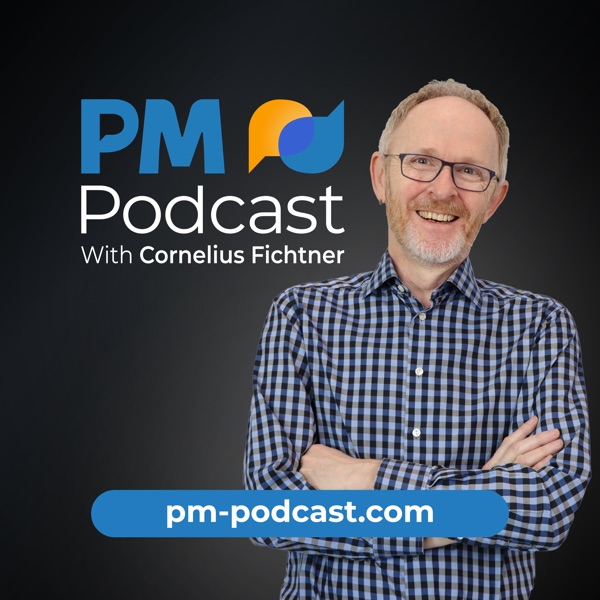
The Project Management Podcast
Become the project manager everyone wants on their team. Tune in to The Project Management Podcast™ and join Cornelius Fichtner, PMP, CSM, as he interviews global PM experts to uncover what drives their project success. Subscribe at https://www.pm-podcast.com and get actionable advice you can apply today. Each episode is packed with hands-on tips for beginners and experts to help you integrate good practices and the latest insights to lead your projects more effectively. Copyright © 2005 - 2025 Cornelius Fichtner. All rights reserved.
- Careers chart
- #75
- Episodes
- 13
- Releases
- Every two weeks
- On air since
- 2026
- Latest episode
- 2 weeks ago
Episodes
13 episodes, newest first
-
Episode 561: Leading AI Projects from Strategy to Reality
Show notes
Play audio-only episode | Play on YouTube | Play on Spotify
Episode Summary
Artificial intelligence projects need more than a promising tool and an ambitious rollout plan. In episode 561, Cornelius Fichtner speaks with Erin Hill, Provost at Austin Christian University and a strategic consultant with experience implementing AI across higher education, legal, and financial organizations. Erin argues that AI leadership begins by asking whether an organization should use AI for a particular business outcome, not simply whether the technology can perform a task. She connects AI initiatives to organizational strategy, mission, governance, data privacy, security, and available resources. For project managers who inherit an AI initiative from senior leadership, she explains why a clear project charter, stakeholder conversations, and decisions about tool selection and employee training matter before implementation begins. The discussion also examines how needs assessments help teams find repetitive tasks and high-friction processes where AI may add value. She warns against introducing AI into disconnected or outdated systems without first addressing their underlying problems. Her examples show why organizations need trustworthy information, clear accountability, and people who understand how the tools fit into their daily work.
-
Episode 559: Why AI Projects Get Worse Before They Get Better
Show notes
Play audio-only episode | Play on YouTube | Play on Spotify
Episode Summary
David Luria, author of Flatten the AI J Curve: Your Unfair Advantage in the Race to Enterprise Adoption, brings a practical conversation about what happens when an AI pilot moves into real operational use. Luria, a vice president and business manager at T. Rowe Price and a Six Sigma Black Belt, explains the AI J curve: productivity can fall before it improves, especially as teams learn new workflows, run old and new processes in parallel, and adjust to changing responsibilities. He argues that project managers should set expectations before implementation begins, keep early scope narrow, and use short stepping-stone projects to learn quickly. He also explains why culture matters. AI often removes tasks that people associate with their expertise, so adoption requires more than access to a chatbot. Leaders and project managers need to create room for experimentation, communicate what will change, and help people understand how their roles can shift toward higher-value work. Luria calls for business ownership close to the work, supported by leadership, IT, and risk teams, rather than treating AI transformation as a technology handoff.
-
Episode 557: PMP Exam Adds AI. You Are Studying the Wrong Thing.
Show notes
Play audio-only episode | Play on YouTube | Play on Spotify
Episode Summary
Artificial intelligence can now appear in PMP exam scenarios, but that does not mean candidates need to study AI technology. In Episode 557, Cornelius Fichtner starts with the PMP Exam Content Outline and separates what PMI actually says from what many candidates may assume. AI appears in the introduction as one of the trends PMI evaluates when researching changes in professional practice expectations, but it does not appear as a task or enabler in the People, Process, or Business Environment domains. That distinction matters because the PMP exam measures project management competencies, not technical mastery of the tools a project manager may use. AI can show up as a project risk, a deliverable, or a tool that a team wants to adopt, while the underlying exam question still asks whether you can manage risk, evaluate a tool, address a stakeholder concern, handle change, or make an accountable project decision. Cornelius also shows the kinds of questions candidates should not expect, including technical questions about generative versus predictive AI, prompt-writing techniques, and AI model selection.
-
Episode 556: Rethinking the PMO: Identity, Design & What’s Next
Show notes
Play audio-only episode | Play on YouTube | Play on Spotify
Episode Summary
Sara Gallagher, President of The Persimmon Group and author of the LinkedIn newsletter Big Dumb Questions, joins Cornelius Fichtner to answer the uncomfortable questions most PMO leaders avoid. The conversation follows four threads: PMO identity, design, accountability, and the future. It opens with the biggest question of all: are PMOs dying? Sara takes an optimistic view, with caveats. She explains that traditional PMOs are built on standardization, which raises weaker projects to a certain ceiling but also flattens excellent, tailored work down to the law of averages. She then paints a concrete picture of what comes next: project managers with robust knowledge bases and AI agents that draft synthesized status reports, simulate steering committee members such as a CFO, and hand results to a PMO agent that standardizes everything for portfolio roll-up. The result combines hyper-customized stakeholder communication with standardization only where it is truly needed, and it frees the PMO to coach project managers in sophisticated stakeholder management and risk practices.
-
Personal Pause Update
Show notes
A brief personal update from your host. My wife recently had a serious fall that required hip surgery and rehabilitation, so my time is fully devoted to her recovery right now. One recorded interview is on its way to your feed shortly, but the schedule will stay quiet for the next few weeks while I reschedule cancelled interviews and we get through this together.
-
Episode 555: Master All 7 PMBOK 8 Performance Domains for the PMP Exam (With Sample Exam Questions)
Show notes
Play audio-only episode | Play on YouTube | Play on Spotify
Episode Summary
The seven performance domains from the PMBOK Guide 8th edition form the backbone of how project work actually happens, and they are woven into nearly every situational question on the PMP exam. The catch is that the exam never labels them. Cornelius Fichtner, PMP, takes you through all seven domains: Governance, Scope, Schedule, Finance, Stakeholders, Resources, and Risk. For each domain, he presents a sample question from The PM Exam Simulator, works through the answer choices, and then hands you a structured takeaway built around three skills: how to recognize the domain in a scenario, how to evaluate your answer options, and how to eliminate the traps. Along the way you work through fourteen exam-style questions, including drag and drop matching, choose-multiple formats, and classic four-option scenarios covering everything from negative float and crashing to contingency reserves and psychological safety.
-
Episode 554: PMBOK Guide 8th Edition, All Six Principles for the PMP Exam
Show notes
Play audio-only episode | Play on YouTube | Play on Spotify
Episode Summary
Preparing for the PMP exam means developing the ability to make sound decisions under pressure, not simply recalling definitions from a textbook. In this lesson, drawn directly from the PM PrepCast PMP exam prep course and PrepCast PMP Exam Simulator, Cornelius Fichtner walks through all six project management principles from the PMBOK Guide 8th Edition and shows exactly how to recognize and apply them when facing the kind of ambiguous, scenario-based questions that appear on the actual exam. Each principle gets its own sample question from the PrepCast PMP Exam Simulator, a step-by-step walkthrough of why the wrong answers are wrong, and a second practice question so listeners can immediately test what they have learned. The episode covers all six principles in sequence: Adopt a Holistic View, Focus on Value, Embed Quality into Processes and Deliverables, Be an Accountable Leader, Integrate Sustainability Within All Project Areas, and Build an Empowered Culture. Each principle is taught not as a concept to memorize but as a mindset to recognize and apply, because the exam consistently rewards situational judgment over terminology.
-
Episode 553: Revenge of the Risk Register (Premium Preview)
Show notes
Premium
This is a preview of our premium episode. Full access is available only to premium subscribers.
Click here and learn about the Premium Podcast to access this interview...
Play audio-only preview episode | Play on YouTube | Play on Spotify
Episode Summary
We welcome back Dawn Mahan and Jerry Manas for a project risk management conversation that connects movie moments with practical project leadership. Dawn and Jerry, co-editors of Projectland Goes to the Movies: 22 Blockbuster Strategies for Project Success, focus on the chapters they personally wrote and use them to examine how project managers identify early warning signs, assess uncertainty, choose risk responses, and handle the human side of risk. Jerry uses Star Wars to explain fast risk assessment, OODA loops, situational awareness, risk response planning, and the difference between risk as threat and risk as opportunity. Dawn uses The Italian Job to discuss trust, hidden resistance, team pressure, stakeholder behavior, sabotage, and what happens when a new person joins an already established team. Together, they make a practical point for project managers: risk management cannot live only in a register. It has to show up in conversations, sponsor alignment, team formation, stakeholder engagement, and regular project decisions.
-
Episode 552: PMP Exam Content Outline
Show notes
Play audio-only episode | Play on YouTube | Play on Spotify
Episode Summary
The PMP Exam Content Outline, often called the ECO, drives everything about the PMP exam, yet many students still focus almost entirely on the PMBOK Guide. In this episode, Cornelius Fichtner explains why the PMP exam is not a test of the PMBOK Guide and why the ECO serves as the real syllabus behind the certification exam. He walks through how PMI develops exam questions, how volunteers create and review questions based on the ECO, and how reference materials such as the PMBOK Guide support the process without directly defining the exam itself. Along the way, Cornelius breaks down the structure of the ECO into domains, tasks, and enablers, helping PMP candidates understand what PMI expects modern project managers to know in predictive, adaptive, and hybrid environments. He also explains why concepts such as value delivery, sustainability, compliance, and artificial intelligence now appear in the latest version of the exam. The discussion includes a practical walkthrough of the People, Process, and Business Environment domains, how exam percentages are distributed, and why PMI periodically updates the exam based on real-world project management practices.
-
Episode 551: What Movies Teach Project Managers
Show notes
Play audio-only episode | Play on YouTube | Play on Spotify
Episode Summary
Project managers often joke that their projects feel like a movie. In this conversation, that idea becomes the central theme as Cornelius Fichtner welcomes Dawn Mahan and Jerry Manas to discuss their book Projectland Goes to the Movies. Together, they examine how famous films reflect real project management challenges involving leadership, teamwork, risk, stakeholder management, planning, and adaptation under pressure. From Apollo 13 and The Martian to Jurassic Park, Twelve Angry Men, and Ocean’s Eleven, the discussion highlights how storytelling creates memorable examples of project leadership in action. The guests explain why movies resonate so strongly with project managers, how fictional situations often mirror real workplace dynamics, and why stories stick with people more effectively than abstract theory. The conversation also connects several examples back to practical project management concepts such as servant leadership, agile adaptation, collaborative problem-solving, stakeholder influence, and the importance of remaining calm during uncertainty.
-
Episode 550: How to Turn Chaos Into Project Clarity (Premium Preview)
Show notes
Premium
This is a preview of our premium episode. Full access is available only to premium subscribers.
Click here and learn about the Premium Podcast to access this interview...
Play audio-only preview episode | Play on YouTube | Play on Spotify
Episode Summary
Projects rarely fall apart because people lack effort. More often, they struggle because teams move forward without a shared understanding of what they are actually trying to achieve. In this conversation, Cornelius Fichtner continues his discussion with Danielle Naomi McCier, Creative Operations leader and author of “Wrangling Chaos,” focusing on what happens after a project is already in motion. The discussion shifts from identifying why projects drift into confusion to understanding how project managers can actively restore clarity, guide decisions, and keep work moving forward in fast-paced environments such as creative agencies. Danielle shares practical techniques for clarifying objectives, aligning stakeholders, and ensuring that teams do not default into rework cycles caused by early misunderstandings. She emphasizes that project clarity is not a one-time activity but an ongoing responsibility that requires attention, communication, and structure throughout execution.
-
Episode 549: How to Bring Clarity to Chaotic Projects
Show notes
Play audio-only episode | Play on YouTube | Play on Spotify
Episode Summary
Danielle Naomi McCier joins the discussion to explain how project managers can create clarity in environments where priorities shift, feedback comes from multiple directions, and teams struggle to stay aligned. The conversation highlights how projects rarely begin in chaos but gradually lose clarity as expectations evolve and communication becomes fragmented. Danielle explains that what many teams interpret as planning issues are often clarity problems rooted in misalignment, unclear ownership, and inconsistent communication. She shares practical ways to identify these issues early and outlines how project managers can act as the central point of alignment, helping teams move forward with confidence even when conditions change.
-
Episode 548: From Project Delivery to Value: How Project Managers Create Real Business Impact
Show notes
Play audio-only episode | Play on YouTube | Play on Spotify
Episode Summary
Project work dominates how organizations grow, transform, and compete, yet many projects still fail to create meaningful impact. This conversation examines why delivering plans, schedules, and outputs no longer defines success for project managers. As expectations shift toward value creation and strategic impact, the role of the project manager expands beyond execution into leadership, influence, and decision-making. Antonio Nieto-Rodriguez, a leading authority on project leadership and organizational transformation, explains how organizations have become project-driven and what that shift demands from those leading initiatives.
Careers lists
More Careers shows picked out from the charts









More in Careers
Placed highest on Apple Podcasts' Careers chart right now