Podcast
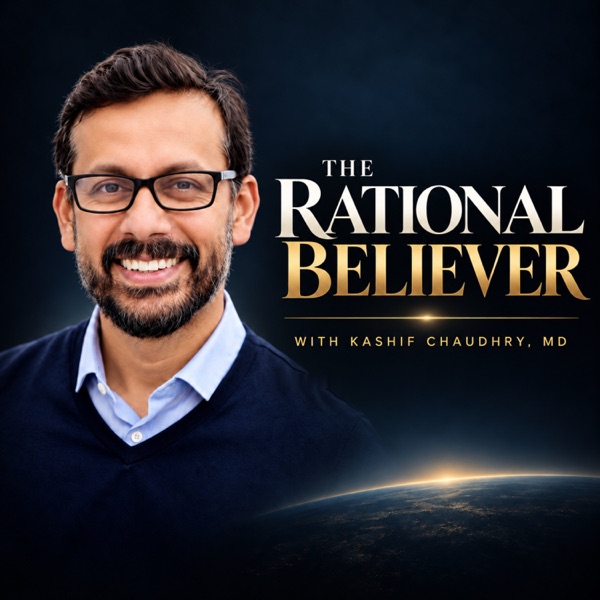
The Rational Believer
Is it still reasonable to believe in God? The Rational Believer takes on the hardest questions about faith: science and creation, suffering, doubt, morality, scripture, and why there are so many religions.
Host Kashif Chaudhry, MD, is a heart rhythm doctor, author and Muslim. Islam is his lens, not a conclusion he argues backward from. He gives skeptics their strongest case, says “I don’t know” when it’s true, and follows the evidence.
You should not have to choose between your intellect and your soul.
- On air since
- 2026
- Episodes
- 6
- Releases · typical length
- Twice a week · 19 min
- Latest episode
- 1 day ago
Episodes
6 episodes, newest first
-
19 min
Is the Universe Fine-Tuned for Life?
Season 1, Episode 1
Show notes
Is the universe fine-tuned for life? Physics lets us ask what the universe would look like if its basic numbers were different, and often the answer is no stars, no carbon and no us.
In 1953 Fred Hoyle predicted that carbon must have an energy level nobody had ever measured. They looked, and it was there. Starting from that story, I walk through Martin Rees's six numbers as a cosmic control panel, explain why a pacemaker's settings came to mind (and why that analogy can't prove a Programmer), warn fellow believers against fake numbers, and give the multiverse and the anthropic objection their full weight. Where I land: not proof, but a serious clue.
This series doesn't assume Islam is true and argue backward. The conclusions have to earn their place.
Chapters
0:00 Fred Hoyle's strange prediction
1:13 Fine-tuning is not God of the gaps
2:32 Six dials: gravity
3:39 Nuclear binding and Hoyle's carbon
5:47 Cosmic density
6:32 The energy of empty space
7:19 The first ripples
8:13 Three dimensions
8:41 The control panel
9:25 The pacemaker analogy
10:31 Don't ruin it with fake numbers
11:48 Does fine-tuning prove God?
13:14 The anthropic objection
14:35 The design inference
15:48 What the Qur'an says
16:51 Where I land
17:58 Back to Fred Hoyle
18:40 Next time: does the Qur'an conflict with science?
Referenced: Qur'an 54:49, 25:2, 3:190–191 · Fred Hoyle, Engineering and Science (1981) · Martin Rees, Just Six Numbers (1999) · Paul Ehrenfest (1917) · Victor J. Stenger, The Fallacy of Fine-Tuning (2011) · Douglas Adams, The Salmon of Doubt (2002) · John Leslie, Universes (1989)
Watch on YouTube: https://youtu.be/NRcVrPxjy3Y
You should not have to choose between your intellect and your soul.
-
19 min
Does Science Make God Unnecessary?
Season 1, Episode 5
Show notes
Does science make God unnecessary? If God is just the name for whatever science hasn't explained yet, every discovery shrinks Him. This episode takes the "God of the gaps" objection at full strength, and argues it defeats one picture of God while missing another.
Medieval church bells were cast with the words "Fulgura frango": "I break the lightning." Then Benjamin Franklin showed that lightning was electrical, and today churches put lightning rods on their own steeples. I let the skeptic make the strongest case (Laplace: "I had no need of that hypothesis"), and separate two questions that keep getting mixed up: how the world works, and why there is a world with laws at all.
This series doesn't assume Islam is true and argue backward. The conclusions have to earn their place.
0:00 I break the lightning
1:16 Is God just a placeholder for the gaps?
3:15 The God who keeps retreating
4:33 The skeptic at full strength: Laplace
5:38 Mechanism and meaning: the letter
6:56 The Qur'an doesn't force the choice
7:58 Ibn al-Khaṭīb and the plague
8:42 Explanation doesn't kill wonder
10:19 God doesn't live where science hasn't arrived
11:29 So what does God explain?
13:50 Have we just renamed the mystery?
14:57 What the believer gives up
16:05 Back to the bell ringers
17:27 Next time: is the universe fine-tuned?
Referenced: Qur'an 30:48, 57:3, 3:190 · Georges Lemaître · Pierre-Simon Laplace · Ibn al-Khaṭīb · John Keats · Albert Einstein, "Physics and Reality" (1936) · Stephen Hawking, A Brief History of Time (1988)
Watch on YouTube: https://youtu.be/xZMC0uKzJgY
You should not have to choose between your intellect and your soul.
-
22 min
What If Science Contradicts Scripture?
Season 1, Episode 4
Show notes
When science and scripture seem to collide, who's wrong: the science, the scripture, or our reading of one of them? A heart rhythm doctor on why God's Word and God's Work can't truly contradict.
I'm Kashif Chaudhry, a heart rhythm doctor. In 1929 a young German doctor, Werner Forssmann, pushed a catheter into his own heart while his colleagues called it reckless. The heart didn't change in 1929. Our understanding of it did. In this episode of The Rational Believer I use that story, and lessons from my own work in AF ablation, to look at how both science and scripture have human readers. We revisit Galileo and the Church, Muslim scholars who once read the Qur'an as astronomy, and the Prophet's date-palm advice, then hear out the skeptic: isn't "reinterpretation" just a way for religion to never lose? I offer three guardrails for when reinterpretation is honest, and why scripture should never be married to today's science.
This series doesn't assume Islam is true and argue backward. The conclusions have to earn their place.
00:00 Werner Forssmann's catheter
01:25 Do science and scripture really clash?
03:05 Two books: God's Word and God's Work
04:56 Science has human readers: lessons from AF ablation
07:13 Scripture has human readers too: Galileo and the date palms
09:34 Revelation may be divine. Our understanding is not.
10:26 Look again: the Qur'an's invitation
12:27 When Word and Work seem to clash
13:55 The skeptic's turn: guardrails for reinterpretation
16:47 Don't marry scripture to today's science
18:01 Why did believers misunderstand it?
18:56 The psychology of being right
20:29 To the young Muslim caught in the middle
21:15 Next time: is God just a placeholder?
REFERENCED
Qur'an 41:53 · 67:3-4 · 10:101 · 29:20 · 18:110
Sahih Muslim 2361-2363 (the date palms)
Ibn Rushd (Averroes), The Decisive Treatise
Haïssaguerre et al., New England Journal of Medicine, 1998
Nobel Prize in Physiology or Medicine 1956: Forssmann, Cournand & Richards
Abdus Salam, Nobel Prize in Physics 1979
Subscribe: https://www.youtube.com/@the-rational-believer?sub_confirmation=1
Watch on YouTube: https://youtu.be/3cKkloyVRRw
Listen on Apple Podcasts: https://podcasts.apple.com/us/podcast/the-rational-believer/id6830421764
Follow me on X: https://x.com/KashifMD
PREVIOUS: What Is Religion Actually For? https://youtu.be/YFuyOASLGkI
START HERE: Can You Believe in God Without Switching Off Your Brain? https://youtu.be/o-MJr5nmwwk
The book: Rational Religion by Kashif Chaudhry https://rationalreligionproject.com
The Rational Believer is for anyone who wonders whether an intellectually serious person can still believe in God: skeptics, seekers, and believers with questions. Islam is the lens, not the assumed conclusion.
You should not have to choose between your intellect and your soul.
#TheRationalBeliever #ScienceAndReligion #Quran
-
20 min
What Is Religion Actually For?
Season 1, Episode 3
Show notes
What is religion actually for? Rules and rituals, or something deeper? The Qur'an answers that question itself, and the answer may surprise you.
I'm Kashif Chaudhry, a heart rhythm doctor. In this episode of The Rational Believer I start with a question the Prophet once asked his companions: "Do you know who is bankrupt?" From there I separate religion's signal from its noise, and boil the Qur'an's core purpose down to four ideas: know God, refine yourself, serve creation, and live with accountability. I take the skeptic's objection head on (did I just cherry-pick the parts I like?) and let the Qur'an explain its own rituals. Along the way, a lesson from pacemakers: when the pacing fires but the heart doesn't respond.
This series doesn't assume Islam is true and argue backward. The conclusions have to earn their place.
CHAPTERS
00:00 Who is truly bankrupt?
01:30 Signal and noise in religion
03:43 The signal in four ideas
04:10 Did I just cherry-pick?
04:57 1. Know God
07:09 2. Refine yourself
08:51 Failure to capture: a pacemaker lesson
11:13 3. Serve creation
13:49 4. Live with accountability
15:43 The signal
16:27 The skeptic's turn
18:21 Back to the bankrupt man
19:22 Next: when science and scripture seem to collide
REFERENCED
Qur'an 51:56 · 22:37 · 91:7-10 · 29:45 · 2:183 · 107:1-7 · 2:177 · 99:7-8
Sahih Muslim 2581 (the bankrupt one)
Subscribe: https://www.youtube.com/@the-rational-believer?sub_confirmation=1
Watch on YouTube: https://youtu.be/YFuyOASLGkI
Listen on Apple Podcasts: https://podcasts.apple.com/us/podcast/the-rational-believer/id6830421764
Follow me on X: https://x.com/KashifMD
PREVIOUS: If God Exists, Would He Speak to Us? https://youtu.be/fPSxyDeOjDk
START HERE: Can You Believe in God Without Switching Off Your Brain? https://youtu.be/o-MJr5nmwwk
The book: Rational Religion by Kashif Chaudhry https://rationalreligionproject.com
The Rational Believer is for anyone who wonders whether an intellectually serious person can still believe in God: skeptics, seekers, and believers with questions. Islam is the lens, not the assumed conclusion.
You should not have to choose between your intellect and your soul.
#TheRationalBeliever #Religion #Quran
-
16 min
Is God Trying to Reach You?
Season 1, Episode 2
Show notes
If God exists, would He speak to us? And if He did, how would we ever tell a real message from noise?
I'm Kashif Chaudhry, a heart rhythm doctor. Every day I read heart monitors, where the hard part is telling a true signal from noise. In this episode of The Rational Believer I ask the same question of God. Is a Creator likely to care about us, and why might He communicate? I look at awe and the pull toward meaning, take the skeptic's explanation seriously, and explore fitrah, the Qur'an's idea of an inner compass. Then I set out the four ideas at the heart of scripture, and why private experience isn't enough without a public message we can test.
This series doesn't assume Islam is true and argue backward. The conclusions have to earn their place.
CHAPTERS
00:00 A signal from the stars
01:29 From a Creator to "God knows me"
02:35 Signal and noise: lessons from a heart monitor
03:53 Why would God care about us?
04:55 What scripture is actually about
05:34 Awe and the pull toward meaning
06:41 The skeptic's explanation
08:55 Fitrah: a compass, not a map
10:25 Four ideas at the heart of scripture
12:47 The investigation ahead
13:35 Private experience vs public revelation
14:12 Back to the signal
15:18 Next time
REFERENCED
Qur'an 16:78 · 30:30
Watch on YouTube: https://youtu.be/fPSxyDeOjDk
Subscribe: https://www.youtube.com/@the-rational-believer?sub_confirmation=1
Listen on Apple Podcasts: https://podcasts.apple.com/us/podcast/the-rational-believer/id6830421764
Follow me on X: https://x.com/KashifMD
PREVIOUS: Can You Believe in God Without Switching Off Your Brain? https://youtu.be/o-MJr5nmwwk
The book: Rational Religion by Kashif Chaudhry https://rationalreligionproject.com
The Rational Believer is for anyone who wonders whether an intellectually serious person can still believe in God: skeptics, seekers, and believers with questions. Islam is the lens, not the assumed conclusion.
You should not have to choose between your intellect and your soul.
#TheRationalBeliever #God #Revelation
On these lists
The Rational Believer is one of the shows picked out on this list