Podcast
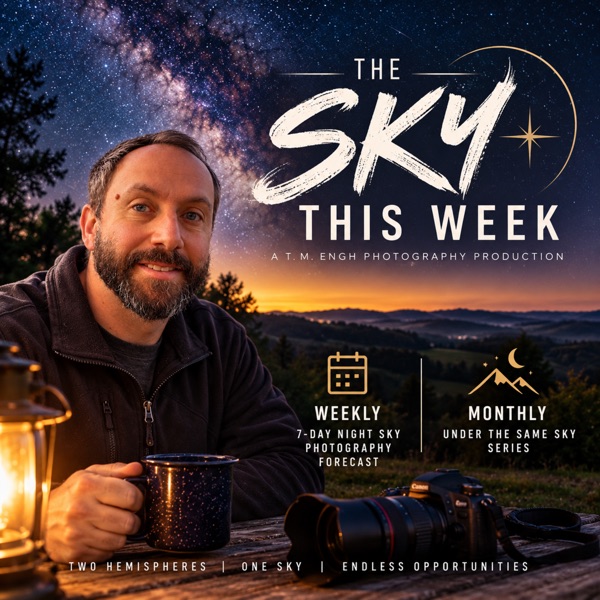
The Sky This Week
Two hemispheres. One sky. Endless opportunities to photograph it.
The Sky This Week is an astronomy and astrophotography podcast hosted by T. M. Engh, a photographer and storyteller from Wisconsin’s Driftless Area.
Every Friday, we explore the night sky and the photographic opportunities waiting overhead. From planets and meteor showers to constellations, the Moon, and deep-sky wonders, we’ll discover what’s happening, when to look, and how to photograph it from both the Northern and Southern Hemispheres.
On the first Sunday of every month, Under the Same Sky takes us beyond the weekly forecast. Through thoughtful storytelling, science, photography, curiosity, and the occasional questionable joke, we explore our relationship with the universe and the reasons we keep looking up.
Whether you’re an experienced astrophotographer, someone learning astronomy, or simply curious about the night sky, you’re welcome here. No expensive equipment or astronomy degree required.
Look up. Stay curious. Keep seeing.
A T. M. Engh Photography production.
- Astronomy chart
- #64
- Episodes
- 4
- Typical length
- 15 min
- On air since
- 2026
- Latest episode
- 1 day ago
Episodes
4 episodes, newest first
-
17 min
The Universe Has a Radio Station: ASKAP, the VLA & VLASS Bonus
Show notes
Want to start your own podcast!? Click here to use my affiliate link, sign up, and bring your ideas to massive audience with rss.com!
https://www.patreon.com/TheSkyThisWeek
What if the night sky isn't silent—our cameras just can't see everything it's saying?
Join T. M. Engh for a story-first look at Australia's 36-dish ASKAP telescope, New Mexico's 27-dish Very Large Array, and VLASS, the radio-sky survey that returns to familiar parts of the universe to discover what changes. We'll explore odd radio circles, the hidden radio sky, and what these remarkable instruments teach everyday photographers about curiosity, careful observation and looking again.
You'll also hear beginner-friendly explanations, a practical night-sky photography exercise, and a modest time-lapse project you can try without needing access to an observatory.
Sources and further reading:
• CSIRO ASKAP: https://www.csiro.au/ASKAP
• CSIRO Murchison observatory and Wajarri Yamaji Country: https://www.csiro.au/mro
• NRAO Very Large Array: https://www.vla.nrao.edu/
• NRAO VLASS survey and current archive status: https://science.nrao.edu/vlass
• NASA: Electromagnetic spectrum: https://science.nasa.gov/ems/01_intro/Scientific radio images are measurements rendered for interpretation; they are not ordinary visible-light photographs. Access to sensitive observatory sites is restricted. Photography results depend on local skies, permissions and equipment. The Sky This Week and Under the Same Sky are T. M. Engh Photography audio productions.
-
15 min
A Reason to Look Up
Season 1, Episode 2
Show notes
Want to start your own podcast!? Click here to use my affiliate link, sign up, and bring your ideas to massive audience with rss.com!
https://www.patreon.com/TheSkyThisWeekWhy does one quiet night photograph stay with us longer than a spectacular image we forget tomorrow?
A Reason to Look Up
In the opening story of Under the Same Sky, T. M. Engh explores the curious moment when a familiar tree, a thin Moon, or a single star becomes the reason to stop and look up. We talk about patience, dark adaptation, star motion, and why an ordinary landscape can give a photograph its meaning. This is an invitation to astronomy and astrophotography without expensive-gear expectations—and without pretending that every night must produce a masterpiece.
Your photographic assignment: Choose a safe, familiar foreground. Record one star or the Moon above it, note the date and direction, and return another evening to see what changed.
This is a standalone, audio-only Under the Same Sky story from T. M. Engh Photography. Observing opportunities and photography results depend on location, season, horizon, local conditions, and equipment. No special gear, perfect sky, or published photograph is assumed.
Research and further exploration:
• https://science.nasa.gov/skywatching/
• https://science.nasa.gov/moon/moon-phases/Under the Same Sky is a T. M. Engh Photography production.
-
17 min
The Dark Between Meteors | 10/31/2026 - 11/6/2026 Bonus
Show notes
Want to start your own podcast!? Click here to use my affiliate link, sign up, and bring your ideas to massive audience with rss.com!
https://www.patreon.com/TheSkyThisWeek
The Sky This Week | October 31–November 6, 2026
The Dark Between the Meteors
Sometimes the best reason to photograph the night sky isn’t a spectacular event. It’s simply having a little more darkness, a familiar landscape, and something extraordinary waiting above it.
This week, the waning Moon opens up darker evening skies, the Southern Taurids offer a chance to catch a meteor, and neighboring galaxies and star clusters give photographers plenty to explore—even if the meteors never show up.
In this episode of The Sky This Week, T. M. Engh explores the astrophotography opportunities for October 31 through November 6, 2026, with practical guidance for photographers in both the Northern and Southern Hemispheres.
This week’s highlights:
* The Moon and darker evenings: How the waning Moon creates better opportunities for photographing faint stars and galaxies, including useful darkness windows for Wisconsin, London, Sydney, and Cape Town.
* Andromeda and the Pleiades: Discover a neighboring galaxy and a family of stars, and learn why both make rewarding northern sky subjects.
* The Magellanic Clouds: Explore two smaller neighboring galaxies that offer remarkable photographic possibilities from suitable southern locations.
* The Southern Taurids: Why Earth encounters debris from Comet Encke, what makes a meteor or fireball, and why November 4–5 is worth watching—even though nothing spectacular is guaranteed.
* The Moon, Mars, and Jupiter: Early-week predawn opportunities, with viewing dates and conditions that change depending on where you live.
* Making the photograph: Practical starting points for exposure, focus, lens selection, and tripod photography, whether you’re a beginner or have more experience.
* The sky in motion: A focused introduction to night-sky time-lapse photography, including a practical one-hour camera plan for capturing the apparent movement of stars above a stationary landscape.
Your Assignment This Week
Make one photograph of a recognizable night-sky subject above a place that means something to you.
It might be the Pleiades above a familiar tree, Andromeda over a distant ridge, or a Magellanic Cloud above a southern coastline. Maybe you’ll get lucky and capture a meteor.
For an additional challenge, try the time-lapse technique from this week’s episode.
You don’t need expensive equipment or a perfect photograph. Just a little curiosity, some patience, and a reason to look up.
Observing dates: Saturday, October 31 – Friday, November 6, 2026.
Viewing opportunities depend on your location, local horizon, moonlight, light pollution, equipment, and weather. Meteor sightings, fireballs, and clear skies are never guaranteed.
Astronomy resources and references
* NASA — Moon Phases
* NASA — How to Photograph a Meteor Shower
* International Meteor Organization — Meteor Calendar
* American Meteor Society — Meteor Shower Calendar
* U.S. Naval Observatory — 2026 Moon Phases
* Timeanddate — Sun, Moon and Astronomy
The Sky This Week is a T. M. Engh Photography production.
Two hemispheres. One sky. Endless opportunities to photograph it!
-
1 min
Introducing The Sky This Week | Astronomy, Astrophotography & Stories Trailer
Season 1
Show notes
Two hemispheres. One sky. Endless opportunities to photograph it.
Welcome to The Sky This Week, an astronomy and astrophotography podcast hosted by T. M. Engh, a photographer and storyteller from Wisconsin's Driftless Area.
Beginning January 1, 2027, join us every Friday as we explore what's happening in the night sky and discover what's actually worth photographing over the next seven days.
From meteor showers and planetary encounters to constellations, the Moon, and deep-sky objects, we'll explore practical photography opportunities across both the Northern and Southern Hemispheres.
And on the first Sunday of every month, we'll slow things down with Under the Same Sky, our monthly storytelling series exploring astronomy, photography, science, and the reasons we keep looking up.
Whether you're an experienced astrophotographer, a curious beginner, or someone who simply enjoys looking at the stars, there's a place for you here.
No expensive equipment required. No astronomy degree necessary. Just curiosity, a little patience, and perhaps a healthy sense of humor when the clouds inevitably arrive.
Our journey begins January 1, 2027.
Subscribe and join us beneath the same sky.
A T. M. Engh Photography production.
Astronomy lists
More Astronomy shows picked out from the charts









More in Astronomy
Placed highest on Apple Podcasts' Astronomy chart right now