Podcast
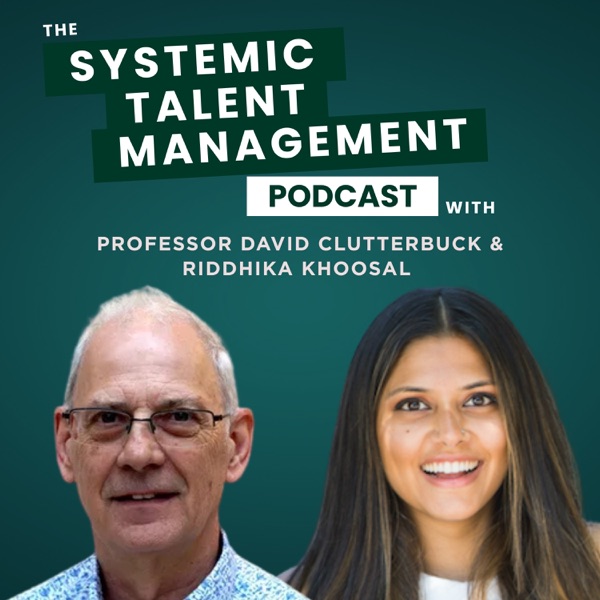
The Systemic Talent Management Podcast
Hosted by Prof. David Clutterbuck and Riddhika Khoosal, this podcast is for HR professionals, leaders, and change-makers navigating the future of work.
Through a systemic lens, we explore how individuals, teams, organisations, and society must evolve to thrive in an era of complexity and transformation. Through thought-provoking conversations with industry pioneers, we challenge conventional wisdom, spark fresh perspectives, and inspire bold new ways of working.
From rethinking leadership to transforming talent management, join us as we push the boundaries of HR, leadership, and workplace innovation.
- Episodes
- 7
- Releases
- Every two weeks
- Typical length
- 42 min
- On air since
- 2026
- Latest episode
- 1 week ago
Episodes
7 episodes, newest first
-
48 min
The One Where We Build Talent Instead of Buying It with Peter Cappelli
Season 1, Episode 6
Show notes
When organisations need new capabilities, the default answer has increasingly become: hire it. But what are we losing by not building it?
In this episode of the Systemic Talent Management Podcast, Professor David Clutterbuck and Riddhika Khoosal are joined by Peter Cappelli, George W. Taylor Professor of Management at The Wharton School and Director of Wharton’s Center for Human Resources, to explore why organisations have moved away from developing people internally and towards a model of buying talent when they need it.
Peter argues that the shift was driven not simply by changing business needs, but by a growing reluctance to invest in development, an increasing reliance on managers who have neither the time nor the skills to develop people, and a fixation on short-term cost reduction. The conversation challenges the assumption that hiring is the answer, explores whether technology is actually making recruitment better, and asks what it would take for HR to stop trying to predict an uncertain future and start managing it more effectively.
About Our Guest
Peter Cappelli is the George W. Taylor Professor of Management at The Wharton School and Director of Wharton’s Center for Human Resources. He has been recognised by HR Magazine as one of the world’s top management thinkers. His research and writing have shaped thinking on talent management, hiring, workforce development and employment, with his work appearing in publications including Harvard Business Review and The Wall Street Journal.
Episode Soundbite
“We have to start thinking about managing uncertainty rather than assuming it away.” - Peter Cappelli
Timestamps
00:00 Episode preview: Why organisations stopped building talent
01:51 Peter’s journey into the study of work and employment
07:02 How talent acquisition eclipsed talent management
08:43 Why organisations stopped developing talent internally
13:36 Why great individual contributors don’t always make great managers
16:10 What candidates really think about AI recruitment
23:16 Rethinking hiring in a rapidly changing world
26:19 The problem with “culture fit”
29:35 Managing uncertainty through scenarios and small bets
34:13 What HR analytics should actually measure
36:21 Why learning by doing matters
40:42 The biggest opportunity for talent management
42:12 Why HR needs to challenge senior leadersFollow and Listen
Peter Cappelli: LinkedIn Profile
David Clutterbuck: LinkedIn Profile
Riddhika Khoosal:LinkedIn ProfileSubscribe:
New episodes released fortnightly. Subscribe wherever you listen to podcasts. -
47 min
The One Where HR Focuses on the Levers That Matter with Marc Effron
Season 1, Episode 5
Show notes
Are we focusing HR’s energy on the things that actually make the biggest difference?
In this episode of The Systemic Talent Management Podcast, Professor David Clutterbuck and Riddhika Khoosal are joined by Marc Effron, Founder and President of The Talent Strategy Group, to explore leverage in HR: identifying the few things within a talent process that have the greatest impact. Marc challenges the complexity that has accumulated around HR practices, making the case for a more disciplined approach grounded in science, business outcomes, and managerial accountability.
From goal setting and talent reviews to potential, talent acquisition, and 360-degree feedback, the conversation asks a fundamental question: are we focusing our time and energy on the things that actually make a difference?
About Our Guest
Marc Effron is the founder and President of The Talent Strategy Group, where he advises leading companies, governments, and nonprofits on talent strategy. He co-authored the bestselling One Page Talent Management and wrote 8 Steps to High Performance, both published by Harvard Business Review Press. Marc co-founded the Talent Management Institute at UNC Kenan-Flagler Business School. He previously held executive HR roles at Bank of America and Avon Products.
Episode Soundbite
"Goal setting is the leverage in performance management... Get goal setting right. Everything flows well from it." - Marc Effron
Timestamps
• 00:00 Episode preview: Why goal setting is HR's greatest lever
• 02:09 Marc's journey: Political campaigns, academic research, and the corporate world
• 05:37 HR bling: When complexity works against its intent
• 08:18 Becoming a business junkie: Why HR must know the numbers
• 10:07 Start with the science: Separating what matters from bling
• 13:20 Swinging the pendulum: Why abandoning processes isn't the answer
• 14:51 Finding the leverage: Goal setting, potential, and managerial accountability
• 18:25 Rethinking potential: The fit between person and situation
• 23:48 Trait vs. state ambition: A powerful combination
• 25:53 Learning agility: What's really behind the label
• 27:16 Hiring for potential when the future of jobs is uncertain
• 30:51 Doing the job vs. transforming it: Risk in hiring decisions
• 33:29 Using the selection tools we already have
• 34:48 Tackling persistent bias through clear standards
• 38:22 The one thing HR should stop: Traditional 360s
• 44:29 Closing thoughts: Start with the science, end with accountabilityFollow and Listen
Marc Effron: Talent Strategy Group | LinkedIn
Prof. David Clutterbuck: LinkedIn
Riddhika Khoosal: LinkedIn
Subscribe: New episodes released fortnightly. Subscribe wherever you listen to podcasts.
-
54 min
The One Where HR Stops Assuming and Starts With Evidence with Prof. Rob Briner
Season 1, Episode 4
Show notes
What if the core HR practices you rely on to drive organisational success are based on unexamined assumptions rather than solid evidence?
In this episode of the Systemic Talent Management Podcast, Professor David Clutterbuck and Riddhika Khoosal sit down with Professor Rob Briner (Queen Mary University of London & Corporate Research Forum) to explore what happens when HR grounds its decisions in evidence. Rob examines why popular practices, from performance appraisals to Tuckman's model and change curves, fail under scientific scrutiny.
Together, they unpack how linear thinking and a bias towards immediate action often prevent organisations from diagnosing the real problems. Rob outlines a practical framework for evidence-based practice, urging HR leaders to slow down, clear the decks of misleading beliefs, and make decisions using multiple sources of structured data.
About Our Guest
Rob Briner is Professor of Organisational Psychology at Queen Mary University of London and Research Director at Corporate Research Forum. For nearly three decades, he has championed Evidence-Based Practice across HRM, management, and work psychology. He leads CRF’s Work Psychology Network and regularly publishes critical reviews examining popular workplace claims (e.g learning styles, psychological safety, growth mindset) to evaluate whether they are backed by scientific evidence.
Episode Soundbite
“To be evidence-based in any field, from medicine to policing to management, a really important first point is to try and clear the decks... and challenge quite a few assumptions that we make about the issues and problems we're dealing with.” - Prof. Rob Briner
Timestamps
00:00 Episode preview: Why evidence-based HR starts with clearing the decks
01:13 Welcome & Guest Introduction
03:10 Beyond linear thinking: Why evidence-based HR requires multiple sources
06:00 - Challenging HR myths: Performance appraisals & change curves
07:31 The engagement myth: Why attitudes don't directly drive performance
09:44 The teamwork myth: Why pseudo-teams fail to deliver expected results
11:05 The deliverables myth: Why individual deliverables don't guarantee organisational performance
13:25 Questioning pseudoscience: Tuckman, Maslow, & Kübler-Ross
17:02 Clearing the decks, challenging assumptions, & recognising bias
21:14 Diagnosing the real problem before jumping to solutions
37:39 Why teams don't always create better performance
44:43 The courage to stop ineffective practices & challenge leaders
47:21 What the research shows about predictors of performance
53:04 Closing thoughts
Follow and Listen
Prof. Rob Briner: LinkedIn | Corporate Research Forum (rob@crforum.co.uk)
Prof. David Clutterbuck: LinkedIn
Riddhika Khoosal: LinkedIn
-
37 min
The One Where Feedback Stops Being One-Way with Peter Berridge
Season 1, Episode 3
Show notes
What if the feedback systems you rely on to help your people grow are actually making their performance worse?
Research shows that over a third of feedback interventions lead to worse performance. In this episode of the Systemic Talent Management Podcast, Professor David Clutterbuck and Riddhika Khoosal sit down with Peter Berridge (CEO of Shift Positive, Executive Coach, and Author) to unpack why traditional feedback models fail and how to fix them.
Peter argues that standard feedback isn't broken by intent, but by design: it isolates individuals, focuses heavily on shortcomings, and hides behind anonymity. Through his Shift Positive® method, Peter introduces a relational framework built on strengths, growth, and allyship, shifting feedback from a one-way evaluation into a collaborative, solution-focused driver of change.
Together, they explore how to build a feedback-seeking culture, transform evaluators into developmental allies, and redesign HR systems around a simple truth: we don't change alone, we change in relationship with others.
About Our Guest
Peter Berridge is CEO of Shift Positive, an Executive Coach and Author. He is the co-creator of the Shift Positive® Method and co-author of Feedback Reimagined, which explores how positive psychology and social support can transform the way organisations approach feedback. Peter holds a Master of Applied Positive Psychology from the University of Pennsylvania and has more than 25 years of experience across executive coaching, facilitation and human resources.
Episode Soundbite
“Feedback is perspective, it's not truth. And feedback is relative and relational to the person providing it.” - Peter Berridge
Timestamps
• 00:00 - Episode preview: Why traditional feedback can make performance worse
• 01:09 - Peter's journey: HR, coaching and positive psychology
• 02:43 - The research behind feedback failure
• 05:08 - Why feedback systems are designed around the illusion of the individual
• 07:18 - Why traditional feedback systems fail
• 10:30 - Introducing Shift Positive: Strengths, Growth and Allyship
• 12:50 - Moving beyond weaknesses: From problem-focused to solution-focused feedback
• 15:15 - Turning stakeholders into allies
• 16:27 - The mindset shifts needed for meaningful feedback
• 18:02 - Feedback is perspective, not truth
• 20:24 - Why confidentiality may be a symptom of a broken system
• 21:45 - What HR leaders can learn from the Shift Positive approach
• 24:09 - Share your goals, ask for help, and follow through
• 26:30 - Embedding solution-focused development into everyday conversations
• 28:21 - Applying Shift Positive to teams and collective development
• 30:46 - Turning feedback into shared responsibility
• 33:43 - Who gives HR the feedback it needs?
• 36:07 - Where to learn more about Shift PositiveFollow and Listen
Peter Berridge: Shift Positive 360
Professor David Clutterbuck: LinkedIn Profile
Riddhika Khoosal: LinkedIn Profile
Subscribe: New episodes released fortnightly. Subscribe wherever you listen to podcasts.
-
35 min
The One Where HR Has an Identity Crisis with Dr. Dieter Veldsman
Season 1, Episode 2
Show notes
Does the world need HR? Absolutely. Does it need HR in the way it exists today? Probably not.
In this episode of the Systemic Talent Management Podcast, Professor David Clutterbuck and Riddhika Khoosal are joined by Dr. Dieter Veldsman, Chief HR Scientist at the Academy to Innovate HR (AIHR), to explore why traditional HR models are struggling to keep pace with an increasingly complex, interconnected and AI-enabled world of work, and why HR may be facing an identity crisis of its own.
Dieter identifies three critical areas for HR to rethink: mandate, operating model and capabilities. They explore why HR needs to move beyond a linear, process-driven mindset, operate as an integrated line of business, and become clearer about the unique contribution it brings to organisational decision-making.
The conversation also looks at how HR can help organisations navigate AI, redesign work around human and technological capabilities, and build responsible governance for the future.
About Our Guest
Dr. Dieter Veldsman is Chief HR Scientist at the Academy to Innovate HR (AIHR) and Professor of Practice in HR and Organisational Behaviour at the University of Johannesburg. An organisational psychologist, researcher, author and former CHRO, his work focuses on strategic HR, organisational design, talent management and the future of work. He is co-author of Work for Humans: Building Sustainable Employee Experience Strategies.
Episode Soundbite
“Does the world need HR? I would say absolutely. If you ask me the follow-up question, does the world need HR in the way and the shape and the form that it is today? Then I would say probably not.”
- Dr. Dieter Veldsman
Timestamps
00:00 - Episode preview: The deep impact of HR beyond standardised processes
01:06 - Welcome and guest introduction: Dr. Dieter Veldsman
01:28 - Dieter's journey: Psychology, consulting, tech, and academia
03:30 - The three critical areas for HR: Mandate, operating model, and capabilities
06:20 - Historical context: Is the HR value gap a new phenomenon?
08:44 - HR's identity crisis: Redefining its contribution
12:18 - Learning what to let go: Why HR can't be everything to everyone
14:42 - Moving from linear process mindsets to systemic thinking
18:52 - What does an organisation actually lose if HR disappears?
20:50 - Claiming space at the table and embedding HR into the business model
24:07 - Running HR as an end-to-end line of business
26:22 - Designing HR around employee needs and experience
28:58 - AI, transparency, work design, and governance
34:25 - Closing advice: Owning HR's unique contribution
Follow and Listen
Dr. Dieter Veldsman: LinkedIn Profile
Professor David Clutterbuck: LinkedIn Profile
Riddhika Khoosal: LinkedIn Profile
Subscribe: New episodes released fortnightly. Subscribe wherever you listen to podcasts.
-
16 min
The One Where We Introduce the Podcast
Season 1, Episode 1
Show notes
In a world that has grown complex, human, and deeply unpredictable, why are most organisations still running on linear HR models? In this introductory episode, co-hosts Professor David Clutterbuck and Riddhika Khoosal launch The Systemic Talent Management Podcast to address the fundamental gap between static corporate processes and complex organisational reality. Unpacking the limits of command-and-control leadership, how quick-fix cultures stall real progress, and why HR must step up to educate decision-makers to view the organisation systemically, David and Riddhika set the stage for an evidence-based journey toward making organisations more agile, transparent, and human-centered.
EPISODE SOUNDBITE:
"[HR] must become the educators of the organisation so that the system becomes transparent to those who have the influence to make it different." — David Clutterbuck
TIMESTAMPS:
• 00:00 - Episode preview: Rethinking HR’s role: Becoming system educators
• 00:50 - Why the podcast is called Systemic Talent Management
• 01:39 - David's 50-year question: why the wrong people get to the top
• 02:57 - Introducing Professor David Clutterbuck
• 04:27 - Introducing Riddhika Khoosal
• 05:27 - What still frustrates David most about talent management
• 06:34 - How quick-fix cultures stall real progress
• 07:46 - Linear vs. systemic thinking (the "teams of teams" exercise)
• 09:25 - How HR can educate decision-makers to view and transform the system
• 11:08 - Navigating workplace disruption with a systemic lens
• 12:19 - Moving beyond command-and-control to develop systemic capability
• 14:04 - Closing thoughts on our evidence-based approachFOLLOW & LISTEN:
• Professor David Clutterbuck: LinkedIn Profile
• Riddhika Khoosal: LinkedIn Profile
• Subscribe: New episodes released fortnightly. Subscribe wherever you listen to podcasts. -
1 min
Trailer - The Systemic Talent Management Podcast Trailer
Show notes
Most organisations don't struggle to develop people because they don't care. They struggle because the systems they're relying on were never designed for the complexity of human beings.
Hosted by Professor David Clutterbuck and Riddhika Khoosal, this podcast explores a different way of thinking about leadership, talent, learning, teams, and the future of work.
Drawing on decades of research, systems thinking, and conversations with pioneering thinkers, we examine the gap between the linear models many organisations still rely on and the complex, deeply human reality of how work actually happens.
If you're ready to challenge conventional thinking and explore what it really takes to build organisations that are not only more effective, but better for the people within them and the purpose they serve, you're in the right place.
Subscribe and join the conversation.
Careers lists
More Careers shows picked out from the charts










More in Careers
Placed highest on Apple Podcasts' Careers chart right now