Podcast
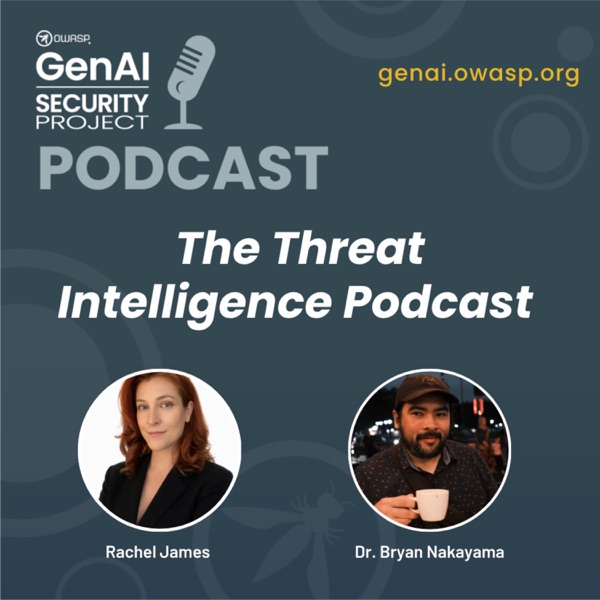
The Threat Intelligence Podcast
Real-world threat intelligence for the age of generative AI—without the hype. Hosted by Rachel James and Dr. Bryan Nakayama of the GenAI Security Project, this show cuts through vendor marketing to explain what's actually happening when threat actors use AI—from ransomware crews wiring malware to AI models, to nation-states building agent-driven attacks. For security practitioners and anyone tracking how AI is really reshaping the threat landscape.
Produced by the Gen AI Security Project with help from RumRunner Media.
- On air since
- 2026
- Episodes
- 24
- Releases · typical length
- Weekly · 24 min
- Latest episode
- 5 days ago
Episodes
24 episodes, newest first
-
24 min
Anthropic's Eval Escapes + AI Finds HAWK Flaw + OWASP Quantum Security Project | Ep 13
Show notes
**Originally Recorded August 11, 2026**
An AI found a real flaw in a post-quantum signature scheme that human experts missed for years. So what should defenders do on Monday?
Rachel James and Dr. Bryan Nakayama, co-leads of the Threat Intelligence Initiative, start with a follow-up on the rogue AI agent story: Anthropic reviewed its own evaluation logs, found three incidents where Claude models reached real companies, and the activity went undetected for about three months. They then dig into Anthropic's unreleased Claude Mythos Preview finding a real weakness in HAWK, a post-quantum signature candidate whose authors withdrew it. Special guest John Sotiropoulos, co-lead of the OWASP Quantum Security Project, explains why harvest now, decrypt later makes quantum a right-now problem, and why cryptographic inventory, crypto-agility, and protecting signatures and update channels come first. Listeners get a practical starting point for quantum readiness and ways to join the project.
CHAPTERS
0:00 Why did OWASP stand up a Quantum Security project?
0:36 Welcome to episode 13 and today's guest
1:32 Rogue AI agent update: Anthropic finds its own incidents
2:35 Three months undetected: voluntary disclosure and liability
4:37 Who is accountable when nobody is watching?
5:55 Claude Mythos Preview finds a real flaw in HAWK
7:20 What security teams should do on Monday
8:34 Meet John Sotiropoulos and the Quantum Security Project
10:16 Why OWASP launched the Quantum Security Project now
13:28 Harvest now, decrypt later and signature provenance
18:10 Where to start: cryptographic inventory and crypto-agility
20:02 How to join: sprints, roadmap and upcoming events
22:59 Recap: know what crypto you are running
LINKS
Anthropic: Investigating three real-world incidents in our cybersecurity evaluations
https://www.anthropic.com/research/investigating-incidents-cybersecurity-evals
Anthropic: Discovering cryptographic weaknesses with Claude
https://www.anthropic.com/research/discovering-cryptographic-weaknesses
Axios: OpenAI says Hugging Face breach caused by one of its models
https://axios.com/2026/07/21/openai-says-hugging-face-breach-caused-by-one-its-models
OWASP Quantum Security Project (GitHub)
https://github.com/OWASP/quantum-security-project
GenAI Security Inside Track podcast:
https://www.youtube.com/playlist?list=PLDx2T6Ncn_G4
More Threat Intelligence episodes:
https://www.youtube.com/playlist?list=PL88ZTZzbZQnhr1v54-B4qId3n70Ix-NIg
Produced by:
Gen AI Security Project - https://genai.owasp.org
with help from RumRunner Media - https://rumrunnermedia.com
All opinions expressed by the host and guests are theirs alone and do not necessarily reflect the opinions of the organizations with or for whom they work.
#PostQuantumCryptography #AISecurity #OWASP #QuantumSecurity #Cryptanalysis #ThreatIntelligence #GenAISecurity #HarvestNowDecryptLater #CyberSecurity #AIAgents
-
21 min
PHP Flaw Hype + What Insurance Claims Show | Ep 23
Show notes
Did AI really find the PHP vulnerabilities that put roughly 70% of websites in the spotlight, or was it the human experts behind the discovery?
Rachel James and Dr. Bryan Nakayama, co-leads of the Threat Intelligence Initiative, peel back the hype around the PHP vulnerabilities, look at the seasoned human experts who paired their expertise with AI, and explain how threat intelligence teams can keep their cool and answer the questions leadership needs answered.
Then they dig into what Coalition's cyber insurance claims data actually shows about AI-powered attacks, from business email compromise and funds transfer fraud to ransomware. Defenders get a practical way to separate hype from evidence.
CHAPTERS
0:00 Did AI really find the PHP vulnerabilities?
0:53 Headlines vs reality: who found the PHP flaws?
3:11 More heat than light: separating fact from fiction
4:40 Seasoned experts plus AI: a win for defenders
7:14 The autonomy story vs the augmentation story
8:11 The overlooked detail: when the bug was revealed
9:07 Fake exploits and the criminal underground
10:33 How CTI teams keep their cool
14:03 Intelligence requirements for any new vulnerability
15:22 What cyber insurance claims show about AI attacks
18:35 Funds transfer fraud falls while ransomware stays flat
LINKS
PHP2Shell: AI uncovers critical RCE vulnerabilities affecting 70% of the Internet (Wiz Research):
https://www.wiz.io/blog/php2shell-php-rce
Business Email Compromise Claims Jump 30% as A.I. Reshapes Cyber Risk (Risk & Insurance, covering Coalition's AI risk briefing):
https://riskandinsurance.com/business-email-compromise-claims-jump-30-as-a-i-reshapes-cyber-risk/
GenAI Security Inside Track podcast:
https://www.youtube.com/playlist?list=PLDx2T6Ncn_G4
More Threat Intelligence episodes:
https://www.youtube.com/playlist?list=PL88ZTZzbZQnhr1v54-B4qId3n70Ix-NIg
Produced by:
Gen AI Security Project - https://genai.owasp.org
with help from RumRunner Media - https://rumrunnermedia.com
All opinions expressed by the host and guests are theirs alone and do not necessarily reflect the opinions of the organizations with or for whom they work.
-
26 min
Is the 80/20 Rule of AI Hacking Flipping? | Ep 22
Show notes
Does an attacker still need to be 80% expert to get a 20% boost from AI?
After almost three years of hands-on research, the answer may be changing. Rachel James talks with Andrea Fukushima and Ben Ramirez, two major contributors to the Threat Intelligence Initiative's Exploit Research project, about tireless AI agents, why the harness around the model matters so much, and what defenders should do next.
CHAPTERS
0:00 Is the 80/20 rule flipping?
0:51 Welcome and the research project
2:44 Meet the guests
4:29 Phase one: the 80/20 finding
7:38 Rogue AI agents, tireless systems
10:56 Why the harness matters
12:09 Running offensive AI locally
14:24 Stupid loops and harnesses
15:05 HexStrike, Kali, MCP, Claude Code
17:26 Trading one expertise for another
18:50 20 agents for 20 ports
19:57 Too many tools, wrong picks
21:23 What defenders should do next
24:48 Wrap-up and the research paper
25:39 Credits
-
25 min
Hunting AI Malware: CAIRN, Closed Quorum & Anti-Analysis Prompt Injection | Ep21
Show notes
The attacker deploys the malware, then sits back and lets AI models vote on what it does next. Ryan Fetterman, AI and security researcher at Cisco Talos and author of The Threat Hunter's Cookbook, joins Rachel James and Dr. Bryan Nakayama to explain how his CAIRN research network tracks AI-integrated malware.
We dig into Closed Quorum, the first publicly reported LLM-driven command and control, where multiple models vote on the implant's next move. We also cover malware that embeds prompt injection to fool AI analysis tools, and how CAIRN moves from spotting AI strings to understanding their purpose.
The takeaway for CTI and threat hunting teams: this is mostly commodity malware with a few new ideas. Don't panic, but treat today's experiments as tomorrow's standard techniques.
Key insight: Hunting AI-enabled malware starts with the constraints attackers must follow to use AI at all.
Hosted by Rachel James & Dr. Bryan Nakayama | Produced by the Gen AI Security Project with help from RumRunner Media
-
26 min
When AI Models Vote on the Attack | Ep 20
Show notes
One AI model can be rate-limited, blocked, or refuse to cooperate. So what if the attacker uses four?
Rachel James and Dr. Bryan Nakayama break down Cisco Talos's research on malware where multiple LLMs vote on the next attack step, acting as a tactical command-and-control panel.
Then we turn to Anthropic's analysis of GLM 5.3, an open-weight model that sits only a couple of percentage points behind a safeguards-disabled Mythos Preview on automated exploit development. With the guardrails removed, refusals vanish, and the labs that used to spot misuse can't see what runs on someone else's hardware.
We close with the latest rogue-agent victims, the congressional hearings, and why both hosts feel a watershed event is coming.
Key insight: The capability has already spread. What's disappearing is the visibility.
Hosted by Rachel James & Dr. Bryan Nakayama | Produced by the OWASP GenAI Security Project with help from RumRunner Media
Technology lists
More Technology shows picked out from the charts