Podcast
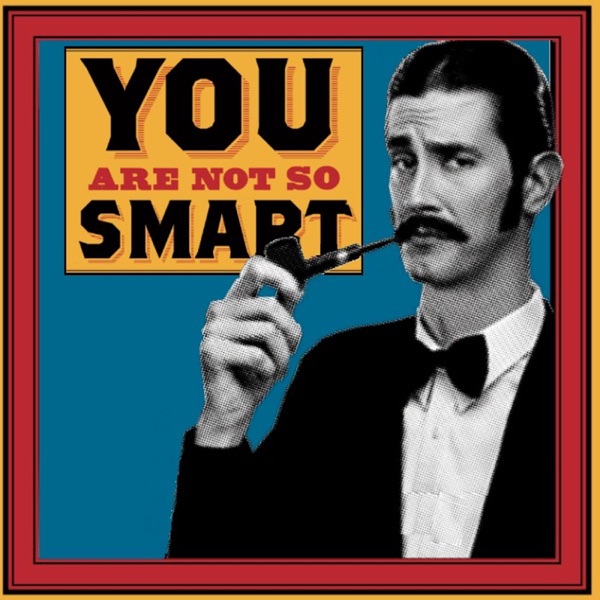
You Are Not So Smart
You Are Not So Smart is a show about psychology that celebrates science and self delusion. In each episode, we explore what we've learned so far about reasoning, biases, judgments, and decision-making.
- Social Sciences chart
- #10
- Episodes
- 348
- Releases
- Every two weeks
- Typical length
- 1 hr 6 min
- On air since
- 2012
- Latest episode
- 1 week ago
Episodes
348 episodes, newest first
-
1 hr 1 min
351 - Megachurches - Hahrie Han
Show notes
What have scientists learned about the social infrastructure of megachurches that not only explains their growth but their resilience, and how can we apply what we've learned to institutions that are not megachurches? Political scientists Hahrie Han joins us to explain why belonging is more important than belief when it comes to the push-pull of top-down and bottom-up within organizations that depend on fractal superstructures of cellular relationships in order to survive internal conflict.
Hosted by Simplecast, an AdsWizz company. See https://pcm.adswizz.com for information about our collection and use of personal data for advertising.
-
1 hr 24 min
350 - Pluralistic Ignorance
Show notes
There are several ways to define pluralistic ignorance, and that’s because it’s kind of a brain twister when you try to put it into words. Strange and harmful behavior can follow from the fact that, on certain issues, most people believe that most people believe what, in truth, few people believe. Or put another way, pluralistic ignorance is the erroneous belief that the majority is acting in a way that matches its internal philosophies, and that you are one of a small number of people who feel differently, when in reality the majority agrees with you on the inside but is afraid to admit it outright or imply such through its behavior. Everyone in a group, at the same time, gets stuck following a norm that no one wants to follow, because everyone is carrying a shared, false belief about everyone else’s unshared true beliefs.
Hosted by Simplecast, an AdsWizz company. See https://pcm.adswizz.com for information about our collection and use of personal data for advertising.
-
1 hr 13 min
349 - AI Risk - Jesse Richardson
Show notes
Jesse Richardson wants to improve our critical thinking about AI risk through the gamification of our rampant speculation. In this episode he explains AI safety isn't just one thing, there are a bunch of different risk profiles and each needs to be considered critically.
Melanie Mitchell on AI Intelligence
Hosted by Simplecast, an AdsWizz company. See https://pcm.adswizz.com for information about our collection and use of personal data for advertising.
-
44 min
348 - The Dress - Decoder Ring
Show notes
We return to The Dress and the psychological lessons offered by one of the most viral moments in the history of the internet via an episode of Decoder Ring in which David McRaney shares some insights from his book, How Minds Change, with Willa Paskin, the host of Decoder Ring.
CBC Interview with Willa Paskin
Hosted by Simplecast, an AdsWizz company. See https://pcm.adswizz.com for information about our collection and use of personal data for advertising.
-
1 hr 10 min
347 - Under Alien Skies - Phil Plait
Show notes
Astronomer Phil Plait joins us to discuss his new book, Under Alien Skies, in which he describes what it would be like (through human eyes and real physical experiences) to actually travel to Saturn, Mars, asteroids, and distant stars. Also, we discuss the recent surge in UFO sighting as well as his famous talk at The Amazing Meeting.
Hosted by Simplecast, an AdsWizz company. See https://pcm.adswizz.com for information about our collection and use of personal data for advertising.
-
1 hr
346 - No Nocebo Effect - Helen Pilcher
Show notes
The suffering is real, but the source may not be what you assume. That's the essence of the nocebo effect, the placebo effect's evil twin. As neuroscientist Dr. Helen Pilcher explains, illness is not simply a matter of biology. Our thoughts, conscious or otherwise, can make lead to symptoms in unexpected ways.
This Book May Cause Side Effects
Hosted by Simplecast, an AdsWizz company. See https://pcm.adswizz.com for information about our collection and use of personal data for advertising.
-
1 hr 6 min
345 - A Pox on Fools - Thomas Levenson
Show notes
MIT professor Thomas Levenson, the author of the book A Pox on Fools, takes us through the same repeating patterns throughout history which have led to antivaxxers and vaccine hesitancy since the very first vaccines.
Hosted by Simplecast, an AdsWizz company. See https://pcm.adswizz.com for information about our collection and use of personal data for advertising.
-
1 hr 8 min
344 - Intellectual Humility - Tenelle Porter
Show notes
Can intellectual humility be measured? What influences it and affects it, limits it and enhances it? What even is it, scientifically speaking? We explore all of this and then play an episode of How to Be A Better Human featuring psychologist Tenelle Porter telling comedian Chris Duffy how she is researching how to conduct better research into intellectual humility.
The Gateway Drugs to Intellectual Humility
The Illusion of Explanatory Depth
Hosted by Simplecast, an AdsWizz company. See https://pcm.adswizz.com for information about our collection and use of personal data for advertising.
-
1 hr 9 min
343 - Misguided - Matthew Facciani
Show notes
What is misinformation? How does it differ from disinformation or just plain ‘ole propaganda? How do we protect ourselves from people with nefarious intentions using all of these things to affect our thoughts, feelings, and behavior? That’s what we discuss in this episode with Matthew Facciani, social scientist and author of Misguided: Where Misinformation Starts, How it Spreads, and What We Can Do About It.
Show Notes
Hosted by Simplecast, an AdsWizz company. See https://pcm.adswizz.com for information about our collection and use of personal data for advertising.
-
47 min
342 - The Conspiracy Theorist Who Changed His Mind
Show notes
Tim Harford of the podcast Cautionary Tales sits down with David McRaney to hear a story from David's book, How Minds Change, about how (and why) a prominent conspiracy theorist realized he was wrong.
Charlie Veitch was certain that 9/11 was an inside job. The attack on the World Trade Center wasn’t the work of Al-Qaeda, but an elaborate conspiracy. He became a darling of so-called “9/11 truthers” until he actually visited Ground Zero to meet architects, engineers and the relatives of the dead.
The trip changed his mind. His fellow “truthers” did not take Charlie’s conversion well.
Hosted by Simplecast, an AdsWizz company. See https://pcm.adswizz.com for information about our collection and use of personal data for advertising.
-
45 min
341 - Positive Rants - Heather Barnes
Show notes
Communications professor Heather Barnes teaches us how to use what she learned teaching at Second City, managing the Museum of Science and Industry, and taking classes at the Alan Alda Center for Communicating Science to truly engage with difficult people through the power of positive rants.
The Center for Enlightened Disagreement
Alan Alda Center for Communicating Science
Hosted by Simplecast, an AdsWizz company. See https://pcm.adswizz.com for information about our collection and use of personal data for advertising.
-
1 hr 3 min
340 - Thinking Sideways - Jennifer Shahade
Show notes
There are more possible chess moves than atoms in the universe, and chess champion Jennifer Shahade tells us how we can borrow from the best chess players' decision-tree approach to avoid considering every possible option and instead "think sideways" to consider the best choices on the board.
Hosted by Simplecast, an AdsWizz company. See https://pcm.adswizz.com for information about our collection and use of personal data for advertising.
-
1 hr 29 min
339 - Enlightened Disagreement
Show notes
Northwestern University just launched the Litowitz Center for Enlightened Disagreement, a real-world institution devoted to "research-backed approaches to cultivating open-mindedness, identifying one’s own cognitive biases, working collaboratively with others despite disagreement and more."
In this episode, David McRaney details his time as a resident of the Center, teaching students how to ask questions that activate a person's introspection, and then follow up with questions that evoke a person's motivated reasoning, then keep going until the other side articulates things they may have never considered before, and, in so doing, reveal the deeper motivations and values generating disagreement.
You'll learn about this and all the other modules of the Center's pilot program. You'll also learn about a new game they are designing to improve scientific literacy of news consumers and news creators.
The Litowitz Center for Enlightened Disagreement
The Center for Public Deliberation
Hosted by Simplecast, an AdsWizz company. See https://pcm.adswizz.com for information about our collection and use of personal data for advertising.
-
40 min
338 - May Contain Lies - Alex Edmans (rebroadcast)
Show notes
Alex Edmans, a professor of finance at London Business School, tells us how to avoid the Ladder of Misinference by examining how narratives, statistics, and articles can mislead, especially when they align with our preconceived notions and confirm what we believe is true, assume is true, and wish were true.
What to Test in a Post Trust World
Hosted by Simplecast, an AdsWizz company. See https://pcm.adswizz.com for information about our collection and use of personal data for advertising.
-
1 hr
337 - Cognitive Surrender - Gideon Nave and Steven D. Shaw
Show notes
How is AI reshaping human reasoning? What is cognitive surrender, and how do we avoid its negative impact? What is system three thinking, and how can we get the most out of it? Artificial intelligence researchers Gideon Nave and Steven D. Shaw have some answers, some questions, and some suggestions.
Thinking: Fast, Slow, and Artificial
Hosted by Simplecast, an AdsWizz company. See https://pcm.adswizz.com for information about our collection and use of personal data for advertising.
-
1 hr 4 min
336 - The 3.5 Percent Rule - Erica Chenoweth (rebroadcast)
Show notes
If you want to overthrow a dictator, resist an authoritarian regime, or create a movement that can change the national status quo, you don't need half the country, you only need 3.5 percent of the population to join – but there are some caveats, and Erica Chenoweth whose research led to the discovery of the 3.5 Percent Rule, explains them to us in this episode.
Why Civil Resistance Works (the paper)
Why Civil Resistance Works (the book)
Hosted by Simplecast, an AdsWizz company. See https://pcm.adswizz.com for information about our collection and use of personal data for advertising.
-
1 hr 13 min
335 - Align Your Mind - Britt Frank (rebroadcast)
Show notes
Therapist, teacher, speaker, and trauma specialist Britt Frank tells us all about her new book, Align Your Mind, an all-access pass to understanding, befriending, and leading the multiple voices within yourself.
Grounded in the latest research on Parts Work and Internal Family Systems, and offering proven techniques from Frank’s clinical practice and personal challenges, this engaging guide is a user manual to your own mind—and presents a road map for finding peace, confidence, and a deeper understanding of who you truly are.
Hosted by Simplecast, an AdsWizz company. See https://pcm.adswizz.com for information about our collection and use of personal data for advertising.
-
1 hr 19 min
334 - Magical Thinking - Matt Tompkins (rebroadcast)
Show notes
In this episode, the story of Clever Hans, the horse who changed psychology for the better. We also sit down with psychologist and magician Matt Tompkins. Matt is the author of The Spectacle of Illusion, a book about the long history of the manipulation of our own magical thinking and how studying deception can help us better understand perception, memory, belief, and more.
Society for Psychical Research
Hosted by Simplecast, an AdsWizz company. See https://pcm.adswizz.com for information about our collection and use of personal data for advertising.
-
38 min
YANSS 333 - Selective Perception - Jay Van Bavel
Show notes
How can two people watch the same video yet see two different things? How can two people witness the same event but arrive at two different truths about what they witnessed? How can the same evidence lead people to drastically different realities? In this episode, Dr. Jay Van Bavel at NYU explains.
Hosted by Simplecast, an AdsWizz company. See https://pcm.adswizz.com for information about our collection and use of personal data for advertising.
-
1 hr 9 min
332 - Concordance Over Truth Bias (rebroadcast)
Show notes
In this episode, we sit down with three disinformation researchers whose new paper found something surprising about both our resistance and our susceptibility to both true news we wish was fake and fake news we wish was true.
Our guests are three of the scientists exploring a newly named cognitive distortion, one that every human being is prone to exhibiting, one that is so common and so easily provoked that nefarious actors depend on it when distributing disinformation and propaganda.
Samuel Woolley, Katie Joseff, and Michael Schwalbe will share their methods, findings, and takeaways. They will also explain the troublesome nature of something they are calling concordance over truth bias – a distortion that most often appears in those who have the most (undeserved) confidence in their own (not-so-objective) objectivity.
- Why Do We Share Our Feelings With Others?
Hosted by Simplecast, an AdsWizz company. See https://pcm.adswizz.com for information about our collection and use of personal data for advertising.
Social Sciences lists
More Social Sciences shows picked out from the charts








More in Social Sciences
Placed highest on Apple Podcasts' Social Sciences chart right now