Podcast
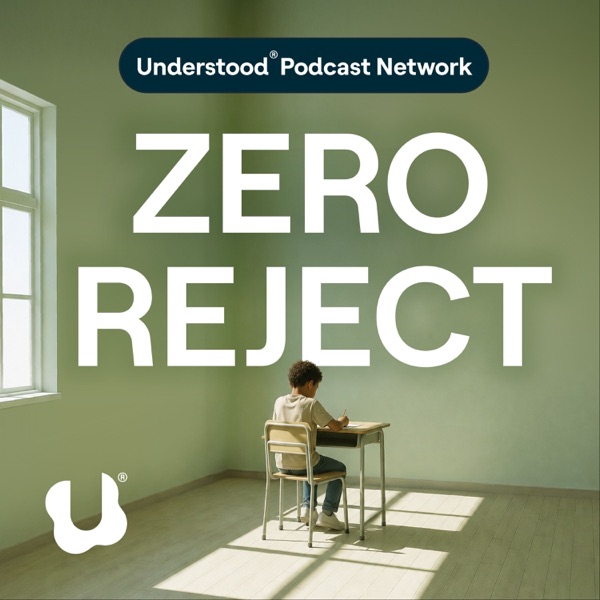
Zero Reject: The Uncertain Future of Special Education
Getting your child the support they need at school shouldn’t feel like a fight. But for millions of families, it does. In Zero Reject, an investigative podcast from Understood.org, award-winning journalist Anya Kamenetz looks at how changing federal policies are reshaping special education — and what’s at stake for families trying to access the support their children are legally entitled to.
- Society & Culture chart
- #168
- Episodes
- 7
- Releases
- Weekly
- Typical length
- 36 min
- On air since
- 2026
- Latest episode
- 1 week ago
Episodes
7 episodes, from the first
Season 1
-
1 min
Introducing “Zero Reject: The Uncertain Future of Special Education” Trailer
Show notes
Every year, millions of families fight to get their kids the special education services they’re legally owed. And right now, changes under the Trump administration are making that fight even harder. Find out what those changes mean on Zero Reject, a new investigative podcast from Understood.org, hosted by award-winning journalist Anya Kamenetz.
Over six episodes, Anya follows real families navigating IEPs, evaluations, and federal complaints. She also traces the policies shaping who gets protected and who doesn’t. Meet a civil rights attorney caught in a wave of federal layoffs, a mom whose complaint disappeared into a 25,000-case backlog, and families finding creative ways to make the system work better despite it all. Zero Reject digs into what’s really happening in special education — and what’s at stake for the millions of kids who depend on it. New episodes drop weekly starting September 29. Listen wherever you get your podcasts.
For more on this topic
• Listen: What you need to know about federal funding for special education
• Read: News to know
• Watch: Trump administration splits special education oversight between HHS and DOJ
• Explore: IEP Guide for Parents
• Read: The Brief: Understood NewsFor a transcript and more resources, visit Zero Reject on Understood.org. You can also email us at podcast@understood.org.
Understood is a nonprofit where millions of people who are navigating neurodivergence find clear guidance, practical tools, and people who get it. To help us continue this work, donate at https://u.org/give
Hosted by Simplecast, an AdsWizz company. See https://pcm.adswizz.com for information about our collection and use of personal data for advertising.
-
30 min
Reduction in force | 1
Episode 1
Show notes
Beth Gellman-Beer spent her whole career fighting for kids with disabilities — first as a student written off as “lazy,” then as a federal civil rights attorney who found her dream job protecting students like her younger self. But on one ordinary night, a phone call changed everything: Her entire office had been eliminated.
In the premiere of Zero Reject, reporter Anya Kamenetz traces Beth’s journey from an unfair fourth-grade classroom to the front lines of a sweeping overhaul at the Department of Education’s Office for Civil Rights — the agency families turn to when a school isn’t meeting their child’s needs. Anya breaks down the reduction in force that gutted OCR’s staff, what it means for the 25,000 families still waiting for a response to their complaints, and the plan to dismantle the Department of Education altogether. With fewer people to enforce the law, what happens to the students the system was built to protect?
For more on this topic
• Read: What is HHS, and what does it have to do with special education?
• Read: What is the Office for Civil Rights (OCR), and what’s its role in special education?
• Explore: IEP Guide for Parents
• Read: The Brief: Understood NewsFor a transcript and more resources, visit Zero Reject on Understood.org. You can also email us at podcast@understood.org.
Understood is a nonprofit where millions of people who are navigating neurodivergence find clear guidance, practical tools, and people who get it. To help us continue this work, donate at https://u.org/give
Hosted by Simplecast, an AdsWizz company. See https://pcm.adswizz.com for information about our collection and use of personal data for advertising.
-
40 min
25,000 complaints, and 7 minutes | 2
Episode 2
Show notes
When the Trump administration gutted the Office for Civil Rights, around 25,000 complaints from families were stuck in limbo. One of them was filed by a mom in southern Indiana on behalf of her two kids with autism, ADHD, and dyslexia. She’d spent years fighting for them after facing suspensions, exclusion, and a school that called her son a “bad kid.”
In this episode, Anya Kamenetz spends a day with that family to see what it actually takes to advocate for a child’s education. The meetings. The paperwork. The years of being told your kid just isn’t trying hard enough. And what it means not that the office meant to protect their kids’ civil rights isn’t answering the phone.
When a seven-minute lapse in supervision becomes the final straw, one family’s decision reveals just how much is riding on where a family happens to live.
For more on this topic
• Read: How is special education funded?
• Read: What is the Office for Civil Rights (OCR), and what’s its role in special education?
• Explore: IEP Guide for Parents
• Read: The Brief: Understood NewsFor a transcript and more resources, visit Zero Reject on Understood.org. You can also email us at podcast@understood.org.
Understood is a nonprofit where millions of people who are navigating neurodivergence find clear guidance, practical tools, and people who get it. To help us continue this work, donate at https://u.org/give
Hosted by Simplecast, an AdsWizz company. See https://pcm.adswizz.com for information about our collection and use of personal data for advertising.
-
44 min
The dumping ground | 3
Episode 3
Show notes
Before 1975, there was no legal guarantee that a child with a disability could attend public school at all. Kids were hidden in attics and basements, sent to state institutions, or simply turned away. Rosemary Kennedy’s family concealed her intellectual disability for decades. It took a movement of parents, teachers, and advocates — like Rosemary’s sister Eunice — to build the legal rights families depend on today.
Now, the Trump administration is dismantling the Department of Education and shifting special education oversight to Health and Human Services. In this episode, Anya Kamenetz speaks with Jonathan Butcher of the Heritage Foundation, the organization behind Project 2025, about his vision for the future of education. And she talks with Ann Turnbull, a special education pioneer who helped shape the law now known as IDEA. Anya asks what today’s families stand to lose, and whether history is closer to repeating itself than anyone expected.
For more on this topic
• Read: The history of special education: From exclusion to IDEA
• Read: 6 options for resolving an IEP dispute
• Explore: IEP Guide for Parents
• Read: The Brief: Understood NewsFor a transcript and more resources, visit Zero Reject on Understood.org. You can also email us at podcast@understood.org.
Understood is a nonprofit where millions of people who are navigating neurodivergence find clear guidance, practical tools, and people who get it. To help us continue this work, donate at https://u.org/give
Hosted by Simplecast, an AdsWizz company. See https://pcm.adswizz.com for information about our collection and use of personal data for advertising.
-
34 min
The chimichanga solution | 4
Episode 4
Show notes
Kelly, a kindergarten teacher, knew her son McKay struggled with reading even before he started school. It took years and repeated pushback from the school before he was tested and diagnosed with dyslexia. Even then, the district resisted formally including it in his education plan. By seventh grade, McKay was faking being sick just to avoid school.
This episode follows the family through years of reading interventions that weren’t working, and their decision to enroll McKay at the Gow School, a boarding school for students with dyslexia — and to sue their district to cover the cost. It asks what school choice really means when getting the right education requires resources most families don’t have.
Along the way: what “wait to fail” means, how structured phonics instruction works, and the legal standard (a Carter case) that determines whether families can be reimbursed for tuition when a public school falls short.
For more on this topic
• Read: The Education Freedom Tax Credit: What families of kids with disabilities need to know
• Listen: What if I think my child might have dyslexia?
• Read: How is special education funded?
• Explore: IEP Guide for Parents
• Read: The Brief: Understood NewsFor a transcript and more resources, visit Zero Reject on Understood.org. You can also email us at podcast@understood.org.
Understood is a nonprofit where millions of people who are navigating neurodivergence find clear guidance, practical tools, and people who get it. To help us continue this work, donate at https://u.org/give
Hosted by Simplecast, an AdsWizz company. See https://pcm.adswizz.com for information about our collection and use of personal data for advertising.
-
37 min
Waterline | 5
Episode 5
Show notes
Ashley Jochim is an education researcher with a PhD, four kids, and two decades of experience studying what makes schools work. None of that prepared her for the day her daughter Evelyn was diagnosed with ADHD and a learning disability — or for how little Ashley actually knew about special education.
That experience sent Ashley down a research rabbit hole: a first-of-its-kind, 50-state database tracking special education identification and outcomes over the past 50 years. What she found raises hard questions about who qualifies for services and who’s left out. And whether the growing number of kids identified for special education is actually making things better or just spreading already-thin resources even thinner.
In this episode, Anya Kamenetz digs into Ashley’s research and her proposal for reimagining the system — one that looks less like gatekeeping and more like good teaching for everyone. But when Anya brings in another perspective, from a longtime disability rights attorney, something else comes into focus for Ashley: that for a lot of families, the fight isn’t over which services their kid gets. It’s over whether their kid gets to go to school at all.
For more on this topic
• Read: School choice and special education: What to know about public, private, and charter schools
• Explore: IEP Guide for Parents
• Read: The Brief: Understood NewsFor a transcript and more resources, visit Zero Reject on Understood.org. You can also email us at podcast@understood.org.
Understood is a nonprofit where millions of people who are navigating neurodivergence find clear guidance, practical tools, and people who get it. To help us continue this work, donate at https://u.org/give
Hosted by Simplecast, an AdsWizz company. See https://pcm.adswizz.com for information about our collection and use of personal data for advertising.
-
34 min
Keeping the lights on | 6
Episode 6
Show notes
After tracing what’s broken in special education — and why — Anya Kamenetz closes the series by asking what’s actually working.
She reconnects with Beth Gellman-Beer, the former federal civil rights attorney from episode one, now a year into life after the Department of Education. Beth gives her honest read on what’s happened to the Office for Civil Rights, and her hopes for what it could become.
Anya also talks to Stephanie Cosey, a longtime special educator in Southern California, about a very different approach to the adversarial relationship between parents and schools — one built on coaching and collaboration instead of legal threats.
And she meets Roberto Rivera, a father in San Francisco who turned his own fight for his son’s speech therapy into grassroots advocacy, and who’s now helping build a tool that translates dense IEP paperwork into plain language for other families.
• Need another podcast? Everyone Gets a Juice Box: For Parents of Neurodivergent Kids
• Explore: IEP Guide for Parents
• Read: The Brief: Understood NewsFor a transcript and more resources, visit Zero Reject on Understood.org. You can also email us at podcast@understood.org.
We’re taking Zero Reject live! Join host Anya Kamenetz on Thursday, October 29, at 6 p.m. ET for an honest conversation with parents, teachers, and policymakers about where special education goes from here.
Be part of the conversation in person in New York City or watch live on YouTube.https://www.understood.org/en/zero-reject-liveSave your spot here: understood.org/zero-reject-live
Understood is a nonprofit where millions of people who are navigating neurodivergence find clear guidance, practical tools, and people who get it. To help us continue this work, donate at https://u.org/give
Hosted by Simplecast, an AdsWizz company. See https://pcm.adswizz.com for information about our collection and use of personal data for advertising.
On these lists
Zero Reject: The Uncertain Future of Special Education is one of the shows picked out on each of these


More in News
Placed highest on Apple Podcasts' News chart right now