Podcast
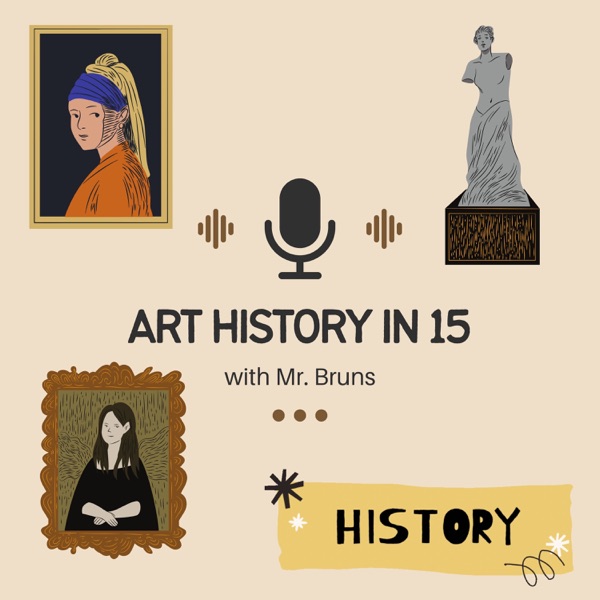
AP Art History in 15
This podcast series is designed to help Advanced Placement (AP) Art History students gain an understanding of the "250" works of art and art history. The series will try to connect works of art and architecture to help students succeed in the AP Exam.
- Courses chart
- #153
- Episodes
- 82
- Releases
- Twice a week
- Typical length
- 16 min
- On air since
- 2024
- Latest episode
- 1 week ago
Episodes
82 episodes, newest first
-
17 min
The Grave Stele Hegeso and Nike of Samothrace - Remembrance and Victory
Show notes
What can a grave marker reveal about ancient Greek society, and how can a winged goddess turn a marble sculpture into a symbol of unstoppable victory? Join Mr. Bruns on AP Art History in 15 as we explore two unforgettable masterpieces of ancient Greece: #36, Grave Stele of Hegeso, and #37, Winged Victory (Nike) of Samothrace.
First, discover how Hegeso's quiet domestic scene reveals Athenian funerary customs, gender expectations, family identity, and social hierarchy. Then, prepare for takeoff as we examine the dramatic movement, flowing drapery, and monumental power of Winged Victory, a Hellenistic masterpiece celebrating triumph and divine favor.
But there's more! Mr. Bruns tackles two essential AP Art History questions: How does Hegeso help us understand Greek cultural practices? And why do archaeological discoveries, missing pieces, and uncertain historical evidence lead to multiple interpretations of Winged Victory?
Using Form, Function, Content, and Context (FFCC), we'll connect artistic choices to the beliefs, values, and historical circumstances of ancient Greece.
Whether you're preparing for the AP Art History exam or simply love discovering the stories behind great works of art, this episode will help you look closer, think critically, and turn visual observations into strong historical analysis.
-
18 min
The Acropolis: Gods, Glory & Athenian Power
Show notes
What can marble tell us about the gods, politics, and power of ancient Athens? Join Mr. Bruns on AP Art History in 15 as we explore the Acropolisand four essential works from AP Art History Work #35!
In this episode, we explore:
•
Helios, Horses, and Dionysus: Discover how the Parthenon's sculptors used mythology, naturalism, and architectural space to celebrate Athena.
•
Temple of Athena Nike: Examine how religious devotion and military victory became powerful symbols of Athenian identity.
•
Victory Adjusting Her Sandal: Unpack the elegance of wet drapery, naturalistic movement, and the personification of victory.
•
Plaque of the Ergastines: Explore the Panathenaic Festival and how religious rituals reinforced Athenian civic identity.
🎯 AP Exam Focus: We go beyond identifying and describing works of art to examine how purpose, intended audience, and patronage influenced artistic choices. Learn how the Athenian state used monumental architecture and sculpture to honor its patron goddess, celebrate civic traditions, and communicate political power.
Whether you're preparing for the AP Art History exam or simply fascinated by the art and culture of ancient Greece, this episode connects Form, Function, Content, and Context (FFCC) in a sharp, engaging, student-friendly format.
-
18 min
Feasting with the Dead & Facing the Gods | Etruscan Tomb of the Triclinium & Greek Niobides Krater
Show notes
Welcome back to AP Art History in 15 with Mr. Bruns! This episode takes us on a Mediterranean journey to explore two fascinating works of art and the societies that created them.
🏛️ First Stop: Etruscan Tomb of the Triclinium (c. 470 BCE)
Step inside an underground burial chamber where banquets, musicians, and dancers transform a tomb into a celebration of life. Discover how Etruscan social hierarchies, funerary customs, and beliefs about death influenced the creation of this lively painted environment.
🏺 Second Stop: Greek Niobides Krater (c. 460–450 BCE)
Meet Niobe, the mortal mother whose pride provokes the wrath of Apollo and Artemis. Explore how Greek mythology, religious beliefs, and symposium culture shaped this remarkable red-figure mixing vessel. We'll also examine how the Niobid Painter experimented with spatial depth and figure placement to bring a dramatic myth to life.
-
16 min
Democracy, Gods & Death: How Culture Shapes Art
Show notes
In this episode of AP Art History in 15, Mr. Bruns—your 29-year AP teaching veteran—takes us into the ancient Mediterranean to explore three important AP Art History works:
🏛️ #26 — Athenian Agora
👗 #28 — Peplos Kore
💀 #29 — Sarcophagus of the SpousesWe'll break down Form, Function, Purpose, and Historical Context while answering one of College Board's biggest questions:
How do cultural practices, belief systems, and physical settings affect art and art making?
You'll discover how the Athenian Agora reflects the civic and political culture of Athens, how the Peplos Kore connects sculpture to Greek religious practices and sacred space, and how the Sarcophagus of the Spouses reveals Etruscan ideas about marriage, social life, death, and the afterlife.
Along the way, we'll uncover some Golden Nuggets—the kind of strange, surprising, and memorable historical facts that can help these works stick in your brain when you're sitting in front of the AP exam.
-
16 min
Ancient Egypt: Purpose, Audience & Patron | Hatshepsut & King Tut
Show notes
Why did the ancient Egyptians create such elaborate temples,tombs, coffins, and funerary objects? In this episode of AP Art History in 15, Mr. Bruns explores how purpose, intended audience, and patronage shaped Ancient Egyptian art and art making.
We’ll examine two essential AP Art History works:
#21. Mortuary Temple ofHatshepsut— Discover how architecture, religious imagery, and royal representation helped Hatshepsut communicate her authority, divine connections, and role as pharaoh.
#23. Tutankhamun’s Tomb,Innermost Coffin — Explore why gold, idealized royal imagery, and traditional symbols of kingship were so important in Egyptian funerary art and beliefs about the afterlife.
Along the way, we’ll explore the ka, Egyptianfunerary beliefs, royal patronage, divine kingship, the purpose of mortuary complexes, and why materials and imagery matter.
AP Art History Takeaway
When studying Egyptian art, remember:
PURPOSE — Why was it made?
AUDIENCE — Who was it made for?
PATRON — Who commissioned it?Then ask the most important AP question:
How did those factors affect the way the artwork wasmade?
-
16 min
Ancient Egypt, Part 1: Pharaohs, Pyramids & the Power of Images
Show notes
In Part 1 of our Ancient Egypt series, Mr. Bruns explores how cultural practices, belief systems, political power, and the Egyptian environment shaped the art and architecture of one of history's most fascinating civilizations.
We'll examine three essential AP Art History works:
#13 Palette of King Narmer — Discover how hierarchical scale, symbolism, and visual conventions communicate the power of the pharaoh and the organization of Egyptian society.
#15 Seated Scribe — Explore the importance of literacy, bureaucracy, and funerary practices—and why this sculpture looks so different from idealized images of Egyptian rulers.
#17 Great Pyramids of Giza — Go beyond "they're giant tombs" and examine how religion, engineering, social organization, geography, and royal power came together to create some of the most famous architecture in the world.
Along the way, we'll tackle a key AP Art History question:
How do culture, belief, and physical setting influence what artists create—and how they create it?
Remember: Don't just identify the artwork. Explain WHY it looks the way it does.
-
16 min
Ancient Mesopotamia Art - Impact of the Environment, Beliefs, and Politics on art
Show notes
Travel back to ancient Mesopotamia—the “land between the rivers”— as we begin a new AP Art History unit and explore how physical setting, belief systems, cultural practices, and political power shaped the art of the ancient world.
In this episode, Mr. Bruns examines four important AP Art History works:
🏛️ #12 White Temple and its Ziggurat— Discover how Mesopotamia’s flat landscape and religious beliefs influenced the creation of monumental ziggurats and elevated sacred spaces.
🙏 #13 Statue of a Votive Figure — Learn why these figures were created as perpetual worshippers and why those enormous eyes are so important to understanding Mesopotamian beliefs.
⚔️ #16 Standard of Ur — Explore the connections between warfare, peace, social hierarchy, kingship, trade, and artistic representation—including the famous hierarchy of scale.
🪽 #25 Lamassu from the Citadel of Sargon II — Meet the human-headed, winged bull that protected Assyrian royal spaces and communicated the power of the empire. And yes… we'll explain the five legs!
Throughout the episode, we’ll use an important AP Art History formula:
CONTEXT → ARTISTIC CHOICE → MEANING
We’ll also tackle the big question:
How do cultural practices, belief systems, and physical setting impact art and art making?
-
17 min
Theories and Interpretations of Prehistory Art
Show notes
In this episode of AP Art History in 15, Mr. Bruns explores how art historians develop theories and interpretations of prehistoric art. Using the Great Hall of the Bulls at Lascauxand Stonehenge, students will examine how visual analysis, archaeology, astronomy, technology, and available evidence shape our understanding of art. Learn how to build evidence-based interpretations and recognize why multiple interpretations of a work can be historically valid.
-
20 min
Materials, Processes & Techniques in Prehistoric Art | Bone, Rock, Clay & Jade
Show notes
How does what an artist uses affect what an artist creates? In this episode of AP Art History in 15, Mr. Bruns takes you deep into prehistoric art to explore how materials, processes, and techniques shaped some of humanity's earliest artistic achievements.
We examine six AP Art History works:
Camelid Sacrum — transforming natural bone into an animal form
Running Horned Woman — pigment, rock surfaces, and the landscape as canvas
Beaker with Ibex Motifs — clay, painting, firing, and visual pattern
Anthropomorphic Stele — carving sandstone into an abstract human figure
Jade Cong — the extraordinary labor and techniques required to work jade
Terra Cotta Fragment — pottery, stamping, and evidence of Lapita cultural connections across the Pacific -
19 min
Before History: How Culture Shaped the First Art (Unit 1.1)
Show notes
What can a 25,000-year-old stone tell us about the people who made it? Quite a lot!
In this episode of AP Art History in 15, Mr. Bruns takes you around the prehistoric world to explore how culture, belief systems, survival, and physical environment shaped the earliest works of art.
We’ll examine three essential AP Art History works:
Apollo 11 Stones — Africa Ambum Stone — Papua New Guinea
Tlatilco Female Figure — Central MexicoUsing the College Board’s four Cultural Understandings, we’ll explore why prehistoric art developed across the globe, how changing environments influenced artistic production, how art connected to survival and community, and why humans repeatedly turned to nature, ritual, and symbolism to understand their world.
Along the way, we’ll break down FORM, FUNCTION, PURPOSE, and CONTEXT—the four questions you should be asking whenever you encounter an AP Art History work.
AP Art History in 15 — hosted by Mr. Bruns
#APArtHistory #APAH #ArtHistory #PrehistoricArt #Apollo11Stones #AmbumStone #Tlatilco #APExamPrep #MrBruns
-
18 min
Global Contemporary Art: Purpose and Audience (1980 to Present)
Show notes
Step into the world of Global Contemporary Art with Mr. Bruns in this episode of AP Art History in 15. This episode explores how artists and architects from 1980 to the present use art to communicate powerful ideas about memory, politics, identity, architecture, globalization, and public experience through the lens of Purpose and Audience.
Mr. Bruns breaks down the essential art historical foundations of each work — including form, composition, materials, scale, content, and historical context — while connecting those ideas directly to the AP Art History exam’s comparison and FRQ skills.
Featured works include:
• Vietnam Veterans Memorialby Maya Lin
• Guggenheim Museum Bilbao by Frank Gehry
• MAXXI National Museum of XXI Century Arts by Zaha Hadid
• Shibboleth by Doris Salcedo
• Kui Hua Zi (Sunflower Seeds) by Ai WeiweiListeners will discover how patrons, institutions, governments, and audiences influence the creation of contemporary art and architecture, and how artists use materials and space to shape emotional and intellectual responses.
-
18 min
How Rulers Used Art to Shape Society - Thrones, Propaganda, and Power
Show notes
In this episode of AP Art History in 15, Mr. Bruns explores one of the most important themes students may encounter on the AP Art History Exam: how rulers used art to regulate society, legitimize authority, and shape public perception across cultures and time periods.
The episode examines the political power of works including the Stele of Hammurabi, Stele of Naram-Sin, Colossal statue of Constantine the Great, the Portrait of Mao Zedong at the Gate of Heavenly Peace, Mao by Andy Warhol, and the Statue of Saddam Hussein.
Mr. Bruns also investigates how female rulers and royal women used art to establish authority and influence society through works such as Theodora and Attendants, the Maya lintel showing Shield Jaguar and Lady Xoc, Akhenaten, Nefertiti, and Three Daughters, The Armada Portrait, and Marie Antoinette and Her Children.
Listeners will learn how form, composition, material, symbolism, and scale helped transform art into propaganda, religious authority, political messaging, and national identity — perfect preparation for thematic comparisons on the AP Art History Exam.
-
19 min
Birth, Death, and Eternity: Themes of Life and Immortality in AP Art History
Show notes
In this episode of AP Art History in 15, Mr. Bruns explores two major themes students may encounter on the AP Art History Exam: Art and the Cycle of Life and Mortality versus Immortality. Through thematic analysis, listeners learn how civilizations across time used art to explain birth, death, rebirth, memory, and eternal existence.
Mr. Bruns breaks down each artwork through:
• form,
• content,
• purpose,
• and cultural meaning,while also discussing the kinds of thematic comparison questions students may face on the AP exam.
Works discussed in this episode include:
• Tlazolteotl Giving Birth to the Maize God
• Nativity by Sandro Botticelli
• Studies of the Fetus in the Womb by Leonardo da Vinci
• Dead Christ by Andrea Mantegna
• The Taj Mahal
• Lord Pacal Sarcophagus Lid
• Shiva Nataraja (Lord of the Dance)
• The Journey of the Sun God Re
• King Tut’s SarcophagusFrom Aztec fertility imagery to Renaissance Christianity, from Maya funerary symbolism to Egyptian afterlife beliefs, this episode helps students connect artistic traditions across cultures while strengthening AP Art History thematic thinking and visual analysis skills.
-
15 min
Global Voices, Shared Forms: Cultural Interactions in Contemporary Art (1980–Present)
Show notes
In this episode of AP Art History in 15, Mr. Bruns explores how Global Contemporary artists navigate identity, power, and globalization through interactions within and across cultures. Focusing on four major works—Rebellious Silence, Lying with the Wolf, Old Man’s Cloth, and Preying Mantra—this episode breaks down both what viewers see and how artists construct meaning through form.
Listeners will gain a deeper understanding of how artists use line, color, texture, material, and scale to communicate complex ideas about gender, colonialism, environment, and global exchange. From Shirin Neshat’s powerful use of contrast and calligraphy to challenge perceptions of Muslim women, to Kiki Smith’s reimagining of human and animal relationships, each work reveals how visual choices carry cultural weight.
Mr. Bruns also examines how El Anatsui transforms discarded materials into monumental statements about trade and history, and how Wangechi Mutu uses fragmentation and collage to critique global beauty standards and postcolonial identity.
Perfect for AP Art History students preparing for the exam, this episode emphasizes a key takeaway: in contemporary art, form is never separate from meaning. Understanding how artists shape their work is essential to understanding what their work says.
-
17 min
Global Contemporary Art (1980–Present): Interactions Within and Across Cultures
Show notes
Mr. Bruns takes listeners deep into Global Contemporary Art (1980–present), focusing on how artists reveal powerful interactions within and across cultures. This episode provides an in-depth exploration of key works that reflect globalization, colonial legacies, identity, and cultural exchange.
Through Pink Panther by Jeff Koons, Trade (Gifts for Trading Land with White People) by Jaune Quick-to-See Smith, No Crying Allowed in the Barbershop by Pepon Osorio, Pisupo Lua Afe (Corned Beef 2000) by Michel Tuffery, and The Swing (after Fragonard)by Yinka Shonibare, Mr. Bruns breaks down:
• The artist’s background, including upbringing, training, and influences
• What the viewer sees through detailed form and content analysis
• The historical, political, and social contexts shaping each work
• How cross-cultural interactions—especially colonialism and globalization—inform meaning
• The impact of cultural practices, belief systems, and environments on artistic productionFrom Koons’ exploration of consumer culture in Pink Panther to Smith’s critique of colonial exchange in Trade, Osorio’s investigation of identity and masculinity in No Crying Allowed in the Barbershop, Tuffery’s commentary on globalization and environmental change in Pisupo Lua Afe, and Shonibare’s postcolonial reimagining of European art in The Swing (after Fragonard), Mr. Bruns frames each artwork as a primary source in a global dialogue.
Ideal for AP Art History students preparing for the exam or anyone interested in how contemporary artists challenge and connect cultures across time and space.
-
14 min
Global Contemporary Moment (1980–Present) - Materials and Meaning
Show notes
In this episode of AP Art History in 15, Mr. Bruns takes you inside the dynamic world of global contemporary art, exploring how artists since 1980 have pushed boundaries in materials, processes, and techniques. From graffiti-inspired canvases to fiber sculptures and video installations, this episode breaks down how art reflects an increasingly interconnected and technologically driven world.
Featuring key works like Horn Players by Jean-Michel Basquiat, Androgyne III by Magdalena Abakanowicz, Dancing at the Louvre by Faith Ringgold, Electronic Superhighway by Nam June Paik, and Stadia II by Julie Mehretu, Mr. Bruns connects each piece to the artist’s background, cultural context, and artistic choices.
Listeners will review essential AP Art History skills, including analyzing form, function, content, and context, while also examining how contemporary artists challenge traditional hierarchies of materials and redefine what art can be. The episode also highlights the impact of globalization, digital technology, and the evolving accessibility of art across cultures.
-
15 min
Power, Purpose, and Audience in West & Central Asian Art
Show notes
In this episode of AP Art History in 15, Mr. Bruns breaks down one of the most important concepts for the AP exam: how purpose and audience shape art—with a focus on West and Central Asia.
From the spiritual center of Islam in the Kaaba, to the communal design of the Great Mosque, to the royal storytelling ofThe Court of Gayumars, this episode explores how cultural practices, belief systems, and historical context influence artistic decisions.
You’ll learn:
• Why art historians prefer the term “Art in the Islamic World”
• How aniconism shapes visual culture
• How architecture like mosques is designed for ritual, movement, and community
• How royal manuscripts communicate power, identity, and legitimacy
• How purpose, audience, and context impact form, materials, and meaningWhether you’re reviewing for the AP exam or just want to understand how art reflects human intention, this episode connects it all.
-
14 min
Art, Exchange, and Iconoclasm in West & Central Asia
Show notes
In this episode of AP Art History in 15, Mr. Bruns takes you to the cultural crossroads of West and Central Asia—where trade routes, empires, and religions collide to shape some of the most powerful works of art in history.
From the rock-cut grandeur of Petra to the towering presence—and tragic destruction—of the Bamiyan Buddhas, this episode explores how cultural interaction drives artistic innovation. You’ll uncover how Hellenistic, Persian, and local traditions blend, adapt, and transform across time and place.
Mr. Bruns also breaks down the spiritual and visual language of Islam through the Dome of the Rock and a Folio from a Qur’an, highlighting why non-figural decoration, calligraphy, and geometry dominate sacred Islamic art.
The episode takes a powerful turn with a discussion of the 2001 destruction of the Bamiyan Buddhas by the Taliban—raising essential questions about iconoclasm, cultural heritage, and the role of art in global conflict.
-
14 min
From Reality to Abstraction: How “Isms” Reshaped Art
Show notes
In this episode of AP Art History in 15, Mr. Bruns takes you on a fast-paced journey through the revolutionary world of Modernism—where artists broke away from tradition and redefined what art could be.
Explore how cultural shifts, belief systems, and historical events shaped groundbreaking works like The Portuguese, Goldfish, Improvisation 28 (Second Version), and Self-Portrait as a Soldier. From the fragmented forms of Cubism to the emotional intensity of Expressionism and the spiritual power of abstraction, this episode connects each artwork to its defining “ism.”
Perfect for AP Art History students, this episode unpacks how artists responded to a rapidly changing world—and how their innovations continue to influence art today.
👉 Press play and discover how art moved beyond reality to capture the modern experience.
-
13 min
Art That Broke the Rules: Surrealism, Dada, and Revolutionary Voices
Show notes
In this episode of AP Art History in 15, Mr. Bruns discusses four groundbreaking works that challenged traditional definitions of art and reshaped the artistic landscape of the 20th century. From the unsettling textures of Object (Le Déjeuner en fourrure) to the provocative simplicity of Fountain (Second Version), listeners will explore how artists embraced radical “isms” like Surrealism and Dada to disrupt expectations and redefine meaning.
The episode also highlights the powerful storytelling of The Migration of the Negro, Panel 49 and the public, political impact of Dream of a Sunday Afternoon in the Alameda Park, showing how art became a tool for cultural identity, historical narrative, and social change.
Perfect for AP Art History students, this episode breaks down how intent, artistic choices, audience reactions, and historical context shape meaning—while also examining the decline of traditional academies and the rise of bold artistic individualism.
🎯 By the end, you’ll be ready to analyze not just what you see—but why it matters.
On these lists
AP Art History in 15 is one of the shows picked out on this list

More in Courses
Placed highest on Apple Podcasts' Courses chart right now