Podcast
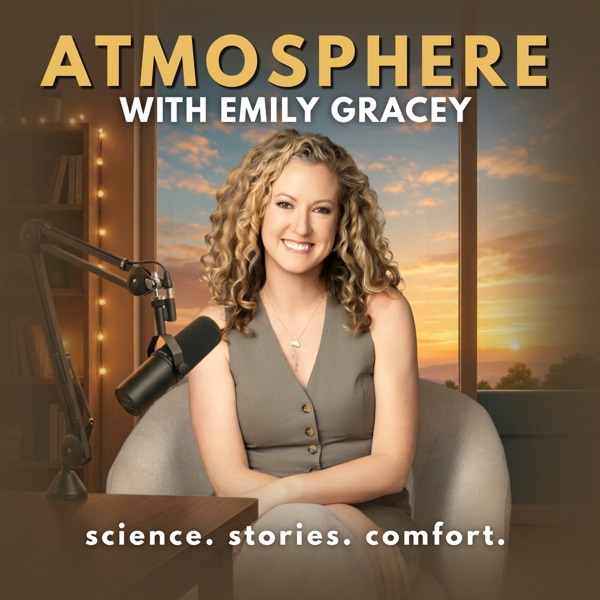
Atmosphere with Emily Gracey
Meteorologist Emily Gracey sits down each week with leading scientists, researchers, and experts in weather, climate, earth science, and beyond. Every episode goes deeper than the science itself, uncovering the human stories behind the work and making complex ideas feel relevant, relatable, and real. From hurricanes and severe storms to earthquakes and emerging research, Atmosphere turns complicated ideas into conversations everyone can connect with.
- Earth Sciences chart
- #77
- Episodes
- 24
- Releases
- Twice a week
- Typical length
- 43 min
- On air since
- 2026
- Latest episode
- 19 hours ago
Episodes
24 episodes, newest first
-
46 min
Why Weather Disasters Hit Some Communities Harder
Show notes
Why do some communities suffer far greater consequences from the same weather disaster? And what can we do to change that?
When Hurricane Katrina struck in 2005, meteorologist Dr. Jamese Sims urged her parents to evacuate. Her father refused, insisting he needed to "protect the house." It took years for Jamese to fully understand what he meant, and that experience helped inspire her new book, Protect the House: Weather Doesn't Discriminate, But Impact Does.
In this episode of Atmosphere, Jamese joins Emily to explore why weather disasters disproportionately affect underserved communities. From financial barriers and generational wealth to cultural beliefs and the lasting impacts of disasters, she explains why preparing for extreme weather isn't as simple as telling people to evacuate or have an emergency kit.
They also discuss where traditional weather communication falls short and share practical ways families, meteorologists, and community leaders can work together to make everyone safer.
Because a good forecast can only save lives if people have the information, resources, and support to act on it.Atmosphere is proudly supported by founding sponsor Weather100. Learn more at https://weather100.com/
Protect the House is available on Amazon: https://a.co/d/0acVHZsW
Subscribe to Atmosphere for more conversations about the science, stories, and people behind our changing world.
-
8 min
BONUS: The History of Daylight Saving Time in America
Show notes
Who decided we should change our clocks twice a year? And why are we still doing it?
From the days when every town kept its own time to America's failed experiment with permanent daylight saving time in 1974, meteorologist Emily Gracey takes a quick trip through the surprisingly messy history of timekeeping.
Plus, why Arizona refuses to play along, how China manages with just one time zone, and what all of this has to do with saving energy.
For more on the science of daylight saving time and how it affects our sleep and health, listen to the full Atmosphere episode featuring Stanford sleep researcher Dr. Jamie Zeitzer.Sources & Further Reading
• Congressional Research Service — Daylight Saving Time: https://www.everycrsreport.com/reports/RS22284.html
• U.S. Department of Transportation — The Daylight Saving Time Study: A Report to Congress (1975): https://rosap.ntl.bts.gov/view/dot/92250
• Smithsonian National Museum of American History — On Time: Synchronizing Time: https://americanhistory.si.edu/ontime/synchronizing/zones.html
• Arizona State University — Why Arizona Has Opted Out of Daylight Saving Time: https://news.asu.edu/20180305-discoveries-why-arizona-has-opted-out-daylight-saving-time?page=3
• Timeanddate — Daylight Saving Time in Arizona: https://www.timeanddate.com/time/us/arizona-no-dst.html
• Timeanddate — China Only Has One Time Zone: https://www.timeanddate.com/time/china/one-time-zone.html -
34 min
Daylight Saving Time: The Great Debate
Show notes
Twice a year, Americans change their clocks. Twice a year, we argue about whether we should stop. But what does the science actually say?
Stanford sleep researcher Dr. Jamie Zeitzer joins Atmosphere to unpack the surprisingly complicated science behind daylight saving time. Is permanent standard time really healthier? And are we overlooking a much bigger problem while arguing about the clocks?
From the Sunshine Protection Act to our alarming lack of natural daylight, Jamie explores how sunlight affects our circadian rhythms, sleep, and overall health. He also shares surprisingly simple ways to get a better night's sleep, explains why some of us are night owls while others are early birds, and challenges some conventional thinking about changing the clocks.
Maybe the problem isn't what time we're setting our clocks. It's what we're doing with the daylight we've got.Atmosphere is supported by founding sponsor Weather100.
Learn more at https://weather100.com/ and use code EMILY20 for 20% off your purchase. -
37 min
Clouds! The Science, the Wonder & Why NASA Needs You.
Show notes
What if simply looking up at the clouds could help NASA?
Satellites can observe Earth in extraordinary detail, but there's something they can't do: stand on the ground and look up with the human eye. And that human perspective turns out to be incredibly valuable to scientists.
In this episode of Atmosphere, meteorologist Emily Gracey talks with Dr. Andy Sayer, an atmospheric scientist working with NASA's PACE satellite, and Jessica Taylor from NASA's GLOBE Clouds program about the surprising limitations of satellite technology and how everyday people can help fill in the gaps.
Through NASA's free GLOBE Observer app, anyone with a smartphone can collect cloud observations that contribute to real scientific research. No scientific background required!
But there's another benefit to all this cloud watching. Taking a few minutes to look up can reconnect us with nature, help us appreciate the world around us, and maybe even bring a little peace to our busy lives.Become a cloud observer:
NASA GLOBE Observer app: https://observer.globe.gov/about/get-the-app
PACE Clouds Challenge: https://www.globe.gov/do-globe/measurement-campaigns/field-measurement-campaigns/pace-clouds-challenge
Atmosphere is supported by founding sponsor Weather100. Learn more at https://weather100.com/ and use code EMILY20 for 20% off your purchase.
-
4 min
BONUS: Kelvin Wave - the '80s Power Ballad
Show notes
What happens when ocean science meets an '80s power ballad?
Oceanographer and coastal scientist Dr. Greg Dusek created Kelvin Wave, an AI-generated song and music video that tells the story of Kelvin waves, El Niño, coastal flooding, and rising seas.
The project was created by Dr. Dusek using Claude.ai for the lyrics and visuals, Suno for the music, and real NOAA water level data to help tell the scientific story.
It's catchy, dramatic, and packed with real science.
We're sharing the complete song as a special bonus episode of Atmosphere.
Want to understand the science behind the lyrics? Listen to this week's full episode, "Ocean Science Gets an '80s Power Ballad," where meteorologist Emily Gracey talks with Dr. Dusek about how he made the video, what Kelvin waves actually are, and why they matter for coastal flooding and sea level rise.
Created by: Dr. Greg Dusek
AI tools: Claude.ai and Suno
Scientific data: NOAAAtmosphere is hosted and produced by meteorologist Emily Gracey.
-
26 min
Ocean Science Gets an '80s Power Ballad
Show notes
What happens when an oceanographer uses artificial intelligence to turn a complicated scientific phenomenon into an '80s power ballad? You get soaring vocals, dramatic lyrics, a saxophone solo... and some surprisingly serious science.
In this episode of Atmosphere, meteorologist Emily Gracey sits down with Dr. Greg Dusek, a coastal scientist and former NOAA oceanographer, to talk about his AI-generated music video, Kelvin Wave. Created in just half a day, the song tells the story of an ocean phenomenon that plays an important role in El Niño and can have major consequences for coastal communities.
Greg breaks down the science behind the lyrics, explaining how Kelvin waves travel across the Pacific, why they matter for sea levels and winter storms, and what they could mean for coastal flooding along the West Coast in the months ahead.
We also explore the creative possibilities of AI in science communication, and how something as unexpected as a power ballad might help people understand the changing world around them.
It's a little rock and roll, a little ocean physics, and a reminder that science doesn't always have to be serious to tell an important story.Thanks to our founding sponsor, Weather100, for supporting independent science storytelling. Learn more at Weather100 and use code EMILY20 for 20% off.
Watch Greg's full Kelvin Wave music video: https://youtu.be/qAYF63a67MI?si=fBkUUiiYwNHD6_os
Lyrics and video are by Claude
Music by Suno
Generated by Greg Dusek, with data provided by NOAASubscribe to Atmosphere on YouTube, Spotify, or Apple Podcasts, and find more science stories at Atmosphere on Substack.
-
50 min
AI & Weather: Where Do We Draw the Line?
Show notes
Artificial intelligence is already changing the way meteorologists forecast and communicate the weather. But how much of the job should we actually hand over?
Meteorologist and weather communications coach Tim Heller joins Atmosphere to talk about the AI weather tools he’s building, how meteorologists are using AI to analyze data and create content, and why simply avoiding the technology isn’t the answer.
We also get into AI-generated weather graphics and avatars, whether these tools could eventually be used to replace meteorologists, the environmental cost of AI, and what consumers should know when scrolling through weather information online.
For Tim, the question isn't whether we use AI. It's where we draw the line and why context, community, empathy and a "human in the loop" may become even more important as the technology gets better.Tim's Website: https://hellerweather.com/
This episode is sponsored by Weather100
Weather100 puts today’s weather into historical context, showing you how your local temperature, rainfall, wind and more compare with the last 100 years.
Atmosphere listeners can save 20% on any Weather100 device with code EMILY20 at checkout.
Learn more at Weather100.com -
43 min
Inside the World of Forensic Meteorology
Show notes
What happens when weather becomes evidence?
Forensic meteorologist Rob Perillo has spent decades reconstructing the atmosphere to help answer that question. Using radar, satellite imagery, weather observations and even a little geometry, he pieces together what happened at a specific place and time—and sometimes takes those findings into a courtroom.
In this episode of Atmosphere, Rob shares some of his most fascinating cases, from hurricane-damaged ships and deadly lightning strikes to extreme heat, icy parking lots and investigations where a few degrees or a single weather observation can change the story.
He also takes us back to the morning the Space Shuttle Columbia broke apart over Texas and Louisiana, when he went from watching the shuttle from his backyard to helping national news networks track its debris on Doppler radar.
It's part meteorology, part detective work and, as Rob calls it, “CSI meteorology.”Sources Rob uses in his forensic work:
Archived Radar and Satellite
NWS/SPC Text Forecasts and Severe Weather Graphics
Weather Prediction Center Archives
Storm Prediction Center Archives
National Hurricane Center Archives -
41 min
Hip Hop Science: Curiosity, Culture & Creativity
Show notes
What if science didn't have to feel like science class?
Maynard Okereke — better known as Hip Hop Science — has built an audience of more than 100,000 followers by blending science with entertainment, pop culture and curiosity.
But before Hip Hop Science, Maynard was a civil engineer who also happened to be a hip-hop artist and performer — two sides of himself he once felt he had to keep separate. Eventually, he stopped trying to fit into one box and built a career that brought them together.
In this episode of Atmosphere, Maynard talks with meteorologist Emily Gracey about making the leap from engineering to entertainment, how Hip Hop Science grew from a sketch comedy idea into a platform for science communication, and the work that goes into making complicated science accurate, accessible and fun.
They also dig into a bigger question: kids are naturally curious about science, so why does that curiosity so often fade as they get older? Maynard shares why representation and confidence matter, why science and creativity aren't opposites, and why we might want to stop asking kids what they want to be when they grow up — and start asking what problems they want to solve.
Plus, wildlife, quantum computing, the Amazon rainforest, wrestling, Shark Tank — and how to turn doom scrolling into learn scrolling.
Links:
-
51 min
Climate Change: We Have the Solutions. So What's Stopping Us?
Show notes
What if the biggest obstacle to tackling climate change isn’t finding the solutions... but actually using them?
Dr. Jonathan Foley, climate scientist and Executive Director of Project Drawdown, joins Atmosphere for a candid conversation about where we really stand on climate change, the solutions already within reach, and why he has little patience for the idea that our individual actions don’t matter.
We talk about the growing pull of climate doomerism, why Foley believes both despair and blind optimism can get in the way of progress, and what it means to choose action when there’s no guarantee of success.
Jonathan also shares his own path from atmospheric science to becoming one of the world’s most highly cited environmental scientists and an award-winning science communicator, plus what Project Drawdown is doing to make climate science and solutions easier for all of us to understand.
This isn’t a conversation about pretending everything is going to be okay. It’s about recognizing what we already know, what we can already do, and deciding what comes next.
Links Mentioned in this Episode:
Hope in the Dark, Rebecca Solnit
-
47 min
Where Are All the Hurricanes? A Mid-Season Check-in with Michael Lowry
Show notes
Halfway through the 2026 Atlantic hurricane season, the biggest story may be what hasn’t happened. The Atlantic has been exceptionally quiet — but does that mean we can relax?
Hurricane expert Michael Lowry joins Atmosphere to explain what’s behind the unusual season, what he’s watching as we head into the fall, and why the Gulf could still play an important role.
Michael also shares the fascinating path that has taken him from the National Hurricane Center and FEMA to The Weather Channel and South Florida television. We talk about how hurricane forecasting and communication have changed, the growing role of AI, and why he believes authenticity still matters in a world of algorithms and clickbait.
And Michael opens up about the very personal reason he draws a firm line between hurricane season and family life — and why stepping away from the weather is essential to doing his job well.
Links:
-
58 min
Sunsets: The Science Behind the Magic
Show notes
Why do sunsets move us so much?
In this episode of Atmosphere, we're exploring the science, stories and emotions behind one of nature's most beautiful daily spectacles.
Cameron Hewitt, director of content at Rick Steves Europe, has traveled the world chasing and photographing sunsets. He'll share what makes a truly spectacular sunset, where he's found the most memorable ones, and why a sunset can mean something completely different depending on where you are — and what is happening in your life.
Then certified consulting meteorologist and green flash photographer Jan Null takes us into the atmosphere to explain what's really happening as the sun drops toward the horizon. Why do sunsets turn red and orange? How do clouds and atmospheric particles shape the colors? And what creates that fleeting, elusive green flash?
It's a conversation about travel, memory, physics, perspective and the simple act of stopping to look up.
Links from the Show:
Jan Null's Green Flash Photography
Cameron Hewitt's Website -
39 min
Flying into Tornadoes with The OTUS Project
Show notes
The OTUS Project is a family-run team flying custom-built drones directly into tornadoes — including the first-ever drone flight inside a tornado's eye, captured in May 2024. Co-founder Louis Tucker joins us to talk about how he and his brother Nelson build drones tough enough to survive tornado wind speeds, how they forecast and chase storms in real time, and the near-surface wind data they're collecting for organizations like NIST — data that could directly shape future building codes. We also cover the near-misses, including a tornado that crossed their exact location two minutes after they left, and what it's actually like to pilot a drone into a tornado while your team protects you from the very phenomenon you are documenting.
-
3 min
Science, Stories & Comfort: A Summer Poem
Show notes
While Emily takes a short break to travel with her family, Atmosphere takes a different form. In this special mini-episode, a rhyming journey through the summer’s biggest weather and natural disaster stories leads us from science, to stories, to comfort, and back again. The poem was written with the help of AI, guided and shaped by Emily. Now is the time to catch up on Atmosphere - new episodes will return later this month!
-
1 hr 1 min
What Scientists Wish They Knew
Show notes
We like to think of scientists as people who have the answers. But what about the questions they still can’t answer?
In this episode of Atmosphere, meteorologist Emily Gracey sits down with marine scientist, author, and science communicator Dr. Ellen Prager to explore some of the biggest mysteries in science and the natural world. What happens beneath a volcano before it erupts? Can we ever truly predict a tsunami, rogue wave, or rapidly intensifying hurricane? What is happening in the deepest parts of the ocean—and why have we explored so little of it? And how quickly will climate change reshape the planet?
From Mount St. Helens and the 2004 Indian Ocean tsunami to rogue waves, rip currents, sharks, hurricanes, deep-ocean exploration, and a changing climate, this conversation explores what scientists know, what they still don't know, and why those unknowns matter.
But perhaps the biggest lesson is that the most important thing keeping scientists up at night isn't always what we don't know. It's what we do know—and whether we're paying attention, preparing, and taking action.
Because science doesn't begin with what we know. It begins with what we don't know.
-
46 min
Dr. Marshall Shepherd: from Science Fair to Science Leader
Show notes
Dr. Marshall Shepherd didn't plan to become a meteorologist. A life-threatening honeybee allergy forced him to abandon his childhood dream of becoming an entomologist, leading to a sixth-grade science project that changed the course of his life, and eventually the field of atmospheric science.
In this episode of Atmosphere, Emily Gracey sits down with Dr. Marshall Shepherd, former president of the American Meteorological Society, former NASA scientist, associate dean and director of the Atmospheric Sciences Program at the University of Georgia, Forbes contributor, and host of Weather Geeks.
Together they explore Dr. Shepherd's concept of the "end-to-end scientist" - the idea that great research isn't enough if scientists can't effectively communicate it to the public. They discuss why science communication matters more than ever, how weather forecasts can save lives only if people understand and trust them, and why scientists must engage beyond academic journals.
The conversation also tackles some of today's biggest issues in meteorology, including weather equity, disaster vulnerability, language barriers in severe weather warnings, the future of artificial intelligence in weather forecasting, growing tornado risks in the Southeast, and the ongoing debate over public versus private weather data. Dr. Shepherd also shares his thoughts on mentorship, increasing diversity in atmospheric science, and how the next generation of meteorologists can better serve their communities.
Whether you're fascinated by weather, climate, science communication, or the future of forecasting, this wide-ranging conversation offers an inside look at the people and ideas shaping modern meteorology.
Topics covered:
• Dr. Marshall Shepherd's journey from sixth-grade science fair to NASA
• Science communication and the "end-to-end scientist"
• Weather forecasting, AI, and the future of meteorology
• Weather equity and protecting vulnerable communities
• Public vs. private weather forecasting
• Building trust in science and improving public understandingLinks:
-
45 min
Weather Myths: What's Fact, What's Fiction?
Show notes
We've all heard them.
Rubber tires protect you from lightning. Heat lightning is a different kind of lightning. A hundred-year flood only happens once every hundred years. If the weather changes, a big earthquake must be coming.
But how many of these weather myths are actually true?
In this episode of Atmosphere, meteorologist Emily Gracey is joined by fellow meteorologist Anthony Yanez for a fun, fast-paced conversation separating weather fact from fiction. Drawing on decades of forecasting, television, school visits, and viewer questions, they unpack the myths they've heard countless times, and explain why so many of them continue to stick.
We cover some of the most common weather misconceptions, including:
• Lightning Safety: Can lightning strike the same place twice? Do rubber tires or shoes really protect you? And is the lightning crouch still recommended?
• Heat Lightning: Is it actually a different type of lightning, or something else entirely?
• Hundred-Year Floods: What does the term really mean, and why is it so widely misunderstood?
• Rain Chances: What meteorologists actually mean when they forecast a "30% chance of rain."
• Earthquake Myths: Can weather trigger earthquakes, and why do these rumors spread after major events?
• Why Myths Persist: The psychology behind why we believe - and pass along - weather misconceptions.Whether you're a weather enthusiast, a science communicator, or someone who's repeated one of these myths without thinking twice, this episode will leave you looking at everyday weather in a whole new way.
Resources & Links
Anthony Yanez's Weather Lab: https://www.click2houston.com/weatherlab/
Anthony's documentary, Garden in the Gulf: A Reef Rescue Mission: https://www.click2houston.com/weather/2025/04/18/garden-in-the-gulf-a-reef-rescue-mission/
Shorely Safe: http://www.shorelysafe.live
Connect with us:
Facebook: Emily Gracey Meteorologist
Instagram: @AtmospherePodcast
Substack: Atmosphere Podcast (Subscribe for a deeper dive into this week's content!)
-
43 min
El Niño, Heat Waves & the Future of Coral Reefs
Show notes
Coral reefs cover less than 1% of the ocean floor, yet they support a quarter of all marine life on Earth. So what happens when the water around them gets too hot to survive?
This year's strong El Niño is pushing already-stressed reefs past their limits. In this episode of Atmosphere, host Emily Gracey sits down with Dr. Tracy Fanara, an environmental engineer and ocean scientist, to break down what's actually happening inside a bleaching coral, why El Niño and climate change are attacking reefs from two directions at once, and a striking theory she's developed linking the 2023 bleaching event to a mysterious die-off of endangered small tooth sawfish.
Then Emily talks with Shachar Damari, co-founder of V-Corals, a Red Sea-based biotech company rethinking how reefs get rebuilt. Instead of the industry-standard method of cutting coral into genetically identical clones, his team works with a rare natural fusion event that combines multiple coral genotypes into a single, hardier colony.
What You'll Learn in This Episode:
• The Bleaching Process: Why a "bleached" coral isn't a dead one, and what determines whether it bounces back.
• A Two-Front Attack: How long-term climate change and short-term El Niño patterns are compounding to hit reefs from both sides at once.
• The Sawfish Mystery: Tracy's leading hypothesis connecting reef collapse to a mass die-off of a critically endangered species.
• The Restoration Problem: Why most reef restoration doesn't hold up long-term, and what "resilience" actually requires.
• A Different Approach: How V-Corals uses a rare natural phenomenon, not genetic editing, to build coral that can survive future heat waves.Connect with the Show:
• Follow Emily on Facebook: Meteorologist Emily Gracey
• Follow the Show on Instagram: @AtmospherePodcast
• Deep Dive on Substack: Subscribe to the Atmosphere Substack for weekly science breakdowns.
• Listen to the Weekly Weather Brief: Catch Emily and meteorologist Kerrin Jeromin every Friday for a quick rundown of the week's biggest science stories.Links:
Follow Dr. Tracy Fanara on Instagram- @InspectorPlanet
V-Corals: https://www.v-corals.com/
-
44 min
250 Years of America's Climate Record
Show notes
How different is America's weather today from the world the founding fathers knew 250 years ago?
On July 4, 1776, as 56 men gathered to declare independence. That same day, Thomas Jefferson bought a brand-new thermometer, and started taking meticulous notes. Those very readings marked the birth of an American climate record that stretches all the way to the present day.
In this episode of Atmosphere, host Emily Gracey sits down with Kaitlyn Trudeau, an applied climate scientist at Climate Central, to unpack two and a half centuries of American weather data. Together, they explore how our climate has shifted from the brutal winters of the Little Ice Age to the rapid warming of the modern era... and what the data tells us to expect by the time the nation turns 300.
What You’ll Learn in This Episode:
• The Weather of 1776: What it was really like in that Philadelphia room (think wool coats, horseflies, and no AC), and how Jefferson became America's original "weather nerd."
• Nature’s Time Capsules: How scientists use paleoclimate proxies—like tree rings, ice cores, and coral—to unlock millions of years of climate history.
• The Rate of Change: Why the dramatic shift in global carbon emissions over the last 50 to 75 years is the real cause for concern.
• Climate Controls: Why the climate is warming differently in places like the Southwest compared to the Great Lakes.
• A Story We Are Still Writing: Why the next 50 years aren't predetermined, and how collective action today dictates our future.Articles referenced in this episode:
https://www.monticello.org/encyclopedia/thermometer
https://founders.archives.gov/documents/Jefferson/02-01-02-0010
https://jefferson-weather-records.org/node/41019
https://journals.ametsoc.org/view/journals/bams/84/1/bams-84-1-57.pdf
https://www.amrevmuseum.org/john-adams-and-revolutionary-philadelphia-s-summer-heat
https://emergingrevolutionarywar.org/2016/01/23/the-hard-winter-of-1779-1780/
Connect with the Show:
• Follow Emily on Facebook: Meteorologist Emily Gracey
• Follow the Show on Instagram: @AtmospherePodcast
• Deep Dive on Substack: Subscribe to the Atmosphere Substack for weekly science breakdowns.
• Listen to the Weekly Weather Brief: Catch Emily and meteorologist Kerrin Jeromin every Friday for a quick rundown of the week’s biggest science stories. -
34 min
NSSL: Inside America's Severe Weather Research Lab
Show notes
What does it actually take to safely chase a tornado, and how does that extreme proximity save lives on the ground?
In this episode of Atmosphere, we’re going inside the National Severe Storms Laboratory (NSSL) in Norman, Oklahoma - the epicenter of severe weather research. Dr. Pam Heinselman, Deputy Director of Science at NSSL, joins us to break down the cutting-edge tech behind today's storm chasing and why humanizing the forecast is the next frontier in science.
In this episode, we discuss:
• The New Mobile Radar Fleet: The next generation of mobile radars and the surprising places they're deploying.
• Project LIFT: What scientists are learning from getting up close and personal with tornadoes.
• The Hail Cam: High-speed cameras capturing hailstones mid-fall to study ice dynamics.
• Closing the Warning Gap: How NSSL is buying you more time when severe weather strikes.
• The Human Element: Why social scientists are now riding shotgun with meteorologists to improve crisis communication.This is severe weather research at its most scrappy, creative, and human.
🔗 Connect with NSSL: Learn more about their current research at http://nssl.noaa.gov.
Earth Sciences lists
More Earth Sciences shows picked out from the charts








More in Earth Sciences
Placed highest on Apple Podcasts' Earth Sciences chart right now