Podcast
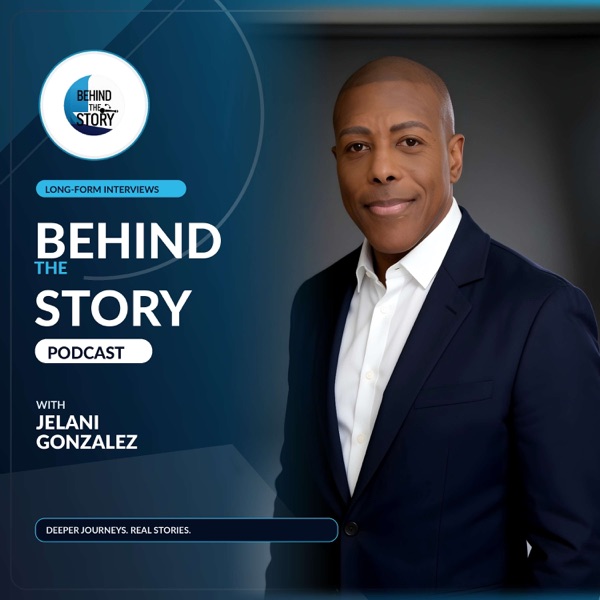
Behind The Story Show
Welcome to Behind The Story Show, a long-form interview podcast hosted by Jelani Gonzalez that goes beyond the headlines to uncover the real journeys behind extraordinary people and powerful ideas.
Each week, Jelani sits down with entrepreneurs, athletes, artists, creators, leaders, and change-makers to explore the defining moments, hard-earned lessons, personal challenges, and bold decisions that shaped their path. From business and creativity to leadership, culture, innovation, and reinvention, Behind The Story brings you candid conversations that reveal not just what people achieved, but what it took to get there.
If you are building something, chasing a vision, navigating change, or looking for stories that educate, inspire, and challenge the way you think, this show is for you.
Join us as we go behind the success, behind the struggle, and Behind The Story.
- Documentary chart
- #4
- Episodes
- 71
- Releases
- Twice a week
- Typical length
- 49 min
- On air since
- 2026
- Latest episode
- 5 days ago
Episodes
71 episodes, newest first
-
50 min
Understand Your Ballot: A Free AI Voter Guide for the Midterms
Show notes
Staring at a seven-page ballot full of names you don't recognize? You're not alone. In this episode of Behind the Story, host Jelani Gonzalez sits down with a Los Angeles software engineer who was born in China, became a U.S. citizen, and set out to fix one of the biggest problems in American elections: most voters have no idea who the candidates really are.
Using AI to gather and summarize public records, he and a team of friends from across the political spectrum built a free, open-source site that shows what candidates have actually done: how they voted, who funded them, and what each office does, all in plain language and always linked to the original source.
In this conversation:
- Why campaign ads make it so hard to know who to trust
- How to research candidates fast, even with only 10 minutes
- What "vote power" means and why local races, like city council and school board, can matter more than the presidential race
- How AI summarizes legislation and ballot measures without making anything up
- How to see who funds a candidate (PACs, super PACs, and donors)
- Why open source matters when you're using AI around elections
- Party loyalty vs. voting your own values
- Mail-in ballots, ballot overwhelm, and what happens after the midterms
Look up your own ballot: https://electionsimplify.com
If you enjoy the show, please leave a 5-star review on Apple Podcasts. It helps more listeners find these conversations.
Behind the Story is a weekly long-form interview podcast hosted by Jelani Gonzalez. Follow @behindthestoryshow on all platforms.
Connect with Jelani
Youtube Channel
Instagram
Tik Tok -
1 hr 7 min
What Americans Get Wrong About Iran: The Regime vs. the Iranian People
Show notes
Zolal Habibi was seven years old when her father, a well-known human rights activist and writer, was killed in the summer of 1988, during the wave of executions of political prisoners in Iran. She found out months later, from a newspaper she wasn’t supposed to see.
In this conversation, Jelani Gonzalez goes behind the headlines with Zolal to explore the personal story that shaped her life’s work. She shares how growing up in the U.S. inside an activist household led her to Congress at twelve. She also explains why the student uprisings of 1999 pulled her away from a planned career in medicine, and what she believes Americans misunderstand about Iran today.
Zolal draws a clear line between the Iranian regime and the Iranian people. She makes the case that the choice isn’t limited to war or appeasement, and she describes what she sees happening inside Iran, from communication blackouts to organized underground networks. She also answers the hard questions about sanctions, the “death to America” footage, and what meaningful outside support would look like.
In this conversation:
• The memory of learning about her father’s death, and what helped her cope
• What the 1988 massacre was and why it still shapes Iran’s politics
• The turning point that led her to give up medicine for activism
• Why she says Iranians aren’t stuck between war and appeasement
• What it’s like to hear so little from ordinary Iranian families
• How she stays hopeful after nearly three decades
• One thing listeners can do this weekThe views and figures shared in this episode are Zolal’s own.
Music licensed through Soundstripe. Code: BALT25ZPX6CHDWKF
Connect with Jelani
Youtube Channel
Instagram
Tik Tok -
55 min
What to Do After You Sell Your Business: Rebuilding Identity After an Exit
Show notes
Why do so many founders feel lost after selling their business? Adam Roach exited three real estate brokerage franchises in 2019, hit the number he’d set for himself, and then faced what he calls the hangover: a loss of identity no exit plan had prepared him for.
Adam, founder of I Love Coaching Co., shares how he rebuilt, from an exercise that connected a wound, a lie and a vow to a question from John Maxwell and a stranger holding old cassette tapes at his father’s funeral.
Questions this conversation answers:
• What do you do after you sell your business?
• How do you know when it’s time to exit?
• How should coaches price their offer? (He says you are not for sale, your payoff is.)
• How do you find your coaching niche and ideal client?
• Why does consistency have to come before scale?
• How should coaches approach AI?Adam’s path runs from eight pro tennis matches without a win to flipping houses, losing $80,000 in 2008 and paying the bank anyway, building a recruiting software company, and starting a coaching community. If you’ve built something, sold something, or wondered who you are without the title, this is for you.
Watch the full conversation on YouTube. Subscribe to Behind the Story for more conversations that go beyond the surface.
Connect with Adam: ilovecoachingco.com Instagram: Adam R. Roach
Music licensed through Soundstripe. Code: BALT25ZPX6CHDWKF
Connect with Jelani
Youtube Channel
Instagram
Tik Tok -
16 min
Can They Strip Your Citizenship? Both Sides of the Omar Case
Show notes
Federal agents searched Rep. Ilhan Omar’s home on Oct 12, and reporting says the investigation centers on her 2000 naturalization. No one has been charged. This episode steps back from the headlines to answer the bigger question: can the U.S. government take away a person’s citizenship, and what does it have to prove?
We cover what is confirmed, what is only alleged, how denaturalization works in plain English (including the Supreme Court cases Fedorenko, Maslenjak and Afroyim), and then the strongest case for the government and for the critics, with equal rigor.
CHAPTERS
0:00 Cold open: the question behind the raid
1:58 What we actually know (confirmed vs. alleged)
6:35 How denaturalization actually works
11:20 The two strongest cases
16:30 Close: the standard that applies to everyone
This is a developing story. Everything about the investigation is reported as alleged or according to named sources. No charges or civil case have been filed as of recording. Sources are linked below.
SOURCES
CNN exclusive: Judge limited DOJ access to Omar’s records (Oct 14, 2026), read via KVIA syndication: https://kvia.com/politics/cnn-us-politics/2026/10/14/exclusive-judge-limited-justice-department-access-to-rep-ilhan-omars-records-in-sprawling-immigration-fraud-probe/
TIME: Can Trump Strip Ilhan Omar of Her Citizenship? How the Process Works (Oct 14, 2026): https://time.com/article/2026/10/14/ilhan-omar-citizenship-investigation-denaturalization-DOJ/
Reason: DHS searched Ilhan Omar’s home (Oct 12, 2026): https://reason.com/2026/10/12/dhs-searched-ilhan-omars-home-as-part-of-immigration-fraud-investigation/
AP via PBS NewsHour: Federal agents search Rep. Ilhan Omar’s home (Oct 12, 2026): https://www.pbs.org/newshour/politics/ap-report-federal-agents-search-rep-ilhan-omars-home-as-part-of-a-criminal-investigation
Fox News: Could Trump revoke Omar’s citizenship? (immigration attorney Michael Wildes): https://www.foxnews.com/politics/could-trump-revoke-ilhan-omars-citizenship-alleged-brother-marriage-ex-federal-prosecutor-breaks-down
Western Journal: Jonathan Turley on denaturalization: https://www.westernjournal.com/legal-expert-jonathan-turley-says-ilhan-omar-line-denaturalization-immigration-laws-clear/
Political Wire: “Ilhan Omar Probe Aims to Revoke Her Citizenship” (summarizing WSJ, Oct 14): https://politicalwire.com/2026/10/14/ilhan-omar-probe-aims-to-revoke-her-citizenship/
Maslenjak v. United States, 582 U.S. ___ (2017), Cornell LII: https://www.law.cornell.edu/supremecourt/text/16-309
Fedorenko v. United States, 449 U.S. 490 (1981), Cornell LII: https://www.law.cornell.edu/supremecourt/text/449/490
Afroyim v. Rusk (1967), EBSCO Research Starters: https://www.ebsco.com/research-starters/law/afroyim-v-rusk
Peter Spiro testimony, Senate Judiciary Subcommittee on the Constitution (June 3, 2026): https://www.judiciary.senate.gov/download/2026-06-03_testimony_spiropdf
National Law Review: DOJ Civil Division denaturalization memo (June 2025): https://www.natlawreview.com/article/doj-civil-division-prioritizes-denaturalization-new-enforcement-memo
Behind the Story goes past the headline with balanced, plain-language explainers on law and civic affairs. Subscribe so you don’t miss the next one.
Connect with Jelani:
-
1 hr 5 min
What If 1% Could Fund the Entire Government?
Show notes
What if you never filed a tax return again — no April 15th, no IRS — and a single 1% tax funded the entire government? In this episode of Behind the Story, Jelani Gonzalez sits down with Gary Barnes, a retired tradesman turned author of Fixing America’s Broken Government, for a wide-ranging conversation about the idea he calls the “receiving tax.”
Gary spent 45 years as a wallpapering artisan in southwest Connecticut, raising six children while wrestling with a tax code he describes as 12,000 pages of complexity. After the 2008 housing crash and years of watching his own kids struggle to reach the American dream, he set out to design a different way to fund government — one that taxes the movement of money beneath the economy rather than the people producing it.
In this conversation, Gary explains how a 1% charge on money changing ownership could, in his telling, replace income, payroll, corporate, capital gains, and inheritance taxes; why he wants to abolish the IRS and route everything through the Treasury; his “nine pillars” model for what government funds and what gets spun off; and his proposals on retirees, property taxes, campaign finance, immigration, and education. Jelani pushes back throughout — on double taxation, on the economists who say the numbers won’t add up, and on the real people whose jobs the plan would eliminate.
Whether you agree with Gary or not, it’s a thought-provoking look at taxation, government, and the question of who really holds the power. Gary’s ideas are his own, offered here for discussion, not as financial or policy advice.
Learn more about Gary’s work:
Book & grassroots community: https://fixyourgov.com
Fixing America’s Broken Government is available in paperback and ebook on Amazon.Subscribe to Behind the Story for more conversations that go beyond the surface.
Follow Behind the Story:
Instagram: @behindthestoryshow
TikTok: @behindthestoryshowX: @behindthestoryshowxDisclaimer: The views expressed by the guest are their own. This conversation is for informational purposes and is not financial, tax, or legal advice.
Connect with Jelani:
-
49 min
Cut the Boot or Lose the Foot: Reid Robinson's Story Behind the X Leg
Show notes
Reid Robinson was a hardworking IT infrastructure architect and father of two in Calgary when an icy-road car crash changed everything. What followed was more than a dozen surgeries, years of crutches, and a recovery that tested his patience, his body, and his determination to stay present for his family.
In this conversation, Reid takes us behind the story of how he went from hospital bed to inventor. Frustrated by how hard crutches were to live with, he sketched an idea for a "crutch for your leg," searched the patent databases, and spent three weeks in his garage welding the first prototype himself. The first time he walked across the road to kick a soccer ball with his kids, he knew it was worth pursuing. That prototype became the X Leg.
We talk about:
• The day of the crash and the moment he chose to cut the boot instead of losing the foot
• What life really looked like between surgeries
• The 16-hour surgery that finally got his leg to heal
• How the X Leg works, who it can help, and when crutches are still the better choice
• The road from prototype to Health Canada and FDA registration, ongoing medical studies, and his goal of making it more affordable
• How the experience reshaped his approach to health, fitness, and longevityIt's a story about resilience, problem-solving, and the idea that we're tougher than we think.
Learn more about the X Leg at xleg.ca.
Subscribe to Behind the Story for more conversations that go beyond the surface, and share this episode with someone who needs to hear it. If you enjoyed it, a 5-star review on Apple Podcasts or Spotify helps the show grow.
connect with Behind the Story Show
Youtube:
Instagram:
Tik Tok:
X:Connect with Jelani:
-
51 min
Why Habits Change When Your Story Does
Show notes
What does it take to change a habit that has outlasted every attempt to break it? Connie Kwan, author of Story Habits, says the answer starts with the story you tell yourself about who you are, not with more willpower.
Connie grew up between Hong Kong and Canada, trained as a computer engineer, and spent much of her career in product. Then she joined a smoking cessation company and, in her words, got a front-row seat to how habit change works. She shares what she saw: two simple self-reported numbers, motivation and confidence, predicted who would quit better than how long or how much someone had smoked.
In this conversation:
• Why the word "habit" originally meant a monk's robe, and what that says about identity
• Clement, a longtime smoker whose father died of lung cancer, and the new story that changed his quit
• The "manipulation fries" reframe that helped an exit founder stop reaching for fries
• Why smokers who eventually quit often needed about seven serious attempts
• Connie's own years-long struggle with late-night binge-watching, and the replacement habit that finally worked
• Why the people closest to you may quietly resist your change, and how to find your champions
• How AI is reshaping product roles, and what it means to be a builderTimestamps:
00:00 The story you were handed about who you'd become
02:12 From engineer to product leader at a quit-smoking company
05:57 Who actually smokes, and what it taught Connie about people
09:50 Motivation and confidence: the two numbers that predicted success
13:29 Clement, and the new story that helped him quit
15:49 The "manipulation fries" reframe
20:48 Why discipline and willpower miss the point
21:05 The monk's habit: where the word comes from
23:42 The magic number seven
25:38 Four a.m. binge-watching and the replacement habit that worked
34:17 Amplify Her and The Dim Sum Club
36:15 "I'm not a writer" and the writing hat
39:27 When the people around you want you to stay the same
46:30 Will AI replace product managers?
50:14 Connie's hope for readers of Story HabitsAbout Connie Kwan:
Connie Kwan is the author of Story Habits, arriving in November 2026, and is building a companion app, the Story Habits Coach. She is a former product leader at a smoking cessation company and co-founder of Amplify Her and The Dim Sum Club.Subscribe to Behind the Story for more conversations that go beyond the surface, and if this one resonated, a 5-star review on Apple Podcasts or Spotify helps the show grow.
Behind the Story is a video podcast hosted by Jelani Gonzalez. Every story has a deeper story.
Instagram: @behindthestoryshow
Tik Tok: @behindthestoryshow
youtube: @behindthestoryshowConnect with Jelani:
-
53 min
What DEI Actually Is — and What It Isn't | Celeste Warren
Show notes
The word "DEI" has been demonized — but what does it actually mean? In this episode of Behind the Story, Jelani Gonzalez sits down with Celeste Warren, former Global Chief Diversity & Inclusion Officer at Merck, decades-long HR leader, author, and founder of CRW Diversity, for the clear-eyed conversation the topic has been missing.
Celeste grew up in a small steel-mill town in Western Pennsylvania, the daughter of the first Black teacher and principal in her part of the state. That front-row seat shaped a career spent making the business case for equity at the highest levels of corporate leadership.
Together, Jelani and Celeste unpack what most people — and even many executives — get wrong about equity. Celeste explains why "diverse" and "qualified" are not mutually exclusive, breaks down her "acts of equity" framework and the now-famous rocks-and-fence illustration, and shares the "five whys" method she uses to surface unconscious bias in real hiring conversations. They also dig into the history behind today's backlash, why equity ultimately benefits everyone regardless of identity, and the difference between DEI and nepotism.
As Celeste puts it, doing this work isn't a program with a start and end date — it's leadership 101, management 101, and business 101.
Connect with Celeste Warren:
Website: https://www.crwdiversity.com
Her book on equity is available on Amazon.Subscribe to Behind the Story for more conversations that go beyond the surface.
Follow Behind the Story:
Instagram: @behindthestoryshow
TikTok: @behindthestoryshow
X: @behindthestoryshowx
Facebook: behindthestoryshowConnect with Jelani:
-
15 min
The Final Ruling: Inside the Supreme Court's 7-2 Mail-Ballot Decision
Show notes
On Monday, September 14, 2026, the Supreme Court closed the book — at least for this election — on a fight Behind the Story has tracked across five episodes. By a 7-2 vote, the justices refused to let the Trump administration enforce a new U.S. Postal Service rule on mail-in ballots for the 2026 midterms, leaving a federal judge's nationwide injunction in place.
In this series finale, host Jelani Gonzalez breaks down what the Court actually decided, why a cross-ideological majority of seven justices agreed, what Justice Kavanaugh's swing vote really turned on, and why Justices Alito and Thomas dissented. He walks through what the USPS rule would have required, how the case reached the Court, and the one big constitutional question the justices deliberately left unanswered.
As always, no side-taking — just the arguments, from both directions, laid out with equal rigor so you can decide for yourself.
What it means for you: for November 2026, mail voting works the way it always has.
Follow Behind the Story for balanced, plain-language breakdowns of the legal stories shaping American life.
Connect with Jelani:
-
18 min
The Ali G Movie Firestorm: Banned Before Anyone Saw It
Show notes
Twenty-six years ago, a comedian in a yellow tracksuit and orange shades sat across from real politicians, generals, and diplomats — and they answered him seriously. That was Ali G. This fall, Sacha Baron Cohen is bringing the character back in Ali G: Who Is I? — and tens of thousands of people are trying to make sure you never get to watch it.
In this Behind the Story Exposé, we go past the headline and into the real tension: a British watchdog group has driven 45,000+ emails urging cinemas worldwide to refuse the film — before almost anyone has seen a single scene. Is that protecting people from harm, or censoring art we haven't judged yet? We lay out the strongest case on both sides, the 1998-vs-2026 history most people forget, and a twist about who's actually funding the campaign that changes the whole conversation.
No lectures. No easy bow. Just the story behind the story — and four questions worth sitting with: Have we become too sensitive, or finally honest? Where's the line between a boycott and a ban? Is there a bridge too far? And who actually gets to decide?
Listen, then tell us where you land.
Subscribe to Behind the Story for more conversations that go beyond the surface. Leave a 5-star review on Apple Podcasts to help the show grow.
Connect with Jelani:
-
49 min
Arrested Over an $87 Check — Dr. Sheena Meade on Second Chances
Show notes
In 2004, Sheena Meade was a young single mother earning about $18,000 a year when an $87.26 check bounced. Two months later, police arrested her in front of her four children. She paid the check back, completed the courses, and thought her sentence was over — but as she says in this conversation, "My true sentence was just beginning."
In this episode of Behind the Story, Jelani Gonzalez sits down with Dr. Sheena Meade — mother, grandmother, lifelong organizer, and CEO of The Clean Slate Initiative — for an honest conversation about being criminalized for poverty and building a national movement for redemption.
Raised by union organizers in South Jersey, Sheena went on to help restore voting rights to 1.4 million Floridians through Amendment 4, then took the blueprint national. Today, Clean Slate has passed in 14 states and DC, putting 18 million people on a pathway to a second chance by automating the record-clearing process most people never even know they qualify for.
We talk about the $87 check, the ripple effect of a record on families and the economy, her honorary doctorate from Cheyney University, marriage and mission alongside her husband Desmond Meade, and the message she has for anyone who feels their sentence will never end: "You are not defined by your record."
Connect with Jelani:
-
49 min
Robert Kennedy III: The Introvert Who Speaks to Thousands for a Living
Show notes
He was born in Jamaica, named Robert Kennedy III by a grandfather who said it "with such glee" — and he's spent his life turning that name into a conversation starter. In this episode of Behind the Story, Jelani Gonzalez sits down with communication coach, speaker, and self-described polymath Robert Kennedy III for an honest look at how a quiet kid who was told "you talk too much, Bobby" became a man who speaks to thousands for a living.
Robert opens up about being an introvert in an extrovert's profession ("our job isn't to get rid of the butterflies — it's to get them to fly in formation"), his winding path through teaching, news anchoring, voiceover, and a gospel project that left his whole group in tears before the first song. He breaks down his 3M framework — Moment, Meaning, Message — and the science of why we forget most talks the moment we reach the car. Along the way: what AI still can't fake on camera, why family is the source of his best material, and the real reason money should come last.
A thoughtful, funny, deeply human conversation about connection, reinvention, and the courage it takes to be heard.
Free resource from Robert — the 3M Story Builder: http://amplifiedvoiceHQ.com
Connect with Jelani:
-
8 min
Judge Rules Trump's Mail Ballot Order Unconstitutional — What Happens Next
Show notes
Back where we started — except this time, it's different. The same judge who was forced to lift her block on Trump's mail-ballot rule put a new one right back up, days later — and for the first time in five months, a federal court actually ruled on whether the policy is constitutional. Her answer was no.
In this episode: how a "motion for reconsideration" unwound Wednesday's ruling, exactly what Judge Talwani found on the merits (including a factual finding that there's no evidence of the fraud USPS cited to justify the rule), the administration's strongest counter-arguments, and what happens next now that the case is headed to the 1st Circuit Court of Appeals — with a September 3rd hearing already on the calendar.
THE THROUGH-LINE
For five months, this fight has been almost entirely about *when* courts are allowed to rule — not *whether* the policy survives. This week, for the first time, a court actually answered the second question. That answer is now being appealed, and the fight isn't over.CATCH UP ON THE SERIES
Part One — Who Controls Your Ballot?:
Part Two — They Violated the Order, Now What?:SOURCES
This episode draws on reporting from Bloomberg, Votebeat, The Epoch Times, Legal Insurrection, the Baltimore Sun/AP, and Judge Talwani's own August 28 court order. Full timeline and sources in the pinned comment.Behind the Story doesn't tell you who's right. We go beneath the surface so you can decide for yourself.
#SupremeCourt #MailInVoting #USPS #ElectionLaw #BehindTheStory
Connect with Jelani:
-
8 min
Mail Ballot Fight Part 2: The Judge Says They Broke Her Order
Show notes
We told you two days ago this story wasn't over — it moved even faster than expected. A federal judge has now ruled that the Trump administration violated her own court order restricting mail ballot rules... and then declined to do anything about it.
In this follow-up, we break down Judge Talwani's violation finding, the administration's two-part legal defense (including a genuinely serious argument tied directly to Monday's Supreme Court ruling), and what happens next now that the final USPS rule is officially public as of today.
THE THROUGH-LINE
Three separate legal fights are now running at once: whether the violation carries consequences, whether the injunction itself survives a Supreme Court-driven challenge, and whether new state lawsuits succeed where the first round couldn't. All of it has to resolve before ballots start going out in October.🔗 WATCH PART ONE FIRST
Who Controls Your Ballot? The Original USPS Mail Voting Explainer:SOURCES
This episode draws on reporting from Axios, Democracy Docket, TIME, NationofChange, Oregon Capital Chronicle, OPB, KATU, and Judge Talwani's own August 25 court filing. Full timeline and sources in the pinned comment.Behind the Story doesn't tell you who's right. We go beneath the surface so you can decide for yourself.
#SupremeCourt #MailInVoting #USPS #ElectionLaw #BehindTheStory
Connect with Jelani:
-
11 min
Supreme Court Rules on Mail Ballots: Who Controls Your Vote?
Show notes
The Supreme Court just ruled 6-3 on who controls your mail-in ballot — but by its own admission, the ruling doesn't decide if any of it is actually legal. "Time will tell," the Court wrote. So what did the justices actually decide today, and what did they deliberately leave unresolved?
In this episode, we go beneath the surface of the March 2026 executive order that put USPS and DHS at the center of a fight over federal election authority — the two lawsuits it triggered, the injunctions still standing, and exactly what today's Supreme Court ruling changes (and doesn't).
THE THROUGH-LINE
This is the second time this year we've watched the Supreme Court's emergency docket shape how a live election runs, before the underlying legal question is ever fully argued. If that sounds familiar, check out our companion episode on the Shadow Docket, linked below.RELATED EPISODE
The Supreme Court's Shadow Docket, Explained:SOURCES
This episode draws on reporting and primary documents from TIME, CBS News, NBC News, CNN, NPR, Axios, The Hill, Issue One, and the Federal Register. Full source list and timeline in the pinned comment.Behind the Story doesn't tell you who's right. We go beneath the surface so you can decide for yourself.
Connect with Jelani:
-
19 min
The Shadow Docket: The Supreme Court Power You've Never Heard Of
Show notes
Somewhere in Washington this week, the Supreme Court will decide something that affects your life — and you may never know why. No hearing. No explanation. Sometimes not even a signature. It's called the emergency docket, better known as the "shadow docket," and over the last decade it has gone from a quiet technical corner of the Court to one of the most powerful and most disputed tools in American government.
In this edition of the Behind the Story Expose series, Jelani Gonzalez breaks down what the shadow docket actually is, where the name came from, and why the numbers behind it have exploded in recent years. He walks through the difference between the Court's normal "merits docket" and these fast, often unsigned emergency rulings — and the landmark June 29, 2026 decisions in Trump v. Cook and Trump v. Slaughter that reshaped the limits of presidential power in a single day.
Then comes the honest question legal scholars on both sides are now asking out loud: is the Court simply managing an overwhelming caseload, or is the deck stacked? Jelani lays out both arguments — the case for bias and the case that this is a bigger structural problem Congress and the lower courts created — and leaves the verdict to you. He closes with what all of this means for your life, and the one lever ordinary citizens actually have.
Every story has a deeper story. This is the one behind the headlines you never see.
Listen now, then follow Behind the Story for more conversations that go beyond the surface. If this episode made you think, leave a 5-star review on Apple Podcasts or Spotify — it genuinely helps the show grow.
Connect with Jelani:
-
44 min
The Mind Is All There Is — Consciousness, AI & the Kingdom Within
Show notes
What happens when a man becomes so convinced of a single truth that he legally changes his name to match it?
In this episode of Behind the Story, Jelani Gonzalez sits down with the author and philosopher known as One I Am — a name he took after a 2004 spiritual awakening and the book I Am That. What follows is a wide-ranging conversation about awareness, identity, and the idea at the center of all his work: the mind is all there is, and the world we see is a perceptive experience arising within it.
One I Am unpacks his blog The Kingdom Within and the 30+ books behind it, from The Architecture of Identity to Attention Loops. He explains why he believes attention is the engine of reality, how the biggest tech companies compete for it, and what the modern attention crisis is really pointing to. The conversation turns to AI and consciousness — whether a machine can be aware, why he thinks today's models are "trained by walking dead consciousness," and what it would take to build them differently.
It's a thoughtful, provocative look behind the public identity of a man who insists you shouldn't focus on him at all — only on what his words reveal about you.
Books mentioned: Seeing God Face to Face, The Architecture of Identity, Attention Loops, and his upcoming The Last Biological Interface.
Connect with Jelani:
-
1 hr 3 min
He Sold the Pills for 20 Years — Then He Walked Away
Show notes
Dr. Keith Hersey spent more than twenty years behind the pharmacy counter. Then he did something most pharmacists never do — he stopped focusing on dispensing pills and started coaching people to need fewer of them.
In this episode, Dr. Keith sits down with Jelani Gonzalez to trace the full arc: caring for his grandmother after her strokes, discovering his own type 2 diabetes from a free glucose check at a pharmacy convention, opening an independent pharmacy in the middle of the 2020 pandemic, and ultimately bridging conventional and functional medicine to help people take back control of their health.
They get into the GLP-1 wave — Ozempic, Wegovy, Mounjaro — what "mastering" one of these drugs really means, the role of ultra-processed food, and why he believes type 2 diabetes can be prevented, mitigated, and even reversed.
An honest conversation about denial, resilience, and the difference between sick care and real health.
About the guest: Dr. Keith Hersey — pharmacist of 20+ years turned diabetes coach, founder of an independent pharmacy, and host of the Destroying Diabetes podcast.
This conversation is for general education and is not medical advice. Always consult your own physician before making changes to medication or treatment.
Connect with Jelani:
-
49 min
He Googled "How to Make Money Without a Degree" — Then Built a Firm
Show notes
Tom Hunter didn't plan any of this. He started as a primary school teacher in London, burned out, and Googled "how to make money without a degree." That search led him into recruitment — and nine years later, he walked away to build Story Recruitment, a firm placing the CFOs and senior finance leaders behind fast-growing startups.
In this episode, Tom sits down with Jelani Gonzalez to talk about the long road from the classroom to founder: why he bet everything on storytelling, how a LinkedIn audience of 30,000 became the foundation of his business, and why he believes finance is a commercial partner — not a back-office function.
He also opens up about the hardest year of his career, the loss that shaped his resilience, and the mission behind his podcast, which reached 100,000 listeners in season one.
A conversation about reinvention, relationships, and finding the story behind the person.
About the guest: Tom Hunter, Story Recruitment — first-CFO and first-finance-hire search for Australian tech, fintech and deeptech startups. Host of the CFO Track Podcast. Storyrecruitment.com.au
Connect with Jelani:
-
1 hr 8 min
The Type of Diabetes Doctors Miss in Adults (LADA)
Show notes
Manny Hernandez grew up in Caracas, Venezuela, in a world that no longer exists — and left in 2000 as the country changed around him. Years later, a routine checkup in the U.S. led to a diabetes diagnosis, and then a misdiagnosis: he was told he had type 2, when he actually had LADA, sometimes called type 1.5, a form that's often missed in adults.
In this episode, Manny sits down with Jelani Gonzalez to trace the full arc — the shock of diagnosis, the pizza-and-insulin-pump meeting where he first realized he'd found "his people," and how that single moment of not feeling alone became the seed for everything that followed. He co-founded the Diabetes Hands Foundation, built the TuDiabetes and EsTuDiabetes online communities, later handed them to Beyond Type 1, and today leads The Diabetes Link, supporting young adults ages 18–30 living with all types of diabetes.
Manny is candid about the parts people don't see: winding down the foundation to care for his mother, an unforgettable send-off in a San Diego bar, the honest limits of diabetes technology, the fight over access and the Insulin Act, and why — after 24 years — he still hasn't "figured it out." His message stays simple throughout: find your community, and take it one day at a time.
Connect with Jelani:
On these lists
Behind The Story Show is one of the shows picked out on each of these



More in Documentary
Placed highest on Apple Podcasts' Documentary chart right now