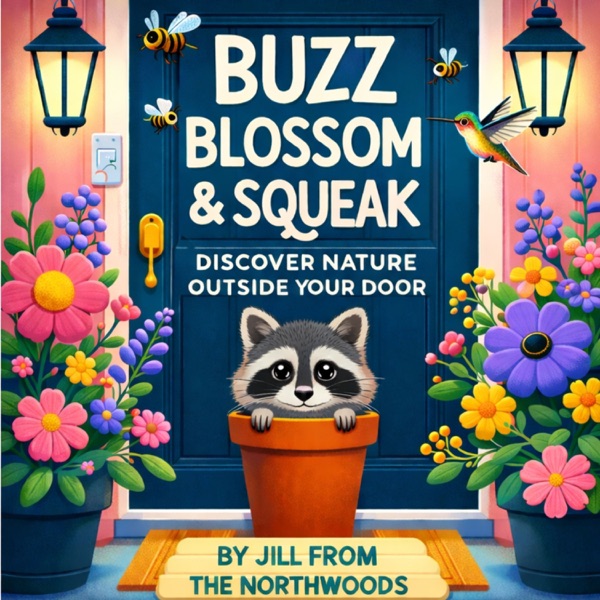
Podcast
Buzz Blossom & Squeak — Be a Neighborhood Naturalist
Buzz, Blossom & Squeak is a quiet, curious walk into the natural world right outside your door.
You don’t need to be a scientist, a hardcore birder, or someone who hikes miles into the wilderness. This podcast is for anyone who has ever paused to notice a bird call, wondered about a plant growing along a sidewalk, watched insects move through a garden, or felt the seasons shifting without quite knowing why.
Each episode focuses on small, approachable pieces of nature—birds, bugs, plants, weather, ecosystems, and natural patterns—explained in a way that’s calm, curious, and grounded in observation. Instead of rushing toward big conclusions, Buzz, Blossom & Squeak invites you to slow down and really notice what’s happening in the living world around you.
You’ll hear about things like:
How birds use different layers of trees and sky
Why certain plants grow where they do
What insects are actually doing when they buzz past
How seasons quietly reshape landscapes
The hidden systems that connect soil, water, plants, and animals
The goal isn’t mastery—it’s familiarity. Nature becomes less overwhelming when you take it one small step at a time.
This podcast is especially for people who:
Want to understand nature without feeling intimidated
Enjoy learning through real-world observation
Prefer gentle explanations over fast facts
Like noticing patterns, habits, and rhythms
Find peace and wonder in everyday outdoor moments
Episodes are designed to be thoughtful, practical, and reflective. You might walk away with a new question to watch for, a detail you’ve never noticed before, or simply a deeper appreciation for the ordinary wild things that share your space.
Buzz, Blossom & Squeak isn’t about traveling far to find nature. It’s about realizing you’ve been standing in it all along.
- Episodes
- 138
- Releases
- Weekly
- Typical length
- 17 min
- On air since
- 2024
- Latest episode
- 6 days ago
Episodes
138 episodes, newest first
-
23 min
Where Do Insects Go in Winter?
Episode 137
Show notes
Where Do Insects Go in Winter?
A Northwoods yard can be buzzing with mosquitoes, butterflies, bees, and beetles in summer and look completely empty by January. But winter does not erase the insect world. We explore how different insects survive as eggs, larvae, pupae, or adults; how diapause differs from simply slowing down; and how natural antifreeze, protected hiding places, and even snow help insects survive. You may look at your autumn leaf piles and garden stems a little differently after this episode.
IN THIS EPISODE
• The mystery of the disappearing insects
• Diapause and winter survival
• Eggs, caterpillars, chrysalises, and adults
• Natural antifreeze and freeze tolerance
• How mosquitoes survive winter
• Shelter in leaves, stems, and snow
• What to leave in your garden for springCHAPTERS
00:00 Introduction: Where Do Insects Go in Winter?
02:12 Diapause and winter survival
04:24 Eggs, caterpillars, chrysalises, and adults
06:39 Natural antifreeze and freeze tolerance
08:53 How mosquitoes survive winter
11:08 Shelter in leaves, stems, and snow
13:22 What to leave in your garden for spring
15:31 Putting the ideas together
17:47 Practical lessons and reflections
19:58 Final thoughts and next stepsREFERENCES AND RESOURCES
Nature notes: diapause; quiescence; woolly bear caterpillars; praying mantis egg cases; swallowtail chrysalises; freeze avoidance and freeze toleranceJill From the Northwoods
https://jillfromthenorthwoods.com -
31 min
When Nature Looks Helpless
Episode 136
Show notes
A fledgling misses a branch, a butterfly emerges with crumpled wings, and a young eagle wanders far from home. These moments can make us want to rush in and help. I look at the different processes behind nature's difficult transitions and why understanding what we are seeing matters before we intervene.
Butterflies and Hatching Chicks
The familiar butterfly story makes a powerful metaphor, but emergence and wing expansion involve a delicate developmental process. A chick also needs time to complete hatching. Something that looks slow or awkward to us may be normal, and premature intervention can cause harm.Fledglings Learn by Doing
Young birds are not miniature experts. Flying, landing, finding food, and avoiding danger involve practice as well as instinct. I share what the house sparrows around my home have taught me about this awkward stage and why a healthy fledgling on the ground is not automatically abandoned.First Migrations and Wandering Eagles
Some birds learn migration routes socially, while others begin their first journeys with inherited guidance. Experience still matters when weather and unfamiliar landscapes complicate the trip. Young bald eagles offer another picture of learning, with years of wandering before their familiar adult appearance and breeding life.Surviving Currents, Predators, and Winter
Salmon migrations, predator and prey interactions, and winter survival are different kinds of challenges. They involve ecology, inherited adaptations, and experience rather than one universal rule that struggle makes every individual stronger. Fire also shows how a disturbance can play a role in some ecosystems.When Helping Really Helps
A healthy fledgling differs from an injured bird or an animal tangled in fishing line. Observation can help us recognize the distinction, but licensed wildlife rehabilitators and wildlife authorities are the right contacts for emergencies. Sometimes leaving room for normal development helps; sometimes prompt expert intervention is needed.Your small step is to watch carefully and keep contact information for a local licensed wildlife rehabilitator handy. Learn to recognize normal development while taking real injuries seriously.
jill@startwithsmallsteps.com and jillfromthenorthwoods.com
A note on this podcast: I’m a birder and backyard naturalist, not a licensed biologist or ecologist. What you hear here comes from personal observation, published research, and conversations with people who study this professionally. For serious fieldwork, conservation planning, or species identification questions that matter, please consult a professional in the field.
TIMESTAMPS
00:00 When nature looks helpless
02:28 Butterflies and the struggle story
05:00 Hatching chicks
07:05 Fledglings learning to fly
09:58 A bird’s first migration
12:09 Young eagles and experience
15:27 Salmon and ecological challenges
17:29 Predators, prey, and winter
21:32 Fire and plant adaptations
23:38 When to call a wildlife rehabilitator -
28 min
Hidden Animal Highways in Your Backyard
Episode 135
Show notes
Fresh snow has a way of telling on everybody. Rabbit tracks, squirrel routes, deer crossings, and tiny paths along shrubs suddenly reveal that the animals in our yards are not wandering randomly. They have roads, and once you learn to look for them, your backyard starts looking less like a lawn and more like a map.
Why Animals Build Familiar Routes
Repeated routes save energy, improve safety, and make travel more efficient. When food, water, shelter, and sleeping places stay in predictable locations, familiar paths become the easiest way to move between them.Deer Trails, Edges, and Backyard Corridors
White-tailed deer make some of the most obvious animal trails, but smaller animals use fence lines, shrubs, wooded edges, and spaces around buildings too. These edges can connect feeding places with safer cover.aSnow Makes the Map Visible
Fresh snow is one of the easiest ways to see wildlife routes because every traveler leaves evidence. Instead of only asking which animal made a track, you can follow the direction and ask where it came from, where it went, and why.A Hidden World Under the Snow
Voles, mice, and shrews can travel in the subnivean zone between the ground and insulating snow. When spring arrives, melting snow can reveal channels and runs that were hidden all winter.Roads Above Us and Through the Water
Squirrels reuse branches, trunks, and even utility lines, while flying squirrels develop familiar gliding routes. Beavers, muskrats, otters, raccoons, mink, and other animals also use waterways and shorelines as efficient transportation corridors.The Biggest Highways Are in the Sky
Bird migration scales the same principle up enormously. Flyways, shorelines, river valleys, ridgelines, stopover habitat, and rising air can help birds move long distances while finding food, rest, and efficient travel conditions.You do not need to identify every footprint to start reading the wildlife map around you. Look along edges, underneath shrubs, through openings in fences, up into connected branches, and across fresh snow. Once you begin noticing routes instead of isolated animals, a whole transportation network appears right outside your back door.
Contact: jill@startwithsmallsteps.com | jillfromthenorthwoods.com
A note on this podcast: I'm a birder and backyard naturalist, not a licensed biologist or ecologist. What you hear here comes from personal observation, published research, and conversations with people who study this professionally. For serious fieldwork, conservation planning, or species identification questions that matter, please consult a professional in the field.
TIMESTAMPS
00:00 Fresh snow reveals hidden highways
03:11 Why animals reuse the same routes
05:37 Deer trails and generations of travel
07:56 Why edges make good animal roads
10:04 Foxes, coyotes, and backyard routes
12:51 Reading tracks after fresh snow
14:53 The subnivean world under the snow
16:40 Highways in the trees
19:28 Waterways and animal travel
20:45 Bird flyways and migration routes -
11 min
Look Closer, Not Farther: See More on Every Walk
Episode 134
Show notes
A few weeks ago, my friend Em and I were scanning the far side of a lake for migrating ducks and shorebirds. When I finally got tired of squinting through binoculars and turned around, there were a dozen American bullfrogs in the little pond right behind us, eyes above the water, watching us. That moment made me admit something: I'm a horizon scanner. And a lot of the best nature is happening within arm's reach. **The Horizon-Scanner Habit** Our attention goes to distance and drama: a soaring hawk, movement at a tree line, the big find. That's not a character flaw, it's how attention works. But it means we walk whole trails and miss most of what's living right beside us. **The Frog on the Leaf** On a birding walk, Em and I looked down only to avoid tripping, and found a tiny frog sitting on a large leaf. We watched it for ten or fifteen minutes while other hikers passed by, never once looking at the ground around them. **A Fly on the Steering Wheel** Waiting in the car at our favorite marsh, a small bug landed on my steering wheel. The Seek app identified it as a maize calligrapher, a hover fly I'd never heard of, sitting right in front of me while I looked out the windshield for birds. **What Lives Within Arm's Reach** Lichen on bark (a living air-quality indicator), mushrooms on a tree you've passed a hundred times, bright berries you never looked up, chickadees, wrens, and kinglets working the brush eight feet away. Up close is where much of the variety lives. **The Spider on the Ring Camera** Something kept triggering my Ring camera. It turned out to be an orb weaver disguised as a little leaf, sitting in a web with an egg sac, right outside my back door. **Tools for Looking Closer** A hand lens (loupe) on a lanyard, a simple magnifying glass, a handheld digital microscope, or your phone's macro mode can open up a world you can't see at arm's length. Take a photo, then identify it at home. The practice is simple: before you scan the horizon, scan near first. Give yourself sixty seconds to look at the ground, the low branches, and the base of the nearest tree, and then stay still and watch whatever you find. Tell me what turns up. You can find everything I do at jillfromthenorthwoods.com, and you can reach me directly at jill@startwithsmallsteps.com. --- **A note on this podcast:** I'm a birder and backyard naturalist, not a licensed biologist or ecologist. What you hear here comes from personal observation, published research, and conversations with people who study this professionally. For serious fieldwork, conservation planning, or species identification questions that matter, please consult a professional in the field. TIMESTAMPS 00:00 Bullfrogs behind us 01:07 Confessions of a horizon scanner 03:06 The frog on the leaf 04:48 A fly on the steering wheel 05:58 Lichen, mushrooms, and small birds 06:50 The practice: scan near first 07:51 Be still and watch 08:16 The spider on the Ring camera 09:12 Tools for looking closer 10:40 Your 60-second challenge
-
10 min
No Bird Can Do It All: Some Can't Walk, Fly, Swim or Stand
Episode 133
Show notes
There's an old joke about a loon, a warbler, an emu, and a duck standing around, each one wishing it had a skill it didn't have, except the duck, who can do all four. I ran across that joke and realized it wasn't a joke at all. It's just basic bird biology wearing a silly hat, and it's a perfect excuse to talk about the birds that got left out on one or more basic skills, and the one that somehow didn't. **Loons Can't Stand** A loon's legs are set way back near its tail instead of in the middle of its body, which makes it a torpedo underwater and a disaster on land. They can't walk, they can't balance, and if you ever see one stranded away from water, that's a genuine emergency for the bird. It's an extreme trade for extreme swimming. **Warblers and Most Songbirds Can't Swim** No webbed feet, no waterproof oil on their feathers, nothing about their bodies built for water. Songbirds optimize for quick bursts through dense cover and precise landings on branches instead, which is exactly what lets a bird like the black-and-white warbler pull off a 3,000-mile migration. **Emus Traded Flight for Speed** Emus have big, heavy bodies and small, vestigial wings that can't generate lift. What they got in return is the ability to run thirty miles an hour on powerful legs built for distance. Ostriches, rheas, and kiwis, the ratite family, made the same trade. **Chimney Swifts Can't Walk at All** This is the bird that started the whole rabbit hole. Their tiny feet and forward-pointed toes are built only for clinging, not walking, and their stiff tail acts as a pivot to hold them upright in a chimney or hollow tree. They eat, drink, and bathe on the wing, and some research suggests they may even sleep while flying. **The Duck Gets to Be the Generalist** Ducks can walk, fly, swim, and dive all reasonably well because wetland habitats reward balance instead of extremes. No single skill gets pushed to the max, so ducks never specialize the way loons, emus, and chimney swifts do. **The Pattern Underneath All Five** Every bird is making a trade-off, just with different numbers. A body only has so many muscles, bones, and so much energy to spend, so whatever skill helps that bird survive and find food is the one it invests in. None of these birds are broken, and the duck isn't the "correct" bird either. It's just the one whose environment doesn't force a choice. Next time you spot a loon, a songbird, or a chimney swift overhead, notice that you're looking at a specialist doing something amazing. This podcast is for entertainment and educational purposes only. I'm not a licensed biologist or ecologist, just someone who loves paying attention to the natural world right outside my front door. Find all of Jill's podcasts and videos at jillfromthenorthwoods.com. Questions or topic requests? Email jill@startwithsmallsteps.com. TIMESTAMPS 00:00 The Joke That Started It All 00:32 Every Bird Trades Something Away 01:29 Loons: Built for Water, Not Land 02:45 Warblers: Masters of the Air, Strangers to Water 04:08 Emus: Trading Flight for Ground Speed 04:52 The Duck's Secret Advantage 06:11 Chimney Swifts: The Bird That Can't Walk at All 07:48 What the Pattern Teaches Us
-
14 min
How to Layer Clothes for Winter (Base, Mid, Outer)
Episode 132
Show notes
Winter doesn't have to be a season you disappear from. Most of the time, being cold outside isn't the weather's fault, it's a clothing problem, and it's a solvable one. This episode breaks down the three-layer system that actually works and why it works. THREE PROBLEMS, THREE JOBS Every layer you wear in winter solves one of three problems: warmth (keeping heat in), wind (keeping it from getting stripped away), and wet (keeping moisture out, whether it's snow or your own sweat). BASE LAYER: FIGHTING WET Snug against the skin, pulling sweat away from your body. Merino wool or synthetics like Cuddl Duds work. Cotton does not, cotton holds moisture right against your skin and pulls heat away faster than a dry fabric, which is where "cotton kills" comes from. MID LAYER: TRAPPING WARMTH Looser fitting, built to trap pockets of air. Fleece, wool sweaters, and down all work well here, the goal is keeping the heat your body already makes instead of letting it drift away. OUTER LAYER: BLOCKING WIND AND WET Roomy enough to not compress your mid layer, ideally waterproof and windproof while still breathable, so sweat has somewhere to go instead of building up inside. EXTREMITIES MATTER MOST Wool socks, a hat and something around your neck, and windproof waterproof gloves or mitts. Heat escapes fastest through your extremities, and for babies specifically, check the back of the neck rather than the hands to gauge how cold they really are. DRESS FOR WHERE YOU'RE ACTUALLY GOING Iceland's brutal wind and wet called for different gear than a dry, cold day at home. Match your gear to the specific threat you'll face, not a generic "it's cold" plan. The three-layer system has worked for people going outside long before anyone had Google. Get the gear right, and winter opens back up instead of shutting you indoors until April. If you've got a favorite piece of winter gear or a layering tip of your own, I'd love to hear it. Email me at northwoodsjill@fastmail.com, or find everything at jillfromthenorthwoods.com.
Jill’s Links
https://jillfromthenorthwoods.com/ - Find my podcasts, videos, downloads and ways to contact me
https://www.buymeacoffee.com/smallstepspod
Email the podcast at NorthwoodsJill@fastmail.com
YouTube @BuzzBlossomSqueak
By choosing to watch this video or listen to this podcast, you acknowledge that you are doing so of your own free will. The content shared here reflects personal experiences and opinions and is intended for informational and educational purposes only. I am not a licensed biologist, ecologist, or wildlife professional. Any nature observations, identifications, or suggestions offered should not be considered a substitute for professional scientific or environmental guidance. Always follow local regulations when observing or interacting with wildlife and natural spaces. You are solely responsible for any decisions or actions you take based on this content.
-
14 min
El Nino Winter: What It Means for Backyard Birds
Episode 131
Show notes
Somewhere out in the middle of the Pacific right now, the ocean is doing something it hasn't done in almost 150 years, and if you keep a feeder in your backyard, that's about to matter more than you'd think. This fall NOAA has put the odds at over 90% that we're headed into a very strong El Nino by winter, with some scientists reaching back to 1877 for a comparable event. I wanted to break down what El Nino actually is in plain terms, and then get into the part I really care about: what a warm, dry winter like this one tends to do to the birds right outside your window. What El Nino actually is El Nino isn't rare or exotic, it's just what happens when the trade winds that normally push warm Pacific water toward Asia and Australia break down or reverse. That warm water piles up in the central and eastern Pacific instead, heats the ocean surface, and that heat rises into the atmosphere and reshapes weather patterns worldwide. It shows up every two to seven years and typically lasts nine to twelve months, you've almost certainly lived through several without ever learning the name. How big is this one, really Scientists measure El Nino by how far ocean temperatures rise above the long term average in a specific patch of the Pacific, half a degree is a weak event, two full degrees is a "super" El Nino. This winter's forecasts are running past that, which is why the 1877 comparison keeps coming up. Our measurement tools are far better now than they were 150 years ago, so a clean comparison is tricky, and our food systems (drought resistant seed, better irrigation) are much more resilient than they were back then too. What a warm, dry winter means for Northwoods birds Birds don't respond to the average temperature on a chart, they respond to food, water, and ice. When a winter runs warmer and drier than normal, all three of those shift, and you start seeing behavior that looks unusual but has a very logical cause behind it. Three groups of birds, three different reasons to watch Waterfowl like ducks and geese stay put longer because the lakes take longer to freeze. Winter finches, redpolls, siskins, crossbills, grosbeaks, and boreal sparrows, may arrive earlier than usual if a poor boreal seed crop up in Canada pushes them south ahead of schedule. And robins and bluebirds may not migrate as far at all, since bare, snow free ground means they can still find fruit and insects without traveling. What to actually watch for this winter Every El Nino has its own personality, the 2015 to 2016 event, for example, didn't bring Southern California the wet winter everyone expected. So instead of predicting exactly what will happen, I'm suggesting you become an outdoor naturalist this winter: keep your feeders up longer than usual, keep water available (I just added a second birdbath), and start keeping simple records, are the ducks still on the pond in December, is it a big finch year, are the robins sticking around. None of this is guaranteed, and that's really the point. El Nino gives you the odds, but your own backyard gives you the actual story. If you notice something unusual at your feeders this winter, I'd genuinely love to hear about it. 00:00 Intro, the Pacific is warming like it hasn't in 150 years 01:32 What El Nino actually is, in plain terms 03:00 How strong could this El Nino get, the 1877 comparison 05:29 Why birds respond to conditions, not the average winter 07:05 Ducks and geese staying later as freeze up is delayed 07:56 Winter finches arriving early 09:24 Robins and bluebirds may not migrate as far this year 11:24 Every El Nino has its own personality 12:24 What to watch for and how to keep your own backyard records 13:22 Wrap up and how to reach Jill northwoodsjill@fastmail.com jillfromthenorthwoods.com
Jill’s Links
https://jillfromthenorthwoods.com/ - Find my podcasts, videos, downloads and ways to contact me
https://www.buymeacoffee.com/smallstepspod
Email the podcast at NorthwoodsJill@fastmail.com
YouTube @BuzzBlossomSqueak
By choosing to watch this video or listen to this podcast, you acknowledge that you are doing so of your own free will. The content shared here reflects personal experiences and opinions and is intended for informational and educational purposes only. I am not a licensed biologist, ecologist, or wildlife professional. Any nature observations, identifications, or suggestions offered should not be considered a substitute for professional scientific or environmental guidance. Always follow local regulations when observing or interacting with wildlife and natural spaces. You are solely responsible for any decisions or actions you take based on this content.
-
12 min
Chimney Swifts - Can't Perch, Can't Walk, and Barely Lands
Episode 130
Show notes
# The Bird That Never Perches: A Chimney Swift Roost at Dusk This week I stood on a picnic table with a few hundred strangers, watching what looked like a tornado of birds pour into a school chimney. It took almost three hours, and by the end I understood exactly why people show up for this every single year. **A Bird Built Only for the Air** Chimney swifts eat, drink, bathe, and even mate in flight. Their feet are built for one thing: clinging to a rough vertical wall. They can't perch on a wire or hop around on the ground like a robin. If they aren't flying, they're clinging to something. **The Long Wait at the Roost** The show doesn't happen all at once. Birds circle and chatter overhead for hours before a few scouts peel off and test the chimney. As the light fades, the funnel tightens until the bulk of the flock finally pours in together, more like water going down a drain than anything organized by a leader. **Packed In Like Shingles** Inside, the swifts cling to the rough brick with their tail feathers, the same trick woodpeckers use on a tree trunk, and stack in tight, overlapping rows. Their combined body heat helps keep the whole roost warm overnight. **The Century-Old Mystery of Where They Go** For decades, nobody knew where chimney swifts disappeared to every winter. Banding studies eventually traced them to the upper Amazon basin in Peru, and more recent tracking shows them drifting on through Venezuela and Brazil before the long flight back north each spring. **A Vanishing Kind of Chimney** Swifts once nested in old hollow trees, then adapted to brick chimneys once those trees disappeared. Now schools and old buildings are being torn down or capped, and the chimneys that host these massive roosts are getting harder to find, which is why the school in my town is weighing a $40,000 decision to rebuild theirs. You don't need any special gear to see this yourself. Find an old school or church chimney, show up twenty minutes before sunset on a late-summer evening, and give it some patience. If you're near one, look up a local Swift Night Out count. Nobody at that roost is in charge, and somehow every bird still knows exactly where to go. You can find everything I do at jillfromthenorthwoods.com, and you can reach me directly at jill@startwithsmallsteps.com. Do you have chimney swifts where you are? --- **A note on this podcast:** I'm a birder and backyard naturalist, not a licensed biologist or ecologist. What you hear here comes from personal observation, published research, and conversations with people who study this professionally. For serious fieldwork, conservation planning, or species identification questions that matter, please consult a professional in the field. TIMESTAMPS 00:00 A thousand swifts, one chimney 01:00 A bird that can't perch or walk 02:00 The long staging process at the roost 03:32 The swirl tightens at sunset 04:29 Packed in like shingles on a roof 05:28 The century-old mystery of where they winter 06:56 When to see them where you live 07:56 Inside a Swift Night Out count 08:55 Why their habitat is disappearing 09:56 Saving a $40,000 chimney for the birds
Jill’s Links
https://jillfromthenorthwoods.com/ - Find my podcasts, videos, downloads and ways to contact me
https://www.buymeacoffee.com/smallstepspod
Email the podcast at NorthwoodsJill@fastmail.com
YouTube @BuzzBlossomSqueak
By choosing to watch this video or listen to this podcast, you acknowledge that you are doing so of your own free will. The content shared here reflects personal experiences and opinions and is intended for informational and educational purposes only. I am not a licensed biologist, ecologist, or wildlife professional. Any nature observations, identifications, or suggestions offered should not be considered a substitute for professional scientific or environmental guidance. Always follow local regulations when observing or interacting with wildlife and natural spaces. You are solely responsible for any decisions or actions you take based on this content.
-
17 min
129 - Five Games That Will Change How You Notice Nature
Episode 129
Show notes
I want to start with a confession: there have been entire walks, even hikes, where I got to the end and realized I couldn’t tell you a single thing I’d passed. My legs did the walk. The rest of me wasn’t there at all. I used to think that was just how I was built, ADHD, always a little scattered. Turns out noticing is a skill, and it’s trainable. Here are the tools I use to train it.
Why noticing is different from just being outside. There’s a real difference between walking a trail to get your steps in and actually being present on that trail. Both are fine, but they’re not the same experience, and the second one is far more enjoyable and far more restful.
The color hunt. Pick one color before you head out and count how many shades of it you notice. I tend to gravitate toward green, and once I actually looked, I stopped seeing it as one flat color and started seeing dozens of different greens in the trees, the grass, the water.
The sit spot. Pick one spot and return to it regularly, same time of day if you can manage it. You’re not looking for something new every time, you’re training yourself to notice how that one place changes over weeks and months, the small differences from one visit to the next.
Sound mapping. Close your eyes for a minute and count how many distinct sounds you can pick out. It’s genuinely surprising how much your brain filters out on a normal day so you can focus on whatever you’re doing. Once you sit with it, you start recognizing sounds you’d normally tune out entirely, right down to the click of a bittern I couldn’t place until I really listened.
The what’s-missing game. For a spot you visit often, instead of asking what’s new, ask what’s gone. I noticed a stand of trees down at my local fen after a windstorm; they weren’t missing from the landscape, they’d just moved from standing to lying down. Noticing absence takes the same muscle as noticing presence.
Field journaling. This one’s about recording, not just noticing. Write down enough detail that you can look back next year and compare: which birds were around, which ones had already migrated out. It turns a single walk into a data point you can actually use.
None of this requires special equipment or a total life overhaul. Pick one game, try it on your next walk, even a short one, even while you’re mowing the lawn. The payoff isn’t becoming a naturalist, it’s noticing more of what’s already right in front of you.
Jill’s Links
https://jillfromthenorthwoods.com/ - Find my podcasts, videos, downloads and ways to contact me
https://www.buymeacoffee.com/smallstepspod
Email the podcast at NorthwoodsJill@fastmail.com
YouTube @BuzzBlossomSqueak
By choosing to watch this video or listen to this podcast, you acknowledge that you are doing so of your own free will. The content shared here reflects personal experiences and opinions and is intended for informational and educational purposes only. I am not a licensed biologist, ecologist, or wildlife professional. Any nature observations, identifications, or suggestions offered should not be considered a substitute for professional scientific or environmental guidance. Always follow local regulations when observing or interacting with wildlife and natural spaces. You are solely responsible for any decisions or actions you take based on this content.
-
11 min
128 - Science Behind 4 Smells You Notice Outdoors
Episode 128
Show notes
Ever walked past a bog and wondered why it smells nothing like your backyard after a rainstorm? Or caught that sharp green scent of fresh-cut grass and had no idea it’s actually a plant screaming for help? In this episode I go down a research rabbit hole into the chemistry behind the smells we associate with the outdoors, and it turns out almost none of them mean what we assume they mean.
The rain smell has a name, and it’s not what causes it. Petrichor is the word for the scent after rain hits dry ground, but the compound your nose is actually detecting is geosmin, a byproduct of soil bacteria that gets launched into the air in tiny aerosol droplets when raindrops hit porous ground. Human noses can detect it at five parts per trillion, which is roughly the same sensitivity a shark has for blood in water.
Bogs smell different because they’re missing something ordinary soil has: oxygen. Bogs are waterlogged and anaerobic, so a completely different set of bacteria takes over and produces hydrogen sulfide instead of geosmin. That same lack of oxygen is why bogs are famous for preserving things for centuries instead of breaking them down.
Cut grass smell is an alarm, not decay. When grass gets cut or chewed, it releases green leaf volatiles within seconds, warning nearby plants and even attracting predatory insects to deal with whatever’s eating it. The smell we love on a summer afternoon is a distress signal we’ve been wired to enjoy because it overlaps with the compounds released when fruit ripens.
Fall leaf litter smell circles back to the same geosmin as rain, just from a different source: woodland bacteria breaking down leaves instead of rain releasing it from soil. Same molecule, different season, different reason.
There’s something kind of wonderful about realizing that half the smells we love outdoors are either bacteria going about their business or a plant sounding an alarm. Doesn’t make me love the smell of a good rain any less. If anything, it makes me love it more.
What’s your favorite seasonal smell? I’d love to hear about it — leave a comment if you’re watching on video, or email me anytime.
Jill’s Links
https://jillfromthenorthwoods.com/ - Find my podcasts, videos, downloads and ways to contact me
https://www.buymeacoffee.com/smallstepspod
Email the podcast at NorthwoodsJill@fastmail.com
YouTube @BuzzBlossomSqueak
By choosing to watch this video or listen to this podcast, you acknowledge that you are doing so of your own free will. The content shared here reflects personal experiences and opinions and is intended for informational and educational purposes only. I am not a licensed biologist, ecologist, or wildlife professional. Any nature observations, identifications, or suggestions offered should not be considered a substitute for professional scientific or environmental guidance. Always follow local regulations when observing or interacting with wildlife and natural spaces. You are solely responsible for any decisions or actions you take based on this content.
-
13 min
127 - Fall Migration Already Started (And You Probably Missed It)
Episode 127
Show notes
It’s the end of July, and while the rest of us are still thinking pools and barbecues, the birds have already started leaving. Not in September like most of us assume — right now. Em and I have been noticing shorebirds we hadn’t seen since April, gathering in loose flocks on wires, and it turns out there’s an entire invisible clock that’s been counting down since the moment this year’s babies fledged.
The Red-Winged Blackbird Timeline
A newly fledged blackbird isn’t ready to migrate for weeks — first it needs parental feeding, then a slow move toward independence, then an entirely new set of flight feathers grown through a pre-basic molt. All told, it’s a solid 6–8 week runway from leaving the nest to being migration-ready.
Fueling Up: The Fattening Phase
Migration isn’t just about working wings — it’s about fuel. A blackpoll warbler nearly doubles its body weight before its long flight, and godwits go so far as to reabsorb up to a quarter of their liver, kidney, and digestive tissue to make room for fat reserves.
Flying Alone, By Instinct Alone
Young birds don’t migrate with their parents. Research on juvenile wood thrushes shows they make short relocation flights to find better feeding grounds, then eventually strike out on that first true migration with no guide but instinct — magnetic fields, star patterns, and daylight cues built in before they ever left the egg.
Who Actually Leaves First
Shorebirds lead the way, with failed or early-finishing Arctic breeders like yellowlegs and sandpipers already moving through the Midwest. Yellow warblers and orchard orioles are among the earliest songbirds to clear out — most orioles are gone from the upper Midwest by late August.
What to Watch For
Loose flocks gathering on wires, roads, and mudflats in late July are staging behavior — juveniles banding together to feed and finish growing their flight feathers before the real journey begins.
By the time most of us notice “fall migration” happening in September, it’s really just the middle of a story that started weeks earlier. Next time you’re out on a walk and see birds clustered on a wire, you’re not looking at teenagers hanging out — you’re looking at the earliest, most visible sign that migration season is already well underway.
Standard Footer (reuse as-is — no need to re-read)
Website: jillfromthenorthwoods.com
Email: northwoodsjill@fastmail.com
I’m Jill from the Northwoods — appreciate you being out there.
Jill’s Links
https://jillfromthenorthwoods.com/ - Find my podcasts, videos, downloads and ways to contact me
https://www.buymeacoffee.com/smallstepspod
Email the podcast at NorthwoodsJill@fastmail.com
YouTube @BuzzBlossomSqueak
By choosing to watch this video or listen to this podcast, you acknowledge that you are doing so of your own free will. The content shared here reflects personal experiences and opinions and is intended for informational and educational purposes only. I am not a licensed biologist, ecologist, or wildlife professional. Any nature observations, identifications, or suggestions offered should not be considered a substitute for professional scientific or environmental guidance. Always follow local regulations when observing or interacting with wildlife and natural spaces. You are solely responsible for any decisions or actions you take based on this content.
-
15 min
126 - Reading a Bird’s Strategy By Where It Stands
Episode 126
Show notes
I promised you a twist at the end of this one, and I’m going to make you wait for it, just like I made myself wait when I first noticed it. Because once you understand why a bird chooses the perch it chooses, you can’t unsee it — every fence wire, dead snag, and mudflat starts telling you a story. This episode grew out of a simple observation from a walk Em and I took a few summers ago, when we spotted two Say’s Phoebes doing two completely different things with two completely different perches. That question — why? — is the whole episode.
The Hunting Blind
Eastern Phoebes perch low and exposed near water or woodland edges, pumping their tails like little metronomes. That perch isn’t decoration — it’s a launch pad for short, fast bursts after flying insects, and the bird returns to the same twig again and again.
The Stage
Dickcissels take the tallest available perch in a treeless prairie — a fence, a shrub, a sign post — for a totally different reason. It’s not about hunting at all. It’s about being seen and heard, broadcasting territory and courtship to everything around them.
Safety in Numbers
Swallows lined up on a wire are doing the same job as a Phoebe — catching insects — but they’ve traded a solo hunting blind for a shared perch, more eyes watching for hawks in exchange for a little competition.
No Perch at All
Great blue herons skip elevation entirely and just stand motionless in the water, waiting the fish out. Killdeer skip perching altogether, running open ground and relying on a broken-wing act instead of height or cover.
Built for the Job
Woodpeckers cling vertically to tree trunks using stiff tail feathers as a brace — anatomy built for a completely different kind of perch than a songbird’s branch-grip. Red-tailed hawks use height on power poles and dead trees the opposite way a Dickcissel does: to see without being seen.
The Catbird Seat, Debunked
“Sitting in the catbird seat” conjures a bird perched high and commanding, but gray catbirds are actually skulkers — they sing from deep inside dense thickets, barely visible. The phrase (popularized in the 1940s through baseball broadcaster Red Barber and later James Thurber’s short story) paints a picture the real bird doesn’t match at all.
The next time you’re outside, before you even try to identify a bird, just look at where it’s sitting. Low and exposed near water? Probably hunting. Standing tall and singing? Probably staging. In a loose group? Probably managing risk together. Motionless at the water’s edge? Definitely hunting, just patiently. The perch tells you the story before the field guide does.
Appreciate you being out there — see you next week.
You can reach me at northwoodsjill@fastmail.com or find every way to connect at jillfromthenorthwoods.com.
Jill’s Links
https://jillfromthenorthwoods.com/ - Find my podcasts, videos, downloads and ways to contact me
https://www.buymeacoffee.com/smallstepspod
Email the podcast at NorthwoodsJill@fastmail.com
YouTube @BuzzBlossomSqueak
By choosing to watch this video or listen to this podcast, you acknowledge that you are doing so of your own free will. The content shared here reflects personal experiences and opinions and is intended for informational and educational purposes only. I am not a licensed biologist, ecologist, or wildlife professional. Any nature observations, identifications, or suggestions offered should not be considered a substitute for professional scientific or environmental guidance. Always follow local regulations when observing or interacting with wildlife and natural spaces. You are solely responsible for any decisions or actions you take based on this content.
-
10 min
125 - Summer Stars and The Best Perseid Meteor Shower in Years (Aug 12–13)
Episode 125
Show notes
Finding Your Way Around the Summer Sky
Step outside tonight and look up — it's not the same sky we talked about in winter. Orion and his belt have slipped below the horizon, and in their place is a whole new cast of characters: a swan flying down a river of stars, a scorpion with a glowing red heart, and a teapot pointed straight at the center of our galaxy. Same backyard, completely different view. Here's how to find your way around it.
Start with the Summer Triangle
Just like Orion's Belt anchors the winter sky, the Summer Triangle anchors summer. Look for three bright stars spread wide across the sky: Vega (the brightest, part of Lyra the Harp), Deneb (marking the tail of Cygnus the Swan, also called the Northern Cross), and Altair (part of Aquila the Eagle). Find these three and everything else branches off from there.
Scorpius and the Teapot
Low in the south is one of the few constellations that genuinely looks like its name — Scorpius, complete with a curling tail and a hook. Its glowing red heart is Antares, a red giant so vivid it visibly rivals Mars in color (its name literally means "rival of Ares/Mars"). Right next door, Sagittarius's teapot shape points almost exactly at the center of the Milky Way — meaning when you look that direction, you're looking straight through the crowded core of our own galaxy.
Chasing True Darkness
In winter we face the galaxy's sparse outer edge; in summer we face the crowded core, and under real darkness — no streetlights, no porch lights — the Milky Way stops being a faint smudge and becomes a thick, wide band running from Cygnus down through Scorpius and Sagittarius. Scouting a dark spot during daylight (open sky, no trees, minimal light pollution) makes it much easier to know exactly where to go once the sun sets.
Two More Landmarks
Follow the arc of the Big Dipper's handle and it leads you to Arcturus, the brightest star in the northern sky — "arc to Arcturus" is the phrase to remember. Overhead, Hercules forms a lopsided box; a pair of binoculars pointed at it reveals a faint smudge that's actually the M13 star cluster, hundreds of thousands of stars packed together.
The Perseids: Mark Your Calendar
The Perseid meteor shower peaks the night of August 12–13, 2026, and the timing this year is about as good as it gets — a new moon means zero moonlight washing out the sky, with 50–100 meteors an hour possible from a dark site. Look northeast after midnight, give your eyes about 20 minutes to adjust, and you don't need any equipment beyond your own eyes.
Your Assignment
Step outside one clear night this week and find the Summer Triangle. That's it. From there, everything else — Scorpius, the Milky Way, Arcturus, the Perseids — is just a matter of branching out.
Getting to true darkness takes a little effort — scouting a spot in daylight, maybe driving out of town or finding a campground — but it's worth doing at least once a season. The stars really do look different when there's nothing between you and them.
Stargazing apps to help you find your way:
• Stellarium — iOS / Android — free, point-your-phone sky map, available on both platforms
• Night Sky — iOS only — the app mentioned in the episodeJill’s Links
https://jillfromthenorthwoods.com/ - Find my podcasts, videos, downloads and ways to contact me
https://www.buymeacoffee.com/smallstepspod
Email the podcast at NorthwoodsJill@fastmail.com
YouTube @BuzzBlossomSqueak
By choosing to watch this video or listen to this podcast, you acknowledge that you are doing so of your own free will. The content shared here reflects personal experiences and opinions and is intended for informational and educational purposes only. I am not a licensed biologist, ecologist, or wildlife professional. Any nature observations, identifications, or suggestions offered should not be considered a substitute for professional scientific or environmental guidance. Always follow local regulations when observing or interacting with wildlife and natural spaces. You are solely responsible for any decisions or actions you take based on this content.
-
19 min
124 - The Birds We’ve Wrongly Decided Are Villains
Episode 124
Show notes
A hawk at the feeder gets hate comments. A crow doing something clever gets called creepy. A circling vulture gets treated like an omen. In this episode, I make the case that none of these birds are villains — they’re doing jobs the ecosystem genuinely needs, and the “enemy bird” story we tell ourselves says a lot more about us than it does about them.
Cooper’s Hawks: Quality Control, Not Cruelty
Built for tight turns through backyard clutter, Cooper’s hawks aren’t wiping out songbird populations — they’re mostly catching the sick, slow, and distracted ones, which keeps the rest of the population sharper and healthier.
Owls and Their Undeserved Reputation
Centuries of folklore call owls omens of death, mostly because they’re silent and nocturnal. Meanwhile, a single barn owl family can work through an enormous number of rodents in a nesting season — which is exactly why farmers put up owl boxes instead of poison.
Turkey Vultures: Nature’s Cleanup Crew
Bald heads, corrosive stomach acid, a habit of circling — every visual cue reads as menace. But vultures neutralize pathogens like botulism, anthrax, and rabies before they can spread, and regions that lost their vulture populations saw real public health consequences.
Shrikes: The “Butcher Bird” Solving an Engineering Problem
Too small to have talons, shrikes impale prey on thorns to store it for later — dramatic to look at, but functionally no different than filling your chest freezer in the fall.
Crows and Ravens: Smart, Not Sinister
Facial recognition that lasts generations, tool use once thought exclusive to primates — the “creepy” reputation crows and ravens carry is really just discomfort with how intelligent they are.
Why Removing These Birds Would Collapse the Ecosystem
Pull every hawk, owl, shrike, and corvid out of the picture, and you don’t get a songbird paradise — you get unchecked rodent and insect populations and faster-spreading disease. These birds aren’t flaws in the system; they’re carrying a load the whole environment depends on.
The next time you see a “scary” bird on a list, remember: it’s doing exactly what it’s supposed to be doing, and the whole yard is healthier for it.
Find every show I do at jillfromthenorthwoods.com, and if you want to go deeper, Cornell’s All About Birds has an excellent page on every species mentioned here.
Jill’s Links
https://jillfromthenorthwoods.com/ - Find my podcasts, videos, downloads and ways to contact me
https://www.buymeacoffee.com/smallstepspod
Email the podcast at NorthwoodsJill@fastmail.com
YouTube @BuzzBlossomSqueak
By choosing to watch this video or listen to this podcast, you acknowledge that you are doing so of your own free will. The content shared here reflects personal experiences and opinions and is intended for informational and educational purposes only. I am not a licensed biologist, ecologist, or wildlife professional. Any nature observations, identifications, or suggestions offered should not be considered a substitute for professional scientific or environmental guidance. Always follow local regulations when observing or interacting with wildlife and natural spaces. You are solely responsible for any decisions or actions you take based on this content.
-
13 min
123 - How Wildfire Smoke Affects Birds, Insects, and Water
Episode 123
Show notes
This week’s episode started with something small and annoying: my air purifier kept kicking on every time I walked across my living room. Turns out my floor wasn’t dirty — it was covered in wildfire smoke particles from Canadian and Boundary Waters fires, and every footstep was stirring them back into the air. That one observation turned into a much bigger question I couldn’t shake all week: where does all this smoke actually go, and what happens to everything living outside that doesn’t have an air purifier of its own?
What Wildfire Smoke Actually Is
These particles are smaller than 2.5 microns — about a thirtieth the width of a human hair — small enough to stay suspended in the atmosphere for days or weeks and travel thousands of miles on the wind. It doesn’t even smell like a campfire anymore by the time it reaches us; the wood smell burns away, leaving a chemical smell behind.
Nature’s Own Cleaning Crew
Some smoke particles simply settle out under gravity, sticking to leaves, rooftops, and fences. But the real workhorse is rain — every raindrop acts like a tiny vacuum cleaner, hauling particles down as it falls. I watched our local air quality index drop from 453 to the 70s after one short rain shower.
Nothing Goes to Waste
The particles that come down don’t disappear — they mix into soil, wash into streams and lakes, and become nutrients for the next generation of plants. Carbon locked inside a tree that burned continents away eventually feeds something else, somewhere else.
Why Birds Feel This Differently Than We Do
Bird respiratory systems are far more efficient than ours — air flows through their lungs in one direction instead of in and out, which is exactly why canaries were historically used in coal mines. That same efficiency means smoke can hit them harder, and researchers have observed birds shortening migration flights, changing altitude, or grounding entirely during heavy smoke events — sometimes right in the middle of already-started migrations.
Beyond Birds
Pollinators and insects are affected too, since dimmed sunlight disrupts temperature and the light cues many species depend on for reproduction. Aquatic life isn’t spared either — ash settling into lakes and streams changes the water chemistry.
The Encouraging Part
Wildfires and the smoke that follows them have been part of this world since the world existed — the same way Saharan dust crosses the Atlantic to fertilize the Amazon rainforest, or pollen and seeds ride the wind across continents. The atmosphere isn’t empty space above us — it’s a river that never stops moving, and everything outside has been living inside that system all along.
Next time the sky looks hazy, it’s worth pausing to ask what’s actually causing it — and remembering that the animals outside have been dealing with this, in one form or another, for a very long time.
You can find everything I do at jillfromthenorthwoods.com. My email is jill@startwithsmallsteps.com.
Jill’s Links
http://jillfromthenorthwoods.com
https://www.buymeacoffee.com/smallstepspod
Twitter - https://twitter.com/schmern
YouTube @BuzzBlossomSqueak
By choosing to watch this video or listen to this podcast, you acknowledge that you are doing so of your own free will. The content shared here reflects personal experiences and opinions and is intended for informational and educational purposes only. I am not a licensed biologist, ecologist, or wildlife professional. Any nature observations, identifications, or suggestions offered should not be considered a substitute for professional scientific or environmental guidance. Always follow local regulations when observing or interacting with wildlife and natural spaces. You are solely responsible for any decisions or actions you take based on this content.
-
20 min
122 - The Hidden Logic of Beaks, Snouts, and Faces
Episode 122
Show notes
Can you identify a critter without ever opening a field guide? I think you can — if you just look at its face first. I stumbled on a chart lineup of bird beaks recently, and it hit me: sometimes the whole story of an animal is sitting right there in its face, before you even check the color or the size.
Seed Eaters: A Nutcracker Built Into the Face
Cardinals, finches, and sparrows have short, thick, conical beaks that work like a pair of pliers, not tweezers. The shorter the beak, the more crushing force it generates — like a short wrench giving you more torque. Many even have a “tomial tooth,” a hard ridge that wedges into a seed and peels the shell right off.
Precision Probers: Hummingbirds and Shorebirds
Long, thin beaks aren’t about reach so much as sensing. A hummingbird’s beak isn’t a straw — it houses a grooved tongue flicking in and out dozens of times a second. Shorebirds like dowitchers use the nerve-loaded tips of their bills as living metal detectors for worms and clams hidden in wet sand.
Hooked Predators, Filter Feeders, and Chisels
Hawks, eagles, and vultures carry a sharp downward hook built for tearing, not killing — that’s the talons’ job. Ducks and spoonbills filter-feed with combed ridges, straining out anything edible. And woodpeckers get their own category entirely: a shock-absorbing skull structure, with a tongue that wraps around the back of their head, built to survive thousands of impacts a day.
Spears and the “Murder Bird”
Herons and kingfishers strike with dagger-sharp, straight beaks after standing motionless for what feels like forever. And then there’s the shrike — a small songbird with a hooked beak nearly identical to a raptor’s, despite being an entirely different family. It impales prey on thorns and barbed wire, which is exactly how it earned the nickname “butcher bird.”
Beyond Birds: Turtles, Alligators, and Anteaters
The same rules apply outside the bird world. A snapping turtle’s hooked jaw works just like a raptor’s beak. A pelican hunts by volume (scooping) while an alligator hunts by clamping force (and has surprisingly weak jaw-opening muscles). And an anteater’s tubular snout exists purely to house a tongue that can be over two feet long.
The underlying rule ties it all together: form follows food. Before you reach for a field guide or an app, just ask three questions — is it short and thick, long and thin, straight or hooked? That’s usually enough to land you in the right neighborhood of what you’re looking at.
Jill’s Links
http://jillfromthenorthwoods.com
https://www.buymeacoffee.com/smallstepspod
Twitter - https://twitter.com/schmern
YouTube @BuzzBlossomSqueak
By choosing to watch this video or listen to this podcast, you acknowledge that you are doing so of your own free will. The content shared here reflects personal experiences and opinions and is intended for informational and educational purposes only. I am not a licensed biologist, ecologist, or wildlife professional. Any nature observations, identifications, or suggestions offered should not be considered a substitute for professional scientific or environmental guidance. Always follow local regulations when observing or interacting with wildlife and natural spaces. You are solely responsible for any decisions or actions you take based on this content.
-
12 min
121 - Yard Work Is a Dinner Bell for Birds
Episode 121
Show notes
The second I start mowing, trimming, or dragging branches around my yard, I get company — robins, sparrows, cardinals, all showing up like they’ve been waiting for me to start. There’s a genuinely fun explanation for why, and it turns out I’ve been running a temporary buffet this whole time without fully realizing it.
Disturb the Ground, Feed the Birds. Mowing, raking, and digging expose the hidden world living just under the grass — earthworms, beetles, grubs, spiders, ants — turning what was tucked away into an easy meal. Different birds cash in differently: robins are visual ground hunters who trail right behind anyone disturbing soil, sparrows go after newly exposed seeds, and cardinals — who eat plenty of insects but are also just deeply curious birds — show up to check out whatever’s happening.
You’re an Ecosystem Engineer. Beavers build dams, woodpeckers excavate cavities other species reuse for years — and when you’re out there dragging branches and flipping logs, you’re running a small, temporary version of the exact same thing.
This Pattern Is Ancient. Long before lawnmowers, birds followed bison, elk, deer, and rooting pigs moving through grasslands, snapping up whatever got exposed in their wake. The behavior is ancient even if the tool driving it now is a lawnmower — and there’s real evidence that birds learn to associate specific human routines with food showing up.
It’s Not Just Birds. Toads and frogs hop out looking for the same exposed insects. Garter snakes do the same. Rabbits like the shorter sightlines after mowing (plus easier access to clover). Squirrels find it easier to dig for buried nuts once the grass is trimmed.
Not All Yard Work Is Equal. Mowing down clover and dandelions can temporarily cut food supply for bees and pollinators, even while it benefits ground-feeding birds — but clearing overgrown areas also opens up sunny patches that some ground-nesting bees and beetles actually prefer. Underground, mowing stimulates denser grass growth, clippings add natural nitrogen back into the soil, and raking aerates compacted ground, which benefits earthworms — who, in the short term, mostly end up serving robins. Circle of life.
So the next time a bird shows up the second you start yard work, you’ll know exactly why — and it’s a connection that stretches all the way back to bison herds on the ancient grasslands.
Jill’s Links
http://jillfromthenorthwoods.com
https://www.buymeacoffee.com/smallstepspod
Twitter - https://twitter.com/schmern
YouTube @BuzzBlossomSqueak
By choosing to watch this video or listen to this podcast, you acknowledge that you are doing so of your own free will. The content shared here reflects personal experiences and opinions and is intended for informational and educational purposes only. I am not a licensed biologist, ecologist, or wildlife professional. Any nature observations, identifications, or suggestions offered should not be considered a substitute for professional scientific or environmental guidance. Always follow local regulations when observing or interacting with wildlife and natural spaces. You are solely responsible for any decisions or actions you take based on this content.
-
11 min
120 - Let Somebody Else Raise Your Kids — A Bird Strategy
Episode 120
Show notes
My friend and I were out at our local federal marsh when we spotted brown-headed cowbirds, a black-billed cuckoo, and a yellow-billed cuckoo — all in the same outing. Three birds with three very different levels of commitment to the same strategy: letting someone else raise your kids. That’s the whole episode right there.
The Spectrum of Commitment. Not all brood parasites operate the same way. The brown-headed cowbird is all-in — she never builds a nest, never incubates an egg, never raises a chick. Her entire reproductive strategy is to find other birds’ nests, drop an egg, and leave. Cowbirds are what’s called obligate brood parasites. Our cuckoos (black-billed and yellow-billed) are facultative parasites — they mostly do the normal bird thing and raise their own young, but they’ll occasionally slip an egg into another nest as a side bet when the opportunity is right.
Why Bother? Building a nest, incubating eggs, and feeding chicks for weeks is expensive — in energy, time, and exposure to predators. A cowbird skips every one of those costs and spreads her eggs across multiple nests in a single season instead of betting everything on one. Some European cuckoo species take it further with egg mimicry, producing eggs that look remarkably similar to the host’s own so they aren’t detected.
The Hard Part to Watch. When a parasite egg shows up in a host’s nest, it’s rarely a neutral addition. The parasitic chick often hatches earlier, grows bigger, and out-competes the host’s own chicks for food — and in some cases physically pushes host eggs or chicks out of the nest entirely. The host bird — a warbler, a vireo — raises a chick that isn’t hers, sometimes at the direct cost of her own.
The Host Fights Back. This isn’t a one-sided story. Species like the American Robin and Gray Catbird can recognize a foreign egg and eject it. Others abandon the parasitized nest entirely and start fresh. Some aggressively mob cowbirds they spot near their territory. And yellow warblers have been known to nest near red-winged blackbirds — who are so loud and aggressive in their own defense that they effectively provide an early warning system for the whole neighborhood.
Where I Land. I’ll admit I’ve groaned at cowbirds before — standing around like teenagers with nothing to do. But a cowbird didn’t choose this strategy any more than the warbler chose to be the host. Two different survival patterns, shaped over a very long time, colliding in our local marsh. It’s uncomfortable to watch sometimes, and that’s okay. But it’s not a villain story.
Jill’s Links
http://jillfromthenorthwoods.com
https://www.buymeacoffee.com/smallstepspod
Twitter - https://twitter.com/schmern
YouTube @BuzzBlossomSqueak
By choosing to watch this video or listen to this podcast, you acknowledge that you are doing so of your own free will. The content shared here reflects personal experiences and opinions and is intended for informational and educational purposes only. I am not a licensed biologist, ecologist, or wildlife professional. Any nature observations, identifications, or suggestions offered should not be considered a substitute for professional scientific or environmental guidance. Always follow local regulations when observing or interacting with wildlife and natural spaces. You are solely responsible for any decisions or actions you take based on this content.
-
19 min
119 - What Are Birds Actually Fighting About?
Episode 119
Show notes
That bird that acts like it owns your entire backyard? It probably does — and it has good reasons for the attitude. While camping last month, I watched a string of bird fights break out around my campsite, and it got me wondering: what are they actually fighting about? It turns out bird aggression isn’t random at all. It follows rules, and once you know what to look for, you’ll start seeing the logic everywhere.
Fighting is expensive, so it’s never random. Conflict costs energy and risks injury, and an injured bird doesn’t survive as well. That means when birds do fight, it’s almost always over one of four things: territory, mates, food, or protecting eggs and chicks.
Territory drives the most conflict, especially in spring. A male robin singing from your rooftop at 5 a.m. isn’t celebrating the morning — he’s broadcasting a warning. Song is a substitute for physical combat. When song fails, things escalate fast: robins are known for genuinely brutal territorial fights, rolling and pecking on the ground.
Mates create a second layer of competition. In most songbirds, males compete for choosy females, and a good territory often wins a good mate — which is exactly why territory and mate competition tend to overlap. But it isn’t always males competing: house wrens and spotted sandpipers flip the script, with females holding territory and competing aggressively for males.
Nest and egg defense is its own category. This is where the famous red-winged blackbird dive-bomb comes from — small, furious, and completely unbothered by your size. It’s also why an eagle resting with a fish in its claws can suddenly find itself mobbed by shorebirds defending their own nests nearby.
Feeders reveal a stable dominance hierarchy. A dominant chickadee displacing everyone else at the sunflower seeds isn’t bullying — it’s a pecking order doing exactly what it’s supposed to do. Real fights mostly break out when that hierarchy gets disrupted: a new bird arrives, breeding season shifts the balance, or resources get scarce.
How a fight actually unfolds. It usually starts with a display — puffed feathers, spread wings, an “arrow” body posture — that lets one bird back down before anything physical happens. Birds also practice the “dear enemy effect,” responding far more aggressively to an unfamiliar male’s song than to an established neighbor’s, because the neighbor already understands the boundaries.
Hummingbirds are the extreme case. Pound for pound, they may be the most aggressive birds in North America — chasing at speeds near 30 mph, spiraling in aerial combat, and one dominant male often controlling an entire feeder or flower patch.
Next time a cardinal displaces a junco at your feeder, or a red-winged blackbird goes after your bike helmet, you’re watching a survival calculation play out in real time. It’s not bad behavior — it’s a bird telling the world exactly what it’s protecting.
If you’ve got a backyard bird drama of your own, I’d love to hear about it. Email me at jill@startwithsmallsteps.com, and find all my podcasts at jillfromthenorthwoods.com.
Jill’s Links
http://jillfromthenorthwoods.com
https://www.buymeacoffee.com/smallstepspod
Twitter - https://twitter.com/schmern
YouTube @BuzzBlossomSqueak
By choosing to watch this video or listen to this podcast, you acknowledge that you are doing so of your own free will. The content shared here reflects personal experiences and opinions and is intended for informational and educational purposes only. I am not a licensed biologist, ecologist, or wildlife professional. Any nature observations, identifications, or suggestions offered should not be considered a substitute for professional scientific or environmental guidance. Always follow local regulations when observing or interacting with wildlife and natural spaces. You are solely responsible for any decisions or actions you take based on this content.
-
19 min
118 - Nobody Loves the Possum. Here’s Why They Should.
Episode 118
Show notes
Nobody loves the possum. That’s kind of the point.
The hissing, the drooling, the naked scaly tail, the teeth — all fifty of them — and the dramatic habit of passing out and smelling like death when startled. None of this is doing the possum any favors in the public opinion department. But here’s what most people don’t know: that possumwandering through your backyard at night may be one of the best things for your family’s health that you’re never going to think to thank.
I’m making the case for the possum today. Stick with me.
Opossum or possum — and what’s the difference?
The animal in the United States is the Virginia opossum, written with an O, but spoken without it. Americans dropped the silent O sometime after the word was recorded from the Algonquin language around 1600. The possums in Australia — the common brushtail possum — are a related marsupial but a different animal entirely. Both usages are considered acceptable in everyday conversation, which makes me feel better about the fact that I’ve been saying it wrong my whole life.
North America’s only marsupial
Yes, really. Right here in the Northwoods, waddling through the leaf litter at night, is our very own pouched mammal. Their ancestors migrated up through South America at some point and have been here for a very long time — long enough to be a genuinely tropical creature that has slowly pushed northward and now has to contend with Wisconsin winters on a body designed for warmer climates. Their ears and tail tips are prone to frostbite. January is a hard month to be a possum.
The tick vacuum in your backyard
This is the part worth remembering. Researchers at the Cary Institute of Ecosystem Studies spent years testing which animals were most effective at killing the black-legged ticks that spread Lyme disease. They put different species in enclosed areas with ticks and counted survivors. White-footed mice? Terrible. Chipmunks and shrews? Similarly bad. Possums? Extraordinary. Because possums are compulsive groomers, and when ticks find their way into their fur, the possum eats them. Researchers found possums killed approximately 96% of the ticks that landed on them. A single possum may kill thousands of ticks per week — up to an estimated 5,000 per season. They’ve been called a “dilution host,” meaning they absorb tick exposure in a way that reduces overall disease pressure in an ecosystem. No spray, no barrier, nothing else out there does what a possum does on the night shift in your backyard.
Playing possum — and why it’s not a choice
The hissing and drooling when threatened? Bluffing. The possum is a small, slow animal with limited options and it’s doing its best impression of something scary. But the playing dead behavior — that’s genuinely strange. Scientists believe it’s involuntary: a catatonic state triggered by the nervous system in extreme moments of stress. The animal isn’t choosing to play dead. Its body just does it. Brain activity recordings show the possum is highly alert throughout. The smell of death it releases is apparently convincing enough to work on most predators, and the possum simply waits it out — anywhere from a few minutes to several hours — then quietly recovers and walks away.
A short, useful life
Virginia possums in the wild live one to two years, occasionally longer. Even in captivity with regular food and no predators, they rarely make it past four. They reproduce quickly — two litters per year, six to nine young each time, born after only thirteen days of gestation at the size of a honeybee, crawling into the pouch to develop. The population constantly replenishes itself. It’s a strategy built for a species that’s going to be someone’s dinner a lot of the time.
A friend shared a photo recently of a possum skeleton in the woods — nearly intact, long narrow snout, all fifty teeth still present. It had been there for months. That was what started this whole episode. A creature that spent its whole short life eating ticks, cleaning up carrion, asking nothing of anyone, and returning quietly to the forest floor. There’s something worth respecting in that.
Next time you see one frozen in your headlights: there goes the tick vacuum. There goes North America’s only marsupial. There goes a creature that nobody loves, doing the work anyway.
Jill’s Links
http://jillfromthenorthwoods.com
https://www.buymeacoffee.com/smallstepspod
Twitter - https://twitter.com/schmern
YouTube @BuzzBlossomSqueak
By choosing to watch this video or listen to this podcast, you acknowledge that you are doing so of your own free will. The content shared here reflects personal experiences and opinions and is intended for informational and educational purposes only. I am not a licensed biologist, ecologist, or wildlife professional. Any nature observations, identifications, or suggestions offered should not be considered a substitute for professional scientific or environmental guidance. Always follow local regulations when observing or interacting with wildlife and natural spaces. You are solely responsible for any decisions or actions you take based on this content.
Nature lists
More Nature shows picked out from the charts






More in Nature
Placed highest on Apple Podcasts' Nature chart right now