Podcast
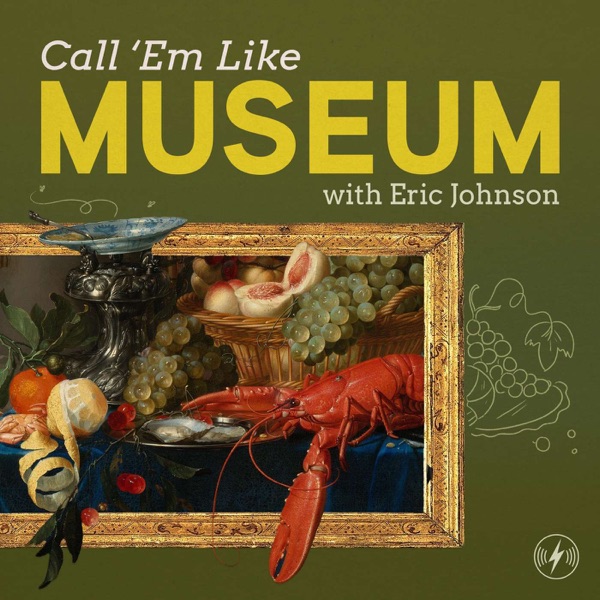
Call 'Em Like Museum with Eric Johnson
Call 'Em Like Museum is a weekly podcast exploring how museums really work, and why we love them. Host Eric Johnson talks with museum directors, curators, experts, and passionate fans about what drives them, from homegrown passion projects to world-famous institutions. Each episode digs into museum curation, exhibit design, and the visitor experience — plus the essential question: What's actually worth buying in the gift shop? Season One spotlights museums in the San Francisco Bay Area, including the Walt Disney Family Museum, the de Young Museum, and the Winchester Mystery House.
- History chart
- #34
- Episodes
- 12
- Releases
- Weekly
- Typical length
- 47 min
- On air since
- 2026
- Latest episode
- 23 hours ago
Episodes
12 episodes, newest first
-
47 min
Are fonts art? Letters find out! (with Stephen Coles)
Episode 11
Show notes
Signs, menus, chopstick wrappers: Most of us see graphic design thousands of times a day without giving it a second thought. But behind every everyday object, someone somewhere was making careful, intentional design choices.
“There’s a human designing the letters that go on that chopstick sleeve,” says Stephen Coles, associate curator and editorial director at Letterform Archive in San Francisco. Even so, he notes, graphic design “has not really been a collecting area of major art museums until fairly recently.”
Letterform Archive began as founder Rob Saunders’s personal collection of calligraphy, rare books, and design. It opened in 2015 in his home, where he swapped out the living room furniture for big tables so friends could gather around the objects. Five years ago, the collection moved to the American Industrial Center in San Francisco's Dogpatch neighborhood, and today it holds about 100,000 objects.
Unlike most special collections libraries, Letterform invites visitors to handle the material (with clean hands, no gloves) and to ask for anything when they come in for a research visit. Even, say, “stuff that’s yellow.”
Today on Call ’Em Like Museum, Stephen talks about why the art world has long looked down on typefaces; why AI generates those notoriously ugly restaurant menus; how cheap sheets of rub-down lettering helped the Black Panther Party get its message out; and the Archive’s efforts to go beyond Eurocentric design history, including new fonts for the Filipino script Baybayin. Plus: Why a typeface is a lot like a chair.
Full transcript of this episode
Visit Letterform Archive
Book a research visitThis episode was hosted, produced, and edited by Eric Johnson from LightningPod
Chapters
• (00:00) - Introduction
• (02:37) - Stephen’s First Museum Memories
• (04:59) - The Origins of Letterform Archive
• (06:52) - Why Museums Overlook Graphic Design
• (11:55) - Classes, Workshops, and Research Visits
• (19:16) - Why You Shouldn’t Wear Gloves
• (23:20) - AI and Ugly Restaurant Menus
• (29:23) - Show and Tell: Soda Labels and Rub-Down Lettering
• (33:56) - Books, the Online Archive, and Global Scripts
• (39:00) - Oohs, Ahs, and Susan Kare
• (40:41) - Do We Really Need More Fonts?
• (42:57) - Berlin’s Museum of ThingsMusic: www.purple-planet.com
Images:
Letterform Archive's Online Archive
The ChatGPT Flyer Pandemic
Epcot
Fake Japan
Behind the Seeds
Rob Saunders
The Newberry Library
AI Taking Over Food Menus
Museum der Dinge
Dishes
Lumio Book Lamp -
49 min
At the Winchester Mystery House, ghosts are just the beginning (with Walter Magnuson)
Episode 10
Show notes
Inside the Winchester Mystery House in San Jose, it is easy to get lost. The 160-room mansion's notorious maze-like design features doors and stairs that seemingly go nowhere, cabinets that are actually windows, and windows that receive no sunlight.
Since becoming a tourist attraction in 1923, the estate's labyrinthine layout has earned it an eerie reputation, drawing visitors eager to learn about the ghosts that may have haunted its owner, Sarah Winchester. But even if you are not interested in ghost stories, you will still get a lot out of your visit.
Executive Director Walter Magnuson notes that many first-time guests arrive expecting a dilapidated roadside attraction, but are instead met with architectural beauty and exquisite craftsmanship. However, he makes no apologies for also telling visitors about the legends and lore.
"Who am I to say my interests are more highbrow and acceptable than someone who is truly fascinated by the paranormal?" he asks.
Today on Call 'Em Like Museum, Walter talks about the line between legend and history, why he feels unfairly slighted by others in the museum world, and everything the house does differently around Halloween. Plus: Why the scariest part of your tour may actually be the sound of an earthquake.
Full transcript of this episode
This episode was hosted, produced, and edited by Eric Johnson from LightningPod
Chapters
• (00:00) - Introduction: The Winchester Mystery House in San Jose
• (02:25) - Walter Magnuson's First Museums
• (07:12) - Separating Fact from Legend at a Haunted Historic House
• (12:07) - Who Was Sarah Winchester? Her Story, Reframed
• (14:29) - Sarah Winchester's Philanthropy, Workers, and Artifacts
• (20:47) - How the Winchester Mystery House Tour Is Structured
• (22:10) - Recreating the 1906 San Francisco Earthquake
• (25:03) - Halloween at the Winchester Mystery House
• (28:16) - In Defense of Paranormal and Ghost-Hunting Fans
• (33:47) - Why Getting Lost in the House Is Part of Staff Training
• (35:08) - Visitor Reactions and Why House Museums Are Like David Bowie's Music
• (38:29) - Walter's Favorite Small Details in the Mansion
• (42:14) - Museum Inspiration and Future GoalsMusic: www.purple-planet.com
Images:
The Met
American Museum of Natural History
Unsolved Mysteries Host Robert Stack
William Wirt Winchester Hospital/Winchester Center for Lung DiseaseBodie, CA
Alcatraz
Graceland Living Room
Graceland Pool Table
Meow Wolf -
49 min
Hauntings, astronauts, and warplanes on the USS Hornet (with Laura Fies)
Episode 9
Show notes
"I consider ghost stories the clickbait of history," says Laura Fies, Executive Director of the USS Hornet Museum. While supernatural tales are a fun thrill for visitors, they also serve as a powerful accessory to historical education.
"We will teach them history... We'll inject it somehow and they'll walk away knowing something more," Laura explains. "And if we have to wrap it into a ghost story, so be it."
As a premier destination for history buffs, tourists, and paranormal investigators alike, the USS Hornet offers something for everybody: Spooky supernatural tours, massive military aircraft, carefully preserved World War II uniforms, and fascinating wartime artifacts—including the crew's original recipe for baking 7,000 donuts at sea.
Today on Call 'Em Like Museum, Laura discusses the unique challenges of running a “midsize museum in a big museum body.” She explains how the Hornet’s exhibits successfully put visitors into the mindset of ordinary enlisted men during World War II, and highlights the crucial role the legendary ship played in recovering astronauts during the Apollo 11 and 12 space missions.
Full transcript of this episode
This episode was hosted, produced, and edited by Eric Johnson from LightningPod
Chapters
• (00:00) - Introduction
• (04:49) - Boarding the USS Hornet Museum
• (08:55) - The Apollo 11 mobile quarantine facility
• (11:00) - Daily life for a WWII sailor
• (15:10) - Why the USS Hornet is considered haunted
• (24:16) - Maintaining an 894-foot aircraft carrier
• (34:39) - Operating the museum without federal funding
• (41:11) - Baking 7,000 donuts during battle stations
• (44:38) - Stealing ideas from other museumsMusic: www.purple-planet.com
Images:
Museum of Ice Cream
Exploratorium
Charles Schulz Museum
NASA Snoopy Poster -
43 min
Everyday life & afterlife in ancient Egypt (with Renée Dreyfus)
Episode 8
Show notes
If you learned about ancient Egypt in school, you likely heard a lot about pharaohs, tombs, and elaborate death rituals. A new exhibition at the de Young Museum juxtaposes this familiar royal history with the lives and afterlives of ordinary citizens. Here, you'll find golden jewelry and shining sarcophagi, but also everyday objects you have likely never seen before: a baby's rattle, a stone headrest, and a jar for cured meat.
"We are learning so much more about how people lived who were not royalty," says Renée Dreyfus, the curator in charge of ancient art at Fine Arts Museums of San Francisco.
Renée oversaw the American debut of "Treasures of the Pharaohs," which expands our understanding of ancient Egyptian culture, fueled by archaeologist Zahi Hawass's recent excavation of the Golden City near Luxor.
Today on Call 'Em Like Museum, we talk about how ordinary people lived, worked, and prepared for an afterlife in ancient Egypt; Renée's collaborative work with global institutions like the Egyptian Museum in Cairo and the Luxor Museum; and what she has learned during her remarkable 50 years working at FAMSF. Plus: Why the most interesting object in the whole exhibition might just be a wooden chair.
Full transcript of this episode
This episode was hosted, produced, and edited by Eric Johnson from LightningPod
Chapters
• (00:00) - Introduction
• (04:07) - What museums means to Renée
• (07:02) - Misconceptions about Ancient Egypt
• (13:37) - The Golden City & regular people
• (22:55) - Renée's favorite object in the exhibition
• (31:46) - Curating King Tut 30 years apart
• (37:34) - The Etruscans exhibit
• (40:29) - What to buy in a museum gift shopMusic: www.purple-planet.com
Images:
Several images courtesy Fine Arts Museums of San Francisco
The de Young Museum
The Legion of Honor
Vincent Price
Brooklyn Museum
The Golden City of Aten
Amenhotep III
Zahi Hawass
SitamunVideos:
Video from Treasures of the Pharaohs, courtesy of Fine Arts Museums of San Francisco -
48 min
How do we actually make museums more diverse? (with Peggy Levitt)
Episode 7
Show notes
Good museums are centers of art, culture, and education. But the richest and most famous museums are clustered in North America and Europe, and that matters more than you might realize.
Sociologist and Wellesley College professor Peggy Levitt describes herself as a decenterer for just that reason. In her books "Artifacts and Allegiances" and "Move Over Mona Lisa," she has explored how art has been shaped by colonialism, globalization and inequality.
In "Move Over Mona Lisa," Peggy asks what it might take to decenter this world. Historically, she explains, many well-intentioned museums have diversified their collection by invited artists from the Global South to relocate to Paris, London, or New York. But the center has not moved.
"There are people that are looking for a harder reform," Peggy says. "So they are happy to take less critical acclaim, less financial acclaim, if they can create their own institutions, their own networks of circulation, their own nodes of activity that don't rely on North America or Europe for permission or facilitation."
Today on Call 'Em Like Museum, we talk about how museums can represent the whole world more fairly; whether artists in the Global South should entirely opt out of the existing systems; and the importance of "having a spine" when your museum comes under scrutiny from donors & politicians.
Full transcript of this episode
This episode was hosted, produced, and edited by Eric Johnson from LightningPod
Chapters
• (00:00) - Introduction
• (04:11) - Museums and Nation Building
• (13:53) - Culture Wars at the Smithsonian
• (15:32) - How to Read Power in Museum Spaces
• (21:11) - Globalization, Colonialism, and Immigration
• (25:53) - Who Drives Change in Museums?
• (30:37) - Move Over, Mona Lisa: Decentering Art
• (36:49) - Opting Out of Traditional Centers of Power
• (40:41) - Standing Up to Museum Donors
• (42:38) - Gift Shops and Favorite MuseumsMusic: www.purple-planet.com
Peggy's Books:
Artifacts and Allegiances: How Museums Put the Nation and the World on Display
Move Over, Mona Lisa: Reimagining What We Read, Look At, and LearnImages:
Met Christmas Tree
Danish Vikings
Museum of Islamic Art
National Museum of Singapore
Smithsonian National Museum of American History
Musée nationale de l'histoire de l'immigration -
47 min
What's inside that fancy old house? (with Woody LaBounty)
Episode 6
Show notes
The Haas-Lilienthal House is one of San Francisco’s most beautiful architectural landmarks, a gorgeous Queen Anne Victorian that stands out amid a modern landscape of grocery stores and car dealerships. Built in the 1880s in the Pacific Heights neighborhood, this beautifully preserved home offers a unique glimpse into the city's 19th-century history.
While many historic house museums are dedicated to diplomats or the incredibly wealthy, original inhabitants William and Bertha Haas were upper-middle-class merchants moving up in the world. As San Francisco Heritage CEO Woody LaBounty explains, their home's location was chosen carefully to be near the true locus of power just one block over on Van Ness Avenue, which was then a showplace boulevard of massive, elaborate estates.
Today on Call ‘Em Like Museum, Woody talks about why the Haas-Lilienthal House is now the headquarters of SF Heritage and how the organization uses it to tell the city’s story. We also discuss what makes this house museum different from so many others, why it’s so important to preserve historic architecture, and why his favorite room in the house is the bathroom.
Visit the Haas-Lilienthal House: https://www.haas-lilienthalhouse.org/
The Halloween Experience, House of Weird: https://www.haas-lilienthalhouse.org/halloweenFull transcript of this episode
This episode was hosted, produced, and edited by Eric Johnson from LightningPod
Chapters
Music: www.purple-planet.comImages:
House exterior
The Ashe-Hobart Residence
Residence of Mr. Charles Holbrook
Claus Spreckel's residence (which also survived the fire!)
1906 firefighters
The burning of the Mission District
The dining room chandelier
The house in 1975
The dining room
Golden Gate Park, c. 1925
De Young Museum, 1921
San Francisco burning
The Haas-Lilienthal House entrance
The bathroom
100 McAllister Street in the 1930s
Castro Camera
Queer Arts Featured
Salvador Dalí Museum
Salvador Dalí, 1939 -
47 min
The living history of radio & broadcasting (with Rachel Lee)
Episode 5
Show notes
When you visit a museum, do you see it as just a collection of artifacts from the past? The California Historical Radio Society (CHRS) is hoping you don't.
Although their museum in Alameda, California has a great collection of preserved & restored vintage radios, their work is really about the present, the future, and building a vibrant community of audio enthusiasts.
For Executive Director Rachel Lee, the real goal of the CHRS is to create a dynamic space where different generations can connect and engage. This welcoming environment often turns casual visitors into dedicated volunteers. As Lee notes, the most rewarding part of her work is watching visitors' eyes light up when they discover a historical space that feels incredibly "alive."
Today on Call 'Em Like Museum, Rachel talks about how different generations of visitors respond to the history of radio; why it’s so important to preserve the medium’s roots; and why radio matters a lot more for life in 2026 than you probably realize. Plus: The story of the huge “music box” machines that replaced live xylophone players at NBC.
Full transcript of this episode
This episode was hosted, produced, and edited by Eric Johnson from LightningPod
Chapters
• (00:00) - Introduction
• (02:49) - The Story of the California Historical Radio Society
• (09:47) - Touring the Radio Museum's Exhibits
• (16:02) - The NBC Chimes Machine & Vintage Broadcast Studio
• (20:19) - Restoring Radios and Preserving Lost Broadcasts
• (26:46) - Funding the Museum and Future Projects
• (31:27) - The Meaning & Community Value of Museums
• (39:53) - Cultivating the Next Generation of Makers
• (43:39) - Profound Museum Memories & the Gift ShopMusic: www.purple-planet.com
-
49 min
How museums make cities stronger (with Tayana Panova)
Episode 4
Show notes
Museums already do a lot: they educate the public, preserve important works of art and culture, and inspire people to create art of their own. But they have the potential to do even more. By adopting principles of urban design, museums can transform into essential "third places"—vibrant social spaces where communities gather, friendships are formed, and societies grow stronger.
"The third place is essential to being healthy and happy because you need to have a place where you can just relax, be yourself, have fun, connect with friends, and meet new people," explains urbanist and psychologist Dr. Tayana Panova.
How we experience a space depends entirely on its design, she says. An engaging environment filled with life makes time fly, whether you are walking down a vibrant city street or exploring a beautiful museum gallery.
Today on Call 'Em Like Museum, Dr. Panova—co-host of The Perfect City podcast and a popular creator exploring how urban design affects our brains—discusses what museums can learn from the design of cities, and vice versa. We also explore the vital, real-world stimulation we get from third places that our screens simply cannot replicate, the right way to integrate technology into an exhibit, and what modern cultural institutions might want to borrow from American shopping malls.
Full transcript of this episode
This episode was hosted, produced, and edited by Eric Johnson from LightningPod
Chapters
• (00:00) - Introduction
• (02:26) - The Role of Museums in a City
• (06:56) - European vs. American Museums
• (10:17) - Designing Human-Scale Cities
• (15:08) - Smartphones vs. Real-World Stimulation
• (19:33) - The Role of Technology in Museums
• (23:21) - Can Museums Be Third Places?
• (28:53) - Building Community Through Museum Programs
• (35:42) - What Museums Can Learn From Urban Design
• (40:21) - What Cities Can Learn From MuseumsMusic: www.purple-planet.com
-
43 min
Walt Disney's life wasn't always magical (with Kirsten Komoroske)
Episode 3
Show notes
The Walt Disney Family Museum in San Francisco faces a unique challenge: How do you tell the story of one of history's most important storytellers? When Diane Disney Miller founded the museum, her goal was to let her father tell his own story. To achieve this, she amassed 30,000 artifacts and extensive archival media to create a deeply personal look at the man behind the magic.
"She really wanted to debunk these myths that he was not a family man, not committed to his friends and family," says Kirsten Komoroske, the executive director of the museum. "She wanted to tell the truth about all of the challenges, the failures, the setbacks."
Those challenges include the devastating loss of his first hit character, Oswald the Lucky Rabbit; a polarizing animators' strike that led to Walt testifying before the House Un-American Activities Committee; and the lifelong smoking habit that ultimately ended his life at age 65.
Today on Call 'Em Like Museum, Kirsten shares how the Walt Disney Family Museum stays fresh as a single-subject institution, the importance of a "good, hard failure," and why there is a plaque next to one of the museum's benches explicitly telling visitors to sit down.
Full transcript of this episode
Subscribe to the newsletterThis episode was hosted, produced, and edited by Eric Johnson from LightningPod
Chapters
• (00:00) - Introduction
• (02:18) - Kirsten Komoroske's Museum Memories
• (06:20) - How Diane Disney Miller Shaped the Story
• (09:38) - Walt Disney's Failures and Perseverance
• (12:09) - The Animators' Strike and HUAC Testimony
• (19:00) - Becoming the Museum's Executive Director
• (24:46) - The Museum's Enormous Collection
• (28:21) - The Ribbon Room and Griffith Park Bench
• (37:08) - The Disneyland Model ExplainedMusic: www.purple-planet.com
Images:
The museum exterior
Walt Disney
Narcissa Niblack Thorne
Thorne's "English Cottage Kitchen of the Queen Anne Period"
Gates of Hell
River of Stone
Faultline
Wood Line
Spire -
47 min
In this pinball museum, the art is meant to be touched (with Evan Phillippe)
Episode 2
Show notes
At the Pacific Pinball Museum in Alameda, California, there are very few "don't touch" signs. In fact, this unique collection actually relies on visitors' touch to keep things running smoothly.
"They actually function better when they're getting played a lot," says Evan Phillippe, the museum's executive director. "They seize up and they freeze when they don't ... The more they get played, the happier they are."
Today on Call 'Em Like Museum, Evan talks about the myriad challenges of maintaining the world's largest playable pinball collection, including what to do with the 1,200 machines that don't fit in the current space. He explains how the museum educates visitors through rooms like "Beyond the Backglass," the first exhibit to celebrate women's contributions to pinball engineering, art, and software. Plus: The small army of volunteers that keeps the games working, what kids who grew up with iPads think of pinball, and the downsides of being thrifty as a nonprofit museum operator.
Full transcript of this episode
This episode was hosted, produced, and edited by Eric Johnson from LightningPod
Listen to "Buzzers and Bells," my original short audio story about the Pacific Pinball Museum, on Twenty Thousand Hertz
Chapters
00:00 Introduction
03:01 Evan's First Museum Memory
07:12 A Tour of the Pacific Pinball Museum
11:46 Why It's a Museum, Not an Arcade
15:27 Fix-It Nights & Pinball Maintenance
21:46 Getting New Generations Into Pinball
27:19 Visitor Reactions & Pinball Nostalgia
33:17 Investing in the Museum's Future
40:50 Museum Inspiration & Tiny Details of JoyMusic: www.purple-planet.com
Images:
Museum exterior -
42 min
What's the point of going to a museum? (with Susan Crane)
Episode 1
Show notes
Did you know the Mona Lisa only got world-famous after it was stolen from the Louvre? In 1911, Leonardo da Vinci's masterpiece was just another portrait in the Salon Carré, shoved between a bunch of other Renaissance paintings. But when a former museum worker stole it, the public flocked to the museum to stare at "nothing," the blank space on the wall.
This phenomenon fascinated Susan Crane, a history professor at the University of Arizona and author of "Nothing Happened: A History."
In 2026, the Mona Lisa's status could not be more different: It has a wall entirely to itself behind bulletproof glass, drawing millions of visitors who wait behind stanchions to catch a glimpse & maybe take a selfie.
Today on Call 'Em Like Museum, Susan questions our relationship to famous works of art in museums, and explains how to cultivate genuine surprise as a visitor. She also explores how museums have been reshaped by technology and politics, the ongoing debate of the Smithsonian versus the White House, and whether school field trips are actually worth the effort. Plus: The absolutely wild way the literary elite used to experience museums in the 19th century.
Full transcript of this episode
Susan’s book: Nothing Happened: A History
This episode was hosted, produced, and edited by Eric Johnson from LightningPod
Chapters
• (00:00) - Introduction
• (04:04) - The Meaning and Early History of Museums
• (07:58) - How Photography Became Fine Art
• (11:52) - Stealing and Photographing the Mona Lisa
• (18:14) - Why Museums Matter
• (23:58) - Who Decides What Belongs in a Museum?
• (29:12) - Goethe's "Gallery Dialogues"
• (31:13) - Politics, Control, and Change
• (40:37) - Exit Through the Gift ShopMusic: www.purple-planet.com
Images:
Stealing Mona Lisa
Vincenzo Peruggia and “Daily Scene in the Louvre”Mystic Marriage of Saint Catherine
Feast in the House of Simon the Pharisee
Videos:
-
2 min
What do museums mean to you? Trailer
Show notes
Call 'Em Like Museum is a weekly podcast exploring how museums really work, and why we love them. Host Eric Johnson talks with museum directors, curators, experts, and passionate fans about what drives them, from homegrown passion projects to world-famous institutions. Each episode digs into museum curation, exhibit design, and the visitor experience — plus the essential question: What's actually worth buying in the gift shop? Season One spotlights museums in the San Francisco Bay Area, including the Walt Disney Family Museum, the deYoung Museum, and the USS Hornet Museum.
Subscribe to the newsletter: https://www.callemlikemuseum.com/
Music: www.purple-planet.com
This episode was hosted, produced, and edited by Eric Johnson from LightningPod: https://lightningpod.fm/
On these lists
Call 'Em Like Museum with Eric Johnson is one of the shows picked out on each of these




More in Visual Arts
Placed highest on Apple Podcasts' Visual Arts chart right now