Podcast
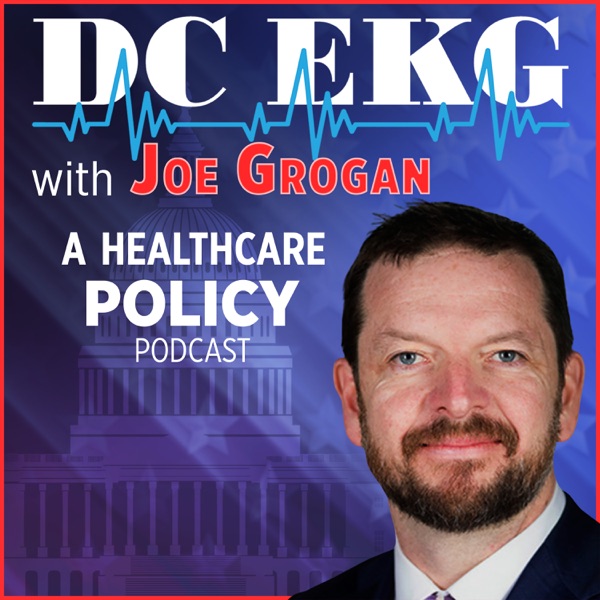
DC EKG
Join former White House policy expert Joe Grogan as he cuts through the complexities of healthcare legislation and its real-world implications. Each episode of DC EKG aims to demystify the policies shaping our healthcare system, uncovering how these changes impact patients, providers, and payers across the country.
- Episodes
- 153
- Releases
- Weekly
- Typical length
- 49 min
- On air since
- 2022
- Latest episode
- 1 month ago
Episodes
153 episodes, newest first
-
40 min
Dr. David Eagle: The Hospital Squeeze
Episode 140
Show notes
DC EKG with Joe Grogan
DC EKG Ep 140 | Joe Grogan & Dr. David Eagle: The Hospital Squeeze
Guest: Dr. David Eagle, President, American Independent Medical Practice Association
Episode Description
Joe Grogan sits down with Dr. David Eagle, President of the American Independent Medical Practice Association and board-certified hematologist oncologist from New York Cancer and Blood Specialists, to discuss the collapse of independent oncology practices in America. Dr. Eagle explains how hospital consolidation through aggressive acquisition strategies, combined with punitive reimbursement policies and the 340B drug pricing program, has devastated independent community oncology practices. He details how independent practices declined from 85% of cancer care in 2000 to roughly 45% today, the "uneven playing field" created by 340B, and how policy changes under the Inflation Reduction Act are accelerating the crisis. The conversation covers Medicare payment systems, facility fee exploitation, reimbursement pressures, and the future of cancer care delivery when independent practices disappear. Dr. Eagle also discusses promising advances in cancer treatment including CAR T cell therapy, personalized vaccines, and precision medicine—innovations that may be lost if the healthcare system cannot maintain community-based oncology practices.
Key Timestamps
0:54 Joe Grogan welcomes Dr. David Eagle from New York Cancer and Blood Specialists
1:44 Why independent medical practice is important for oncology and the healthcare system
3:38 Current state of independent oncology practices in America
3:42 In 2000, community practices were 85% of cancer care; now roughly 45%
5:04 How hospitals create artificial competition by setting up practices nearby
6:02 The transition when Dr. Eagle's practice was acquired by a hospital system
6:08 How hospitals exploit facility fees while patients pay higher copays
7:11 Medicare Modernization Act 2003: The ASP system shift that squeezed independent doctors
10:18 IRA drug pricing: How add-on payments shrink as negotiated drug prices fall
10:51 2025 physician fee schedule: The grim economic reality for independent practices
12:29 Why independent community oncologists aren't valued by policymakers
15:51 Jeff Faserka: CEO of New York Cancer and Blood, previously in FDA commissioner contention
26:18 340B playbook: How hospitals have spent 15 years acquiring independent practices
32:52 Cancer treatment breakthrough: From leukemia to solid tumors, we're in a new frontier
36:40 Personalized medicine: The future requires maintaining community-based delivery systems
Key Topics
Hospital consolidation, independent oncology practices, 340B drug pricing program, reimbursement crisis, Inflation Reduction Act, Medicare payment systems, facility fees, CAR T cell therapy, personalized medicine, physician economics, healthcare policy, community medicine
Podcast: DC EKG with Joe Grogan | Episode: 140 | Host: Joe Grogan | Guest: Dr. David Eagle, President, American Independent Medical Practice Association
Sponsor: Survivors for Solutions - https://survivorsforsolutions.org
Executive Producer: John "CZ" Czwartacki, DC EKG Podcast
Producer: Stay on Course Studios - https://www.stayoncourse.studio
-
51 min
John Desser: Health Savings Accounts and Market-Based Healthcare Solutions
Episode 141
Show notes
Joe Grogan talks with John Desser, VP and Head of Government Affairs at Health Equity, about market-based healthcare and why
Health Savings Accounts (HSAs) may be its future. John's 35-year career runs from an internship in Senator John McCain's office through the Bush administration, eHealth, and now Health Equity. He recounts how the ACA's first draft nearly wiped out private online insurance marketplaces, why healthcare.gov stumbled, and how consumer control can fix healthcare's misaligned incentives. He also reflects on Ron Wyden's universal coverage plan without a mandate, Ted Kennedy's role in bipartisan reform, McCain's skinny repeal vote, and Trump's "give the money to the people" approach.
Key Timestamps
1:10 Joe welcomes John Desser of Health Equity
1:26 From foreign policy major to healthcare policy
1:46 Falling into healthcare in McCain's office, summer 1989
2:40 35 years in healthcare, thanks to Dave McIntyre
3:18 Coalition for Affordable Health Coverage and refundable tax credits
4:45 Bill Thomas: Spend as much as Democrats, but spend it our way
6:11 Updating the Archer MSA law
7:30 How Bill Thomas put HSAs in the Medicare Modernization Act
8:06 Leading health policy in the Bush administration
10:45 The uninsured project and Ron Wyden's universal coverage bill
12:03 Why dropping the mandate cost zero coverage
15:09 eHealth: Selling insurance online for a decade
17:05 Waxman's ACA draft and the 100% premium surtax
19:54 The John Dingell meeting that removed the surtax
21:14 The healthcare.gov disaster
22:55 Marketing costs: $20,000 per healthcare.gov sign-up
27:06 Trump administration launches enhanced direct enrollment
30:22 John joins Health Equity in July 2022
30:54 Why HSAs matter: Consumers, not bureaucrats, should ration care
34:18 Trump's "give the money to the people" instinct
35:35 The problem with arbitrary value-based pricing
39:21 ACA criticism: Ted Kennedy's absence and the 60-vote problem
41:51 Why bipartisan healthcare laws are more durable
44:15 "Build a new house next to the old one"
44:50 John Goodman's case for HSAs in Medicaid
45:28 Why every employer plan should include HSAs
Key Topics
HSAs, market-based healthcare, the ACA, healthcare.gov, online insurance marketplaces, Medicare Modernization Act, Medicaid reform, employer-sponsored coverage, bipartisan healthcare policy, consumer-driven healthcare
About the Guest
John Desser is VP and Head of Government Affairs at Health Equity, the nation's largest HSA provider, with 17 million total accounts. In more than 35 years in healthcare policy, he has worked for Senator John McCain, led health policy at HHS in the Bush administration, and run government affairs at eHealth during the ACA rollout. He is an expert in consumer-driven healthcare and market-based reform.
Podcast: DC EKG with Joe Grogan | Episode: 141 | Host: Joe Grogan | Guest: John Desser, Vice President and Head of Government Affairs, Health Equity
Sponsor: Survivors for Solutions – https://survivorsforsolutions.org
Executive Producer: John "CZ" Czwartacki, DC EKG Podcast | Producer: Stay on Course Studios
-
47 min
Elizabeth Chamblee Birch on The Pain Brokers
Episode 139
Show notes
Elizabeth Chamblee Birch, law professor and author of The Pain Brokers, exposes a coordinated healthcare fraud scheme targeting over 100,000 women. Stolen HIPAA-protected health records were weaponized by call centers in India and South Florida to convince women they needed emergency mesh removal surgery. Many women were left permanently incontinent after unnecessary procedures. The scheme involved call centers using stolen medical data, South Florida surgical operations, lawyers creating hidden liens, and litigation funders profiting from women's suffering. Birch introduces the villains: Vince Chabra (online pill mill founder), Blake Barber (travel concierge), and complicit doctors. She also highlights heroes: Barbara Bennis (defense attorney who uncovered the conspiracy) and J.R. Baxter (young plaintiffs lawyer who fought back). The episode reveals how electronic health record systems enabled massive data breaches, how private equity infiltrated the legal system, and what reforms are desperately needed to prevent future schemes.
Key Timestamps
0:53 Joe Grogan introduction
1:25 Joe asks Elizabeth about her background
1:37 Elizabeth's background: 21 years teaching mass torts
2:25 Elizabeth's MFA in narrative nonfiction at UGA
3:26 What is vaginal mesh used for?
5:21 Sharon gets intimate stolen medical data in phone call
6:00 Sharon didn't know she had mesh inserted
6:32 Call centers in India and South Florida
7:32 Alpha Law: Frankenstein firm through D.C. loophole
9:31 Outbound calls fueled by illegal stolen HIPAA data
10:12 Sharon's journey through the system
12:39 Sharon's financial devastation: $69-120K lien
13:24 Litigation funders threaten Sharon's house after settlement
15:00 Multi-district litigation vs class action
16:15 The perverse economics of the scheme
17:33 Economics: $15K vs $215K+ for removal
19:10 Women left permanently incontinent after unnecessary surgeries
21:15 Meet Vince Chabra and Blake Barber: the kingpins
26:11 Wolf of Wall Street moment: 14,000 claims for $40 million
27:45 Cold called over 100,000 women, signed 14,000 as clients
28:35 Barbara Bennis: defense attorney hero discovers conspiracy
30:37 Jerry Plummer and J.R. Baxter: young lawyer fighting back
34:36 Electronic health records enabled the data breach
36:07 Women receive $40K average settlement before fees
37:30 Data bias in medicine: gender gap in settlements
42:37 Solutions: anti-kickback statute reform
43:35 Private equity infiltrating law firms: the next frontier
Key Topics
Vaginal mesh litigation, healthcare fraud, HIPAA violations, stolen health records, call center fraud, litigation funding, private equity, women's health bias, legal reform, unnecessary surgery, settlement bias, data breach, electronic health records
Podcast: DC EKG with Joe Grogan | Episode: 139 | Host: Joe Grogan | Guest: Elizabeth Chamblee Birch, Law Professor, University of Georgia
Sponsor: Survivors for Solutions – https://survivorsforsolutions.org
Executive Producer: John "CZ" Czwartacki, DC EKG Podcast
Producer: Stay on Course Studios – https://www.stayoncourse.studio
-
48 min
John Bertrand on FDA Approval, CMS Reimbursement, and AI Healthcare Reality
Episode 138
Show notes
Guest: John Bertrand, former Digital Diagnostics
Episode Description
Joe Grogan sits down with John Bertrand, a veteran healthcare technology executive who scaled Digital Diagnostics to 75 health systems and achieved the first FDA approval and CMS reimbursement for an autonomous AI diagnostic device without a physician in the diagnostic loop. Bertrand reveals the harsh realities of bringing AI innovation to market: FDA and CMS regulatory frameworks are built for traditional medical devices and physician-driven care, not autonomous AI diagnostics. The conversation covers the shocking CMS reimbursement draft that came in 40-60% below cost of goods sold, the massive first-mover disadvantage in regulated medical device AI, and why reimbursement is the true gating factor for adoption—not clinical superiority. Bertrand explains how workflow integration and financial incentives matter far more than being clinically better. The episode explores the massive gap between what entrepreneurs think should happen with new innovations and the regulatory reality. He concludes with a sobering assessment: if building diagnostic AI again, he would choose supply chain automation instead because the regulatory and reimbursement headwinds are so significant they punish innovators. Where AI is actually making an impact today is patient-facing triage agents, administrative automation, and revenue cycle management—areas with far less friction.
KEY TIMESTAMPS
0:40 Joe introduces John Bertrand and his healthcare tech background
1:28 John clarifies he recently left Digital Diagnostics for supply chain work
2:40 John's career: 13 years at Epic Systems across multiple roles
6:10 What does Digital Diagnostics' AI device do? Automating retinal imaging
7:56 First FDA approval and first CMS reimbursement for autonomous AI diagnostic
9:02 Joe's threshold question: shouldn't better innovation be easily adopted?
9:50 Reality: workflow integration and reimbursement matter more than clinical quality
11:50 The adoption curve: all successful FDA-approved AI devices have CMS reimbursement
14:10 FDA experience: desire to help but frameworks built for old technology
15:40 FDA scrutiny on AI exceeds scrutiny on human clinicians
18:05 FDA guidance changes every 6-12 months, creating constant pivoting and delays
20:08 Shifting to CMS: the shocking draft reimbursement story
20:45 Draft came in at $10 per test, needed $30+ to be viable
22:42 Four months of negotiations with CMS to shift value argument
24:40 Process not codified: each company follows unique regulatory path
28:04 Six years at Digital Diagnostics: was it worth it?
28:44 John would not recommend diagnostic AI to new founders
33:02 Turning down multiple diagnostic AI opportunities post-Digital Diagnostics
34:19 AI hype vs reality: where are patients actually seeing life improvements?
34:19 Patient-facing triage agents are the second inning of real AI opportunity
36:25 Reimbursement for chat-based triage: who gets paid?
38:23 Autonomous vs assistive AI: the regulatory gap that exists
40:31 Could Digital Diagnostics have done physician-in-loop from the start?
41:33 Real opportunity: clinical practices deploying their own AI
42:20 State licensing nightmare: deploying AI across 50 states
44:55 The real concern: RCM automation becoming a zero-sum AI bot battle
45:20 Dead Internet Theory applied to healthcare revenue cycle
47:38 Closing: a tour de force on AI healthcare reality
Key Topics
AI in healthcare, FDA approval process, CMS reimbursement, autonomous AI diagnostics, Digital Diagnostics, diabetic retinopathy, regulatory frameworks, first-mover disadvantage, workflow integration, reimbursement strategy, patient-facing AI, healthcare innovation, regulatory friction, adoption barriers, state licensing, RCM automation, healthcare AI reality
About the Guest
John Bertrand is a veteran healthcare technology executive with over 20 years of experience. He spent 13 years at Epic Systems in analyst, product manage
-
54 min
REFILL | Tomas Philipson on IRA, Inflation, Real Wages, and COVID Policy Tradeoffs (Originally Aired: June 2, 2023)
-
46 min
REFILL | Naomi Lopez on Healthcare AI, ACCESS, TEMPO, and the Future of Care (Originally Aired: January 23, 2026)
Show notes
This is a legacy episode recorded in January 2026. At the time of recording, Naomi Lopez was founder of Nexus Policy Consulting and a leading voice in healthcare policy, healthcare AI, and state health reform.
Joe Grogan sits down with Naomi Lopez from Nexus Policy Consulting to recap the first Healthcare AI Policy Summit held in December 2025 in Washington, DC. They discuss big themes shaping healthcare AI, HHS approaches to AI adoption, and what regulatory clarity could look like. The conversation covers new federal initiatives like ACCESS and TEMPO that may reshape chronic disease management for Medicare patients. They unpack HHS Deputy Secretary Jim O'Neill's vision for AI in government, including using large models to improve physician productivity, payment integrity, and care coordination. They dig into ACCESS Medicare payment model and FDA TEMPO initiative, explaining how these pilots test AI tools in real-world chronic disease management for hypertension, diabetes, musculoskeletal pain, and depression. The discussion widens to physician burnout, interoperability, rural care, states and federal preemption, and what tech companies becoming Medicare Part B providers could mean for healthcare innovation.
Key Timestamps
0:00 Intro and why the Healthcare AI Policy Summit matters
2:00 Summit recap: big themes and regulatory pressure points
6:00 Jim O'Neill at HHS: regulatory clarity and adoption inside government
12:00 ACCESS explained: Medicare chronic disease management payment model
18:00 TEMPO explained: FDA's risk-based approach for chronic care tools
24:00 Wearables, remote patient monitoring, and virtual ICU models
30:00 Privacy, de-identification, and re-identification risk
35:00 AI inside HHS and FDA: productivity, payment integrity, care coordination
41:00 Reducing admin burden and physician burnout
47:00 Rural healthcare: scaling diagnostics and access with AI
52:00 Interoperability and data sharing: APIs, friction, and incentives
58:00 State AI laws versus federal preemption
1:04:00 2026 outlook: tech companies as Medicare Part B providers
1:09:00 Wrap-up and what to watch next
Key Topics
Healthcare AI, ACCESS payment model, TEMPO initiative, FDA regulation, Medicare reimbursement, chronic disease management, AI in government, physician productivity, care coordination, wearables, remote patient monitoring, privacy and de-identification, rural healthcare, interoperability, state AI regulation, federal preemption, healthcare innovation, payment integrity
About the Guest (at time of recording, January 2026)
Naomi Lopez is the founder of Nexus Policy Consulting and a leading voice in healthcare policy, healthcare AI, and state health reform. She co-founded a healthcare AI working group and co-hosted the inaugural Healthcare AI Policy Summit in December 2025 in Washington, DC. Her work focuses on how regulation, Medicare and Medicaid policy, and state law shape healthcare innovation, access, and affordability.
Podcast: DC EKG with Joe Grogan
Host: Joe Grogan
Guest: Naomi Lopez
Sponsor: Survivors for Solutions
Executive Producer: John CZ Czwartacki, DC EKG Podcast
-
51 min
REFILL | Jackson Hammond on NHE, CMS Reform, and Making Insurance Almost Obsolete (Originally Aired: January 22, 2026)
Show notes
In this "REFILL" episode, Joe Grogan sits down with Jackson Hammond from Paragon Health Institute to unpack what the latest CMS National Health Expenditure data says about where U.S. healthcare is headed. They break down spending trends from $5.2 trillion to projections of $8.6 trillion, explaining what changed, what didn't, and what it means for affordability, Medicare, Medicaid, and long-run fiscal pressure. The conversation connects spending outlook to Jackson's work on CMS Innovation Center reform and debates whether CMMI is bending the cost curve or adding bureaucracy without accountability. Jackson argues we should aim for healthcare so affordable you barely need insurance, exploring how choice and competition could reshape the system.
Key Timestamps
0:55 Jackson's background and how he got into health policy
3:39 Focus areas: Medicare, hospitals, drug pricing, PBMs, and 340B
5:14 What the NHE report is showing
6:14 Healthcare spending trajectory: $5.2T to $8.6T and why it matters
8:00 Why health spending is not really optional
10:11 Where the money goes: payer mix and per-enrollee costs
12:23 Medicaid costs, provider taxes, and state financing tactics
15:58 Medicare spending pressure and fiscal risk
21:06 Misconception: coverage equals care
26:18 Why provider payments keep rising after COVID demand and consolidation
33:01 Rural care, consolidation, and rural emergency hospital models
40:08 Drug pricing: retrospective versus prospective MFN approaches
49:20 2026 outlook and closing thoughts
Key Topics
National Health Expenditure, healthcare spending, CMS reform, CMS Innovation Center, Medicare spending, Medicaid costs, hospital consolidation, rural healthcare, drug pricing, PBMs, 340B program, provider payments, patient-centered care, healthcare affordability, choice and competition, fiscal policy
About the Guest (at time of recording, January 2026)
Jackson Hammond is a Senior Policy Analyst at the Paragon Health Institute focused on health spending, CMS policy, and reforms centered on choice, competition, and patient-centered care. He authors Paragon's Paragon Prognosis analyses and has written extensively on CMS Innovation Center reform and strategies for making healthcare more affordable through competitive market approaches.
Podcast: DC EKG with Joe Grogan
Host: Joe Grogan
Guest: Jackson Hammond
Sponsor: Survivors for Solutions
Executive Producer: John CZ Czwartacki, DC EKG Podcast
-
42 min
REFILL | Michael Cannon on STLDI and ACA Coverage: Costs, Choice, and Tradeoffs (Originally Aired: January 27, 2026)
Show notes
This is a legacy episode recorded in January 2026. At the time of recording, Michael Cannon was Director of Health Policy Studies at the Cato Institute, a leading voice on healthcare reform, the Affordable Care Act, and market-based health policy solutions.
Episode Description
Joe Grogan sits down with Michael Cannon from the Cato Institute to discuss short-term, limited-duration insurance (STLDI), also known as "Obamacare-exempt" plans, and why they can be significantly cheaper than ACA exchange coverage. Cannon explains how renewal guarantees work and why allowing more consumer choice can reduce pressure on exchange risk pools. The conversation covers the politics of pre-existing conditions, how ACA rules change insurers' incentives, and why coverage debates often miss the real drivers of cost, access, and quality. They also discuss public trust in healthcare following the Brian Thompson murder and explore how policy choices shape what insurers can and cannot do.
Key Timestamps
0:23 Michael Cannon joins and what STLDI is
2:27 STLDI explained: Obamacare-exempt plans, renewal guarantees, and lower premiums
6:00 ACA history: why STLDI was restricted
7:46 International comparisons and pre-existing conditions incentives
12:10 Why healthcare stays broken: regulation, lobbying, and government-designed systems
16:59 Subsidies and the politics of pre-existing conditions
22:22 Renewal guarantees, employer tax exclusion, and Medicare history
30:37 Public trust after Brian Thompson's murder and Cannon's letter
41:56 Wrap-up and key takeaways
Key Topics
STLDI insurance, short-term limited-duration plans, ACA coverage, renewal guarantees, risk pools, pre-existing conditions, insurance regulation, healthcare costs, consumer choice, affordability, public trust, healthcare policy, market-based reform, junk insurance debate, employer-based coverage, Medicare policy
About the Guest (at time of recording, January 2026)
Michael Cannon is the Director of Health Policy Studies at the Cato Institute and a leading voice on healthcare reform, the Affordable Care Act, health insurance regulation, and market-based health policy solutions. He is a policy expert focused on expanding consumer choice and reducing the regulatory barriers that limit access to affordable coverage options.
Podcast: DC EKG with Joe Grogan
Host: Joe Grogan
Guest: Michael Cannon
Sponsor: Survivors for Solutions
Executive Producer: John CZ Czwartacki, DC EKG Podcast
-
48 min
REFILL | Ryan Long on 340B Drug Pricing, Enhanced ACA Tax Credits, and Medicare Part D (Originally Aired: September 24, 2025)
Show notes
Joe Grogan sits down with Ryan Long, healthcare policy expert and senior research fellow at Paragon, to discuss three critical healthcare policy issues facing Congress. First, the Congressional Budget Office's landmark analysis of the 340B drug pricing program, which revealed the program increases federal spending, drives up premiums, and channels most benefits to wealthy hospitals rather than those serving low-income patients. Second, the enhanced premium tax credits set to expire at the end of 2025, which have been plagued by fraud and fraudulent enrollment. Long explains how unscrupulous brokers have exploited the system, enrolling people without their knowledge, with billions in improper payments going to insurance companies. Third, the Inflation Reduction Act's devastating impact on Medicare Part D, including premium increases from thirty to sixty dollars monthly, coinsurance replacing copays, and seniors paying higher out-of-pocket costs despite the legislation's promise to lower drug costs.
Key Timestamps
1:20 Welcome to DC EKG and introduction of Ryan Long
2:15 Congressional Budget Office analysis of 340B program
4:06 Why CBO conducted the 340B study
4:25 How 340B increases federal spending and premiums
4:58 Studies showing 340B drives higher-cost drug utilization
5:30 Will CBO analysis lead to legislative reform efforts
6:15 Program expansion from 90 to 2,600 participating hospitals
8:06 Timeline for 340B reform legislation
10:43 340B program growth from two billion to sixty-six billion annually
11:52 Why insurance companies support limiting 340B
12:20 Enhanced premium tax credits and ACA credits expiring
14:22 Difference between baseline and enhanced ACA credits
16:34 Zero-dollar plans and fraud mechanisms
18:19 Broker fraud and fraudulent enrollment schemes
21:09 How fraudulent brokers exploit free plans and commission structure
22:53 Paragon study showing four times over-enrollment in Florida
25:30 Misleading polling about ACA credits expiring
28:18 Groups pushing misleading messaging on enhanced credits
29:31 Political dynamics and Republican position on credits
33:17 Government shutdown politics and Democrat strategy
36:09 Elevance exiting standalone Medicare Part D plans
38:03 Migration from Part D to Medicare Advantage due to IRA
39:15 How IRA's out-of-pocket cap restructuring increased premiums
40:34 Coinsurance replacing copays and cost shift to seniors
42:20 IRA using fictitious list price to calculate negotiated savings
44:47 Multiple factors causing Medicare Part D premium increases
Key Topics
340B program, Congressional Budget Office, drug pricing, hospital consolidation, enhanced premium tax credits, ACA fraud, fraudulent enrollment, broker fraud, government subsidies, Medicare Part D, out-of-pocket costs, coinsurance, Inflation Reduction Act, pharmaceutical pricing, program integrity
About the Guest (at time of recording, September 2025)
Ryan Long is a Senior Research Fellow at the Paragon Health Institute and affiliated with the USC Schaefer Center for Health Policy and Economics. He is a healthcare policy expert with extensive experience on Capitol Hill, including service as a staffer on the House Energy and Commerce Committee and chief health policy advisor to Speaker Kevin McCarthy. Long specializes in healthcare reform, pharmaceutical pricing policy, Medicare and Medicaid issues, and legislative strategy.
Podcast: DC EKG with Joe Grogan
Host: Joe Grogan
Guest: Ryan Long
Sponsor: Survivors for Solutions
Executive Producer: John CZ Czwartacki, DC EKG Podcast
-
53 min
"REFILL" | Dutch Rojas on Healthcare Economics, Direct Contracting, and Tax-Exempt Health Systems (Originally Aired: September 15, 2025)
Show notes
This is a "REFILL" episode recorded in September 2025. At the time of recording, Dutch Rojas was a healthcare entrepreneur, founder of multiple direct contracting companies, and board member of Physician Led Healthcare for America, with a growing following on social media advocating for market-based healthcare solutions.
Joe Grogan sits down with Dutch Rojas, healthcare entrepreneur and social media advocate, to discuss his journey from accounting to building direct contracting companies that revolutionize employer healthcare. Rojas explains how direct contracting allows employers to negotiate directly with physicians, bypassing insurance middlemen. The conversation covers his experience building ambulatory surgery centers, certificate of need laws, self-funded employer plans, and his critique of not-for-profit health systems. Rojas argues that academic medical centers masquerade as not-for-profit organizations while receiving seventy-four subsidies annually from taxpayers, acquiring massive real estate holdings, and avoiding property and federal taxes. He advocates for policy changes on not-for-profit tax status and site-neutral payments, arguing these represent unfair advantages that harm independent physicians and patients.
Key Timestamps
0:18 Joe introduces Dutch Rojas and asks who is Dutch Rojas
1:32 Dutch's background, career path, and journey to social media
2:22 Physician-led Healthcare for America and PHA board
4:32 Starting in accounting, real estate investment trust, and ambulatory surgery centers
5:14 150 ambulatory surgery center deals and certificate of need experience
7:34 Building a practice in Scottsdale and expanding to 16 states
9:30 First direct contracting company in 2009 and how direct contracting works
12:45 Self-funded employer plans and 106 million Americans not covered by insurance
15:22 Deals with banks and large employers in New York City
18:09 The difference between clinical medicine and business in medicine
22:15 Building insurance products on top of physician-led care
28:30 How direct contracting saves employers money
32:18 The three companies Dutch has started and sold
38:45 Healthcare as a percentage of GDP and rising costs
42:10 Regulatory hurdles and state-level barriers
46:54 Not-for-profit tax status and academic health systems
48:07 How health systems receive subsidies but claim non-profit status
48:22 Academic medical centers owning four to five percent of city real estate
49:21 Site-neutral payments and payment disparities between settings
50:28 Dutch's social media reach and audience impact
Key Topics
Direct contracting, healthcare economics, physician-led care, ambulatory surgery centers, certificate of need, self-funded employer plans, not-for-profit health systems, tax exemptions, site-neutral payments, healthcare regulation, real estate holdings, academic medical centers, employer negotiations, insurance reform, market-based healthcare
About the Guest (at time of recording, September 2025)
Dutch Rojas is a healthcare entrepreneur with over 25 years of experience in healthcare economics and business. He started in accounting and real estate investment, then moved into healthcare, developing over 150 ambulatory surgery centers. Rojas founded multiple direct contracting companies that help employers negotiate directly with physicians, bypassing traditional insurance intermediaries. He serves on the board of Physician Led Healthcare for America. He has built a significant social media following on X (formerly Twitter), sharing his analysis of healthcare policy and economics. Rojas is the author of the Rojas Report and hosts a YouTube channel and Substack focused on healthcare reform and market-based solutions.
Podcast: DC EKG with Joe Grogan
Host: Joe Grogan
Guest: Dutch Rojas
Sponsor: Survivors for Solutions
Executive Producer: John CZ Czwartacki, DC EKG Podcast
-
45 min
"REFILL" | Dr. Brian Miller on FDA Regulatory Reform and the Valley of Death in Medical Innovation (Originally Aired: March 21, 2025)
Show notes
In this "Refill" episode, Joe Grogan sits down with Dr. Brian Miller to discuss the "Valley of Death" - the gap between FDA approval and CMS coverage - and how regulatory reform can accelerate medical innovation. Miller explains how FDA product review can be made more efficient through automation and algorithmic analysis of routine tasks, allowing highly trained reviewers to focus on clinical interpretation rather than data processing. The conversation covers clinical trial reform, device review modernization, third-party review programs, and CMS coverage decision processes. Miller argues that these are operational challenges that can be fixed with executive leadership, and that transforming FDA and CMS procedures is critical to bringing new medicines and devices to patients faster.
Key Timestamps
1:23 Brian Miller background and AEI role
2:47 The Valley of Death - gap between FDA approval and CMS coverage
5:06 Making FDA and CMS review processes more synergistic
7:43 Example of hypertension drug review and routine tasks
8:26 Data overload in FDA review process
10:40 Supplemental applications and unnecessary information
12:01 FDA reviewer burnout and middle management proliferation
15:30 Automating routine tasks at FDA
17:33 Clinical trial reform discussion and regulatory risk
20:03 Practical approach for new FDA commissioner and DOGE
21:22 Operational changes needed at FDA
22:48 Tobacco regulation at FDA and resource allocation
25:10 Device world getting short shrift in FDA priorities
27:33 Third-party 510k review program and third-party organizations
29:09 COVID diagnostic tests and pandemic review process
30:51 Reforming CDRH through third-party reviews
31:36 70-year comparison of heart attack treatment advances
32:46 CMS coverage decisions and Coverage with Evidence Development
36:02 Medicare Administrative Contractors (MACs) and local coverage decisions
38:12 Practical market-based approach to MAC appeals
39:54 National vs local coverage decisions and reasonable and necessary standard
42:28 Defining reasonable and necessary through algorithms and guidance
Key Topics
FDA regulatory reform, Valley of Death, clinical trial reform, FDA product review automation, CMS coverage decisions, Medicare Administrative Contractors, third-party device review, drug development costs, medical innovation, device regulation, regulatory science, operational efficiency
About the Guest (at time of recording, March 2025)
Dr. Brian Miller is a physician and non-resident fellow at the American Enterprise Institute (AEI) focusing on FDA regulatory policy and Medicare payment policy. He practices medicine at Johns Hopkins Hospital and serves as an associate professor of medicine and business at Johns Hopkins University. His research and policy work emphasize making regulatory systems more efficient to accelerate the development and approval of innovative medicines and medical devices.
Podcast: DC EKG with Joe Grogan
Host: Joe Grogan
Guest: Dr. Brian Miller
Sponsor: Survivors for Solutions
Executive Producer: John CZ Czwartacki, DC EKG Podcast
-
45 min
"REFILL" | Peter Pitt on FDA Advisory Committees, Make America Healthy Again, and Drug Pricing (Originally Aired: May 23, 2025)
Show notes
Joe Grogan sits down with Peter Pitt, FDA veteran and expert on healthcare regulation, to discuss FDA advisory committees, the Make America Healthy Again initiative, and critical gaps in pharmaceutical labeling. Pitt addresses why obesity-related drug dosing information is missing from labels, the importance of vaccine safety, food regulation reform, and strategies for lowering drug prices through generic drug reviews and supply chain diversification. He also discusses the need for FDA and CMS to work together and warns against mission creep at CMS.
Key Timestamps
0:44 Background: East Coast native, McGill University, from New York City
1:07 How he got a professorship at University of Paris School of Medicine
2:35 Mark McClellan connection and FDA career start
5:19 Conflicts of interest versus interests in FDA advisory committees
7:07 Why people need to be dismissed from advisory committees
9:13 Three basic reasons FDA holds advisory committee meetings
11:08 Why Canada keeps advisory committees secret versus FDA transparency
14:08 Advisory committees for CYA, new science, and lack of consensus
19:44 Op-ed on vaccines and nutrition under Make America Healthy Again
22:44 Cancer drug dosing for obese patients and missing label information
27:15 Learning about drug dosing outside of clinical trials
30:42 Food regulation and FDA's second-class treatment of food safety
32:02 MAHA moment and removing red food dyes from food supply
34:00 Dietary supplements regulation under DSHEA
35:21 Nutrition labeling updates and soda bottle serving sizes
38:21 PDUFA reauthorization and user fees
40:32 User fees about predictability not speed
42:54 CMS mission creep and encroaching on FDA authority
Key Topics
FDA advisory committees, transparency, vaccine safety, Make America Healthy Again, pharmaceutical labeling, obesity and drug dosing, food regulation, dietary supplements, generic drug review, PDUFA reauthorization, user fees, CMS mission creep, drug pricing
About the Guest (at time of recording, May 2025)
Peter Pitt is President and Co-Founder of the Center for Medicine in the Public Interest and a visiting professor at the University of Paris School of Medicine. He is a former associate commissioner at the FDA where he oversaw advisory committees and served as a senior policy and communications advisor. Pitt is a native of New York City, a McGill University graduate, and speaks fluent French.
Podcast: DC EKG with Joe Grogan
Host: Joe Grogan
Guest: Peter Pitt
Sponsor: Survivors for Solutions
Executive Producer: John CZ Czwartacki, DC EKG Podcast
-
48 min
"REFILL" - Ryan Long on the ACA Subsidy Fight, Phantom Enrollees, and Reforming 340B
Show notes
Podcast TitleDC EKG with Joe Grogan: A Healthcare Policy Podcast
This is a REFILL of Episode124 - (Original air date: January 27, 2026)
Episode Title - Ryan Long on the ACA Subsidy Fight, Phantom Enrollees, and Reforming 340B
Episode Description - Joe Grogan is joined by Ryan Long of Paragon Health Institute and the University of Southern California to break down two fights shaping health policy right now: a California wealth tax pitch framed as a health care fix, and the battle over extending enhanced Affordable Care Act subsidies.
They unpack how enhanced subsidies changed who qualifies, why zero-premium plans opened the door to broker-driven enrollment and fraud, and why the medical loss ratio creates perverse incentives that can push premiums higher. They also explain how silver loading and cost-sharing reduction policy distort the exchange market, and what reforms could lower costs without writing a blank check.
The episode closes with Ryan's latest work on the 340B program, including why drug arbitrage rewards hospitals with a stronger commercial mix and can fuel consolidation, and why direct, targeted assistance could better support hospitals that truly serve low-income and rural patients.
Chapters and Timestamps
00:01 Intro
00:23 Welcome, and what is on the agenda
01:25 California wealth tax and structural deficits
11:20 Enhanced ACA subsidies and the shutdown fight
16:54 Income caps, zero premium plans, and phantom enrollees
21:50 Fraud, Medicaid exposure, and public trust
30:39 Medical loss ratio incentives and ACA market fixes
38:41 340B: how arbitrage works and why it drives consolidation
44:51 What reform could look like
47:20 Closing
SEO Keywords | Affordable Care Act, ACA subsidies, enhanced subsidies, premium tax credits, exchange plans, zero premium plans, phantom enrollees, medical loss ratio, cost sharing reduction, silver loading, Medicaid fraud, Minnesota fraud, California wealth tax, 340B program, drug arbitrage, hospital consolidation, site neutral payments, commercial mix, Medicare Trust Fund
About Our Guest | Ryan Long is a health policy expert with experience on Capitol Hill, including years in the Speaker's office and on the House Energy and Commerce Committee. He is affiliated with Paragon Health Institute and the University of Southern California.
CreditsSponsor: Survivors for SolutionsExecutive Producer: John “CZ” Czwartacki, DC EKG PodcastProducer: Julie Riga, Stay on Course Studios, https://www.stayoncourse.studio/
-
49 min
"REFILL" White House Rivalries and CDC Reform with Dr. Tevi Troy
Show notes
An episode pulled from the archives, Joe Grogan and Eric Ueland welcome Dr. Tevi Troy, former Deputy Secretary of Health and Human Services, presidential historian, and best selling author of Fight House: Rivalries in the White House from Truman to Trump. First aired in February 2023 at the midpoint of the Biden administration, this conversation diagnoses how White House infighting actually works, why the Biden team leaked so much less than its predecessors, and what discipline does and does not buy a president.
From there the conversation turns to the machinery of the State of the Union, why the speech always collapses into a laundry list, and how Ronald Reagan invented the pageantry that every president has copied since. Troy then makes the bipartisan case for reforming the Centers for Disease Control, arguing for a congressional charter and a sharper pandemic mission separate from behavioral health. Along the way Joe, Eric, and Tevi cover Lyndon Johnson and Vietnam, Ed Koch and the art of criticizing opponents without alienating voters, the real origin of the Bull Connor line in Biden speeches, and why Troy believes the Republican party has a brighter future after Trump than the Democrats have after Biden.
TIMESTAMPS
0:00 Tevi Troy on a brighter Republican future after Trump
0:47 DC EKG intro
1:10 Joe and Eric welcome Tevi Troy, refill context from February 2023
3:00 Why the Biden White House leaks far less than Trump's did
6:15 Neera Tanden, Afghanistan, and where the grumbling did surface
9:30 Is the press softer on Democratic administrations
12:10 Lessons from the hyper disciplined Bush 43 operation
15:00 Friction as a feature: Johnson, Ford, and creative tension
18:20 Johnson, Vietnam, and the limits of dominating Congress
21:00 Biden faces a Republican House and a debt ceiling fight
24:15 How a State of the Union actually gets built
27:30 Why every State of the Union becomes a laundry list
30:45 Reagan, Lenny Skutnik, and the birth of pageantry
33:50 The case for reforming the CDC with a congressional charter
36:20 Behavioral health versus the pandemic mission
39:10 Ed Koch, Carter, and criticizing without alienating voters
41:40 Where Meacham's Bull Connor line came from
44:30 Troy's path to DC: AEI, Ben Wattenberg, and the PhD
47:15 The conservative movement in flux and the future of the parties
48:33 Wrap up
ABOUT OUR GUEST
Dr. Tevi Troy is a presidential historian, best selling author, and former Deputy Secretary of the Department of Health and Human Services. An insider's insider in Washington, he warned of US vulnerability to coronavirus in 2016 and has since written widely on the failures at the CDC. He began his career at the American Enterprise Institute working for Ben Wattenberg, earned a PhD from the University of Texas at Austin, and served in a range of roles in the George W. Bush administration, including at the Domestic Policy Council. He is the author of Fight House: Rivalries in the White House from Truman to Trump, What Jefferson Read, Ike Watched, and Obama Tweeted, and Intellectuals and the American Presidency, along with more than four hundred articles.
CREDITS
Podcast: DC EKG with Joe Grogan
Episode: 137b
Guest: Dr. Tevi Troy, former Deputy Secretary of Health and Human Services
Sponsor: Survivors for Solutions, https://survivorsforsolutions.org/
Executive Producer: John “CZ” Czwartacki, DC EKG Podcast
Producer: Stay on Course Studios, https://www.stayoncourse.studio/
-
1 hr 8 min
"REFILL" | Dr. Jay Bhattacharya on COVID Infection Rates, Natural Immunity, and the Great Barrington Declaration (Originally Aired: July 20, 2023)
Show notes
Dr. Jay Bhattacharya on COVID-19 Seroprevalence, Natural Immunity, and the Great Barrington Declaration (Originally Aired July 20, 2023)
This episode originally aired on July 20, 2023, the same day Stanford University President Tessier-Levine was forced to resign. Dr. Jay offers detailed commentary on the hostile work environment at Stanford and how government, big tech, and academia conspired to suppress scientific voices.
Episode Description
In this wide-ranging conversation, Joe Grogan and Eric Ueland sit down with Dr. Jay Bhattacharya to discuss his groundbreaking work on COVID-19 seroprevalence studies, the suppression of natural immunity data, and the origins of the Great Barrington Declaration.
Dr. Bhattacharya shares his immigrant family story and early recognition that COVID-19 was far more widespread than official counts indicated. He conducted one of the first seroprevalence studies in April 2020 in Santa Clara and Los Angeles Counties, using antibody test kits provided by Major League Baseball, and found that the disease was 40 to 50 times more common than reported cases.
The episode covers the intense backlash Dr. Bhattacharya faced for publishing these findings, including death threats, racist attacks, and institutional pressure from Stanford to suppress the research. He discusses how public health authorities suppressed evidence of natural immunity, the unethical decision-making by officials like Tony Fauci and Debbie Birx, and the formation of the Great Barrington Declaration.
Dr. Bhattacharya details the coordinated campaign against him, censorship on social media, including Twitter blacklisting, federal government threats to ensure censorship, and the terrible price paid that will echo through generations. He reflects on the failures of scientific institutions and the reforms needed to restore public trust in science.
Key Timestamps
4:27 Background: born in India, immigrant family, father was a rocket scientist
14:07 COVID enters consciousness: late December 2019, early January 2020
16:47 Wall Street Journal op-ed calling for seroprevalence studies
19:06 Major League Baseball provides 10,000 antibody test kits
20:30 Study results: 3 percent of Santa Clara had COVID by April 2020
26:12 Death threats, racist attacks, and pressure from Stanford
34:51 Evidence of natural immunity being suppressed by Fauci and Birx
39:52 Genesis of Great Barrington Declaration, October 2020
50:10 Hostile work environment at Stanford and Tessier-Levine impact
56:44 FOIA requests revealing government targeting
1:00:16 Twitter blocklist discovery and Elon Musk's Twitter Files
1:05:00 Reform is needed in the scientific community to restore public trust
About the Guest (at time of recording, July 2023)
Dr. Jayanta Jay Bhattacharya is a Professor of Health Policy at Stanford University's School of Medicine and a Senior Fellow at the Hoover Institution. He holds an MD and a PhD in Economics from Stanford. Born in Kolkata, India, he immigrated to the US at age four. His research focuses on the health and well-being of vulnerable populations. He has published over 160 peer-reviewed articles and is the author of a leading textbook on health economics. Dr. Bhattacharya co-authored the Great Barrington Declaration and is a co-founder of the Academy of Science and Freedom.
Dr. Jay's Current Role (June 2026)
Since this episode was recorded in July 2023, Dr. Bhattacharya has assumed significant leadership roles in the federal government. He is the 18th Director of the National Institutes of Health (NIH), confirmed March 25, 2025, and took office April 1, 2025. As of February 18, 2026, he also serves as Acting Director of the Centers for Disease Control and Prevention (CDC), bringing his emphasis on scientific integrity and evidence-based policy to these critical positions.
Podcast: DC EKG with Joe Grogan
Guest: Dr. Jay Bhattacharya
Host: Joe Grogan and Eric Ueland
Sponsor: Survivors for Solutions
Executive Producer: John CZ
-
46 min
Tax Expenditures, 340 B Drug Pricing, and Kidney Donation Reform
Episode 137
Show notes
DC EKG with Joe Grogan
Episode 137: Tax Expenditures, 340 B Drug Pricing, and Kidney Donation Reform
Air Date: June 15, 2026
Episode Description
In this episode, Joe Grogan sits down with Dr. Ike Brannon, President of Capital Policy Analytics and Senior Fellow at the Jack Kemp Foundation, to discuss hidden tax expenditures, the 340 B drug pricing program, and innovative solutions to the kidney shortage crisis.
Dr. Brannon brings decades of Capitol Hill experience, including roles as chief economist of the House Energy and Commerce Committee and senior advisor to Senator Orrin Hatch. He and co-author Tony LoSasso recently published groundbreaking research in Health Affairs Forefront arguing that the 340 B drug pricing program should be classified as a hidden tax expenditure costing the federal government 15 to 20 billion dollars annually.
The conversation covers how the 340 B program evolved from providing discounted drugs to uninsured patients into a massive subsidy for nonprofit institutions with little benefit to poor patients. Dr. Brannon explains how the same drug acquired at a 340 B discount often results in full commercial copays for patients.
Joe and Dr. Brannon explore other problematic tax expenditures including the mortgage interest deduction, employer health insurance exclusion, and credit union tax breaks. The episode pivots to Dr. Branons passionate work on kidney donation reform. Forty-five thousand Americans die annually from end stage renal failure due to kidney shortage, disproportionately affecting African Americans. Dr. Brannon advocates for fully reimbursing kidney donors for all expenses.
Key Topics
340 B drug pricing program, tax expenditures, pharmaceutical discounts, nonprofit hospitals, mortgage interest deduction, kidney donation, end stage renal failure, organ shortage, entitlement reform, social security, Medicare, federal deficit, health economics
Key Timestamps
0:00 Opening: What should be in a reconciliation bill?
4:38 The 340 B drug pricing program explained
13:54 How the 340 B discount does not reach patients
20:13 Mortgage interest deduction: the most irritating tax break
31:00 Prospects for reconciliation under Trump administration
34:57 The kidney donation crisis: 45,000 deaths per year
39:02 How kidney donation reimbursement would work
40:00 Would you allow kidney sales? The ethical debate
45:13 Final thoughts
About the Guest
Dr. Ike Brannon is President of Capital Policy Analytics and Senior Fellow at the Jack Kemp Foundation. He holds a PhD in Economics from Indiana University. Dr. Brannon served as chief economist of the House Energy and Commerce Committee, senior advisor to Senator Orrin Hatch on tax and trade policy, and has worked at the Congressional Joint Economic Committee, Treasury Department, and for the McCain presidential campaign. He is founder of the Prosperity Caucus and focuses on growth-oriented economic policy and healthcare innovation.
Featured Research
The 340 B Drug Pricing Program is a Hidden Tax Expenditure
Health Affairs Forefront, April 24, 2026
Co-authored by Ike Brannon and Tony LoSasso
https://www.healthaffairs.org/content/forefront/340b-drug-pricing-program-hidden-tax-expenditure
Podcast: DC EKG with Joe Grogan
Episode: 137
Guest: Dr. Ike Brannon
Sponsor: Survivors for Solutions
Producer: Stay on Course Studios
Executive Producer: John CZ Czwartacki, DC EKG Podcast
-
43 min
"REFILL" - The Economics of Ozempic and Other Weight Loss Drugs (Originally Aired: May 2024) Bonus
Show notes
DC EKG with Joe Grogan
The Economics of Ozempic and Other Weight Loss Drugs
Episode 136.5 (“Prescription Refill” – A replay from the archives)
Original Air Date: May 2024
In this episode, Joe Grogan welcomes Ben Ippolito, Senior Fellow in Economic Policy Studies at the American Enterprise Institute, to discuss the rapidly evolving economics of GLP-1 weight loss drugs like Ozempic and Wegovy.
Ben explains the two main competitors in this market—Novo Nordisk's Ozempic and Wegovy versus Eli Lilly's Mounjaro and Zepbound. Revealing how insurance coverage decisions drive pharmaceutical marketing strategy.
The conversation reveals a critical irrationality in Medicare policy: the statutory prohibition on covering weight loss drugs despite their profound clinical and quality-of-life benefits. Yet these same drugs are covered for diabetes and cardiovascular risk reduction.
Ben explores the surprising economics of drug pricing through gross-to-net pricing—the massive gap between list prices and what insurers actually pay through rebates and discounts.
The episode examines critical implications of the Inflation Reduction Act's price negotiation provisions. Once Medicare negotiates Ozempic's price, that same price applies to all products using the same active ingredient. This creates cascading market effects: competitors must match those prices to remain on formularies, new entrants face lower pricing power even if clinically superior, and pharmaceutical companies may abandon promising programs due to regulatory uncertainty.
Ben argues Congress doesn't need to act immediately to expand Medicare coverage, but likely will within a few years.
Joe and Ben discuss unintended consequences of government price regulation, including effects on innovation and drug development pipelines. They explore how price controls announced before elections affect pharmaceutical strategy and development timelines.
Concluding with Ben's research on Medicare Advantage and why both Democrats and Republicans scrutinize this private alternative to traditional Medicare. With over 50 percent of seniors enrolled in Medicare Advantage plans, bipartisan interest in reform is reshaping healthcare policy conversations on Capitol Hill.
Key Topics
GLP-1 drugs, Ozempic, Wegovy, Mounjaro, Zepbound, weight loss medications, obesity treatment, Medicare coverage, drug pricing, Inflation Reduction Act, pharmaceutical competition, rebates, gross-to-net pricing, health economics, cardiovascular benefits, diabetes treatment, Medicare Advantage, healthcare policy, innovation incentives
Key Timestamps
00:00 Cold Open: "Turned Up to 11"
00:24 Welcome to DC EKG
00:46 Meet Ben Ippolito (AEI)
03:48 The GLP-1 Landscape: Ozempic, Wegovy, and the Field
05:04 One Drug, Two Names
06:45 Medicare's Weight-Loss Coverage Ban
07:21 Blockbusters and Big Effect Sizes
09:32 Why Isn't Congress Acting?
10:17 Why It Costs Less Than You Think
12:34 The Coverage Irrationality
14:05 Quality of Life as a Real Benefit
15:17 Beyond Weight: Cravings and Addiction
18:21 Devil's Advocate: Why Cover It At All?
19:48 Gross-to-Net and the Rebate Problem
22:41 Why Can't You Just Pay Cash?
25:43 The IRA and the Ozempic Price Cut
27:32 One Ingredient, One Price
30:10 Unintended Consequences in Part D
34:01 New Competitors and Killed Programs
38:03 What's Next: Medicare Advantage
42:04 Wrap-Up and Credits
About the Guest
(As of May 2024) Ben Ippolito is a Senior Fellow in Economic Policy Studies at the American Enterprise Institute. He holds a PhD and Master's degree in Economics from the University of Wisconsin-Madison and a Bachelor's degree in Mathematics and Economics from Emory University. Ben examines drug pricing policy, Medicare Advantage, and healthcare innovation economics with regular engagement with Congress.
Podcast: DC EKG with Joe Grogan
Guest: Ben Ippolito
Sponsor: Survivors for Solutions
Producer: Stay on Course Studios
Executive Producer: John CZ Czwartacki, DC EKG Podcast
-
47 min
Tom Barker on The Truth About Drug Pricing Policy
Episode 136
Show notes
In Episode 136 of DC EKG, Joe Grogan hosts Tom Barker, a top drug-pricing attorney at Foley Hoag and former acting general counsel of Health and Human Services (HHS) under the Bush administration. Tom helped implement Medicare Part D and now advises drugmakers and policymakers on complex pricing issues. The episode traces 20 years of policy: what went right with Part D, what the Inflation Reduction Act (IRA) did, and what effective policy should look like.
Tom explains that Part D's success rested on three pillars: private plans only, limited government control over benefit design, and a non-interference clause barring the government from intervening in negotiations among plans, pharmacies, and manufacturers. Competition worked and premiums stayed low, until the government asserted more control and weakened those pillars. The IRA, he argues, was a 16-year Democratic effort to repeal non-interference, creating price controls disguised as negotiations.
The Trump administration has taken a different tack, focusing not on the IRA but on MFN and Globe Guard models pegged to other developed countries. Tom also breaks down the 340B program, now the country's second-largest expenditure program, and the fight between manufacturers and covered entities over contract pharmacies.
His prescription is simple: let competition work. Speed FDA approval of generics and biosimilars, and trust the marketplace over price controls. He points to hepatitis C, where prices fell sharply once competition entered.
In This Conversation
The three pillars that made Part D successful for 20 years
How non-interference kept government from setting drug prices
The IRA as a 16-year Democratic push to repeal non-interference
Why Tom calls the IRA price controls disguised as negotiations
The Trump administration's focus on MFN and Globe Guard pricing
340B and the battle between manufacturers and covered entities
The Chevron repeal's impact on drug pricing law
HRSA's proposed rebate model and ongoing 340B litigation
Why effective policy means competition, not controls
Tom's work helping North Korean defectors and refugees
Key Timestamps
1:51 Tom's background at HHS and CMS
2:30 The three pillars of Part D's success
5:10 Why Democrats wanted to repeal non-interference
5:55 Ted Kennedy's compromise and bipartisan votes
11:38 The IRA as a 16-year repeal attempt
12:03 What the IRA changed in Part D
15:02 IRA negotiations vs. real negotiations
16:25 How the excise tax makes it no real negotiation
21:32 Trump's focus on MFN and Globe Guard
25:37 340B's history back to 1991
28:45 340B as the second-biggest expenditure program
29:30 Manufacturer vs. covered-entity acrimony
33:18 The Chevron repeal's impact on pricing
34:54 HRSA's rebate model, the next step on 340B
35:40 The lawsuit over "patient" in 340B
38:18 Tom's advice: let competition work
39:30 Hepatitis C: competition drives prices down
40:34 Competition for gene therapies and CRISPR
41:36 Tom's work for North Korean defectors
44:49 Sponsoring Free North Korea Radio
Medicare Part D, drug pricing policy, Inflation Reduction Act, non-interference clause, 340B program, MFN pricing, Globe Guard pricing, pharmacy benefit managers, covered entities, contract pharmacies, biosimilars, generics, federal drug pricing, government price controls, Tom Barker
About the Guest
Tom Barker is a partner at Foley Hoag in Washington, DC, and one of the country's top drug pricing attorneys. He served as acting general counsel of HHS and chief legal officer at CMS under the Bush administration, where he helped implement Part D from its inception. He is now a go-to expert on drug pricing, and helps North Korean defectors navigate US immigration law.
Podcast: DC EKG with Joe Grogan
Episode: 136 Guest: Tom Barker
Sponsor: Survivors for Solutions - https://survivorsforsolutions.org
Executive Producer: John "CZ" Czwartacki,
DC EKG Podcast Producer: Stay on Course Studios - https://www.stayoncourse.studio
-
55 min
Dr. Mark McClellan on How FDA and CMS Should Work Together
Episode 135
-
49 min
Dr. Redfield's Warning: Hantavirus| Bird Flu| Long COVID and More
Episode 134
Show notes
In Episode 134 of DC EKG, former CDC Director Dr. Robert Redfield joins Joe Grogan to discuss his new book, Redfield's Warning, and break down three major threats to public health: Long COVID, Hantavirus, and bird flu. Dr. Redfield explains the persistent viral reservoirs in long COVID patients, the cognitive dysfunction and autonomic dysfunction that devastate these individuals, and why the federal government must partner with the private sector to develop meaningful treatments. He also walks through the current Hantavirus outbreak on a cruise ship, the human-to-human transmission of the Andes virus strain, and why bird flu is the most likely candidate for the next pandemic. Throughout, Dr. Redfield emphasizes the critical importance of antiviral development and the dangers of gain-of-function research.
In This Conversation
The current Hantavirus outbreak on a cruise ship and human-to-human transmission
The Andes virus strain and why it differs from Sin Nombre and Four Corners Disease
Two transmission routes: aerosolization and direct contamination
Asymptomatic transmission and the intrinsic bias in testing
Why has the US government not developed Hantavirus countermeasures in 70 years
Bird flu is the most likely candidate for the next pandemic.
Gain-of-function research and the public disclosure of dangerous genetic data
Long COVID: viral reservoirs and the need for effective antiviral treatments
Why antivirals should be the priority over vaccines for emerging viruses
Operation Warp Speed and the importance of private sector partnerships
The dismissal of long COVID patients as psychosomatic and the need for validation
Key Timestamps
1:49 Details of the Hantavirus outbreak and cruise ship cases
3:00 Two methods of transmission: aerosolization and direct contamination
5:24 Asymptomatic transmission and testing bias
10:35 The Hantavirus family and why the Andes virus goes from human to human
12:35 How nervous should the public be
16:43 Shifting to bird flu and Redfield's Warning
19:00 Bird flu spread in US poultry and mammal populations
22:00 The four amino acids for bird flu to infect humans
23:30 The debate with Fauci over gain-of-function research
27:55 Unregulated gain-of-function research worldwide
33:35 Why antivirals should be the priority
37:55 Long COVID viral reservoirs and treatment gaps
42:37 The economic burden and need for solutions
43:57 The story of Joy and psychiatric misdiagnosis of long COVID
48:12 The solvability of long COVID and the importance of investing
Hantavirus, Hantavirus transmission, Andes virus, Sin Nombre virus, Four Corners Disease, cruise ship outbreak, bird flu, avian influenza, gain of function research, Dr. Robert Redfield, CDC Director, antivirals, vaccines, long COVID, pandemic preparedness, infectious disease, virology, Redfield's Warning
About the Guest
Dr. Robert Redfield is the former Director of the Centers for Disease Control and Prevention. A trained virologist with decades of experience in infectious disease, he has been a leading voice on public health policy, pandemic preparedness, and biosecurity. He is the author of Redfield's Warning: What I Learned as CDC Director and What We Must Do to Be Prepared for the Next Pandemic, available on Amazon: https://www.amazon.com/Redfields-Warning-Learned-Couldnt-Might/dp/1510785051
Podcast: DC EKG with Joe Grogan
Episode: 134
Guest: Dr. Robert Redfield, former CDC Director
Sponsor: Survivors for Solutions –
https://survivorsforsolutions.org
Executive Producer: John "CZ" Czwartacki, DC EKG Podcast
Producer: Stay on Course Studios –
Politics lists
More Politics shows picked out from the charts







More in Politics
Placed highest on Apple Podcasts' Politics chart right now