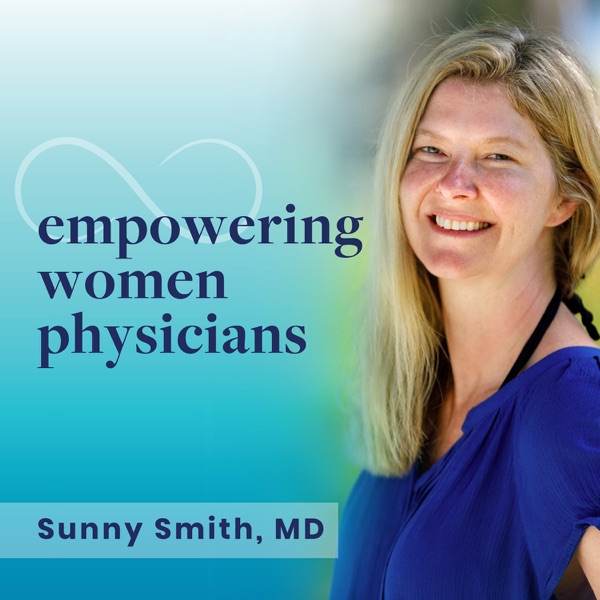
Podcast
Empowering Women Physicians
Medicine is truly the most noble profession. It is an honor and a privilege to be responsible for the health and well being of our society. As physicians, we aim to relieve human suffering. Then why are so many of us unhappy, stressed, and even considering leaving medicine?
Characteristics of self sacrifice and delayed gratification allowed women physicians to get through medical school and residency. Yet these very same traits can cause increasing distress and may no longer be serving us. This podcast encourages women physicians to reflect on the wise words of the Hippocratic Oath and consider what more they could be doing to maintain the utmost respect for their OWN human life and its quality.
Women physicians are strong, intelligent, resilient, hard working, insightful, and live their lives in service of others. Through this podcast, Dr Sunny Smith reminds them that they must first care for themselves so that they may care for others. As a practicing physician and certified coach, she offers tools that can be used to help them take a closer look at their life right now, what they love and what they'd like to change. She helps physicians set goals and empowers them to take steps toward creating their best lives starting today.
- On air since
- 2018
- Episodes
- 40
- Releases · typical length
- Monthly · 51 min
- Latest episode
- 5 days ago
Chart history since Oct 26
| Now | Chart | Peak | Since Oct 26 |
|---|---|---|---|
| 124 Back | Medicine Arrived Nov 7 | #85 |
Episodes
40 episodes, newest first
-
52 min
Episode # 40 - Attrition of Women Physicians
Season 1, Episode 40
Show notes
Recent research reveals a shocking difference in physician attrition: the median age for women physicians leaving clinical medicine is 49 years old. Forty-nine. After at least 12 years of training half of women physicians stop practicing medicine by the time they are 49 years old. Perhaps even more shocking is that this is in stark contrast to the median age men retire from clinical medicine which was 64 years old. That's a 15 year difference. Being a physician is hard. Being a woman physician is harder. In this episode we discuss this study and many more regarding the attrition of women physicians in medicine. We discuss the sustainability of medical careers for women, the financial and personal implications of leaving clinical practice earlier, and the need for systemic change. In this episode, we also discuss if awareness of all-or-nothing thinking may be able to create some alternative options for women physicians. When we believe our only choices are to continue practicing medicine exactly as we are or leave altogether, we may be overlooking other possibilities. By questioning our assumptions and exploring a third option, or allowing ourselves to search for multiple pathways forward, we may be able to approach our careers and our lives with greater psychological flexibility and intentionality.
You can sign up for the EWP newsletter here: http://empoweringwomenphysicians.com/newsletter
1. Nationwide physician attrition (2026)
Rotenstein LS, He Z, Dziura J, Tsugawa Y, Venkatesh AK, Melnick ER, Gettel CJ. Sex Differences in Physician Attrition from Clinical Practice Across Specialties: A Nationwide, Longitudinal Analysis. Journal of General Internal Medicine. Published online April 2, 2026.
https://doi.org/10.1007/s11606-026-10362-1
2. Emergency medicine physician attrition (2023)
Gettel CJ, Courtney DM, Agrawal P, Madsen TE, Rothenberg C, Mills AM, et al. Emergency medicine physician workforce attrition differences by age and gender. Academic Emergency Medicine. 2023;30(11):1092–1100.
https://doi.org/10.1111/acem.14764
3. Physician workforce transitions and temporary exits (2026)
Fraher E. Physician transitions out of clinical practice: age, sex, generational, and specialty effects. Health Affairs Scholar. 2026;4(10).
https://doi.org/10.1093/haschl/qxag257
4. Attrition from academic medicine (2023)
Chen YW, Orlas C, Kim T, Chang DC, Kelleher CM. Workforce Attrition Among Male and Female Physicians Working in US Academic Hospitals, 2014–2019. JAMA Network Open. 2023;6(7).
https://doi.org/10.1001/jamanetworkopen.2023.23872
5. Physician retirement planning — systematic review (2016)
Silver MP, Hamilton AD, Biswas A, Warrick NI. A systematic review of physician retirement planning. Human Resources for Health. 2016;14:67.
https://doi.org/10.1186/s12960-016-0166-z
6. The $2 million lifetime physician earnings gap (2021)
Whaley CM, Koo T, Arora VM, Ganguli I, Gross N, Jena AB. Female Physicians Earn An Estimated $2 Million Less Than Male Physicians Over A Simulated 40-Year Career. Health Affairs. 2021;40(12):1856–1864.
https://doi.org/10.1377/hlthaff.2021.00461
7. Marriage, children, and the physician earnings gap (2023)
Skinner L, Yates M, Auerbach DI, Buerhaus PI, Staiger DO. Marriage, Children, and Sex-Based Differences in Physician Hours and Income. JAMA Health Forum. 2023;4(3).
https://doi.org/10.1001/jamahealthforum.2023.0136
8. Characteristics of physician marriages (2018)
Ly DP, Seabury SA, Jena AB. Characteristics of U.S. Physician Marriages, 2000–2015: An Analysis of Data From a U.S. Census Survey. Annals of Internal Medicine. 2018;168(5):375–376.
https://doi.org/10.7326/M17-1758
9. Parenting and domestic responsibilities among physician-researchers (2014)
Jolly S, Griffith KA, DeCastro R, Stewart A, Ubel P, Jagsi R. Gender differences in time spent on parenting and domestic responsibilities by high-achieving young physician-researchers. Annals of Internal Medicine. 2014;160(5):344–353.
https://doi.org/10.7326/M13-0974
10. Early-career physicians' work and parental status (2019)
Frank E, Zhao Z, Sen S, Guille C. Gender Disparities in Work and Parental Status Among Early Career Physicians. JAMA Network Open. 2019;2(8).
https://doi.org/10.1001/jamanetworkopen.2019.8340
11. Medicare participation among physicians (KFF)
KFF. How Many Physicians Have Opted Out of the Medicare Program? Policy analysis discussing physician participation in Medicare, including the estimate that 98% of nonpediatric physicians participate.
https://www.kff.org/medicare/how-many-physicians-have-opted-out-of-the-medicare-program/
-
43 min
Episode #39 - Adult Development & Self-authoring mind
Show notes
Psychologist Robert Keagan taught about how adults make meaning can change over time. He states that most adults are living with a Socialized Mind which means that how we conduct ourselves is shaped by the expectations, values, and validation of those around us. We observe others and learn to behave in ways that conform to what is socialized as the norm. The Self-Authoring Mind is being willing to conduct one's self based on one's own values, even if others may disapprove. The Self-Transforming Mind is when one can also recognize the possible limitations of holding only their own views and values and is able to hold space for the views and values of others, even holding contradictory perspectives. In this episode we discuss how we have all been socialized in medicine to certain kinds of behaviors and how we may consider moving into a Self-Authoring or Self-Transforming Mind to be able to live in alignment with what is most important to us, even if it may not align with others.
-
36 min
Episode #38 - The Work with Byron Katie
Show notes
Byron Katie is one of the matriarchs of modern thought work. Her process, known as The Work, is a powerful tool for examining how our thoughts, our perspectives, and our interpretation of the world around us may be serving us or may be causing undue suffering. It offers the opportunity for cognitive reappraisal where we question the thought, notice it's impact on us, and notice what changes when we offer ourselves a more helpful perspective.
You can sign up for the EWP newsletter here: http://empoweringwomenphysicians.com/newsletter
The Work of Byron Katie worksheets are found here: https://thework.com/instruction-the-work-byron-katie/
-
1 hr 3 min
Episode # 37 - Perfectionism
Show notes
In this episode we discuss how medicine selects for people who have a strong tendency for perfectionism. We reflect on the socialization and enculturation we have experienced that creates that and amplifies that. We then talk about how being willing to take messy imperfect action or allowing ourselves to do "B minus" work can help move us forward.
References from this episode
Thomas Curran TED talk: https://www.ted.com/talks/thomas_curran_our_dangerous_obsession_with_perfectionism_is_getting_worse Amna Shabbir TEDx talk: https://www.youtube.com/watch?v=oNIzzM4Vg3s
-
34 min
Episode # 36 - Fierce Self Compassion with Dr. Kristen Neff
Show notes
This episode included clips from a workshop inside the Empowering Women Physicians coaching program with Dr. Kristen Neff on self-compassion. We discuss the difference between tender self-compassion and fierce self-compassion. Dr. Neff speaks up about the need for women to advocate for themselves and how that is indeed an act of self-compassion.
We discussed that self-compassion can be measured using the Clinical Self-Valuation Scale and that it can be significantly improved in just a short period of time, as documented by a change from 18% to 64% of women physicians inside EWP meeting criteria for a self-compassionate perspective in just 8 weeks.
Links for resources mentioned in this episode.
EWP coaching guide https://empoweringwomenphysicians.com/guide EWP Newsletter: https://empoweringwomenphysicians.com/newsletter
EWP Published data: https://pubmed.ncbi.nlm.nih.gov/38840137/
Stanford Clinician Self Valuation Scale https://med.stanford.edu/wellmd/selfassessment.html Self-valuation. Attending to the most important instrument in the practice of medicine. https://pubmed.ncbi.nlm.nih.gov/31543254/
Study on self-valuation being the largest mediator in the difference in burnout between male and female physicians: https://jamanetwork.com/journals/jamanetworkopen/fullarticle/2846632
On these lists
Empowering Women Physicians is one of the shows picked out on this list