Podcast
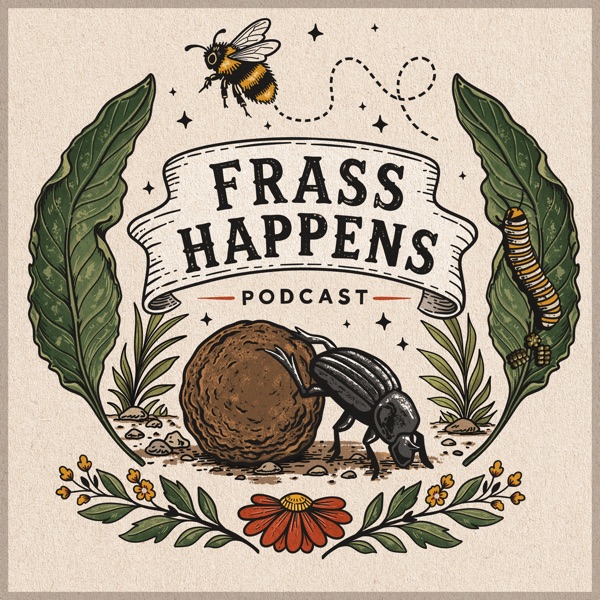
Frass Happens
Join Casey and Katie, a couple of entomologists, educators, and best friends, as they explore the planet’s largest group of animals – invertebrates! In each biweekly episode of Frass Happens, the two share wild facts and stories about the “little things that run the world” and hope to turn their listeners into lovers of ALL animals (not just the furry ones).🐝
-----
Instagram: @frasshappenspodcast
Website: https://frasshappenspodcast.com
-----
🐛Logo artwork by Alyssa Carvara
🪲Intro music by Maxwell Burns
- Nature chart
- #87
- Episodes
- 11
- Releases
- Every two weeks
- Typical length
- 1 hr
- On air since
- 2026
- Latest episode
- 1 week ago
Episodes
11 episodes, newest first
-
56 min
Why are we afraid of spiders?
Episode 11
Show notes
Arachnophobia is a common human fear, but where does it come from? Are we born with it? And if so, why? In this episode, Katie not only untangles a web of myths about spiders, but she also spins a tale about the nature of fear itself! Whether you are on Team Spider or Team Scream, we hope that you’ll join us for Episode 9 as we delve into the intriguing (and controversial!) world of spiders, confronting our own feelings about our eight-legged neighbors along the way.
----
Science Vs (Dr. Jessica Ware clip): https://youtu.be/SrL5FQ-0s3w?si=pbwYnZAqtT_FthTz
Green Street Photo Collective (Arachnophilia Exhibit): https://www.greenstreetphoto.com/events
----
Citations Referenced:
Cardoso, P., Pekár, S., Birkhofer, K., et. al. (2025), Ecosystem services provided by spiders. Biol Rev, 100: 2217-2236. https://doi.org/10.1111/brv.70044
Michael C. Beuhler, Ryan Feldman, David D. Gummin, et. al. (2025) 2024 Annual Report of the National Poison Data System® (NPDS) from America’s Poison Centers®: 42nd Annual Report, Clinical Toxicology, 63:12, 1029-1280. https://doi.org/10.1080/15563650.2025.2571299
Garcia R. (2017) Neurobiology of fear and specific phobias. Learn Mem. 24(9):462-471. https://doi.org/10.1101/lm.044115.116
Grogans S.E., Bliss-Moreau E., Buss K.A., et. al. (2023) The nature and neurobiology of fear and anxiety: State of the science and opportunities for accelerating discovery. Neurosci Biobehav Rev. 151:105237. https://doi.org/10.1016/j.neubiorev.2023.105237
Frynta, D., Janovcová, M., Štolhoferová, I. et al. (2021) Emotions triggered by live arthropods shed light on spider phobia. Sci Rep. 11, 22268. https://doi.org/10.1038/s41598-021-01325-z
Grill M. and Haberkamp A. (2023) Out of control: The role of spider movement and intolerance of uncertainty in spider fear. J Exp Psychopathol. 14(1). https://doi.org/10.1177/20438087231151502
----
Instagram: @FrassHappensPodcast
Website: https://frasshappenspodcast.com/
----
Logo artwork by Alyssa Carvara
Music by Maxwell Burns
-
1 hr 1 min
Episode 8: Nostalgic childhood pets
Episode 10
Show notes
Insects and other invertebrates have stoked our curiosity since we were children. For many of us, these creepy crawlies were beloved childhood pets who taught us how to become responsible caretakers and opened up our realm to the wonders and joys associated with the miniature worlds around us. In today’s episode, Casey explains the natural history of two favorite invertebrates that many of us kept as kids in the 90’s and early 2000’s: Mexican jumping beans and sea monkeys! So put down the Tomagotchi, hop on your Razor scooter, and let’s explore the secret lives of these nostalgic creatures.
----
Instagram: @FrassHappensPodcast
Website: https://frasshappenspodcast.com/
----
Logo artwork by Alyssa Carvara
Music by Maxwell Burns
-
1 hr
Episode 7: The tortoise and the moth
Episode 9
Show notes
Grab your bucket hats, you beautiful creatures! We're going to Florida. In this episode, Katie introduces us to a highly specialized insect with a fascinating life history. Along the way, we zigzag our way through a variety of related topics, from the ingredients in your shampoo to island biogeography! Join us for Episode 7 as we learn all about a hungry, hungry caterpillar with a craving for carapace.
----
Citations Referenced:
Zeveloff, S. and Mull, J., 2024. Keratinophagy and the horn moth's curious protuberances. Frontiers in Ecology & the Environment, 22(1), p.1. https://doi.org/10.1002/fee.2709
Deyrup, M., N. D. Deyrup, M. Eisner, & T. Eisner. 2005. A Caterpillar that Eats Tortoise Shells. American Entomologist, 51(4): 245–248. https://doi.org/10.1093/ae/51.4.245
----
Instagram: @FrassHappensPodcast
Website: https://frasshappenspodcast.com/
----
Logo artwork by Alyssa Carvara
Music by Maxwell Burns
-
1 hr 16 min
Episode 6: The 1999 Long Island Sound lobster die-off
Episode 8
Show notes
We just can’t get enough of the ocean! In today’s episode, Casey brings us back in time to 1999 to discuss the Long Island Sound lobster die-off. This event just so happened to follow heavy, recurrent pesticide use in New York City in response to the first US-based West Nile Virus outbreak. So, were pesticides to blame for this massive die-off in our beloved crustaceans?! To find out, join us for Episode 6 as we delve into this buttery tale!
----
Citations Referenced:
Pearce, J. and Balcom, N. The 1999 Long Island Sound lobster mortality event: Findings of the comprehensive research initiative. Journal of Shellfish Research 24 (3), 691-697 (2005). https://doi.org/10.2983/0730-8000(2005)24[691:TLISLM]2.0.CO;2
Seara, T. et al. Lessons learned from a natural resource disaster: The long-term impacts of the Long Island Sound lobster die-off on individuals and communities. Marine policy 136, 104943 (2022). https://doi.org/10.1016/j.marpol.2021.104943
----
Instagram: @FrassHappensPodcast
Website: https://frasshappenspodcast.com/
----
Logo artwork by Alyssa Carvara
Music by Maxwell Burns
-
48 min
Episode 5: A deep dive into marine pollination
Episode 7
Show notes
Join us on a journey under the sea! Did you know that there are tiny critters pollinating seagrasses in the ocean? Well, neither did anyone else until 2016! In this episode, Katie submerges us into the fascinating universe of marine pollination and discusses the implications of this recent discovery. So, grab your scuba gear and dive into Episode 5!
----
Black Forager reel on pollen allergies: https://www.instagram.com/p/DXcfnNDycTI/
YouTube video of marine pollination: https://www.youtube.com/watch?v=B7VLBhQ-rQo
----
Citations (in order of reference):
B. van Tussenbroek, N. Villamil, J. Márquez-Guzmán, et al., Experimental evidence of pollination in marine flowers by invertebrate fauna. Nature Communications 7, 12980 (2016). https://doi.org/10.1038/ncomms12980Evan K. G. McKenzie et al. ,Crush-resistant air sacs allow insect larvae to exploit aquatic habitats at extreme depth. Science 393, 398-402 (2026). https://doi.org/10.1126/science.aed0667
E. Lavaut et al., Pollinators of the sea: A discovery of animal-mediated fertilization in seaweed. Science 377, 528-530 (2022). https://doi.org/10.1126/science.abo6661
EDIT: Researchers at the Ecology and Biodiversity of Marine Invertebrates Lab of UNAM requested that we mention that their research on seagrass pollination was conducted in close collaboration with the Laboratory of Plant Development at the Faculty of Sciences of UNAM with Dr. Judith Marquez Guzman as the lead.
----
Instagram: @FrassHappensPodcast
Website: https://frasshappenspodcast.com/
----
Logo artwork by Alyssa Carvara
Music by Maxwell Burns -
1 hr 29 min
Episode 4: Save the (native) bees!
Episode 6
Show notes
Did you know that there are approximately 20,000 species of bees?! In this episode, Casey & Katie take us into the wonderful, diverse world of native bees, and help to dispel some myths surrounding bees at the same time! They discuss native bee diversity, the pros and cons of bee hotels, why you shouldn't get a honey bee hive to "save the bees," and how you can support your local pollinators in your own backyard!
----
Xerces Society Native Plant Lists: https://xerces.org/pollinator-conservation/pollinator-friendly-plant-lists
----
If you're enjoying Frass Happens, please don't forget to like, comment, review, and subscribe wherever you listen to podcasts! To purchase Frass Happens stickers or learn more about how to support our podcast, visit https://frasshappenspodcast.com/support-the-podcast/ <3
----
Instagram: @FrassHappensPodcast
Website: https://frasshappenspodcast.com/
----
Logo artwork by Alyssa Carvara
Music by Maxwell Burns
-
1 hr 6 min
Episode 3: A “harmful” change to the Endangered Species Act (Part 2)
Episode 5
Show notes
Welcome to Part Two of our episode on the Endangered Species Act! In Part Two, Casey and Katie share the stories of three endangered insects: The American Burying Beetle, the Karner Blue Butterfly, and the Rusty Patched Bumble Bee. At the end, we discuss what folks can do to protect endangered and otherwise threatened species. And, luckily, there’s a lot we can do! Including a little bit of mischief-making…
----
American Burying Beetle: https://www.fws.gov/species/american-burying-beetle-nicrophorus-americanus
Karner Blue Butterfly: https://www.fws.gov/species/karner-blue-butterfly-lycaeides-melissa-samuelis
Rusty Patched Bumble Bee: https://www.fws.gov/species/rusty-patched-bumble-bee-bombus-affinis
----
Instagram: @FrassHappensPodcast
Website: https://frasshappenspodcast.com/
----
Logo artwork by Alyssa Carvara
Music by Maxwell Burns
-
31 min
Episode 3: A “harmful” change to the Endangered Species Act (Part 1)
Episode 4
Show notes
Well… it turns out we had a lot to say in this episode! Welcome to the podcast’s first two-parter! In Part 1, Katie and Casey provide a brief(ish) history of the Endangered Species Act and discuss the recent, disturbing changes to this US law (July 2026). Knowledge is one of the best weapons we have to fight injustice, so let’s get informed so we can protect our non-human neighbors!
----
Endangered Species Act Milestones: https://www.fws.gov/esa50/our-history
----
If you're enjoying Frass Happens, please don't forget to like, comment, review, and subscribe wherever you listen to podcasts! And, if you find yourself in a position to financially support our work, you can buy us a “coffee” at http://buymeacoffee.com/frasshappenspodcast <3
----
Instagram: @FrassHappensPodcast
Website: https://frasshappenspodcast.com/
----
Logo artwork by Alyssa Carvara
Music by Maxwell Burns
-
1 hr 21 min
Episode 2: What the heck is a bug?
Episode 3
Show notes
What makes an invertebrate an invertebrate? What makes an insect an insect? And what the HECK is a bug?! In this episode of Frass Happens, Katie and Casey provide an “Intro to Entomology” crash course, in which they discuss invertebrate taxonomy and insect anatomy! This episode not only serves as a great jumping off point for new insect enthusiasts, but also provides a good refresher for those who are already familiar with insect anatomy. Hop (or fly, scuttle, or wriggle) into the episode to learn more about your spineless neighbors!
-----
Instagram: @FrassHappensPodcast
Website: https://frasshappenspodcast.com/
-----
Logo artwork by Alyssa Carvara
Music by Maxwell Burns
-
1 hr
Episode 1: Meet the Hosts of Frass Happens!
Episode 2
Show notes
Meet Casey and Katie, the hosts of Frass Happens! We are so excited to introduce you to the secret, wonderful world of insects and other invertebrates. Before we begin this journey with you beautiful creatures, we think that it’s important (especially in a world filled with misinformation and greenwashing) that you know who we are and why you can trust us to give you good information on these deeply misunderstood animals. Please join us for this fun interview episode to get to know your hosts! You’ll hear some hair-raising tales, surprising confessions, friendship lore, and downright ridiculous anecdotes from the field.
-----
Instagram: @FrassHappensPodcast
Website: https://frasshappenspodcast.com/
-----
Logo artwork by Alyssa Carvara
Music by Maxwell Burns
-
2 min
Introducing Frass Happens Trailer
Season 1
Show notes
Join Casey and Katie, entomologists, educators, and best friends, as they explore the planet’s largest group of animals – invertebrates! Bonded by a love of insects and queer dance parties, your hosts have made it their life’s work to advocate for and conserve the strange and wonderful creatures that so often go unnoticed. In each biweekly episode, the two share wild facts and stories about the “little things that run the world” and hope to turn their listeners into lovers of ALL animals - not just the furry ones. Tune in bi-weekly to Frass Happens for a deep dive into the exciting, fascinating world of insects and other invertebrates!
(No backbone required!)
-----
Instagram: @frasshappenspodcast
Website: https://frasshappenspodcast.com
On these lists
Frass Happens is one of the shows picked out on this list
More in Nature
Placed highest on Apple Podcasts' Nature chart right now