Podcast
Insight Myanmar
Insight Myanmar is a beacon for those seeking to understand the intricate dynamics of Myanmar. With a commitment to uncovering truth and fostering understanding, the podcast brings together activists, artists, leaders, monastics, and authors to share their first-hand experiences and insights. Each episode delves deep into the struggles, hopes, and resilience of the Burmese people, offering listeners a comprehensive, on-the-ground perspective of the nation's quest for democracy and freedom.
And yet, Insight Myanmar is not just a platform for political discourse; it's a sanctuary for spiritual exploration. Our discussions intertwine the struggles for democracy with the deep-rooted meditation traditions of Myanmar, offering a holistic understanding of the nation. We delve into the rich spiritual heritage of the country, tracing the origins of global meditation and mindfulness movements to their roots in Burmese culture.
Each episode is a journey through the vibrant landscape of Myanmar's quest for freedom, resilience, and spiritual riches. Join us on this enlightening journey as we amplify the voices that matter most in Myanmar's transformative era.
- Episodes
- 650
- Releases
- Daily
- Typical length
- 1 hr 44 min
- On air since
- 2020
- Latest episode
- 1 day ago
Episodes
650 episodes, newest first
-
1 hr 35 min
In Other News
Episode 635
Show notes
Episode #635: “The thing that works the best is always to humanize the numbers,” says Australian journalist Libby Hogan. That principle has emerged from more than a decade of trying to report Myanmar without reducing the country either to a democratic success story or to whichever crisis temporarily commands international attention. Hogan first encountered Myanmar as a backpacker before the NLD’s 2015 electoral victory, then returned through an internship with the Democratic Voice of Burma that became years of reporting during the country’s fragile political opening.
The limits of that opening became impossible to ignore during the violence against the Rohingya. Restricted access to Rakhine State complicated reporting while Facebook filled with hate speech and misinformation. From Yangon, Hogan watched international images of mass displacement alongside a far more muted response around her, forcing difficult questions about prejudice, fear, restrictions and the responsibilities of local journalism. International coverage created another problem: editors initially wanted almost nothing except Rohingya stories, then gradually lost interest even as the crisis continued.
Now working for the Australian Broadcasting Corporation, Hogan has to persuade an audience thousands of kilometers away to keep caring about Myanmar. That can mean telling the story of menstrual pads stopped at a military checkpoint because they might be used as bandages, or documenting scam compounds along the Thai-Myanmar border where trafficking victims are forced to defraud strangers online.
Inside one raided compound, Shunda Park, investigators found thousands of SIM cards, photographs used for face-swapping, scripts for cultivating romance-scam victims, rows of computers and isolation cells for workers who failed to meet quotas. Yet even these large compounds are changing. Operations are appearing deeper inside Myanmar and becoming smaller, more mobile and harder to observe. Hogan is still pursuing the problem that first drew her to the country: finding ways to make hidden realities visible when both access and international attention keep narrowing.
-
2 hr 12 min
Beyond the Now
Episode 634
Show notes
Episode #634: Christopher Titmuss has spent more than fifty years teaching Buddhist insight meditation, yet he warns that the very practices intended to bring liberation can become sources of attachment. Having trained as a monk in Thailand and India before helping establish Western insight meditation institutions, he has witnessed how spiritual traditions can gradually elevate particular teachers, methods, and organizational forms into unquestioned authorities. “If you totally identify with one teacher, one form, one method, one technique, one language, or whatever, this might be imprisoning and not liberating,” he cautions.
His understanding developed through intensive monastic practice under Ajahn Dhammadharo, the teachings of Ajahn Buddhadāsa, and encounters with spiritual traditions throughout India. His experience with S. N. Goenka reinforced both his appreciation for disciplined meditation and his concern about claims of exclusive authority over Vipassanā. For Titmuss, no single form can contain the full possibilities of the Dhamma.
That conviction carries ethical consequences. Myanmar’s continuing suffering under military violence highlights the responsibility of Buddhist practitioners to confront harm rather than retreat into private spiritual cultivation. Titmuss argues for unwavering commitment to nonviolence without identifying with political factions, while distinguishing moral clarity from anger and self-righteousness. He also questions whether secular mindfulness, despite its demonstrated benefits, has neglected the explicit ethical commitments found in Buddhist teachings.
His critique extends to meditation itself. Present-moment awareness is useful, but fixation on the here and now can obscure the causes of suffering and the consequences of present actions. Retreats likewise offer valuable training without encompassing the speech, livelihood, relationships, and responsibilities that occupy daily life. Drawing on his experiences with death contemplation and the Buddhist understanding of non-self, Titmuss continues to examine how a path intended to dissolve attachment can remain free of attachment to its own methods.
-
2 hr 10 min
Stringer, Soldier, Spymaker
Episode 633
Show notes
Episode #633: “We’re in the dreams-come-true business.” Barry Broman uses that line to explain the human side of espionage, but it also captures the path that took him from teenage photojournalism in Thailand to combat service in Vietnam, twenty-five years in the CIA’s clandestine service, and eventually the station chief’s office in Rangoon. His career was built around access: finding people, earning trust, entering closed places, and learning what could not be understood from a distance.
Broman first reached Thailand in 1962, when he left college for a year and became an Associated Press stringer in Bangkok. He later studied Southeast Asia and Thai, served as a Marine infantry officer in Vietnam, and entered the CIA only fifteen days after leaving the Corps. In the Agency, he made his reputation as a recruiter of human sources, a method that later shaped his work on Burma and the Golden Triangle.
As chief of station in Rangoon from 1994 to 1996, Broman worked in a country where U.S. relations with the military government were poor but narcotics cooperation remained possible. He helped pursue intelligence against Khun Sa’s heroin network, defended working relationships with Burmese military officials, and drew a sharp distinction between corruption and state-directed trafficking. He rejects claims that the CIA itself participated in the regional drug trade, while acknowledging that later developments in the borderlands extend beyond the period he knew firsthand.
After retiring, Broman kept returning to Burma with cameras rather than classified reporting, producing books and documentaries on the country’s rivers, architecture, ethnic communities, narcotics economy, and politics. One film took him to Aung San Suu Kyi under surveillance; another brought him into Wa territory. Now the war has shut down many routes he once traveled along the Irrawaddy, Chindwin, and Andaman coast. For a career built on going closer, Burma has again become a place where access itself is uncertain.
-
1 hr 59 min
Burning through Norwegian Wood
Episode 632
Show notes
Episode #632: “I was not political at all until 1988,” says Dr. Maung Maung Myint, the National Unity Government’s (NUG) representative to Norway. He describes how dictatorship, exile, and decades of activism have shaped his conviction that Myanmar’s military regime will eventually fall.
Born in 1958, he grew up under military rule. After General Ne Win’s 1962 coup, his family’s home and business were seized. He became a dentist in 1983, but the 1988 uprising changed everything. Angered by poverty, propaganda, and the killing of two students, he led a student union, organized protests, and published an underground newsletter. After the crackdown, he was sentenced in absentia to four years in prison; in 1989, he fled to Norway.
In exile, he joined the Norwegian Burma Committee (NBC), helped establish the Democratic Voice of Burma (DVB), and later worked for Radio Free Asia (RFA). He credits Norway’s early support, including its hosting of the National Coalition Government of the Union of Burma (NCGUB) and funding of DVB, as “the biggest thing that happened for us.” He appreciates Norway’s post-coup policies, in particular its shift to bypassing the junta and funding local civil society directly for humanitarian needs.
Maung Maung Myint feels that today’s opposition to the military is more hopeful and far more committed than during the transition period, when the military was able to entrench its influence in government. Unlike in the past, it no longer revolves around a single figure such as Aung San Suu Kyi. Instead, a younger generation is taking a leading role, with broader participation from ethnic minorities in a genuinely inclusive way. This, he says, gives him hope.
Despite decades in exile, his resolve remains firm: “We just have to keep going. Because this is the only way. We cannot give up.”
-
1 hr 56 min
Defined Elsewhere
Episode 631
Show notes
Episode #631: “Community for me is an other-making category.” Judith Beyer, a legal and political anthropologist and the author of Rethinking Community in Myanmar, uses an ordinary word to expose a long political inheritance. Her fieldwork in Yangon began with Muslim and Hindu individuals who presented themselves to an outsider first and foremost as members of ethno-religious communities. But the closer she looked, and the more acquainted she became with these individuals, the less stable this self-categorization became.
In her book, Beyer traces the category back through British colonial rule, when law, land grants, religious property, and trusteeship helped organize migrants into corporate ethno-religious groups. Those arrangements survived independence and still shape property, personal-status law, and the way minorities are recognized by the state and present themselves to others. Yet the same temples and mosques that embody these classifications also contain relations that exceed them. For example, at the Mahapeinne Temple in Yangon, Buddhists, Hindus, Muslims, trustees, priests, workers, and worshippers can occupy the same space without becoming one coherent community. In the life of Mukhtaar Bhai,a Muslim of Shia identity, class, skin color, intermarriage, and his Sunni business relationships repeatedly cross the lines that supposedly define him.
The danger of fixed belonging becomes clearest in Beyer’s discussion of the Rohingya, whom she places at the far end of Myanmar’s long practice of making an excluded other. After the attempted military coup of 2021, the same problem follows people into exile. Beyer now prepares country-of-origin reports for British asylum cases, where courts may question whether someone is genuinely Rohingya or stateless. Rather than treating identity as an essence to be verified, she examines how states categorize people and what those classifications do to their lives.
She has not returned to Myanmar since the attempted coup because visiting her interlocutors could endanger them. The book grew from relationships she once expected to continue in person; now many of those relationships came to an end due to death or are separated by exile. While the categories she set out to question keep determining who can belong, who can be protected, and who can return.
-
2 hr 3 min
No Fixing Saṃsāra
Episode 630
Show notes
Episode #630: “There's no fixing saṃsāra.” Khemarato Bhikkhu heard that line from a bhikkhuni in Berkeley after the 2016 U.S. election, at the moment when his faith in progress was already failing. An American monk now seven years ordained in Thailand’s Thai forest tradition, he had come to Buddhism through university stress, a Zen meditation group, friendships with Thai students, and a 2012 journey through Thailand. The Dhamma first made sense to him as something honest about craving, not-self, and the limits of worldly identity.
Before ordination, he had also entered one of the most future-facing worlds available: Silicon Valley. He joined Facebook early, then moved into education technology because he wanted his work to help society. But education’s deepest problems began to look political rather than technical, and Trump’s rise broke something in the narrative that history naturally moves forward. A month-long retreat in 2018 clarified what the Berkeley discourse had exposed: he had been trying to repair saṃsāra itself.
Ordination did not erase grief. It required leaving a romantic relationship, disappointing parents proud of his career, and accepting that the ordinary future of marriage, children, status, and income was no longer his path. In Thailand, however, renunciation became concrete rather than abstract: an alms bowl, food freely offered by lay supporters, a forest monastery where community provides enough support for solitude, and a practice life organized around Buddho, vipassana, the Pāṭimokkha, and the rains retreat.
The hardest teachings remain bodily. Autopsy practice at a Bangkok hospital turns death from doctrine into direct perception; each corpse trains the mind to see that every living person is already dying. Khemarato Bhikkhu does not present the monastery as a way to fix the world. It is the place where he tests whether the Buddha was right that saṃsāra is not the only possibility, and whether a human life can be organized around that fact before the body ends.
-
1 hr 26 min
Moving Parts
Episode 629
Show notes
Episode #629: “They don’t sleep with their leg on.” Jason Bender, a certified prosthetist who lived and worked in Myanmar from 2014 to 2021 before supporting cross-border work from Thailand, uses that basic reality to explain why providing a prosthetic limb cannot be reduced to handing someone a device. A leg may restore mobility after a landmine injury, but the socket changes as the body changes, feet wear out, sores develop, and users must learn to walk again across environments that were difficult to navigate even before amputation.
In Myanmar, that process can require months of healing followed by a journey to one of relatively few clinics, where a patient may remain for days or weeks while a socket is made and walking begins. Rural hills, dirt paths, stilt houses, and inaccessible urban sidewalks often make wheelchairs impractical, while years on crutches can damage the shoulders and leave both hands occupied. Near conflict-affected border regions, Bender recalls landmines and other war injuries accounting for most of the amputations he encountered.
The work demanded adaptation. Forestry workers asked Bender’s team to remove the toes from prosthetic feet because the shortened shape made steep mountain climbing easier. When imported aluminum pylons became unavailable at one remote clinic, local practitioners found a strong, lightweight tree and carved wooden replacements. New technologies may offer further options: digitally scanned and 3D-printed sockets could allow more stages of care to happen closer to patients.
The 2021 coup intensified the contradiction. War-related trauma increased while clinics moved, supply routes deteriorated, and patients with conspicuous injuries risked questioning at military checkpoints. Bender sees local training, digital tools, and improvisation as ways to preserve access, but none eliminates the need for continuing care. A prosthesis may restore a person’s ability to move through the world; keeping that possibility alive depends on people and services remaining close enough to repair it when the body, the device, or the country changes.
-
1 hr 53 min
Fight and Flight
Episode 628
Show notes
Episode #628: “We started with emotions, not with the basic fundamental facts.” Nay Chi Min Htun was a university student and hotel receptionist in Yangon before the 2021 coup. Within months, she had left the home of her police-officer father, joined an underground resistance network, and begun transporting explosives. She later moved into Karen State, where she produced ammunition, trained as a drone operator, and participated in frontline operations against military positions.
The physical details stayed with her. Ammunition production repeatedly burned her fingertips, marks she wore with pride because other resistance workers had lost limbs or died in accidents. Her first bomb-carrying fixed-wing drone nose-dived back toward her own team and landed within feet of them without exploding. During another battle, her team lost contact with a loaded drone flying across villages and resistance positions until a commander improvised a repair using a motorcycle battery.
Over time, technical competence brought greater responsibility. Nay Chi trained new recruits and became head of a resistance column’s news and information department, where she raised funds and had to take on her most challenging duty yet, which was to publicly announce comrades’ deaths and oversee their funerals. By April 2026, after family trauma, the end of a long relationship, declining physical health, and growing doubts about whether she possessed the knowledge required to lead others, she left.
Her moral certainty has also become more complicated. Meeting a detained suspected soldier, his wife, and their infant forced her to confront the humanity she had tried not to see while fighting. She still believes the resistance is justified and may return to the armed resistance, but she no longer thinks courage alone is enough. The unresolved question is now what she must learn so that other people can safely depend on her decisions as a leader.
-
2 hr 25 min
A Mind of Its Own
Episode 627
Show notes
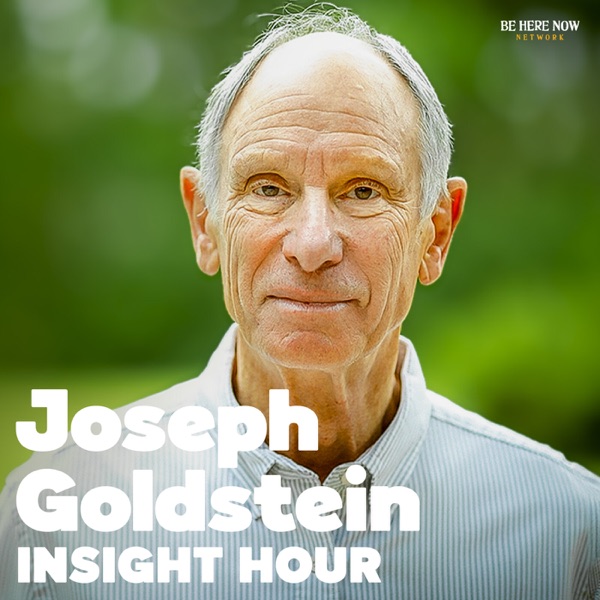
Episode #627: Joseph Goldstein’s introduction to meditation came almost accidentally. Sent to Thailand with the Peace Corps in the 1960s, he discovered Buddhist practice through monks at a Bangkok temple before traveling to Bodh Gayā, where he trained under Munindraji in the Burmese Mahāsī tradition. What followed was a lifetime spent exploring how teachings rooted in Asian Buddhist cultures could be carried into Western society without losing their essential purpose.
His years in India brought him into contact with S. N. Goenka, Dipa Ma, and other influential practitioners whose approaches differed considerably. After returning to America in 1974, Goldstein helped establish the Western Vipassanā movement alongside Jack Kornfield and Sharon Salzberg, eventually co-founding the Insight Meditation Society. Yet the growing movement also confronted differences over methodology, lineage, and whether practitioners should remain within one tradition or learn from several.
Goldstein's understanding of transmission evolved beyond questions of meditation technique. Initially confident that universal Buddhist teachings required little adaptation, he gradually recognized how social exclusion, racism, and trauma could prevent people from accessing or integrating those teachings. His involvement in expanding diversity at IMS challenged assumptions he had carried for decades. “The teachings are universal, but for people to hear them and learn from them, they have to come.”
His reflections also return to Myanmar, where he practiced intensively under Sayadaw U Paṇḍita and witnessed the extraordinary generosity of communities supporting monastic life, often despite having very little themselves. As warfare and military repression have devastated the country, Goldstein acknowledges the responsibility felt by those who have benefited from its Buddhist traditions to support the people who preserved and transmitted these teachings. Rather than prescribing a single form of engagement, he emphasizes that practitioners can respond in different ways according to their circumstances, while sharing a common sense of gratitude, compassion, and responsibility toward the country and its people.
-
1 hr 23 min
Holding Space
Episode 626
Show notes
Episode #626: This is the first episode of a seven-part series reflecting voices of people who attended the Fifth International Conference on Burma/Myanmar Studies in Chiang Mai, which explored how people are responding to the crisis while working toward a different future. Through shorter conversations with scholars, activists, educators, and community organizers, we connect regional politics with the everyday work of sustaining care, learning, livelihoods, and solidarity.
The first guest, Fuadi Pitsuwan, a Thammasat University lecturer and former foreign policy adviser to Thailand’s Move Forward Party, questions why Thailand invests so heavily in Myanmar’s military as a source of stability when its actions keep the country fragmented.
Thailand once supported ethnic armed groups as a buffer, then pursued trade and investment in the hope of political opening. Gas dependence, business interests and competition with China now constrain its choices, but Fuadi disputes whether those pressures justify the legitimacy granted to the junta.
Alongside official diplomacy, Thailand allows space for ethnic leaders and civil society. He wants civilian agencies to develop those relationships deliberately, supporting education, administration and health services that benefit both countries. Yet even proposals to let displaced Myanmar medical workers treat their compatriots have stalled despite broad agreement. His difficulty lies in converting acceptance into action: “I don’t know which lever to pull.”
“We have to do something more,” says our second guest, Agnes, a counseling who developed the suicide-prevention app Shin Tan after years of training and support failed to stop reports of deaths from reaching her. After Myanmar’s 2021 military coup, displacement, lost work, and interrupted education placed further strain on families already affected by COVID. Agnes also identifies beliefs that make suicide seem predetermined, complicating efforts to recognize distress and seek help.
A workshop in 2022 drew more than 200 participants, but many could not take the training back to their communities. Alongside supervised group and individual support, Shin Tan offers mental-health information, self-care tools, and questions directing users toward guidance. It works offline after downloading, addressing the unreliable connections that can keep help distant. However, the people she hopes to reach may have neither reliable internet nor someone they feel able to call.
-
1 hr 22 min
Cut To Action
Episode 625
Show notes
Episode #625: “When nobody helps you, what you have to do is go. You know what? I’m just gonna do it myself.” Adrian Zaw, a Burmese-American actor, producer, and founder of Zaw Studios, has turned that refusal to wait into both a business method and a response to cultural absence. His family left Myanmar after the 1988 uprising, when his father’s political involvement made remaining unsafe. His parents had worked as rural doctors, but in the United States their credentials disappeared; they took cafeteria and laboratory jobs while Zaw learned English by imitating television.
Acting gave him a route through adolescence, but Hollywood offered almost no Burmese-American models or roles. He learned producing, photography, editing, and studio management so that he could create work rather than depend on someone else to recognize him. In 2012, he opened a small production space whose rent forced him to work quickly. Speed became a philosophy: deliver what a client needs, revise it immediately, and refuse to hide delay behind artistic perfectionism.
Zaw now passes that discipline to young Burmese-American interns, matching practical training to whatever skills they bring. He tells them to replace “I can’t” with “How can I?” and identify the personal advantage that might open the next door. Yet his method also carries a distance: the access he can provide in Orange County does not automatically reach people inside Myanmar, and after the 2021 coup he has been unable to return.
His larger answer is cultural production. Through Myanmar American TV, he wants Burmese performers to tell sitcoms, dramas, and thrillers shaped by their own humor and family experience. Mainstream roles have often reduced Burmese characters to antagonists; his sketches use fortune telling, in-laws, and generational pressure to make Burmese-American life visible from within. The proof of concept exists, and the studio continues training people through it, but the platform still needs money, collaborators, and an audience willing to act with the urgency he demands. “Opportunity is knocking, and nobody’s answering the door because they’re not being responsive quick enough.”
-
1 hr 1 min
Turning the Page
Episode 624
Show notes
Episode #624: “Even before the coup, books gave me ideas, empathy, and hope,” says Zu May Lwin, a student activist and library organizer from Magway, She argues that education and access to books are essential not only for personal growth but also for rebuilding Myanmar after military repression.
Before the 2021 coup, she explains, reading culture in Magway was limited by cost, scarcity, and exhaustion. Books were hard to obtain, many families were focused on survival, and schools did little to cultivate a meaningful relationship with literature beyond textbooks. She joined a mobile library initiative that brought books directly to parks and university campuses. It was very successful, showing her that interest in reading could grow when books became part of public life.
The coup transformed that work into something more urgent. Believing students had a duty to defend freedom and the right to learn, she joined peaceful demonstrations in Magway as part of the Civil Disobedience Movement. At one protest, she was arrested, and spent over eight harsh months in prison. After her release, she could not safely return home and instead moved through displacement areas near the Thai border. There she saw young people continuing to study despite losing schools, textbooks, and stability, which deepened her conviction that education was a form of resistance.
In response, she helped found Saffron Traveler, a project that builds small, mobile libraries in rural and conflict-affected areas. Supported by donations and local cooperation, these libraries serve displaced students while remaining movable enough to survive military pressure. As she puts it, “My dream is to create a strong library culture in Myanmar, where every young person—no matter where they live or what their background—can have access to books and learning spaces and the opportunity to grow.”
-
1 hr 44 min
No Retreat Is an Island
Episode 623
Show notes
Episode #623: This is the third episode in a series of talks with Tempel Smith, who shares his deeper impressions of Burmese Buddhist culture, and how he became a bridge for other Americans to understand it better.
Tempel starts by continuing his reflection into the polarities that defined his early life experiences, mainly in terms of social engagement versus quiet meditation. As a young monk in Burma, he tried to consciously negotiate those apparent tensions, and questioned whether they could be integrated into a single practice. However, when he attained deeper states of calm, he realized that they were not, in fact, contradictions.
Another dissonance he reconciled for himself was cultural: being a Western practitioner in a Burmese Buddhist context. Westerners often want to do “a stripped-down Buddhist practice that doesn't have ritual and doesn't have community.” But in the end, he feels they lose out. While noting that the teachings of most Burmese monks encourage strict silence and an exclusive focus on meditation, Tempel found these guidelines produce very different results in Burmese yogis than those coming from abroad. As a teacher, he has seen Western students develop remarkable insights during courses, yet be unable to integrate them into daily life. The Burmese, however, see practice and their culture/society as intertwined.
Tempel had previously led meditation retreats for youth, but with these insights, he wanted to expand their Dharma experience into social engagement and community building. His idea developed into a three-month trip to Thailand, India, and Burma, where Tempel exposed the group to various aspects of Buddhist life. The result was transformative. Rather than Westerners opening their hearts through intensive retreats with less integration, the hearts of these youth opened instead through engagement with Burmese Buddhist society, which was deeply inspiring.
“You let your activism and your meditation harmonize, and you get a liberated mind!” he notes in closing. “That's what 30 years of practice has shown me and what I'm trying to help people get to their own integrative mind state. And then the suffering falls away of the mind and the beauty flourishes.”
-
1 hr 57 min
Reasonable Doubt
Episode 622
Show notes
Episode #622: “We need to recognize that we really don't know as much as we think we do about what's going on,” Jason Eligh says. As senior expert on drugs and drug markets at the Global Initiative Against Transnational Organized Crime, Eligh argues that Myanmar’s methamphetamine economy has been misunderstood not only because it is hidden, but because governments and analysts have mistaken partial evidence for knowledge.
Myanmar’s Shan State sits inside one of the world’s major drug-producing regions, supplying opium and heroin while also forming one of the three major global methamphetamine production zones, alongside Mexico and the Afghanistan-Pakistan-Iran nexus. But meth is harder to measure than opium. Poppy fields can be seen from above; synthetic drugs can be made indoors, through multiple chemical pathways, with legal dual-use substances that move through ordinary commercial channels. Even seizures, Eligh warns, cannot tell us the size of the market. They can reveal enforcement activity, but not total production.
That caution reshapes how he reads the post-coup period. The 2021 coup intensified conflict and changed routes, but Eligh rejects the easy claim that it alone caused a sudden meth surge. Prices, seizures, chemical data, and trafficking flows all point in several directions at once. Conflict can disrupt business, but corruption, armed taxation, and state-linked protection can also keep illicit trade stable.
Eligh’s analysis moves from drug production to drug policy. If the goal is “to save lives,” he argues, punishment alone drives users underground and weakens the ability to understand what harms are spreading. Opium farmers face a different trap: eradication without real alternatives can destroy the only income available in remote conflict zones.
The Mekong meth trade is no longer a contained Golden Triangle story. It is a global synthetic drug platform, tied to chemicals, logistics, corruption, poverty, and demand across continents. “It's a global problem,” Eligh says. “We can't kid ourselves any longer.”
-
1 hr 25 min
An Unexploded Past
Episode 621
Show notes
Episode #621: Please note that interview is intended solely as a record of Aki Ra’s personal experiences and historical demining work in Cambodia. His descriptions of past methods reflect what he personally did under very differentcircumstances and should not be understood as instructions, training, or advice for handling landmines, unexploded ordnance, or other explosives. Such devices are extremely dangerous and should only be approached, identified, or removed by properly trained and authorized professionals following current safety procedures.
Aki Ra was about ten years old when the Khmer Rouge forced him into military life, where he learned to plant landmines and survive in Cambodia’s war. After later fighting alongside Vietnamese forces, he eventually turned the same technical knowledge toward removing the explosives left behind. “I wanted to change from bad to be good,” he says. Since 1990, he has spent decades clearing mines and unexploded ordnance from Cambodian farmland and villages.
That experience gives his story particular relevance to Myanmar, where landmines are again shaping civilian life and will remain dangerous long after front lines move. The comparison becomes concrete around the small M14 anti-personnel mine, a weapon Aki Ra knows from his own clearance work. Touching upon the difficulty of detecting them in Myanmar, he emphasizes a distinction central to the work he does today: civilians should not search for, touch, or attempt to remove mines themselves. His education sessions instead teach people to recognize danger, mark or remember the location, and contact trained disposal teams.
Aki Ra also contrasts the conditions in Myanmar with his own memories of Cambodia. He says soldiers in his units warned villages about mined areas and tried to avoid homes, schools and religious buildings. Yet Cambodia also demonstrates how little protection wartime intentions ultimately provide. Decades after the fighting ended, mines and unexploded ordnance still remain in fields, still injure civilians, and still require organized clearance.
Aki Ra now works with trained teams, medics, metal detectors and formal safety procedures, while the Cambodia Landmine Museum near Siem Reap helps finance their work. The war that created Cambodia’s minefields is over; the labor of making the land safe is not. For Myanmar, that is perhaps the hardest part of the comparison: the mine crisis will not necessarily end when the fighting does.
-
1 hr 49 min
All in the Family
Episode 620
Show notes
Episode #620: “This was not just my family's mission, but it could also be mine through Jesus.” For Peter Eubank, that realization marks the shift that also defines the lives of his sisters, Sahale and Suuzanne: growing up inside the Free Burma Rangers bound together Burma, conflict, service, human rights, and Christian faith, but adulthood has required each of them to decide what part of that inheritance they will choose for themselves.
Their earliest memories hold danger and belonging together. Sahale remembers walking through the jungle at night without a headlamp so the Burma Army would not see the group, while holding a Karen elder’s hand and looking at the stars. Suuzanne remembers being five and packing water, a light, a lighter, and a snack as a village evacuated under approaching mortar fire. Peter remembers riding a horse while an elder taught him Karen, before he was old enough to understand that displacement was not simply ordinary life for his friends back in the United States.
After the 2021 coup, the siblings watched older divisions change as young Bamar people left universities and joined anti-coup resistance or the Free Burma Rangers. At the same time, Sahale and Suuzanne were studying in Texas, struggling with the distance as friends were killed and attacks intensified. They came to see education not as withdrawal from Burma but as preparation to return with skills: Sahale through emergency nursing and Suuzanne through veterinary medicine. Peter, who has worked in frontline medical logistics, is still deciding between missionary work, military service, or another path.
Their memories also refuse to reduce Burma to war. They recall monkeys causing chaos, meals assembled whatever could be found, hunted, or picked at hand, and relatives whose generosity shaped their idea of love. They all still hopes for a free, democratic Burma where visiting friends no longer means calculating the danger of jets, mortars, or gunfire. While the siblings choose separate futures, the people who raised them remain inside those choices.
-
1 hr 22 min
Ten Million Fireflies
Episode 619
Show notes
Episode #619: “My motto is love is the most powerful magic,” says Elizabeth Yee, a Burmese medical doctor, writer, and activist who joined the Civil Disobedience Movement after the 2021 coup. Now living in Thailand, she works with the Assistance Association for Political Prisoners (AAPP) on mental-health and psychosocial support, while also branching into art.
As a child, Elizabeth devoured Chinese martial-arts novels that inspired her belief in justice and self-discipline. The work of one Burmese author, a physician-novelist, persuaded her to enter medical school, where she had the thought to “become a doctor and then write a lot of books.” Supported by Chinese-Burmese parents who broke with tradition to favor their daughter— based largely on her father’s belief that she was the reincarnation of his father— she excelled and became an assistant surgeon. Yet she rebelled against Myanmar’s military-controlled, politically-entangled medical system. She refused to take its restrictive exam and instead studied for the UK’s MRCP (Membership of the Royal Colleges of Physicians) qualification.
During the COVID pandemic, she began exploring digital education and saw the regime’s inefficiency firsthand. When the coup erupted, she resigned to join the protests. She was cited under Article 505A—effectively her arrest warrant. She fled her Yangon apartment and went underground while continuing to provide medical aid at demonstrations. Eventually, she fled to the countryside. After a year treating rural villagers, she crossed into Thailand, determined to stay there and not to abandon the revolution.
At AAPP, she combines medicine, psychology, and activism, learning from political-prisoner survivors and discovering feminism, which she defines as “justice with love.” She is now a dedicated artist, using AI to help compose music, and creating paintings that express her feelings and passions around the themes of feminism, ecology, and resistance. Art, she says, is both healing and defiance. “We need to fight until we are done,” she says quietly, “because there are so many unjust things.”
-
1 hr 43 min
An Experiment in Dhamma
Episode 618
Show notes
Episode #618: U Jāgara’s journey into Burmese Buddhism provides valuable exploration of meditation traditions and their adaptation to modern contexts. In this fourth appearance on the platform, he begins by talking about Ledi Sayadaw, a Burmese monk who revitalized Theravada meditation in the late 19th and early 20th centuries, making it accessible to both monks and lay practitioners through his teaching and writings. U Jāgara emphasizes Ledi Sayadaw’s dynamic and personalized approach to teaching, contrasting it with the standardized method of S.N. Goenka, highlighting the flexibility of Burmese Buddhism in addressing varied, spiritual needs.
U Jāgara also explores the tension between universal accessibility on the one hand, and preserving the nuanced richness of Burmese traditions on the other. He contrasts Goenka’s singular focus on sensation-based vipassana with Ledi Sayadaw’s multifaceted approach, which integrates textual study, personalized meditation, and understanding foundational Buddhist principles such as dependent origination and the analysis of the four elements. He believes that these distinctions underscore the need to find a balance between authenticity and modernization in Burmese Buddhism, as well as in the global mindfulness movement.
He delves into Pa Auk Sayadaw’s teachings, which emphasize deep concentration (samathā) to achieve profound insight (vipassanā) into dependent origination and karmic causality. While controversial to some, Pa Auk’s methods resonate deeply within Burmese cultural and religious norms and enrich the ongoing dialogue among practitioners worldwide about the relationship between concentration and insight.
U Jāgara reflects on the need to balance textual study with meditative practice, cautioning against overemphasizing either. He discusses the resilience of Burmese Buddhism even amid socio-political challenges. And he advocates for a deeper engagement with the ethical and philosophical dimensions of one’s practice as a transformative journey toward self-understanding and compassion, in contrast to the belief that reliance on a single meditation technique can have the same effect. U Jāgara’s narrative underscores Burmese Buddhism’s enduring relevance and adaptability.
-
1 hr 46 min
Articles of Faith
Episode 617
Show notes
Episode #617: This is the first episode in a seven part series, which examines how Buddhist law and institutions have shaped religious life, and how they interact with secular legal systems.
The first guest, Rebecca Redwood French, begins with a lawyer’s question: “What [is] the morality behind legal systems?” It took her from public defense work to Tibetan exile communities in India, where she interviewed former judges and officials, translated law codes, and eventually wrote her acclaimed book, The Golden Yoke. Returning to North American academia, she found Buddhism treated mainly as meditation and private morality, while its legal traditions were dismissed as monastic discipline.
French responded by helping to build a field. An initial meeting produced plans for books, conferences, a journal, and a scholarly network, eventually leading to Buddhism, Law and Society and four conferences by 2026. Her claim is that the Vinaya shaped far more than monastery life; it influenced punishment, exchange, political authority, and statecraft.
Her Tibetan cases showed judges sometimes trying to transform offenders rather than isolate them. Her later work extended Buddhist law into donation, merit, intention, and joy. The difficulty remains making these legal worlds visible without reducing them to rules or stripping away the values that gave them force.
The next guest, Sanjayan Rajasingham, is a Tamil Christian and law professor at the University of Jaffna, and he studies how Buddhism has shaped constitutions in Theravada-majority states. His concern is that religious power often enters law indirectly, through national stories that make majority control appear necessary for protecting the Dhamma.
In Sri Lanka, the unitary state and executive presidency contain little explicitly Buddhist language. Yet both are understood through the Mahavamsa story that the Sinhala people were entrusted with preserving Buddhism. Centralized authority can then appear necessary, while minorities are cast as threats.
Thailand follows a related pattern, with the monarch treated as a Buddhist guardian able to restrain elected institutions. Rajasingham argues that inherited narratives “have a power of their own,” and their consequences have included violence against non-Buddhists and repression of dissent.
Yet he sees another possibility within the same tradition: “What better way to preserve the Dhamma than to live out the fact that ‘the other’ is truly welcome?” As for Myanmar, he feels that a future constitution must prevent religious protection from becoming another route back to exclusion.
-
1 hr 14 min
Don't Have To Live Like a Refugee
Episode 616
Show notes
Episode #616: Joseph, a community leader among Myanmar refugees in Malaysia, and Patrick, an advocacy specialist working on refugee and migrant issues there, speak about their work and the very challenging situation faced by Myanmar refugees. Refugees themselves, while they have adapted to daily life in Malaysia, that adaptation never became security. Even after many years, they still live with constraints imposed by their legal status.
Because Malaysia was not a signatory to the 1951 Refugee Convention, those fleeing conflict are permitted to remain in the country but are not legally recognized as refugees and have no pathway to citizenship or permanent residency. There is also a large and growing group of stateless children born to refugee parents, who can neither obtain citizenship from Myanmar nor legal status in Malaysia.
Joseph and Patrick connect the cumulative effects of violence in Myanmar, dangerous flight, detention risk, economic exploitation, and prolonged legal uncertainty to a widening mental health crisis. They hear from individuals experiencing severe psychological distress, including suicidal thoughts and paranoia. At the same time, mental health services for refugees have largely collapsed there. As a result, refugees with serious psychological conditions have nowhere else to turn.
In response to all these challenges, Joseph and Patrick run community-based training programs that teach culture, language and survival skills. Many newcomers have never before lived outside Myanmar and so are unfamiliar with the exigencies of cross-cultural awareness and understanding. These programs also address the importance of dignity and restoring hope.
Both men reflect on the psychological toll of their own long-term exile and community involvement. Unlike those resettled in Western countries, they continue to imagine their return at some unknown point in the future as the only true endpoint. This prolonged suspension—neither fully rebuilding a life elsewhere, nor fully relinquishing the hope to return home—shapes how Myanmar refugees in Malaysia endure displacement.
Patrick and Joseph say the Burmese people are fighting not for leaders but for freedom and dignity, and he asks those who believe in freedom to stay with them. They end with this plea: “Please don’t forget about Myanmar!”
Buddhism lists
More Buddhism shows picked out from the charts









More in Buddhism
Placed highest on Apple Podcasts' Buddhism chart right now