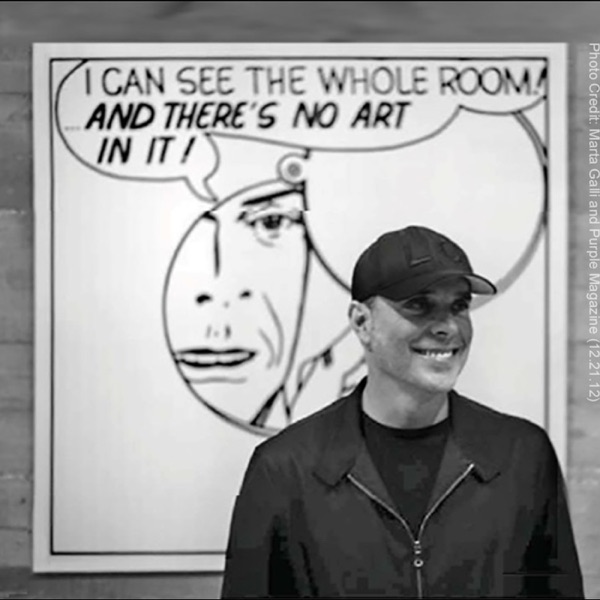
Podcast
LG Williams — Audio Essays & Criticism
Essays, letters, criticism, archival audio, and new writing by LG Williams. Drawn from decades of published and independently circulated texts, the series explores contemporary art, artists, exhibitions, institutions, publishing, and cultural criticism.
More at lgwilliams.com, lgwilliams.substack.com, and pcppress.substack.com.
LG Williams is an American artist, writer, publisher, critic, art historian, and educator. His practice spans visual art, publishing, criticism, pedagogy, and digital projects. He received his B.F.A. in Sculpture from the Kansas City Art Institute and his M.F.A. in Visual Art from the University of California, Davis. He has exhibited nationally and internationally, including at The Internet Pavilion of La Biennale di Venezia, Ludwig Forum für Internationale Kunst, Yerba Buena Center for the Arts, Laguna Art Museum, the Nelson-Atkins Museum of Art, Crocker Art Museum, and di Rosa Art Preserve, as well as at Artissima, Art Cologne, ARCO, and ART-O-RAMA.
- Episodes
- 30
- Releases
- Daily
- Typical length
- 10 min
- On air since
- 2026
- Latest episode
- 1 hour ago
Episodes
30 episodes, newest first
-
15 min
THE PAIN!!! — LG Williams' 2004 Letter to Dave Hickey
Show notes
Include me in your next article, Dude. Any article.
In November 2004, LG Williams sent art critic Dave Hickey an outrageously profane demand: include Williams in his next published review, regardless of subject, merit, historical relevance, or taste.
Hickey had just attacked the contradictory logic of curatorial selection in his Artforum review of Beyond Geometry at the Los Angeles County Museum of Art. Williams wanted to know whether the critic would dare practice the freedom his own criticism seemed to expose.
This episode presents one complete original letter, including its archival footer, from Williams' larger 123-part artwork This Fucking Sucks (catalogue no. 12), preceded by new editorial narration. The letter itself is not abridged.
What sounds like a narcissistic tantrum is also a calculated conceptual intervention.
Williams, confronting poverty, homelessness, and professional exclusion, makes a spectacle of demanding the recognition that museums, critics, galleries, and collectors routinely confer under the respectable language of judgment and historical importance.
His provocation is simple: If critics can expose the absurdity of institutional selection, can they also demonstrate how selection manufactures authority?
Hickey neither answered the letter nor published the requested inclusion.
But the critic who had not included Williams in his criticism had already been included in Williams' art.
In 2016, Williams, through PCP Press, conceived and produced two books of Hickey's online writing, Wasted Words and Dust Bunnies.
David Hawkes reviewed both in the Times Literary Supplement. According to Williams, Hickey had sought such a review for more than thirty years, while Williams remained homeless, penniless, and professionally marginalized.
Who, exactly, gets to decide what survives?
Written by LG Williams.
Original artwork and letter dated November 20, 2004.
Archived at: https://lgwilliams.com
More at: https://pcppress.com, https://lgwilliams.substack.com, and https://pcppress.substack.com.
LG Williams is an American artist, writer, publisher, critic, art historian, and educator. His practice spans visual art, publishing, criticism, pedagogy, and digital projects. He received his B.F.A. in Sculpture from the Kansas City Art Institute and his M.F.A. in Visual Art from the University of California, Davis. He has exhibited nationally and internationally, including at The Internet Pavilion of La Biennale di Venezia, Ludwig Forum für Internationale Kunst, Yerba Buena Center for the Arts, Laguna Art Museum, the Nelson-Atkins Museum of Art, Crocker Art Museum, and di Rosa Art Preserve, as well as at Artissima, Art Cologne, ARCO, and ART-O-RAMA.
-
9 min
The Mona Lisa Mystery Solved: The 2005 Discovery Behind Her Expression
Show notes
For five centuries, the world has tried to decide whether the Mona Lisa is smiling. LG Williams proposes that this is the wrong question—and that Leonardo constructed something far more unsettling: a mouth capable of appearing to express contradictory emotions without changing at all.
In an August 16, 2005 announcement, Williams advanced an explanation of the painting's enigmatic expression, locating the source of its instability in the relationship between the anatomically resting mouth and the shadows surrounding it.
This audio edition presents a spoken adaptation of selected passages from the original 2005 announcement; it is not a complete verbatim reading.
Williams's argument begins with sfumato, which Leonardo uses not only to model form but, in Williams's reading, as an independent expressive artifice. To the viewer's left, shadow appears to pull the mouth downward. At the center, the anatomy remains at rest. To the viewer's right, shadow appears to lift the mouth upward. Down. Flat. Up. Three signals give rise to fifteen initial ordered arrangements, initiating an increasingly complex, recursive process of emotional interpretation.
The painting remains fixed. The viewer's understanding does not. What looks melancholy may become amused; what appears neutral acquires another emotional register. Leonardo's trap springs open, and the mystery of her entire expression—not merely her smile—becomes the subject of Williams's audacious visual equation.
Written by LG Williams.
Originally published August 16, 2005.Original text and archive: https://lgwilliams.com
More at: https://lgwilliams.com, https://pcppress.com, https://lgwilliams.substack.com, and https://pcppress.substack.com.
LG Williams is an American artist, writer, publisher, critic, art historian, and educator. His practice spans visual art, publishing, criticism, pedagogy, and digital projects. He received his B.F.A. in Sculpture from the Kansas City Art Institute and his M.F.A. in Visual Art from the University of California, Davis. He has exhibited nationally and internationally, including at The Internet Pavilion of La Biennale di Venezia, Ludwig Forum für Internationale Kunst, Yerba Buena Center for the Arts, Laguna Art Museum, the Nelson-Atkins Museum of Art, Crocker Art Museum, and di Rosa Art Preserve, as well as at Artissima, Art Cologne, ARCO, and ART-O-RAMA.
-
10 min
Everyone Sucks: The 100 Letters Sent to the Art World’s Power Brokers
Show notes
One hundred celebrated artists. One hundred unsolicited propositions. One artist determined to turn obscenity into professional opportunity.
In September 2002, LG Williams assembled a wish list of prominent artists, dealers, and other figures in the contemporary art world, and approached them with an extraordinarily candid offer. The project, Everyone Sucks, premiered that October as a nationwide exercise in correspondence, artistic ambition, and professional advancement.
This audio edition presents an excerpt from the complete project. It includes one complete original letter, preceded by a contextual introduction and followed by archival closing narration. The recording does not contain all one hundred letters.
Armed with his reading of Eugène Delacroix and a particularly uncharitable observation by Dave Hickey, Williams set out to reconcile the artist's contempt for cultural authority with his own need for recognition. His solution involved a censored photograph, a detailed personal proposition, an editioned artwork, and an administrative notice allowing recipients to object to the appearance of their names in the publication by October 15, 2002.
A remarkably efficient way to approach the very art-world establishment one professes to disdain — and perhaps acquire a few useful names for one's résumé in the process.
The complete project, including all one hundred letters and accompanying imagery, is reproduced in Everyone Sucks, published by PCP Press.
Written by LG Williams.
Original letters dated September 26, 2002; project premiered October 2002.
Subsequently reproduced as Everyone Sucks, published by PCP Press.
Published by PCP Press.
Available on Amazon: https://amazon.com
Publisher's website, book info and complete catalogue: https://pcppress.com
More at: https://lgwilliams.com, https://lgwilliams.substack.com, and https://pcppress.substack.com.
LG Williams is an American artist, writer, publisher, critic, art historian, and educator. His practice spans visual art, publishing, criticism, pedagogy, and digital projects. He received his B.F.A. in Sculpture from the Kansas City Art Institute and his M.F.A. in Visual Art from the University of California, Davis. He has exhibited nationally and internationally, including at The Internet Pavilion of La Biennale di Venezia, Ludwig Forum für Internationale Kunst, Yerba Buena Center for the Arts, Laguna Art Museum, the Nelson-Atkins Museum of Art, Crocker Art Museum, and di Rosa Art Preserve, as well as at Artissima, Art Cologne, ARCO, and ART-O-RAMA.
-
18 min
Nothing, Not Really: Pace Gallery, Loie Hollowell, and the Institutional Manufacture of Advancement
Show notes
What if an artist inherits the visual discoveries of others, a gallery inherits its authority from artists who actually changed art, and everyone agrees to call the result progress?
In Nothing, Not Really, LG Williams puts Pace Gallery and painter Loie Hollowell on trial—not for making money, but for confusing market success, autobiographical disclosure, and institutional endorsement with artistic invention. The argument begins with Hollowell's attempt to “mother-ize” Ellsworth Kelly's color and ends with a gallery deciding what artistic inheritance is supposed to mean.
This audio edition presents selected passages from the book, interwoven with commentary.
Two inheritances drive the indictment. Arne Glimcher passes Pace to Marc; painter and educator David Hollowell passes down a demanding artistic discipline to his daughter. What did the heirs actually do with what they received? Williams brings Agnes Pelton, Zilia Sánchez, Robert Irwin, Jackson Pollock, Cy Twombly, and Kelly into the argument—not as a parade of visual similarities but as a test of what it means to discover, transform, or merely repeat an artistic problem.
The commercial plot is no gentler. Joel Mesler becomes Hollowell's Frank Dunphy, helping turn signature imagery and renewable autobiography into a saleable career before becoming a practitioner of a similar formula himself. At Pace Berlin, the Surrealists' exquisite corpse—a game of concealed collaboration and unforeseen invention—returns as an orderly inheritance pageant. The corpse gets a makeover. And a pedigree.
A gallery in contraction certifies a formula that cannot advance. An artist who recycles inherited forms becomes a curator of inheritance. One exhausted institution finds its ideal companion in an exhausted artistic formula.
Written by LG Williams.
Originally published October 2026, by PCP Press.
Book and publisher catalogue: https://pcppress.com
Available on Amazon: https://amazon.com
Publisher's website, book info and complete catalogue: https://pcppress.com
More at: https://lgwilliams.com, https://lgwilliams.substack.com, and https://pcppress.substack.com.
LG Williams is an American artist, writer, publisher, critic, art historian, and educator. His practice spans visual art, publishing, criticism, pedagogy, and digital projects. He received his B.F.A. in Sculpture from the Kansas City Art Institute and his M.F.A. in Visual Art from the University of California, Davis. He has exhibited nationally and internationally, including at The Internet Pavilion of La Biennale di Venezia, Ludwig Forum für Internationale Kunst, Yerba Buena Center for the Arts, Laguna Art Museum, the Nelson-Atkins Museum of Art, Crocker Art Museum, and di Rosa Art Preserve, as well as at Artissima, Art Cologne, ARCO, and ART-O-RAMA.
-
14 min
Regime of Impunity — When Art Exhibits Its Critics
Show notes
The art world no longer needs to defeat its critics. It can exhibit them.
Museums can display attacks on museums. Collectors can acquire works that condemn collecting. An artist's refusal of the market can become a marketable signature. Criticism circulates. Prestige accumulates. The institution survives.
Regime of Impunity: A Diagnostic Essay on Contemporary Power, by LG Williams, examines a condition in which exposure, failure, and judgment no longer necessarily end authority. This episode brings that diagnosis into the institutions of art and culture.
This episode is an original, condensed audio adaptation of the book's central argument. It is not a verbatim excerpt, a complete reading, or the full audiobook.
The argument is not that criticism has disappeared. It is that criticism can flourish while losing the power to compel an ending. Truth becomes circulation. Politics becomes procedure. Opposition becomes something institutions can display, brand, and absorb. Legitimacy gives way to impunity. Finance then makes the arrangement durable by converting penalties into prices and failure into manageable cost.
The book does more than name the problem. Its second part develops three negative theoretical investigations—legitimate exit, non-absorbable refusal, and institutional forfeiture—and explains why none can yet become an operative positive program without risking absorption by the system it describes.
What is missing is not another revelation, another exhibition, or another critical performance. What is missing is judgment with consequences: the capacity for failure to end authority.
When does this end?
Regime of Impunity: A Diagnostic Essay on Contemporary Power.
Written by LG Williams.
Originally published: 2026.Published by PCP Press in the Éditions des Pirates series.
Available on Amazon: https://amazon.com
Publisher's website, book info and complete catalogue: https://pcppress.com
More at: https://lgwilliams.com, https://lgwilliams.substack.com, and https://pcppress.substack.com.
LG Williams is an American artist, writer, publisher, critic, art historian, and educator. His practice spans visual art, publishing, criticism, pedagogy, and digital projects. He received his B.F.A. in Sculpture from the Kansas City Art Institute and his M.F.A. in Visual Art from the University of California, Davis. He has exhibited nationally and internationally, including at The Internet Pavilion of La Biennale di Venezia, Ludwig Forum für Internationale Kunst, Yerba Buena Center for the Arts, Laguna Art Museum, the Nelson-Atkins Museum of Art, Crocker Art Museum, and di Rosa Art Preserve, as well as at Artissima, Art Cologne, ARCO, and ART-O-RAMA.
-
13 min
100 Women Artists: Problem Solved
Show notes
In May of 2023, one book solved the greatest problem in contemporary art.
That book was 100 Women Artists, by artist LG Williams, published with PCP Press. This original audio essay tells the story of how it was done.
What would happen if Pablo Picasso were a woman?
Same paintings. Same dates. Same inventions. Only the painter changes. Pablo Picasso becomes Paula Picasso. The artwork and its achievement remain. The way museums talk about them does not.
For more than half a century, women artists, critics, curators, and institutions have argued that Western art museums lack adequate female representation. The art world responded with exhibitions, acquisitions, departments, budgets, and strategic plans. It is slow. It is expensive. It is never finished.
Published May 21, 2023, during the first months of publicly accessible generative AI, 100 Women Artists takes one hundred men from the canon of Western art, transforms their portraits into women, and gives them female names. Paula Picasso. Marcelle Duchamp. Jacqueline Pollock. Georgia Baselitz.
The argument is simple. The problem was never in the art. It was in the filing system. And a problem that lives in the filing system is solved in the filing system.
In 2013, Georg Baselitz declared that women don't paint very well. With 100 Women Artists, Georg Baselitz becomes Georgia Baselitz. The paintings remain. The achievement remains. Only the classification changes.
Now men don't paint very well. It's a fact.
No painting repainted. No sculpture removed, defaced, or toppled. No acquisitions committee. The entire cost of the correction: one book.
Along the way: Linda Nochlin's foundational question about great women artists; the Guerrilla Girls at the Metropolitan Museum of Art; Simone de Beauvoir on becoming a woman; Helen Frankenthaler and the difference between identity and invention; OpenAI's announced Navier–Stokes result and Terence Tao's response; and Jason Farago's assessment of artistic stagnation in The New York Times.
Mathematics got its revolution in 2026. Contemporary art got its revolution in 2023. It took one homeless artist, one decades-old laptop, a slow public library connection, and one book.
100 Black Artists was the first case. 100 Women Artists is the second. It will not be the last.
Problem solved. Once and for all.
Now we can move on to more important matters. Like the stagnation of contemporary art itself.
100 Women Artists, by LG Williams.
Text and photographs by LG Williams.
Published by PCP Press.
Available on Amazon: https://amazon.com
Publisher's website, book info and complete catalogue: https://pcppress.com
More at: https://lgwilliams.com, https://lgwilliams.substack.com, and https://pcppress.substack.com.
LG Williams is an American artist, writer, publisher, critic, art historian, and educator. His practice spans visual art, publishing, criticism, pedagogy, and digital projects. He received his B.F.A. in Sculpture from the Kansas City Art Institute and his M.F.A. in Visual Art from the University of California, Davis. He has exhibited nationally and internationally, including at The Internet Pavilion of La Biennale di Venezia, Ludwig Forum für Internationale Kunst, Yerba Buena Center for the Arts, Laguna Art Museum, the Nelson-Atkins Museum of Art, Crocker Art Museum, and di Rosa Art Preserve, as well as at Artissima, Art Cologne, ARCO, and ART-O-RAMA.
-
13 min
100 Black Artists: Problem Solved
Show notes
In May of 2023, one book solved the greatest problem in contemporary art.
That book was 100 Black Artists, by artist LG Williams, published with PCP Press. This original audio essay tells the story of how.
What would happen if Pablo Picasso were Black?
Same paintings. Same dates. Same inventions. Only the classification changes. The artwork and its achievement remain. The way museums talk about them does not.
For more than a generation, artists, critics, curators, and institutions have argued that Western art museums lack adequate Black representation. The art world responded with exhibitions, acquisitions, departments, budgets, and strategic plans. It is slow. It is expensive. It is never finished.
Published May 18, 2023, during the first months of publicly accessible generative AI, 100 Black Artists takes one hundred artists from the canon of Western art and presents them as Black artists. Salvador Dalí. Alberto Giacometti. Gerhard Richter. Cy Twombly.
The argument is simple. The problem was never in the art. It was in the filing system. And a problem that lives in the filing system is solved in the filing system.
No painting repainted. No sculpture removed, defaced, or toppled. No acquisitions committee. The entire cost of the correction: one book.
Along the way: Kerry James Marshall at LACMA; Martin Luther King Jr.'s dream sixty years on; Jacob Lawrence and the difference between experience and invention; OpenAI's announced Navier–Stokes result and Terence Tao's response; and Jason Farago's assessment of artistic stagnation in The New York Times.
Mathematics got its revolution in 2026. Contemporary art got its revolution in 2023. It took one homeless artist, one decades-old laptop, a slow public library connection, and one book.
Problem solved. Once and for all.
Now we can move on to more important matters. Like the stagnation of contemporary art itself.
100 Black Artists, by LG Williams.
Text and photographs by LG Williams.
Published by PCP Press.
Available on Amazon: https://amazon.com
Publisher's website, book info and complete catalogue: https://pcppress.com
More at: https://lgwilliams.com, https://lgwilliams.substack.com, and https://pcppress.substack.com.
LG Williams is an American artist, writer, publisher, critic, art historian, and educator. His practice spans visual art, publishing, criticism, pedagogy, and digital projects. He received his B.F.A. in Sculpture from the Kansas City Art Institute and his M.F.A. in Visual Art from the University of California, Davis. He has exhibited nationally and internationally, including at The Internet Pavilion of La Biennale di Venezia, Ludwig Forum für Internationale Kunst, Yerba Buena Center for the Arts, Laguna Art Museum, the Nelson-Atkins Museum of Art, Crocker Art Museum, and di Rosa Art Preserve, as well as at Artissima, Art Cologne, ARCO, and ART-O-RAMA.
-
5 min
Wally Hedrick: I'm on Strike! — An Emergency Antiwar Exhibition Proposal to LG Williams, January 8, 2003
Show notes
What does an artist do when another war is coming—and painting seems powerless to stop it?
Wally Hedrick (1928 – 2003) had an answer: paint everything black, resurrect the wounded veterans, and prepare for battle.
A foundational figure in the San Francisco avant-garde and a veteran of the Korean War, Hedrick spent decades confronting American militarism through his Black Paintings and War Room, a monumental enclosure of eight towering black canvases. His protest began during the Vietnam War, continued through the Gulf War, and returned with renewed urgency as the United States prepared to invade Iraq.
This audio edition presents the complete text of a handwritten letter — not an excerpt — written by Hedrick to artist LG Williams on January 8, 2003.
The letter is an extraordinary document of artistic refusal, black humor, and impending catastrophe. Hedrick recounts painting over his existing works, describes his battered canvases as wounded veterans, and proposes an immediate exhibition synchronized with the outbreak of war.
He needs walls. He needs ceilings. He needs transportation, publicity, and a venue. Above all, he needs a collaborator willing to launch what he calls a "monolateral sneek attack."
Here, painting is neither decoration nor passive commentary. It becomes a deliberately improvised act of resistance, with the artist treating his surviving works as troops awaiting deployment.
The letter concludes not with a manifesto, but with a demand addressed personally to Williams: "RU? YES OR NO?"
Written by Wally Hedrick.
Addressed to LG Williams.
January 8, 2003.Historical archive and related exhibition documentation:
https://lgwilliams.comWally Hedrick — Wikipedia:
https://en.wikipedia.org/wiki/Wally_HedrickWar Room (Wally Hedrick) — Wikipedia:
https://en.wikipedia.org/wiki/War_Room_(Wally_Hedrick)More at: https://lgwilliams.com, https://lgwilliams.substack.com, and https://pcppress.substack.com.
LG Williams is an American artist, writer, publisher, critic, art historian, and educator. His practice spans visual art, publishing, criticism, pedagogy, and digital projects. He received his B.F.A. in Sculpture from the Kansas City Art Institute and his M.F.A. in Visual Art from the University of California, Davis. He has exhibited nationally and internationally, including at The Internet Pavilion of La Biennale di Venezia, Ludwig Forum für Internationale Kunst, Yerba Buena Center for the Arts, Laguna Art Museum, the Nelson-Atkins Museum of Art, Crocker Art Museum, and di Rosa Art Preserve, as well as at Artissima, Art Cologne, ARCO, and ART-O-RAMA.
-
6 min
Help Wanted: Artist / Fix-It-Man — The 2004 Craigslist Ad Nobody Should Answer — But Thousands Did
Show notes
What happens when a homeless artist pretends to be an employer—and thousands of people take his fictional job advertisements seriously?
In March 2004, LG Williams was unemployed, without stable housing, and working from public computers at the University of California, San Diego's Geisel Library. Instead of answering another employment advertisement, he reversed the arrangement: he invented employers, advertised impossible jobs, and transformed Craigslist into an international exhibition.
This audio edition presents the complete text of Artist / Fix-It-Man, one of five fictional employment advertisements from Williams's larger Help Wanted online exhibition (2004).
Inspired directly by Williams's late friend and mentor Wally Hedrick, Artist / Fix-It-Man demands an almost superhuman combination of artistic talent, mechanical competence, intellectual independence, moral character, and professional nonconformity. In return, the position offers minimum wage, no benefits, no advancement, and virtually no security. Its ideal candidate must possess an exceptional work ethic, an inability to take New York City seriously, and a natural capacity to remain wholly uncooperative.
The joke is deadly serious.
Across sixteen metropolitan markets, the five advertisements generated more than 5,000 reported replies. Some respondents applied sincerely. Others praised, denounced, threatened, flirted, offered employment, or proposed romantic relationships. Approximately 500 exchanges survive in the published archive.
The exhibition turned a website's ordinary employment machinery into an artistic system: advertisements became artworks, job seekers became unwitting participants, and recorded removals and repostings became part of the work's history.
But beneath the comedy lies a darker reversal. The man offering imaginary employment was himself seeking real work, shelter, and economic stability. Help Wanted exposed the ease with which professional authority could be manufactured through the language of qualifications, institutional expectations, and online advertisements.
The result is simultaneously a parody of recruitment culture, a tribute to Hedrick's anti-institutional independence, and a disturbing experiment in the relationship between art, labor, deception, and economic vulnerability.
Written by LG Williams.
Original advertisement dated March 5, 2004.
Complete exhibition archive:
https://lgwilliams.comThe Book — Help Wanted: The Complete Resource
PCP Press, 2017. 359 pages.Available on Amazon: https://amazon.com
Publisher's website, book info and complete catalogue: https://pcppress.com/
More at: https://lgwilliams.com, https://lgwilliams.substack.com, and https://pcppress.substack.com.
LG Williams is an American artist, writer, publisher, critic, art historian, and educator. His practice spans visual art, publishing, criticism, pedagogy, and digital projects. He received his B.F.A. in Sculpture from the Kansas City Art Institute and his M.F.A. in Visual Art from the University of California, Davis. He has exhibited nationally and internationally, including at The Internet Pavilion of La Biennale di Venezia, Ludwig Forum für Internationale Kunst, Yerba Buena Center for the Arts, Laguna Art Museum, the Nelson-Atkins Museum of Art, Crocker Art Museum, and di Rosa Art Preserve, as well as at Artissima, Art Cologne, ARCO, and ART-O-RAMA.
-
13 min
Dave Hickey vs. Everybody: The Art Critic Who Lost to Facebook (and Kept Swinging)
Show notes
Dave Hickey spent his career defending the right to judge art. Then Facebook gave everyone a verdict—and almost no one an argument.
In 2014, seriously ill and finding extended writing physically difficult, the American critic entered Facebook expecting something resembling an intellectual salon. Instead, he found a torrent of instantaneous opinion, vanity, hostility, and performance. He was no innocent observer: Hickey joined the fray with his own insults, provocations, and devastating judgments.
Audio excerpt edition — not a complete reading.
This episode presents a selection of Dave Hickey's original aphorisms from Wasted Words: The Essential Dave Hickey Online Compilation (2016). An edited selection of these writings also appears in its companion volume, Dust Bunnies: Dave Hickey's Online Aphorisms (2016). Both books were conceived and produced by LG Williams for PCP Press and are available for purchase on https://Amazon.com.
Together, the books preserved two sides of the experiment: the sprawling exchanges and the short, incendiary remarks that survived them. In March 2016, Hickey described the project to Nevada Public Radio as a failure to generate serious discussion. That failure became an extraordinary document of the art world's collision with social media.
In his May 27, 2016 Times Literary Supplement essay, “Everyone's a Critic,” David Hawkes saw a deeper historical reversal. Hickey had spent decades challenging academic orthodoxy and institutional authority. But what if the triumph of individual judgment, market logic, and self-presentation had helped create the very culture in which criticism was swallowed by publicity?
These selections do not rehabilitate Hickey, domesticate his profanity, or make his contradictions disappear. They allow him to be difficult: contemptuous, funny, acute, unfair, fiercely independent, and occasionally merciless toward himself.
One book captured the noise. The other, the sparks.
And Hickey left us the evidence.
Read The Complete Works
Wasted Words: The Essential Dave Hickey Online Compilation (PCP Press, 2016):
Dust Bunnies: Dave Hickey's Online Aphorisms (PCP Press, 2016)Available on Amazon: https://amazon.com
Publisher's website, book info and complete catalogue: https://pcppress.com/
More at: https://lgwilliams.com, https://lgwilliams.substack.com, and https://pcppress.substack.com.
LG Williams is an American artist, writer, publisher, critic, art historian, and educator. His practice spans visual art, publishing, criticism, pedagogy, and digital projects. He received his B.F.A. in Sculpture from the Kansas City Art Institute and his M.F.A. in Visual Art from the University of California, Davis. He has exhibited nationally and internationally, including at The Internet Pavilion of La Biennale di Venezia, Ludwig Forum für Internationale Kunst, Yerba Buena Center for the Arts, Laguna Art Museum, the Nelson-Atkins Museum of Art, Crocker Art Museum, and di Rosa Art Preserve, as well as at Artissima, Art Cologne, ARCO, and ART-O-RAMA.
-
14 min
The End of Conceptual Art Was Two Years Ago: The Mathematicians Are Just Finding Out
Show notes
An exiled Los Angeles artist announced the end of Conceptual Art in 2024. Nobody opened his email. Two years later, the mathematicians made it front-page news.
On June 3, 2024, LG Williams unveiled Art After Humanity: The Most Profound Conceptual Artwork of the 21st Century—an undertaking that marshaled the world's technological and financial infrastructure to create an artwork beyond human comprehension, bringing Conceptual Art to an end once and for all.
By October 16, 2026, The New York Times was reporting on Terence Tao, OpenAI's release of more than 350 mathematical findings, and the upheaval caused by AI-generated proofs that experts struggled to interpret.
This audio edition presents a lightly abridged reading of LG Williams's original June 3, 2024 press release, Art After Humanity: The Most Profound Conceptual Artwork of the 21st Century.
Duchamp made the art object unnecessary while keeping the art. Williams made the spectator unnecessary while keeping the artwork. The work eliminates the human viewer, displaces the critic, escapes the collector, and proceeds without requiring anybody to understand it. Conceptual Art reaches its terminal contradiction: an artwork whose concepts no human mind can wholly comprehend.
When mathematicians confronted the limits of human intellectual authority, the story commanded international attention. Williams had announced the crisis more than two years earlier. The art world failed to notice. Not even his caseworker opened the email.
Terence Tao already had a Fields Medal and a MacArthur Fellowship. Williams wanted to know where his money was.
The artwork had transcended money. The artist had not.
Written by LG Williams.
Originally published June 3, 2024.Original text and archive: https://lgwilliams.com
More at: https://lgwilliams.com, https://pcppress.com, https://lgwilliams.substack.com, and https://pcppress.substack.com.
LG Williams is an American artist, writer, publisher, critic, art historian, and educator. His practice spans visual art, publishing, criticism, pedagogy, and digital projects. He received his B.F.A. in Sculpture from the Kansas City Art Institute and his M.F.A. in Visual Art from the University of California, Davis. He has exhibited nationally and internationally, including at The Internet Pavilion of La Biennale di Venezia, Ludwig Forum für Internationale Kunst, Yerba Buena Center for the Arts, Laguna Art Museum, the Nelson-Atkins Museum of Art, Crocker Art Museum, and di Rosa Art Preserve, as well as at Artissima, Art Cologne, ARCO, and ART-O-RAMA.
-
13 min
The Line That Knew Too Much: The Lascaux Bull and Contoured-Consciousness
Show notes
What if the first great masterpiece of Western art was also one of its greatest—and what if the evidence has been in plain sight for millennia?
In The Line That Knew Too Much, LG Williams returns to a prehistoric bull at Lascaux, France, to challenge the assumption that the sophistication of drawing is a later achievement. Originally developed from a 1997 University of California, Davis lecture, the analysis follows the bull's contour from its back toward its face.
This episode is a condensed hybrid audio adaptation, not an unabridged reading. It combines selected and adapted passages from Williams's original essay with newly written narration. The complete essay contains further analysis, critical apparatus, and a technical appendix.
The claim is audacious: graphic illusionism can make a motionless line seem to generate an entire living creature. A thickening contour suggests strength. Overlapping shoulders create depth, movement, and time. An upright ear freezes an instant; an invisible second ear makes us imagine a head we cannot fully see. Horns reconcile competing viewpoints. And the curve of a mouth produces the most startling effect: the apparent presence of an emotional life.
The comparisons with ancient Egyptian art, Picasso, the Greek Archaic smile, and Leonardo da Vinci's Mona Lisa establish formal parallels across art history, not a claim of direct historical transmission.
Written by LG Williams.
Essay Origin: Lecture at the University of California, Davis, January 14, 1997; subsequently edited and adapted for publication.
Original text and archive: https://lgwilliams.com
More at: https://lgwilliams.com, https://pcppress.com, https://lgwilliams.substack.com, and https://pcppress.substack.com.
LG Williams is an American artist, writer, publisher, critic, art historian, and educator. His practice spans visual art, publishing, criticism, pedagogy, and digital projects. He received his B.F.A. in Sculpture from the Kansas City Art Institute and his M.F.A. in Visual Art from the University of California, Davis. He has exhibited nationally and internationally, including at The Internet Pavilion of La Biennale di Venezia, Ludwig Forum für Internationale Kunst, Yerba Buena Center for the Arts, Laguna Art Museum, the Nelson-Atkins Museum of Art, Crocker Art Museum, and di Rosa Art Preserve, as well as at Artissima, Art Cologne, ARCO, and ART-O-RAMA.
-
5 min
Invitation to the Dance: A Foreword, or Introductory Essay by Dr. Seymour Howard for Year In Rearview
Show notes
Invitation to the Dance: A foreword, or introductory essay, by art historian Dr. Seymour Howard for Year In Rearview, a book of photographs by artist LG Williams.
One hundred used condom wrappers. An AIDS epidemic. And an art historian who discovers sex, money, mortality, and the stubborn persistence of desire in the least exalted objects imaginable.
In 1998, artist LG Williams published Year In Rearview, a book featuring 100 selected black-and-white photographs of condom wrappers collected over the course of a year. Transforming ordinary discarded packaging into an unsettling visual archive, Williams confronts questions of intimacy, protection, and risk at a time when the AIDS epidemic continued to cast a shadow over sexual life. The book’s foreword, Invitation to the Dance, was written by distinguished art historian Dr. Seymour Howard, Williams’s former teacher and later colleague at the University of California, Davis.
This audio edition presents Howard’s complete, unabridged 1998 foreword to Year In Rearview, not the entire photographic artist book.
What can a discarded condom wrapper tell us about the human condition? For Howard, considerably more than one might imagine. He traces unexpected connections between the commercial machinery of eroticism, the biological vulnerability exposed by HIV and AIDS, and the enduring powers of pleasure, love, and desire. Along the way, the wrappers summon echoes of modernist painters Barnett Newman, Jasper Johns, and Franz Kline, turning disposable packaging into an unlikely encounter with art history.
What begins as an apparently absurd collection becomes something far more provocative: a serious, irreverent, and unexpectedly life-affirming reflection on sexuality, commerce, mortality, and the refusal of human desire to surrender to fear.
Foreword by Dr. Seymour Howard (1928–2018).
Artist book of photographs by LG Williams.
Originally published in 1998; foreword dated April 1998, Davis, California.Published by PCP Press.
Available on Amazon: https://amazon.com
Publisher's website, book info and complete catalogue: https://pcppress.com/
More at: https://lgwilliams.com, https://lgwilliams.substack.com, and https://pcppress.substack.com.
LG Williams is an American artist, writer, publisher, critic, art historian, and educator. His practice spans visual art, publishing, criticism, pedagogy, and digital projects. He received his B.F.A. in Sculpture from the Kansas City Art Institute and his M.F.A. in Visual Art from the University of California, Davis. He has exhibited nationally and internationally, including at The Internet Pavilion of La Biennale di Venezia, Ludwig Forum für Internationale Kunst, Yerba Buena Center for the Arts, Laguna Art Museum, the Nelson-Atkins Museum of Art, Crocker Art Museum, and di Rosa Art Preserve, as well as at Artissima, Art Cologne, ARCO, and ART-O-RAMA.
-
9 min
LG Williams: Anthology 1987–2012 — Milan Mid-Career Retrospective | Essay by Dr. Thomas Frangenberg
Show notes
What happens when an artist stages a twenty-five-year mid-career retrospective—and leaves the gallery almost entirely empty?
In November 2012, LG Williams / The Estate of LG Williams presented Anthology 1987–2012, a twenty-five-year mid-career retrospective at Gloria Maria Gallery in Milan, organized in collaboration with Baron Osuna of Super Window Project, Kyoto, Japan. Rather than filling the gallery with decades of artistic production, the exhibition centered on a single artwork that transformed Roy Lichtenstein's famous declaration that there was nobody in the room into a more unsettling proposition: there was no art in it.
This full-text audio edition presents Dr. Thomas Frangenberg's complete original catalogue essay, written for the exhibition.
Frangenberg turns this apparently simple provocation into an investigation of looking, absence, voyeurism, surveillance, and the unstable relationship between art and its institutions. Moving from Lichtenstein through Watteau, Bernini, Duchamp, and other figures, he asks how a seemingly empty gallery can become an artwork—and how a retrospective can exist simultaneously as exhibition, catalogue, and online archive.
The result is a meditation on what the viewer actually encounters when the art supposedly isn't there.
Presented at Gloria Maria Gallery, Milan, November 14–December 21, 2012.
Organized in collaboration with Baron Osuna, Super Window Project, Kyoto, Japan.
Catalogue essay by Dr. Thomas Frangenberg, University of Leicester.Originally published in connection with Anthology 1987–2012, November 2012.
Exhibition and original essay archive: https://lgwilliams.com
Publisher's website, book info and complete catalogue: https://pcppress.com
Available on Amazon: https://amazon.com
More at: https://lgwilliams.com, https://lgwilliams.substack.com, and https://pcppress.substack.com.
LG Williams is an American artist, writer, publisher, critic, art historian, and educator. His practice spans visual art, publishing, criticism, pedagogy, and digital projects. He received his B.F.A. in Sculpture from the Kansas City Art Institute and his M.F.A. in Visual Art from the University of California, Davis. He has exhibited nationally and internationally, including at The Internet Pavilion of La Biennale di Venezia, Ludwig Forum für Internationale Kunst, Yerba Buena Center for the Arts, Laguna Art Museum, the Nelson-Atkins Museum of Art, Crocker Art Museum, and di Rosa Art Preserve, as well as at Artissima, Art Cologne, ARCO, and ART-O-RAMA.
-
6 min
Polymorphous Swinger in Pink: Unlocking Jean-Honoré Fragonard’s Radical Eroticism
Show notes
Fragonard hid the origin of the world in plain sight—and art history spent more than two centuries calling it Rococo flirtation.
Painted around 1767, Jean-Honoré Fragonard’s The Swing stages one of the most famous erotic games in Western painting: a young woman in a billowing pink dress flies through a shadowy garden while a concealed lover positions himself below her to see beneath her skirt. That scandal is only the beginning.
This audio edition presents an excerpt from the full essay.
The painting’s dark shrubbery, blazing pink center, bodies, repetitions, and very structure form a visual metaphor for the object everyone in the picture—and everyone looking at it—is trying to see. The Swing does not merely represent voyeurism. It becomes voyeurism: an elaborate mechanism of concealment, discovery, erotic looking, and female anatomy.
Nearly a century before Gustave Courbet made L’Origine du monde brutally literal, Fragonard had already built the origin of the world into the architecture of a Rococo garden.
The result is not a decorative fantasy but a conceptual trap. Hidden below, the lover looks; so does the viewer. Meanwhile, the painting withholds, reveals, redirects, and rewards. Its “money shot,” its “big red sun,” and its pink anatomical center turn the entire composition into a circular structure of desire—a visual Ouroboros in which looking produces more looking.
Fragonard is not merely a painter of eighteenth-century pleasure. Here he becomes a radical visual thinker who hides the subject in plain sight and forces the viewer to discover it—not by looking harder, but by looking differently.
Written by LG Williams.
Originally published November 31, 2009.Original text and archive: https://lgwilliams.com
More at: https://lgwilliams.com, https://pcppress.com, https://lgwilliams.substack.com, and https://pcppress.substack.com.
LG Williams is an American artist, writer, publisher, critic, art historian, and educator. His practice spans visual art, publishing, criticism, pedagogy, and digital projects. He received his B.F.A. in Sculpture from the Kansas City Art Institute and his M.F.A. in Visual Art from the University of California, Davis. He has exhibited nationally and internationally, including at The Internet Pavilion of La Biennale di Venezia, Ludwig Forum für Internationale Kunst, Yerba Buena Center for the Arts, Laguna Art Museum, the Nelson-Atkins Museum of Art, Crocker Art Museum, and di Rosa Art Preserve, as well as at Artissima, Art Cologne, ARCO, and ART-O-RAMA.
-
9 min
Caravaggio — High Minds, Low Subjects: Visual Imagination and Hidden Forms in The Conversion of Saint Paul
Show notes
Caravaggio puts Saint Paul on the floor and instead gives the church a “big horse painting.”
Painted in 1601 for the Cerasi Chapel in Santa Maria del Popolo in Rome, The Conversion of Saint Paul was commissioned to picture one of Christianity’s great moments of divine revelation. Caravaggio does something far more perverse. He suppresses the heavenly spectacle, marginalizes Paul, and allows an enormous piebald horse to seize the composition.
This audio edition presents an excerpt from the full essay.
For LG Williams, the horse is not a compositional accident. It is the painting’s true protagonist—and the instrument of Caravaggio’s rebellion. Its body becomes a hiding place for transformations, erotic mischief, visual traps, and deliberately improper forms concealed inside a sacred commission. Most outrageous of all is the figure embedded in the horse’s piebald markings: a youthful satyr—pagan, sexual, hybrid, and spectacularly out of place in one of Western Christianity’s canonical images.
The result is not merely an unconventional religious painting, or even revenge disguised as one. It is a holy commission turned against itself. Paul is displaced. Pagan flesh infiltrates Christian revelation. The sacred and the profane occupy the same body. Caravaggio gives his patrons something still largely unrecognized: a devotional picture covertly loaded with bawdy, raw, sexual imagery, ambiguity, mockery, and insubordination.
A masterpiece of Christian art becomes, simultaneously, an extraordinarily sophisticated act of blasphemy hiding in plain sight.
Written by LG Williams.
Originally published December 20, 2024.Original text and archive: https://lgwilliams.com
More at: https://lgwilliams.com, https://pcppress.com, https://lgwilliams.substack.com, and https://pcppress.substack.com.
LG Williams is an American artist, writer, publisher, critic, art historian, and educator. His practice spans visual art, publishing, criticism, pedagogy, and digital projects. He received his B.F.A. in Sculpture from the Kansas City Art Institute and his M.F.A. in Visual Art from the University of California, Davis. He has exhibited nationally and internationally, including at The Internet Pavilion of La Biennale di Venezia, Ludwig Forum für Internationale Kunst, Yerba Buena Center for the Arts, Laguna Art Museum, the Nelson-Atkins Museum of Art, Crocker Art Museum, and di Rosa Art Preserve, as well as at Artissima, Art Cologne, ARCO, and ART-O-RAMA.
-
6 min
What Do You Say To That?: Édouard Manet’s Mademoiselle V. in the Costume of an Espada
Show notes
For more than a century, viewers have been looking directly at one of Manet’s most radical inventions—and, LG Williams argues, art history has largely failed to see it.
Édouard Manet’s Mademoiselle V. in the Costume of an Espada presents the artist Victorine Meurent dressed as a male bullfighter in an intentionally artificial Spanish setting. The painting has long been discussed through gender, costume, Goya, espagnolisme, and Manet’s fascination with Spain. Williams shifts attention to the strange pink cape held directly before the viewer.
This audio edition presents an excerpt from the full essay.
The argument goes substantially beyond cross-dressing or conventional discussions of gender ambiguity. Williams contends that Manet transforms the cape into an anatomically hybrid pictorial invention—masculine and feminine, body and object, costume and anatomy simultaneously. Its faded, flesh-like pink, peculiar shape, brushwork, and relation to Victorine turn an ordinary bullfighting object into the painting’s radical axis.
The excerpt argues that Manet’s supposed anomalies are not mistakes, accidents, or merely “enigmatic” details. They are deliberate acts of transformation. The cape becomes evidence of an imagination refusing stable categories and conventional representation—and of an art history that has failed to recognize what has been sitting in plain sight.
Written by LG Williams.
Originally published December 1, 2024.Original text and archive: https://lgwilliams.com
More at: https://lgwilliams.com, https://pcppress.com, https://lgwilliams.substack.com, and https://pcppress.substack.com.
LG Williams is an American artist, writer, publisher, critic, art historian, and educator. His practice spans visual art, publishing, criticism, pedagogy, and digital projects. He received his B.F.A. in Sculpture from the Kansas City Art Institute and his M.F.A. in Visual Art from the University of California, Davis. He has exhibited nationally and internationally, including at The Internet Pavilion of La Biennale di Venezia, Ludwig Forum für Internationale Kunst, Yerba Buena Center for the Arts, Laguna Art Museum, the Nelson-Atkins Museum of Art, Crocker Art Museum, and di Rosa Art Preserve, as well as at Artissima, Art Cologne, ARCO, and ART-O-RAMA.
-
12 min
Repainting the Past: Kerry James Marshall and the Bureaucratic Canon
Show notes
What if one of contemporary painting’s most celebrated advances is not an advance at all—but an inherited visual language with different casting?
Kerry James Marshall occupies a central position in contemporary museum culture and in debates surrounding race, representation, and the Western art-historical canon. His paintings are widely associated with the insertion of Black figures, histories, and cultural references into established pictorial traditions.
This audio edition presents an excerpt from the full essay.
LG Williams challenges the claim that such substitution constitutes artistic invention. The essay argues that Marshall alters who appears within inherited forms while leaving their underlying visual grammar largely intact—and uses that distinction to confront a larger institutional problem: a culture increasingly willing to mistake representation for invention, visibility for vision, and moral recognition for the harder artistic task of transforming perception, and through it, thought and imagination.
The excerpt moves from Hans Holbein’s radical use of anamorphic perspective in The Ambassadors to Marshall’s dependence on canonical precedent; from Audre Lorde’s “master’s tools” to the economics of institutional approval; from Wally Hedrick’s refusal of the art system to the bureaucratic arithmetic of representation. Its final wager is severe: when museums can deliver the appearance of progress without the disruption of genuine invention, everyone may benefit except painting itself.
Written by LG Williams.
Originally published November 9, 2025.Original text and archive: https://lgwilliams.com
More at: https://lgwilliams.com, https://pcppress.com, https://lgwilliams.substack.com, and https://pcppress.substack.com.
LG Williams is an American artist, writer, publisher, critic, art historian, and educator. His practice spans visual art, publishing, criticism, pedagogy, and digital projects. He received his B.F.A. in Sculpture from the Kansas City Art Institute and his M.F.A. in Visual Art from the University of California, Davis. He has exhibited nationally and internationally, including at The Internet Pavilion of La Biennale di Venezia, Ludwig Forum für Internationale Kunst, Yerba Buena Center for the Arts, Laguna Art Museum, the Nelson-Atkins Museum of Art, Crocker Art Museum, and di Rosa Art Preserve, as well as at Artissima, Art Cologne, ARCO, and ART-O-RAMA.
-
12 min
Nice but Nothing Special: Julia Bryan-Wilson and the Inflation of Louise Nevelson
Show notes
What happens when museums, galleries, universities, critics, and publishers spend decades telling you that an artist is major—but the work itself never answers the objections that once called it mediocre?
Louise Nevelson has long been treated by museums, galleries, and art history as a major twentieth-century American sculptor, best known for monumental assemblages of found wood arranged in compartments and unified with monochromatic paint. Donald Judd looked at those governing operations and called her “nice but nothing special.” Ad Reinhardt questioned whether immense historical meanings attached to her sculpture had actually been earned by the art itself. Hal Foster later dismissed Mrs. N’s Palace as “a kind of designer boutique of sculpture” and a “Bloomingdale’s chapel.”
This audio edition presents an excerpt from the full book.
Nice But Nothing Special: Julia Bryan-Wilson and the Inflation of Louise Nevelson examines Julia Bryan-Wilson’s four-volume rehabilitation of Nevelson through queer theory, speculative comparison, political history, biography, and what Bryan-Wilson herself calls productive misreadings and imaginative provocations. Williams asks a more difficult question than whether an old judgment can be overturned: can the new interpretive method ever permit a negative judgment to remain negative?
The excerpt follows that question to its most consequential point. Badness becomes camp. Belatedness becomes drag. Repetition becomes persistence. Stylistic stagnation becomes endurance and commitment. Williams argues that adverse evidence is repeatedly translated into affirmative theoretical value rather than allowed to terminate the interpretation.
The argument then widens beyond Nevelson and Bryan-Wilson. When universities, museums, galleries, foundations, publishers, and biennials repeatedly fund, circulate, exhibit, teach, and celebrate an interpretation, institutional repetition can begin to resemble intellectual confirmation. The question is no longer simply whether Nevelson has been convincingly rehabilitated. It is whether contemporary art history has developed a system in which criticism remains permissible while losing the power to conclude anything.
Written by LG Williams.
Originally published September 19, 2026.Published by PCP Press in the Éditions des Pirates series.
Available on Amazon: https://amazon.com
Publisher's website, book info and complete catalogue: https://pcppress.com/
More at: https://lgwilliams.com, https://lgwilliams.substack.com, and https://pcppress.substack.com.
LG Williams is an American artist, writer, publisher, critic, art historian, and educator. His practice spans visual art, publishing, criticism, pedagogy, and digital projects. He received his B.F.A. in Sculpture from the Kansas City Art Institute and his M.F.A. in Visual Art from the University of California, Davis. He has exhibited nationally and internationally, including at The Internet Pavilion of La Biennale di Venezia, Ludwig Forum für Internationale Kunst, Yerba Buena Center for the Arts, Laguna Art Museum, the Nelson-Atkins Museum of Art, Crocker Art Museum, and di Rosa Art Preserve, as well as at Artissima, Art Cologne, ARCO, and ART-O-RAMA.
-
16 min
Why Didn't She Quit? Mediocrity as Method in Andrea Zittel's Return
Show notes
What if artist Andrea Zittel’s return is not a comeback at all, but proof that contemporary art no longer knows how to stop?
Andrea Zittel’s 2025 exhibition Public Performance of the Self at Sprüth Magers, Berlin, marked a renewed period of public visibility after years of relative withdrawal in the Mojave Desert. LG Williams reads that return not as rejuvenation, but as the endpoint of a long cultural and institutional exhaustion.
Beginning with Allan Kaprow’s dissolution of the boundaries between art and ordinary life, the essay follows a lineage through Joseph Beuys and into a contemporary art system where discipline becomes procedure, artistic transformation becomes management, and withdrawal becomes therapeutic self-maintenance.
Zittel, in this account, represents the fully institutionalized endpoint: a practice perfectly suited to an overstretched and economically optimized art world. The work is easy to store, ship, photograph, reproduce, circulate, and explain. It generates abundant narrative without corresponding difficulty or risk.
“This is art engineered for the spreadsheet.”
Williams’s argument becomes more severe as it unfolds. Zittel’s routines are read as performance after belief has collapsed; her desert withdrawal as therapeutic insulation rather than transformation; her “new rules” as procedural selfhood; and her return as the resumption of a practice whose continuation has become more important than its artistic necessity.
The essay’s central claim is not merely that the work is mediocre. It is that mediocrity has become an institutional asset.
The final question is therefore the one contemporary art may be least equipped to answer: what would it mean for an artist simply to stop?
Williams’s answer is uncompromising. The only gesture that could have restored seriousness to the practice was the one the system could not permit:
She should have quit.
This audio edition presents an excerpt from the full essay.
Written by LG Williams.
Originally published November 23, 2025.Original text and archive: https://lgwilliams.com
More at: https://lgwilliams.com, https://pcppress.com, https://lgwilliams.substack.com, and https://pcppress.substack.com.
LG Williams is an American artist, writer, publisher, critic, art historian, and educator. His practice spans visual art, publishing, criticism, pedagogy, and digital projects. He received his B.F.A. in Sculpture from the Kansas City Art Institute and his M.F.A. in Visual Art from the University of California, Davis. He has exhibited nationally and internationally, including at The Internet Pavilion of La Biennale di Venezia, Ludwig Forum für Internationale Kunst, Yerba Buena Center for the Arts, Laguna Art Museum, the Nelson-Atkins Museum of Art, Crocker Art Museum, and di Rosa Art Preserve, as well as at Artissima, Art Cologne, ARCO, and ART-O-RAMA.
Visual Arts lists
More Visual Arts shows picked out from the charts






More in Visual Arts
Placed highest on Apple Podcasts' Visual Arts chart right now