Podcast
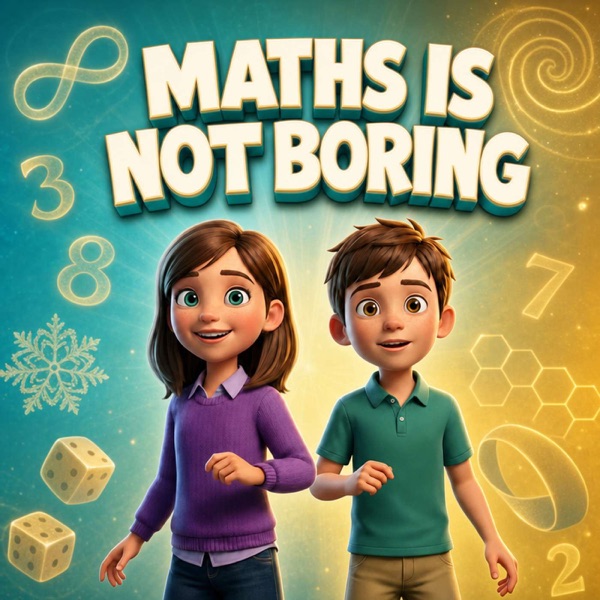
Maths for Kids / Maths is Not Boring: The Kids Maths Podcast
A groundbreaking podcast for curious kids aged 4-12 that proves maths is anything but dull.
Join our fictional AI hosts Mira, a brilliant 9-year-old, and her younger brother Finn, age 7, as they set off on a journey into one great mathematical idea each episode. From numbers that never end and shapes with only one side to the strange rules of chance and the secret patterns in a snowflake, each episode uncovers an idea that is simple at its heart and extraordinary because it is everywhere - told in a way that actually makes sense to kids.
Nobody does sums here. Whether you're discovering why infinity comes in different sizes, how a shuffled pack of cards is almost certainly in an order no one has ever seen, why honeycombs are made of hexagons, where the number zero came from, or what makes a prime number special - Maths is Not Boring turns big ideas into stories that ignite curiosity and wonder, and gives kids one more clue to how the world works.
Because maths isn't a list of rules to learn. It's the most beautiful way anyone has ever found of seeing the world.
A note on why we use AI. For us, AI allows us to deliver learning at a scale and quality that previously would have been too expensive. If we make the odd technical error, or the sound goes a bit funny, bear with us, we’re trying our best. We hope you enjoy the show!
- Kids & Family chart
- #147
- Episodes
- 53
- Releases
- Daily
- Typical length
- 11 min
- On air since
- 2026
- Latest episode
- 19 hours ago
Episodes
53 episodes, newest first
-
12 min
What is a weather forecast?
Season 1, Episode 903
Show notes
Have you ever looked at a weather app and seen a "70% chance of rain"? What does that actually mean? Most people think it means it will rain for 70% of the day, or that 70% of your city will get soaked. But that is entirely wrong! Join Mira and Finn as they uncover the mind-bending math behind predicting the weather!
Our journey starts all the way back in London in 1861 with a brilliant sea captain named Robert FitzRoy, who once sailed the world with the famous scientist Charles Darwin. FitzRoy created some of the very first public weather forecasts to keep sailors safe from dangerous storms!
Today, scientists use giant supercomputers to create dozens of different fake futures for tomorrow's weather. They let these futures race each other inside the computer! So, if your app says there is a 70% chance of rain, it means that out of ten identical futures, seven of them have rain falling right on your house! Grab your umbrella and get ready to hold a little piece of probability in your hand! It is a magical game of chance with the sky!
-
13 min
What is a tangram?
Season 1, Episode 902
Show notes
Have you ever played with a puzzle that can turn into a crouching cat, a running person, or a tall sailing boat? Welcome to the magical world of tangrams! A tangram is a famous puzzle from China made of exactly seven pieces: five triangles, one square, and a slanted shape called a parallelogram. When an American sea captain brought these puzzles home in 1815, it started a massive craze across America and Europe. People were so obsessed that even the French Emperor Napoleon played with them while stranded on a lonely island! But here is the most amazing secret hiding inside those seven pieces: no matter what crazy shape you build, it will always cover the exact same amount of space on the table. In maths, this mind-bending trick is called "conservation of area"! Join Mira and Finn as they uncover the incredible history and hidden maths behind this shape-shifting puzzle. Grab your puzzle pieces and let's get building!
-
12 min
What is Benford's Law?
Season 1, Episode 901
Show notes
Have you ever thought about which number is the most common in the whole wide world? You might think numbers are totally fair and show up equally, like rolling a giant dice. But guess what? The universe has a secret favorite number!
Join Mira and Finn on Maths is Not Boring as they uncover the amazing mystery of Benford's Law! Our story starts all the way back in 1881, when an astronomer named Simon Newcomb noticed something super weird at the library. A heavy book of numbers was completely worn out and grubby on the pages starting with the number 1, but totally pristine on the pages starting with 9!
Decades later, a physicist named Frank Benford tested 20,000 real-world numbers, from the lengths of rushing rivers to the populations of huge cities. He discovered that the number 1 shows up as the first digit a whopping 30 percent of the time! Discover how this magical math rule actually works, why growing towns get "stuck" on the number 1, and how real-life scientists use this invisible pattern as a secret lie detector to spot made-up numbers!
-
9 min
What is a labyrinth?
Season 1, Episode 899
Show notes
Have you ever been totally lost in a spooky corn maze, wandering around tall stalks as the sun goes down? What if we told you there is a secret math trick to escape ANY maze without a map? In this episode of Maths is Not Boring, Mira and Finn uncover the amazing secrets of the labyrinth! We travel back to an ancient Greek legend to see how the hero Theseus escaped the grumpy Minotaur's twisting labyrinth using just a ball of thread. But what if you don't have any string? Learn about the magical "right-hand rule"—a genius math trick where you never let go of the wall! Discover how tricky maze builders in 1690 created sneaky "islands" at Hampton Court Palace to mess up this rule, and find out why your very own robot vacuum cleaner uses maze math every single day to clean your living room. Grab your favorite listening spot and get ready to solve the ultimate puzzle. You will never look at a maze—or your vacuum cleaner—the same way again!
-
11 min
What is 360 degrees?
Season 1, Episode 898
Show notes
Have you ever watched a skateboarder do a crazy full spin in the air and heard someone call it a "360"? But wait, where does that giant number even come from? Why do we use 360 to measure one single spin? In this amazing episode of Maths is Not Boring, Mira and Finn uncover a mathematical secret that is over two thousand years old! We are traveling all the way back to ancient Babylon to meet the brilliant astronomers who first chopped the huge night sky into 360 tiny slices. Discover how the stars take one tiny step each night to make a full circle in about a year (which is super close to 360 days!), and why 360 is the most perfect number for dividing things up evenly! You will also learn why the sharp corner of your favorite book is exactly 90 degrees, and how these ancient numbers are still used today to steer giant ships and guide airplanes through the clouds! Get ready to look at a simple spin in a completely new way. Put on your ancient astronomer hat and let's go!
-
13 min
What is Pascal's triangle?
Season 1, Episode 897
Show notes
Imagine building a pyramid entirely out of numbers! Start with a single '1' at the very top. The only rule to build the rest? Every number inside is just the two above it added together! It sounds incredibly simple, but this one tiny rule creates one of the most magical shapes in the universe: Pascal's triangle! Join Mira and Finn as they uncover the mind-bending secrets hiding inside this famous number pyramid. You'll find regular counting numbers, secret patterns used for setting up bowling pins, and even a quick way to figure out how many pairs of friends you can make! But the best part? If you color in only the odd numbers, a beautiful, infinite mosaic of tiny triangles magically appears! Even though it's named after the French thinker Blaise Pascal from 1654, brilliant mathematicians and poets in ancient India, Persia, and China discovered it hundreds of years earlier. It can even help you understand games of chance like flipping coins and rolling dice! Get ready to explore an infinite puzzle that never, ever breaks!
-
9 min
What is a leap year?
Season 1, Episode 896
Show notes
Have you ever imagined building a snowman in the middle of July? That is exactly what could happen if we didn't have leap years! Join Mira and Finn as they uncover the mind-bending space secret behind February 29th. You will discover that a year isn't actually a neat 365 days long—it takes the Earth 365 and a quarter days to travel all the way around the Sun! Without that extra quarter of a day, our calendar would slowly drift away from the seasons until summer turned into winter.
Learn how the Roman leader Julius Caesar tried to fix this giant mess by adding one extra day every four years. But nature loves a tricky fraction, and his math was off by just eleven minutes! Find out how Pope Gregory XIII made an even cleverer rule, and hear the wild true story of why the people of Britain once had to skip eleven whole days in 1752—going to sleep on September 2nd and waking up on September 14th! Get ready to bend your brain and travel through time as we explore the incredible science of calendars!
-
12 min
What are irrational numbers?
Season 1, Episode 895
Show notes
Have you ever tried to measure something, only to find the number goes on forever? Join Mira and Finn as they uncover one of the biggest, wildest mysteries in the history of mathematics! Over two thousand years ago, a group of ancient Greek thinkers called the Pythagoreans believed the whole universe was built on neat, perfectly tidy fractions. But then, a man named Hippasus looked at a totally normal square and its diagonal line. When he tried to measure it, he discovered a wild, rebellious number that just wouldn't stop! These never-ending decimals are called irrational numbers, and their discovery literally shocked the ancient world! Learn how a simple bathroom floor tile hides a magical portal to infinity, and why a normal piece of A4 printer paper has a secret mathematical superpower. You actually hold an irrational number in your hands every single day without even knowing it! Get ready to look at straight lines, shapes, and paper in a completely new way. Tap play to dive into this mind-bending mathematical adventure!
-
9 min
Who was Florence Nightingale?
Season 1, Episode 894
Show notes
Have you ever looked at a giant list of numbers and felt your brain turn to mush? You're not alone! A long time ago in 1854, a nurse named Florence Nightingale traveled to an army hospital in Scutari to help sick soldiers. But she quickly discovered a shocking secret: the dirty, crowded hospital was actually making soldiers sicker than the battles were!
Florence kept incredibly careful records and gathered thousands of numbers to prove this. But there was a huge problem. The busy officials back in London refused to read her boring, gigantic lists of numbers! How could she make them see the truth?
With the help of a statistician named William Farr, Florence did something truly magical. She turned her numbers into a picture! By drawing a brilliant chart shaped like a flower—called a polar-area diagram—she made the invisible truth beautifully clear in a single glance. Her amazing chart convinced leaders to clean up the hospitals and saved countless lives! Dive into this incredible true story to learn how a magnificent math flower changed the world forever!
-
11 min
What is the math of origami?
Season 1, Episode 893
Show notes
Did you know that every time you fold a simple paper airplane or a beautiful paper crane, you are actually doing some seriously cool math? It’s true! For centuries, people folded paper just for fun, but in the 1980s, a Japanese physicist named Jun Maekawa discovered a secret rule hiding inside the paper. If you flatten out an origami shape, the creases always follow a strict mathematical code of upward "mountains" and downward "valleys" that always differ by exactly two!
But that’s not all! A single sheet of paper can solve puzzles that are totally impossible with normal tools. For two thousand years, people tried to split an angle into three equal parts with just a ruler and compass. In 1837, mathematician Pierre Wantzel proved it was impossible—but guess what? A few clever paper folds can do it easily!
These amazing origami rules aren't just for making fun shapes on your desk. They are so incredibly powerful that scientists use them to pack giant solar panels into rockets and send them into outer space! Join Mira and Finn as they unfold the mind-blowing secrets of origami!
-
12 min
What is a solved game?
Season 1, Episode 891
Show notes
Have you ever played a game of noughts and crosses (or tic-tac-toe!) and ended up in a tie every single time? You weren't playing it wrong—you were actually playing it perfectly! Join Mira and Finn as they uncover the mind-bending math behind solved games! A solved game is a game where the perfect outcome is one hundred percent known from the very first move. Discover the amazing true story from 1952, when a Cambridge student named Sandy Douglas taught a giant, room-sized computer called EDSAC to play noughts and crosses using a chunky rotary telephone dial! The crazy part? The computer never lost a single game! Learn why checkers is also a solved game (after computers spent 18 years checking 500 billion billion possibilities!), and why chess has more possible games than atoms in the entire universe! Plus, find out how the brilliant math used to master these games helps plan real-world traffic lights and huge auctions. Tune in to find out why a perfect brain sometimes just leads to a massive tie!
-
13 min
What is volume?
Season 1, Episode 890
Show notes
Have you ever wondered how to measure the exact size of a twisty, bumpy, lumpy dragon toy? It sounds completely impossible! But over two thousand years ago, an incredibly smart ancient Greek thinker named Archimedes solved this exact mystery using... a bath! In this amazing episode, we travel back to the ancient city of Syracuse in Sicily. King Hiero had a gigantic problem: he thought a sneaky goldsmith had stolen some royal gold and swapped it for cheaper silver when making his spectacular new crown! The king ordered Archimedes to find out the truth without making a single scratch on the beautiful crown. Archimedes was completely stuck until he stepped into a bathtub filled to the very top. Splosh! As the water spilled over the sides, he realized a brilliant secret about how objects take up space, called volume! Legend says he was so excited, he ran through the streets shouting, "Eureka! I have found it!" Join Mira and Finn as they explore how this simple bath gave the world a brilliant mathematical tool that scientists still use today to measure everything from space rocks to crazy toys!
-
11 min
What are magic squares?
Season 1, Episode 889
Show notes
Have you ever heard of a math puzzle so mysterious that famous artists hid it in paintings and giant turtles carried it on their backs? Welcome to the incredible world of magic squares! These aren't just ordinary boxes of numbers. In a magic square, every single row, column, and diagonal adds up to the exact same secret number! Join Mira and Finn as they travel back in time to ancient China, where a legendary giant turtle climbed out of a rushing river with a magical pattern of dots on its shell. Then, journey to Germany in the year 1514 to uncover a secret code hidden inside a stunning masterpiece by the artist Albrecht Dürer—he even snuck the year he made it into the math! You will also find out which famous American inventor (who famously experimented with kites and lightning!) used to doodle massive magic grids just because he was bored in long meetings. If you love Sudoku, secret codes, or amazing patterns, you will not want to miss this mind-bending puzzle adventure!
-
12 min
What is a percentage?
Season 1, Episode 888
Show notes
Have you ever noticed that weird little symbol on your phone's battery or your weather app? The percent sign (%) is everywhere, but what does it actually mean? Join Mira and Finn as they uncover the invisible mathematical superpower hiding in plain sight! You'll travel back over two thousand years to Ancient Rome, where Emperor Augustus created a special rule called the "centesima" to collect exactly one out of every hundred items sold at massive, chaotic auctions. Discover how thinking "out of a hundred" is an amazing trick that lets you compare absolutely anything in the entire universe on the exact same scale—whether it's half of a tiny peppermint sweet or half of a gigantic football stadium! Plus, find out the hilarious true story of how hurrying Italian merchants scribbling down the words "per cento" squashed their messy handwriting into the famous percent symbol we use today. Is it really mathematically impossible to give 110 percent effort on the sports field? Tune in to find out!
-
13 min
What is six degrees of separation?
Season 1, Episode 887
Show notes
Have you ever wondered how you might be connected to a baker in Peru or a fisherman in Japan? It sounds like magic, but it is actually math! In 1929, a Hungarian writer named Frigyes Karinthy came up with a wild idea: that every single person on Earth is connected by just a few invisible handshakes! Decades later in 1967, an American scientist named Stanley Milgram decided to test this theory in real life. He asked people in the middle of the United States to mail folders to a specific stockbroker in Boston, but they could only pass the mail to someone they knew personally! Believe it or not, the folders that successfully made it there took an average of only five or six steps! This incredible pattern is called a Small-World Network, and it explains how funny jokes, catchy songs, and even the common cold spread so incredibly fast. Join Mira and Finn on this mind-expanding episode as they uncover the hidden web that links the entire world together! You will never look at a crowd of strangers the same way again!
-
11 min
What are coordinates?
Season 1, Episode 886
Show notes
Have you ever played a game of Battleships, looked at a secret pirate treasure map, or watched a little red pin drop on a smartphone map? If so, you have used coordinates! But what exactly are they, and who invented this amazing invisible grid? Join Mira and Finn as they uncover the magic of the Cartesian grid!
Travel all the way back to the year 1637 to meet René Descartes, a brilliant French thinker who loved sleeping in until noon. Legend has it that while he was staring at his ceiling from his cozy bed, he watched a tiny fly crawl across the roof and wondered how to describe exactly where it was. His big idea? You only need two numbers—how far across, and how far up—to pin down any spot on a flat page!
Discover how this one simple idea built a magical bridge between shapes and numbers, and how another clever thinker named Pierre de Fermat had the exact same idea at the same time. Tune in to find out how an invisible web of lines secretly runs our modern world!
-
10 min
How did Julius Caesar write secret messages?
Season 1, Episode 885
Show notes
Imagine you are a Roman general holding a piece of parchment, but all the words are a completely jumbled mess! Did the messenger drop it in a puddle? No! You are holding a top-secret message locked by Julius Caesar himself! Join Mira and Finn as we travel back two thousand years to Ancient Rome to uncover the amazing mathematical secret behind the famous Caesar shift. Discover how sliding the alphabet over by just three letters created a giant game of hide-and-seek between clever code-makers and code-breakers! We will find out how Caesar's great-nephew Augustus used his own sneaky cipher, and how this brilliant ancient trick started a race that lasted all the way to Alan Turing and the brilliant code-breakers at Bletchley Park during the Second World War. But the race isn't over yet! Did you know you use super-powered secret ciphers every single day? Find out how the exact same idea protects the text messages and video calls you make right now! Get ready to crack the code and discover the incredible math hiding right inside your pocket!
-
10 min
What is a Reuleaux polygon?
Season 1, Episode 883
Show notes
Have you ever noticed that manhole covers on the street are almost always round? It turns out, this isn't just a random design choice—it is a life-saving piece of maths! If a manhole cover were square, it could accidentally tilt and slip diagonally right down the hole, crashing into the dark sewer below! But a circle is a special shape with "constant width." That means no matter which way you turn it, measure it, or tip it, it is exactly the same distance across. It can never fall in! But hold onto your hats, because circles aren't the only shapes with this math magic. In the 1870s, a German engineer named Franz Reuleaux discovered weird, bulging, curved-sided shapes that also have constant width! Even though they have corners, they can roll completely flat! Join Mira and Finn as they uncover the incredible secrets of Reuleaux polygons. You will even learn how the bumpy, seven-sided British fifty pence coin tricks vending machines into thinking it is perfectly round! Get ready to look at the streets and your piggy bank in a totally new way!
-
12 min
What is estimation?
Season 1, Episode 882
Show notes
Have you ever tried to guess how many sweets are in a giant glass jar? It is super tricky! Usually, if you ask just one person, their guess is way off. But what if you asked hundreds of people and put all their wrong guesses together? Could they magically find the exact right answer?
Join Mira and Finn on a time-traveling trip back to a bustling country fair in Plymouth, England, in the year 1906! Right in the middle of the fair was a massive, heavy ox. A curious scientist named Francis Galton watched as 787 people paid a tiny coin to guess the giant animal's weight. Some guesses were way too high, and some were way too low. But when Galton lined up every single piece of cardboard and found the exact middle guess, something unbelievable happened! The crowd’s middle guess was 1,207 pounds, missing the real weight by less than one percent!
Discover the amazing mathematical magic of estimation, learn what a "median" is, and find out why the "wisdom of the crowd" means that we are always smarter when we work together! You will be a master at guessing games!
-
10 min
What is a random walk?
Season 1, Episode 881
Show notes
Have you ever wondered what happens if you wander around completely by chance? Imagine a tiny ant on a giant, endless flat grid. At every single corner, she rolls a four-sided dice to decide which way to go: left, right, forwards, or backwards! Do you think she will ever find her way back home? Amazingly, mathematician George Pólya proved that the answer is YES! Given enough time, she is mathematically guaranteed to step on her exact starting spot again!
But what if she was a bird flying up and down in the sky? The rules completely change! In 3D space, a random wanderer only has a one-in-three chance of getting home, and will probably get lost forever! Join Mira and Finn as they explore the mind-bending mystery of Random Walks! We’ll travel back in time to discover how jiggling flower pollen amazed a botanist, and how the famous Albert Einstein figured out that invisible water molecules act like wild bumper cars! You’ll never look at a spreading drop of blue ink or a flying bird the exact same way again!
On these lists
Maths for Kids / Maths is Not Boring: The Kids Maths Podcast is one of the shows picked out on this list

More in Education
Placed highest on Apple Podcasts' Education chart right now