Podcast
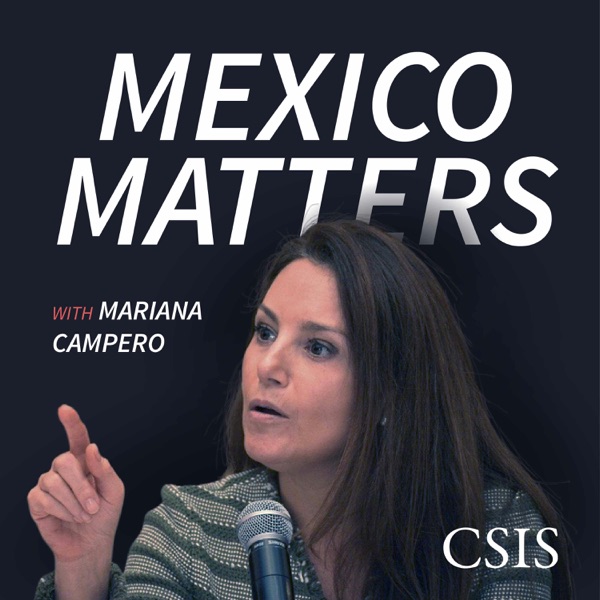
Mexico Matters
The Mexico Matters podcast series highlights key developments in Mexico and their impact on the United States.
Produced by Marla Hiller.
- Episodes
- 60
- Releases
- Monthly
- Typical length
- 43 min
- On air since
- 2021
- Latest episode
- 6 days ago
Episodes
60 episodes, newest first
-
43 min
Drones, Cartels, and Sovereignty: Inside the U.S.-Mexico Security Cooperation
Show notes
In this episode of Mexico Matters, Mariana Campero is joined by David Mora, Senior Analyst for Mexico at the International Crisis Group, for a candid, field-based examination of the escalating power of Mexican cartels and the controversial increase in bilateral intelligence cooperation.
Together, they unpack the subtleties and the realities of criminal territorial control and how criminal group dominance impacts everyday life and regional economies. They also explain how drone technologies are being weaponized by cartels, through improving cartels’ ability for control, surveillance, and waging war. They also discuss how President Claudia Sheinbaum has drawn a clear red line of cooperation with the United States and is not applying the same rules when it comes to prosecuting members of her own party. Finally, they speak about the systemic challenge of U.S. firearm trafficking into Mexico, and the future of cross-border intelligence sharing.
-
49 min
Lower Than Tokyo: Mexico's Fertility Shock and Growth Puzzle
Show notes
In this episode, Mariana Campero speaks with Valeria Moy, Director of IMCO and host of the Peras y Manzanas podcast. They kick off with a demographic shockwave: Mexico’s Statistics Institute, INEGI, released an intercensal figures which revealed that Mexico’s fertility rate plummeted to 1.2, with Mexico City dropping to an astonishing 0.8—lower than Tokyo. What does the rapid shattering of the "endless young labor supply" mean for the nation's pension system, long-term productivity, and labor market?
Beyond the demographic shift, they tackle Mexico’s persistent growth puzzle. Despite direct access to the world’s largest market, annual GDP growth remains stagnant at around 2% (or lower). Valeria unpacks the structural bottlenecks, fiscal handcuffs left behind by previous infrastructure projects, low tax revenues due to an informal economy, and the widening gap between nearshoring hype and actual foreign direct investment.
From the trade-offs of the "Super Peso" to the real economic costs of judicial uncertainty and insecurity, this episode delivers a sharp, reality-grounded look at what it will take for President Claudia Sheinbaum’s administration to unlock real potential growth or not.
-
51 min
Energy is Destiny
Show notes
In this episode, Mariana Campero sits down with Guillermo García Alcocer, former chairman of Mexico’s Energy Regulatory Commission (CRE) and one of the region’s premier energy policy experts. Together, they break down Mexico’s dramatic shift from a dominant energy exporter to a country relying on the U.S. for over 70% of its refined fuels and natural gas. They explore the strategic trade-offs and vulnerabilities of this dependence on cheap American gas, as well as the pragmatic policy shifts being implemented to power Mexico's booming manufacturing sector and data centers.
They also discuss the unrealistic outlook for Mexico’s new policy on fracking, Pemex’s mounting debt burden, and why public-private "mixed contracts" struggled to attract bidders.
Finally, they look at the broader regional landscape, examining how the rise of energy players in Guyana, Brazil, and Venezuela could permanently redirect vital capital away from Mexico, and why Mexico’s own energy policies mean fewer companies are moving to Mexico.
-
47 min
Soccer in America: From the Sidelines to the Mainstream
Show notes
In this episode, Mariana sits down with Andres Martinez, journalist, Co-Director of the Great Game Lab at Arizona State University, and author of the gripping new book, The Great Game: A Tale of Two Footballs and America’s Quest to Conquer Global Sport.
Together, they decode the massive forces driving soccer from the American fringes into the mainstream. From the explosive evolution of the tournament since 2024 to becoming a global blueprint for women’s soccer, they break down how American capital is aggressively buying into and controlling historic European clubs, among others.
They also look ahead to the expanded 48-team World Cup. What are the realistic odds for Mexico and the United States teams to survive the brutal new Round 32 and move beyond?
Finally, they dive into a fascinating, high stakes human story unfolding on the U.S.-Mexico border, where scouts from both federations fiercely battle to recruit the next generation of dual-national stars.
-
26 min
Iran, the World Cup, and the New Asymmetric Front: A Global Game of Chicken
Show notes
In this episode, Mariana speaks with counter-terrorism and Middle East expert Dan Byman to dissect the current state of the US-Iran conflict and its potential impact on the upcoming North American World Cup 2026. They analyze Iran’s increased deterrence positioning with the closure of the Strait of Hormuz, their use of asymmetric warfare, and lay potentials scenarios to explain Iran’s current terrorism restraint. Is it a sign of incapacity or strategic pause? They also discuss the importance for the Iran’s soccer players to participate in the sporting tournament,ent and the risks it implies from a security and diplomatic perspective. They discuss why Mexico can be a security “soft spot” as the country maintains diplomatic ties with Teheran, and the bigger challenges posed by a lone person attack.
-
49 min
It's the Monopolies, Stupid
Show notes
In this episode, Mariana speaks with Adolfo Babatz, Founder and CEO of Clip, the company that transformed the Mexican streetscape by not only putting a payment terminal into the hands of micro-merchants but also by offering them financial services to help them become more efficient to survive.
They discuss the structural issues blocking Mexico’s fintech revolution and digital currency adoption. They also explore what other countries like Brazil and India have done to reduce the attractiveness of cash, the impact of AI on Clip and Latin America, and which model will the region follow: the “Super App” model of China, or the fragmented, specialized approach of the U.S.
Lastly, they touch upon Adolfo’s personal qualities and his mission to bridge the socioeconomic gap between the banked and unbanked merchants.
-
38 min
U.S.-Mexico Tensions in the Era of the Don-Roe Doctrine
Show notes
Note: This episode was recorded on February 17th, 2026, before the death of Mexican cartel leader “El Mencho.”
In this episode, Mariana speaks with Jorge Castaneda, a Mexican politician and academic who served as Secretary of State from 2000 to 2003.
They discuss President Trump’s high-pressure stance toward Mexico and how President Sheinbaum has thus far been able to navigate his demands while avoiding a face-to-face meeting. They also explore the on-the-ground realities behind President Trump’s claims that Mexican trafficking organizations are allied with the government, the recent shifts in Mexico's security strategy, and the risks of a unilateral U.S. incursion.
Finally, the conversation turns to the broader region, examining the likelihood of regime change in Cuba, the evolving situation in Venezuela, and the anticipated pushback to the new "Don-Roe Doctrine" in South America.
As these nations increasingly depend on China as a primary market for commodities and a major source of foreign direct investment, the tension between U.S. hemispheric policy and global economic realities has never been higher.
-
41 min
Trump the Price Setter, Mexico the Price Taker
Show notes
In this episode, Mariana speaks with Alan Stoga, former partner of Henry Kissinger and Chairman of the Tallberg Foundations, about the historical consequences of the Trump presidency, how the world we grow up in is morphing, and what is likely to be America’s role in this new world.
They also discuss how countries like Mexico will not only have to learn how to adapt to this new context but also recognize that President Trump will not shy away from merging economic, commercial, military and security tools to achieve his desired outcomes. Lastly, they discern how the Don-Roe Doctrine is different (or similar) to the traditional U.S. approach towards Latin America, and how, in this context, China's presence in the Americas might be challenged.
-
37 min
Until You Run Out of Other People’s Money
Show notes
In this episode, Mariana speaks with Juan Pablo Spinetto, an opinion columnist at Bloomberg covering Latin America business, economic affairs and politics, about President Claudia Sheinbaum’s first year in office.
They discuss the differences in her style and policies from her predecessor, the popularity and sustainability of her government’s entitlements, and the biggest challenges she and Mexico will face in 2026, particularly when renewing (or renegotiating with President Trump) the North American Free Trade Agreement (USMCA).
They also talk about the rationale behind Mexico’s recent imposition of a 50% tariff on 1,400 goods coming from China and other Asia countries and the potential short term impact these tariffs might have on Mexican consumers and manufacturers.
Lastly, the touch upon the current U.S. military build up in the Caribbean and the economic pressure the U.S. is currently imposing on the Venezuelan regime, as well as the geopolitical risks in the region of a U.S. intervention.
-
40 min
AI: Leapfrogging into the Future
Show notes
In this episode, Mariana speaks with Jimena Pardo and Federico Antoni, Managing Partners of Hi Ventures, a Venture Capital fund investing in AI startups in Latin America. They discuss how a second generation of entrepreneurs are applying AI to find unique solutions and what potential economic (and other) benefits AI could bring to the region. They also speak about how AI is being used and adapted at the same time than in any developed country, as opposed to the Internet, smart phones or other technologies which took years to penetrate due to a lack of infrastructure.
They also explain how WhatsApp has helped to familiarize most people in the region with AI tools to conduct day-to-day activities. They analyze how AI’s productivity benefits might be greater in the region as AI allows businesses with systems dating back to the 1980s to leapfrog into the future. And they visit the problems in the region where AI entrepreneurs are focusing their attention, how most entrepreneurs thus far are adapting U.S. vs Chinese platforms and list the key gaps that need to be addressed to allow the region to reap AI’s potential.
-
47 min
Can the U.S. Win the Narcos War?
Show notes
In this episode, Mariana speaks with Ioan Grillo, a journalist and prolific author specializing in organized crime and drug trafficking. They discuss how and why security cooperation between the U.S. and Mexico has increased to historic levels—fueled by the threats and demands imposed by President Trump, the impact U.S.-Mexican cooperation could actually have (and is starting to have) on the ground, the power and control organized crime exerts in large parts of the Mexican territory, and the size of the U.S. drug market which fuels this vicious circle. They also speak about the internal cartel wars, benefits that the designation of cartels as terror organizations could bring, the complications of going after the money, and how the use of military grade weaponry is changing the realities of this war.
-
44 min
Breaking All the Rules
Show notes
In this episode, Mariana speaks with Juan Carlos Baker, former USMCA negotiator and Director General for North America at the Ministry of the Economy, about the impact tariffs have had on Mexico and how they have served President’s Trump goal of curbing the flow of fentanyl into the U.S. They also discuss why 83% of Mexican exports are currently being exempted from tariffs, the consequences of the U.S. signing agreements with Japan, Europe, South Korea before its largest trading partner, and the unintended (or intended) consequences for North American automobile manufacturers who are still subject to 25% tariffs. They also offer a factual description behind Chinese exports and investments in Mexico and on how Mexico has been in breach of USMCA.
-
27 min
Benefiting Cartels by Law
Show notes
In this episode, Mariana speaks with former Supreme Court Minister, Jose Ramon Cosío about the implications of the judicial constitutional reform pushed by President Claudia Sheinbaum and passed by Mexico’s Congress. The reform effectively kills the independence of all local, state, and federal judges as they now must go through elections like any other local, state, or federal politician. Under the new laws, approximately 2,000 judges have been fired and are being replaced by those recently elected out of a pool of approximately 7,700 candidates. Mariana and Jose also discuss the likelihood of the new laws benefiting organized crime organizations, foreign governments, or specific interest groups—or any other group with enough resources to support specific candidates. They speak about how these new laws are also a reversal to the rule of law and how the lack of certainty will hurt Mexico’s attractiveness as an investment destination, both national and international.
-
36 min
More Carrots and Less Sticks
Show notes
In this episode, Mariana speaks with Dr. Ryan Berg, director of the Americas Program at CSIS, about China’s increased presence in Latin America, transforming itself from a distant economic partner into a central player in Latin America’s trade, infrastructure, and key strategic technology sectors.
They also discuss how the new Trump Administration appears to be abandoning a policy of strategic neglect and is turning its attention towards the region. In addition, they discuss how Latin American countries don’t want to pick between the two biggest world economies and how the US can solve this dilemma by offering private-public partnerships in key strategic sectors.
Lastly, they analyze how various Latin countries are following the US in raising tariffs to protect their own industries from Chinese overcapacity, and why Mexico must live up to its commitment and start tracking Chinese investment in the country, particularly in sensitive areas to maintain the trust of the Trump Administration.
-
45 min
What Mexico Has to Offer
Show notes
In this episode, Mariana speaks with Alan Bersin, former U.S. Attorney for the Southern District of California and US Border Czar under President Obama and Luis Rubio, a leading Mexican political analyst, Chairman of the think tank Mexico Evalua. They discuss the impact of President Trump’s migration policies at the border and on the Mexican side, analyze the potential benefits of designating Mexican cartels as terrorist organizations, and discuss the need to increase security cooperation between the two countries. They also speak about the importance for the Mexican government to take a proactive approach in the issues of migration, security, and trade when negotiating with the United States and break down the many challenges that the Sheinbaum Administration is facing—externally and internally—to create the conditions for the country to grow.
-
29 min
Brazil’s Protectionist Model Should Be No Guide for the US
Show notes
In this episode, Mariana speaks with Pedro Pullen Parente, a remarkable Brazilian public servant and businessmen. Pedro was previously Minister of Planning, Chief of Staff, Minister of Mines and Energy under President Cardoso. He was also the CEO of Petrobras, ran Bunge Brazil, and was the CEO of BRF, one of the world’s largest food companies
Mariana and Pedro speak about the pros and cons of Brazil’s protectionist economic model. The model might serve as a vision for President Trump as high tariffs, local content requirements, and many other non-market barriers have allowed Brazil to protect its manufacturing sector and jobs while also lowering competitiveness and protecting vested interests.
They also discuss how choosing between the United States and China may not be beneficial to countries like Brazil as well as the likelihood that Brazil might benefit from the current trade war as increased food productivity in the country will allow it to increase supply. However, they emphasize how the only way for Brazil to reach its potential is to focus on removing its own internal barriers to competition and free markets, not the other way around.
-
35 min
Everything is Relative—including Tariffs
Show notes
In this episode, Mariana speaks with Luis de la Calle, renowned economist, former NAFTA negotiator and the CEO of CMM Asociados. They discuss the future of globalization, the current perceptions on trade, the potential consequences for North America—and the world—of imposing tariffs, and what can Mexico do to help more Mexican producers comply with USMCA. They also discuss the recent popularity surge of Mexican president, Claudia Sheinbaum, and what she needs to do to put her country (not her party) first.
-
46 min
Are Tariffs THE Right Weapon?
Show notes
In this episode, Mariana speaks with Kevin Brady, former U.S. Rep. (R-TX) and Chairman of the House Ways and Means Committee, and Kenneth Smith Ramos, former USMCA Chief negotiator for Mexico, about the shift in Washington away from free trade, President Trump’s use of tariffs as leverage to solve the fentanyl and border security crises, and the potential consequences of starting a trade war within North America by imposing 25% tariffs on Mexico and Canada. They also speak about the importance for Mexico to satisfy the US’s security demands and to comply with its own energy and other trade commitments in order to allow for a more successful 2026 review of USMCA. Finally, they discuss the importance for collaboration between the United States and Mexico to reduce the power of organized crime and address China’s growing presence in the region.
-
50 min
America and the World under Trump 2.0
Show notes
In this episode, Mariana speaks with Dr. Hamre, President and CEO of CSIS and Seth Jones, President of the Defense and Security Department at CSIS. They discuss the role America has had historically in the world and why it might be entering a new epoch of parochialism. They also speak about the world that President Trump has inherited and how its competition with China is playing out in Latin America and elsewhere. They analyze the importance for America to protect and strengthen its borders, the advantages and disadvantages of sending troops to the southern border, and designating cartels as terrorist organizations. Finally, they speak about the importance of increasing security and economic cooperation with Mexico.
-
36 min
Trump is Not The Enemy, Narcos Is
Show notes
In this episode, Mariana speaks with Vanda Felbab-Brown, a senior fellow in the Strobe Talbott Center for Security, Strategy, and Technology in the Foreign Policy program at Brookings. She is the director of the Initiative on Nonstate Armed Actors. She is also the co-director of the Brookings series on opioids: “The Opioid Crisis in America: Domestic and International Dimensions.
They discuss the unprecedented epidemic caused by the synthetic drug revolution and the role that Mexican cartels have played in driving this crisis, bankrolled by Chinese money laundering organizations. They also discuss what concrete actions the Mexican government should take to reduce the flow of narcotics and migrants across the border, and dive into how the Mexican cartels, aided by misguided policies, corruption, and weak judicial institutions, now control large swaths of Mexico’s territory. Finally, they speak about the importance of U.S. and Mexican cooperation to regain the Mexican territory from organized crime.
On these lists
Mexico Matters is one of the shows picked out on this list


More from Center for Strategic and International Studies
All Center for Strategic and International Studies podcasts
More in Government
Placed highest on Apple Podcasts' Government chart right now