Podcast
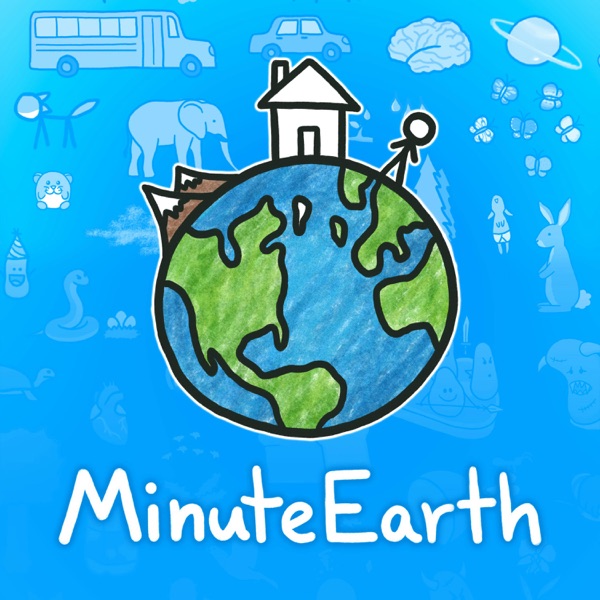
MinuteEarth
From the creators of the popular science show with millions of YouTube subscribers comes the MinuteEarth podcast. Every episode of the show dives deep into a science question you might not even know you had - but once you hear the answer, you’ll want to share it with everyone you know. Our team of scientists digs into the research and breaks it down into a short, entertaining explanation jam-packed with science facts and terrible puns. We’ll tell the incredible story of how monkeys crossed the Atlantic ocean on natural rafts, and we’ll explain why it gets hotter the deeper you dig underground.
- Earth Sciences chart
- #39
- Episodes
- 569
- Releases
- Daily
- Typical length
- 2 min
- On air since
- 2024
- Latest episode
- 2 days ago
Episodes
569 episodes, newest first
-
2 min
Why do humans stop growing at a certain point, while other animals don’t?
Show notes
Many bones have special layers of cells on each end known as "growth plates"; these cells are constantly dividing and turning into brand-new bone. That's what makes both you and, say, an alligator grow.
But in humans, once puberty is complete, our bodies release hormones that harden our growth plates permanently, turning them into "no-more-growth" plates.
Humans –along with other mammals, and birds– are energy-hungry critters. Our fast metabolisms allow us to run –or swim or fly– long distances, but they require a lot of energy to sustain, even when we’re at rest. And burning all that energy produces a lot of heat. And if you recall, as an animal grows, its volume, and therefore the amount of heat it produces, increases much faster than its surface area does – surface that's needed to vent that heat outward. Getting too big would burn us up, so it makes sense that there’s a biological process that limits our growth.
MinuteEarth is produced by Neptune Studios LLC
If you like what we do, you can help us!
- Sign up to our newsletter: http://news.minuteearth.com
- Share with your friends and family
- Leave us a comment (we read them!)
Learn more about your ad choices. Visit megaphone.fm/adchoices
Learn more about your ad choices. Visit https://megaphone.fm/adchoices
-
2 min
What does a mushroom get out of making animals trip?
Show notes
Here are three of our best theories:
The first is that fungi might not get anything from producing psilocybin. Maybe the compound is an evolutionary accident like our widow’s peaks, or a relic from the species’ past, like our tailbone nubbins.
Another idea is that maybe it helps them fend off hungry critters… after all, soil-bound species make all sorts of chemicals whose bitter taste or toxins keep herbivores at bay.
A third idea is that psilocybin helps the fungus spread its reproductive spores far and wide. Like, say a slug munches on a mushroom, triggering a psilocybin-induced seizure. That tripping-out slug with a belly full of spores might attract the attention of a toad, which might eat the slug, and then hop far away before it poops out the spores.
So, despite a lot of study, scientists still don't have a grand unified theory of what psilocybin does for fungi.
For now, the bottom line is that when it comes to our scientific understanding of psilocybin, there is still so mushroom for improvement.
MinuteEarth is produced by Neptune Studios LLC
If you like what we do, you can help us!
- Sign up to our newsletter: http://news.minuteearth.com
- Share with your friends and family
- Leave us a comment (we read them!)
Learn more about your ad choices. Visit megaphone.fm/adchoices
Learn more about your ad choices. Visit https://megaphone.fm/adchoices
-
2 min
What do YOU have in common with an Electric Eel?
Show notes
An electric eel can deliver a shock of as much as 860 volts, which is about seven times higher than the voltage of the average US power outlet. That’s enough to paralyze other animals, or even kill them outright.
Being able to produce electric shocks sounds… well… shocking, but all animals are capable of producing electricity – even you. Every time an animal’s nerve or muscle cell fires, it generates an itty-bitty amount of electricity; these tiny jolts do all sorts of important jobs, from regulating an animal’s heartbeat to making it’s body move.
MinuteEarth is produced by Neptune Studios LLC
If you like what we do, you can help us!
- Sign up to our newsletter: http://news.minuteearth.com
- Share with your friends and family
- Leave us a comment (we read them!)
Learn more about your ad choices. Visit megaphone.fm/adchoices
Learn more about your ad choices. Visit https://megaphone.fm/adchoices
-
2 min
What is kangaroo care - and why is it one of the best ways to help save at-risk premature babies
Show notes
One of the best ways to help save at-risk premature babies is to have their parents spend hours snuggling them to their bare chests; it's called kangaroo care because the skin-to-skin contact it creates is a lot like the cozy confines of a kangaroo’s pouch.
There seems to be a couple major reasons it works so well. First, kangaroo care is a great way to keep a baby warm.
Premature babies have less fat and more relative surface area than full-term babies, so they can’t always keep their body temperature up. And it turns out that skin is way better at conducting heat than air is. Preemies that get skin-to-skin care are 67% less likely to suffer from hypothermia than those that don’t.
Second, during kangaroo care, bacteria from the parent’s skin hop onto the baby. Which sounds dangerous, but in order to develop a healthy immune system, a baby needs to be exposed to the right amount of bacteria early in life. Full-term babies get this exposure in their mom’s womb during the last few months of pregnancy, but preemies miss out. By microdosing them with bacteria, kangaroo care can cut a preemie’s chances of developing a major infection like sepsis in half.
MinuteEarth is produced by Neptune Studios LLC
If you like what we do, you can help us!
- Sign up to our newsletter: http://news.minuteearth.com
- Share with your friends and family
- Leave us a comment (we read them!)
Learn more about your ad choices. Visit megaphone.fm/adchoices
Learn more about your ad choices. Visit https://megaphone.fm/adchoices
-
2 min
Milk Stealing
Show notes
One of the strangest-ever crime sprees hit a small town in England in 1921. It wasn't murder or bank robbery - instead, people were finding that the milk bottles delivered to their houses would have the foil caps pierced and the cream on top of the milk sucked out. Turns out, birds - specifically a species called great tits - had learned a new way to find a meal. The wildest part is that within a few years, birds all over Europe had copied the behavior.
The original birds who had figured out how to steal the cream had taught their neighbors how to do it, who in turn, taught their friends. It's a phenomenon called social transmission, and scientists can replicate it by teaching birds a pretty arbitrary skill - like opening a puzzle box in a specific way - and watching how it spreads through a population. Studying this phenomenon gives scientists a window into the way non-human animals learn new behaviors, even naughty ones like stealing.
MinuteEarth is produced by Neptune Studios LLC
If you like what we do, you can help us!
- Sign up to our newsletter: http://news.minuteearth.com
- Share with your friends and family
- Leave us a comment (we read them!)
Learn more about your ad choices. Visit megaphone.fm/adchoices
Learn more about your ad choices. Visit https://megaphone.fm/adchoices
-
2 min
Why space rocks are so hard to find
Show notes
There are a few reasons space rocks are so hard to find. For starters, more than two thirds of the Earth is covered with water, so for all the meteorites that actually get to Earth, most of them splash down into oceanic obscurity. For a meteorite to be discovered and studied, it has to land… on land. most meteorites that ARE found are found in Earth’s deserts. And it turns out that the biggest desert in the world is – you guessed it – Antarctica.
So of the 67,000 meteorites discovered and documented, some 42,000 have been found in Antarctica, and each year, expeditions bring back nearly 1000 more. But scientists estimate that the meteorites we’ve found so far are just the tip of the iceberg; they probably only represent about 13% of the space rocks locked up in Antarctica; so there are plenty more secrets left out there, lurking in the ice.
MinuteEarth is produced by Neptune Studios LLC
If you like what we do, you can help us!
- Sign up to our newsletter: http://news.minuteearth.com
- Share with your friends and family
- Leave us a comment (we read them!)
Learn more about your ad choices. Visit megaphone.fm/adchoices
Learn more about your ad choices. Visit https://megaphone.fm/adchoices
-
2 min
How Do Birds Use GPS?
Show notes
Birds are incredible navigators that can travel half the world to find the same patch of forest or ponds every single year.
Many birds learn their migration routes from older, more experienced birds while others make their migrations alone following maps encoded in their genes.
They track their positions using the sun, stars, and even landmarks like rivers.
But when all of these things fail, some birds can navigate by sensing the Earth’s magnetic field, although scientists aren’t completely sure how they manage to do it.
MinuteEarth is produced by Neptune Studios LLC
If you like what we do, you can help us!
- Sign up to our newsletter: http://news.minuteearth.com
- Share with your friends and family
- Leave us a comment (we read them!)
Learn more about your ad choices. Visit megaphone.fm/adchoices
Learn more about your ad choices. Visit https://megaphone.fm/adchoices
-
2 min
Birds have an embarrassing problem...
Show notes
This bird has a superpower most animals don’t have: it can fly. And the reason birds can fly is because every part of their body is optimized for an airborne life.
Birds have really efficient – and kinda weird – respiratory systems. They don’t just have two lungs like we do – they also have air sacs tucked away in their bodies to hold extra air.
Birds also have really big hearts to pump blood to their energy-hungry muscles, and they have big brains because flying requires smarts – I mean, they have to be quick thinkers to avoid flying into trees.
But there is a tradeoff – for some parts to become heavier, others had to become lighter. Birds lost many unneeded bones, like fingers, and even gave up their teeth and jaws, opting instead for lighter beaks.
Birds don’t even bother with a bladder – in other words, birds can’t even hold their pee because it might weigh them down too much.
MinuteEarth is produced by Neptune Studios LLC
If you like what we do, you can help us!
- Sign up to our newsletter: http://news.minuteearth.com
- Share with your friends and family
- Leave us a comment (we read them!)
Learn more about your ad choices. Visit megaphone.fm/adchoices
Learn more about your ad choices. Visit https://megaphone.fm/adchoices
-
2 min
Best Worst
Show notes
MinuteEarth is produced by Neptune Studios LLC
If you like what we do, you can help us!
- Sign up to our newsletter: http://news.minuteearth.com
- Share with your friends and family
- Leave us a comment (we read them!)
Learn more about your ad choices. Visit megaphone.fm/adchoices
Learn more about your ad choices. Visit https://megaphone.fm/adchoices
-
2 min
Synthetic Fuel
Show notes
MinuteEarth is produced by Neptune Studios LLC
If you like what we do, you can help us!
- Sign up to our newsletter: http://news.minuteearth.com
- Share with your friends and family
- Leave us a comment (we read them!)
Learn more about your ad choices. Visit megaphone.fm/adchoices
Learn more about your ad choices. Visit https://megaphone.fm/adchoices
-
2 min
Alternative Fuels
Show notes
MinuteEarth is produced by Neptune Studios LLC
If you like what we do, you can help us!
- Sign up to our newsletter: http://news.minuteearth.com
- Share with your friends and family
- Leave us a comment (we read them!)
Learn more about your ad choices. Visit megaphone.fm/adchoices
Learn more about your ad choices. Visit https://megaphone.fm/adchoices
-
2 min
Counting Fish
Show notes
MinuteEarth is produced by Neptune Studios LLC
If you like what we do, you can help us!
- Sign up to our newsletter: http://news.minuteearth.com
- Share with your friends and family
- Leave us a comment (we read them!)
Learn more about your ad choices. Visit megaphone.fm/adchoices
Learn more about your ad choices. Visit https://megaphone.fm/adchoices
-
2 min
Fish Evolution
Show notes
MinuteEarth is produced by Neptune Studios LLC
If you like what we do, you can help us!
- Sign up to our newsletter: http://news.minuteearth.com
- Share with your friends and family
- Leave us a comment (we read them!)
Learn more about your ad choices. Visit megaphone.fm/adchoices
Learn more about your ad choices. Visit https://megaphone.fm/adchoices
-
2 min
Collective Nouns
Show notes
MinuteEarth is produced by Neptune Studios LLC
If you like what we do, you can help us!
- Sign up to our newsletter: http://news.minuteearth.com
- Share with your friends and family
- Leave us a comment (we read them!)
Learn more about your ad choices. Visit megaphone.fm/adchoices
Learn more about your ad choices. Visit https://megaphone.fm/adchoices
-
4 min
The Heaviest Part of a Forest Is NOT What You Think
Show notes
To learn more about this topic, start your googling with these keywords:
• Canopy: The uppermost layer of a forest, formed by the crowns and foliage of the tallest trees.
• Detritus: Dead and decaying organic matter, such as fallen leaves, twigs, bark, and animal remains, that accumulates on the forest floor.
• Nutrient Cycling: The continuous movement of nutrients (such as nitrogen, phosphorus, and carbon) through a forest ecosystem, from soil to plants, through animals and decomposers, and back to the soil again.
• Topsoil: The uppermost layer of soil, typically rich in organic matter, nutrients, and microbial life. Topsoil is where most root growth, seed germination, and biological activity occur, making it essential to forest health and productivity.MinuteEarth is produced by Neptune Studios LLC
If you like what we do, you can help us!
- Sign up to our newsletter: http://news.minuteearth.com
- Share with your friends and family
- Leave us a comment (we read them!)
Learn more about your ad choices. Visit megaphone.fm/adchoices
Learn more about your ad choices. Visit https://megaphone.fm/adchoices
-
2 min
most of the images that pop up in a Google Image search for pine trees aren’t pine trees.
Show notes
MinuteEarth is produced by Neptune Studios LLC
If you like what we do, you can help us!
- Sign up to our newsletter: http://news.minuteearth.com
- Share with your friends and family
- Leave us a comment (we read them!)
Learn more about your ad choices. Visit megaphone.fm/adchoices
Learn more about your ad choices. Visit https://megaphone.fm/adchoices
-
2 min
Not A Pine
Show notes
MinuteEarth is produced by Neptune Studios LLC
If you like what we do, you can help us!
- Sign up to our newsletter: http://news.minuteearth.com
- Share with your friends and family
- Leave us a comment (we read them!)
Learn more about your ad choices. Visit megaphone.fm/adchoices
Learn more about your ad choices. Visit https://megaphone.fm/adchoices
-
2 min
Hot Water 2
Show notes
MinuteEarth is produced by Neptune Studios LLC
If you like what we do, you can help us!
- Sign up to our newsletter: http://news.minuteearth.com
- Share with your friends and family
- Leave us a comment (we read them!)
Learn more about your ad choices. Visit megaphone.fm/adchoices
Learn more about your ad choices. Visit https://megaphone.fm/adchoices
-
2 min
Hot Water
Show notes
MinuteEarth is produced by Neptune Studios LLC
If you like what we do, you can help us!
- Sign up to our newsletter: http://news.minuteearth.com
- Share with your friends and family
- Leave us a comment (we read them!)
Learn more about your ad choices. Visit megaphone.fm/adchoices
Learn more about your ad choices. Visit https://megaphone.fm/adchoices
-
5 min
What's The Fewest People That Could Repopulate Earth?
Show notes
To learn more about this topic, start your googling with these keywords:
• Gene Pool: The total collection of different genes within a population. A larger gene pool means more genetic diversity.
• Genetic Diversity: Having a wide variety of different genes within a population.
• Inbreeding Depression: The reduced biological fitness caused by loss of genetic diversity as a result of inbreeding, or mating between closely related individuals within a species.
• Recessive Genes: Genes that only cause a trait or disease when two copies are present (one from each parent).MinuteEarth is produced by Neptune Studios LLC
If you like what we do, you can help us!
- Sign up to our newsletter: http://news.minuteearth.com
- Share with your friends and family
- Leave us a comment (we read them!)
Learn more about your ad choices. Visit megaphone.fm/adchoices
Learn more about your ad choices. Visit https://megaphone.fm/adchoices
Earth Sciences lists
More Earth Sciences shows picked out from the charts








More in Earth Sciences
Placed highest on Apple Podcasts' Earth Sciences chart right now