Podcast
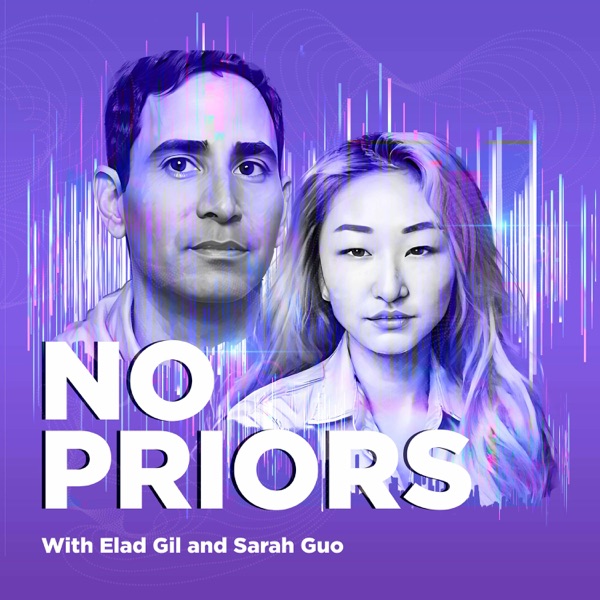
No Priors: Artificial Intelligence | Technology | Startups
At this moment of inflection in technology, co-hosts Elad Gil and Sarah Guo talk to the world's leading AI engineers, researchers and founders about the biggest questions: How far away is AGI? What markets are at risk for disruption? How will commerce, culture, and society change? What’s happening in state-of-the-art in research? “No Priors” is your guide to the AI revolution. Email feedback to show@no-priors.com.
Sarah Guo is a startup investor and the founder of Conviction, an investment firm purpose-built to serve intelligent software, or "Software 3.0" companies. She spent nearly a decade incubating and investing at venture firm Greylock Partners.
Elad Gil is a serial entrepreneur and a startup investor. He was co-founder of Color Health, Mixer Labs (which was acquired by Twitter). He has invested in over 40 companies now worth $1B or more each, and is also author of the High Growth Handbook.
- Technology chart
- #26
- Episodes
- 186
- Releases
- Weekly
- Typical length
- 41 min
- On air since
- 2023
- Latest episode
- 5 days ago
Episodes
186 episodes, newest first
-
38 min
Taking on ServiceNow: Coding Agents the Rest of Us with Serval Co-Founder and CEO Jake Stauch
Show notes
What happens when you put code-generation agents in the hands of enterprise IT teams? With Serval, you get a system where it's easy for everyone to be a builder. Sarah Guo and Elad Gil sit down with Serval co-founder and CEO Jake Stauch to analyze his company’s direct challenge to ServiceNow as the enterprise automation and service management system of record. Jake explains that by building an AI platform for enterprise IT departments with Serval, users can safely build while still safeguarding permissions by strict deterministic approvals and an audit trail. He also talks about ProServal, the company’s team that embeds automation engineers directly with customers in order to provide ongoing support and service. Jake also discusses how AI was the big unlock to taking on ServiceNow, why he’s betting on coding agents getting even better, why consumer is a window into what will happen next in enterprise and why the SaaS-pocalypse might look more like a consolidation, why background agents are still a moonshot in enterprise software, and the importance of hiring product-oriented engineers.
Sign up for new podcasts every week. Email feedback to show@no-priors.com
Follow us on Twitter: @NoPriorsPod | @Saranormous | @EladGil | @jakeserval | @getserval
Chapters:
00:47 – Jake Stauch Introduction and Serval’s Background
03:00 – Expanding Coding Agents Beyond Engineers
04:40 – Limitations with Personal Agents in Enterprise
06:29 – Deploying Serval Effectively in Large Orgs
07:55 – Day 1 Ambition and Attacking Enterprise Systems of Record
09:51 – Taking on ServiceNow with Workflow Automation Platform
11:01 – Betting on the Evolution of Coding Agents and Building Guardrails in Enterprise
13:48 – Big Risks, Big Rewards, and Big Predictions for Serval and Coding Agents
16:40 – Adopting Different Sets of Building Principles at an Enterprise Level
20:49 – Token Maxing, Long-Term Budget Impacts, and ROI
22:39 – The SaaS-pocalypse and SaaS vs. AI
24:39 – The Mental Model for Delivering Platform-Level Power to the IT User at Enterprise
26:43 – Building Automations with Catalyst and Raising Technical Competence
28:55 – The Next Wave: Background Agents and Autonomy in Enterprise
32:23 – Hiring Velocity and Unlimited Ambition at Serval
34:17 – Keeping Pace with Customers and Fundamental Shifts in Product Function
37:05 – Conclusion
-
41 min
Democratizing Security for the Agentic Web with CloudFlare CTO Dane Knecht
Season 1, Episode 184
Show notes
In the transition to the agentic web, security has become an afterthought. Now, organizations are racing to figure out what AI security means, and how to keep their data safe. Live from Cloudflare Connect, Sarah Guo sits down with Cloudflare CTO Dane Knecht to discuss the changing attacker landscape, and how his company is allocating its engineering resources to meet this emerging security challenge. Dane explains how enterprises that have moved away from castle-and-moat infrastructure to more of a zero trust infrastructure for security are in better positions than those who haven’t. He also discusses the challenges of patching 70 years of software and why the software development lifecycle will need to change for security for the agentic web, why he sees token spend in the next 18 months primarily going towards security rather than engineering, how the current web is in a ‘messy middle’ state where humans and agents are riding the same ‘rails’ on the internet, Cloudflare’s conference monetization gateway release as well as its Signals project with OpenAI, the rationale behind the release of Cloudflare OS, and the thinking behind a recent company restructuring. Plus, why Cloudflare hired one thousand interns, and why curiosity about AI is required to be successful at Cloudflare.
Sign up for new podcasts every week. Email feedback to show@no-priors.com
Follow us on Twitter: @NoPriorsPod | @Saranormous | @EladGil | @Cloudflare | @dok2001
Chapters:
00:00 – Trailer
00:55 – Cloudflare CTO Top Priorities
05:03 – Today’s Attacker Landscape
06:16 – State of Internet Infrastructure
07:31 – Shift Towards Security Spend
08:39 – Road to Better Software and Internet Security
09:50 – Building Secure Production Software
11:41 – Reducing Surface Area
12:54 – Near Future of the Web
17:27 – Monetization and Signals
19:13 – Success for Content Creators
20:07 – Workplace OS and Use Cases
24:07 – Restructuring for AI-First
27:11 – Token Budgeting
29:32 – Cloudflare’s Intern Strategy
33:39 – Importance of Curiosity
35:29 – Attacking the Legacy Software Security Problem
37:08 – Engineering Team Prioritization
38:25 – Open vs. Closed Models
39:43 – Democratizing Security for Everyone
41:29 – Conclusion
-
45 min
The New Apex Predator: CrowdStrike CEO George Kurtz on Adversaries Armed With AI Agents
Show notes
Adversaries are already running AI agents, and the fastest attacks now play out in seconds. Sarah Guo and Elad Gil sit down with CrowdStrike president and CEO George Kurtz on what AI-equipped attackers mean for enterprise security. George explains how agents are flattening the adversary pyramid by putting advanced tradecraft in the hands of low-skill attackers, and why CrowdStrike and Nvidia are building a frontier-style lab of their own to train security models. They also get into how open-weight and closed models compare on security, where CrowdStrike is directing its platform investment, lessons from the recent Hugging Face incident, and why George sees AI, like every platform shift before it, as a net creator of opportunity.
Sign up for new podcasts every week. Email feedback to show@no-priors.com
Follow us on Twitter: @NoPriorsPod | @Saranormous | @EladGil | @CrowdStrike | @George_Kurtz
Chapters:
00:42 – Trailer
00:59 – George Kurtz Introduction
00:12 – Agentic Landscape
01:34 – AI and Adversaries
03:40 – Open Weight Models and Adversarial Attacks
05:27 – Adversary Geography
07:24 – Attacker Capability in Context
10:14 – Hugging Face Takeaways
12:49 – CrowdStrike Frontier Security Models
15:22 – CrowdStrike Key Offerings
18:41 – What Differentiates CrowdStrike’s Models
22:47 – Near Term State of Security World
24:37 – State of Model Distillation
26:42 – Open Weight Model Importance and Cost
28:49 – Assessing Real Agent Threat
31:29 – Areas to Watch in AI
33:52 – Case for Defense Dominance
38:03 – Executive Advice
42:05 – Shifts Create Opportunity
44:14 – Conclusion
-
39 min
The Changing Physics of Cybersecurity and Drug Development with OpenAI President Greg Brockman
Season 1, Episode 129
Show notes
Technology has always been the fundamental driver of improvement for human quality of life. And with the recent rollout of advanced frontier models, like OpenAI’s GPT-6, humanity can now massively accelerate scientific discovery for its benefit. Sarah Guo and Elad Gil are joined by OpenAI President and co-founder Greg Brockman to discuss the company’s rapid progress across frontier models, cybersecurity, and scientific discovery. Greg shares how nearly 400 century-old math problems have been solved using its AI agents, and how the technology has the potential to transform other fields like biology in the realm of drug discovery. He also talks about how proactive, always-on AI agents like Dots impact modern productivity, why he believes the best UI is no UI at all, how cybersecurity is in a critical window of time to use peak intelligence to find and fix vulnerabilities in systems, and why OpenAI remains committed to keeping humans in the driver’s seat even as models surpass us in capability.
Sign up for new podcasts every week. Email feedback to show@no-priors.com
Follow us on Twitter: @NoPriorsPod | @Saranormous | @EladGil | @gdb | @OpenAI
Chapters:
00:42 – Trailer
00:59 – Greg Brockman Introduction
01:11 – AI and Advancements in Mathematics
05:55 – AI Communication and Oversight
07:45 – AI for Overcoming Biology Data Bottlenecks
11:28 – Revolutionizing Drug Discovery
14:18 – Changing Regulations to Accelerate Progress
16:51 – Dots the Proactive Agent
19:19 – Unifying Work and Consumer Agents
22:02 – How UI Will Evolve
26:08 – Cybersecurity in the AI Age
32:55 – Shift in Security Investment
35:49 – OpenAI’s Human-Centric Ethos
38:28 – Conclusion
-
1 hr 10 min
Beam: The Great American Open Model with ReflectionAI Co-Founder and CEO Misha Laskin
Season 1, Episode 181
Show notes
Is the future of frontier AI open or closed? ReflectionAI co-founder and CEO Misha Laskin joins Sarah Guo and Elad Gil to discuss the launch of Beam, the company’s 500 billion parameter open-weight reasoning model. Misha breaks down the pre-training and reinforcement learning required to produce Beam’s reasoning efficiency, the shift in enterprise compute from renting to owning intelligence, and how he believes that open models will capture the majority of global token demand. He also talks about the open model ecosystem in China and why competition with China’s models is a good thing, safety considerations around open models, and how frontier-level open models may accelerate the pace of scientific discovery.
Sign up for new podcasts every week. Email feedback to show@no-priors.com
Follow us on Twitter: @NoPriorsPod | @Saranormous | @EladGil | @MishaLaskin | @reflection_ai
Chapters:
00:42 – Misha Laskin Introduction
00:59 – Latest with ReflectionAI
02:07 – Challenges Building an Open Model
03:56 – ReflectionAI’s Agentic Shift
07:37 – Resources for Model Training
10:09 – Scaling Efficiency
12:18 – Training Beam
16:51 – Where Model Value Comes From
19:55 – Beam’s Reasoning Efficiency
22:35 – Monetizing Open Weight Models
25:03 – Future of Open Versus Closed Tokens
31:29 – Competition with Open Models
34:38 – Chinese Open Source Model Ecosystem
38:40 – Will Chinese Models Remain Open
44:44 – Safety and Open Models
53:02 – Debating Access to Powerful Tools
57:16 – AI and Scientific Progress
01:00:36 – Data Centers and Jobs
01:02:07 – Beam and Scientific Research
01:05:37 – Research Head Count to Compute Ratio
01:10:29 – Conclusion
-
36 min
Frontier Chips for Frontier AI Labs, with Walter Goodwin, Founder/CEO of Fractile
Show notes
Founder and CEO of full-stack AI chip company Fractile, Walter Goodwin, joins Sarah Guo to discuss the bets he’s made on the future of the chip market as other major players like Broadcom, NVIDIA, and AMD try to accelerate their workloads. They discuss the difference in Fractile’s newer approach on model architecture with a full-stack team in the current chip landscape and the technical bets they’re making in that direction. Walter also talks about compressing the gap between the chip design cycle and its payoff period, and making a generational leap in AI inference to realize the bet in volume against the value to be captured.
Sign up for new podcasts every week. Email feedback to show@no-priors.com
Follow us on Twitter: @NoPriorsPod | @Saranormous | @EladGil | @goodwin_ml | @fractile_ai
Chapters:
00:46 – Walter Goodwin and Fractile Introduction
02:29 – The Chip Landscape Now
04:56 – Common Handoffs From Architecture-Focused Players
07:18 – Full Stack Approach and Team Setup
09:49 – Fractile’s Most Important Technical Bets
15:32 – Workload Predictions and Compressing the Chip Design Cycle
23:03 – Architect Intent to Output Bottlenecks and Accelerating Trials
28:16 – Workload Bets on Model Architectural Shifts
31:20 – The Future of AI Chip Players and Market Structure
35:14 – Conclusion
-
43 min
Re-Founding Incumbents for the AI Era with Sequence Holdings Co-Founder and CEO Michael Lee
Show notes
Can AI transform legacy incumbents rather than replacing them? Sequence Holdings co-founder and CEO Michael Lee joins Sarah Guo to discuss how holding company structures and engineering integrations are reshaping market leaders from the inside out. Michael details Sequence’s $7.7 billion take-private transaction of Baldwin alongside Dell Family Office (DFO), and shares his thesis on why traditional consulting models and software sales fall short for real enterprise AI transformations. They also talk about why permanent holding company structures are good for long-term compounding, real-world results from applying frontier engineering to BankSouth, and Michael’s lessons from his time in public investing, private equity, and operating at the intersection of market incumbents and AI.
Sign up for new podcasts every week. Email feedback to show@no-priors.com
Follow us on Twitter: @NoPriorsPod | @Saranormous | @EladGil | @mjlee_2014 | @seqholdings
Chapters:
00:34 – Michael Lee Introduction
01:03 – Sequence Holdings and Baldwin
01:54 – Idea for Sequence
04:36 – Incumbents in the AI Era
06:32 – Why a Holding Company
11:21 – Recruiting Top Engineers
13:08 – Investing in BankSouth
17:46 – Why an Insurance Brokerage
20:17 – Atlas Platform Explained
23:53 – Traditional Private Equity Limitations
27:23 – What Sequence Looks For in Management Teams
31:04 – Accomplishments at BankSouth
34:45 – Founder Lessons
36:08 – Story of Dell Partnership
37:10 – Career and Investment Approach
40:00 – Value of Exceptional People
42:23 – Conclusion
-
38 min
Why Diffusion Will Win AI Inference with Inception Co-Founder and CEO Stefano Ermon
Season 1, Episode 178
Show notes
As generative AI hits hardware and latency bottlenecks, Stanford professor, diffusion pioneer, and Inception co-founder and CEO Stefano Ermon is betting on a radical new architecture. Stefano joins Sarah Guo to talk about Inception, and how his team is applying diffusion architecture beyond images and video into discrete text and code generation. Stefano explains the limitations of autoregressive LLMs, as well as why parallel token generation in diffusion models offers superior inference scaling and hardware utilization on standard GPUs. He also shares details about Inception’s Mercury models, real-world voice agent applications, the software stack required to serve diffusion-based models at scale, academia’s role at the frontier of AI innovations, and why the next era of AI competition will be defined by efficiency.
Sign up for new podcasts every week. Email feedback to show@no-priors.com
Follow us on Twitter: @NoPriorsPod | @Saranormous | @EladGil | @StefanoErmon | @_inception_ai
Chapters:
00:00 – Stefano Ermon Introduction
00:35 – Research Background
02:54 – Starting Inception
05:59 – Why Diffusion Beats Autoregressive
11:10 – Discrete vs. Continuous Modalities
13:19 – Inception Today
16:45 – Where Speed Wins
17:31 – Inception Customer Base
18:49 – Interaction with Hardware Landscape
19:34 – Inception and the Broader Industry
21:41 – Data Compression and Structure
24:45 – Controllability of Diffusion Modeles
27:25 – Emergent Capabilities at Scale
29:02 – Future Workload Split Between Diffusion vs. Traditional
30:03 – Adoption Challenges
31:44 – Hiring and Team Organization
32:50 – Recursive Self Improvement
34:02 – Resource Allocation
35:10 – Impact of Academia
38:13 – Conclusion
-
45 min
Coinbase’s Everything Exchange: Agentic Finance, Stablecoins, and Tokenization with CEO Brian Armstrong
Season 1, Episode 177
Show notes
From the tokenization of real-world assets to funding research on anti-aging therapeutics, Coinbase co-founder and CEO Brian Armstrong is focused on solving meta-problems for the benefit of society. Brian joins Elad Gil this episode to discuss the intersections of artificial intelligence, crypto rails, and biotechnology. He details Coinbase’s vision for agentic finance, as well as how Coinbase is becoming the ‘Everything Exchange’, which includes tokenized real-world stocks, stablecoin payment adoption, and prediction markets. Brian also introduces his new venture, New Limit, a company founded to tackle longevity through epigenetic reprogramming, and outlines initial therapeutic programs and the roadmap toward clinical trials.
Sign up for new podcasts every week. Email feedback to show@no-priors.com
Follow us on Twitter: @NoPriorsPod | @Saranormous | @EladGil | @brian_armstrong | @Coinbase
Chapters:
00:00 – Cold Open Trailer
00:45 – Brian Armstrong Introduction
01:13 – Coinbase and the Everything Exchange
05:52 – Agentic Commerce
10:00 – AI and Crypto
10:49 – AI Inside Coinbase
15:39 – Productivity and Company Size
17:26 – The Everything Exchange and Tokenization
20:53 – Prediction Markets
23:15 – Introducing New Limit
34:17 – Looking Forward Five Years
40:24 – Special Economic Zones
44:26 – Conclusion
-
37 min
Redefining Chip Architecture with Arm CEO Rene Haas
Season 1, Episode 176
Show notes
From data center orchestrators to AGI and robotics, CPUs remain the heart of modern computing. Arm CEO Rene Haas joins Elad Gil and Sarah Guo to explore how Arm is positioned at the epicenter of AI-driven demands for compute. Rene explains Arm’s position in the chip supply chain, and how Arm transitioned from an IP licensing model to producing physical chips like the Arm AGI CPU for Meta. He also discusses bottlenecks in hardware supply chains, SoftBank’s ecosystem and capital strategy, why US semiconductor manufacturing independence is critical, the future of robotics, and why CPUs remain crucial for executing AI workloads.
Sign up for new podcasts every week. Email feedback to show@no-priors.com
Follow us on Twitter: @NoPriorsPod | @Saranormous | @EladGil | @renehaas237 | @Arm
Chapters:
00:00 – Cold Open Trailer
00:49 – Rene Haas Introduction
01:14 – Arm and Chip Supply Chain
02:37 – Shift from IP to Manufacturing CPUs
04:23 – CPU IP and Customers
06:55 – AI Adoption at Arm
10:15 – Changes in Chip Time to Market
13:27 – Data Center Buildout Bottleneck
15:13 – Softbank Leverage and Capital Strategy
17:43 – Softbank Portfolio Overview
20:13 – Robotics Opportunities for Arm
24:49 – US Manufacturing Protectionism
28:59 – Data Center Backlash
32:30 – Arm Outlook
33:31 – CPU Opportunity
37:06 – Conclusion
-
35 min
Rethinking Legacy Data Infrastructure with Eon Co-Founders Ofir Ehrlich and Gonen Stein
Season 1, Episode 175
Show notes
Google’s purchase of Spirit Airlines’ data out of bankruptcy signaled a shift in how the tech world values real-world datasets. Although compute and models get much of the attention, in this landscape, it’s data that is a company’s protective moat. Eon CEO / Co-Founder Ofir Ehrlich and President / Co-Founder Gonen Stein join Elad Gil to talk about how Eon is redefining cloud backup into a secure data foundation designed to power and protect enterprise AI. Ofir and Gonen discuss why historical enterprise data is in demand by AI labs, and how Eon facilitates access to scattered and locked data across business units through providing the mapping, classification, and access controls needed to connect it into AI workflows. They also explore how traditional ransomware defenses must now protect against rogue AI agents with legitimate system permissions, concerns around the influx of autonomous agents and non-human identities, and the implications for the breakneck speed of AI adoption compared to the slowness of the cloud era.
Sign up for new podcasts every week. Email feedback to show@no-priors.com
Follow us on Twitter: @NoPriorsPod | @Saranormous | @EladGil | @Eon_io_ | @OfirEhrlich
Chapters:
00:00 – Cold Open Trailer
00:59 – Ofir Ehrlich and Gonen Stein Introduction
01:27 – What Eon Does
02:41 – Data as Moat
06:43 – Training Agents with Good Data
09:39 – Data is the New Oil
15:00 – Autonomous Security Threats
18:15 – How Agents Change the Enterprise Stack
22:11 – Re-imagining Data Infrastructure
27:52 – Cloud vs. AI Era Shift
30:26 – How AI is Changing Companies
34:31 – Conclusion
-
32 min
From Restoring Sight to Reimagining the Brain, with Max Hodak
Season 1, Episode 174
Show notes
Max Hodak, co-founder and CEO of Science Corporation, joins Sarah Guo to discuss the future of vision, brain-computer interfaces, and the human experience. Max explains how Science’s PRIMA retinal implant could restore functional vision for people who have lost their sight, and why treating the brain as a computational system could unlock new approaches to medicine.
They explore the broader potential of neural devices, from restoring lost capabilities to expanding human potential, as well as deeper questions around identity, consciousness, and whether the human experience can persist as our biological hardware changes.
Max also shares Science’s long-term vision for reducing the fragility of the human condition by repairing, replacing, and ultimately upgrading parts of ourselves. Finally, he discusses the surprising parallels between AI models and biological brains, and why AI may offer a powerful new lens for understanding intelligence.
Chapters:
00:00 – Cold Open Trailer
01:40 – Max Hodak Introduction
02:00 – Science Corporation Overview and Origin
02:53 – A Revolutionary Solve for Blindness
06:32 – Scope of Timeline and Engineer Cost
09:10 – Clinic Trial Process
09:45 - The Response from Clinicians
12:21 – Broader Biotech Landscape
14:59 – Brain’s Relationship to Senses
17:35 – The Study of Consciousness
19:50 – Investments in Brain Computer Interface
22:10 – Fertile Ways to Study Neuroscience
24:46 – Biotech Expansion for Science Corporation
27:50 – What Success Looks Like in Neuroscience and Tech
29:06 - Goals Within Human Preservation vs. Adaptation
30:25 – Conclusion
-
46 min
What Chess.com Teaches US About Superhuman Capabilities, with CEO Erik Allebest
Season 1, Episode 173
Show notes
In a world of infinite gaming and entertainment possibilities, how does a centuries-old game stay so popular? Chess.com co-founder and CEO Erik Allebest joins Sarah Guo to explain how the evolution of technology has kept people coming back to chess, even when machines can beat us at the game. Erik talks about how the desire to build a MySpace-like community for chess led to the purchase of a domain name from a bankruptcy sale back in 2005, and scaled into a community with 10 million daily active users and 250 million total registered members. He also discusses the growth of the cultural relevance of chess, how investments from private equity firms General Atlantic and CVC helped grow and strengthen their platform, and how Chess.com is leveraging AI both within the business itself and to make a better product for its community.
Sign up for new podcasts every week. Email feedback to show@no-priors.com
Follow us on Twitter: @NoPriorsPod | @Saranormous | @EladGil | @chesscom | @erikallebest
Chapters:
00:00 – Cold Open Trailer
01:05 – Erik Allebest Introduction
01:48 – Chess.com Today
02:57 – Buying and Scaling Chess.com
06:29 – Competition and Growth
11:52 – Chess and Cultural Relevance
14:32 – Private Equity Investment
19:31 – Playing Games Amid Evolving Tech
25:09 – Tech, Skill Distribution, and Expertise
28:40 – Chess and Cheating
31:20 – What Makes Chess Special
33:17 – Chess.com Future Vision
34:54 – Founder Advice
36:48 – AGI/ASI Predictions
40:02 – AI Investments at Chess.com
42:13 – How AI May Change Product at Chess.com
43:27 – Poker Rating Algorithms
46:07 – Conclusion
-
39 min
Chasing Trillion-Dollar Companies, Founder Ambition, Token Budgets, and Regulatory Capture with Sarah & Elad
Season 1, Episode 172
Show notes
Is the tech industry moving too quickly, or are founders letting fear of AI labs stunt their ambitions? Sarah and Elad explore the current landscape of artificial intelligence, venture capital, and startup dynamics. They discuss the realities of building multi-trillion-dollar companies, shifting market sizes and outcome-based pricing models, and how founders are reacting to the rise of major AI labs. They also talk about what the framework for startup exits should look like, the potential for researcher burnouts in the next eighteen months as ASI looms on the horizon, bottlenecks for compute, and the impact of regulatory capture and shifting ecosystems from California to Texas.
Apply for Embed - Conviction’s Catalyst for AI-Native Startups
Sign up for new podcasts every week. Email feedback to show@no-priors.com
Follow us on Twitter: @NoPriorsPod | @Saranormous | @EladGil
Chapters:
00:00 – Cold Open Trailer
00:31 – Episode Introduction
01:44 – The Next Trillion-Dollar Company
03:12 – Tech Waves as Punctuated Equilibria
04:42 – TAM vs. Revenue Reality
07:14 – Market Size vs. Speed
10:32 – When Founders Should Sell
14:04 – Financing and Time Cost
17:57 – RSI and the Looming Promise of ASI
21:49 – Compute Power Laws
28:12 – Regulations and Disruption
33:06 – Beyond Transformers
34:26 – Tradeoffs - Safety vs. Progress
39:11 – Conclusion
-
34 min
Building an Autonomous Enterprise for Real-World Services with Netic Founder Melisa Tokmak
Season 1, Episode 171
Show notes
When your AC fails in a heatwave, you don’t want a busy signal; you need a solution. Netic founder and CEO Melisa Tokmak joins host Elad Gil to explain how Netic’s autonomous AI platform acts as an intermediary between companies and customers, deploying agents to instantly handle essential services, from emergency home repairs to hospitality to pet care. Melisa describes the complexity of these real-world workloads, which have traditionally relied on large human support teams, and how over 70% of Netic’s customers interact first with AI. She also talks about the reasoning behind building a scalable product company rather than an AI roll-up, why she believes robotics will not catch up in these industries in the near future, why she doesn’t view large frontier labs as competitive threats, and how private equity’s playbook has shifted toward measurable ROI in the AI-era. Plus, why Melisa is optimistic about the impact AI will have on education.
Sign up for new podcasts every week. Email feedback to show@no-priors.com
Follow us on Twitter: @NoPriorsPod | @Saranormous | @EladGil | @netic_AI | @melisatokmak
Chapters:
00:00 – Melisa Tokmak Introduction
00:32 – What Netic Builds
03:53 – Automating Workflows for Essential Services
06:26 – Building a Service vs. AI Roll-Up
10:38 – AI for the Real World Timeline
12:56 – Can Big Labs Compete?
15:35 – Modern Founder Mindset
19:09 – Screening for Agency
22:25 – Five Year Vision
23:53 – Selling to Slow Industries
27:23 – How Private Equity Approached AI
31:14 – What Excites Melisa About the Future of AI
34:27 – Conclusion
-
49 min
Building an Autonomous Delivery Experience with DoorDash Co-Founders Andy Fang and Stanley Tang
Season 1, Episode 170
Show notes
DoorDash is not just a delivery company. From its inception, co-founders Andy Fang and Stanley Tang operated it as a robotics and autonomy company. Andy and Stanley join Sarah Guo to explain how autonomous tech and AI are reshaping consumer habits, commerce, and delivery. Andy and Stanley talk about the rollout of Ask DoorDash, a natural-language interface that’s driving both restaurant discovery and larger grocery orders. They also discuss Dot, their in-house autonomous delivery robot that has operated in Phoenix for over two years, and how it highlights the operational and hardware challenges they have faced and solved in autonomous tech. Andy and Stanley also speak about the “first and last 100 feet problem” in autonomous delivery, why multimodal strategies are the key to success, scaling autonomy and operations, and why they believe that more Dashers, not fewer, are the future of DoorDash.
Sign up for new podcasts every week. Email feedback to show@no-priors.com
Follow us on Twitter: @NoPriorsPod | @Saranormous | @EladGil | @stanleytang | @andyfang | @DoorDash
Chapters:
00:00 – Andy Fang and Stanley Tang Introduction
00:34 – Agentic Commerce and Behavioral Changes
03:52 – Next Steps for Ask DoorDash
06:54 – Investing in Robotics and Autonomy
16:31 – Building Autonomous Tech in the Physical World
21:20 – Dot: DoorDash’s Autonomous Delivery Robot
22:08 – Collecting Realistic Data
25:48 – Why Work at DoorDash
28:04 – Challenges in Scaling Up Autonomy
39:30 – Productivity Benchmarks
44:56 – Future of Agentic Commerce
49:10 – Conclusion
-
41 min
Travel Through the Lens of AI with with Booking.com CEO Glenn Fogel
Season 1, Episode 169
Show notes
When Glenn Fogel joined Priceline in 2000, the business was worth a few hundred million dollars. One week later, the Nasdaq peaked, eventually sending its stock down to a dollar a share. But over 25 years later, Booking Holdings has scaled over 1000x into an over $100 billion dollar global travel behemoth. Elad Gil is joined by Booking Holdings CEO Glenn Fogel to discuss his career, from law school and Wall Street to working at Priceline through the dot-com crash, and to helping grow the business into a multifaceted, dynamic travel marketplace in the AI era. Glenn explains how leveraging AI and agents such as Priceline’s ‘Penny’ makes travel planning and customer service better, while emphasizing the importance of preserving some human support for some users. He also talks about Booking’s strategy of reinvesting over $700 million into AI and other technologies while still offering stock buybacks and dividends, the durability of their scale and complexities of dealing with a large portfolio physical properties across the world, and why upskilling is so important for employees amid concerns about AI-driven job displacement.
Sign up for new podcasts every week. Email feedback to show@no-priors.com
Follow us on Twitter: @NoPriorsPod | @Saranormous | @EladGil | @bookingcom | @priceline
Chapters:
00:00 – Cold Open
00:05 – Glenn Fogel Introduction
00:41 – Glenn’s Early Career
06:49 – Lessons from the Early Internet
09:24 – Deciding Factors for Exiting
10:56 – Travel Through the Lens of AI
13:30 – Agentic Travel Planning
18:59 – Agents, Token Economics, and ROI
22:46 – Booking’s Capital Investment Philosophy
25:23 – Scale as Durable Asset
29:40 – Purpose and Choosing Wisely
33:18 – AI’s Impact on Jobs
36:38 – Upskilling in the AI Era
38:36 – Public Perception of AI
40:24 – Conclusion
-
1 hr 1 min
How Nuclear Will Unlock Energy Abundance with Valar Atomics Founder Isaiah Taylor
Season 1, Episode 168
Show notes
While the rest of the nuclear industry still relies on simulations and paper designs, Valar Atomics is busy splitting atoms. In fact, they just powered an NVIDIA Blackwell chip directly with a live nuclear reactor in order to power the world’s first nuclear powered website. Sarah Guo joins Valar Atomics founder and CEO Isaiah Taylor on-site at their reactor site in Utah to talk about how Valar is shifting nuclear energy from the theoretical to the practical by building and perfecting reactors via hardware iteration. Isaiah discusses why the US stopped building nuclear reactors in the 1970s, and how Valar utilized a little-known pathway via the Department of Energy, revived by a Trump administration executive order, to successfully develop and run their advanced reactor. He also shares Valar’s strategy for vertical integration, their venture-backed approach to financing, their giga-site plans, and why he believes cheap, abundant atomic energy has the power to vastly improve the quality of human life.
Sign up for new podcasts every week. Email feedback to show@no-priors.com
Follow us on Twitter: @NoPriorsPod | @Saranormous | @EladGil | @isaiah_p_taylor | @valaratomics
Chapters:
00:00 – Cold Open
00:57 – Isaiah Taylor Introduction
01:30 - Valar’s Mission and Origin
04:24 - Why Nuclear Development Stalled
07:18 - Reviving Nuclear through DoE and Executive Order
10:59 - Control Room Tour
16:17 - Misunderstandings About Nuclear
20:07 - Issues with Reliability
22:14 - Nuclear is a Hardware Execution Problem
24:32 - Timeline to Scale Production
26:32 - Introducing Ward 250
30:42 - Speed Through Simplicity
33:33 - AI Drives Nuclear Demand
35:02 - Running a Reactor with NVIDIA Blackwell
36:27 - Valar’s Nuclear Conviction
40:16 - Verticalization as Path to Scale
43:58 - Valar’s Control Skid
48:00 - Venture-Backed Nuclear
50:51 - Gigasite Strategy
53:11 - CEO Tick Rate
55:37 - Abundant Energy and Hyper-Techno Industrialism
1:01:27 – Conclusion
-
36 min
Really Big Test-Time Compute in AI Changes Benchmarks, Safety and Research with OpenAI Research Scientist Noam Brown
Season 1, Episode 167
Show notes
When a new AI model drops, it’s judged based on a static benchmark grid that doesn’t account for how long the model is allowed to think. How then should we measure a model’s true capability? OpenAI research scientist Noam Brown returns to talk with Sarah Guo about his latest essay on why the AI industry’s traditional benchmark grids are broken, and how large-scale test-time compute is fundamentally changing how models are evaluated. Noam explains how, if properly scaffolded, today’s models can reason for weeks or even months on complex tasks. He also discusses real-world implications of test-time compute, from building poker solver bots to disproving legendary math conjectures. Together, they also unpack the large gaps in current AI safety frameworks, explore the bottlenecks for recursive self-improvement, and look ahead at the future of multi-agent collaboration and global knowledge sharing.
Read more: Implications of Large-Scale Test-Time Compute
Sign up for new podcasts every week. Email feedback to show@no-priors.com
Follow us on Twitter: @NoPriorsPod | @Saranormous | @EladGil | @polynoamial | @OpenAI
Chapters:
00:00 – Cold Open
00:43 – Noam Brown Introduction
01:23 – Why Benchmarks Are Broken
04:19 – Compute Budgets and Projections
05:34 – How Long Should Models Think?
06:47 – Benchmark-Maxxing
08:34 – Using Poker Bots as Evals
11:26 – Safety Evals When Model Capability Scales With Budget
14:41 – Release Cycle vs. Agent Runtime
17:06 – Latent Model Capability
20:59 – Limits on Recursive Self-Improvement
27:09 – Large-Scale Multi-Agent Coordination
29:11 – Competition at the Frontier
31:51 – Breaking the Benchmark Grid Equilibrium
33:29 – Why Benchmarks Should be Evaluated by Cost
36:18 – Conclusion
-
45 min
Re-engineering the Semiconductor Supply Chain with Intel CEO Lip-Bu Tan
Season 1, Episode 166
Show notes
At 66 years old, instead of heading towards retirement, former Cadence CEO and legendary investor Lip-Bu Tan decided to take on the hardest job in tech: turning Intel around. Elad Gil and Sarah Guo sit down with Intel CEO Lip-Bu Tan to talk about why he took the job and what “saving” Intel actually looks like. Tan explains how his experience in startup culture informed his decisions to drive Intel’s culture towards faster decisions, focus on customer satisfaction, and engineer accountability. He also discusses his strategy to strengthen Intel’s balance sheet by welcoming investments from Jensen Huang’s Nvidia, Softbank, and the US government. Tan also shares his product roadmap that centers the CPU for agentic AI and inference, the collaboration with Elon Musk on Terafab, his investing framework for semiconductors, and his views on how AI is reshaping design and operations at, as he puts it, a ‘legacy spreadsheet’ tech company.
Sign up for new podcasts every week. Email feedback to show@no-priors.com
Follow us on Twitter: @NoPriorsPod | @Saranormous | @EladGil | @LipBuTan1 | @intel
Chapters:
00:00 – Cold Open
01:01 – Lip-Bu Tan Introduction
01:24 – Why Lip-Bu Took the Reins at Intel
03:00 – Fixing Culture
04:08 – Intel’s 10-Year Vision
07:57 – Working with Elon Musk on Terafab
09:59 – Shifting Supply Chain for Semiconductors
15:34 – Limits to Scaling and Packaging
18:30 – Physical Limits to Engineering and Design
20:33 – Challenges in Semiconductor Investing
26:29 – Lessons from Cadence
28:02 – Scaling and Investment Decisions
32:03 – Rethinking Teams in AI Era
34:31 – Industrial Policy and Funding
37:25 – What Investors Misunderstand About Intel
41:10 – Where Compute Will Live
44:59 – Conclusion
Entrepreneurship lists
More Entrepreneurship shows picked out from the charts









More in Entrepreneurship
Placed highest on Apple Podcasts' Entrepreneurship chart right now