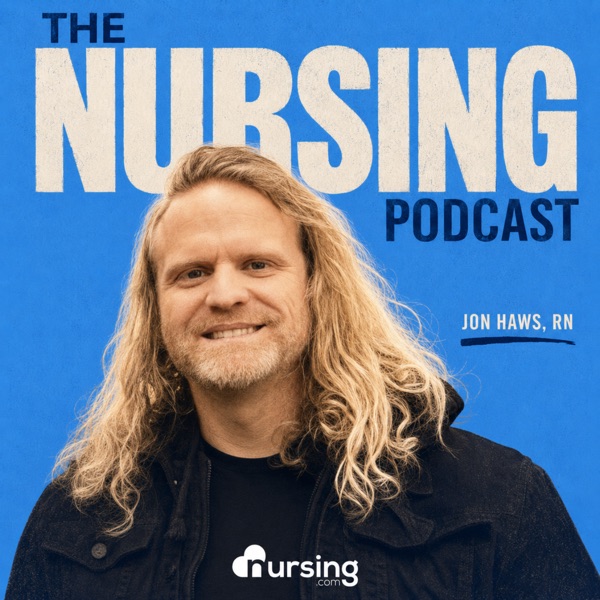
Podcast
NURSING.com Podcast — NCLEX Prep for Nursing Students
Helping Nursing Students Succeed. Period.
Free Nursing School and NCLEX Cheat Sheets at nursing.com/freebies
Welcome to the NURSING.com Show from NURSING.com . . . #1 Nursing Podcast and the leader in nursing student education.
New motivational episodes 2-3 times per week covering:
Struggling Students - common questions and concerns from students.
Tips and Nurse Life - how to succeed as a nursing student and nurse.
Interviews - discussion with through leaders, entrepreneurs, and authors.
Anatomy and Physiology and Nursing Care for various disease processes.
Follow us on social media @nursing.com_ on Instagram or @nursing.comofficial on Facebook
From the leading nursing education website (NURSING.com) comes the top nursing podcast. With pharmacology episodes, test taking tips, student struggles, interviews (with leading nurse advocates like Kati Kleber, Nurse Bass, Nurse Nacole, and more), NCLEX review, we cover the information that nurses need to know to accelerate their career and become incredible RNs.
Jon Haws RN, the host has worked as a critical care registered nurse in a Level I Trauma hospital in Dallas, TX.
Jon is the creator of NURSING.com. Visit the site and check out the books on Amazon.com We discuss current trends in the ICU, anatomy, physiology, nursing care, and much more. Our goal is to change nursing education forever by making it more accessible, cutting the fluff, and teaching students how to think like nurses through modern technology.
For full disclaimer information visit: nursing.com
NCLEX®, NCLEX-RN® are registered trademarks of the National Council of State Boards of Nursing, INC.
- Episodes
- 212
- Releases
- Daily
- Typical length
- 4 min
- On air since
- 2020
- Latest episode
- 9 hours ago
Episodes
212 episodes, newest first
-
4 min
LAB VALUES IN 5: Aspartate Aminotransferase for NCLEX
Show notes
Aspartate Aminotransferase (AST) — the must-know liver lab value for the NCLEX, covered in 5 minutes.
In this episode: what AST measures, the normal reference range of about 8-40 (ranges differ slightly for males and females), how AST is found in the liver plus the heart, skeletal muscle, kidneys, brain and red blood cells — and how that differs from ALT which is mostly just in the liver, why AST is part of the liver function tests (LFTs) alongside ALT, bilirubin and protein, when it's ordered including liver disorder symptoms like jaundice, abdominal swelling, nausea, vomiting, weakness, fatigue, loss of appetite, itching and darker urine, at-risk patients like those exposed to hepatitis, heavy drinkers, drug use, overweight and diabetes, how high AST climbs in viral hepatitis (up to 10 times normal) versus chronic hepatitis (4-5 times normal), and other causes of elevated AST like myocardial infarction and kidney disease.
Keywords: AST, aspartate aminotransferase, normal range, reference range 8-40, elevated AST, liver function tests, LFTs, liver panel, amino acid metabolism, viral hepatitis, chronic hepatitis, myocardial infarction, kidney disease, jaundice, ALT vs AST, bilirubin, NCLEX lab values, nursing labs.
FREE DOWNLOAD: Get the 63 must-know lab values to pass the NCLEX at https://nursing.com/63labs — the free study guide every nursing student needs before test day.
New episodes of Lab Values in 5 drop every Tuesday.
-
3 min
MED OF THE DAY: Bismuth subsalicylate (Pepto-Bismol)
Show notes
Welcome to Med of the Day — new episodes drop every Monday. It's Med Monday!
Bismuth subsalicylate (Pepto-Bismol, Kaopectate) is an adsorbent antidiarrheal/antiulcer med for diarrhea, heartburn, indigestion, and H. pylori-associated ulcers. Its exact mechanism isn't fully documented — it's thought to stimulate intestinal fluid/electrolyte absorption, reduce stomach hypermotility, bind E. coli toxins, and has weak antacid properties. Nursing considerations: contraindicated with aspirin hypersensitivity (it's a salicylate); impaction risk in geriatric and pediatric patients; bismuth can interfere with radiologic exams; monitor liver profile (LFTs).
Download your FREE cheatsheet of the 50 most commonly prescribed medications: https://nursing.com/50meds
-
4 min
The Baby Who Wouldn't Wait: New Nurse Stories | First Shift
Show notes
"She was trying to place a catheter. She almost delivered a baby instead."
A new L&D nurse, still orienting. Her preceptor steps out for lunch — and in that window, a routine in-and-out cath turns into the wildest twenty minutes of her new career: she can't visualize the urethra ("felt like I was hitting baby head"), her preceptor finally gets the cath in and urine flowing, and then the patient says, "I think I feel something coming out." An entire baby head. The call button, the yelling for doctors — too late. Eight pounds, eight ounces, slides out onto the bed. She never even pushed.
In this episode of First Shift, Jon Haws, RN — founder of NURSING.com — tells her story, then gets honest about the L&D learning curve: OB humbles everyone, the curve is vertical, and sometimes your failures protect you — she's very, very glad she never got that cath in.
If you're a nursing student or a new nurse, this one's for you. New episodes of First Shift drop every Friday — real stories from nurses' first shifts, and the honest talk that gets you through yours.
Studying for the NCLEX? Try SIMCLEX — the adaptive practice exam that tells you when you're ready: https://nursing.com/simclex
It's time to go out and be your best self today. Happy nursing, y'all.
-
3 min
QOD: Spica Cast | NCLEX Practice Question
Show notes
Today's NCLEX Question of the Day:
The nursing category is musculoskeletal. The NCLEX category is basic care and comfort. A nurse is working with a family whose child was born with developmental dislocation of the hip. The physician has applied a spica cast to the child. Which statement from the nurse best describes this type of cast to the child's family? A, your child will need to wear this cast for the first year of his life. B, you will have to take the cast off when your child needs to urinate or have a bowel movement. C, this cast will make it so your child will be able to walk some day. D, this cast will keep the hip joints in the correct position so they can heal.
Think you know the answer? Listen to the episode for the full breakdown and rationale.
Do you actually KNOW if you're ready for the NCLEX, or are you just hoping? Stop guessing and find out for free. Take the free SIMCLEX at nursing.com/simclex. It simulates the algorithms of the NCLEX, the same question rules, the same difficulty, so you get a real feel for what the actual exam is like.
New NCLEX Question of the Day episodes drop every Thursday.
-
2 min
PISO Electrolyte Location | Nursing Mnemonics for NCLEX
Show notes
Welcome to Nursing Mnemonics — new episodes drop every Wednesday.
Where do the electrolytes actually live — inside or outside the cell? The PISO mnemonic makes potassium, sodium, and the rest stick so you never mix them up on the NCLEX.
Go to nursing.com/cheatsheets to get the must-know nursing mnemonics for NCLEX.
-
4 min
LAB VALUES IN 5: Amylase for NCLEX
Show notes
Amylase — the must-know pancreatic lab value for the NCLEX, covered in 5 minutes.
In this episode: what amylase measures, the normal reference range of 30-110 units per liter, how this digestive enzyme splits starch into disaccharides and comes from the parotid glands and pancreas, why it's run to diagnose early acute pancreatitis, causes of elevated amylase including pancreatitis, peritonitis, DKA, pancreatic cancer, alcoholism and abdominal trauma, why amylase can be decreased after pancreatectomy or with pancreatic insufficiency, and nursing considerations like diet progression from clear liquids and advancing as tolerated.
Keywords: amylase, normal range, reference range 30-110, elevated amylase, pancreatic function, pancreatitis, acute pancreatitis, pancreatic cancer, DKA, peritonitis, abdominal trauma, pancreatectomy, pancreatic insufficiency, digestive enzymes, NCLEX lab values, nursing labs.
FREE DOWNLOAD: Get the 63 must-know lab values to pass the NCLEX at https://nursing.com/63labs — the free study guide every nursing student needs before test day.
New episodes of Lab Values in 5 drop every Tuesday.
-
3 min
MED OF THE DAY: Bisacodyl (Dulcolax)
Show notes
Welcome to Med of the Day — new episodes drop every Monday. It's Med Monday!
In this episode: Bisacodyl (Dulcolax) — a stimulant laxative that stimulates enteric nerves to cause peristalsis and draws fluid into the colon. Used for constipation as part of a bowel regimen. The must-knows: it can cause hypokalemia, so monitor electrolytes; watch for abdominal cramps and distension; confirm it's working and communicate bowel movements at handoff; push 1,500 to 2,000 mL of fluids daily; and warn patients to take only as ordered, since overuse flips constipation into diarrhea.
Download your FREE cheatsheet of the 50 most commonly prescribed medications: https://nursing.com/50meds
-
6 min
Trial by Fire: New Nurse Stories | First Shift
Show notes
"Eight weeks of orientation. A wonderful preceptor. And then... her first day... on her own. Six patients. Three on heparin drips. And the minute she got report... all heck broke loose."
Her first day by herself on step-down: six patients, three on heparin drips, one on a Cardizem drip, four diabetics, two on contact precautions. A patient got up when he'd been told not to, fell, and fractured his ankle — on a heparin drip. Another started bleeding heavily and needed blood STAT. A third was signing himself out AMA. A fourth waited on dialysis. With one tech on the unit, she ran to the pharmacy herself. She ran to the blood bank herself. She wheeled the fracture patient to the ER for his X-ray herself. In her words: "Between hanging drips, calling MDs, stat EKGs and X-rays... I thought whatever hair I had left after nursing school... it was gonna fall out."
In this episode of First Shift, Jon Haws, RN — founder of NURSING.com — tells her story, then gets honest about his own: he dropped out of nursing school ten weeks from graduation... and came back a year later to finish. Three things for the trial-by-fire days: asking for help IS the clinical skill. When everything explodes, line it up — sickest first, one thing at a time. And don't quit on day one: the doubt is the proof you care enough to be good at this.
If you're a nursing student or a new nurse, this one's for you. New episodes of First Shift drop every Friday — real stories from nurses' first shifts, and the honest talk that gets you through yours.
Studying for the NCLEX? Try SIMCLEX — the adaptive practice exam that tells you when you're ready: https://nursing.com/simclex
It's time to go out and be your best self today. Happy nursing, y'all.
-
2 min
QOD: Crutches | NCLEX Practice Question
Show notes
Today's NCLEX Question of the Day:
The nursing category is musculoskeletal. The NCLEX category is basic care and comfort. A child was injured in an accident and has become a paraplegic. The child must use crutches on a permanent basis, most likely for the rest of his life. Which type of crutches would most commonly be used in this situation? A, axillary crutches. B, forearm crutches. C, platform crutches. D, leg support crutches.
Think you know the answer? Listen to the episode for the full breakdown and rationale.
Do you actually KNOW if you're ready for the NCLEX, or are you just hoping? Stop guessing and find out for free. Take the free SIMCLEX at nursing.com/simclex. It simulates the algorithms of the NCLEX, the same question rules, the same difficulty, so you get a real feel for what the actual exam is like.
New NCLEX Question of the Day episodes drop every Thursday.
-
3 min
SALT LOSS Hyponatremia | Nursing Mnemonics for NCLEX
Show notes
Welcome to Nursing Mnemonics — new episodes drop every Wednesday.
Hyponatremia signs and symptoms don't have to be a guessing game. Learn the SALT LOSS mnemonic and lock in low sodium for test day.
Go to nursing.com/cheatsheets to get the must-know nursing mnemonics for NCLEX.
-
5 min
LAB VALUES IN 5: Alkaline Phosphatase for NCLEX
Show notes
Alkaline Phosphatase (ALP) — the must-know liver and bone lab value for the NCLEX, covered in 5 minutes.
In this episode: what ALP measures, the normal reference range of 40-130 units per liter, where ALP is found in the body with the highest concentrations in bone and liver, how this test detects liver disease and bone disorders, why ALP rises with blocked bile ducts and hepatobiliary disorders, how elevated ALP can signal cancer that has spread to the bone, how ALP fits into the liver panel alongside bilirubin, AST and ALT, liver symptoms like jaundice, weakness, fatigue, dark urine and dark stool, and bone symptoms like bone or joint pain, frequent fractures and bone deformities.
Keywords: alkaline phosphatase, ALP, normal range, reference range 40-130, elevated ALP, liver panel, liver function, bone disorders, biliary obstruction, hepatobiliary disorders, bone metastasis, jaundice, bilirubin, AST, ALT, NCLEX lab values, nursing labs.
FREE DOWNLOAD: Get the 63 must-know lab values to pass the NCLEX at https://nursing.com/63labs — the free study guide every nursing student needs before test day.
New episodes of Lab Values in 5 drop every Tuesday.
-
3 min
MED OF THE DAY: Benztropine (Cogentin)
Show notes
Welcome to Med of the Day — new episodes drop every Monday. It's Med Monday!
In this episode: Benztropine (Cogentin) — an anticholinergic anti-Parkinson agent that blocks acetylcholine to reduce tremors and rigidity. The must-knows: watch for anticholinergic effects — dry mouth, constipation, tachycardia; plus arrhythmias, hypotension, and palpitations; assess for extrapyramidal symptoms; instruct patients to maintain good oral hygiene; and take it exactly as directed.
Download your FREE cheatsheet of the 50 most commonly prescribed medications: https://nursing.com/50meds
-
5 min
First Night Alone: New Nurse Stories | First Shift
Show notes
Two years on the unit as a tech — then her first night alone as the nurse. The quiet shift that teaches you everything.
"She'd worked the unit for two years. As a tech. And then came her first night... alone. As the nurse."
Not every first shift is a disaster. Some of them are quiet — and the quiet ones teach you something too. The night team took care of her with a fair, gentle assignment. She made it through. And she wrote something worth keeping: it felt "really, really lonely"... with no preceptor beside her. But she didn't mind the sound of silence.
In this episode of First Shift, Jon Haws, RN — founder of NURSING.com — tells her story, then tells his own: his first solo shift in the Neuro ICU, sitting with a family as they withdrew life support. Afterward, the patient's mother hugged him and said, "I love you. I will never forget you." He didn't do anything special. He just stayed.
Three things for the quiet shifts: you're never actually alone — build your team, learn their names, say thank you. Asking for help is the job, not a weakness. And the oxygen mask rule: take care of yourself first, so you can take care of everybody else.
If you're a nursing student or a new nurse, this one's for you. New episodes of First Shift drop every Friday — real stories from nurses' first shifts, and the honest talk that gets you through yours.
Studying for the NCLEX? Try SIMCLEX — the adaptive practice exam that tells you when you're ready: https://nursing.com/simclex
It's time to go out and be your best self today. Happy nursing, y'all.
-
3 min
QOD: Impaired Physical Mobility | NCLEX Practice Question
Show notes
Today's NCLEX Question of the Day:
The nursing category is musculoskeletal. The NCLEX category is basic care and comfort. A nurse has given a patient with joint stiffness and limited range of motion a nursing diagnosis of impaired physical mobility. Which nursing intervention would be most appropriate when caring for this patient? A, screen for signs of ineffective coping or helplessness. B, ensure that the patient receives enough food and fluids. C, assess the patient's relationship with his spouse. D, monitor for changes in the patient's affect that indicate anxiety or panic.
Think you know the answer? Listen to the episode for the full breakdown and rationale.
Do you actually KNOW if you're ready for the NCLEX, or are you just hoping? Stop guessing and find out for free. Take the free SIMCLEX at nursing.com/simclex. It simulates the algorithms of the NCLEX, the same question rules, the same difficulty, so you get a real feel for what the actual exam is like.
New NCLEX Question of the Day episodes drop every Thursday.
-
2 min
6 L's Hypokalemia | Nursing Mnemonics for NCLEX
Show notes
Welcome to Nursing Mnemonics — new episodes drop every Wednesday.
Low potassium signs and symptoms are pure NCLEX gold. This episode walks you through the 6 L's mnemonic so you can recall every sign of hypokalemia without second-guessing.
Go to nursing.com/cheatsheets to get the must-know nursing mnemonics for NCLEX.
-
5 min
LAB VALUES IN 5: Albumin for NCLEX
Show notes
Albumin — the must-know protein lab value for the NCLEX, covered in 5 minutes.
In this episode: what albumin is, the normal reference range of 3.5-6 grams per deciliter, how this liver-synthesized transport protein carries bilirubin, calcium, progesterone and medications through the blood, its key role in fluid balance and colloid oncotic pressure keeping fluid in the blood, why it's part of the comprehensive metabolic panel (CMP), how it evaluates liver function, nutritional status and kidney function, causes of low albumin including liver disease, cirrhosis, inflammation, shock, malnutrition and kidney disease, and serum versus urine albumin with nephrotic syndrome signs like swelling around the eyes, belly and legs.
Keywords: albumin, normal range, reference range 3.5-6, low albumin, transport protein, colloid oncotic pressure, osmotic pressure, CMP, comprehensive metabolic panel, liver function, nutritional status, prealbumin, nephrotic syndrome, cirrhosis, edema, malnutrition, NCLEX lab values, nursing labs.
FREE DOWNLOAD: Get the 63 must-know lab values to pass the NCLEX at https://nursing.com/63labs — the free study guide every nursing student needs before test day.
New episodes of Lab Values in 5 drop every Tuesday.
-
4 min
MED OF THE DAY: Azithromycin (Zithromax)
Show notes
Welcome to Med of the Day — new episodes drop every Monday. It's Med Monday!
In this episode: Azithromycin (Zithromax) — a macrolide anti-infective that inhibits bacterial protein synthesis. Broad-spectrum: respiratory infections, otitis media, skin infections, STIs, endocarditis prophylaxis, and cystic fibrosis. The must-knows: watch for C. diff and pseudomembranous colitis (report new diarrhea, or blood or pus in stool), Stevens-Johnson syndrome, angioedema that can close the airway, anaphylaxis, and increased warfarin toxicity; and patients must finish the entire course even once they feel better.
Download your FREE cheatsheet of the 50 most commonly prescribed medications: https://nursing.com/50meds
-
6 min
Everything Went Wrong: New Nurse Stories | First Shift
Show notes
Six months pregnant, first day in the ER — everything that could go wrong did. The disaster shift every nurse survives.
"She was six months pregnant. It was her first day in the ER. And everything that could possibly go wrong... went wrong."
She'd been out of clinical for four months — a new grad, back for her first ER shift. Her hands were so sweaty the sterile gloves wouldn't go on. She blanked on the foley kit, forgot IVs she'd done as a student, pulled the glucometer strip out mid-reading, forgot to hit START on the blood pressure cuff. In her own words: "Everything that could have possibly gone wrong... with the exception of killing someone... went wrong." She cried the whole drive home.
In this episode of First Shift, Jon Haws, RN — founder of NURSING.com — tells her story, then tells his own: his first day in the Neuro ICU was a total disaster too. He names the massive canyon between nursing school and BEING a nurse, and shares the three things that get you across it: your skills didn't disappear (they're buried under adrenaline), nobody expects you to know much of anything yet, and slow down to speed up. Plus: write the story down — one day you'll tell it laughing.
If you're a nursing student or a new nurse, this one's for you. New episodes of First Shift drop every Friday — real stories from nurses' first shifts, and the honest talk that gets you through yours.
Studying for the NCLEX? Try SIMCLEX — the adaptive practice exam that tells you when you're ready: https://nursing.com/simclex
It's time to go out and be your best self today. Happy nursing, y'all.
-
2 min
QOD: General Adaptation Syndrome | NCLEX Practice Question
Show notes
Today's NCLEX Question of the Day:
The nursing category is mental health. The NCLEX category is basic care and comfort. Which of the following descriptions best defines general adaptation syndrome? A. Activation of brain signals followed by avoidance and response to a perceived threat. B. The arousal of the hippocampus after being triggered by a specific memory. C. The body's response to stress over both short and long-term periods. D. The development of depression over time as a result of a negative situation.
Think you know the answer? Listen to the episode for the full breakdown and rationale.
Do you actually KNOW if you're ready for the NCLEX, or are you just hoping? Stop guessing and find out for free. Take the free SIMCLEX at nursing.com/simclex. It simulates the algorithms of the NCLEX, the same question rules, the same difficulty, so you get a real feel for what the actual exam is like.
New NCLEX Question of the Day episodes drop every Thursday.
-
3 min
CATS Hypercalcemia and Hypocalcemia | Nursing Mnemonics for NCLEX
Show notes
Welcome to Nursing Mnemonics — new episodes drop every Wednesday.
Calcium imbalances show up on the NCLEX all the time. This episode teaches you CATS for hypocalcemia (convulsions, arrhythmias, tetany, spasms) and the groans, moans, bones, stones, and overtones of hypercalcemia — so you can nail any calcium question.
Go to nursing.com/cheatsheets to get the must-know nursing mnemonics for NCLEX.
Courses lists
More Courses shows picked out from the charts











More in Courses
Placed highest on Apple Podcasts' Courses chart right now