Podcast
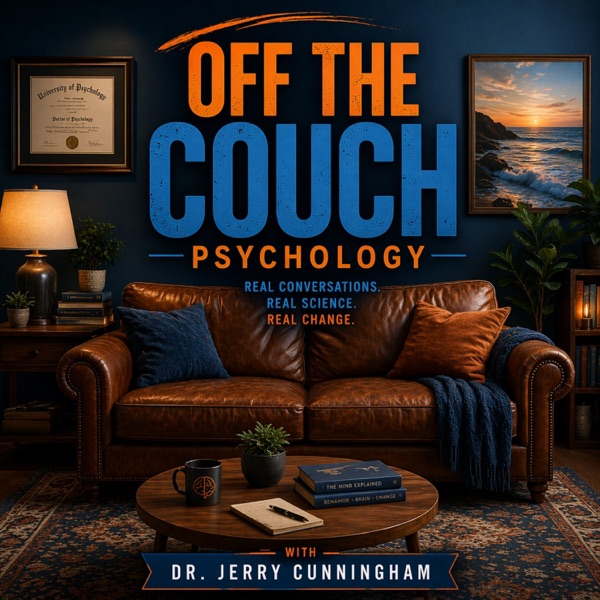
Off the Couch Psychology
Off the Couch Psychology Podcast is your go-to source for understanding mental health, breaking the stigma around mental illness, and learning how to take control of your mind and your life.
Hosted by Dr. Jerry Cunningham, psychologist, author, and podcast host, this show breaks down complex psychological topics into real, practical conversations you can actually use in your everyday life.
Each episode explores mental health in a way that is clear, relatable, and grounded in real science. From anxiety, depression, ADHD, trauma, and burnout to cutting-edge psychological research and treatment approaches, you'll gain a deeper understanding of what's really going on in your mind—and what you can do about it.
This isn't therapy—but it might be the closest thing you can get in your car, at the gym, or sitting on your couch.
If you've ever struggled with stress, overthinking, emotional exhaustion, or just found yourself wondering, "What is going on in my mind?"—this podcast is for you.
You'll learn:
• How anxiety, depression, and other mental health disorders actually work
• Evidence-based therapy approaches that professional use and coping strategies you can use
• How to manage stress, overthinking, and emotional overwhelm
• Information about mental health medications and treatment options
• Practical tools to improve your mental health and daily life
This podcast is designed to educate, motivate, and empower you to take action—because understanding your mind is the first step to changing your life.
- Mental Health chart
- #36
- Episodes
- 58
- Releases
- Twice a week
- Typical length
- 28 min
- On air since
- 2026
- Latest episode
- 18 hours ago
Episodes
58 episodes, newest first
-
27 min
Are You Catching Other People's Moods?
Episode 57
Show notes
Ever walk into a room feeling great, only to leave irritated, stressed, or exhausted because of somebody else's attitude? You may have caught something more contagious than the common cold!
In this crossover episode of Quest for Success and Off the Couch Psychology, Dr. Jerry Cunningham explores emotional contagion, the psychological process through which other people's emotions influence our own.
You'll discover why one person's bad mood can spread through an entire workplace, how body language influences emotional reactions, and why some people seem to absorb everybody else's feelings.
We'll explore fascinating psychological research, the importance of emotional awareness in relationships and therapy, and how understanding emotional contagion can give you an advantage in business negotiations.
With everyday stories, humor, and a little help from Pixar's Inside Out, you'll discover how to recognize emotional influences and become more intentional about the energy you bring into every room.
Key Takeaways
•
Understand how emotions spread between people.
•
Recognize how facial expressions and body language influence feelings.
•
Discover why leaders influence the emotional atmosphere.
•
Learn how emotional awareness strengthens relationships.
•
Apply emotional intelligence to business meetings and negotiations.
•
Develop strategies to avoid absorbing unnecessary negativity.
Continue Your Quest for Success
Visit https://www.quest-success.com/ for more episodes, books, and resources to help you grow mentally, morally, physically, spiritually, and financially.
Suggested Reading & References
•
Hatfield, E., Cacioppo, J. T., & Rapson, R. L. (1994). Emotional Contagion. Cambridge University Press. A foundational book explaining how emotions spread through mimicry and feedback.
•
Friedman, H. S., & Riggio, R. E. (1981). Effect of individual differences in nonverbal expressiveness on transmission of emotion. Journal of Nonverbal Behavior, 6, 96–104. Research examining how emotional expressiveness influences others.
•
Barsade, S. G. (2002). The Ripple Effect: Emotional Contagion and Its Influence on Group Behavior. Administrative Science Quarterly, 47(4), 644–675. Research on how emotions spread within workplace groups and influence cooperation.
•
Doherty, R. W. (1997). The Emotional Contagion Scale: A Measure of Individual Differences. Journal of Nonverbal Behavior, 21, 131–154. Research exploring why some individuals are more susceptible to others' emotions.
•
Docter, P., & Del Carmen, R. (Directors). (2015). Inside Out [Film]. Pixar Animation Studios / Walt Disney Pictures. An entertaining exploration of emotions, empathy, and human behavior.
People, Movies & Books Mentioned
#InsideOut #Pixar #Disney #PeteDocter #ElaineHatfield #HowardFriedman #RonaldRiggio #SigalBarsade #WilliamDoherty #EmotionalContagion #EmotionalIntelligence #QuestForSuccess #OffTheCouchPsychology #DrJerryCunningham
-
33 min
Bulimia: The Eating Disorder Nobody Sees
Episode 56
Show notes
What if someone could be struggling with a dangerous eating disorder while appearing perfectly healthy to everyone around them? Bulimia nervosa often goes unnoticed because its symptoms can remain hidden behind everyday routines, successful careers, and seemingly normal lives.
In this episode of Off the Couch Psychology, Dr. Jerry Cunningham explores the psychological struggles behind bulimia nervosa and why this disorder involves far more than food or body weight.
Through the story of Sandra, a former college athlete battling bulimia while attending graduate school, you'll discover how distorted body image, guilt, and emotional distress can create a dangerous cycle. You'll also hear how Princess Diana publicly revealed her own struggle with bulimia despite living a life that appeared to have everything.
Discover how psychological treatment, nutritional counseling, and support can help people reclaim control of their lives.
Key Takeaways
•
Understand the differences between bulimia nervosa and anorexia nervosa.
•
Recognize the hidden warning signs of bulimia.
•
Discover how body image and self-worth influence eating disorders.
•
Learn how CBT, nutritional counseling, and other treatments support recovery.
•
Understand why eating disorders can affect anyone, regardless of appearance or social status.
Visit https://www.quest-success.com/ for more episodes and resources.
Suggested Reading & References
•
American Psychiatric Association (2022). Diagnostic and Statistical Manual of Mental Disorders, Fifth Edition, Text Revision (DSM-5-TR). American Psychiatric Association Publishing.
•
National Institute of Mental Health (NIMH). Eating Disorders: What You Need to Know. NIMH Eating Disorders.
•
National Eating Disorders Association (NEDA). Bulimia Nervosa. https://www.nationaleatingdisorders.org/.
•
Fairburn, Christopher G. (2008). Overcoming Binge Eating, Second Edition. Guilford Press.
•
BBC Panorama (1995). An Interview with HRH The Princess of Wales. Interview conducted by Martin Bashir, featuring Princess Diana's public discussion of bulimia nervosa.
People, Books & Media Mentioned
#PrincessDiana #PrinceCharles #MartinBashir #BBCPanorama #DSM5TR #OvercomingBingeEating
-
27 min
Anorexia Nervosa: When Thin Becomes Dangerous
Episode 55
Show notes
What happens when the desire to be healthy becomes a dangerous obsession with weight, food, and body image? How can someone who appears successful and confident be fighting a serious psychological disorder that nobody sees?
In this episode of Off the Couch Psychology, Dr. Jerry Cunningham takes you inside the complicated world of anorexia nervosa, exploring how self-esteem, family expectations, social pressure, and distorted body image can influence someone's relationship with food.
Through the story of Evie, you'll discover how anorexia can develop, why recognizing the warning signs matters, and what recovery can involve. You'll also hear about legendary singer Karen Carpenter, whose tragic struggle brought national attention to eating disorders.
Key Takeaways
•
Recognize the psychological and physical warning signs of anorexia nervosa.
•
Understand how body image and self-worth become connected.
•
Explore the influence of family, peers, and social expectations.
•
Learn about hospitalization, therapy, and nutritional treatment.
•
Discover why early intervention and professional support matter.
For more episodes and resources, visit https://www.quest-success.com/.
Suggested Reading and Additional Resources
•
American Psychiatric Association — Treatment of Patients With Eating Disorders (2023). Evidence-based recommendations for diagnosis and treatment.
•
NICE — Eating Disorders: Recognition and Treatment. Information on CBT, MANTRA, family therapy, and medical care.
•
National Institute of Mental Health — Eating Disorders. An overview of symptoms, risk factors, and treatment.
•
The Karen Carpenter Story (1989). A dramatization of Karen Carpenter's life and her struggle with anorexia nervosa.
People, Movies, and Music Mentioned
#KarenCarpenter #RichardCarpenter #TheCarpenters #TheKarenCarpenterStory #CloseToYou #WeveOnlyJustBegun #RainyDaysAndMondays
-
32 min
When Your Body Screams for Help
Episode 54
Show notes
What happens when your body tells you something is wrong, but medical tests don't provide a clear answer? The pain is real, the symptoms are frightening, and the search for answers can begin taking over your life.
In this episode of Off the Couch Psychology, Dr. Jerry Cunningham explores Somatic Symptom Disorder and the complicated relationship between physical symptoms, anxiety, and the mind.
You'll discover why physical symptoms can become overwhelming, how this disorder differs from Factitious Disorder, and what treatments can help people regain control of their lives. We'll also explore the psychological thriller Nocebo and what it reveals about the power of expectations.
If you or someone you love struggles with unexplained physical symptoms or constant health-related worry, this episode offers insight, understanding, and hope.
Key Takeaways
•
Understand what Somatic Symptom Disorder really is.
•
Recognize how anxiety can intensify physical suffering.
•
Learn how CBT and other treatments can help.
•
Discover why consistent medical care matters.
•
Understand the nocebo effect and the power of expectations.
Learn more and explore additional episodes at https://www.quest-success.com/.
Suggested Reading & References
•
American Psychiatric Association (2022). Diagnostic and Statistical Manual of Mental Disorders, Fifth Edition, Text Revision (DSM-5-TR). Official diagnostic criteria for Somatic Symptom Disorder. American Psychiatric Association
•
National Library of Medicine. Somatic Symptom Disorder — MedlinePlus. Overview of symptoms, diagnosis, and treatment. MedlinePlus
•
Henningsen, P. (2018). Management of Somatic Symptom Disorder. Dialogues in Clinical Neuroscience, 20(1), 23–31. Research on psychological treatment and coordinated medical care. Read Article
•
Colloca, L., & Barsky, A. J. (2020). Placebo and Nocebo Effects. New England Journal of Medicine, 382, 554–561. Research explaining how expectations influence physical symptoms. Read Article
•
Nocebo (2022). Directed by Lorcan Finnegan, starring Eva Green. A psychological thriller exploring guilt, fear, and physical suffering through supernatural storytelling.
Movies, People & Topics Mentioned
#Nocebo #EvaGreen #LorcanFinnegan #SomaticSymptomDisorder #FactitiousDisorder #NoceboEffect #CognitiveBehavioralTherapy #MentalHealthAwareness
-
34 min
When Being Sick Becomes the Goal
Episode 53
Show notes
What happens when someone deliberately creates an illness to receive medical attention? And what happens when an innocent child becomes the patient?
In this episode of Off the Couch Psychology, Dr. Jerry Cunningham explores the disturbing world of factitious disorder, once commonly associated with Munchausen syndrome, and its dangerous counterpart, factitious disorder imposed on another, historically known as Munchausen syndrome by proxy.
You'll discover why some individuals manufacture medical symptoms, how professionals recognize the warning signs, and what treatments may help break the cycle. We'll also examine Munchausen by Internet and the tragic real-life story of Gypsy Rose Blanchard.
This episode will challenge how you think about illness, attention, deception, and the need for care.
Key Takeaways
•
Understand the difference between factitious disorder and malingering.
•
Recognize warning signs without jumping to conclusions.
•
Learn why someone might deliberately create medical symptoms.
•
Discover treatment approaches and their limitations.
•
Understand the dangers of factitious disorder imposed on another.
Visit https://www.quest-success.com/ for more episodes and resources.
Suggested Reading & References
1. Richard Asher (1951). Munchausen's Syndrome — The Lancet. The original medical article introducing the term discussed in this episode.
2. American Psychiatric Association (2022). Diagnostic and Statistical Manual of Mental Disorders, Fifth Edition, Text Revision (DSM-5-TR). Overview of Somatic Symptom and Related Disorders.
3. Merck Manual (2026). Factitious Disorder Imposed on Self — Symptoms, diagnosis, and treatment.
4. Merck Manual (2026). Factitious Disorder Imposed on Another — Medical deception involving children and dependent individuals.
5. American Psychological Association (2023). Medical Deception: Understanding Munchausen Syndrome/Factitious Disorder — Discussion with Dr. Marc Feldman and Dr. Janet Cahill, including Munchausen by Internet.
People & Topics Mentioned — Hashtags
#GypsyRoseBlanchard #DeeDeeBlanchard #NicholasGodejohn #BaronMunchausen #RichardAsher #FactitiousDisorder #MunchausenSyndrome #MunchausenByProxy #MunchausenByInternet
-
35 min
How Cults Take Control of You
Episode 52
Show notes
How does an ordinary person become so devoted to a leader that they surrender their money, relationships, freedom, and sometimes even their life? Could someone you love be under the influence of a destructive group without realizing it?
In this episode of Off the Couch Psychology, Dr. Jerry Cunningham explores the disturbing psychology of cults, beginning with the tragic story of Jim Jones and the Peoples Temple.
You'll discover how cults recruit members, why intelligent people become trapped, and how manipulation, isolation, and fear can gradually replace independent thinking. More importantly, you'll learn how to recognize warning signs, protect yourself, and help someone you care about find a way out.
The most frightening part? Cults don't always look like cults, and their leaders rarely look dangerous in the beginning.
Key Takeaways
•
Recognize five warning signs of destructive cults.
•
Understand how psychological manipulation and thought control work.
•
Discover why intelligent people join and remain in cults.
•
Learn how to approach someone caught in a controlling group.
•
Understand practical steps toward leaving safely and rebuilding independence.
Visit https://www.quest-success.com/ for more episodes and resources to help you better understand your mind and take control of your life.
Suggested Reading and References
•
— Jeff Guinn (2017). A detailed investigation of Jim Jones, the Peoples Temple, and the events leading to Jonestown.
•
— Robert Jay Lifton (1961). A foundational examination of psychological control and thought reform.
•
— Steven Hassan (1988; revised editions). Explores destructive influence and strategies for recovery.
•
— Robert B. Cialdini (1984; expanded edition 2021). Explains psychological principles behind persuasion and compliance.
•
— Margaret Thaler Singer with Janja Lalich (1995). Examines cult recruitment, manipulation, and recovery.
People, Books, and Historical References
#JimJones #PeoplesTemple #Jonestown #JeffGuinn #TheRoadToJonestown #RobertJayLifton #ThoughtReformAndThePsychologyOfTotalism #SolomonAsch #StanleyMilgram #LeoRyan #StevenHassan #CombatingCultMindControl #RobertCialdini #InfluenceThePsychologyOfPersuasion #MargaretThalerSinger #JanjaLalich #CultsInOurMidst
-
28 min
When Grief Won't Let Go
Episode 51
Show notes
Everyone says time heals all wounds, but what happens when the world keeps moving and you feel trapped in the moment someone you love died?
In this episode of Off the Couch Psychology, Dr. Jerry Cunningham explores Prolonged Grief Disorder, a condition where the pain of losing someone becomes so overwhelming that moving forward feels almost impossible.
You'll discover how prolonged grief differs from normal grieving, why some people struggle to reconnect with life, and what psychology tells us about finding a way forward. We'll also explore treatments that can help you honor someone you've lost while learning to live again.
And through a touching story about a heart kept inside a bottle, you'll discover why protecting yourself from pain can sometimes keep you from experiencing life.
Key Takeaways
•
Understand prolonged grief disorder and its warning signs.
•
Learn how prolonged grief differs from depression and normal grieving.
•
Discover evidence-based treatments that can help.
•
Explore practical ways to reconnect with life.
•
Learn how to honor your loved one while moving forward.
Visit https://www.quest-success.com/ for more episodes and resources.
Suggested Reading & References
•
American Psychiatric Association (2022). Diagnostic and Statistical Manual of Mental Disorders, Fifth Edition, Text Revision (DSM-5-TR). Diagnostic criteria for prolonged grief disorder.
•
Szuhany, K. L., Malgaroli, M., Miron, C. D., & Simon, N. M. (2021). Prolonged Grief Disorder: Course, Diagnosis, Assessment, and Treatment. Focus, 19(2), 161–172.
•
Shear, M. K., et al. (2016). Optimizing Treatment of Complicated Grief: A Randomized Clinical Trial. JAMA Psychiatry, 73(7), 685–694.
•
Jeffers, Oliver. (2010). The Heart and the Bottle. Philomel Books. A moving illustrated story about loss, emotional protection, and rediscovering life.
•
Columbia University Center for Prolonged Grief. Educational resources about prolonged grief disorder and grief-focused treatment. https://prolongedgrief.columbia.edu/
People, Books & Topics Mentioned
#OliverJeffers #TheHeartAndTheBottle #AdamAndEve #CainAndAbel #DSM5TR #ProlongedGriefDisorder #ComplicatedGriefTreatment
-
25 min
When Caring Starts Wearing You Down
Episode 50
Show notes
What happens when you still care about someone, but you are simply exhausted from caring? Compassion fatigue can leave caregivers, healthcare professionals, therapists, first responders, and family members feeling emotionally drained, irritable, detached, and guilty about feelings they may not understand.
In this episode of Off the Couch Psychology Podcast, you'll learn what compassion fatigue is, how it differs from burnout and secondary traumatic stress, and why constantly caring for others without enough recovery or support can begin affecting your own life. You'll also meet Rachel, a 40-year-old woman caring for a grandmother with dementia while receiving almost no help from the rest of her family. Her story shows how love, responsibility, exhaustion, resentment, and guilt can exist at the same time.
Most importantly, you'll learn practical ways to recognize compassion fatigue, protect your own well-being, ask for specific help, create healthier boundaries, and make caring for someone else more sustainable.
Key Takeaways
•
Recognize the warning signs of compassion fatigue before you reach complete exhaustion.
•
Understand the differences between compassion fatigue, burnout, and secondary traumatic stress.
•
Stop confusing exhaustion with a lack of love or compassion.
•
Ask others for specific, concrete help rather than waiting until you are overwhelmed.
•
Protect recovery time and maintain parts of your life outside caregiving.
•
Remember that sustainable caregiving includes caring for the caregiver.
Learn more and explore additional episodes at https://www.quest-success.com/.
Suggested Reading & Research
Professional Quality of Life (ProQOL): Compassion Fatigue and Secondary Traumatic Stress — Resources explaining compassion fatigue, compassion satisfaction, burnout, and secondary traumatic stress.
What Do Family Caregivers of People With Dementia Need? — A systematic review examining support, information, education, and balance among dementia caregivers.
Becoming a Family Caregiver to a Person With Dementia — A literature review examining changing family roles, caregiver burden, respite, and the need for support.
Effects of Peer Support Interventions for Family Caregivers of Persons With Dementia — A 2026 systematic review and meta-analysis examining peer support and caregiver outcomes.
Themes Describing Social Isolation in Family Caregivers of People Living With Dementia — A review exploring isolation, psychological strain, social networks, and support among dementia caregivers.
Mentioned in This Episode
#SuperheroMovies #Caregiving #Dementia
-
26 min
49 adjustment disorder
Episode 49
Show notes
One week your life feels predictable. The next, a job loss, divorce, medical diagnosis, financial problem, or another major change leaves you wondering why you suddenly cannot handle things the way you normally do.
In this episode of Off the Couch Psychology Podcast, you'll learn what an adjustment disorder is, how it differs from the normal stress that follows a difficult life event, and what the symptoms can look like in everyday life. Through the story of Karen—a woman facing the loss of her 23-year career and her marriage at nearly the same time—you'll see how quickly major change can affect sleep, concentration, mood, anxiety, relationships, and daily functioning.
More importantly, you'll hear practical ways to begin moving forward when life changes faster than you can adjust.
Key Takeaways
•
How adjustment disorders can develop after an identifiable stressor
•
The major symptoms and different ways they can appear
•
Why struggling with change is not a measure of personal strength
•
How CBT and solution-focused brief therapy may help
•
Practical ways to rebuild routine and regain a sense of control
•
Why focusing on the next reasonable step can make a difference
Learn more and explore additional episodes at https://www.quest-success.com/.
Suggested Reading & References
American Psychiatric Association. Diagnostic and Statistical Manual of Mental Disorders, Fifth Edition, Text Revision (DSM-5-TR). American Psychiatric Association Publishing.
Clear, James. Atomic Habits: An Easy & Proven Way to Build Good Habits & Break Bad Ones. Avery, 2018.
Salinger, J. D. The Catcher in the Rye. Little, Brown and Company, 1951.
O'Donnell, M. L., et al. "Adjustment Disorder: Current Developments and Future Directions." International Journal of Environmental Research and Public Health.
Mentioned in This Episode
#TheCatcherInTheRye #JDSalinger #AtomicHabits #JamesClear
-
25 min
Your Body Can Calm Your Mind
Episode 48
Show notes
What if calming your mind sometimes starts with your body?
In this crossover episode of Quest for Success Podcast and Off the Couch Psychology Podcast, Dr. Jerry Cunningham explores practical ways to use your body to change the intensity of what you're feeling. You'll learn why breathing, facial tension, movement, your senses, and even temperature can influence your emotional state—and what you can do when stress, anxiety, anger, or feeling overwhelmed starts taking control.
You'll discover the physiological sigh, the 5-4-3-2-1 grounding technique, facial feedback, temperature shifts, and simple movement strategies you can use in everyday life. More importantly, you'll learn how to recognize your body's warning signs before your emotions reach the point where your mouth starts making decisions your brain may have to apologize for later.
Key Takeaways
•
Use breathing to reduce physical arousal and regain control.
•
Recognize tension in your jaw, face, shoulders, and muscles as early warning signs.
•
Use your senses to interrupt emotional spirals and reconnect with the present.
•
Move your body when stress has created physical activation.
•
Create space between what you feel and what you do.
•
Practice these strategies before you desperately need them.
For more episodes and resources, visit https://www.quest-success.com/.
Suggested Reading & Research
Yilmaz Balban, M., et al. (2023). "Brief Structured Respiration Practices Enhance Mood and Reduce Physiological Arousal." Cell Reports Medicine. This randomized controlled study examined several breathing practices and found that five minutes of daily breathwork, particularly exhale-focused cyclic sighing, was associated with improved mood and reduced respiratory rate.
Coles, N. A., Larsen, J. T., & Lench, H. C. (2019). "A Meta-Analysis of the Facial Feedback Literature: Effects of Facial Feedback on Emotional Experience Are Small and Variable." Psychological Bulletin. A useful scientific look at the facial-feedback hypothesis; importantly, the researchers found that the effects exist but tend to be small and vary across circumstances.
Levine, Peter A. — Waking the Tiger: Healing Trauma. Levine explores the relationship between trauma, bodily sensations, nervous-system responses, and body-based approaches to regulation.
Dialectical Behavior Therapy (DBT) Distress-Tolerance Skills. For listeners interested in going deeper, DBT provides a broader framework for managing periods of intense emotional arousal through practical distress-tolerance and regulation strategies.
People & Books Mentioned
#AndrewHuberman #PeterLevine #WakingTheTiger
-
33 min
When a Child Cannot Trust
Show notes
What happens when a child learns early in life that the people they need most cannot always be trusted?
In this episode of Off the Couch Psychology Podcast, you'll get a clearer understanding of Reactive Attachment Disorder (RAD), a condition associated with severe disruptions in early caregiving and a child's ability to form healthy attachments. You'll learn what RAD can look like beyond the labels of "defiant," "cold," or "unloving," and why some children may reject the very comfort they desperately need.
We'll look at what may be happening in the developing brain, how early neglect and unstable caregiving can shape a child's expectations of relationships, and why simply placing a child in a loving home may not immediately erase those lessons.
You'll also hear the disturbing story of Theodore, a troubled little boy who eventually became known to the world as Ted Bundy. His story raises an important question about childhood trauma and intervention while also reminding us that there is no documented RAD diagnosis for Bundy and that RAD does not predict serial violence.
Most importantly, you'll learn how consistent caregiving, professional treatment, family involvement, and repeated experiences of safety can help a child begin building something they may never have learned to expect: trust.
Key Takeaways
•
RAD involves much more than difficult or defiant behavior.
•
Severe neglect and disrupted caregiving can interfere with a child's ability to seek and accept comfort.
•
A safe home is important, but rebuilding trust can take time and repeated experiences of dependable care.
•
Treatment should involve qualified professionals and often includes caregivers as part of the process.
•
Coercive or frightening "attachment therapies" can be dangerous and should be avoided.
•
A child's difficult beginning does not determine the ending of their story.
For more episodes, resources, and information from Dr. Jerry Cunningham, visit https://www.quest-success.com/.
Suggested Reading & Resources
American Academy of Child & Adolescent Psychiatry — Attachment Disorders A family-focused resource for understanding attachment disorders and the importance of proper assessment. AACAP Facts for Families: Attachment Disorders
Ellis, Yilanli & Saadabadi — "Reactive Attachment Disorder," StatPearls A clinical overview covering symptoms, diagnostic criteria, evaluation, and management of RAD. Read Reactive Attachment Disorder — StatPearls
American Academy of Child & Adolescent Psychiatry — Policy Statement on Coercive Interventions for Attachment Disorders Important guidance concerning appropriate treatment and the dangers associated with coercive attachment interventions. Read the AACAP Policy Statement
Boris & Zeanah — Practice Parameter for the Assessment and Treatment of Children and Adolescents With Reactive Attachment Disorder A detailed professional resource on assessment, caregiver relationships, treatment, and attachment-focused care. Read the AACAP Practice Parameter
People & Movies Mentioned
#TedBundy #TheBoarder #TroubledChild
-
27 min
Therapy or Coaching: Which Do You Need?
Episode 46
Show notes
Do you need help healing something from your past—or help figuring out what to do next?
Therapy and life coaching can both help people make meaningful changes, but they are not interchangeable. In this crossover episode of Quest for Success Podcast and Off the Couch Psychology Podcast, you'll discover where therapy and coaching differ, where they overlap, and why choosing the right kind of help matters.
Through real-world examples, humor, and a little Good Will Hunting, we'll look at how therapy can address emotional distress and unresolved issues while coaching can focus on goals, habits, performance, accountability, and forward movement. You'll also hear what can happen when a coaching conversation uncovers something deeper that may need the attention of a mental health professional.
Key Takeaways
•
How therapy and coaching serve different purposes
•
Why looking backward can sometimes help you move forward
•
When goal setting and accountability may be useful
•
When a coaching issue may actually require therapy
•
How therapy and coaching can sometimes complement each other
•
Questions to consider when deciding what kind of help you need
For more episodes and resources, visit https://www.quest-success.com/.
Suggested Reading & Resources
American Psychological Association — Understanding Psychotherapy and How It Works — A practical overview of psychotherapy, what it addresses, and how the process works.
International Coaching Federation — Guide to Experiencing Coaching — Explains coaching, its focus on growth and goals, and important distinctions between coaching and therapy.
International Coaching Federation — Coaching vs. Therapy — A resource specifically addressing the differences and areas of overlap between the two approaches.
Atomic Habits — James Clear — The book discussed in this episode explores how small, consistent changes and better systems can produce meaningful behavior change. Learn more about Atomic Habits
American Psychological Association — How to Choose a Psychologist — Includes signs that professional psychological help may be appropriate and guidance on finding a psychologist.
Mentioned in This Episode
#GoodWillHunting #MichaelPhelps #SerenaWilliams #JamesClear #AtomicHabits #MattDamon #RobinWilliams
-
31 min
Pica: When Cravings Aren't Food
Episode 45
Show notes
What happens when someone craves ice, paper, dirt, or even pieces of sheetrock—and cannot simply promise to stop? In this episode of Off the Couch Psychology Podcast, you will meet Jenny, whose behavior began with eating paper as a child and continued through adulthood and three pregnancies.
Through Jenny's story, you will discover what pica looks like beyond its clinical definition, why people often hide it, and how shame can prevent them from seeking help. You will also learn about possible nutritional, medical, and emotional factors behind these cravings. Most importantly, you will hear how medical testing, prescribed supplements, cognitive behavioral therapy, safer replacement behaviors, and practical changes at home can help someone move forward.
If you have ever wondered why someone would eat non-food substances—or why stopping can be so difficult—this episode offers answers without ridicule or judgment.
Key Takeaways
•
How to recognize the major signs of pica
•
Why iron and zinc deficiencies may matter
•
Medical dangers connected with non-food substances
•
How CBT can help someone respond to cravings
•
Why support works better than shame
Find more episodes and resources at https://www.quest-success.com/.
Suggested Reading
•
Diagnostic and Statistical Manual of Mental Disorders, Fifth Edition, Text Revision
•
Pica: Symptoms, Causes, and Treatment — Cleveland Clinic
•
•
Pica — StatPearls, National Library of Medicine
•
The Association Between Pica and Iron-Deficiency Anemia
Mentioned in This Episode
#MyStrangeAddiction #TLC
-
30 min
The Rules Your Family Never Said
Episode 44
Show notes
What happens when someone breaks a rule nobody ever said out loud? An elevator ride turns awkward. A family dinner goes quiet. A conversation about money becomes an argument, and neither person knows how it started.
In this crossover episode of Quest for Success and Off the Couch Psychology, you'll hear how unwritten rules shape what feels safe, what causes tension, and what you expect from the people closest to you. Through the Crenshaw family's story, you'll see how some rules bring people together while others make it hard to speak up. You may even recognize a rule you've been following for years without knowing it was there.
Key Takeaways
•
Notice the unspoken expectations behind everyday conflicts.
•
Recognize family rules worth keeping and rules worth questioning.
•
Understand why a small change in behavior can cause a big reaction.
•
Start a conversation without expecting someone to read your mind.
•
Examine the money beliefs your family passed down.
Listen in, then visit https://quest-success.com/ for more.
Suggested Reading
•
Harold Garfinkel, Studies in Ethnomethodology.
•
Judee K. Burgoon, "A Communication Model of Personal Space Violations: Explication and an Initial Test".
•
Harriet Lerner, The Dance of Anger.
People and Shows Mentioned
#HaroldGarfinkel #JudeeBurgoon #Bridgerton #LadyWhistledown #Mandy
-
33 min
When Anxiety Steals Your Voice
Show notes
What happens when you know exactly what you want to say, but anxiety will not let the words come out? Selective mutism is often mistaken for shyness, stubbornness, or a child simply refusing to talk, but there is much more happening behind the silence.
In this episode of Off the Couch Psychology Podcast, you'll meet nine-year-old Amber and follow her through a typical day to see how selective mutism can change dramatically from home to school. You'll learn why a child may talk nonstop around family yet struggle to say a single word in another setting, what anxiety and the brain's fear response have to do with it, and why telling someone to "just talk" can actually make speaking harder.
Most importantly, you'll discover how gradual exposure, stimulus fading, positive reinforcement, speech-language support, family involvement, and other treatment approaches can help someone slowly expand where and with whom they can comfortably use their voice.
If you've ever wondered what is really happening behind selective mutism—or how you can better support someone experiencing it—this episode is for you.
Key Takeaways
•
Selective mutism is not simply a choice to remain silent.
•
Anxiety can make speaking extremely difficult in particular settings.
•
Pressure and coercion can increase anxiety rather than improve communication.
•
Small, gradual speaking experiences can help build confidence.
•
Parents, schools, therapists, and speech-language professionals can work together to support progress.
•
The goal is not to force a voice out, but to make using that voice feel safer.
For more episodes, resources, and information from Dr. Jerry Cunningham, visit https://www.quest-success.com/.
Suggested Reading & Resources
American Speech-Language-Hearing Association — Selective Mutism. A detailed overview of assessment, behavioral and cognitive-behavioral approaches, exposure, desensitization, stimulus fading, speech-language services, and treatment across settings. Read the ASHA Selective Mutism guide
Selective Mutism Association — Treatment Statement. Explains why selective mutism should be approached through anxiety reduction rather than pressure to speak and discusses gradual movement from nonverbal to verbal communication. Read the Selective Mutism Association Treatment Statement
Selective Mutism Association — Treating Selective Mutism. An accessible resource covering behavioral and cognitive-behavioral treatment, psychotherapy, medication, and speech-language intervention. Explore Selective Mutism treatment options
American Academy of Child & Adolescent Psychiatry — Anxiety and Children. Provides additional information about childhood anxiety, including selective mutism and when professional evaluation may be appropriate. Read AACAP's guide to childhood anxiety
James Clear — Atomic Habits: An Easy & Proven Way to Build Good Habits & Break Bad Ones. Mentioned in the episode for its broader concept of making change easier through small, manageable steps. Selective mutism itself is not a habit, but the book's small-step concept provides a useful analogy for understanding gradual progress. Learn more about Atomic Habits
Mentioned in This Episode
#AtomicHabits #JamesClear
-
26 min
Can Weight Loss Hurt Your Mental Health?
Episode 42
Show notes
Losing weight is supposed to make you feel better—but what happens when the scale goes down and your anxiety, depression, or body-image struggles don't go with it?
In this episode of Off the Couch Psychology Podcast, you'll discover why improving your physical health doesn't automatically resolve what's happening psychologically. We'll look at research involving restrictive dieting, unhealthy weight-loss methods, bariatric surgery, and significant weight loss—and why the way you lose weight may matter as much as the number of pounds you lose.
You'll also meet Kathy, a woman who believed bariatric surgery would finally help her feel comfortable with herself. Her experience shows how anxiety about regaining weight, changes in eating, loose skin, old emotional wounds, and unrealistic expectations can follow someone even after successful weight loss.
If you're losing weight, considering weight-loss treatment, or supporting someone who is, this episode will help you think beyond the scale and focus on becoming healthier both physically and mentally.
Key Takeaways
•
Weight loss can improve health without automatically eliminating depression or anxiety.
•
Extreme or unhealthy weight-loss methods can be associated with greater psychological distress.
•
Major weight loss may create unexpected challenges involving food, body image, and fear of regaining weight.
•
Bariatric surgery often improves mental health, but some people continue to struggle or experience new psychological concerns. (PubMed)
•
Mental health deserves to be monitored along with weight, nutrition, and physical health.
•
Successful weight loss should be measured by overall health—not simply the number on the scale.
For more episodes and resources, visit https://www.quest-success.com/.
Suggested Reading & Research
•
Law et al. (2023), "Bariatric Surgery and Mental Health Outcomes: An Umbrella Review." A broad review examining both the mental-health benefits and potential psychological risks associated with bariatric surgery. (PubMed) Read on PubMed
•
Castaneda et al. (2019), "Risk of Suicide and Self-Harm Is Increased After Bariatric Surgery." A systematic review and meta-analysis examining self-harm and suicide risk following bariatric surgery. (PubMed) Read on PubMed
•
Martinelli et al. (2024), "Bariatric Surgery and New-Onset Substance Use Disorders." Research examining the risk of developing new substance-use problems following bariatric surgery. (PubMed) Read on PubMed
•
"Weight Loss Methods and Risk of Depression" (2025). An analysis of more than 9,000 adults that distinguishes healthier weight-loss approaches from potentially harmful strategies associated with depressive symptoms. (PubMed) Read on PubMed
•
"Depressive Symptoms at Short-, Medium-, and Long-Term Follow-Up After Bariatric Surgical Procedures" (2025). A systematic review of more than 13,000 people showing that depressive symptoms generally improve after bariatric surgery while also identifying a subgroup whose symptoms worsen. (PubMed) Read on PubMed
-
27 min
Is It ADHD or Anxiety?
Episode 41
Show notes
Your child can't focus, avoids homework, struggles in class, or seems restless. Is it ADHD—or could anxiety be driving the behavior?
In this episode of Off the Couch Psychology Podcast, Dr. Jerry Cunningham breaks down why ADHD and anxiety in children can look surprisingly similar on the outside while very different things may be happening underneath. You'll learn what research tells us about attention, mistakes, worry, task avoidance, and social situations—and why understanding the reason behind a child's behavior matters.
Through the stories of Kavion and Rhonda, you'll hear how ADHD-related distractibility can differ from attention that gets hijacked by fear, perfectionism, or worry. You'll also learn practical clues parents and teachers can watch for and how those observations can help professionals make a more accurate diagnosis.
If you've ever wondered whether a child's difficulty concentrating is ADHD, anxiety, or possibly both, this episode will give you a clearer way to think about the question.
Key Takeaways
•
ADHD and anxiety can produce similar-looking attention problems for different reasons.
•
ADHD may involve broader difficulties regulating and sustaining attention.
•
Anxiety can pull attention toward worry, threat, mistakes, and fear of judgment.
•
Task avoidance can come from distractibility or from fear of failure and perfectionism.
•
Patterns across home, school, and social situations provide important diagnostic clues.
•
ADHD and anxiety can occur together, making a thorough professional evaluation important. (American Academy of Pediatrics)
For more episodes, articles, books, and resources from Dr. Jerry Cunningham, visit https://www.quest-success.com/.
Suggested Reading & References
•
American Academy of Pediatrics — Clinical Practice Guideline for the Diagnosis, Evaluation, and Treatment of ADHD in Children and Adolescents. The guideline emphasizes evaluating symptoms across multiple settings and screening for conditions such as anxiety that can coexist with or resemble ADHD. (American Academy of Pediatrics) Read the AAP guideline
•
Jarrett & Ollendick — "Attention Mechanisms in Children With Anxiety Disorders and in Children With Attention Deficit Hyperactivity Disorder." This is the study discussed in the episode comparing attention patterns in children with ADHD and anxiety, including selective and sustained attention and attention toward threatening faces. (PubMed) View the study on PubMed
•
American Academy of Child and Adolescent Psychiatry — Clinical Practice Guideline for the Assessment and Treatment of Children and Adolescents With Anxiety Disorders. Reviews evidence supporting treatments including cognitive behavioral therapy and, when appropriate, medication. (PubMed) View the anxiety guideline on PubMed
•
Centers for Disease Control and Prevention — Diagnosing ADHD. A practical overview explaining why there is no single test for ADHD and why clinicians consider other possible causes of similar symptoms, including anxiety. (CDC) CDC: Diagnosing ADHD
•
Centers for Disease Control and Prevention — Treatment of ADHD. Covers behavior therapy, parent training, school interventions, and medication recommendations for children with ADHD. (CDC) CDC: Treatment of ADHD
People & Topics Mentioned
#ADHD #Anxiety #ChildhoodAnxiety #ChildPsychology #MentalHealth #Parenting #Attention #CognitiveBehavioralTherapy
-
26 min
Why Can't I Throw It Away?
Episode 40
Show notes
When does clutter become something more serious? Hoarding disorder isn't simply having a messy house or refusing to throw things away. The possessions you see are often only the visible part of a much more complicated struggle.
In this episode of Off the Couch Psychology Podcast, you'll learn what separates hoarding disorder from ordinary clutter and collecting, why getting rid of seemingly worthless objects can cause genuine distress, and how decision-making and emotional attachment can keep the cycle going. We'll also step inside a realistic hoarding scenario to see what the disorder can look like for the person experiencing it—and why family members saying, "Just throw it away," rarely solves the problem.
You'll also hear about specialized CBT for hoarding disorder, in-home interventions, reducing excessive acquiring, the Buried in Treasures approach, and why cleaning out a home without treating the underlying problem may not produce lasting change. (American Psychological Association)
If you've watched the television shows and wondered, How does someone get to this point?, this episode takes you beyond the piles and into the psychology behind them.
Key Takeaways
•
Hoarding disorder is different from ordinary clutter, collecting, and OCD. (American Psychiatric Association)
•
Difficulty discarding often involves powerful emotional attachments, beliefs about usefulness, and distress over making decisions.
•
Forced cleanouts may change the environment without addressing the psychological patterns behind the hoarding.
•
Specialized CBT can target discarding, acquiring, organization, and decision-making skills. (Hoarding)
•
Progress is about making a home safe and functional—not turning someone into a minimalist.
•
Long-term improvement requires continuing to practice new ways of relating to possessions.
For more episodes and resources, visit https://www.quest-success.com/.
Suggested Reading & Resources
Tolin, D. F., Frost, R. O., & Steketee, G. — Buried in Treasures: Help for Compulsive Acquiring, Saving, and Hoarding, 2nd ed. This is the book behind the Buried in Treasures approach discussed in the episode. (Oxford University Press) Buried in Treasures — Oxford Academic
Steketee, G., & Frost, R. O. — Treatment for Hoarding Disorder: Workbook, 2nd ed. A research-based workbook focused on CBT strategies for hoarding disorder. (OUP Academic) Treatment for Hoarding Disorder: Workbook
American Psychological Association — "Treating People With Hoarding Disorder." An accessible overview of the characteristics, research, brain science, and treatment of hoarding disorder. (American Psychological Association) Read the APA article
International OCD Foundation — "Treatment of HD: Cognitive Behavioral Therapy." More information about specialized CBT and the role of practicing sorting and discarding within the home. (Hoarding) Read about CBT for Hoarding Disorder
Mayo Clinic — "Hoarding Disorder: Diagnosis and Treatment." A useful overview for listeners wanting to learn more about evaluation and treatment options. (Mayo Clinic) Mayo Clinic Hoarding Disorder Guide
People, Books & Shows Mentioned
#HoardingDisorder #BuriedInTreasures #GailSteketee #RandyFrost #DavidTolin #HoardingShows
-
27 min
PMDD: More Than Bad PMS
Episode 39
Show notes
For years, severe premenstrual symptoms were sometimes dismissed as simply "bad PMS." But Premenstrual Dysphoric Disorder—PMDD—is a recognized disorder that can seriously affect mood, relationships, work, and everyday functioning.
In this episode of Off the Couch Psychology Podcast, you'll learn what separates PMDD from typical PMS, why the timing and pattern of symptoms are so important, and why the problem may involve the brain's response to normal hormonal fluctuations rather than simply having "too many hormones." You'll also meet Connie and see how PMDD can play out in everyday life when ordinary situations suddenly feel much harder to manage.
Most importantly, we'll explore what can actually help. From symptom tracking and therapy to SSRIs, hormonal approaches, lifestyle strategies, and emerging areas of research, you'll get a practical introduction to the treatment options being studied and used today.
If you—or someone you care about—seems to become a dramatically different person during the same part of the menstrual cycle each month, this episode may help you understand why.
Suggested Reading & References
•
American College of Obstetricians and Gynecologists (ACOG), "What I Wish Everyone Knew About Premenstrual Dysphoric Disorder." A listener-friendly overview of PMDD symptoms and treatment. (ACOG) Read the ACOG PMDD overview
•
American College of Obstetricians and Gynecologists (ACOG), Clinical Practice Guideline: Management of Premenstrual Disorders. Evidence-based guidance covering diagnosis and pharmacologic, psychological, lifestyle, and other treatment approaches. (ACOG) Read the ACOG clinical guideline
•
Mishra, S., Elliott, H., & Marwaha, R., "Premenstrual Dysphoric Disorder," StatPearls. Reviews diagnostic criteria, symptom patterns, biology, assessment, and treatment. (NCBI) Read the StatPearls PMDD review
•
Cochrane Review, "Selective Serotonin Reuptake Inhibitors for Premenstrual Syndrome and Premenstrual Dysphoric Disorder." Reviews evidence for SSRI treatment, including continuous and luteal-phase dosing. (PubMed) View the review on PubMed
Key Takeaways
•
PMDD is more than ordinary PMS; symptoms can significantly interfere with relationships, work, and daily functioning.
•
The cyclical timing of symptoms is an important part of recognizing PMDD.
•
Daily symptom tracking across menstrual cycles can provide valuable information for diagnosis and treatment planning.
•
PMDD appears to involve an increased sensitivity to normal hormonal fluctuations rather than simply abnormal hormone levels.
•
Treatment may include SSRIs, hormonal approaches, psychotherapy, lifestyle strategies, or a combination of approaches. (ACOG)
•
Newer treatments are being researched, but experimental approaches should not be confused with established PMDD treatments.
For more episodes, resources, and information from Dr. Jerry Cunningham, visit: https://www.quest-success.com/
-
27 min
You're Probably Not Antisocial
Episode 38
Show notes
You skip the party. You avoid small talk. The gas pump says, "See cashier for receipt," and suddenly you decide you never really needed that receipt anyway. So you call yourself antisocial.
But is that actually the right word?
In this episode of Off the Couch Psychology Podcast, you'll discover why antisocial and asocial describe two very different patterns of behavior—and why mixing them up can completely change what you're saying about yourself.
Through the stories of Amy and Becca, you'll hear how these differences show up in everyday life without getting buried in psychological jargon. We'll explore when enjoying solitude is simply a preference, when social withdrawal may signal something more, and why true antisocial behavior goes far beyond wanting people to leave you alone.
And we'll finish with one of cinema's most memorable examples: Travis Bickle from Taxi Driver, a character who gives us a fascinating look at how antisocial and asocial behaviors can exist in the same person.
If you've ever proudly announced, "I'm antisocial," this episode might make you reconsider your choice of words.
Key Takeaways
•
Antisocial and asocial behavior are not interchangeable terms.
•
Preferring solitude does not automatically indicate a psychological disorder.
•
Antisocial behavior involves disregard for the rights, safety, or well-being of others.
•
Social withdrawal can have very different causes, including preference, anxiety, depression, or other psychological factors.
•
Social Anxiety Disorder involves more than simply not wanting to socialize.
•
Understanding why someone avoids people is often more important than noticing that they avoid them.
For more episodes, resources, and information, visit https://www.quest-success.com/.
Suggested Reading & Resources
•
American Psychiatric Association — APA Dictionary of Psychology: Antisocial Personality Disorder. A concise clinical explanation of the chronic pattern of disregarding and violating the rights of others associated with ASPD. (APA Dictionary) Read the APA definition
•
Torrico, T. J., & Hany, M. — "Antisocial Personality Disorder," StatPearls. An in-depth review covering diagnosis, development, associated behaviors, differential diagnosis, and treatment. (NCBI) Read the StatPearls review at NCBI Bookshelf
•
Merck Manual Professional Edition — "Antisocial Personality Disorder." Reviews the clinical features, diagnosis, and treatment of Antisocial Personality Disorder. (Merck Manuals) Read the Merck Manual overview
•
National Institute of Mental Health — "Social Anxiety Disorder: What You Need to Know." Explains how Social Anxiety Disorder differs from simply preferring less social interaction and reviews symptoms and treatment options. (National Institute of Mental Health) Read the NIMH guide
•
**American Psychiatric Association — Diagnostic and Statistical Manual of Mental Disorders, Fifth Edition, Text Revision (DSM-5-TR). ** The diagnostic reference discussed in the episode for understanding Antisocial Personality Disorder and related mental-health diagnoses.
Mentioned in This Episode
#TaxiDriver #TravisBickle #RobertDeNiro #MartinScorsese #DSM5TR
On these lists
Off the Couch Psychology is one of the shows picked out on this list


More in Mental Health
Placed highest on Apple Podcasts' Mental Health chart right now