Podcast
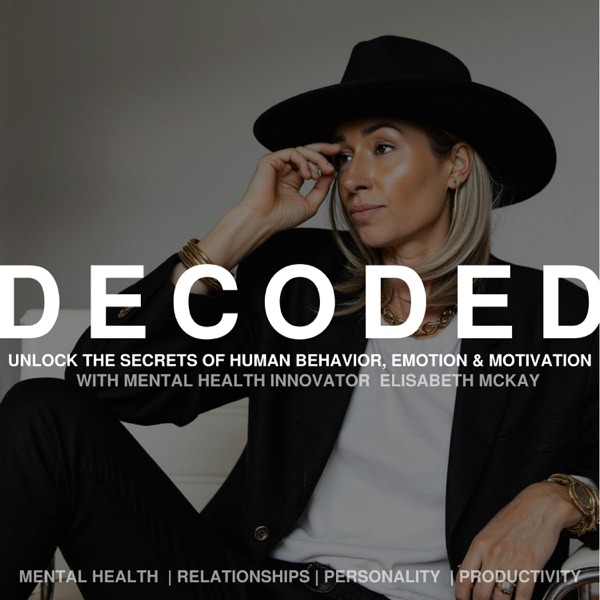
Decoded | Unlock The Secrets of Human Behavior, Emotion and Motivation
Unlock the Hidden Code Running Your Life—And Rewrite It for Good.
Your thoughts, relationships, addictions, and self-sabotaging behaviors aren’t random—they’re programmed patterns your brain has been running on autopilot.
Decoded breaks down the subconscious lies shaping your reality and gives you the tools to rewire them. Whether you're stuck in toxic cycles, battling destructive coping mechanisms, or just tired of feeling out of control, this podcast hands you the blueprint to disrupt the patterns, take back your mind, and start living with intention.
- Mental Health chart
- #3
- Episodes
- 64
- Releases
- Weekly
- Typical length
- 55 min
- On air since
- 2025
- Latest episode
- 5 days ago
Episodes
64 episodes, newest first
-
53 min
Procrastination Isn't A Laziness Problem–It's a Commitment Problem
Show notes
Procrastination isn't always a time management problem. What if it's a commitment problem that began in childhood?
You know what needs to get done. You understand the consequences of putting it off. And yet, your brain produces a perfectly reasonable explanation for why you should do something else first.
In this episode of Decoded, Elisabeth McKay examines the childhood roots of procrastination, the psychological mechanisms behind chronic delay, and how to interrupt those patterns through the Break Method.
Elisabeth explores why procrastination can develop when children aren't taught to make decisions, follow through on commitments, tolerate discomfort, and recognize the consequences of their choices.
She also challenges the idea that procrastination is simply laziness. In her framework, procrastination often involves distorted perceptions of time, minimization, chaotic prioritization, avoidance, and an inability to commit when a task becomes uncomfortable.
The problem isn't necessarily that you don't know what to do. It's that you've learned how to justify not doing it.
In this episode, Elisabeth breaks down:
• The childhood roots of procrastination: How early experiences with responsibility, decision-making, and follow-through can influence adult behavior.
• Minimization and delay: The internal rationalizations that make putting something off sound reasonable.
• Chaotic prioritization: When your brain convinces you that another task is more important than the one you're avoiding.
• All-or-nothing thinking: Why refusing to make incremental progress can keep simple responsibilities unfinished.
• Distorted time perception: How overestimating difficult tasks and underestimating enjoyable ones contributes to procrastination.
• Self-trust and self-efficacy: Why children need opportunities to make decisions, take action, and experience appropriate consequences.
• Timers and focused work sprints: How defined periods of effort can help interrupt avoidance and build commitment.
• Parenting and follow-through: Teaching children to make informed decisions, finish what they start, and develop emotional resilience without relying on shame.
• Pattern opposition: Recognizing the exact moment your brain attempts to justify delay and choosing a different response.Through examples involving household responsibilities, schoolwork, restaurant orders, children's activities, and her own experiences with procrastination, Elisabeth illustrates how these patterns develop and how they can be challenged.
Her central argument is direct:
Procrastination is a commitment problem. And overcoming it requires learning to commit before your brain talks you out of taking action.
Watch the full episode and identify the rationalization you use most often when you avoid something that needs to get done.
🔗 Find out your Brain Pattern Type: https://predictivemind.io/
🔗 Learn about Rapid Emotional Rewiring: https://breakmethod.com/
🔗 Grab a Copy of Your Brain is a Filthy Liar: https://www.amazon.com/YOUR-BRAIN-FILTHY-LIAR-Self-Deception/dp/1967424284/
🔗 My Peptide Supplier: https://elliemd.com/bizziegold
🔗 The Only Sauna I Recommend: https://www.healingsauna.com/bizzie?rfsn=8731070.5183d1 (Use CODE: BGHEAL for $200 OFF + Free Shipping)
Learn more about your ad choices. Visit https://megaphone.fm/adchoices
-
1 hr 2 min
Stop the Scroll: How Social Media Reinforces Your Worst Patterns
Show notes
What if your doomscrolling isn't about boredom at all? What if you're unconsciously choosing content that reinforces the exact emotional patterns you're trying to break?
In this episode of Decoded, Elisabeth McKay examines why we repeatedly reach for social media, news, podcasts, television, and other forms of media consumption—even when the content leaves us feeling more anxious, inadequate, distracted, or disconnected from our actual priorities.
Through the Break Method framework, Elisabeth explores how emotional triggers, unconscious behavioral patterns, and self-sabotage influence what we consume. She challenges the assumption that scrolling is a reward, that constant information is productive, and that deleting an app automatically changes the psychological mechanism behind the behavior.
The issue isn't simply how much time you spend on your phone.
It's what you're trying to feel, avoid, reinforce, or escape when you reach for it.
In this episode, Elisabeth breaks down:
• The when, where, and why of media consumption: Identifying the times, environments, and emotional states that trigger automatic scrolling.
• Comparison and copycat behavior: Why some people repeatedly consume content from individuals they admire while reinforcing inadequacy, resentment, and negative self-talk.
• Fear-based consumption: How news, true crime, health searches, and cultural commentary can become tools for confirming existing fears.
• Imagination and escape: When researching, planning, or consuming inspirational content replaces meaningful action in the real world.
• Sexualized media consumption: Examining whether the content you're consuming supports or undermines your stated relationship and personal priorities.
• The rationalization mechanism: How seemingly reasonable explanations disguise the emotional purpose of a behavior.
• Pattern opposition: A practical exercise for observing urges, documenting justifications, delaying consumption, and redirecting behavior toward actual goals.
• Digital boundaries: Why phone baskets, algorithm cleanup, and intentional device restrictions can become useful after identifying the underlying pattern.
• The importance of analog time: What happens when you stop filling every quiet moment with stimulation and begin paying attention to your own thoughts.Elisabeth also shares her own experiences with scrolling, parenting, and anxiety to illustrate how media consumption can become part of a larger behavioral cycle.
Her central challenge is direct:
Are your consumption habits moving you toward the life you say you want—or are they reinforcing the patterns keeping you from it?
Watch the full episode, identify your dominant consumption pattern, and consider what your scrolling behavior is taking away from your relationships, responsibilities, and personal goals.
🔗 Find out your Brain Pattern Type: https://predictivemind.io/
🔗 Learn about Rapid Emotional Rewiring: https://breakmethod.com/
🔗 Grab a Copy of Your Brain is a Filthy Liar: https://www.amazon.com/YOUR-BRAIN-FILTHY-LIAR-Self-Deception/dp/1967424284/
🔗 My Peptide Supplier: https://elliemd.com/bizziegold
🔗 The Only Sauna I Recommend: https://www.healingsauna.com/bizzie?rfsn=8731070.5183d1 (Use CODE: BGHEAL for $200 OFF + Free Shipping)
Learn more about your ad choices. Visit https://megaphone.fm/adchoices
-
1 hr 2 min
When Did You Stop Trusting Yourself?
Show notes
Self-trust determines whether you can act on what you perceive—or whether you immediately look outside yourself for reassurance, validation, permission, or someone else to take over.
This episode is an excerpt from a lecture series Elisabeth originally taught on renewing the mind through a biblical and psychological framework. Elisabeth McKay breaks down how self-trust is built through childhood, how parenting can unintentionally damage it, and what adults can do when they realize they were never taught to trust themselves in the first place. She also connects self-trust to self-efficacy, independence, discernment, and her Christian framework for following God and responding to the Holy Spirit.
Self-trust isn't the same as confidence.
Elisabeth describes it as the ability to trust what you're thinking, feeling, and perceiving enough to move forward. Self-efficacy is the next step: believing you can actually execute.
When those mechanisms aren't developed, the consequences can show up as second-guessing, overanalysis, learned helplessness, neediness, dependence on perceived authorities, susceptibility to groupthink, and difficulty making decisions without reassurance.
For parents, this creates a different question:
Are you helping your child become capable—or repeatedly communicating that they need you to function?
Using examples from raising her own children, Elisabeth examines the small moments that can either strengthen or undermine self-trust: letting a toddler pour the juice, allowing a child to make an informed clothing choice, resisting the impulse to rescue a child from a manageable challenge, and asking strategic questions instead of immediately supplying the answer.
She also explores:
• The relationship between self-trust and self-efficacy
• How parental enabling can create dependency
• Why a parent's anxiety can interrupt a child's confidence
• Letting children experience manageable struggle
• Why mistakes and mess can be necessary inputs for independence
• Giving children realistic information before allowing them to choose
• Montessori principles and self-directed learning
• Why Elisabeth believes ages two through five are especially important
• Asking strategic questions instead of immediately rescuing
• How concern with appearances can undermine a child's self-trust
• Second-guessing and overanalysis as signs of damaged self-trust
• Learned helplessness and dependence on authority
• Self-trust, emotional regulation, and spiritual discernment
• Why Elisabeth warns against automatically outsourcing beliefs to pastors, experts, influencers, or groups
• Groupthink and cultural pressure
• The relationship between self-trust and honest self-reflection
• Using "fear dates" to confront avoidance and rigidity
• Rebuilding self-trust through repeated pattern opposition
• Elisabeth's prayer points for identifying where self-trust was damagedWithin Elisabeth's faith framework, the consequence extends beyond decision-making. She argues that continually doubting yourself can make it harder to discern what you believe God is asking you to do—while emotional reactivity, fear, and projection can make that discernment even more difficult.
The objective isn't believing you're always right.
It's developing the capacity to think, assess, act, learn from the outcome, and take responsibility without constantly handing your authority to someone else.
Watch the full episode and ask yourself: when did you stop trusting yourself—and what do you do every day that continues reinforcing that pattern?
🔗 Find out your Brain Pattern Type: https://predictivemind.io/
🔗 Learn about Rapid Emotional Rewiring: https://breakmethod.com/
🔗 Grab a Copy of Your Brain is a Filthy Liar: https://www.amazon.com/YOUR-BRAIN-FILTHY-LIAR-Self-Deception/dp/1967424284/
🔗 My Peptide Supplier: https://elliemd.com/bizziegold
🔗 The Only Sauna I Recommend: https://www.healingsauna.com/bizzie?rfsn=8731070.5183d1 (Use CODE: BGHEAL for $200 OFF + Free Shipping)
Learn more about your ad choices. Visit https://megaphone.fm/adchoices
-
1 hr 42 min
The Trap Of Victim Consciousness | Dr. Kelly Brogan
Show notes
What happens when the system you trusted to explain the human mind stops making sense to you?
In this episode of Decoded, Elisabeth McKay sits down with psychiatrist and author Dr. Kelly Brogan for a wide-ranging conversation about psychiatry, medication, personal responsibility, nervous system regulation, victim consciousness, authority, relationships, feminism, AI, and what Kelly describes as the maturational movement from compliance to defiance—and eventually toward greater neutrality and sovereignty.
Kelly traces that evolution through her own life: from training inside conventional psychiatry and prescribing medication, to questioning the model after her own Hashimoto's diagnosis, to becoming an outspoken activist against systems she once trusted. But she doesn't stop there.
She describes eventually recognizing that defiance can keep you psychologically tethered to the same authority you're trying to escape. That realization becomes the thread running through this conversation.
Elisabeth and Kelly examine what happens when patients give authority over their bodies to doctors, when diagnoses become part of identity, and when the role of victim, villain, and rescuer begins organizing how we understand our struggles. Kelly also reflects on the guilt she experienced over her earlier medical practice and why her subsequent activism eventually became another identity she needed to question.
They also explore:
• Kelly's journey from conventional psychiatry to questioning its assumptions
• The difference between symptom management and Kelly's concept of healing
• Diagnosis, patient identity, and the needs illness can sometimes fulfill
• The victim–villain–rescuer triangle
• Compliance, defiance, and the movement toward sovereignty
• Why activism can become another form of attachment to an enemy
• Guilt, responsibility, and changing your beliefs without condemning your past self
• Wellness dogma and Kelly's 15 years of restrictive eating
• AI, technology, mental health, and human connection
• Career, feminism, financial independence, and Kelly's changing beliefs about freedom
• Nervous system safety, relationships, and self-regulation
• Anxious and avoidant relational tendencies
• Responsibility, vulnerability, and changing marriage dynamics
• What a more integrated "third path" could look like in medicine and relationshipsThis conversation isn't a simple rejection of one system in favor of another. It's about what happens after rejection—when you stop needing an authority to be completely right or completely wrong in order to decide what is true for you.
Kelly currently describes her work as holistic psychiatry and centers personal reclamation across health, relationships, and nervous-system regulation.
Watch the full conversation and consider where you may still be organizing your choices around an authority you're either obeying—or fighting.
🔗 Find out your Brain Pattern Type: https://predictivemind.io/
🔗 Learn about Rapid Emotional Rewiring: https://breakmethod.com/
🔗 Grab a Copy of Your Brain is a Filthy Liar: https://www.amazon.com/YOUR-BRAIN-FILTHY-LIAR-Self-Deception/dp/1967424284/
🔗 My Peptide Supplier: https://elliemd.com/bizziegold
🔗 The Only Sauna I Recommend: https://www.healingsauna.com/bizzie?rfsn=8731070.5183d1 (Use CODE: BGHEAL for $200 OFF + Free Shipping)
Learn more about your ad choices. Visit https://megaphone.fm/adchoices
-
1 hr 8 min
The Parenting Mistakes Your Kids Carry Into Adulthood
Show notes
Your child is not just reacting to what happens today. They are building assumptions about themselves, other people, trust, conflict, responsibility, and how the world works—and those assumptions can follow them into adulthood.
In Part 2 of this Decoded parenting series, Elisabeth McKay breaks down the parenting keystones she believes have the greatest impact on the adult your child becomes. The focus isn't perfect parenting. It's understanding the relationship between parental input and adult behavioral patterns—and becoming deliberate about what you're reinforcing while you still have the opportunity to influence it.
Elisabeth explores why dismissing a child's perception can damage self-trust, why unresolved experiences can become faulty assumptions, and why parents need to help children make sense of what happened instead of simply telling them what they should think.
She also breaks down the importance of age-appropriate truth, especially when children encounter difficult subjects like death, and explains why avoiding uncomfortable conversations can create more confusion than telling the truth in a form a child can actually process.
The episode gets equally direct about parental accountability.
What happens when you are the one who gets it wrong?
Instead of hiding mistakes, doubling down, projecting guilt, or pretending nothing happened, Elisabeth explains why parents should learn to identify the mistake, own it in real time, repair it, and allow their children to give honest feedback.
From there, she breaks down how to teach children metacognition: how to question their immediate emotional interpretation, separate what happened from what their brain is adding to the story, identify what they actually need, and move toward resolution instead of building a victim narrative.
This episode also covers:
• Why Elisabeth says children remember more than parents assume
• Helping children reconcile experiences instead of invalidating them
• How childhood assumptions can become adult behavioral patterns
• Teaching children how to think instead of what to think
• Why compliance should not be confused with healthy development
• Age-appropriate truth and difficult conversations
• Owning parenting mistakes in real time
• Giving children permission to hold parents accountable
• Learning how each individual child receives attention and love
• Teaching children to question their emotional interpretation
• Metacognition and pattern opposition
• Why boundaries require actual consequences
• Individualizing discipline instead of treating every child identically
• Accurate self-measurement without shame
• Why empty praise can create its own problemsThe central question is simple:
Are you parenting the behavior happening in front of you—or parenting the future human that behavior is helping create?
Watch Part 2 and examine the inputs you're giving your children now—and what those inputs may become later.
🔗 Find out your Brain Pattern Type: https://predictivemind.io/
🔗 Learn about Rapid Emotional Rewiring: https://breakmethod.com/
🔗 Grab a Copy of Your Brain is a Filthy Liar: https://www.amazon.com/YOUR-BRAIN-FILTHY-LIAR-Self-Deception/dp/1967424284/
🔗 My Peptide Supplier: https://elliemd.com/bizziegold
🔗 The Only Sauna I Recommend: https://www.healingsauna.com/bizzie?rfsn=8731070.5183d1 (Use CODE: BGHEAL for $200 OFF + Free Shipping)
Learn more about your ad choices. Visit https://megaphone.fm/adchoices
-
1 hr 36 min
Do You Actually Like Your Kids? The Parenting Question No One Wants to Answer
Show notes
Do you love your kids—but sometimes realize you don't actually like the behavior they've become?
That's the uncomfortable question Elisabeth McKay is asking in this episode of Decoded. Because parenting isn't a lottery, and a child's behavior doesn't develop inside a vacuum. Your household is constantly providing inputs—and those inputs are helping shape the behavioral outputs you eventually have to live with.
This episode challenges both ends of the parenting pendulum: harsh, authoritarian discipline on one side and hyper-attentive, permissive parenting on the other. Elisabeth argues that love, empathy, and good intentions don't automatically produce resilient, capable children. Sometimes the behaviors parents believe are compassionate in the moment can create dependency, emotional dysregulation, entitlement, or a lack of self-trust downstream.
Using the household as a Petri dish, Elisabeth breaks down how everything from boundaries and routines to emotional reactions, family dynamics, work, spirituality, conversations, and even what parents don't explain becomes part of the environment shaping a child's developing brain.
She also examines why the toddler years shouldn't simply be survived, why children repeatedly test boundaries, and why rescuing a child from every struggle can interfere with the exact capabilities they'll need as adults.
In this episode:
• Why loving your kids isn't the same as liking who they're becoming
• Parenting as an input → output relationship
• Why permissive and authoritarian parenting can both miss the mark
• The household as a developmental Petri dish
• Why children continually test inconsistent boundaries
• What happens when parents threaten consequences but don't follow through
• Why toddlers don't necessarily just "outgrow" behavioral patterns
• Strategic struggle versus immediately rescuing your child
• Teaching emotional regulation without reinforcing emotional escalation
• Why Elisabeth delays comfort during certain emotional reactions
• How to help children reality-test their interpretation of conflict
• Why routine and consistency create structure
• Building autonomy through chores and age-appropriate responsibility
• Why Elisabeth recommends Montessori principles for young children
• Intentional versus unintentional parenting inputs
• How parental work, relationships, emotions, and communication pattern children
• Self-efficacy and allowing children to struggle through tasks
• Self-regulation versus dependence on co-regulation
• How parents can unintentionally undermine self-trust
• Metacognition and teaching children to think about their thinking
• Why confidence comes after action—not before it
• The commitment style Elisabeth associates with positive adult outcomesThe objective isn't perfect parenting.
It's recognizing that everything you repeatedly reinforce is teaching your child something.
And when the output isn't working, separating yourself from the inputs prevents you from changing it.
This is Part One. Part Two continues with Elisabeth's Break parenting keystones and the specific qualities to nurture at home when you're trying to raise children who can thrive as adults.
Watch the full episode, then look at your household honestly: What is your parenting currently teaching your child to become?
🔗 Find out your Brain Pattern Type: https://predictivemind.io/
🔗 Learn about Rapid Emotional Rewiring: https://breakmethod.com/
🔗 Grab a Copy of Your Brain is a Filthy Liar: https://www.amazon.com/YOUR-BRAIN-FILTHY-LIAR-Self-Deception/dp/1967424284/
🔗 My Peptide Supplier: https://elliemd.com/bizziegold
🔗 The Only Sauna I Recommend: https://www.healingsauna.com/bizzie?rfsn=8731070.5183d1 (Use CODE: BGHEAL for $200 OFF + Free Shipping)
Learn more about your ad choices. Visit https://megaphone.fm/adchoices
-
1 hr 25 min
Sex, Fantasy & Media Priming: Who Programmed Your Desire?
Show notes
What if your sexual desires aren't simply "who you are"?
What if fantasy, attraction, kink, pornography, and even the way you experience intimacy have been shaped by years of childhood exposure, media priming, repetition, brain patterning, and unresolved behavioral frameworks you didn't consciously choose?
In this episode of Decoded, Elisabeth McKay challenges the cultural narrative that sexual liberation automatically produces greater freedom, consciousness, or intimacy. Instead, she examines what happens when sexual desire is treated as an identity to continually explore rather than a behavioral pattern whose origins and consequences can be questioned.
Elisabeth traces the conversation back to childhood: what you saw, overheard, searched for, experienced, or were repeatedly exposed to before you had the cognitive framework to understand it. She explains how these early priming events and source belief patterns can influence intrusive thoughts, sexual fantasy, attraction, pornography consumption, power dynamics, and the way adults attempt to build intimate relationships.
The episode also examines the opposite extreme. Sexual repression and rigid attempts to completely shelter children can create their own pendulum swing. The objective isn't repression versus liberation. It's understanding what shaped your desires so you can determine whether repeatedly feeding them is actually creating the life and relationships you consciously want.
Elisabeth explores:
• Childhood sexual priming and source belief patterns
• How early media exposure can influence intrusive thoughts
• Sexual fantasy through the lens of brain patterning
• Pornography, repetition, novelty, and escalating stimulation
• Fifty Shades of Grey and the mainstreaming of kink and BDSM
• Sexual liberation and the pendulum swing from repression
• Power dynamics, domination, submission, and role-play
• Synaptic pruning and reinforcing versus starving behavioral pathways
• Why fantasy can interfere with vulnerable intimacy
• Hypersexualized media and changing beauty standards
• Social media algorithms and repeated sexual imagery
• Polyamory, commitment, and Elisabeth's perspective on relational transformation
• Protecting childhood innocence without bubble-wrapping children
• The difference between sexual connection and sexual impulse
• The "weeds vs. flowers" framework for deciding what you're reinforcingThis isn't an argument for sexual repression.
It's an argument for examining the origin of what you desire before automatically deciding that desire deserves to be fed.
Because repetition matters. Priming matters. What you consume matters. And the patterns you continually reinforce can eventually compete directly with the marriage, family, intimacy, identity, and life you're consciously trying to build.
Watch the episode and ask yourself: Are you feeding the flowers—or reinforcing the weeds?
🔗 Find out your Brain Pattern Type: https://predictivemind.io/
🔗 Learn about Rapid Emotional Rewiring: https://breakmethod.com/
🔗 Grab a Copy of Your Brain is a Filthy Liar: https://www.amazon.com/YOUR-BRAIN-FILTHY-LIAR-Self-Deception/dp/1967424284/
🔗 My Peptide Supplier: https://elliemd.com/bizziegold
🔗 The Only Sauna I Recommend: https://www.healingsauna.com/bizzie?rfsn=8731070.5183d1 (Use CODE: BGHEAL for $200 OFF + Free Shipping)
Learn more about your ad choices. Visit https://megaphone.fm/adchoices
-
1 hr 19 min
Your Diagnosis Isn't The Root Cause | Dr. Will Cole
Show notes
What if the anxiety, brain fog, fatigue, intrusive thoughts, or dysregulation you're experiencing isn't coming exclusively from your thoughts? And what if a physical symptom isn't exclusively physical either?
In this episode of Decoded, Elisabeth McKay sits down with functional medicine expert Dr. Will Cole to examine the intersection between mental health, cellular health, inflammation, hormones, environmental exposures, gut health, and behavioral patterns.
The central question is one that conventional conversations often separate into competing camps: Is the origin of a symptom physiological, psychological—or both?
Dr. Cole explains how functional medicine approaches that question through comprehensive lab testing, tighter functional ranges, health history, and bio-individuality. They discuss cellular aging, mitochondrial dysfunction, metabolic health, thyroid function, environmental toxins, mold, intrusive thoughts, trauma, peptides, IV therapy, and why receiving a diagnosis still doesn't necessarily explain the mechanism that produced it.
They also get into the philosophy behind longevity. Dr. Cole distinguishes extending healthspan from the pursuit of immortality and discusses the spiritual dimension of health explored in his new book with Dr. Josh Axe, Heal Yourselves: Reversing the Irreversible.
In this episode:
• Mental health symptoms and cellular dysfunction
• Why mental health and physical health aren't separate systems
• Intrusive thoughts and neuro-immune-endocrine dysregulation
• What functional medicine actually is
• Optimal lab ranges vs. conventional reference ranges
• Why the same diagnosis can have different underlying mechanisms
• Autoimmunity, thyroid function, and metabolic health
• Cellular aging and mitochondrial function
• Mold, biotoxins, heavy metals, pesticides, PFAS, and microplastics
• Stress, trauma, shame, and physiological dysregulation
• Healthspan vs. the pursuit of immortality
• The spiritual component of longevity
• Biomarkers Dr. Cole looks at when evaluating cellular health
• Why peptides are a tool—not a substitute for addressing underlying dysfunction
• When IV therapy may be useful and when it may simply become an expensive bandageThe point isn't to decide that every psychological symptom is secretly physical—or that every physiological symptom can be changed through thought.
It's to stop forcing the human body into an either/or framework when the systems affecting your behavior, emotions, brain, immune function, hormones, and cellular health are constantly interacting.
Watch the full conversation and ask a better question: What is actually upstream of the symptom you're trying to change?
🔗 Find out your Brain Pattern Type: https://predictivemind.io/
🔗 Learn about Rapid Emotional Rewiring: https://breakmethod.com/
🔗 Grab a Copy of Heal Your Cells: Reversing The Irriversable:
https://www.amazon.com/s?k=heal+your+cells+by+dr+josh+axe&hvadid=810242586169&hvdev=c&hvexpln=67&hvlocphy=9029650&hvnetw=g&hvocijid=3115731636250114120--&hvqmt=e&hvrand=3115731636250114120&hvtargid=kwd-2486225119640&hydadcr=11928_13659523&mcid=07dbe94efda0309f9c54d23f4f7ebffd&tag=googhydr-20&ref=pd_sl_6w8kwzbyh6_e_p67🔗 My Peptide Supplier: https://elliemd.com/bizziegold
🔗 The Only Sauna I Recommend: https://www.healingsauna.com/bizzie?rfsn=8731070.5183d1 (Use CODE: BGHEAL for $200 OFF + Free Shipping)
Learn more about your ad choices. Visit https://megaphone.fm/adchoices
-
38 min
When Your Child Suddenly Develops OCD, Anxiety or Tics
Show notes
What if your child seemed completely normal—and then, within days, became a completely different person?
Sudden OCD. Severe separation anxiety. Food restriction. Tics or unusual movements. Sleep disruption. Frequent urination. Explosive behavior. Developmental regression. Even symptoms that appear irrational, obsessive, or psychiatric.
In this episode of Decoded, Elisabeth McKay breaks down PANS and PANDAS—two controversial areas of pediatric neuropsychiatry that force us to ask a critical question: Are we mistaking psychiatric symptoms for the origin of the problem?
PANS stands for Pediatric Acute-Onset Neuropsychiatric Syndrome. PANDAS refers specifically to Pediatric Autoimmune Neuropsychiatric Disorders Associated with Streptococcal Infections. But understanding the labels is only the beginning.
Elisabeth examines how sudden behavioral deterioration can potentially emerge from multiple directions. In some cases, psychological and environmental inputs may be involved. In others, infection, immune activity, inflammation, mold toxicity, or another medical process may warrant investigation. And sometimes, multiple factors may be operating at once.
In this episode:
•
What PANS and PANDAS actually mean
•
The defining importance of sudden symptom onset
•
OCD, food restriction, anxiety, aggression, regression, tics, and sleep changes
•
The history of PANDAS and its association with Group A strep
•
Why PANS is broader than PANDAS
•
Basal ganglia circuitry and the proposed immune hypothesis
•
Why there is currently no single definitive PANS biomarker
•
What the American Academy of Pediatrics has said about PANS
•
PANS vs. autoimmune encephalitis
•
Why psychiatric symptoms don't automatically prove psychiatric origin
•
Psychological and environmental "perfect storm" events
•
Mold toxicity and other potential environmental factors discussed in the episode
•
How parental behavior during illness can affect a child's interpretation
•
Why parents should document patterns without catastrophizing
•
What information can make conversations with clinicians more productive
•
Why medical investigation and behavioral support don't necessarily have to be either/or
The goal isn't to diagnose your child from a podcast.
It's to stop confusing the description of an output with an explanation of its mechanism.
When a child's functioning changes rapidly, the question isn't simply, "What psychiatric label fits these symptoms?"
It's also: What changed—and where did this process actually begin?
Watch, observe carefully, document what you can, and work with qualified clinicians when medical evaluation is warranted.
🔗 Find out your Brain Pattern Type:https://predictivemind.io/
🔗 Learn about Rapid Emotional Rewiring:https://breakmethod.com/
🔗 Grab a Copy of Your Brain is a Filthy Liar:https://www.amazon.com/YOUR-BRAIN-FILTHY-LIAR-Self-Deception/dp/1967424284/ref=sr_1_1?crid=390FC0W304YNI&dib=eyJ2IjoiMSJ9.I8_kpD55nc-N5yNG8B9OPQ.Q7fi8mscYcCo01FBkOKtQgnXw7exKMp_Qus3pkQiQDw&dib_tag=se&keywords=your+brain+is+a+filthy+liar&qid=1767306891&sprefix=your+brain+is+a%2Caps%2C212&sr=8-1
🔗 My Peptide Supplier:https://elliemd.com/bizziegold
🔗 The Only Sauna I Recommend:https://www.healingsauna.com/bizzie?rfsn=8731070.5183d1 (Use CODE: BGHEAL for $200 OFF + Free Shipping)
Learn more about your ad choices. Visit https://megaphone.fm/adchoices
-
55 min
When Does a Thought Become a Delusion?
Show notes
What separates an intrusive thought from a delusion? And at what point does your interpretation of reality become so rigid that contradictory evidence can no longer reach you?
In this episode of Decoded, Elisabeth McKay breaks down the difference between intrusive thoughts, delusion, and psychosis—and why understanding that distinction matters far beyond severe psychiatric illness.
Using the Lindsay Clancy trial as a starting point, Elisabeth examines how reality testing deteriorates, why emotionally driven interpretations can become self-sealing, and how persecutory, referential, grandiose, jealous, somatic, and nihilistic delusions actually function. She also explores the complicated intersection between spirituality and psychosis, gaslighting and coercive control, and the role agency and metacognition play in keeping you anchored to objective reality.
The episode also returns to new evidence discussed in the Lindsay Clancy trial, including searches allegedly made while Lindsay was away from the home, and the questions those details raise within Elisabeth’s stated hypothesis about Lindsay’s psychological deterioration. These are presented as questions and hypotheses—not established conclusions.
In this episode:
• Intrusive thoughts vs. delusions vs. psychosis
• What reality testing actually looks like
• How to separate evidence from assumptions
• Persecutory and referential delusions
• Grandiose and spiritual delusions
• Jealous, somatic, and nihilistic delusions
• Why contradictory evidence can strengthen a delusion
• How spirituality can become entangled with psychosis
• Gaslighting, coercive control, and destabilized self-trust
• New questions raised by the Lindsay Clancy trial
• Why intrusive thoughts do not equal intention
• Agency and metacognition
• 10 rules for protecting your grip on objective realityThe central question isn't whether you've ever had a disturbing, irrational, or emotionally charged thought.
It's whether you can still recognize that a thought is a thought, a feeling is not evidence, and your interpretation is not automatically reality.
Watch, reflect, and ask yourself: What do I actually know using only three-dimensional evidence?
🔗 Find out your Brain Pattern Type: https://predictivemind.io/
🔗 Learn about Rapid Emotional Rewiring: https://breakmethod.com/
🔗 Grab a Copy of Your Brain is a Filthy Liar: https://www.amazon.com/YOUR-BRAIN-FILTHY-LIAR-Self-Deception/dp/1967424284/
🔗 My Peptide Supplier: https://elliemd.com/bizziegold
🔗 The Only Sauna I Recommend: https://www.healingsauna.com/bizzie?rfsn=8731070.5183d1 (Use CODE: BGHEAL for $200 OFF + Free Shipping)
Learn more about your ad choices. Visit https://megaphone.fm/adchoices
-
59 min
The Lindsay Clancy Trial: What Doesn't Add Up?
Show notes
The Lindsay Clancy trial raises a question bigger than guilt or innocence: What happens when psychiatry, self-reporting, medication, human perception, and the judicial system collide?
In this episode of Decoded, Elisabeth McKay examines the Lindsay Clancy case—not as a true crime investigation, but through the psychological and systemic questions emerging from the trial.
The Commonwealth argues that Clancy intentionally murdered her three children. Her defense has argued that she was experiencing postpartum psychosis. But as Elisabeth examines the testimony and competing narratives surrounding the case, a much larger conversation emerges about psychiatric care, pharmacological intervention, self-reporting, perception, gaslighting, and the limitations of attempting to reconstruct objective reality through subjective human observation.
Elisabeth also examines an alternate theory circulating around the case: What if Lindsay Clancy didn't kill her children? She makes clear that this is a hypothesis—not an established fact—and discusses the details that caused her to question the dominant narrative.
This episode explores:
• The Lindsay Clancy trial and postpartum psychosis defense
• Questions surrounding Clancy's psychiatric treatment
• The limitations of patient self-reporting
• Why practitioner observation can also be distorted
• Psychiatric medication and cascading pharmacological interventions
• Concerns raised during testimony about suicidal ideation
• The difference between symptoms and root causes
• Questions surrounding Patrick Clancy's account
• Why certain details of the night raise questions for Elisabeth
• Gaslighting, self-trust, and distorted perception
• How psychologically vulnerable people can lose confidence in their own reality
• The limitations of traditional talk therapy
• Why data-driven mental health assessment matters
• The larger mental health failures exposed by this caseThis is not an attempt to determine guilt from a podcast.
It is an examination of what happens when every layer of a system depends on human beings accurately reporting, observing, interpreting, and remembering reality.
And when those systems fail, the consequences aren't theoretical.
People's lives can be destroyed.Watch the episode, examine the available evidence yourself, and draw your own conclusions.
🔗 Find out your Brain Pattern Type: https://predictivemind.io/
🔗 Learn about Rapid Emotional Rewiring: https://breakmethod.com/
🔗 Grab a Copy of Your Brain is a Filthy Liar: AmazonLearn more about your ad choices. Visit https://megaphone.fm/adchoices
-
1 hr 6 min
What Is Mental Illness Really?
Season 3, Episode 1
Show notes
What if mental illness isn’t where the problem actually begins?
In the Season 3 premiere of Decoded, Elisabeth McKay challenges the dominant framework for understanding mental health and presents a different hypothesis: what we call mental illness may be a downstream expression of a much larger neurocognitive process that begins with how the brain perceives reality.
The sequence matters.
Childhood experience creates underlying rules. Those rules shape perception. Perception generates biochemical states. Familiar biochemical states influence behavior. When that process becomes sustained, rigid, and difficult to interrupt, the downstream symptoms can begin to impair relationships, communication, decision-making, emotional regulation, and daily functioning.
In this episode, Elisabeth breaks down:
•
What “mental illness” actually describes
•
Why a diagnosis is not the same thing as a cause
•
How distorted perception changes behavior
•
The role of childhood in constructing underlying rules
•
Why intelligence doesn’t guarantee objective perception
•
The Neurocognitive Funnel
•
Emotional homeostasis and why the familiar can feel safe
•
How perception generates biochemical responses
•
Anxiety, depression, agency, and self-efficacy
•
Why self-regulation is not the absence of emotion
•
Metacognition and the ability to question your own thinking
•
Why adaptive communication matters
•
The chemical imbalance model and its limitations
•
Why medication cannot explain the root cause by itself
•
How parents can build self-trust, self-regulation, self-efficacy, and metacognition in children
•
Why mental illness should never become an identity
•
What it means to intervene at the root of the process
This episode does not argue that suffering is imaginary or that biological factors don't exist. It argues that treating behavior or biochemistry in isolation leaves the rest of the process untouched.
If mental illness is produced through a process, then understanding that process creates opportunities to interrupt it.
🔗 Find out your Brain Pattern Type:https://predictivemind.io/
🔗 Learn about Rapid Emotional Rewiring:https://breakmethod.com/
🔗 Grab a Copy of Your Brain is a Filthy Liar:https://www.amazon.com/YOUR-BRAIN-FILTHY-LIAR-Self-Deception/dp/1967424284/ref=sr_1_1?crid=390FC0W304YNI&dib=eyJ2IjoiMSJ9.I8_kpD55nc-N5yNG8B9OPQ.Q7fi8mscYcCo01FBkOKtQgnXw7exKMp_Qus3pkQiQDw&dib_tag=se&keywords=your+brain+is+a+filthy+liar&qid=1767306891&sprefix=your+brain+is+a%2Caps%2C212&sr=8-1
🔗 My Peptide Supplier:https://elliemd.com/bizziegold
🔗 The Only Sauna I Recommend:https://www.healingsauna.com/bizzie?rfsn=8731070.5183d1 (Use CODE: BGHEAL for $200 OFF + Free Shipping)
Learn more about your ad choices. Visit https://megaphone.fm/adchoices
-
50 min
Is Reality Even Real? Part 2 | Self-Deception, Consciousness & Objective Truth
Season 2
Show notes
If your perception isn't objective...How do you know what's actually real?
In Part 2 of this Decoded series, Elisabeth McKay explores one of the most unsettling questions in neuroscience and psychology: How does self-deception form, and why does it feel indistinguishable from truth?
Building on the foundation established in Part 1, this episode examines how attention, memory, emotional salience, prediction, and past experiences shape the reality you experience every day. Elisabeth explains why two people can experience the same event and leave with completely different conclusions—and why certainty itself may be one of the brain's greatest illusions.
In this episode:
•
Why attention determines your experience of reality
•
The Reticular Activating System (RAS) explained
•
How the salience network decides what matters
•
Why memory is reconstructed—not replayed
•
Narrative formation and emotional meaning
•
Why relationships break down over interpretation
•
Trauma, prediction, and self-fulfilling prophecies
•
The psychology of self-deception
•
Reality vertigo and cognitive dissonance
•
Plato's Cave and modern neuroscience
•
Consciousness and the "hard problem"
•
Simulation theory through a neuroscience lens
•
Why objective truth still matters
This conversation connects neuroscience, psychology, philosophy, and behavioral science to challenge one of our deepest assumptions—that the way we experience reality is reality itself.
If Part 1 explained how your brain constructs reality, Part 2 explains why that construction becomes so convincing that it feels like truth.
RESOURCES
🔗 Find out your Brain Pattern Type:https://predictivemind.io/
🔗 Learn about Rapid Emotional Rewiring:https://breakmethod.com/
🔗 Grab a Copy of Your Brain is a Filthy Liar:https://www.amazon.com/YOUR-BRAIN-FILTHY-LIAR-Self-Deception/dp/1967424284/ref=sr_1_1?crid=390FC0W304YNI&dib=eyJ2IjoiMSJ9.I8_kpD55nc-N5yNG8B9OPQ.Q7fi8mscYcCo01FBkOKtQgnXw7exKMp_Qus3pkQiQDw&dib_tag=se&keywords=your+brain+is+a+filthy+liar&qid=1767306891&sprefix=your+brain+is+a%2Caps%2C212&sr=8-1
🔗 My Peptide Supplier:https://elliemd.com/bizziegold
🔗 The Only Sauna I Recommend:https://www.healingsauna.com/bizzie?rfsn=8731070.5183d1 (Use CODE: BGHEAL for $200 OFF + Free Shipping)
Learn more about your ad choices. Visit https://megaphone.fm/adchoices
-
50 min
Is Reality Even Real? Your Brain Constructs the World You Experience
Show notes
What if you've never actually experienced objective reality?
In this episode of Decoded, Elisabeth McKay explores one of the most profound questions in neuroscience, philosophy, and psychology: How does the brain transform information into the world you believe you're experiencing?
From color and sound to pain, emotion, memory, and meaning, your brain isn't passively recording reality—it's actively constructing it.
This episode breaks down how perception is created through predictive processing, sensory translation, and childhood conditioning, revealing why two people can witness the exact same event and walk away with completely different experiences.
In this episode, Elisabeth explores:
•
Why your brain never directly experiences reality
•
How the brain constructs color, sound, touch, and pain
•
The neuroscience of perception and consciousness
•
Why atoms are mostly empty space
•
Predictive processing and Bayesian brain theory
•
Interoception and its role in anxiety and panic
•
Phantom limb syndrome and the brain's model of reality
•
How childhood experiences shape adult perception
•
Why memories and emotions influence every experience
•
Brain Pattern Mapping and the roots of self-deception
•
Why objective reality and subjective experience are often confused
Reality may exist. But your experience of reality is constructed. Understanding that distinction changes everything—from relationships and communication to anxiety, trauma, emotional regulation, and mental health.
This is Part One of a two-part exploration into perception, consciousness, and the neurological foundations of reality itself.
RESOURCES
🔗 Find out your Brain Pattern Type:https://predictivemind.io/
🔗 Learn about Rapid Emotional Rewiring:https://breakmethod.com/
🔗 Grab a Copy of Your Brain is a Filthy Liar:https://www.amazon.com/YOUR-BRAIN-FILTHY-LIAR-Self-Deception/dp/1967424284/ref=sr_1_1?crid=390FC0W304YNI&dib=eyJ2IjoiMSJ9.I8_kpD55nc-N5yNG8B9OPQ.Q7fi8mscYcCo01FBkOKtQgnXw7exKMp_Qus3pkQiQDw&dib_tag=se&keywords=your+brain+is+a+filthy+liar&qid=1767306891&sprefix=your+brain+is+a%2Caps%2C212&sr=8-1
🔗 My Peptide Supplier:https://elliemd.com/bizziegold
🔗 The Only Sauna I Recommend:https://www.healingsauna.com/bizzie?rfsn=8731070.5183d1 (Use CODE: BGHEAL for $200 OFF + Free Shipping)
Learn more about your ad choices. Visit https://megaphone.fm/adchoices
-
29 min
Who Killed God? The Spiritual Cost of Modern Progress
Show notes
What happens when a civilization removes God—but keeps searching for meaning?
In this episode of Decoded, Elisabeth McKay explores one of the most important cultural questions of our time: Who killed God?
This is not about religion versus atheism. It's a deeper examination of how modern society gradually replaced transcendence with human-centered systems—and what happened as a result.
From the Enlightenment and the French Revolution to Darwin, Freud, Marx, modern psychology, consumer culture, and the rise of self-worship, Elisabeth traces the historical and psychological shifts that transformed how we understand morality, suffering, purpose, identity, and death.
In this episode:
•
The Enlightenment and the rise of secularism
•
Why Nietzsche warned that "God is dead"
•
The Prosperity Paradox and modern hedonism
•
How comfort replaced dependence on transcendence
•
Why identity became the new religion
•
The psychological consequences of moral relativism
•
The sexual revolution and the commodification of the self
•
Why modern mental health feels incomplete
•
Death, meaning, and the loss of spiritual frameworks
•
What happens when suffering no longer has purpose
This is an invitation to ask deeper questions about meaning, morality, suffering, purpose, and the spiritual foundations that shape human life.
Because the question may not be who killed God. The question may be what dies in a civilization when God becomes unnecessary.
🔗 Find out your Brain Pattern Type:https://predictivemind.io/
🔗 Learn about Rapid Emotional Rewiring:https://breakmethod.com/
🔗 Grab a Copy of Your Brain is a Filthy Liar:https://www.amazon.com/YOUR-BRAIN-FILTHY-LIAR-Self-Deception/dp/1967424284/ref=sr_1_1?crid=390FC0W304YNI&dib=eyJ2IjoiMSJ9.I8_kpD55nc-N5yNG8B9OPQ.Q7fi8mscYcCo01FBkOKtQgnXw7exKMp_Qus3pkQiQDw&dib_tag=se&keywords=your+brain+is+a+filthy+liar&qid=1767306891&sprefix=your+brain+is+a%2Caps%2C212&sr=8-1
🔗 My Peptide Supplier:https://elliemd.com/bizziegold
🔗 The Only Sauna I Recommend:https://www.healingsauna.com/bizzie?rfsn=8731070.5183d1 (Use CODE: BGHEAL for $200 OFF + Free Shipping)
Learn more about your ad choices. Visit https://megaphone.fm/adchoices
-
46 min
6 Reasons Weed Is Making Your Anxiety Worse
Show notes
Weed culture has spent years convincing people that THC helps anxiety. But what if the opposite is true?
In this episode of Decoded, Elisabeth McKay breaks down the psychology, neuroscience, and behavioral patterns behind marijuana use, anxiety, emotional regulation, and perception. This isn't an anti-weed conversation. It's an examination of why so many people use THC to manage anxiety while simultaneously becoming more emotionally reactive, more dependent on external coping mechanisms, less capable of self-regulation, and increasingly disconnected from objective reality.
In this episode:
• Why THC may worsen anxiety over time
• The difference between sedation and regulation
• Why relief is not the same as healing
• How marijuana alters perception and emotional salience
• The relationship between THC and panic attacks
• Hyper-focus, paranoia, and distorted priorities
• The difference between intuition and fear
• How THC impacts metacognition and self-awareness
• False memories, emotional reasoning, and subjective reality
• Why marijuana suppresses REM sleep
• The connection between weed, emotional avoidance, and dependency
• Why self-regulation cannot be outsourced to a substanceElisabeth also explores the growing normalization of cannabis culture, the rise of marijuana use disorder, teen mental health concerns, and why many people mistake reduced awareness of a problem for actually solving it.
Because feeling better isn't always the same thing as getting better.
And a sedated nervous system is not the same thing as a regulated one.
🔗 Find out your Brain Pattern Type: https://predictivemind.io/
🔗 Learn about Rapid Emotional Rewiring: https://breakmethod.com/
🔗 Grab a Copy of Your Brain is a Filthy Liar: https://www.amazon.com/YOUR-BRAIN-FILTHY-LIAR-Self-Deception/dp/1967424284/
🔗 My Peptide Supplier: https://elliemd.com/bizziegold
🔗 The Only Sauna I Recommend: https://www.healingsauna.com/bizzie?rfsn=8731070.5183d1 (Use CODE: BGHEAL for $200 OFF + Free Shipping)
Learn more about your ad choices. Visit https://megaphone.fm/adchoices
-
44 min
What Happened After a Year of Peptides
Season 2, Episode 22
Show notes
A year ago, Elisabeth McKay made a decision she never thought she’d make.
After years of managing lupus symptoms, inflammation, migraines, hormonal dysfunction, and unexplained weight gain through diet, exercise, and lifestyle interventions, her body stopped responding to everything that had worked before.
In this episode of Decoded, Elisabeth shares her full one-year peptide update, including what happened after microdosing tirzepatide, coming off of it completely, and eventually returning after autoimmune symptoms and inflammation resurfaced.
FYI -This is not a weight-loss story.
This is a conversation about chronic inflammation, autoimmune disease, hormones, stress, recovery, and what happens when your body finally starts responding again.
In this episode, Elisabeth discusses:
• Her history with lupus and autoimmune symptoms
• The role stress played in inflammation and weight gain
• Why traditional fitness approaches stopped working
• Her experience microdosing tirzepatide for a full year
• What happened when she stopped taking it
• Protein, electrolytes, and nutrition considerations
• Other peptides she has explored
• Sauna, red light therapy, vibration plates, and recovery protocols
• How she feels at 41 compared to 35
If you've been curious about peptides, tirzepatide, inflammation, autoimmune recovery, or microdosing protocols, this episode provides a transparent look at one person's long-term experience.
RESOURCES
🔗 Find out your Brain Pattern Type:https://predictivemind.io/
🔗 Learn about Rapid Emotional Rewiring:https://breakmethod.com/
🔗 Grab a Copy of Your Brain is a Filthy Liar:https://www.amazon.com/YOUR-BRAIN-FILTHY-LIAR-Self-Deception/dp/1967424284
🔗 My Peptide Supplier:https://elliemd.com/bizziegold
🔗 The Only Sauna I Recommend:https://www.healingsauna.com/bizzie?rfsn=8731070.5183d1(Use CODE: BGHEAL for $200 OFF + Free Shipping)
Learn more about your ad choices. Visit https://megaphone.fm/adchoices
-
55 min
The Dark Side of Psychedelic Therapy
Show notes
Psychedelics have gone from fringe culture to mainstream mental health conversation. But what if the discussion is missing the most important question?
Who should never be taking them?
In this episode of Decoded, Elisabeth McKay examines the growing normalization of psychedelics, ketamine therapy, medicine journeys, and modern psychedelic culture through the lens of brain patterns, psychological risk, emotional regulation, and personal responsibility.
This is not an anti-psychedelic episode.
It’s an examination of why certain people may benefit from psychedelic experiences while others may experience devastating psychological consequences—including psychosis, false memories, emotional destabilization, identity confusion, and long-term dysregulation.
This episode explores:
•
The normalization of psychedelic culture
•
Why most people are not ideal candidates for psychedelics
•
Ketamine therapy and psychological risk
•
The relationship between psychedelics and psychotic breaks
•
False memories and altered states of consciousness
•
Emotional dysregulation and vulnerability
•
The difference between healing and truth-seeking
•
Why some people become spiritually obsessed after medicine journeys
•
Psychedelics, personality disorders, and screening protocols
•
The hidden risks of medicine ceremonies
•
Psychedelic experiences vs genuine emotional healing
•
Why curiosity alone may be a warning sign
Elisabeth also shares personal experiences with mushrooms, peyote, rave culture, and altered states while explaining why psychedelic experiences should never be treated as universally beneficial.
Because the question isn't whether psychedelics can change your life. The question is whether they change it for the better.
🔗 Find out your Brain Pattern Type:https://predictivemind.io/
🔗 Learn about Rapid Emotional Rewiring:https://breakmethod.com/
🔗 The Only Sauna I Recommend:https://www.healingsauna.com/bizzie?rfsn=8731070.5183d1 (Use CODE: BGHEAL for $200 OFF + Free Shipping)
Learn more about your ad choices. Visit https://megaphone.fm/adchoices
-
48 min
Jealousy, Scarcity, and Toxic Relationships Explained
Show notes
Jealousy is one of the most socially normalized forms of self-destruction.
People romanticize it. Joke about it. Build identities around it. But jealousy has very little to do with the other person.
It’s about what your nervous system believes their existence means about you.
In this episode of Decoded, Elisabeth McKay breaks down the psychology of jealousy, comparison, insecurity, emotional scarcity, and the destructive behavioral loops that emerge when worth becomes tied to external validation.
This episode explores:
•
Why jealousy is rooted in perceived scarcity
•
How childhood environments condition comparison and insecurity
•
Why attention, validation, and approval become addictive
•
The connection between jealousy, gossip, resentment, and control
•
How confirmation bias destroys relationships
•
Why jealousy creates emotional dysregulation and distorted perception
•
The link between jealousy, victimhood, and self-sabotage
•
How parents accidentally reinforce jealousy patterns in children
•
Why admiration often precedes resentment
•
The behavioral patterns required to rewire jealousy
Elisabeth also breaks down how jealousy quietly corrodes relationships, friendships, parenting, discernment, and self-respect—while trapping people inside obsessive emotional comparison loops they often mistake for truth.
This is not about shaming jealousy. It’s about understanding the mechanism so you can stop feeding it. Because jealousy doesn’t destroy the person you envy first. It destroys you.
RESOURCES
🔗 Find out your Brain Pattern Type: https://predictivemind.io/
🔗 Learn about Rapid Emotional Rewiring: https://breakmethod.com/
🔗 The Only Sauna I Recommend: https://www.healingsauna.com/bizzie?rfsn=8731070.5183d1 (Use CODE: BGHEAL for $200 OFF + Free Shipping)
Learn more about your ad choices. Visit https://megaphone.fm/adchoices
-
1 hr 16 min
DARVO, Gaslighting, and the Collapse of Discernment
Show notes
DARVO has become one of the most overused and misunderstood psychological terms on the internet.
In this episode, Elisabeth McKay breaks down the difference between actual DARVO behavior and “truth advocacy” — the attempt to restore factual accuracy, context, and alignment in emotionally distorted conflict.
Because in today’s mental health culture, emotional certainty is often treated like objective truth.
This episode explores:
•
Why viral psychology content rewards emotional validation over accuracy
•
How confirmation bias distorts relationship dynamics
•
The difference between feeling attacked vs actually being attacked
•
Why emotionally reactive people often misread clarification as abuse
•
How interpretation drift escalates conflict
•
Why both sides in a conflict can identify with the same mental health content
•
The psychology behind DARVO (Deny, Attack, Reverse Victim & Offender)
•
Why context, specificity, and factual correction matter
•
How self-deception reshapes perception and memory
•
The difference between emotional filtering and objective reality
Elisabeth also breaks down how emotional states distort communication, why assumptions feel like facts, and how modern psychology culture increasingly labels precision, boundaries, and factual correction as manipulation.
This is not a defense of abuse. It’s a discussion about the collapse of discernment we are experiencing as a collective.
If you’ve ever struggled to tell the difference between manipulation, projection, emotional reasoning, and genuine attempts to repair communication, this episode will challenge the frameworks you’ve probably absorbed online.
Not every disagreement is gaslighting. Not every correction is DARVO. And not every emotional reaction is proof.
Learn more about your ad choices. Visit https://megaphone.fm/adchoices
Mental Health lists
More Mental Health shows picked out from the charts












More in Mental Health
Placed highest on Apple Podcasts' Mental Health chart right now