Podcast
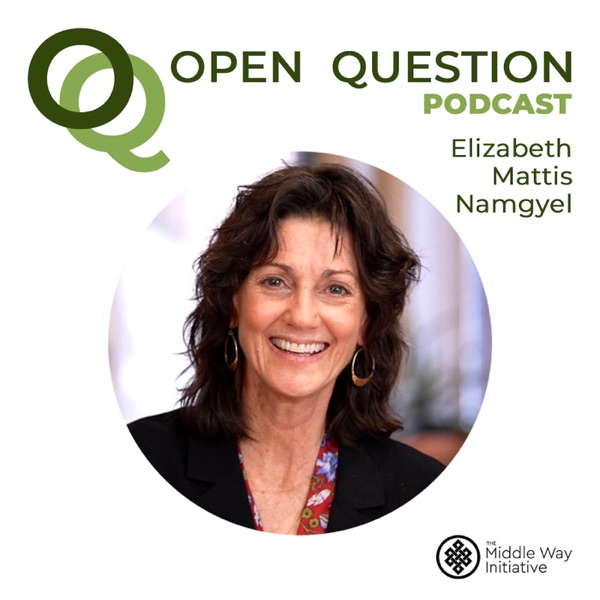
Open Question
On Open Question Podcast, Buddhist teacher, Elizabeth Mattis Namgyel, explores topics central to the Mahayana view - emptiness, dependent arising and bodhicitta - using a fresh mix of language, storytelling and guided inquiry. Elizabeth invites listeners to establish a practical understanding of these topics to enhance their daily lives.
Elizabeth has studied and practiced Buddhism since 1985 under the guidance of Dzigar Kongtrul Rinpoche. After completing a six year retreat, she was appointed Retreat Master at the Samten Ling retreat center in Colorado. Elizabeth is the author of two books, The Power of an Open Question and The Logic of Faith. She is a teacher in the Mangala Shri Bhuti lineage, and is the founder/president of Middle Way Initiative, an educational non-profit.
For more information, please visit: www.middlewayinitiative.org
- Episodes
- 40
- Releases
- Every few months
- Typical length
- 23 min
- On air since
- 2020
- Latest episode
- 1 month ago
Episodes
40 episodes, newest first
-
27 min
OQ 703 - TWO TRUTHS: NOT TWO, NOT TRUE
Season 7, Episode 703
Show notes
In episode 703, Elizabeth asks the question: "If the absolute nature is not to be found within the nature of appearances themselves, where else would we find it?" She takes us on a journey to explore this question through the Buddha's teaching on dependent arising, Nagarjuna's two truths, and a curious teaching she received directly from her own teacher. The investigation reconciles common confusions about the essential teaching of the two truths.
-
23 min
OQ 702 - What Am I Looking At?
Season 7, Episode 702
Show notes
Elizabeth has a curious encounter at the local post office, which ignites a profound inquiry into what keeps us from the nature of appearance.
-
23 min
OQ 701 - The Great Escape
Season 7, Episode 701
Show notes
In episode 701, Elizabeth takes us through a classical teaching on the 12 links of dependent origination, which explores the genesis of our confusion, the dazzling spectacle of samsara, and how we can free ourselves from it. "When we feel confused about why we are practicing" she suggests, "just look at the wheel of becoming and it will remind you that there is nothing mystical about liberation. It is very matter-of-fact and within our reach."
-
25 min
OQ 603 - DISRUPTION!
Season 6, Episode 603
Show notes
Elizabeth explores absolute bodhicitta through the story of the 11th century spiritual quest of Naropa. His training, under Mahasiddha Tilopa, illustrates the necessity of disrupting delusion in the context of spiritual awakening. At the heart of it all lies a deep examination of the meaning and experience of what is real.
-
23 min
OQ 602 - Sujata's Offering
Season 6, Episode 602
Show notes
In the context of a recent pilgrimage in India, Elizabeth opens up the topic of "engaged" bodhicitta and the six paramitas. She weaves in the story of Sujata, the young woman known for generously offering a bowl of sweet milk-rice to Siddhartha who was debilitated after years of austerities. Revived and refocused, Siddhartha then made his way to the shade of a pipal tree and attained enlightenment, becoming The Buddha. Join the pilgrimage and explore India's conspiracy of great giving.
-
23 min
OQ 601 - Across The Valley
Season 6, Episode 601
Show notes
In episode 601, Across the Valley, Elizabeth uses the analogy of two communities situated on opposite sides of the valley where she lives to consider our tendencies towards fundamentalism and rightness. "What happens" she asks, "when everyone feels absolutely right?" The Bodhisattva Vow is a commitment to create connection with others, without bias, by looking inward at the mechanisms of reification, and then applying the Buddha's Middle Way Beyond The Extremes.
-
23 min
OQ 505 - Looking Into the World
Season 5, Episode 505
Show notes
In this episode Elizabeth reflects upon the provocative poem by renowned Buddhist teacher, Chogyam Trungpa Rinpoche, entitled, "Looking Into the World." "It's not a cozy poem," she says, "It's an incantation to NOT trust, a reflection on loneliness, and a tribute to the freedom and confidence that comes from standing on our own two feet." You have to put your familiar views aside to explore this one!
-
23 min
OQ 504 - Hook And Ring
Season 5, Episode 504
Show notes
Devotion is one of the many expressions of faith. When understood clearly, devotion can hasten the process of awakening for the student on the spiritual path, ripening and maturing them in a simple and direct way. Elizabeth brings us through various definitions of devotion, explores devotion as an experience, and considers the cultural and interpersonal challenges that can arise through misunderstanding the nature of the teacher/student dynamic.
-
19 min
OQ 503 - The Ineffable
Season 5, Episode 503
Show notes
All great spiritual lineages point us back to that which defies concept and language. Authentic practitioners describe awakening as being touched by a sense of awe, overcome by the beauty, fierceness and power of being. To be in AWE is a natural human experience. Ironically, so is the discomfort that leaves us restless with the experience, making it almost impossible to bear. Our inability to bear the ineffable gives rise to dualism and our conflict with faith.
-
23 min
OQ 502 - Hail The Impossible!
Season 5, Episode 502
Show notes
At 7:15 am on August 7th, 1974, 1,300 feet above a gathering crowd, French high wire artist, Philip Petit, renowned for his unauthorized public stunts, stepped onto a 131-foot wire rigged between the twin towers of New York City's World Trade Center. In this episode, Elizabeth recalls Petit 's "impossible" display of human courage and confidenceas an analogy for faith, why we need to cultivate it, what it is, and how it works.
-
22 min
OQ 501 - The F Word
Season 5, Episode 501
Show notes
In this episode, Elizabeth takes us on a journey through the term 'faith.' We may assume we know what faith is, but most of us have never truly explored its nuance or spectrum of meanings. We often use the term faith to refer to: dogma, fundamentalism, doctrine, confidence, devotion conviction, just to name a few. In the context of contemporary culture, there are those who suggest that we replace the world faith with spirituality, but Elizabeth requests us not to write-off faith so glibly. Faith carries with it the undeniable tension between our search for security and the limits of our ability to know. Faith keeps us connected to the heart of the human condition.
-
25 min
OQ 405 - The Self: Bearing Witness
Season 4, Episode 405
Show notes
Elizabeth shares the classic Buddhist narrative of Avaloketeshvara, the bodhisattva of compassion, and asks us to contemplate the story carefully, adding, "because something similar could happen to you." Continuing her exploration of the self, Elizabeth navigates the common responses to our challenging human experience: fixing, despairing or withdrawing…all of which are rooted in misunderstanding. Elizabeth takes inspiration, instead, from Avaloketeshvara's example to bear steadfast witness to experience.
-
24 min
OQ 404 - The Self: When Does Bread Become Toast?
Season 4, Episode 404
Show notes
In previous episodes we engaged in the liberating practice of looking and not finding, as we searched for something singular or independent. In this episode, Elizabeth explores the topic of permanence - the 3rd in this triad of classical Middle Way inquiries.
Elizabeth drops back into her grandmother's kitchen for a tour of the nature of time, what it might mean to 'live in the moment,' and the difference between impermanence and emptiness.
-
24 min
OQ 403 - The Self: Into The Watery Depths
Season 4, Episode 403
Show notes
Continuing with the theme - The Self: Walking the Middle Way Path, we meet the 2nd Century spiritual genius, Nagarjuna, who is considered the father of the Middle Way school. Nagarjuna once paid homage to the Buddha, saying, "I prostrate to he who has abandoned all views." Looking into the topic of views, Elizabeth will take us on a fascinating quest.
-
26 min
OQ 402 - The Self: Mind and Its World
Season 4, Episode 402
Show notes
The most intimate relationship you will ever have is the relationship you have with your SELF! Ironically, when looking for a singular, permanent or autonomous self, all we find is a myriad of dynamic, contingent relationships. In this episode, Elizabeth introduces us to the Buddha's most essential insight - dependent arising - and guides us through a classic Middle Way investigation, leading us to a deeper understanding of mind and its world.
-
22 min
OQ 401 - The Self: Beyond Existence and Extinction
Season 4, Episode 401
Show notes
Many of us can recall our earliest encounters with the quandary of death. As children, we possess a natural longing to make sense of the world; to find explanations for things that disturb or amaze us. Throughout our lives, we are continually confronted by the conundrum of existence and extinction. How do we straddle the tension between our longing to exist and our fear of extinction? Are these dualistic constructs an accurate framework? And what does it mean to either be or not be?
-
27 min
OQ 305 - Sacred World: Life is Rich!
Season 3, Episode 305
Show notes
Our life - our world - can be rich…and it can also be a bitch. We walk the terrain of multiple - maybe infinite - grounds. We move in and out of these overlapping spaces.They are not geographical territories, but rather various ways we encounter our human condition as our mind and its world engage in the playful exchange we call, 'experience.'
-
20 min
OQ 304 - Sacred World: Where is "THE" World?
Season 3, Episode 304
Show notes
What do you see when you think about the world? You might picture a rainforest or desert. You might envision a crowded subway terminal. You might imagine a household or a war zone. You might think: "the world is a mess," or feel touched by the beauty and the beings that inhabit it. Where exactly is "the" world? Is it conscious or material? Does it exist within our individual mind streams or outside of us? Is it cruel, mundane or sacred? Is it one or many? Is "the" world even findable?
-
24 min
OQ 303 - Sacred World: The Shimmering Apparition
Season 3, Episode 303
Show notes
In Open Question 303, Elizabeth explores the power of words and what it means to go beyond them in the tradition of Prajnaparamita.
-
21 min
OQ 302 - Sacred World: Awakening Natural Intelligence
Season 3, Episode 302
Show notes
The Buddha Nature teachings of Mahayana Buddhism reason that all beings possess natural intelligence. We can observe in ourselves and others that the instinct for wellbeing drives everything we do. We bend toward wellbeing like a plant bends toward the light of a sunny window. How is it then, that we create so much suffering? To bring our actions together with our true intentions requires discernment, or prajna. Prajna is our inherent resource—but unrecognized, it remains dormant. How do we wake it up?
Buddhism lists
More Buddhism shows picked out from the charts






More in Buddhism
Placed highest on Apple Podcasts' Buddhism chart right now