Podcast
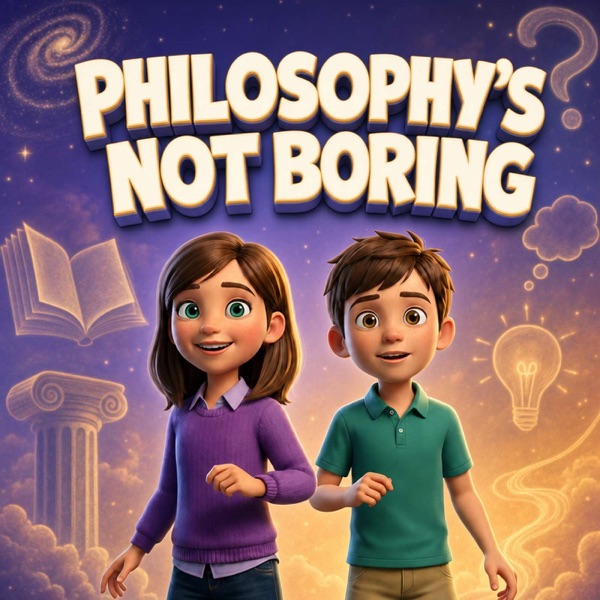
Philosophy for Kids / Philosophy's Not Boring: The Kids Philosophy Podcast
A groundbreaking podcast for curious kids aged 4-12, and the grown-ups listening with them, that proves philosophy, psychology and religion are anything but dull.
Join our fictional AI hosts Mira, a brilliant 9-year-old, and her younger brother Finn, age 7, as they explore philosophy, psychology and religion as one big family of questions about how we make sense of things. Each episode takes a real thinker or idea seriously, from what makes you the same person you were as a baby to why people across the world believe such different things about the soul, and then lands it somewhere in your actual life.
We don't hand you the answer and move on. Some questions have one; some have several worth comparing; some nobody has ever settled, and we'll tell you which is which. On matters of faith we stay even-handed: we describe what people believe from the outside, and never tell you what to believe yourself. Because philosophy isn't a pile of hard words to memorize. It's learning to ask a better question, and to sit with it honestly, even when it's uncomfortable.
A note on why we use AI. For us, AI allows us to deliver learning at a scale and quality that previously would have been too expensive. If we make the odd technical error, or the sound goes a bit funny, bear with us, we're trying our best. We hope you enjoy the show!
- Kids & Family chart
- #177
- Episodes
- 103
- Releases
- Daily
- Typical length
- 12 min
- On air since
- 2026
- Latest episode
- 20 hours ago
Episodes
103 episodes, newest first
-
13 min
What is democracy?
Season 1, Episode 941
Show notes
Imagine you are on a giant wooden ship in the middle of a dangerous, stormy ocean! Who should steer? Should it be a trained, expert captain who knows how to read the stars, or should all the passengers take a vote? In this brain-twisting episode, Mira and Finn travel back over two thousand years to Ancient Athens to answer a massive question: What is democracy, and is it really the fairest way to make decisions? Dive into the incredible mind of the philosopher Plato! In his famous book The Republic, Plato argued that only trained experts should be in charge—otherwise, it's like letting someone who just throws a good party fly an airplane! But the ancient Athenians believed that everyone living on the ship deserves a say in where it goes. Get ready for wild historical facts about how Athenians voted using broken pottery, picked leaders by random lottery, and the ultimate debate between knowing what is best versus doing what is fair! Will you choose Plato's expert captain, or will you vote with the passengers?
-
14 min
What is a Zen koan?
Season 1, Episode 940
Show notes
Have you ever tried to solve a riddle that is actually impossible? What if the whole point of a puzzle is to completely break your brain? Welcome to the wild world of the Zen koan! In the 1700s, a famous Japanese Zen teacher named Hakuin asked his students a brain-twisting question: 'Two hands clap and there is a sound. What is the sound of one hand?' Students would spend months—even years!—trying to figure it out. They would guess snapping, waving, or even total silence, but every single answer was wrong! Why? Because this special puzzle wasn't meant to test their logic. It was designed to exhaust their busy, thinking minds until they simply gave up! Once their brains stopped trying to solve the problem, they could finally relax and experience the beautiful present moment without worrying. Join Mira and Finn on Philosophy is Not Boring as they explore this amazing ancient brain hack, learn how to turn off the noisy static in our heads, and challenge you with a fun trivia quiz! Get ready to listen... with one hand!
-
12 min
Why do we pick sides?
Season 1, Episode 939
Show notes
Have you ever been on the playground and suddenly found yourself in an intense game of "sneakers versus boots"? Why do our brains pick sides so incredibly fast, even over silly, meaningless things? In this mind-bending episode of Philosophy is Not Boring, Mira and Finn uncover the hidden secrets of how humans form groups! First, we travel back to 1970 to meet researcher Henri Tajfel. He discovered that kids would form fiercely loyal teams over something as tiny as picking between two abstract paintings—even if they never actually met their teammates! It gets even wilder when we learn that people will sometimes give up a good deal just to make sure the "other team" loses. But wait, can we stop a rivalry once it starts? Yes! We explore a famous 1954 summer camp experiment called Robbers Cave, where two rival groups of kids learned to get along. How did they do it? By fixing a broken water supply and pulling a heavy food truck out of the mud together! Join us to find out how a shared problem (and a round of milkshakes!) can turn bitter enemies into fast friends!
-
10 min
What is Halloween?
Season 1, Episode 938
Show notes
Get ready to uncover the ultimate mystery of spooky season! Have you ever wondered why we celebrate Halloween on October 31st, or why it is called Halloween in the first place? Join Mira and Finn on Philosophy is Not Boring as they travel back in time to discover the secret history of this famous holiday! It turns out, Halloween comes from an old phrase meaning All Hallows' Eve, the night before the Christian holiday of All Saints' Day. But the story goes back even further! Thousands of years ago, the ancient Celts celebrated a festival called Samhain, where they believed the boundary between the living and spirit worlds grew super thin. From inviting ancestors to dinner, to lighting paper lanterns in Japan for the summer festival of Obon, to building beautiful marigold-covered altars for Mexico's Day of the Dead, people all over the world have incredible ways to remember loved ones! Discover why remembering someone is an amazing superpower, how traditions stack on top of each other, and why death doesn't mean someone stops being part of your family. Hit play and let's explore the beautiful magic of memories!
-
12 min
Who was Ibn Sina?
Season 1, Episode 937
Show notes
Have you ever tried to feel absolutely nothing? It’s almost impossible! You can always feel your toes in your shoes or hear your own heartbeat. But what if you couldn't? Join Mira and Finn on a mind-bending journey back to the early 1000s to meet a brilliant Persian doctor and philosopher named Ibn Sina! During the Islamic Golden Age, Ibn Sina created one of the most famous and spooky thought experiments in history: The Floating Man. Imagine a man created in a single instant, floating in total darkness, with no memories and absolutely no way to feel his own physical body. Would he still know that he exists? Ibn Sina said yes! This wild puzzle proved that our minds, or our "selves," are completely different from our physical bodies. It even inspired the famous philosopher René Descartes to declare, "I think, therefore I am" over 600 years later! Tune in to discover why you are so much more than just a pile of bones and muscles, and explore the ultimate magic of the human mind!
-
11 min
How did babies count?
Season 1, Episode 936
Show notes
Have you ever wondered what is going on inside a tiny baby's head? Do they only know how to sleep, cry, and eat snacks, or are their brains already working super hard? For a long time, famous thinkers believed babies were born with a "blank slate"—like an empty computer with zero programs installed! But in 1992, a scientist named Karen Wynn at the University of Arizona decided to test this with a brilliant experiment. She created a tiny puppet stage with colorful toys to see if five-month-old babies could actually do math! But how do you give a math test to someone who can't even hold a pencil? With a sneaky magic trick! Using a hidden trap door, researchers secretly took a toy away. When the screen dropped, one plus one suddenly equaled one! The babies were so surprised that they stared for a super long time! Does this mean we are all born with a built-in math calculator in our brains, or were the babies just tracking their toys? Join Mira and Finn as we dive into this amazing mystery, discover ancient Roman pebbles, and find out if tiny babies are actually math geniuses!
-
11 min
Who was John Stuart Mill?
Season 1, Episode 935
Show notes
Have you ever wanted to eat a whole gallon of double chocolate fudge ice cream for dinner and thought, 'It's my body, it's my choice!'? Well, get ready to test that idea! Travel back to 1859 England to meet a super-smart philosopher named John Stuart Mill. He was a certified genius who started learning Ancient Greek when he was just three years old! When he grew up, he wrote a famous book called 'On Liberty' and came up with one giant rule for the world: The Harm Principle. This rule says you should be allowed to do whatever you want, as long as you aren't hurting anyone else! Sounds awesome, right? But wait... what actually counts as 'harm'? If you play the drums at 3 AM and make your neighbors grumpy, is that causing harm? What if your bad choices make your family sad? Join Mira and Finn as they untangle the invisible spiderweb of human connection, discover what 'experiments in living' are, and learn why this famous rule doesn't actually apply to kids!
-
10 min
What is the invisible gorilla?
Season 1, Episode 934
Show notes
Have you ever been staring right at something, like a missing Lego piece or the ketchup in the fridge, but you literally cannot see it? Get ready for a mind-bending episode that will change how you look at the world! In 1999, psychologists Daniel Simons and Christopher Chabris set up a famous experiment at Harvard University. They asked students to watch a video of people passing basketballs and carefully count the passes. But halfway through the game, someone in a giant, furry black gorilla suit walked right into the middle of the players, thumped their chest, and walked away. Guess what? Almost half of the viewers completely missed the giant gorilla! How is that even possible?! Join Mira and Finn as they uncover the wild science of "inattentional blindness." You will learn how your brain acts like a busy movie editor, quietly deleting things from your vision so you don't get overwhelmed. Discover why your brain tricks you, how even expert doctors miss crazy details, and why you might not hear your parents when you are playing a tough video game. Tune in to test your own brain!
-
11 min
What is the Amish community?
Season 1, Episode 933
Show notes
Imagine waking up tomorrow and deciding to get rid of your family car, the television, and all the iPads for good! Sounds crazy, right? But for the Amish community, living without modern technology isn't a punishment—it's a thoughtful choice! Travel back in time with Mira and Finn to 1500s Switzerland to discover the origins of the Anabaptists, and find out why thousands later settled in Pennsylvania for religious freedom. Today, over 400,000 Amish people drive horse-drawn buggies, wear plain clothes without zippers, and live very simply. But why do they say no to super-fast cars and video games? Because they ask a totally different question about new inventions: Does this bring our family closer together, or pull us apart? You won't believe what happens when an Amish community works together—they can build an entire two-story wooden barn from the ground up in just a single day! Tune in to learn why sometimes, you don't need the fastest modern gadgets to have a wonderful life, you just need your neighbors!
-
11 min
What is a blank slate?
Season 1, Episode 932
Show notes
Have you ever looked closely at a tiny, squishy newborn baby and wondered... what is actually going on inside their head? Are they thinking, or is their brain totally empty? Join Mira and Finn on Philosophy is Not Boring for a mind-bending puzzle! In 1689, an English philosopher named John Locke argued that babies are born knowing absolutely nothing. He called their minds a "Tabula Rasa" or a blank slate, like an empty piece of white paper waiting to be filled with everything they see, taste, and touch! But jump ahead almost 300 years, and a linguist named Noam Chomsky says that can't be entirely true! He noticed that toddlers learn tricky grammar rules way too fast to be starting from scratch. Chomsky believed we are actually born with a built-in "app" in our brains for language! So, which is it? Are you a totally blank page, or did you arrive with an invisible instruction manual already written inside you? Discover the incredible Nature vs. Nurture debate, find out why identical twins can be so spooky, and see if you can ace our fun trivia quiz!
-
12 min
What is sibling rivalry?
Season 1, Episode 918
Show notes
Do you ever wonder why your brother or sister can drive you absolutely bananas?! You are definitely not alone! In this exciting episode of Philosophy is Not Boring, Mira and Finn dive into the wild world of family psychology to answer a huge question: Why do the people we live with annoy us the most? It turns out, there is an amazing scientific reason behind all those arguments! We'll explore something called "natural rivalry," which goes all the way back to ancient human history when kids had to compete for their parents' attention. Plus, learn all about the incredible discoveries of psychologist Judy Dunn, who found out that your sibling knows exactly which buttons to push because they are actually an emotional genius! We will also uncover the mystery of the "social allergy"—where tiny habits get magnified in our brains just because we see them every single day! Tune in to find out how boundary-setting and perspective-taking can turn your most annoying sibling into your lifelong best friend and greatest ally. Get ready for some mind-blowing psychology facts!
-
11 min
What is a phobia?
Season 1, Episode 913
Show notes
Have you ever wondered why you might be terrified of a tiny little spider in the bathtub, but you aren't scared of getting into a fast-moving car every day? It turns out, our fears aren't just silly glitches in our brains—they are ancient survival tools! Join Mira and Finn as they explore the wild world of fear and phobias. You'll discover the amygdala, a tiny, almond-shaped part of your brain that acts like a built-in fire alarm. We will learn all about "biological preparedness," a cool theory by psychologist Martin Seligman that explains why we are born ready to fear ancient threats like snakes and falling off cliffs, but not modern things like electricity! But what happens if your brain's alarm gets stuck on too loud? Can you unlearn a fear? Yes, you can! We'll explore how psychiatrist Joseph Wolpe invented "systematic desensitization," and how a trick called "reciprocal inhibition" proves you can't be relaxed and terrified at the exact same time. We will even learn how modern doctors use super cool Virtual Reality headsets to help people become braver! Get ready to hack your brain!
-
12 min
What is naive realism?
Season 1, Episode 856
Show notes
Have you ever gotten into a massive argument over something silly, like whether a hot dog is a sandwich, and felt one hundred percent sure you were right? You're not alone! In this fascinating episode, Mira and Finn explore the big question: why do people disagree?
Journey back over two thousand years to ancient India to hear the famous parable of the blind men and the elephant! When a group of blind men all touch different parts of an elephant, they end up furious at each other because they each think their piece is the whole truth. It turns out, our brains do the exact same thing today! In the 1990s, Stanford psychologist Lee Ross called this "naïve realism"—the sneaky habit of assuming we see reality perfectly, so anyone who disagrees must be totally crazy!
But don't worry, there's a secret to getting along! Discover how a famous 1954 summer camp experiment by Muzafer Sherif proved that arguing enemies can become best friends when they are given a "superordinate goal"—a massive shared problem they must solve together. Tune in to uncover the incredible psychology of arguments, elephants, and learning to finally agree!
-
11 min
What is Eid?
Season 1, Episode 845
Show notes
Imagine trying not to eat a single snack or take a sip of water from sunrise to sunset for an entire month! That’s exactly what millions of Muslims do during the holy month of Ramadan to practice patience and gratitude. But when that month finally ends? It’s time for one of the biggest, most joyful celebrations on the planet: Eid!
Join Mira and Finn on a delicious and heart-warming journey to discover what Eid is all about! Did you know there are actually TWO major Eids? First, there’s Eid al-Fitr, the legendary festival of breaking the fast! Then there's Eid al-Adha, which honors trust and sacrifice during the amazing annual Hajj journey to Mecca.
Learn about incredible traditions like wearing brand-new clothes, praying together in huge parks, and sharing mouth-watering treats like sweet, crunchy noodles called sheer khurma! Best of all, discover the beautiful rule of Zakat al-Fitr, which ensures nobody goes hungry on Eid, and the ultimate kid-favorite tradition: getting surprise gifts of money called Eidi! Get ready to say "Eid Mubarak" and celebrate the incredible power of sharing joy!
-
12 min
What is the purpose of life?
Season 1, Episode 842
Show notes
Have you ever watched a tiny ant carrying a crumb and wondered... what is it actually doing? What is the point of it all? That little mental jolt you just felt is the biggest question ever asked: What is the purpose of life? In this amazing episode of Philosophy is Not Boring, Mira and Finn go on a global adventure to find the answer!
First, we look at science! Biology tells us our drive is survival, like passing the baton in a giant relay race of life. But human beings do so much more than just survive—we build spaceships and tell ridiculous jokes! That's where philosophers come in! We travel back to Ancient Greece where Aristotle talks about "eudaemonia"—flourishing and growing your mind like a mighty oak tree. Then, we explore the beautiful Southern African philosophy of "Ubuntu," which means we find our purpose by caring for our community and playing as a team! Finally, we travel to Japan to learn about "Ikigai," discovering the sweet spot between what you love doing and what the world needs.
Join us to learn why finding your purpose is an exciting adventure!
-
12 min
What is the Spotlight Effect?
Season 1, Episode 822
Show notes
Have you ever tripped in the cafeteria, spilled your milk, or worn your shirt inside out by accident? Did you feel like the whole world stopped just to stare at you? That terrible feeling is called the Spotlight Effect, and it might just be a giant trick your brain is playing on you! Join Mira and Finn as they explore a brilliant and super funny experiment from the year 2000. Psychologist Thomas Gilovich at Cornell University wanted to know why humans are so self-conscious. He made college students wear the most embarrassing t-shirt imaginable—featuring a giant picture of singer Barry Manilow—and walk into a room full of strangers! The students were absolutely sure everyone was staring and judging them. But the actual results of the study will completely shock you! Discover why people aren't actually secretly laughing at your bad hair days, and how everyone is just busy starring in their own movie! This mind-bending psychology secret will take that heavy invisible backpack off your shoulders and let you just be you. Tune in to find out the truth!
-
11 min
What is the Turing Test?
Season 1, Episode 821
Show notes
Have you ever wondered if your tablet, smartphone, or smart speaker is actually thinking, or just pretending? In this mind-boggling episode of Philosophy is Not Boring, Mira and Finn tackle a massive question: Can a computer think?! Back in 1950, a genius mathematician named Alan Turing decided to stop arguing about what the word "think" means and created a super fun hide-and-seek game instead. It is called the Turing Test! Imagine texting a stranger hidden in another room—could you figure out if they were a real human or a clever robot? But wait, the debate doesn't stop there! In 1980, a philosopher named John Searle came up with a wild thought experiment called "The Chinese Room" to prove that computers do not actually understand anything—they just follow giant, super-fast rulebooks! From giant, noisy vintage computers the size of whole rooms to the very first chatting robot named ELIZA, get ready for an awesome ride through the history of artificial intelligence. Will Finn figure out how to trick his smart speaker? Tune in to find out!
-
12 min
What is confirmation bias?
Season 1, Episode 820
Show notes
Have you ever been absolutely sure you were right about something, only to find out you were totally wrong? Welcome to the ultimate brain trap! In this mind-bending episode of Philosophy is Not Boring, Mira and Finn dive into a sneaky psychological puzzle from 1960. A clever psychologist named Peter Wason challenged people to figure out his secret math rule using the numbers 2, 4, and 6. It sounds super easy, right? But almost everyone failed! Why? Because of a tricky little thing called confirmation bias!
Our brains love to be right, so we usually only look for clues that prove our own ideas and completely ignore everything else. It’s like wearing invisible sunglasses that only let you see what you want to see! Join us as we explore how this sneaky bias works, why we fall into its trap even when arguing with our friends, and how you can develop a mental superpower to beat it. Get ready to discover why the absolute smartest thing you can ever do to find the real truth is to hunt for a "no" and try to prove yourself wrong!
-
13 min
Why did religions make food rules?
Season 1, Episode 819
Show notes
Have you ever wondered why your lunchbox might hold a secret story about the universe? It’s true! For thousands of years, billions of people around the world have followed special rules about what they can and cannot eat. But why? Join Mira and Finn as they explore the fascinating philosophy behind religious food rules! Discover why Jewish people keep Kosher and never mix meat with milk, and what it means for Islamic food to be Halal. We'll travel to ancient India to learn about Ahimsa, a concept where Jain and Hindu believers practice extreme kindness by never eating animals—and sometimes even avoiding potatoes to protect tiny bugs in the dirt! You'll also find out why Buddhist monks in Thailand stop eating solid food after midday, and how Christian traditions like Lent use small sacrifices to focus on big beliefs. It turns out, sharing a food rule is one of the oldest ways humans say, "We belong together." Get ready to turn your ordinary dinner plate into a magical connection spanning the globe!
-
12 min
What is Existentialism?
Season 1, Episode 818
Show notes
Have you ever wondered if you were born with a set personality, kind of like the instructions printed on the back of a toy box? Or do you invent yourself from scratch every single day? Join Mira and Finn on a time-traveling adventure to a packed, rock-star-level lecture in Paris in 1945! We are meeting a famous French philosopher named Jean-Paul Sartre who completely flipped how people think about human beings upside down. He used a simple paper knife to explain a massive, brain-bending idea called Existentialism! While a tool is designed with a specific purpose before it is made, Sartre said humans are the exact opposite. We just exist first, and we decide our purpose later through our actions! The room was so incredibly crowded with people wanting to hear this idea that listeners were fainting from the heat and the police had to be called! Discover the super-freeing secret of Existentialism: you are never finished! A bad day does not settle who you are. Tune in to find out why you are definitely not a paper knife!
On these lists
Philosophy for Kids / Philosophy's Not Boring: The Kids Philosophy Podcast is one of the shows picked out on each of these




More in Education
Placed highest on Apple Podcasts' Education chart right now