Podcast
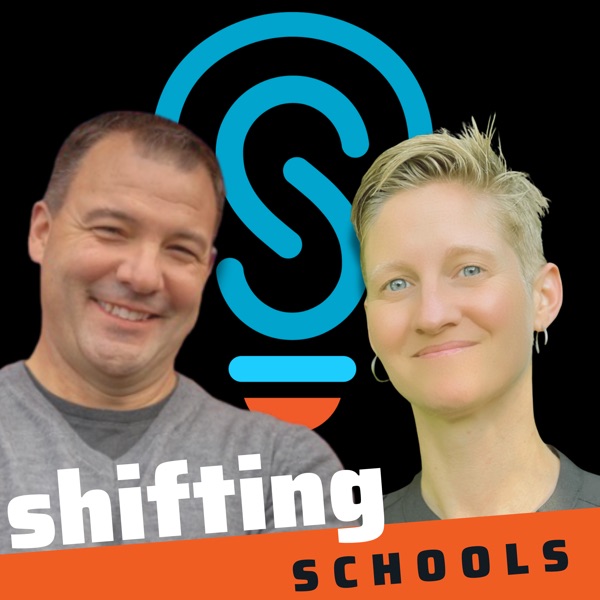
Shifting Schools: Conversations for K12 Educators
Shifting Schools is a thought-provoking podcast that explores the latest trends, strategies, and tools in K-12 education. Hosted by educators Jeff Utecht and Tricia Friedman, the podcast provides a platform for teachers, administrators, and education thought leaders to share their experiences and insights on how to improve teaching and learning. From innovative approaches in classroom management to leveraging technology for personalized learning, Shifting Schools tackles the most pressing issues facing K12 educators today. Whether you are a seasoned teacher or a new educator, this podcast will inspire you to think outside the box and shift your educational approach. Tune in to Shifting Schools to gain new perspectives, share ideas, and join a community of passionate educators who are committed to making a positive impact in the lives of their students.
Follow us at @shiftingschools on Twitter and @shiftingschoolspod on Instagram and Tiktok
- Episodes
- 304
- Releases
- Twice a week
- Typical length
- 26 min
- On air since
- 2022
- Latest episode
- 1 day ago
Episodes
304 episodes, newest first
-
26 min
What Sending Humans to Mars Teaches Us About Human Resilience
Season 9, Episode 349
Show notes
What will it actually take—mentally, physically, and socially—to send humans to Mars and bring them back?
In this episode, host Tricia sits down with Dr. Mark Shelhamer, former Chief Scientist of NASA's Human Research Program, Professor at Johns Hopkins University, and author of Are We Ready for Mars?. Dr. Shelhamer shares his journey from biomedical engineering to astronaut healthcare, diving deep into the unexpected psychological and behavioral hurdles of long-duration space travel. Together, they explore why technical engineering is only half the battle, what the "Earth out of view" effect does to the human mind, how crew autonomy is forged under intense isolation, and why learning to deal with the unexpected in deep space holds profound lessons for human resilience right here on Earth.
In this episode, we discuss:
•
The path to space healthcare: Moving from pacemakers and vestibular balance research into NASA human spaceflight .
•
The commercial space era: Why private and government collaboration has shifted Mars from science fiction into serious mission planning .
•
Expanding the human experience: The philosophical and scientific incentives behind tackling a multi-year planetary mission .
•
The "Earth out of view" effect: How profound isolation, communication delays, and total autonomy reshape astronaut psychology .
•
Resilience & the unexpected: Why preparing for what you cannot predict is the single biggest operational lesson of spaceflight .
•
Generalists in extreme environments: How music, calculated risk-taking, and interdisciplinary thinking foster adaptive teams .
About the Guest: Dr. Mark Shelhamer is a Professor of Otolaryngology–Head and Neck Surgery at Johns Hopkins University School of Medicine and the former Chief Scientist of NASA's Human Research Program . His upcoming book, Are We Ready for Mars?, examines the critical biomedical and psychological challenges standing between humanity and the Red Planet .
-
29 min
Teaching Big Emotions Through Spooky Stories with Kara LaReau
Season 9, Episode 348
Show notes
How do we help children navigate profound, often overwhelming emotions like grief, fear, and insecurity without overwhelming them? In this episode, host Tricia sits down with author Kara LaReau
to discuss her newest book, Licorice—a captivating, seasonal mystery that doubles as a gentle vehicle for deep classroom and family discussions.
Paying homage to Daphne du Maurier's classic Gothic novel Rebecca, Licorice uses a cast of imperfect, relatable animal characters to give young people the language and emotional distance they need to unpack heavy life experiences. Whether you are an educator designing a supportive literature unit, a parent guiding a child through loss, or simply looking for an engaging, atmospheric read-aloud, this conversation offers invaluable insights into the intersection of storytelling, empathy, and emotional growth.
In this episode, we explore:
•
How Gothic mystery conventions can create a safe framework for young readers exploring fear and grief.
•
Translating adult literary homage (Rebecca) into an accessible, child-friendly animal allegory.
•
Practical tips for teachers and caregivers using Licorice as a prompt for social-emotional learning (SEL).
•
Why flawed, imperfect characters are critical for helping students build self-compassion and a sense of belonging.
Connect with the Guest: https://karalareau.com/
What We Discuss in This Episode:
•
(00:41) The "Human and Cat" Dance of Editing: Why trust is essential when receiving an editorial letter, how Kara's background as an editor shapes her writing, and finding the magic "Option C."
•
(04:56) Feedback as Emotional Intelligence: How learning to truly listen to critique builds empathy in writing and everyday life.
•
(06:13) Anatomy of a Physical Book: Sprayed edges, Scholastic design collaboration, and working alongside neighbor and illustrator Kelly Murphy without exchanging a single email during production.
•
(09:29) De-Weaponizing Big Emotions: Adapting Daphne du Maurier's Rebecca for middle-grade readers to talk honestly about loss, fear, and belonging without feeling pedantic.
•
(12:13) From Manderley to Menagerie: Translating Mrs. Van Hopper into a haughty rabbit, Ben into an anxious house squirrel named Skur, and Mrs. Danvers into an imposing gray parrot.
•
(15:32) The Unseen Drawer of Manuscripts: Why Kara lists unpublished books in her FAQ, recycling cut characters (like an old poodle named Ostie), and treating rejection as a learning curve.
•
(20:14) "Winging It and Flinging It": Kara's drafting process, daily journaling habits, and sneak peek into her next Gothic-inspired animal mystery.
•
(23:22) The Storytelling Power of True Crime & British TV: Exploring illogical choices, imperfect humans, and using imagination to cultivate compassion for difficult characters (and bad drivers).
-
19 min
How to Embrace Creative Risk | Jasmine Guillory
Season 9, Episode 347
Show notes
What happens when a young person starts to wonder, "Maybe I could make something?" In this episode, New York Times bestselling author Jasmine Guillory joins the show to discuss her debut young adult novel, It's Only Dancing (out October 6th), inspired by the classic film Dirty Dancing. Jasmine shares her personal journey pivoting from a career in law to becoming a successful novelist, detailing the encouragement she needed to start and the evolving routines that keep her writing. The conversation dives deep into the realities of pursuing creative work in a world increasingly shaped by AI, why struggling through the learning process is essential, and how friendships give us the courage to take meaningful risks. Key Takeaways
• Honoring Teenage Passions: Why educators and parents must take young people's creative curiosities seriously and foster environments that support exploration.
• The Role of Friendship: How peer support and collaboration provide the necessary safety net to take creative leaps.
• The Value of the Struggle: What we fundamentally gain by wrestling with something we don't yet know how to do, rather than skipping the hard parts.
• Navigating the AI Era: Fresh perspectives on human creativity, the joy of collaboration, and why the messy process of learning still matters deeply.
• Sustaining Creativity: Practical insights into Jasmine's transition from lawyer to author, and how she adapts her daily routines to maintain a full-time creative career.Resources Mentioned
• Book: It's Only Dancing by Jasmine Guillory (Available October 6th)
• Inspiration: Dirty Dancing (1987 film)About the Guest Jasmine Guillory is a New York Times bestselling author known for her beloved contemporary romances. A former lawyer, she successfully transitioned to a full-time career in writing. With It's Only Dancing, she brings her signature warmth and engaging storytelling to the young adult genre, exploring themes of creative courage, friendship, and self-discovery. https://www.jasmineguillory.com/
-
30 min
Writing Worlds Where Readers Find Friends with Claribel A. Ortega
Season 9
Show notes
What happens when a reader's first friends are characters in a book?
Author Claribel A. Ortega joins Tricia to talk about the Witchlings series and the connections readers build through stories. She shares how gaming shaped her worldbuilding, why fantasy gives us room to explore frightening questions, and what young readers have taught her about loneliness, anger, and belonging.
The conversation also explores the creative work that happens away from the page: making playlists, walking the dog, spending time in nature, and giving an idea space to grow. Claribel reflects on crediting illustrators, designing playful online spaces for readers, and practicing the kindness and community she writes about.
In this episode:
•
How The Sims helped Claribel develop as a storyteller.
•
Why stories need room for difficult feelings and darker questions.
•
How Witchlings readers find friendship and see their experiences reflected.
•
What educators can notice about creativity, play, and reader communities.
•
Why artists and illustrators deserve recognition.
•
How Steven, Claribel's puppy and unofficial manager, keeps her writing life on schedule.
Books discussed include Witchlings, Ghost Squad, and Frizzy, plus a preview of Claribel's forthcoming graphic novel, Thirty Ways to Kill Your Avatar.
Learn more:
https://www.claribelortega.com/
Learn more about the Shifting Schools cohort:
https://www.shiftingschools.com/ai-for-curriculum-instruction-cohort
-
23 min
Googly Eyes, Big Feelings, and Asking for Help with Christy Mandin
Season 9, Episode 366
Show notes
What can picture books teach us about helping children feel heard—and learning to ask for help ourselves?
Author and illustrator Christy Mandin returns to explore Millie Fleur's Pumpkin Problem and Millie Fleur's Worst Day Ever. Through her imaginative characters, Christy opens up conversations about creativity, community, and respecting children's emotional experiences.
Together, we consider why a child's "worst day ever" deserves our attention, even when the problem seems small to an adult. Christy shares how life in her neurodivergent household shapes her approach to communication and why supporting someone involves both expressing our needs and noticing the needs of others.
We also go behind the scenes of her creative process—from gardening and escaping chickens to a beloved shed character—and hear her refreshingly honest three-day rule for processing feedback.
In this episode, we explore:
•
Respecting children as whole people with experiences that matter.
•
Asking for help and challenging the fear of burdening others.
•
Using picture books to spark conversations and build community.
•
Finding characters and creative inspiration in everyday life.
•
Making space to process feedback before deciding what comes next.
For educators, librarians, parents, and anyone nurturing creativity, this conversation offers an invitation to notice more, listen closely, and make room for support.
Explore Christy's books and work: https://www.christymandin.com/
Discover the Millie Fleur series: https://www.scholastic.com/site/millie-fleur.html
-
22 min
What Horror Teaches Us About Grief and Belonging—with Ryan La Sala
Season 9, Episode 365
Show notes
What can a horror novel teach us about friendship—and why might surviving together be its most hopeful message?
Author Ryan La Sala joins Tricia Friedman to explore the queer horror of The Dead of Summer, where estranged childhood friends must decide whether they can hold onto one another when disaster strikes.
Their conversation moves beyond the scares to examine representation, found family, grief, and the surprising relationship between terror and joy. Ryan explains why he writes queer characters whose lives extend beyond coming out, how each novel challenges his creative process, and what it means to see The Honeys adapted for film.
For educators, librarians, readers, and writers, this episode opens up questions about whose stories young people encounter—and how fiction can invite deeper conversations about belonging, loss, and care.
In this conversation:
•
Why horror creates room for creative experimentation and queer storytelling.
•
How friendship and community shape survival in The Dead of Summer.
•
How humor and joy coexist with fear.
•
Exploring grief across The Honeys, Beholder, and The Dead of Summer.
•
Anticipatory grief: how fear of future loss can interrupt the present.
•
Ryan's collaborative role in the film adaptation of The Honeys.
Explore the books: The Dead of Summer, The Honeys, and Beholder by Ryan La Sala. Ryan also discusses Bodies of Water, the sequel to The Dead of Summer.
A question to carry forward: Which stories help young people imagine that they don't have to face difficult things alone?
Share this episode with a reader or educator who would appreciate a different perspective on horror.
Content note: Discussion of grief, sibling death, cancer, and fictional horror.
-
32 min
Building a Firm Around People Who Need an Advocate
Season 9, Episode 364
Show notes
What does it take to build a firm around the needs of people facing some of life's most difficult circumstances?
Tricia welcomes the founder of USA4ALL to explore the purpose behind its work, including serving survivors of domestic violence and human trafficking. The conversation begins with the firm's origin story and the question of what makes its approach distinctive.
For educators and community leaders, this episode invites reflection on how compassion shapes the organizations we build—and how we recognize whose needs deserve greater attention.
As you listen, consider:
•
What can an organization's origin story reveal about its values?
•
How does compassion influence everyday decisions about whom we serve and how?
•
Whose needs might be overlooked by the systems we work within?
•
What would it take to strengthen connections between our communities and people who can offer informed support?
Learn more about Renata Castro and USA4ALL, and use this conversation as a starting point for thinking about what purposeful, compassionate leadership can look like in practice.
-
12 min
When Should Students Use AI? Let Them Design a Game
Season 9, Episode 363
Show notes
What if your next assessment asked students to pitch a board game—and explain when they chose to use AI?
In this episode, Tricia Friedman explores how game design can bring together research, persuasive writing, creativity, collaboration, and AI literacy. The central challenge: help students make thoughtful decisions about where AI supports their learning and where they want to work without it.
You don't need time to develop an entire board game. Tricia introduces a smaller game-pitch challenge, using the history of the Spokane River as an example that educators can adapt to their own curriculum and local context.
Together, we explore:
•
A task that asks students to choose three moments to use AI and two to work without it—and justify those decisions.
•
How matching game mechanics to a researched theme creates opportunities for testing, feedback, and revision.
•
Connections to ELA, humanities, art, and mathematics through persuasive pitches, visual design, pricing, and material costs.
•
How game reviews, playthrough videos, and crowdfunding pitches can become texts worth studying.
•
What it means to approach assessment redesign with both boldness and humility.
A question to bring to your next planning meeting: How could an assessment make students' judgment about AI as visible as their final product?
Explore Tricia's free GAMES framework and consider where a game-pitch challenge could fit into an upcoming unit.
https://shifting-schools-games.netlify.app/
Reach out: tricia@shiftingschools.com
-
13 min
From Research to Collective Action: Dr. Camille Busette on Healthcare Advocacy
Season 9, Episode 362
Show notes
What happens when the cost of healthcare forces someone to delay a doctor's visit, skip a prescription, or take on debt?
Tricia Friedman welcomes Dr. Camille Busette, executive vice president of Programs at the Robert Wood Johnson Foundation, to discuss One Nation, Overcharged. The nationwide campaign brings people together to call for more affordable healthcare.
The challenge is widespread, but it is not shared equally. In this conversation, Tricia and Dr. Busette examine what the data reveals about healthcare costs, whose experiences are too often overlooked, and how sharing those experiences can help communities push for change.
Learn more about the campaign: https://onenationovercharged.org/
-
32 min
Beyond Screen-Time Bans: Student Safety in the Age of AI
Season 9, Episode 361
Show notes
School districts are reaching a turning point in how they manage classroom technology.
After years of rapid device adoption and policies that often responded to one risk at a time, leaders are asking a harder question: How can schools protect students from cyberbullying, data theft, AI-enabled scams, distraction and online harm without cutting them off from the learning, creativity and connection technology can provide?
In this episode, Tricia speaks with Harrison Parker, Executive Vice President at Linewize, about the shift from reactive restrictions toward a more coordinated approach to student digital safety and well-being.
Harrison explains why this work cannot sit solely with a district's technology department. Effective digital safety connects IT leaders, educators, safeguarding teams, administrators, students and families. It also brings together prevention, early detection, intervention and education rather than treating each new platform or threat as a separate problem.
Their conversation examines three changes taking place across K–12 education:
• Moving beyond screen-time bans toward digital-health strategies that address distraction and burnout while preserving useful learning • Replacing panic-driven AI bans with practical guardrails for privacy, safety and classroom use • Managing the "3 PM hand-off" by helping families understand and supervise what happens on school-issued devices after students leave campus
Harrison also discusses how districts can identify concerning online behavior earlier, understand which applications students are actually using and give families greater visibility into children's digital experiences.
In this episode:
• Why banning the latest technology rarely provides a lasting solution • What schools need to know about student screen time and app use • How AI is changing online risks for students and districts • Why data privacy must be part of classroom AI decisions • How schools can distinguish productive technology use from distraction • What early detection and intervention can look like • Why digital safety should not belong exclusively to the IT department • How responsibility shifts when students take school-issued devices home • Ways schools and families can develop a more coordinated approach • How districts can protect students without abandoning technology-supported learning
Questions for your leadership team:
• Who owns digital safety in our school or district right now? • How well connected are our technology, safeguarding, instructional and family-engagement teams? • Do we know which digital tools students are using and how they are using them? • Are our policies teaching students to navigate digital environments, or only restricting access? • What happens to our duty of care when a school-issued device goes home? • Are our AI policies based on specific risks, or on a general fear of the technology? • How quickly could our current approach respond to a new digital threat?
About Harrison Parker
Harrison Parker is Executive Vice President at Linewize, the K–12 online safety division of Qoria. He works with district leaders across North America on digital safety, student well-being, technology management and family engagement.
Learn more:
Linewize: https://www.linewize.com/ Harrison Parker on LinkedIn: https://www.linkedin.com/in/harrison-parker-02951921
Subscribe to Shifting Schools for more conversations about AI, technology and the changing needs of learners.
Topics: student digital safety, screen time in schools, AI in education, cyberbullying, student mental health, online safety, data privacy, school-issued devices, digital citizenship, family engagement, educational technology and K–12 leadership
#StudentSafety #AIinEducation #DigitalCitizenship #SchoolLeadership #EdTech
-
19 min
Why the World Has Always Been Weird — and Why That Matters
Season 9, Episode 360
Show notes
Uncle John's All-Knowing Bathroom Reader, Curiosity, and the Weirdness of Human History
Brian Boone joins the show to talk about why the world has always been weird—not just now. The conversation ranges from animal history and television oddities to fact-checking, collaboration, and why curiosity is the engine behind good stories and human wisdom. In this episode, Tricia and Brian Boone discuss how access to information can make the present feel stranger than the past, even though human behavior has always been full of surprises. They also explore the storytelling and editorial work behind Uncle John's All-Knowing Bathroom Reader, including how the team verifies claims, chooses topics, and turns obscure facts into accessible reading.
Key topics
• Why the world has always been weird, even if modern media makes us more aware of it
• Why dogs have so many breeds while cats have comparatively few
• How horses helped shape agriculture, travel, trade, language exchange, and city states
• Why fact-checking is more important—and more difficult—in an age of copied information
• The story of J. Fred Muggs, the chimp who co-hosted Today in the early days of television
• How risk-taking and strange ideas contribute to human innovation
• Why fads are much older than mass media
• How writers, editors, designers, and marketers collaborate on the bathroom reader
• How colleagues' different passions can make unfamiliar subjects fascinating
• Why curiosity may be the engine behind wisdom and connectionTimestamps 00:00
— Why the world feels weirder now than it used to
00:42
— The case for "the world has always been weird"
01:55
— Why cats have far fewer breeds than dogs
03:18
— How horses helped shape the modern era
05:23
— Why fact-checking is harder in an age of copied information
06:41
— The strange story of J. Fred Muggs on Today
08:42
— Why risk-taking and weird ideas are part of human progress
10:23
— Fads are older than mass media
12:51
— How the bathroom reader team collaborates
14:21
— Learning from coworkers with radically different interests
15:46
— Curiosity as the engine of wisdom
Learn more https://bathroomreader.com/
-
23 min
From Super Bowl Champion to Literacy Champion | Malcolm Mitchell
Season 9, Episode 359
Show notes
What if readers and writers received the same attention, celebration, and investment as star athletes?
In this episode, Tricia speaks with Super Bowl champion, children's author, and literacy advocate Malcolm Mitchell about his new picture book, My Super Duper Me. They discuss the lasting effect of a few encouraging words, the role librarians can play in helping children see their own possibilities, and why adults should never underestimate the power of simply showing up with a positive message.
Malcolm shares his own journey from struggling reader to member of the Silverleaf Book Club, published author, and founder of Share the Magic Foundation. He explains why reading is not only an academic skill, but also a source of confidence, community, opportunity, and belonging.
The conversation also considers what schools and communities could learn from the cultural power of sports. If young people see athletes celebrated everywhere, how might their aspirations change if readers, writers, books, and libraries were made just as visible?
Malcolm also offers a candid look at his writing practice and the connection between athletic and creative training: show up, make the most of each repetition, and be willing to try again tomorrow.
In this episode:
• Why brief words of encouragement can stay with a young person • The librarian at the heart of My Super Duper Me • Malcolm's journey from struggling reader to passionate literacy advocate • How a welcoming book club helped change his life • Why reading can build confidence, connection, and belonging • What it would mean to celebrate literacy as loudly as sports • How educators can participate in free Share the Magic reading challenges • What football taught Malcolm about writing, practice, and persistence
Learn more about Malcolm Mitchell, Share the Magic Foundation, and its free reading programs at readwithmalcolm.com.
We also talk about:
📚 Librarians as guides, bridges, and heroes 📚 Reading as a source of confidence, community, and belonging 📚 What schools can learn from the visibility and cultural power of sports 📚 Why creative practice is not so different from athletic training 📚 The willingness to show up and try again
-
29 min
Never Underestimate a Young Reader
Season 9, Episode 372
Show notes
What do young people understand that adults mistakenly believe they have hidden from them?
Award-winning author Tiffany D. Jackson returns to the podcast to discuss Ghost in the Night, her haunting middle-grade novel set against the ghost tours, buried histories, and complicated beauty of Savannah, Georgia.
Tiffany invites educators to take young readers—and their capacity to confront difficult subjects—seriously. We explore why children sometimes attach themselves intensely to a particular interest while processing grief, and what educators might discover if they look beyond the fascination and ask what need it may be meeting.
We also discuss the importance of grief literacy, the trust created when adults acknowledge what children already know, and the difference between protecting young people and underestimating them.
The conversation moves beyond the ghosts of Savannah to examine whose histories become tourist attractions, whose stories remain untold, and how literature can inspire students to investigate the overlooked histories of their own communities.
Tiffany also shares why young characters need opportunities to form friendships without constant adult choreography, how she calibrates horror for middle-grade readers, and the deceptively simple practice she recommends to every aspiring writer: read closely enough to notice how a story works.
This episode explores:
•
Why educators need to take children's inner lives seriously
•
How intense interests can sometimes help young people process grief
•
The role of grief literacy in schools and classrooms
•
How honest conversations can build trust between adults and children
•
Why young people need agency in friendship and problem-solving
•
Whose histories are preserved, promoted, ignored, or buried
•
How place can function as a character in a novel
•
What horror offers middle-grade readers
•
How students can learn the craft of writing by reading like writers
At its heart, this conversation asks educators to consider what becomes possible when we stop assuming young people cannot handle the truth—and begin giving them stories that honour their intelligence, curiosity, and humanity.
-
58 min
The Humanoid Robot, the Headlines, and What Really Happened
Season 9, Episode 371
Show notes
When Salamanca City Central School District announced plans to bring a humanoid robot into its robotics program, the story quickly became something else entirely: "A school is replacing teachers with robots."
That was never the plan.
In this episode, Jeff Utecht speaks with Superintendent Mark Beehler about what the district was actually trying to build—and what happened when an AI-generated image, alarming headlines, and social media outrage overtook the facts.
Mark explains how students helped shape the project, why the district saw the robot as an opportunity to explore emerging technology, and how a locally controlled AI platform could give students in an underserved rural community greater access to personalized academic support.
The conversation also examines a harder question: What does it cost a school leader to pursue responsible innovation when public fear moves faster than the truth?
You'll hear about:
•
Why Salamanca invested in a humanoid robot for its advanced robotics students
•
How students influenced its appearance, identity, purpose, and safeguards
•
The difference between the physical robot and the district's customized AI learning platform
•
How the technology was designed to scaffold learning—not provide answers or replace teachers
•
What happened when an AI-generated image distorted the story
•
Why even some edtech leaders helped spread the misinformation
•
How students who initially wanted AI banned became some of the project's most thoughtful contributors
•
The leadership lessons Mark learned about communication, control, and public trust
•
How the backlash gave him a new understanding of what young people experience when social media turns against them
This is not simply an episode about a robot. It is a candid conversation about educational risk-taking, media literacy, rural equity, and what it means to prepare students for a future that many adults are still struggling to imagine.
-
50 min
Game Design Could Transform Assessment in the AI Era
Season 9, Episode 370
Show notes
What if students didn't simply complete an assessment—but designed an experience for someone else?
In this episode of Shifting Schools, Tricia Friedman pitches Jeff Utecht a new approach to assessment for the AI era: invite students to become game designers.
Games are memorable, social, challenging, and full of consequential choices. Designing one asks students to think about systems, understand an audience, establish meaningful constraints, gather feedback, solve problems, and defend the decisions they make. Those may be precisely the capabilities that matter most when AI can help produce a polished final product.
Tricia introduces the GAMES learning-design framework:
• Goal: What should players understand, practise, or accomplish? • Audience: Who is the game being designed for? • Mechanics: What rules, choices, and constraints make it work? • Engagement: When do players experience agency, challenge, or frustration? • Show It: How did testing and revision improve the game?
Check it out: https://shifting-schools-games.netlify.app/
Jeff and Tricia also explore how teachers and students can intentionally decide where AI belongs in the design process—and where the thinking should remain entirely human.
Along the way, they discuss centaur chess, systems thinking, authentic audiences, collaborative games, playtesting, vibe coding, and why assessment should increasingly examine a learner's judgment and reasoning rather than only the finished product.
You'll also hear about Bark Park, Tricia's AI-assisted dog-park simulator, where limited budgets, overflowing bins, rainy weather, unhappy visitors, and a neighbouring pickleball court turn one small public space into a surprisingly complex systems challenge.
In this episode:
• Why games often remain in our memories longer than individual lessons • How game design develops systems thinking and executive function • Why creating for a real audience builds empathy • How playtesting makes feedback, failure, and revision feel natural • What human-only and AI-supported stages might look like • Why students need to explain and defend their design choices • How AI can expand what students are capable of creating • Why play may bring greater joy and meaning to assessment
Explore the GAMES framework, student design kit, research, standards connections, printable resources, and Bark Park through the links accompanying this episode.
We would love your feedback. Could this approach work in your classroom, course, or curriculum? Better yet, send us the unit you believe could never become a game. We would love to test the framework at its edges.
Thank you to our show sponsor: Unfurl
Learn more with Unfurl: https://unfurl.sh/
Connect with us:
Tricia Friedman: tricia@shiftingschools.com General inquiries: info@shiftingschools.com
-
45 min
What's Your Wellness Anchor This School Year?
Season 9, Episode 369
Show notes
The beginning of a school year often arrives with a familiar message: do more, organize more, and somehow become a brand-new person before the first bell rings.
This episode offers a different invitation.
Instead of attempting a total wellness overhaul, we explore four small anchors that can help educators, students, colleagues, and families start the year feeling a little more grounded: sleep, movement, attention, and connection.
We talk about the habits that quietly shape how we show up—including where our phones sleep, how we build movement into an ordinary day, what helps us recover our attention, and the small acts of connection that make a school community feel human.
Along the way, we share some of the tools we've been trying to support better rest, breathing, mobility, focus, and time together. The goal isn't to add another obligation to your list. It's to notice what genuinely helps—and choose one small place to begin.
In this episode, we explore:
•
Why educator wellness shouldn't become another performance metric
•
The relationship between our own habits and what we ask of students
•
Simple ways to make sleep feel more restorative
•
"Movement snacks" that don't require a gym or workout plan
•
Screen-free tools for breathing, focus, and nervous-system regulation
•
Small, playful ways to strengthen connection with students, colleagues, and family
•
A four-week challenge that adds one manageable anchor at a time
You don't need to reinvent your life before school begins. Pick one category, make one small choice on purpose, and start there.
Explore the complete Start the Year Well guide, product recommendations, listener discounts, reflection prompts, and printable four-week tracker: https://www.shiftingschools.com/start-the-year-well
A big thanks to the following brands for offering us a chance to test out their products, and offering listeners a discount:
SLEEP
Loftie Clock — code SHIFTINGSCHOOLS for 20% off https://byloftie.com/discount/SHIFTINGSCHOOLS
Slip Silk Sleep Mask https://slipsilkpillowcase.ca/collections/sleep-masks
TUO Fara Circadian Bulb https://www.thetuolife.com
MOBILITY
Backpod https://buybackpod.com
Naboso — Standing Mat + Neuro Ball — code SCHOOL for 20% off https://www.naboso.com
Gokhale Stretchsit Cushion https://shop.gokhalemethod.com/bbhqox
ATTENTION
Komuso — The Shift — code SCHOOL15 for 15% off https://www.komusodesign.com
Pso-Rite — code SHIFTINGSCHOOLS for 30% off https://pso-rite.com/shiftingschools
Moonbird & Moonbuddy — 20% off applied automatically at checkout (or code SHIFTING10 for 10% off) https://moonbird.life/discount/?ref=wusymhxf&utm_medium=affiliate&utm_source=goaffpro
CONNECTION
Global Grub — code ShiftingSchools for 40% off (first 10 orders, through Sept 7) https://globalgrub.com
eat2explore — code EE10 for 10% off https://eat2explore.com
A note on transparency: Brands featured in this episode provided samples, and some of the links may be affiliate links or include listener discounts. We only share tools we genuinely use and would recommend to a friend.
-
28 min
Lisa Gardner on Creativity and Curiosity
Season 9, Episode 368
Show notes
What can ELA teachers learn from a bestselling suspense novelist who begins writing without knowing who the villain is?
In this episode of Shifting Schools, Tricia Friedman speaks with Lisa Gardner about the habits, questions, and research behind her novels. Their conversation offers ELA teachers a fresh way to think about character development, suspense, inquiry, and the creative conditions young writers need.
Lisa explains that she does not begin with characters divided neatly into heroes and villains. She gives each person layers, contradictions, motivations, and a moral code. As the story develops, she allows the characters to reveal who they are. That process offers a useful alternative to writing instruction that asks students to plan every part of a story before they have had a chance to discover it.
Lisa also shares how she researches fictional crimes by speaking with police officers, medical examiners, and other specialists. She does not ask only what would happen. She asks what highly capable people would notice, what they would try, and why their best efforts might still fail. For ELA classrooms, her process models research as part of imaginative writing rather than something reserved for essays and reports.
The conversation also considers the role of walking, daydreaming, reading, games, puzzles, and unstructured time in creative thought. Lisa describes writing as an individual craft supported by a community of other writers, researchers, readers, and even her three dogs.
In this episode, ELA teachers will hear ideas for helping students:
•
Create characters with competing motives and believable moral codes
•
Move beyond simple hero-and-villain categories
•
Use research to make fictional worlds more convincing
•
Treat unanswered questions as fuel for writing
•
Experiment with discovery writing before committing to an outline
•
Build suspense by asking why an obvious solution would not work
•
Use walking, conversation, and time away from screens to generate ideas
•
Give and seek feedback while preserving an individual creative voice
•
See reading, games, and puzzles as part of a larger writing practice
Lisa also introduces her latest novel, You'll Be Sorry, a suspense story involving a family that vanished 30 years ago, a small town filled with secrets, a mysterious couple who purchases the abandoned crime scene, and a dog who may know more than anyone else.
This episode invites ELA teachers to consider a different starting point for writing instruction: What might students create if they were not required to know exactly where their stories were going before they began?
Learn more about Lisa https://www.lisagardner.com/
Thank you to our show sponsor: Unfurl
Learn more with Unfurl: https://unfurl.sh/
Are you subscribed to AI Forward?
One lucky listener can win a pro account, be sure to subscribe to AI Forward to learn more:
-
26 min
How to Raise a Reader from Birth with Sandra Magsamen
Season 9, Episode 367
Show notes
What can a board book offer a baby who cannot yet speak or even hold it independently?
Award-winning author, illustrator, and art therapist Sandra Magsamen joins Tricia to discuss Hello, Baby, her new board book created for children from birth to age three. With bright illustrations, melodic language, playful terms of endearment, and a mirror that places the baby inside the story, the book is designed to support far more than early literacy.
Sandra explains how reading with a baby can build connection, vocabulary, attention, curiosity, and a growing sense of belonging. She also shares practical advice for parents, grandparents, and caregivers who may feel unsure about reading aloud: hold the baby close, play with the words, welcome the giggles, and do not worry about delivering a perfect performance.
The conversation also considers what happens when adults treat books as objects children may freely touch, explore, drop, and even chew. Sandra and Tricia discuss why a home filled with accessible books and a healthy tolerance for "uh-oh" moments can help children associate reading with pleasure, discovery, and agency.
Sandra closes by reflecting on her own growth as an artist. After more than 25 years of creating for children and families, she explains why successful artists still need to experiment, how becoming a grandmother is opening new creative directions, and why our work should be allowed to change as we do.
In this conversation:
• What babies notice in illustrations
• How reading aloud supports bonding and early development
• Simple ways to make board books playful and interactive
• Why babies benefit from seeing themselves in a book
• The connection between reading, safety, and belonging
• Why children should be allowed to handle and explore books
• What mistakes and mess can contribute to creativity
• How Sandra continues to grow after a long creative careerHello, Baby is written and illustrated by Sandra Magsamen and published by Cartwheel Books, an imprint of Scholastic. It is intended for babies from birth to age three and includes an embedded mirror on its final spread. Learn more from Scholastic.
Thank you to our show sponsor: Unfurl
Learn more with Unfurl: https://unfurl.sh/
Are you subscribed to AI Forward?
One lucky listener can win a pro account, be sure to subscribe to AI Forward to learn more:
-
39 min
Who Gets to Lead? Expanding Student Voice with Rachel Thrash
Season 9, Episode 365
Show notes
When schools picture a student leader, they often imagine the confident speaker, the high achiever, or the student who already understands how to succeed within existing systems. But what about the students who are rarely invited to lead?
In this episode, Tricia speaks with educator and author Rachel Thrash about expanding student leadership beyond the familiar few. Her book, Let the Learners Lead: Empowering Student Voice to Co-Create School Culture, presents leadership as something every young person can practice, not a privilege reserved for students who already fit a traditional leadership profile.
Rachel explains how educators can move from simply asking for student input to genuinely co-creating with learners. She discusses why adults need the courage to admit they do not have every answer, what students gain when educators resist solving every problem for them, and how shared responsibility can strengthen student agency, belonging, and school culture.
The conversation also offers practical tools schools can use to make student voice more authentic and inclusive.
In this episode:
•
Why traditional student leadership models leave many learners out
•
The difference between student voice, student agency, and student leadership
•
How co-creation changes the relationship between educators and students
•
Why adults should resist rushing in to solve every student problem
•
How uncertainty can become part of authentic leadership
•
Practical ways to create more inclusive leadership opportunities
•
How shared responsibility supports belonging and school culture
•
What it means to treat leadership as a practice rather than a title
This conversation is for teachers, school leaders, instructional coaches, and anyone seeking practical ways to increase student voice, agency, belonging, and participation in school decision-making.
Featured guest: Rachel Thrash, educator and author of Let the Learners Lead: Empowering Student Voice to Co-Create School Culture
Thank you to our show sponsor: Unfurl
Learn more with Unfurl: https://unfurl.sh/
Are you subscribed to AI Forward?
One lucky listener can win a pro account, be sure to subscribe to AI Forward to learn more:
-
24 min
How do we teach students to sit with evidence longer?
Season 9, Episode 364
Show notes
What happens when historical research uncovers a truth you are not sure you want to know?
In this episode of Shifting Schools, Tricia speaks with author Christine Kuehn and her husband and research partner, Mark Schiponi, about Family of Spies: A World War II Story of Nazi Espionage, Betrayal, and the Secret History Behind Pearl Harbor.
Christine's investigation began with a startling discovery: members of her family had been deeply involved with the Nazi Party, and her grandfather had been convicted for his role connected to the attack on Pearl Harbor. What followed was a 30-year search through family testimony, declassified FBI files, National Archives records, historical accounts, photographs, and long-buried memories.
Christine and Mark describe the emotional strain of researching a painful family history and the many times the project was packed away because the discoveries became too difficult to face. They also explain how they compared official records with family stories, handled contradictions, organized years of handwritten notes, and decided what evidence could be trusted.
The conversation also examines the craft of making history readable. Christine and Mark wanted the book to reach people who might never choose a conventional work of World War II history. They discuss weaving the past together with Christine's present-day investigation, writing nonfiction with the momentum of a novel, and removing compelling material when it no longer served the larger story.
For educators, the episode offers a useful exploration of historical inquiry, source evaluation, inherited narratives, memory, and the role storytelling plays in keeping difficult history visible. It raises questions that belong in history, humanities, media-literacy, and ELA classrooms:
How do we respond when evidence challenges the stories we have inherited?
What responsibilities come with uncovering painful history?
How can writers make complex historical research accessible without weakening its accuracy?
What can students learn by comparing personal testimony, archival documents, photographs, government records, and published histories?
Christine also reflects on secrecy, shame, and the realization that people are not responsible for their ancestors' actions. They can, however, decide how honestly they will confront that history and what choices they will make in their own lives.
In this episode:
• The emotional cost of investigating a family's Nazi past • Using declassified FBI files and National Archives records • Comparing family memories with documentary evidence • Turning 30 years of research into a coherent narrative • Writing history for readers who do not consider themselves historians • Confronting inherited shame and family secrecy • Deciding what to remove when it no longer serves the story • Teaching difficult history through human stories • Responding to historical denial and misinformation
Timestamps:
00:00 The emotional and practical challenges of the research 03:49 Organizing decades of evidence and handwritten notes 07:20 Why confronting painful truths can matter 11:36 Sharing a private family history with the public 15:15 Historical storytelling and what comes next 18:55 Creating the book's past-and-present structure 21:48 Knowing when a powerful passage must be removed
About the book:
Family of Spies by Christine Kuehn combines memoir, archival investigation, World War II history, Nazi espionage, and the secret history surrounding Pearl Harbor. The book follows Christine's effort to understand her family's involvement and the effects that secrecy had on later generations.
Content note: This conversation discusses Nazism, antisemitism, the Holocaust, Pearl Harbor, family trauma, and inherited shame.
Resources mentioned:
Family of Spies by Christine Kuehn Christine Kuehn's Politics and Prose conversation The United States National Archives Declassified FBI records and Freedom of Information Act research
Subscribe to Shifting Schools for conversations about education, historical and media literacy, emerging technology, storytelling, and the questions shaping how young people understand the world.
On these lists
Shifting Schools: Conversations for K12 Educators is one of the shows picked out on this list



More in Courses
Placed highest on Apple Podcasts' Courses chart right now