Podcast
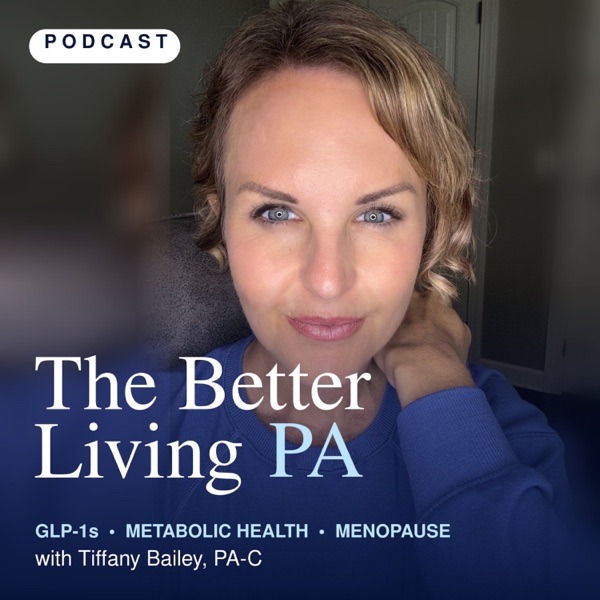
The Better Living PA: GLP-1s, Metabolic Health & Midlife Hormones
GLP-1s, metabolic health, perimenopause and menopause, explained by a Board Certified Physician Assistant. On The Better Living PA, Tiffany Bailey PA-C breaks down what the research actually says and what real patients experience, so you can make informed decisions about your health. Expect myth-busting deep dives on GLP-1 medications, side effects, protein and muscle, hormones and midlife health, plus honest conversations with patients, experts and advocates. For education only, not medical advice. Watch on YouTube @thebetterlivingPA | Links: linktr.ee/TiffanyBaileyPA
- Medicine chart
- #144
- Episodes
- 26
- Releases
- Daily
- Typical length
- 20 min
- On air since
- 2026
- Latest episode
- 14 hours ago
Episodes
26 episodes, newest first
-
36 min
Tammy's Story: Bariatric Surgery, GLP-1s & Losing 150 Pounds
Show notes
After years of living with obesity and Hashimoto's disease, Tammy had vertical sleeve gastrectomy in 2020. Bariatric surgery helped her lose weight, but she realized it hadn't fully addressed the complex biological factors behind her obesity. Eighteen months after surgery, she started GLP-1 therapy. Today she's 150 pounds down from her highest weight and uses her experience to advocate for people seeking access to GLP-1 treatment when insurance coverage falls short.
Tammy shares the reality of combining bariatric surgery with GLP-1 therapy, what she learned along the way, and why obesity deserves to be treated as a chronic, complex medical condition rather than a personal failure.
In this conversation:
• Mindset more than size, and the "if I'd just lost 10 more pounds" trap
• Phentermine and the Fen-Phen history
• Deciding on bariatric surgery and the two-week liquid diet
• Hashimoto's, PCOS and what else was going on
• Shortages, coverage changes and finding another way
• Why this isn't a quick fix, and getting protein inChapters
00:00 Meet Tammy
02:00 Looking back: mindset more than size
04:00 Wedding photos and "if I'd just lost 10 more pounds"
06:00 Phentermine and the Fen-Phen history
08:00 Considering bariatric surgery
10:00 The vicious cycle and kidney issues
12:00 The two-week liquid diet before surgery
14:00 Hashimoto's, PCOS and what else was going on
16:00 When Mounjaro stopped being prescribed for obesity
18:00 Shortage again - and finding another way
20:00 "It's not about the weight anymore"
22:00 The sign around her neck nobody checked
24:00 Why this isn't a quick fix
26:00 Getting protein in, and food as fuel
28:00 Wanting a safe place for people to get this
30:00 One-on-one access to the providers
32:00 Her advice: research it and ask questionsFollow Tammy
TikTok: @mom_is_gonna_lose_it
Instagram: @mom_is_gonna_lose_it
Facebook: Tammy on Facebook
Get started with Tammy's link: https://link.joinbelle.com/tammy-st-germain (code TAMMY)This episode shares one patient's personal experience. Individual results vary.
Interested in GLP-1s, peptides, hormones and metabolic health? Start here:
https://link.joinbelle.com/betterliving (coupon code BELLE15)
You'll find information on eligibility, available programs and next steps.Follow The Better Living PA so you don't miss new episodes on GLP-1 medications, peptides, perimenopause and menopause, weight loss, metabolic health and healthy aging.
Watch on YouTube: @thebetterlivingPA
All my links: https://linktr.ee/TiffanyBaileyPA
Instagram: @betterliving_pa
TikTok: @betterlivingforeveryoneMedical disclaimer: The information shared on this podcast is for educational and informational purposes only and should not be considered medical advice. Listening to or watching these episodes does not create a provider-patient relationship. Always consult with your own qualified healthcare provider before starting, stopping, or changing any medication, supplement, peptide, treatment plan, or healthcare regimen.
-
15 min
GLP-1s Before and After Surgery: When to Stop and When to Restart
Show notes
If you take a GLP-1 medication and have surgery or a procedure coming up, when should you stop it, and when is it safe to restart?
In this episode, I explain why GLP-1 medications matter when you receive general anesthesia or deep sedation. The primary concern isn't bleeding or wound healing. It's delayed stomach emptying and the potential risk of aspiration during anesthesia.
In this episode:
• Why GLP-1s can affect stomach emptying, and how anesthesia changes the risk
• Why recommendations vary between providers
• Who may have a higher risk of delayed gastric emptying
• Whether everyone needs to stop their medication
• When you may be able to restart after surgery
• Why missing several doses could mean restarting at a lower dose
• What to tell your surgeon and anesthesia teamCurrent guidance doesn't automatically require every patient to stop GLP-1 therapy. Your plan may depend on your medication, dose, symptoms, recent dose changes, medical conditions and the type of procedure. Always tell your surgeon and anesthesia team that you take a GLP-1, including the date of your last dose. If you take it for diabetes, speak with your prescribing provider before holding it, because stopping could affect your blood sugar. Always follow the instructions from your surgeon, anesthesia professional and prescribing provider.
Chapters
00:00 Why GLP-1s and surgery is such a confusing topic
00:48 It is not about bleeding or wound healing
01:14 Why every provider gives you a different answer
02:30 Aspiration: the real reason we hold GLP-1s
03:49 The recovery room is the riskiest window
04:25 Who is at higher risk
05:25 Do you actually have to stop? The newer guidance
06:44 Pre-op vs post-op: two different reasons
07:15 What changes if you take a GLP-1 for diabetes
08:12 When it is safe to restart after surgery
08:51 Narcotics plus GLP-1s: nausea and constipation
09:34 Abdominal surgery and post-op ileus
10:31 Do you need to restart at a lower dose?
11:56 Your pre-op appointment and your medication list
12:40 Do not forget to list your injections
13:14 The bottom lineInterested in GLP-1s, peptides, hormones and metabolic health? Start here:
https://link.joinbelle.com/betterliving (coupon code BELLE15)
You'll find information on eligibility, available programs and next steps.Follow The Better Living PA so you don't miss new episodes on GLP-1 medications, peptides, perimenopause and menopause, weight loss, metabolic health and healthy aging.
Watch on YouTube: @thebetterlivingPA
All my links: https://linktr.ee/TiffanyBaileyPA
Instagram: @betterliving_pa
TikTok: @betterlivingforeveryoneMedical disclaimer: The information shared on this podcast is for educational and informational purposes only and should not be considered medical advice. Listening to or watching these episodes does not create a provider-patient relationship. Always consult with your own qualified healthcare provider before starting, stopping, or changing any medication, supplement, peptide, treatment plan, or healthcare regimen.
-
18 min
Breast Cancer Screening: When to Start Mammograms & Are You High Risk? With Dr. Kristen Williams
Show notes
When should you start getting mammograms, and how do you know if you're at high risk for breast cancer?
In this episode, Tiffany Bailey, PA-C, sits down with Dr. Kristen Williams, MD, a general surgeon whose practice focuses on breast health, to break down breast cancer screening and what every woman should know.
In this episode:
• Why Dr. Williams recommends a yearly mammogram starting at age 40
• How a mammogram works, and how much radiation it really is
• Why ultrasound isn't a screening tool, and when you need a breast MRI
• High-risk breast programs and the Tyrer-Cuzick risk score (the 20% threshold)
• Family history (including your dad's side), gene mutations like BRCA, CHEK2 and PALB2, and genetic testing
• Why self-exams aren't enough and why catching breast cancer early mattersCheck your breast cancer risk with the Tyrer-Cuzick (IBIS) calculator we talked about: https://ibis-risk-calculator.magview.com
Bring your results to your primary care provider or OB/GYN to talk about next steps.
Follow Dr. Kristen Williams:
TikTok: @thesurgeoninpink
Instagram: @knwilliams01
Interested in women's health care, GLP-1s, peptides, hormones and metabolic health? Start here:
https://link.joinbelle.com/betterliving (coupon code BELLE15)
You'll find information on eligibility, available programs and next steps.
Follow The Better Living PA so you don't miss new episodes on GLP-1 medications, peptides, perimenopause and menopause, weight loss, metabolic health and healthy aging.
Watch on YouTube: @thebetterlivingPA
All my links: https://linktr.ee/TiffanyBaileyPA
Instagram: @betterliving_pa
TikTok: @betterlivingforeveryone
Medical disclaimer: The information shared on this podcast is for educational and informational purposes only and should not be considered medical advice. Listening to or watching these episodes does not create a provider-patient relationship. Always consult with your own qualified healthcare provider before starting, stopping, or changing any medication, supplement, peptide, treatment plan, or healthcare regimen.
-
38 min
Abbs' GLP-1 Story: When Working Out and Dieting Weren't Working
Show notes
Abbs is a registered nurse with a master's degree who spent much of her twenties slowly gaining weight without realizing how much it could eventually affect her health. Then the pandemic hit. Working in healthcare during such an overwhelming time took a toll, and her weight kept climbing.
Determined to make a change, she joined CrossFit and showed up consistently. But despite years of effort, the scale barely moved. After learning about GLP-1 medications on social media, Abbs began exploring whether they could provide the support she needed. In this interview, she shares how GLP-1 therapy became part of her journey and helped her build an approach that finally felt sustainable.
In this conversation:
• Shift work, sleep and next-day hunger
• Working in the hospital during the pandemic years
• Weightlifting without losing weight
• No PCP, insurance changes and choosing semaglutide or tirzepatide
• The first two weeks and how fast the weight came off
• Fiber, non-scale victories and judging progress by her PRsThis is an honest conversation about effort, biology, healthcare-worker burnout, and why needing medical support doesn't mean someone failed to work hard enough.
Chapters
00:00 Meet Abbs
02:00 How long the struggle actually goes back
04:00 The denial phase
06:00 Shift work, sleep and next-day hunger
08:00 Working in the hospital during the crazy years
10:00 What she tried before GLP-1s
12:00 Weightlifting without losing weight
14:00 When she started thinking about GLP-1s
16:00 The year she realized her body could do it
18:00 No PCP, and insurance changes
20:00 Choosing semaglutide or tirzepatide
22:00 Wanting better nutrition and sleep
24:00 The first two weeks
26:00 How fast the weight came off
28:00 Inflammation, and not a slow responder
30:00 Fiber, and what her body tells her
32:00 Non-scale victories
34:00 Judging progress by her PRsIndividual experiences and results vary.
Interested in GLP-1s, peptides, hormones and metabolic health? Start here:
https://link.joinbelle.com/betterliving (coupon code BELLE15)
You'll find information on eligibility, available programs and next steps.Follow The Better Living PA so you don't miss new episodes on GLP-1 medications, peptides, perimenopause and menopause, weight loss, metabolic health and healthy aging.
Watch on YouTube: @thebetterlivingPA
All my links: https://linktr.ee/TiffanyBaileyPA
Instagram: @betterliving_pa
TikTok: @betterlivingforeveryoneMedical disclaimer: The information shared on this podcast is for educational and informational purposes only and should not be considered medical advice. Listening to or watching these episodes does not create a provider-patient relationship. Always consult with your own qualified healthcare provider before starting, stopping, or changing any medication, supplement, peptide, treatment plan, or healthcare regimen.
-
15 min
Jalen Hurts' Blood Clots Explained: DVT, Pulmonary Embolism & Who's at Risk
Show notes
Philadelphia Eagles quarterback Jalen Hurts was diagnosed with a deep vein thrombosis (DVT) and blood clots in both lungs after what first looked like a routine calf injury and a superficial clot. As a board-certified physician assistant, I walk through the publicly reported timeline and explain, in plain language, how a clot in the leg can travel to the lungs, who is at higher risk, and the warning signs you should never brush off.
In this episode:
• Superficial clot vs. DVT: what "superficial" and "deep" really mean
• How a pulmonary embolism (PE) forms, and why clots often reach both lungs
• Common risk factors: injury, long travel, surgery, pregnancy, cancer, and oral vs. transdermal hormones
• Warning signs of a DVT or PE
• What blood thinners actually do, and why contact sports are off the table
• Tips for lowering clot risk on long flights and road tripsNote: I'm discussing only what has been publicly released by the Eagles and reported in the news. I don't have access to his medical records. One-sided leg swelling, new shortness of breath or chest pain deserve prompt medical attention.
Chapters
00:00 Jalen Hurts' blood clots: what we'll cover
01:22 The timeline: calf injury, London flight and ultrasound
03:22 Superficial clot vs. deep vein thrombosis
04:48 What a DVT is and how it feels
05:55 How a leg clot reaches the lungs
07:03 What causes blood clots
08:40 Who's at higher risk, including hormones
10:23 Warning signs of a DVT or PE
11:38 What blood thinner treatment really means
12:37 Lowering clot risk on long trips
13:41 Key takeawaysInterested in GLP-1s, peptides, hormones and metabolic health? Start here:
https://link.joinbelle.com/betterliving (coupon code BELLE15)
You'll find information on eligibility, available programs and next steps.Follow The Better Living PA so you don't miss new episodes on GLP-1 medications, peptides, perimenopause and menopause, weight loss, metabolic health and healthy aging.
Watch on YouTube: @thebetterlivingPA
All my links: https://linktr.ee/TiffanyBaileyPA
Instagram: @betterliving_pa
TikTok: @betterlivingforeveryoneMedical disclaimer: The information shared on this podcast is for educational and informational purposes only and should not be considered medical advice. Listening to or watching these episodes does not create a provider-patient relationship. Always consult with your own qualified healthcare provider before starting, stopping, or changing any medication, supplement, peptide, treatment plan, or healthcare regimen.
-
18 min
Answers to the Most Frequently Asked Questions About GLP-1s
Show notes
Are GLP-1 medications cheating? Will you regain the weight if you stop? Are compounded GLP-1s safe? Can you get addicted to semaglutide or tirzepatide?
In this episode, I break down the most frequently asked questions about GLP-1 medications in a simple, science-based way. If you're considering a GLP-1 for weight loss, insulin resistance, perimenopause weight gain or metabolic health, this will help you understand what's real and what's hype.
In this episode:
• How GLP-1 medications work in the body
• Will you have to take it forever, and what maintenance looks like
• How much protein you need
• Are compounded GLP-1s safe and legal, and how the grey market is different
• How to find a vetted provider
• Is this addiction? Obesity as a chronic disease
• Hair shedding, and why shampoos and supplements often aren't worth the money
• The other benefits, from kidney disease and beyondChapters
00:00 Why there's so much GLP-1 misinformation
02:00 Where to find nutrition guides and community
03:00 Q1: How GLP-1s actually work in your body
05:00 Q2: Will I have to take this forever?
06:00 What maintenance actually looks like
07:00 How much protein you need
08:00 Why you can't compare your results to anyone else's
09:00 Q3: Are compounded GLP-1s safe and legal?
10:00 The grey market and why it's different
11:00 How to find a vetted provider
12:00 Q4: Is this addiction? Obesity as a chronic disease
13:00 Q5: Hair shedding - why it happens
15:00 Shampoos and supplements: don't waste your money
16:00 You are not broken
17:00 The other benefits: kidney disease and beyondInterested in GLP-1s, peptides, hormones and metabolic health? Start here:
https://link.joinbelle.com/betterliving (coupon code BELLE15)
You'll find information on eligibility, available programs and next steps.Follow The Better Living PA so you don't miss new episodes on GLP-1 medications, peptides, perimenopause and menopause, weight loss, metabolic health and healthy aging.
Watch on YouTube: @thebetterlivingPA
All my links: https://linktr.ee/TiffanyBaileyPA
Instagram: @betterliving_pa
TikTok: @betterlivingforeveryoneMedical disclaimer: The information shared on this podcast is for educational and informational purposes only and should not be considered medical advice. Listening to or watching these episodes does not create a provider-patient relationship. Always consult with your own qualified healthcare provider before starting, stopping, or changing any medication, supplement, peptide, treatment plan, or healthcare regimen.
-
22 min
How to Talk to Your Daughter About Her Period: When to Start & What to Say with Educator Janet Throgmorton
Show notes
Not sure how to talk to your daughter about her period, or when to start? I'm Tiffany Bailey, a board certified physician assistant, and in this episode I sit down with educator Janet Throgmorton (Mrs. Janet), who spent 31 years in schools as a teacher, elementary principal and high school principal. We talk about why girls are starting their periods earlier, the right age to begin the conversation, how to frame periods and puberty as a normal, healthy part of growing up, and why boys need to hear it too.
We also talk about period poverty: how many students rely on their school for pads and tampons, why the right-size products matter for young girls, and how educators and communities are stepping in.
In this episode:
• Why girls are starting their periods earlier (some as young as 8 or 9)
• Why so many of us grew up with no "period talk" at home
• What age to start talking to your daughter about periods
• How to start the conversation at home without shame
• Why boys should learn about periods and puberty too
• Period poverty and why girls miss school without period products
• Choosing the right period products for a young girlChapters:
0:00 Meet Mrs. Janet: 31 years in education
1:51 Girls are starting their periods earlier
3:32 When schools teach about periods
4:35 Our own first period talks growing up
7:03 What age to start talking about periods
8:31 Why how you talk about periods matters
9:48 Should we talk to boys about periods too?
12:31 How many kids get no guidance at home
13:32 How to start the conversation at home
16:02 Period poverty: girls missing school
17:31 Why the right period products matter
18:27 How schools and communities help
20:24 Period poverty and lack of education
21:32 Final thoughts: we can't ignore women's healthInterested in learning more about GLP-1s, peptides, hormones, and metabolic health? START HERE:
https://link.joinbelle.com/betterliving
Coupon code: BELLE15Join our FREE community for GLP-1 support and nutrition tips: https://the-belle-community.circle.so
Watch on YouTube: https://www.youtube.com/watch?v=6_MnkZX_hy0
Linktree: https://linktr.ee/TiffanyBaileyPA
Instagram: https://www.instagram.com/betterliving_pa
TikTok: https://www.tiktok.com/@betterlivingforeveryoneFollow the show so you don't miss new episodes on women's health, GLP-1 medications, peptides, perimenopause and menopause, weight loss, metabolic health and healthy aging.
Medical disclaimer: This podcast is for educational and informational purposes only and is not medical advice. Listening does not create a provider-patient relationship. Always consult your own qualified healthcare provider with questions about your or your child's health.
-
22 min
GLP-1 Maintenance: Plateau vs. Maintenance & 4 Ways to Keep the Weight Off
Show notes
Your weight has stopped moving on your GLP-1. Are you in maintenance, or are you in a plateau? I'm Tiffany Bailey, a board certified physician assistant, and in this episode I break down the difference between a weight loss plateau and planned GLP-1 maintenance, what the research shows about stopping semaglutide or tirzepatide cold turkey, and 4 maintenance strategies to discuss with your provider so you can keep the weight off long term.
In this episode:
• Plateau vs. maintenance, and why the real difference is your intention
• Why a maintenance weight range works better than one number on the scale
• What the STEP 1 extension and SURMOUNT-4 trials showed about stopping GLP-1s
• Why "60% of people regain all their weight" is misleading
• Obesity as a chronic disease, and why food noise can come back
• 4 maintenance strategies: staying on your dose, carefully adjusting it, extending time between doses, and stopping with a plan
• Is microdosing a maintenance strategy?
• How your care team personalizes maintenance, plus nutrition, strength training, cost and access
• The emotional side of maintenance, and why needing ongoing treatment is not a failure
• DMR (duodenal mucosal resurfacing), an investigational procedure being studied for weight maintenanceChapters:
0:00 Plateau or maintenance?
0:22 Intro: what we'll cover
0:54 Plateau vs. maintenance: what's the difference
2:54 Why you need a maintenance weight range
3:40 When the scale stalls before your goal
4:04 What happens if you stop a GLP-1 cold turkey
4:20 STEP 1 extension trial (semaglutide)
5:15 SURMOUNT-4 trial (tirzepatide)
5:44 The "60% regain all their weight" myth
6:29 Obesity is a chronic disease
7:28 Strategy 1: Stay on the dose that worked
8:40 Strategy 2: Carefully adjust your dose
10:44 Strategy 3: Extend the time between doses
11:43 Strategy 4: Stop with a plan and close monitoring
13:13 Is microdosing a maintenance strategy?
13:53 Your dose is not a willpower test
14:36 How your care team personalizes maintenance
15:54 Health conditions that favor staying on your dose
16:46 Nutrition and strength training
18:03 Cost, access and insurance
18:35 The emotional side of maintenance
19:45 DMR: an investigational procedure for maintenance
21:12 Key takeawaysInterested in learning more about GLP-1s, peptides, hormones, and metabolic health? START HERE:
https://link.joinbelle.com/betterliving
Coupon code: BELLE15Join our FREE community for GLP-1 support and nutrition tips: https://the-belle-community.circle.so
Watch on YouTube: https://www.youtube.com/watch?v=eYGqXvP9578
Linktree: https://linktr.ee/TiffanyBaileyPA
Instagram: https://www.instagram.com/betterliving_pa
TikTok: https://www.tiktok.com/@betterlivingforeveryoneFollow the show so you don't miss new episodes on GLP-1 medications, peptides, perimenopause and menopause, weight loss, metabolic health and healthy aging.
Medical disclaimer: This podcast is for educational and informational purposes only and is not medical advice. Listening does not create a provider-patient relationship. Always consult your own qualified healthcare provider before starting, stopping, or changing any medication, supplement, peptide, or treatment plan.
-
44 min
Carolina's Story: Gastric Bypass, Weight Regain & Finding GLP-1s
Show notes
Carolina struggled with obesity from childhood and spent years searching for a sustainable way to manage her health and weight. Eventually she traveled to Mexico for gastric bypass surgery, and went from 320 to 165 pounds. But she discovered surgery wasn't a permanent fix for the biological and emotional challenges she'd faced her whole life, and when maintaining her results became difficult, she started looking for another option.
In this conversation, Carolina shares her experience with weight-loss surgery, weight regain and discovering GLP-1 therapy, and how it helped her better understand her body and finally build an approach that feels sustainable.
In this conversation:
• Growing up with obesity
• Traveling to Mexico for gastric bypass surgery
• Why weight regain can happen after bariatric surgery
• Pregnancy, a new baby and no family nearby
• What she can and can't eat after bypass
• Why surgery doesn't change obesity hormonally
• Discovering GLP-1 therapy and building a sustainable approachCarolina's story is an important reminder that obesity is a complex, chronic condition. Needing additional support after bariatric surgery does not mean someone failed.
Chapters
00:00 Meet Carolina
02:30 Starting a new job, and starting a GLP-1
05:00 Being loved for who she was
07:30 Moving away and grieving
10:00 Getting back into the swing of things
12:30 Flying out for gastric bypass surgery
15:00 Throwing away the old X-rays
17:30 Getting down to 165 from 320
20:00 How desperate people get, and a broken system
22:30 Pregnancy and gaining weight
25:00 A new baby with no family nearby
27:30 Her son starting kindergarten
30:00 A torn foot and what the X-ray showed
32:30 Getting back on the bike for herself
35:00 What she can and can't eat after bypass
37:30 Why surgery doesn't change obesity hormonally
40:00 Why compounded lets you inch your dose upThis episode shares one patient's personal experience. Individual results vary.
Interested in GLP-1s, peptides, hormones and metabolic health? Start here:
https://link.joinbelle.com/betterliving (coupon code BELLE15)
You'll find information on eligibility, available programs and next steps.Follow The Better Living PA so you don't miss new episodes on GLP-1 medications, peptides, perimenopause and menopause, weight loss, metabolic health and healthy aging.
Watch on YouTube: @thebetterlivingPA
All my links: https://linktr.ee/TiffanyBaileyPA
Instagram: @betterliving_pa
TikTok: @betterlivingforeveryoneMedical disclaimer: The information shared on this podcast is for educational and informational purposes only and should not be considered medical advice. Listening to or watching these episodes does not create a provider-patient relationship. Always consult with your own qualified healthcare provider before starting, stopping, or changing any medication, supplement, peptide, treatment plan, or healthcare regimen.
-
36 min
Can GLP-1s Cause Blindness? An Eye Doctor Explains the Real Risk of NAION
Show notes
Can GLP-1 medications like semaglutide and tirzepatide really cause blindness?
In this episode, Tiffany Bailey, PA-C, sits down with optometrist Dr. Kelly Bugg, OD, to talk about GLP-1s and vision loss, what the research on NAION (non-arteritic anterior ischemic optic neuropathy) actually shows, and what the real risk is for most patients.
In this conversation:
• What optometrists do and how they differ from ophthalmologists
• What NAION is and how it affects the optic nerve
• What the semaglutide research shows, and how rare NAION actually is
• Who has a "crowded disc" and may be at higher risk
• How diabetes and fast blood sugar changes affect your eyes
• Dry eye and blurry vision that comes and goes on GLP-1s
• Why to call your eye doctor, not the ER, for sudden vision changes
• How often to get an eye exam, and dilation vs. retinal photosChapters
00:00 Meet Dr. Kelly Bugg, optometrist
01:46 What an optometrist treats
02:30 Optometrist vs. ophthalmologist
04:06 Why see an eye doctor for eye problems
04:47 The scary GLP-1 blindness headlines
05:09 What is NAION?
05:55 What the semaglutide research shows
06:18 How rare is NAION?
08:05 Does she see NAION in her practice?
09:54 Diabetes, GLP-1s and your eyes
10:19 How diabetic retinopathy damages the eye
12:15 Fast blood sugar changes and when to come in
14:34 Crowded discs and who is at higher risk
15:46 Weighing the benefits vs. the risk
18:07 Warning signs of NAION
19:23 If you've already had NAION in one eye
20:37 Dry eye on GLP-1s
22:18 Blurry vision that comes and goes
25:22 Eye doctor vs. the ER for vision changes
27:17 How often to get an eye exam
29:09 A patient story: what an eye exam caught
32:13 Dilation vs. retinal photography
34:04 Final takeaways
Connect with Dr. Kelly Bugg, OD:
Website: https://keepingyourlifeinfocus.com/
Lone Oak Family Eye Care (Paducah, KY): https://www.facebook.com/lofamilyeye
Mayfield Family Eye Care (Mayfield, KY): https://www.facebook.com/MayfieldFamilyEyeCare
Interested in GLP-1s, peptides, hormones and metabolic health? Start here:
https://link.joinbelle.com/betterliving (coupon code BELLE15)
You'll find information on eligibility, available programs and next steps.
Follow The Better Living PA so you don't miss new episodes on GLP-1 medications, peptides, perimenopause and menopause, weight loss, metabolic health and healthy aging.
Watch on YouTube: @thebetterlivingPA
All my links: https://linktr.ee/TiffanyBaileyPA
Instagram: @betterliving_pa
TikTok: @betterlivingforeveryone
Medical disclaimer: The information shared on this podcast is for educational and informational purposes only and should not be considered medical advice. Listening to or watching these episodes does not create a provider-patient relationship. Always consult with your own qualified healthcare provider before starting, stopping, or changing any medication, supplement, peptide, treatment plan, or healthcare regimen.
-
15 min
Is Your GLP-1 Dose Too High? 7 Signs to Watch For
Show notes
Is your GLP-1 dose too high? A higher dose is not automatically better. Semaglutide and tirzepatide work best at the dose that helps you reach your goals while still letting you eat, drink, function and feel like yourself.
In this episode, I walk through 7 signs your GLP-1 dose may be too high for your body, why the old "move up every month" titration approach doesn't fit everyone, and why your dose should be judged by how you feel and function, not just the number on the scale.
In this episode:
Why so many people were titrated up every single month
What the Wegovy and Zepbound prescribing information says about tolerability
Nausea that keeps you from eating, drinking or functioning
Repeated vomiting or trouble keeping fluids down
Constipation or diarrhea that becomes a real problem
Food aversion and barely being able to eat
Feeling weak, dizzy or exhausted
Losing strength and muscle
Side effects that get worse with every dose increase
Why returning hunger doesn't always mean you need a higher dose
Symptoms that need prompt medical attention
Chapters
00:00 How to tell if your GLP-1 dose is too high
00:35 Why so many people were moved up every month
01:32 What Wegovy and Zepbound prescribing info says now
02:21 Your dose should be personalized
02:34 Don't judge your dose by the scale
03:00 Sign 1: Nausea that stops you from functioning
04:22 Sign 2: Vomiting or trouble keeping fluids down
05:14 Sign 3: Constipation or diarrhea that becomes a problem
06:25 Sign 4: You can barely eat (food aversion)
08:04 Sign 5: Feeling weak, dizzy or exhausted
09:12 Sign 6: You're losing strength
10:22 Sign 7: Side effects get worse with every dose increase
11:13 Returning hunger doesn't mean you need a higher dose
11:57 Your rate of weight loss vs. your dose
12:47 Symptoms that need prompt evaluation
13:22 Talk to your provider before changing your dose
13:51 Low and slow: individualized GLP-1 dosing
14:30 Tell me your experience
Interested in GLP-1s, peptides, hormones and metabolic health? Start here:
link.joinbelle.com/betterliving (coupon code BELLE15)
You'll find information on eligibility, available programs and next steps.
Follow The Better Living PA so you don't miss new episodes on GLP-1 medications, peptides, perimenopause and menopause, weight loss, metabolic health and healthy aging.
Watch on YouTube: @thebetterlivingPA
All my links: linktr.ee/TiffanyBaileyPA
Instagram: @betterliving_pa
TikTok: @betterlivingforeveryone
Medical disclaimer: The information shared on this podcast is for educational and informational purposes only and should not be considered medical advice. Listening to or watching these episodes does not create a provider-patient relationship. Always consult with your own qualified healthcare provider before starting, stopping, or changing any medication, supplement, peptide, treatment plan, or healthcare regimen.
-
58 min
GLP-1 Microdosing & Menopause: Weight Gain, HRT & Tirzepatide with Dr. Pat Taylor
Show notes
Can GLP-1s help with perimenopause and menopause? In this live conversation, I'm joined by Dr. Pat Taylor, a board-certified family physician specializing in obesity, menopause and metabolic medicine, to talk about GLP-1 therapy, microdosing, menopause and metabolic health.
Perimenopause can start as early as your mid-30s, and the hormonal shifts can bring belly weight gain, insulin resistance, mood changes and more, even when nothing else in your routine has changed. We explain what's happening, how GLP-1s and menopausal hormone therapy may work together, what microdosing means, and who may or may not be a good candidate, plus live Q&A.
In this episode:
• When perimenopause starts and common symptoms
• Estrogen, mood and the brain
• Why weight shifts to your midsection
• Insulin resistance and the labs to check
• Surgical menopause and testosterone
• Why GLP-1s may work differently in menopause
• Hormone therapy plus GLP-1s, and tirzepatide and hot flashes
• What GLP-1 microdosing really means, and who is (and isn't) a good candidate
• Maintenance without BMI cutoffsChapters
00:00 Welcome: microdosing and menopause
01:00 Perimenopause starts earlier than you think
03:00 Meet Dr. Pat Taylor
04:03 When perimenopause starts and common symptoms
06:01 Estrogen, mood and the brain
07:05 Why weight shifts to your midsection
08:02 Insulin resistance in perimenopause
09:04 Labs to check for insulin resistance
11:01 Visceral fat and health risks
12:01 Surgical menopause and testosterone
14:03 Why GLP-1s may work differently in menopause
16:00 Estrogen, your cycle and GLP-1 response
17:03 Hormone therapy plus GLP-1s
20:01 Tirzepatide and hot flashes
21:01 Q&A: itchy skin and ears
23:00 Prediabetes, diabetes and your chart
26:06 Diabetes medications and longevity
27:00 BMI and insurance coverage
30:04 Why Dr. Pat joined Belle
31:01 Belle launches GLP-1 microdosing
33:01 Food noise and mental capacity
34:03 Two pathways to start microdosing
36:00 What microdosing really means
39:02 Who's a good candidate for microdosing
43:03 Why menopausal hormone therapy matters
44:04 Who's not a good candidate
47:01 Maintenance with no BMI gates
50:01 How to join the microdosing program
52:06 Q&A: HRT timing and starting doses
54:05 Tirzepatide with B6
55:05 Wrap-upLearn more about Belle's microdosing program: https://microdose.joinbelle.com/
Interested in GLP-1s, peptides, hormones and metabolic health? Start here:
https://link.joinbelle.com/betterliving (coupon code BELLE15)
You'll find information on eligibility, available programs and next steps.Follow The Better Living PA so you don't miss new episodes on GLP-1 medications, peptides, perimenopause and menopause, weight loss, metabolic health and healthy aging.
Watch on YouTube: @thebetterlivingPA
All my links: https://linktr.ee/TiffanyBaileyPA
Instagram: @betterliving_pa
TikTok: @betterlivingforeveryoneMedical disclaimer: The information shared on this podcast is for educational and informational purposes only and should not be considered medical advice. Listening to or watching these episodes does not create a provider-patient relationship. Always consult with your own qualified healthcare provider before starting, stopping, or changing any medication, supplement, peptide, treatment plan, or healthcare regimen.
-
44 min
Olivia's GLP-1 Journey: 98 Pounds Down on Compounded Tirzepatide
Show notes
Olivia has been on a compounded tirzepatide journey for over a year and is down 98 pounds. In this conversation she shares her wins, what made her journey hard, and why she now spends her time advocating for GLP-1 patients who need access to care.
In this conversation:
• Researching GLP-1s and falling for the flood of marketing ads
• Choosing semaglutide on price, and the side effects she had
• Hitting Onederland, then hitting a stall
• Why eating 800 calories was the wrong move, and focusing on maintaining muscle
• Loose skin, rings that fit differently and other surprises
• Whether she expects to be on a GLP-1 long-term
• Why a GLP-1 is a tool, and she's still doing the workChapters
00:00 Meet Olivia
02:30 Researching GLP-1s and the flood of ads
05:00 Falling for marketing campaigns
07:30 Choosing semaglutide on price
10:00 Constipation, and how much nausea she had
12:30 Hitting Onederland
15:00 When weekly drops turn into a stall
17:30 Working out and morning bike rides
20:00 Eating 800 calories, and why that was wrong
22:30 Rings and jewelry feeling strange
25:00 Focusing on maintaining muscle
27:30 Not checking whether she'd fit the booth
30:00 Loose skin as part of the loss
32:30 Did she expect to be on this long-term?
35:00 Her husband dreaming about food
37:30 Not thinking about supper at all
40:00 It's a tool - she's still doing the workFollow Olivia
TikTok: @glpwitholivia
YouTube: @GLPWithOlivia
Instagram: @glpwitholivia
Get started with Olivia's link: https://link.joinbelle.com/olivia (code OLIVIA)This episode shares one person's experience. Individual results vary.
Interested in GLP-1s, peptides, hormones and metabolic health? Start here:
https://link.joinbelle.com/betterliving (coupon code BELLE15)
You'll find information on eligibility, available programs and next steps.Follow The Better Living PA so you don't miss new episodes on GLP-1 medications, peptides, perimenopause and menopause, weight loss, metabolic health and healthy aging.
Watch on YouTube: @thebetterlivingPA
All my links: https://linktr.ee/TiffanyBaileyPA
Instagram: @betterliving_pa
TikTok: @betterlivingforeveryoneMedical disclaimer: The information shared on this podcast is for educational and informational purposes only and should not be considered medical advice. Listening to or watching these episodes does not create a provider-patient relationship. Always consult with your own qualified healthcare provider before starting, stopping, or changing any medication, supplement, peptide, treatment plan, or healthcare regimen.
-
12 min
Allodynia on GLP-1s: Why Your Skin Hurts to the Touch | PA Explains
Show notes
Have you noticed your skin feels sore, burning, tingly or sunburned, even when nothing is touching it but your clothes or your sheets? That symptom has a name: allodynia. It's being reported by some people taking GLP-1 medications like tirzepatide and semaglutide, and it can be confusing and worrying when it shows up.
In this episode, I explain what allodynia is, why it may happen on GLP-1s, what it typically looks like, and what you can do about it, so you know what's expected and when it's worth talking to your provider.
In this episode:
• What allodynia is and what it can feel like
• Burning, tingling and sunburn-like skin sensitivity on GLP-1s
• Which GLP-1 medications it's been reported with, and the role of dose increases
• Why it may happen, including nerve signaling and rapid weight loss
• How long it tends to last
• Practical ways to manage it and when to talk to your provider about your dose
• Symptoms that aren't typical and should be checked outInterested in GLP-1s, peptides, hormones and metabolic health? Start here:
https://link.joinbelle.com/betterliving (coupon code BELLE15)
You'll find information on eligibility, available programs and next steps.Follow The Better Living PA so you don't miss new episodes on GLP-1 medications, peptides, perimenopause and menopause, weight loss, metabolic health and healthy aging.
Watch on YouTube: @thebetterlivingPA
All my links: https://linktr.ee/TiffanyBaileyPA
Instagram: @betterliving_pa
TikTok: @betterlivingforeveryoneMedical disclaimer: The information shared on this podcast is for educational and informational purposes only and should not be considered medical advice. Listening to or watching these episodes does not create a provider-patient relationship. Always consult with your own qualified healthcare provider before starting, stopping, or changing any medication, supplement, peptide, treatment plan, or healthcare regimen.
-
17 min
What I'd Tell You If You Were Starting GLP-1s Over | PA Advice
Show notes
Starting GLP-1s, or wishing you could start your GLP-1 journey over? I'm Tiffany Bailey, a board certified physician assistant, and after talking with thousands of people on GLP-1 medications, these are the 10 things patients most often tell me they wish they'd done differently from day one.
We cover building a care plan before your first dose, why you shouldn't judge results in the first 4 weeks, eating regularly even when your appetite is low, protecting your muscle, planning ahead for side effects like nausea and acid reflux, tracking progress beyond the scale, weekly vs. split dosing, the mental and emotional side of weight loss, and taking life on GLP-1s one step at a time. Whether you're on week one or month twelve, you can still make these changes.
⏱️ Chapters
0:00 Starting GLP-1s over: what I'd do differently
1:20 #1 Have a care plan before you start
3:18 #2 Don't judge results in the first 4 weeks
4:57 #3 Eat regularly, even when you're not hungry
6:28 #4 Protect your muscle early
7:34 #5 Plan ahead for side effects
8:35 #6 Take before photos and measurements
10:15 #7 Weekly vs. split dosing
11:29 #8 The mental and emotional side + community
12:39 #9 Take others' advice with a grain of salt
13:38 #10 One step at a time (do I stay on it forever?)
15:44 Your turn + free resources👇 Interested in learning more about GLP-1s, peptides, hormones, and metabolic health?
START HERE:
🔗https://link.joinbelle.com/betterlivingCoupon Code- BELLE15
If you're considering treatment options, this is the best place to begin. You'll find information on eligibility, available programs, and next steps.
📌 Subscribe to my channel so you don't miss future videos on:
https://www.youtube.com/@thebetterlivingPA
🔔𝐃𝐨𝐧'𝐭 𝐟𝐨𝐫𝐠𝐞𝐭 𝐭𝐨 𝐬𝐮𝐛𝐬𝐜𝐫𝐢𝐛𝐞 𝐭𝐨 𝐦𝐲 𝐜𝐡𝐚𝐧𝐧𝐞𝐥 𝐟𝐨𝐫 𝐦𝐨𝐫𝐞 𝐮𝐩𝐝𝐚𝐭𝐞𝐬.• GLP-1 medications
• Peptides
• Perimenopause & menopause
• Weight loss
• Metabolic health
• Healthy agingJoin our FREE community to learn more about GLP1s and get nutritional tips and tricks-
https://the-belle-community.circle.so/join?invitation_token=480b6c976ec2285d8e8a6a56a0f3487d5fc2e09d-073e1d62-688d-4de9-b85d-d05af356cb9b⚠️ Medical Disclaimer:
The information shared on this channel is for educational and informational purposes only and should not be considered medical advice. Watching these videos does not create a provider-patient relationship. Always consult with your own qualified healthcare provider before starting, stopping, or changing any medication, supplement, peptide, treatment plan, or healthcare regimen.✅ Important Link to Follow
🔗 Linktree
https://linktr.ee/TiffanyBaileyPAInstagram:
https://www.instagram.com/betterliving_paTikTok:
https://www.tiktok.com/@betterlivingforeveryone#GLP1 #GLP1Journey #WeightLossJourney
-
15 min
The #1 Rule on a GLP-1: Eat Until You're No Longer Hungry, Not Full
Show notes
The number one rule every GLP-1 user should practice sounds incredibly simple: eat until you're no longer hungry, not until you feel full.
Those may sound like the same thing, but they're two very different stopping points, and learning the difference is one of the biggest things that separates a smooth GLP-1 journey from a miserable one. In this episode, I explain how GLP-1 medications like semaglutide and tirzepatide can change your appetite faster than they change your lifelong eating habits, why so many of us were conditioned to clean our plates, and why your old portion sizes may suddenly leave you feeling miserable.
In this episode:
• The difference between hunger, satisfaction, fullness and feeling stuffed
• How your stomach, gut hormones, nerves and brain communicate during a meal
• Why slowing down and chewing more can help
• The halfway pause you can practice at your next meal
• How GLP-1s may change food motivation and reward
• How to stop eating when hunger disappears without accidentally under-eatingA GLP-1 can turn down the hunger signal, but it can't put your fork down for you.
Chapters
00:00 The #1 rule most GLP-1 users get wrong
00:23 Eat until you're no longer hungry, not full
01:12 Hunger vs fullness - two different points
01:59 Why we were trained to clean our plates
03:08 Eating too fast and not chewing enough
03:47 How your body knows you have had enough
05:56 What GLP-1s actually change in your stomach
07:03 Practicing the pause during a meal
07:48 Put your fork down - two questions to ask
08:44 The 1 to 10 fullness scale
10:12 Food is not just fuel - the emotional side
11:19 Losing the dopamine hit from food
12:24 Finding non-food rewards
13:11 Hunger vs food noise
14:07 Tell me what has helped youInterested in GLP-1s, peptides, hormones and metabolic health? Start here:
https://link.joinbelle.com/betterliving (coupon code BELLE15)
You'll find information on eligibility, available programs and next steps.Follow The Better Living PA so you don't miss new episodes on GLP-1 medications, peptides, perimenopause and menopause, weight loss, metabolic health and healthy aging.
Watch on YouTube: @thebetterlivingPA
All my links: https://linktr.ee/TiffanyBaileyPA
Instagram: @betterliving_pa
TikTok: @betterlivingforeveryoneMedical disclaimer: The information shared on this podcast is for educational and informational purposes only and should not be considered medical advice. Listening to or watching these episodes does not create a provider-patient relationship. Always consult with your own qualified healthcare provider before starting, stopping, or changing any medication, supplement, peptide, treatment plan, or healthcare regimen.
-
14 min
Is GLP-1 Divorce Real? How GLP-1s Can Change Your Relationship | PA Advice
Show notes
Is "GLP-1 divorce" real? Can a GLP-1 medication like semaglutide or tirzepatide actually change your relationship with your partner? I'm Tiffany Bailey, a board certified physician assistant and GLP-1 advocate, and in this episode I break down the trend some people call "GLP-1 divorce" or "Ozempic divorce," what the research does (and doesn't) show, and the real factors that can shift a relationship when one partner starts a GLP-1.
We cover:
• What "GLP-1 divorce" means and why it's not a new phenomenon
• What we learned from bariatric surgery patients and relationship changes
• Why most separations start with cracks that were already there
• How new confidence, less food noise, and new interests can feel threatening to a partner
• Feeling emotionally flat on a GLP-1 and how it can affect dates and intimacy
• What early research on GLP-1s and marriage outcomes shows so far
• Why "you look amazing now" can land the wrong way
• GLP-1s, dopamine, and the reward system (food, alcohol, and desire)
• Losing food as a comfort strategy and finding new ways to cope
• When shared routines like dinners, drinks, and movie snacks changeChapters:
0:00 What is "GLP-1 divorce"?
0:43 Not new: what we saw after bariatric surgery
1:19 Can a GLP-1 actually cause a divorce?
1:52 Scenario: when one partner starts changing
3:40 Feeling emotionally flat on a GLP-1
4:38 New confidence exposes old cracks
5:00 What the research says
6:31 How your partner sees you vs. how you see yourself
7:08 Intimacy and "you look amazing now"
7:51 When old feelings come into focus
8:29 GLP-1s, dopamine and the reward system
8:57 When food is no longer your comfort
10:20 When shared habits and routines change
11:15 GLP-1s, alcohol cravings and desire
12:12 Why partners miss the old routines
12:55 So, is GLP-1 divorce real?
13:21 Share your experience👇 Interested in learning more about GLP-1s, peptides, hormones, and metabolic health?
START HERE:
🔗https://link.joinbelle.com/betterlivingCoupon Code- Belle15
If you're considering treatment options, this is the best place to begin. You'll find information on eligibility, available programs, and next steps.
📌 Watch the video version on YouTube and subscribe so you don't miss future episodes on:
https://www.youtube.com/@thebetterlivingPA• GLP-1 medications
• Peptides
• Perimenopause & menopause
• Weight loss
• Metabolic health
• Healthy agingJoin our FREE community to learn more about GLP1s and get nutritional tips and tricks-
Join The Belle Community (free)⚠️ Medical Disclaimer:
The information shared on this show is for educational and informational purposes only and should not be considered medical advice. Listening to this podcast does not create a provider-patient relationship. Always consult with your own qualified healthcare provider before starting, stopping, or changing any medication, supplement, peptide, treatment plan, or healthcare regimen.✅ Important Links to Follow
🔗 Linktree
https://linktr.ee/TiffanyBaileyPAInstagram:
https://www.instagram.com/betterliving_paTikTok:
https://www.tiktok.com/@betterlivingforeveryone#GLP1 #GLP1Divorce #OzempicDivorce #WeightLossJourney #Semaglutide
-
14 min
Am I Crazy or Is It Perimenopause? Sneaky Symptoms Women Miss
Show notes
Do you feel like you're going crazy, or like you just don't feel like yourself anymore? It might be perimenopause.
I'm Tiffany Bailey, a board certified physician assistant, and in this episode I break down the sneaky perimenopause symptoms so many women in their late 30s and 40s miss: anxiety and irritability, waking up in the middle of the night, brain fog, and achy, stiff joints. Perimenopause can start up to 10 years before menopause, and you can still have regular periods while it's happening.
In this episode:
• What perimenopause is (and why menopause is really just one day)
• Why regular periods don't rule out perimenopause
• Anxiety, irritability and the emotional roller coaster
• Waking up at night with racing thoughts
• Brain fog, forgetfulness and trouble concentrating
• Physical clues: stiff, achy joints, getting hot at night, vaginal dryness
• Why women get treated symptom by symptom and nobody connects the dots
• Conditions that can mimic perimenopause (thyroid problems, anemia, sleep disorders, anxiety and depression)
• Why starting hormone therapy earlier in perimenopause mattersBelle's women's hormone therapy program launches October 15. Join the waitlist here: https://link.joinbelle.com/betterliving
Disclosure: I'm the Director of Patient Education at Belle, a telehealth company I talk about in this episode.
Chapters
00:00 Am I crazy or is it perimenopause?
01:03 What is perimenopause?
02:06 You can still have regular periods
02:37 Anxiety, irritability and mood swings
04:06 Waking up at night: sleep changes
05:46 Brain fog and forgetfulness
07:10 Physical clues: joints, night heat, dryness
09:00 How to figure out what's going on
10:53 Conditions that can mimic perimenopause
12:04 Why earlier hormone therapy matters
12:43 Belle's women's hormone therapy program
13:33 Tell me your experienceInterested in GLP-1s, peptides, hormones and metabolic health? Start here:
https://link.joinbelle.com/betterliving (coupon code BELLE15)
You'll find information on eligibility, available programs and next steps.Follow The Better Living PA so you don't miss new episodes on GLP-1 medications, peptides, perimenopause and menopause, weight loss, metabolic health and healthy aging.
Watch on YouTube: @thebetterlivingPA
All my links: https://linktr.ee/TiffanyBaileyPA
Instagram: @betterliving_pa
TikTok: @betterlivingforeveryoneMedical disclaimer: The information shared on this podcast is for educational and informational purposes only and should not be considered medical advice. Listening to or watching these episodes does not create a provider-patient relationship. Always consult with your own qualified healthcare provider before starting, stopping, or changing any medication, supplement, peptide, treatment plan, or healthcare regimen.
-
14 min
Should You Get GLP-1s From Telehealth or Your Primary Care? | PA Advice
Show notes
Should you get your GLP-1 from telehealth or from your primary care provider? You can love your primary care provider and still choose someone else for your GLP-1 care. I'm Tiffany Bailey, a board certified physician assistant who spent 18 years in primary care and internal medicine, and in this episode I share an honest, inside look at why primary care offices often struggle with GLP-1 care, when staying with your PCP makes the most sense, and what to look for in a telehealth GLP-1 provider.
In this episode:
0:00 Primary care vs. telehealth for GLP-1s
0:26 Why primary care providers are stretched thin
2:13 A prescription vs. a system built for your success
4:09 When staying with your primary care makes sense
4:45 No insurance? The compounding roadblock
6:10 How telehealth works with 503A pharmacies
7:01 Dosing and concentration mix-ups
9:04 What about the relationship with my provider?
9:48 What makes Belle different
11:48 Worried about upsetting your doctor?
13:38 You still need a primary care provider
14:00 Tell me your experienceInterested in learning more about GLP-1s, peptides, hormones, and metabolic health? Start here: https://link.joinbelle.com/betterliving (Coupon code: BELLE15)
All my links: https://linktr.ee/TiffanyBaileyPA
Watch on YouTube: @thebetterlivingPADisclosure: I'm the Director of Patient Education at Belle, a telehealth company I talk about in this episode.
Medical Disclaimer: This content is for educational and informational purposes only and should not be considered medical advice. Listening does not create a provider-patient relationship. Always consult your own qualified healthcare provider before starting, stopping, or changing any medication, supplement, peptide, treatment plan, or healthcare regimen.
-
52 min
Brittany Rose's GLP-1 Journey: Trauma, Healing & 115 Pounds Lost
Show notes
Brittany Rose has built a community of more than 45,000 YouTube subscribers by sharing her GLP-1 journey with honesty, vulnerability and a refreshing sense of humor.
In this deeply personal conversation, Brittany opens up about the childhood trauma that shaped her relationship with her body and how weight became a form of protection. She shares what led her to start Mounjaro in 2022, how losing access to the original $25 savings card changed the course of her treatment, and how she eventually moved to a compounded GLP-1 and has now lost 115 pounds. But this is about so much more than a number on the scale. It's a story of survival, healing, self-discovery and completely changing the way she sees herself.
In this conversation:
• Childhood trauma, food as protection, and how childhood weight becomes adult obesity
• Starting Mounjaro, titrating up and losing 80 pounds in year one
• $550 a month, shortages and the move to compounded GLP-1s (503A vs 503B)
• Why hunger coming back is not the drug failing
• Diet culture, macros over calories and when food tracking helps or hurts
• Maintenance, the fear of losing access, and non-scale victoriesPlease note: this episode includes a sensitive discussion of childhood trauma and abuse. Please listen with care.
Chapters
00:00 Meet Brittany Rose
01:00 115 pounds down, the short version
03:14 Where the name Brittany Rose came from
05:00 Childhood trauma and food as protection
08:00 How childhood weight becomes adult obesity
12:00 Growing up without sit-down dinners
14:25 Pregnancy and the weight that never came off
16:04 Weight loss, fertility, and finding Mounjaro in 2022
19:11 Being prescribed phentermine at the same time
21:07 Titrating up and losing 80 pounds in year one
22:47 $550 a month and the move to compounded
24:20 Shortages: a prescription for every dose
26:10 Is compounded safe? 503A vs 503B
28:00 Why feeling miserable is not the goal
29:28 Hunger coming back is not the drug failing
31:00 Diet culture and the calorie myth
33:06 Macros over calories: protein first
36:27 Food tracking: when it helps and when it hurts
41:06 Her hardest struggle in maintenance
42:07 Biological hunger vs. appetite
44:00 The fear of losing access
45:00 The boundary she was finally able to set
48:07 Non-scale victories and building her channel
50:16 What her 15-year-old saidFollow Brittany Rose
YouTube: @BrittanylosingThis episode shares one person's experience and is intended for education and support.
Interested in GLP-1s, peptides, hormones and metabolic health? Start here:
https://link.joinbelle.com/betterliving (coupon code BELLE15)
You'll find information on eligibility, available programs and next steps.Follow The Better Living PA so you don't miss new episodes on GLP-1 medications, peptides, perimenopause and menopause, weight loss, metabolic health and healthy aging.
Watch on YouTube: @thebetterlivingPA
All my links: https://linktr.ee/TiffanyBaileyPA
Instagram: @betterliving_pa
TikTok: @betterlivingforeveryoneMedical disclaimer: The information shared on this podcast is for educational and informational purposes only and should not be considered medical advice. Listening to or watching these episodes does not create a provider-patient relationship. Always consult with your own qualified healthcare provider before starting, stopping, or changing any medication, supplement, peptide, treatment plan, or healthcare regimen.
On these lists
The Better Living PA: GLP-1s, Metabolic Health & Midlife Hormones is one of the shows picked out on this list
More in Medicine
Placed highest on Apple Podcasts' Medicine chart right now