Podcast
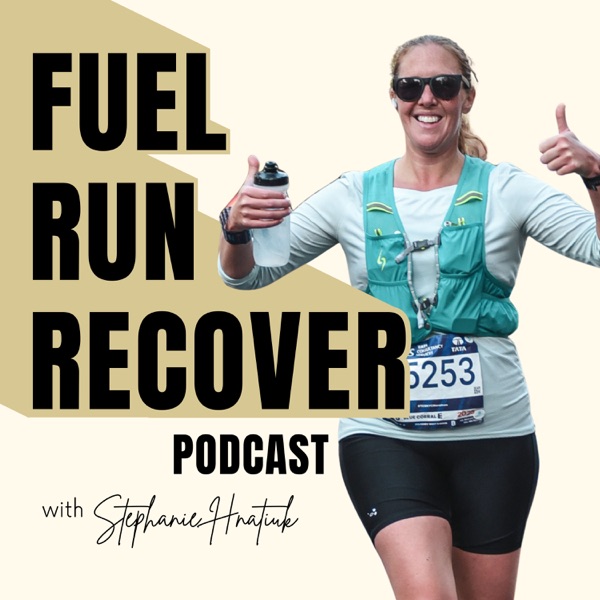
The Fuel Run Recover Podcast
New episodes weekly! Fuel Run Recover is a podcast for everyday runners who want to learn how to fuel better, run smarter, and recover faster. We'll be doing deep dives on the nutrition and training strategies you need to improve your running performance, body composition, and develop a healthier relationship with food and exercise. Learn more about your host Stephanie Hnatiuk by visiting www.stephaniehnatiuk.com, or on Instagram @steph.the.runners.dietitian
- Episodes
- 196
- Releases
- Weekly
- Typical length
- 33 min
- On air since
- 2022
- Latest episode
- 17 hours ago
Episodes
196 episodes, newest first
-
44 min
How to Fuel for HYROX: From Training to Race Day
Season 4, Episode 41
Show notes
Training for HYROX? Your fueling strategy deserves just as much attention as your workouts.
In this episode, we’re breaking down how to fuel for the combination of running and strength work that makes HYROX so demanding. From everyday training and recovery to race-day nutrition and hydration, I share how to support your energy, get more out of your workouts, and arrive at the start line prepared.
Whether you’re tackling your first HYROX or adding it to your running calendar, this episode will help you think through a fueling plan you can practise before race day.
Ready to take the next step with your fueling?
Not sure what's working (or what's missing) in your current nutrition strategy? Start with my FREE Runner's Fueling Audit. In just 5 minutes, you'll identify the biggest gaps in your fueling and what to focus on next.
Take the free Runner's Fueling Audit
Ready to stop piecing together nutrition advice and build a fueling strategy that actually works for you?
The Fueled Runner is my 8-week nutrition program designed to help runners fuel better for their training, performance, recovery, and body composition goals—with the education, tools, and support to put it all into practice.
-
1 hr 6 min
From Almost Quitting to Beating Her A Goal: Carol’s Story
Season 4, Episode 41
Show notes
After two pregnancies and a frustrating return to running, my client Carol was ready to quit running altogether. Instead, she took a step back, asked for support, and gave herself time to rebuild instead of rushing the process.
In this episode, Carol joins me to share how she went from struggling through run-walk intervals to blowing her A goal (and even her predicted race time) in a her recent 10-mile race. We talk about finding her love of running again, moving away from restrictive diets, and learning to fuel her training while balancing motherhood, work, and a life outside running.
It’s an honest conversation about patience, imperfect training days, and what can happen when you build an approach that fits your life.
If you’ve felt discouraged about starting again or wondered whether your running goals are still possible, Carol’s story is one you’ll want to hear.
Ready to feel stronger and more confident in your running?
Start with my free Runner’s Fueling Audit to uncover potential gaps in your fueling
Want the run and nutrition coaching support that helped Carol return to running with the right strategy and the confidence she needed to succeed?
Learn more about the Fuel Train Recover Club here!
-
1 hr 2 min
Low Iron and Running: Why a Supplement Isn’t Always Enough
Season 4, Episode 40
Show notes
Feeling unusually tired, finding your runs harder than they used to be, or struggling to improve your iron levels despite taking a supplement?
In this episode, we’re talking about iron, why it matters for running performance, and why addressing low iron can involve more than simply taking a supplement and hoping for the best.
We discuss why runners can be at higher risk of iron deficiency, what blood tests can tell us, and how fueling, absorption, and iron losses all fit into the bigger picture. I also share practical ways to include more iron-rich foods and what to consider with your healthcare provider if supplementation isn’t moving the needle.
If iron has been an ongoing struggle for you—or you’re wondering whether it could be affecting your running—this episode will help you understand what questions to ask and where to start.
Ready to take the next step with your fueling?
Not sure what's working (or what's missing) in your current nutrition strategy? Start with my FREE Runner's Fueling Audit. In just 5 minutes, you'll identify the biggest gaps in your fueling and what to focus on next.
Take the free Runner's Fueling Audit
Ready to stop piecing together nutrition advice and build a fueling strategy that actually works for you?
The Fueled Runner is my 8-week nutrition program designed to help runners fuel better for their training, performance, recovery, and body composition goals—with the education, tools, and support to put it all into practice.
-
33 min
The Long Road Is the Shortcut: How to Make Progress That Sticks
Season 4, Episode 39
Show notes
What if the long road to reaching your running and nutrition goals is actually the shortcut?
If you’re great at starting a new plan but keep finding yourself back at square one, this episode is for you. We’re talking about why quick fixes, restrictive diets, and all-or-nothing training can keep you stuck, and how the less exciting, everyday habits help you make lasting progress.
In this episode, I share:
•
Why chasing faster results can end up taking you longer
•
How to break out of the cycle of being “all in” or completely off track
•
Three ways to build a more sustainable approach to fueling and training
•
Why imperfect weeks don’t mean you need to start over
•
How my own Project Speed journey fits into my long-term running goals
Where could you be a year from now if you stopped starting over and gave a realistic plan time to work?
Slow down and find out.
Ready to take the next step with your fueling?
Not sure what's working (or what's missing) in your current nutrition strategy? Start with my FREE Runner's Fueling Audit. In just 5 minutes, you'll identify the biggest gaps in your fueling and what to focus on next.
Take the free Runner's Fueling Audit
Ready to stop piecing together nutrition advice and build a fueling strategy that actually works for you?
The Fueled Runner is my 8-week nutrition program designed to help runners fuel better for their training, performance, recovery, and body composition goals—with the education, tools, and support to put it all into practice.
-
32 min
What Runners Need to Know about GLP-1s
Season 4, Episode 38
Show notes
GLP-1 medications are everywhere right now, but what should runners know before considering them?
This week, I’m joined by pharmacist, evidence-based medicine educator, and fellow runner Zack Dumont to unpack the conversation around medications like Ozempic, Wegovy, Mounjaro, and Zepbound.
We discuss:
•
How these medications work and why there are so many different names.
•
Who might benefit and why individual circumstances matter.
•
Side effects and how they could affect your eating, training, and recovery.
•
Why meeting your fueling needs deserves extra attention as a runner.
•
Questions to ask your healthcare team when weighing your options.
We also explore the gaps in research specific to runners and why a change on the scale doesn’t tell the whole story.
Zack has been a pharmacist since 2008 and holds a Master’s Degree in Pharmacy Leadership. He develops educational resources to support patient-centred medication decisions and lectures on leadership and evidence-based medicine.
If you’ve been curious about GLP-1s and how they might fit alongside your running goals, this episode will give you plenty to think about.
And, if you have questions about GLP-1s, you can connect with Zack at zackdumont@me.com, or reach out to your local pharmacy team.
Ready to take the next step with your fueling?
Not sure what's working (or what's missing) in your current nutrition strategy? Start with my FREE Runner's Fueling Audit. In just 5 minutes, you'll identify the biggest gaps in your fueling and what to focus on next.
Take the free Runner's Fueling Audit
Ready to stop piecing together nutrition advice and build a fueling strategy that actually works for you?
The Fueled Runner is my 8-week nutrition program designed to help runners fuel better for their training, performance, recovery, and body composition goals—with the education, tools, and support to put it all into practice.
-
45 min
What's New with Creatine with Dr. Scott Forbes
Season 4, Episode 37
Show notes
Creatine has come a long way from its reputation as a bodybuilding supplement. But with so many new claims about brain health, endurance performance, and “optimal” doses, what’s actually supported by research?
In this episode, I’m joined by creatine researcher Dr. Scott Forbes, who last visited the podcast in season one. We discuss what’s changed in the research over the past four years and what recreational runners should know before adding creatine to their routine.
We cover:
• How creatine works and why the training still matters
• Whether it can help endurance athletes, especially during bursts of high intensity effort
• What the evidence says about muscle, body composition, bone health, injury, and cognition
• Why the research doesn’t establish that you need 20 grams a day for brain benefits
• Who may respond differently to supplementation, including plant-based athletes
• Why creatine monohydrate remains the practical choice, and what to watch for with gummiesWhile creatine may offer a small benefit, particularly alongside strength training, it isn’t a requirement for being a strong, well-fueled runner. Sleep, training, and nutrition still do most of the heavy lifting.
Be sure to follow Dr. Forbes on Instagram: @scott_forbes_phd
Ready to take the next step with your fueling?
Not sure what's working (or what's missing) in your current nutrition strategy? Start with my FREE Runner's Fueling Audit. In just 5 minutes, you'll identify the biggest gaps in your fueling and what to focus on next.
Take the free Runner's Fueling Audit
Ready to stop piecing together nutrition advice and build a fueling strategy that actually works for you?
The Fueled Runner is my 8-week nutrition program designed to help runners fuel better for their training, performance, recovery, and body composition goals—with the education, tools, and support to put it all into practice.
-
35 min
The Hidden Cost of Not Having a Fueling Strategy
Season 4, Episode 36
Show notes
If your approach to fueling is a little… willy nilly, this episode is for you.
Maybe you eat breakfast before your run. Maybe you don’t. Sometimes you nail your post-run meal, other times lunch is a protein bar you found in your bag. And when your training ramps up, you’re never quite sure whether you should be eating more, when those extra carbs should happen, or what your body actually needs.
The problem? Not having a consistent fueling strategy could be costing you more than you realize.
In this episode, we discuss how your everyday nutrition impacts your training quality, recovery, consistency, injury risk, gut health, appetite, body composition goals, and ultimately, how much you’re able to get out of all the work you’re putting into your running.
We also talk about why a nutrition strategy that worked perfectly well for shorter workouts may stop working when you start training for a half marathon, marathon, or ultra — and why simply “eating healthy” isn’t the same thing as fueling your training.
If you’re putting in the miles but still struggling with low energy, unpredictable workouts, excessive soreness, GI issues, cravings, injuries, or disappointing race-day performances, it might be time to look at what’s actually going into the tank.
Ready to take the next step with your fueling?
Not sure what's working (or what's missing) in your current nutrition strategy? Start with my FREE Runner's Fueling Audit. In just 5 minutes, you'll identify the biggest gaps in your fueling and what to focus on next.
Take the free Runner's Fueling Audit
Ready to stop piecing together nutrition advice and build a fueling strategy that actually works for you?
The Fueled Runner is my 8-week nutrition program designed to help runners fuel better for their training, performance, recovery, and body composition goals—with the education, tools, and support to put it all into practice.
-
33 min
Should You Run Less to Run a Faster Marathon?
Season 4, Episode 35
Show notes
Should you be running less?
The “3 runs per week” debate is making the rounds again, with runners sharing stories about how cutting back their running helped them get faster, stay injury-free, and finally hit a big PR.
But there’s an important piece of context that often gets left out.
A runner with 10–15 years and thousands of miles under their belt can thrive on three runs per week for very different reasons than a newer runner training for their first half or full marathon.
In this episode, we’re breaking down why there isn’t one “ideal” running frequency, and why copying someone else’s training schedule without considering their running history can backfire.
We discuss:
• Why running frequency and total running volume aren’t the same thing
• How years of easy mileage build an aerobic foundation you can’t shortcut
• Why an experienced runner might get faster by temporarily running less
• Why a newer runner may actually need MORE running to improve
• The relationship between training volume, intensity, recovery, and performance
• How strength training and cross-training fit into the equation
• Why marathon “durability” matters, and what your training has to do with falling apart late in a race
• When focusing on your 5K speed could eventually make you a better marathoner
• How to decide whether 3, 4, 5, or 6 runs per week makes sense for YOUThe goal isn’t to run as much—or as little—as possible. It’s to find the amount of running that gives your body the stimulus it needs while still allowing you to recover, stay consistent, and actually get better.
Looking for the resources mentioned in today's episode?
Get your free fueling audit here!
And if you’re ready for more support, I’ve got options—whether it’s my nutrition ebook Fuel Smarter, Run Stronger, my online coaching programs The Fueled Runner or The Fuel Train Recover Club, or apply for limited spots in my personalized 1:1 coaching programs.
-
42 min
Why Running Makes You So Hungry (And What to Do About It)
Season 4, Episode 34
Show notes
If marathon or half marathon training suddenly has you feeling like you could eat everything in sight, this episode is for you.
An increase in hunger when your training volume goes up is normal—but feeling constantly ravenous, thinking about food all day, or reaching the end of the day completely starving can also be a sign that something about your fueling strategy needs to change.
In this episode, we’re revisiting one of our most popular conversations about runner hunger and breaking down some of the most common reasons your appetite might feel out of control during training.
We discuss:
•
Why simply eating “healthy” foods doesn’t necessarily mean you’re eating enough for your training
•
How meal size and eating frequency can impact hunger later in the day
•
Why skipping meals or doing a lot of fasted training can leave you playing catch-up with your nutrition
•
The importance of including carbohydrates, protein, fibre, and fats in your everyday meals
•
Why big salads, protein shakes, and other seemingly filling meals might not actually keep a runner satisfied
•
How drinking too many of your calories can affect fullness
•
Why your hunger cues aren't always a perfect indicator of whether you're fueling enough
•
What it can mean if you’re experiencing the opposite problem and rarely feel hungry at all
If you’ve ever wondered, “Why am I SO hungry when I’m running more?”—or felt frustrated that race training seems to send your appetite through the roof—this episode will help you understand what might actually be going on and how to fuel in a way that better supports your training, recovery, and performance.
Ready to take the next step with your fueling?
Not sure what's working (or what's missing) in your current nutrition strategy? Start with my FREE Runner's Fueling Audit. In just 5 minutes, you'll identify the biggest gaps in your fueling and what to focus on next.
Take the free Runner's Fueling Audit
Ready to stop piecing together nutrition advice and build a fueling strategy that actually works for you?
The Fueled Runner is my 8-week nutrition program designed to help runners fuel better for their training, performance, recovery, and body composition goals—with the education, tools, and support to put it all into practice.
-
25 min
The Realities of Running and Weight Loss
Season 4, Episode 33
Show notes
What if your nutrition and training plan is working… just not as quickly as you expected?
In this episode of The Fuel Run Recover Podcast, we’re continuing the conversation about expectations—this time when it comes to weight loss and body composition for runners.
If you’re trying to improve your body composition while also getting faster, stronger, and better fueled, it can feel like those goals are constantly competing with each other. But they don’t have to be.
We’re talking about why sustainable progress often happens much more slowly than diet culture has taught us to expect, and why that doesn’t mean your approach isn’t working. I’m also sharing the stories of two runners with very similar goals and results—but very different perspectives on their progress—to show just how much our expectations can influence whether we feel successful or frustrated.
In this episode, we cover:•
Why runners don’t have to choose between fueling well and improving body composition
•
Why quick-fix weight loss strategies often clash with the demands of training for a race
•
How realistic timelines can completely change how you view your progress
•
Why consistency matters more than constantly starting over with a “better” plan
•
How to recognize progress beyond the number on the scale
•
Why the strategies you can sustain for months (and years!) are often the ones that create the biggest transformation
If you’ve ever thought, “I’m doing everything right… so why isn’t this happening faster?” this episode will help you zoom out, reset your expectations, and see your progress a little differently.
Ready to take the next step with your fueling?
Not sure what's working (or what's missing) in your current nutrition strategy? Start with my FREE Runner's Fueling Audit. In just 5 minutes, you'll identify the biggest gaps in your fueling and what to focus on next.
Take the free Runner's Fueling Audit
Ready to stop piecing together nutrition advice and build a fueling strategy that actually works for you?
The Fueled Runner is my 8-week nutrition program designed to help runners fuel better for their training, performance, recovery, and body composition goals—with the education, tools, and support to put it all into practice.
-
33 min
A Birthday Q&A: Running, Fueling, Twin Mom Life + My Biggest Running Goals
Season 4, Episode 32
Show notes
It's my 38th birthday! 🎉
So we're doing something a little different on The Fuel Run Recover Podcast this week.
I asked you to send me your questions about running, fueling, business, motherhood, and life behind the scenes—and today, I'm answering them.
In this episode, we're chatting about:
• My most memorable finish line (and why it wasn't at an official race!)
• The fuel I personally reach for most often during long runs
• Whether runners actually need to use gels
• What returning to running after having twins really looked like for me
• My favorite race distance and the races still sitting on my bucket list
• The BIG running goal I'd love to accomplish someday
• Why I wasn't always a runner—and how I spent five years making the same training mistakes before finally having a breakthrough
• My favorite (and hardest!) parts of being a twin momThis one's a little more personal, a little behind-the-scenes, and hopefully a fun way to celebrate another trip around the sun together.
Thanks for being here and being part of The Fuel Run Recover Podcast!
Ready to take the next step with your fueling?
Not sure what's working (or what's missing) in your current nutrition strategy? Start with my FREE Runner's Fueling Audit. In just 5 minutes, you'll identify the biggest gaps in your fueling and what to focus on next.
Take the free Runner's Fueling Audit
Ready to stop piecing together nutrition advice and build a fueling strategy that actually works for you?
The Fueled Runner is my 8-week nutrition program designed to help runners fuel better for their training, performance, recovery, and body composition goals—with the education, tools, and support to put it all into practice.
-
22 min
You Did Everything Right… So Why Did Your Run Still Feel Hard?
Season 4, Episode 31
Show notes
Sometimes the thing ruining your run isn’t your fitness, your fueling, or your training plan.
It’s your expectations.
In this episode, we’re talking about how the gap between what you expect a workout or race to feel like and what actually happens can completely change your experience — and even impact how well you perform.
We discuss:
•
Why even a well-fueled, well-trained run can still feel hard
•
How unrealistic expectations can turn a perfectly normal workout into a “bad” one
•
Why better fueling or hydration may not feel as dramatic as you expected right away
•
How exceeding your expectations can give you a huge mental boost
•
The difference between an actual problem and simply having your expectations unmet
•
How to set more realistic expectations before long runs, hard workouts, and races
•
Why “feeling good” and “working hard” can absolutely coexist
If you’ve ever finished a run thinking, “Why did that feel so hard? I did everything right,” this episode will help you look at your training from a completely different perspective.
Because sometimes, nothing is actually going wrong.
The experience just didn’t match the picture you had in your head.
Ready to take the next step with your fueling?
Not sure what's working (or what's missing) in your current nutrition strategy? Start with my FREE Runner's Fueling Audit. In just 5 minutes, you'll identify the biggest gaps in your fueling and what to focus on next.
Take the free Runner's Fueling Audit
Ready to stop piecing together nutrition advice and build a fueling strategy that actually works for you?
The Fueled Runner is my 8-week nutrition program designed to help runners fuel better for their training, performance, recovery, and body composition goals—with the education, tools, and support to put it all into practice.
-
27 min
Why Tracking Your Calories Isn't Working For You (pt 2)
Season 4, Episode 30
Show notes
If you've ever adjusted your meals because your watch said you "earned" more calories, or wondered why you're tracking everything but still not seeing the results you want, this episode is for you.
In Part 2 of this calorie tracking series, we dive into three more common mistakes that can hold runners back from improving their performance, body composition, and relationship with food.
In this episode, we discuss:
•
Why eating back your exercise calories can work against your training and weight loss goals
•
The problem with relying too heavily on calorie burn estimates from your watch
•
Why calorie tracking isn't nearly as accurate as many people think
•
How to fuel before your hardest workouts instead of trying to "earn" your food afterward
•
Why meal timing matters just as much as total calories
•
Two simple strategies to transition away from calorie tracking while still eating with confidence
Whether you're currently tracking every bite or looking for a more sustainable way to fuel your running, this episode will help you spend less time obsessing over numbers and more time building habits that actually support better performance and long-term results.
-
23 min
Why Tracking Your Calories Isn't Working For You (pt 1)
Season 4, Episode 29
Show notes
Are you tracking calories... but still not seeing the results you want?
In part one of this two-part series, we break down three of the biggest mistakes runners make when tracking calories—and why simply logging your food isn't enough to improve your nutrition or body composition.
We discuss why calorie tracking should be used as a short-term assessment tool rather than a lifelong habit, how tracking without analyzing your data wastes time, and why using calorie targets as the "diet" often leads to an unhealthy cycle of restriction and overeating.
If you've ever felt like you're "good" when you're tracking but lose control as soon as you stop, this episode is for you.
In this episode, we cover:
• When calorie tracking can actually be helpful
• Why simply collecting data isn't enough
• The difference between using tracking as a tool versus using it as the diet
• How overly restrictive calorie targets can backfire
• Why incomplete food logs make it harder to improve your nutrition
• How to use tracking to build habits you can maintain without logging every mealIf you're tired of tracking everything you eat but still want to fuel your running well, this episode will help you build a more sustainable approach.
Looking for the resources mentioned in today's episode?
Get your free fueling audit here!
And if you’re ready for more support, I’ve got options—whether it’s my nutrition ebook Fuel Smarter, Run Stronger, my online coaching programs The Fueled Runner or The Fuel Train Recover Club, or apply for limited spots in my personalized 1:1 coaching programs.
-
25 min
Why You're Not Getting Faster (it might be your fueling)
Season 4, Episode 28
Show notes
Want to get faster? Your nutrition might be the missing piece.
If you're showing up for your workouts but your race times aren't improving, it might not be your training plan, it could be how you're fueling it.
In this episode, we break down the nutrition strategies that help runners maximize the quality of their workouts, recover better, and ultimately run faster. From daily meal timing to carb loading, hydration, and fueling during long runs, you'll learn how to support your training so you can get more from every mile.
Whether you're chasing a new 5K PR or training for your next half or full marathon, these fueling strategies can help you unlock your performance potential.
In this episode, we discuss:
•
Why your nutrition should change based on your training schedule
•
How daily fueling impacts workout quality, recovery, and injury risk
•
The importance of meal timing before and after runs
•
Why carbohydrates are essential for speed workouts and higher-intensity training
•
How to fuel long runs for stronger finishes
•
The biggest mistakes runners make with carb loading
•
Why practicing your race fueling strategy during training matters
•
How hydration impacts performance—and why it may be the real cause of late-run stomach issues
If your goal this season is to run faster, this episode will help you build a nutrition strategy that supports stronger training sessions, faster recovery, and more confident race-day performances.
Looking for the resources mentioned in today's episode?
Get your free fueling audit here!
And if you’re ready for more support, I’ve got options—whether it’s my nutrition ebook Fuel Smarter, Run Stronger, my online coaching programs The Fueled Runner or The Fuel Train Recover Club, or apply for limited spots in my personalized 1:1 coaching programs.
-
39 min
What is it really like working with a Sport Dietitian?
Season 4, Episode 27
Show notes
What is it actually like to work with a sports dietitian?
If you've ever thought about hiring a sports dietitian or running coach but felt intimidated by the process, this episode is for you.
Maybe you're worried you'll have to give up all your favorite foods, track every bite you eat, or follow another restrictive meal plan that isn't realistic for your life. In this episode, I pull back the curtain on what coaching really looks like—and why it's probably very different than you expect.
I walk you through my coaching process from the very first assessment to creating practical, individualized nutrition strategies that fit your training, schedule, and goals. You'll also hear real examples (shared anonymously) of runners and endurance athletes I've been working with recently, including a postpartum runner rebuilding her confidence, an Ironman triathlete fine-tuning his race nutrition, and a busy working mom learning how to fuel for better energy, performance, and body composition.
In this episode, we discuss:
•
What happens during your first appointment with a sports dietitian
•
Why nutrition coaching isn't about perfection or restrictive eating
•
Different ways to assess your nutrition (without obsessively tracking calories)
•
The role of mindset, diet culture, and your relationship with food in long-term success
•
Why sustainable nutrition plans must fit your real life—not someone else's
•
Three real client case studies and the nutrition strategies we're using together
•
How personalized coaching helps runners improve performance, energy, recovery, and body composition
Whether you're training for your first 5K, chasing a marathon PR, or simply want to feel stronger on your runs, this episode will give you a behind-the-scenes look at how individualized nutrition coaching can help you reach your goals—without guilt, food rules, or giving up the foods you love.
Looking for the resources mentioned in today's episode?
Get your free fueling audit here!
And if you’re ready for more support, I’ve got options—whether it’s my nutrition ebook Fuel Smarter, Run Stronger, my online coaching programs The Fueled Runner or The Fuel Train Recover Club, or apply for limited spots in my personalized 1:1 coaching programs.
-
50 min
Are You Holding Yourself Back From Reaching Your Goals? (re-release)
Season 4, Episode 26
Show notes
Have you ever set a running or nutrition goal—only to find yourself doing the exact opposite of what would help you achieve it? You're not alone.
In this episode of The Fuel Run Recover Podcast, we’re unpacking one of the biggest mindset blocks holding runners back: self-sabotage.
We’ll explore why self-sabotage happens, how it shows up in training, nutrition, recovery—and even weight-related goals—and most importantly, how to recognize and break free from these self-defeating habits.
Whether you struggle with all-or-nothing thinking, negative self-talk, or the fear of success, this episode will help you reframe your mindset and start making meaningful progress toward your goals.
In this episode, you’ll learn:
What self-sabotage really is—and why it’s not about laziness or lack of willpower
How to recognize self-sabotaging behaviors in your running, nutrition, and recovery routines
Common thought patterns that keep runners stuck (hello, all-or-nothing mindset)
The role of identity, limiting beliefs, and fear of failure or success
How friends, family, and social dynamics can unintentionally fuel self-sabotage
Practical steps to break free from these habits and move toward your goals with confidence
Looking for the resources mentioned in today's episode?
Get your free fueling audit here!
And if you’re ready for more support, I’ve got options—whether it’s my nutrition ebook Fuel Smarter, Run Stronger, my online coaching programs The Fueled Runner or The Fuel Train Recover Club, or apply for limited spots in my personalized 1:1 coaching programs.
-
26 min
The Real Reasons You Aren't Meeting Your Nutrition Goals
Season 4, Episode 25
Show notes
If you've ever wondered how other runners are hitting 170–200 grams of protein a day, or why it feels impossible to reach your nutrition goals despite your best efforts, then this episode is for you.
This week, we're unpacking three of the biggest reasons runners struggle to meet their nutrition targets. From overly restrictive calorie goals to lingering carb fears and unrealistic protein recommendations, we break down why the math sometimes doesn't seem to add up, and what to do instead.
If you've been chasing numbers that never seem achievable, this episode will help you step back, rethink your nutrition strategy, and focus on targets that actually support your running performance and long-term health.
Looking for the resources mentioned in today's episode?
Get your free fueling audit here!
And if you’re ready for more support, I’ve got options—whether it’s my nutrition ebook Fuel Smarter, Run Stronger, my online coaching programs The Fueled Runner or The Fuel Train Recover Club, or apply for limited spots in my personalized 1:1 coaching programs.
-
20 min
When Should You Start Training Your Gut?
Season 4, Episode 24
Show notes
When Should You Start Training Your Gut for Race Day?
If you've ever hit the wall, struggled with GI issues, dealt with dehydration, or finished a race wondering where it all went wrong, your fueling strategy may be part of the problem.
In this episode of The Fuel Run Recover Podcast, we're talking all about gut training—what it is, why it matters, and most importantly, when you should start practicing your race-day fueling strategy.
Spoiler alert: waiting until your longest runs or race week is probably too late.
Whether you're training for a half marathon, marathon, or ultra, your fueling strategy deserves the same attention as your training plan. We break down how to build gut tolerance, test products effectively, practice carb loading, and create a fueling plan that leaves you feeling confident when you step up to the start line.
•
Why gut training should start when your training plan starts
•
The role of gut training in preventing bonking, dehydration, and GI distress
•
How long it takes to effectively train your gut
•
Why starting small and progressing gradually is key
•
How to determine your race-day fueling and hydration needs
•
The importance of understanding race logistics and aid station support
•
Why you shouldn't write off a fuel product after one bad run
•
How to test and troubleshoot different fueling options
•
Why midweek runs can be great opportunities to practice fueling
•
Common mistakes runners make when trying new products
•
How to incorporate carb loading into your training cycle
•
Turning your final long runs into full race-day dress rehearsals
Your fueling strategy shouldn't be an afterthought.
Just like your muscles, heart, and lungs adapt to training, your digestive system adapts too. The earlier you start practicing your race-day fueling and hydration plan, the more confident you'll be when it matters most.
By the time race week arrives, you should already know what you're eating, drinking, carrying, and fueling with, not still be scrambling to figure it out.
The goal isn't perfection. The goal is showing up to the start line with a plan you've practiced, tested, and trust.
Looking for the resources mentioned in today's episode?
Get your free fueling audit here!
And if you’re ready for more support, I’ve got options—whether it’s my nutrition ebook Fuel Smarter, Run Stronger, my online coaching programs The Fueled Runner or The Fuel Train Recover Club, or apply for limited spots in my personalized 1:1 coaching programs.
-
34 min
Can Runners Balance Fueling for Performance with Intuitive Eating?
Season 4, Episode 23
Show notes
Can Runners Really Eat Intuitively?
In this episode of The Fuel Run Recover Podcast, we dive into the relationship between intuitive eating and sports nutrition—and whether runners can successfully balance both.
While intuitive eating is often presented as the alternative to restrictive dieting, runners have unique fueling needs that can sometimes make relying solely on hunger and fullness cues challenging. We explore what intuitive eating actually is, where it came from, and why it's often misunderstood online.
We also discuss how many runners find themselves caught between two extremes: rigid nutrition rules on one side and a "just eat whatever you want" interpretation of intuitive eating on the other. The reality is that fueling for performance doesn't have to live at either extreme.
• What intuitive eating is (and what it isn't)
• Why restrictive diets often fail long-term
• Common misconceptions about intuitive eating
• The challenges of learning to trust your hunger and fullness cues
• Why runners have unique nutrition needs that can sometimes override intuition
• Situations where hunger cues may not accurately reflect what your body needs
• How training volume, hydration, recovery, and energy availability affect appetite
• When calorie tracking can be a useful tool—and when it isn't necessary
• How to develop a healthier relationship with food while still pursuing performance goals
• Finding a sustainable middle ground between structured fueling and food freedomYou don't have to choose between intuitive eating and sports nutrition.
The goal isn't to follow rigid rules forever, nor is it to ignore your body's nutritional needs. Instead, it's about building the knowledge, confidence, and self-awareness to fuel appropriately for your training while maintaining a positive, flexible relationship with food.
As runners, there are times when our hunger cues don't tell the whole story—whether we're carb loading before a race, fueling during a long run, or recovering after a hard workout. Understanding when to trust your body's signals and when to lean on nutrition knowledge is one of the most valuable skills you can develop as an athlete.
If you're looking to fuel your running without food guilt, confusion, or restrictive dieting, this episode will help you better understand how to support both your performance and your relationship with food.
Looking for the resources mentioned in today's episode?
Get your free fueling audit here!
And if you’re ready for more support, I’ve got options—whether it’s my nutrition ebook Fuel Smarter, Run Stronger, my online coaching programs The Fueled Runner or The Fuel Train Recover Club, or apply for limited spots in my personalized 1:1 coaching programs.
On these lists
The Fuel Run Recover Podcast is one of the shows picked out on this list


More in Running
Placed highest on Apple Podcasts' Running chart right now