Podcast
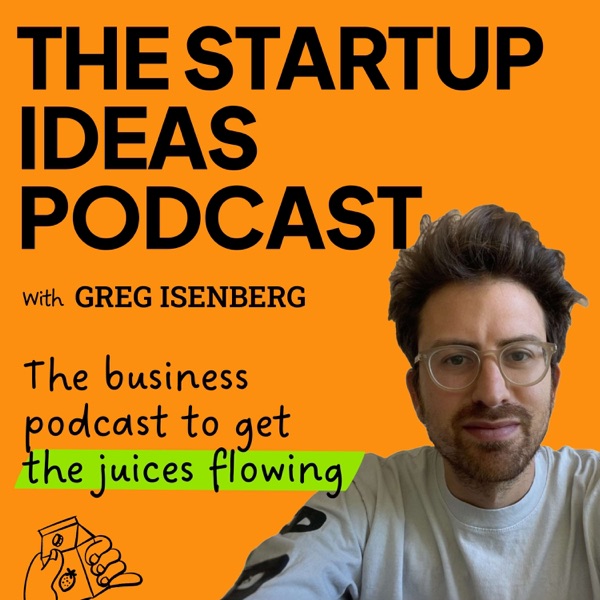
The Startup Ideas Podcast
Get your creative juices flowing with The Startup Ideas Podcast. Published twice a week, we bring you free startup ideas to inspire your next venture. Hosted by Greg Isenberg, CEO of Late Checkout and former advisor to Reddit and TikTok. Subscribe so you don't miss out.
For more startup ideas, we created a database of 30+ startup ideas you can take at https://gregisenberg.com/30startupideas
- Entrepreneurship chart
- #81
- Episodes
- 392
- Releases
- Twice a week
- Typical length
- 31 min
- On air since
- 2021
- Latest episode
- 1 day ago
Episodes
392 episodes, newest first
-
50 min
The $1M+ Solo Grok Bot Business (Full Course)
Show notes
I sit down with Nick, co-founder of Orgo, to break down how to build a custom Grok Bot for a business and sell it for $25,000 up front with a $3,000-a-month retainer. Nick demos Bops, the agent platform he built in a 36-hour weekend, where each bot has its own phone number, email, and computer with four screens. He walks me through his research, design, and build process, the stack behind each bot, and the offer he takes to business owners. We also cover how to pick a niche by calling 50 people you know and how to turn one free case study into warm referrals. If you want to sell AI employees to businesses, this episode gives you the stack, the offer, and an open source repo you can fork today.
Links Mentioned
Nick’s Bops: https://startup-ideas-pod.link/bops
Timestamps
00:00 – Intro
03:09 – Bops, Custom Grok Bot Team
05:07 – Dumb SaaS vs. Custom Apps
07:02 – Selling AI Agent Teams
09:49 – Demoing Bop
13:57 – One Agent per Platform
15:07 – Step 1: Research
17:49 – Step 2: Design
22:12 – Step 3: Picking The Stack
26:43 – Step 4 and 5: Hosting and Shipping Fast
27:21 – The Offer and Business Model
38:02 – Why start this now
40:21 – Finding your first client
47:27 – Closing Thoughts
Key Points
• Busy owners want their problems solved, so a GrokBot built for their industry wins over a platform they have to set up.
• Nick builds in three steps: research the category, design in Paper, then pick a stack and read the docs.
• Each bot gets its own email, phone number, computer, and connectors through Agent Mail, Agent Phone, Orgo, and Composio.
• The SMB offer is $25,000 up front for a system the owner keeps, plus an optional $3,000-a-month retainer.
• A free website redesign, a money-back guarantee, and free lead magnets make the offer easy to accept.
• Call 50 people you know, do the first build free, and trade the case study for warm intros.The #1 tool to find startup ideas/trends - https://www.ideabrowser.com/
LCA helps Fortune 500s and fast-growing startups build their future - from Warner Music to Fortnite to Dropbox. We turn 'what if' into reality with AI, apps, and next-gen products https://latecheckout.agency/
FIND ME ON SOCIAL
X/Twitter: https://twitter.com/gregisenberg
Instagram: https://instagram.com/gregisenberg/
LinkedIn: https://www.linkedin.com/in/gisenberg/
FIND NICK ON SOCIAL
Youtube: https://www.youtube.com/@nickvasiles
Instagram: https://www.instagram.com/nickvasilescu/
Personal Website: https://www.nickvasilescu.com/
-
11 min
SaaS is dead?
Show notes
In this solo episode, I explain why I say SaaS is dead and what I see taking its place. For 15 years, SaaS meant paying engineers to build a tool and charging per seat, and now models like Opus 5.5, GPT-6, and Argon make the tool easy to build. I walk through what I call smart SaaS: give the tool away for free, collect data and network effects, and make money by upselling AI agents and human services. I share a calorie tracking example, three ways to charge, and why enterprises still pay per seat. If you build software, this episode gives you a map for building something people want in a market where the tool is free.
Timestamps
00:00 – Intro
00:47 – SaaS 1.0
02:56 – SaaS 2.0: The New Business Model
05:12 – How to monetize SaaS 2.0
06:18 – Service is the new Software
07:22 – SaaS Is Dead, Long Live SaaS
08:58 – SMB vs Enterprise
10:31 – Closing Thoughts
Key Points
• AI makes the tool easy to build, so the per-seat model of the last 15 years has run its course.
• Smart SaaS gives the tool away and collects data and network effects as payment.
• The money comes from upselling intelligence from AI agents and services from humans.
• Agents can charge by token or by outcome, and human services by the week or month.
• SaaS for SMBs, prosumers, and individuals trends toward free, while enterprises still pay something per seat.
• The market for getting things done is bigger than the market for tools, so the total market for SaaS grows.The #1 tool to find startup ideas/trends - https://www.ideabrowser.com/
LCA helps Fortune 500s and fast-growing startups build their future - from Warner Music to Fortnite to Dropbox. We turn 'what if' into reality with AI, apps, and next-gen products https://latecheckout.agency/
FIND ME ON SOCIAL
X/Twitter: https://twitter.com/gregisenberg
Instagram: https://instagram.com/gregisenberg/
LinkedIn: https://www.linkedin.com/in/gisenberg/
-
49 min
Stop building AI wrappers. Start building agent harnesses.
Show notes
I sit down with Jon Noronha, co-founder and chief product officer of Gamma, to break down agent harnesses and the startup openings around them. Jon explains how Gamma rebuilt its product as a creative agent this year and walks me through the roughly 20 models and 200 calls behind one finished presentation. We talk about AI smell, why taste carries more weight than evals in creative work, how Gamma tests a new model within the hour, and the fast mode test that lost to good friction. Jon also shares the harnesses he wants to see, from a Slack agent that learns his voice to a couch shopping tool that checks the fit in your room. If you want to build a vertical agent, this episode gives you a clear model of what a harness is and where your edge can come from.
This episode was made possible thanks to Anthropic (the team behind Claude) for hosting us at Claude Founder house and sponsoring the episode.
Timestamps
00:00 – Intro
01:23 – What Is an Agent Harness
03:36 – Harnesses as the New Wrappers
04:25 – Inside One Gamma Prompt
08:23 – Where Vertical Harnesses Fit
11:08 – Finding Your Edge
11:56 – Opportunities for Harnesses
13:09 – Designing a Niche Harness
13:48 – AI Smell
15:49 – Evals and Taste
18:40 – Who Pays for AI
19:44 – The Gamma for X
20:19 – A Harness for Slack
22:01 – Building on Other People's Models
23:28 – Closed vs. Open Source Models
24:11 – A Broad but Shallow Stack
24:57 – Prompts vs. Fine-Tuning
25:30 – Testing New Models
26:25 – Running Experiments
29:10 – The Marketing Engineer
32:26 – Interesting Automations
33:33 – The Top 1% Marketing Engineer
35:00 – Everyone Is Now a VP of Agents
36:19 – Experiments as a Numbers Game
38:26 – Underhyped: AI Image Models
40:42 – Startup Opportunities
45:40 – What Jon Would Build Next
47:26 – Closing Thoughts
Key Points
• An agent harness is the set of tools an agent uses to act, check its own work, and deliver a finished result.
• One Gamma presentation uses about 20 models and 200 calls, including rounds of visual QA.
• Strong harness ideas sit in subjective work, where people care about the output and want a human in the loop.
• Your edge comes from a distinct vision, proprietary data, or a business that mixes AI with the physical world.
• Gamma gets 98% of its value from prompts and treats fine-tuning as a cost and quality optimization.
• Experiments reward volume, and Gamma's fast mode test showed that good friction raised paid conversion.FIND ME ON SOCIAL
X/Twitter: https://twitter.com/gregisenberg
Instagram: https://instagram.com/gregisenberg/
LinkedIn: https://www.linkedin.com/in/gisenberg/
FIND JON ON SOCIAL
X/Twitter: https://x.com/thatsjonsense?lang=en
LinkedIn: https://www.linkedin.com/in/jonnoronha/
-
44 min
How to sell AI to Main Street (Full Playbook)
Show notes
Get Your Complete Financial OS at https://startup-ideas-pod.link/brex_SIP
I sit down with James Dickerson, the Boring Marketer, who owns Diesel Dudes, a mobile diesel repair business in Charlotte, North Carolina, and spent years running agencies for local businesses. James shows how to sell AI-built funnels to Main Street trades businesses doing $2 million to $20 million a year, starting with a Boring Funnels search that found 100 Dallas plumbers worth pitching. He walks through the leaks he finds on their landing pages, the funnel offers he'd sell, and how he'd win clients with the Dream 100, lumpy mail, and local meetups. If you know how to use coding agents, this episode gives you a full playbook for a service business built around booked jobs.
Build funnels that sell: https://startup-ideas-pod.link/boring_funnels
Timestamps
00:00 – Intro
01:23 – Sponsor: Brex
02:08 – Why sell AI to Main Street
03:05 – James's Background
04:32 – Finding and Picking a Niche
07:26 – The $2M to $20M Opportunity
09:02 – Plumbing and HVAC Market Size
10:56 – Underserved Trades Niches
12:38 – Auditing Five Dallas Plumbers
13:50 – Personal Agents vs. Google
15:02 – Selling Booked Jobs and Phone Calls
17:41 – Funnel Offer Overview
19:43 – Funnel Example
23:19 – Matching Ads to Funnels
24:14 – Chet Holmes and the Dream 100
28:18 – Branding your Firm
30:04 – Meta Ads for your firm
31:37 – Stacking Old School and New School Marketing Strategy
34:31 – Find, Pitch, Deliver
36:02 – Showing Owners the ROI
37:37 – Pricing your Offer
41:45 – Reporting With AI
42:33 – Closing Thoughts
Key Points
• Main Street trades businesses doing $2 million to $20 million a year have budgets and few useful pitches in their inbox.
• James sells booked jobs and phone calls, since owners care about revenue and ROI over AI.
• The biggest leaks sit on the landing page: missing ad promises, hidden Google ratings, and buried booking buttons.
• Funnels with tripwires, instant prices, quizzes, and owner videos turn paid traffic into booked jobs.
• The Dream 100, lumpy mail, and local meetups build trust with owners over months.
• One free build in exchange for a case study gets you to paid work.The #1 tool to find startup ideas/trends - https://www.ideabrowser.com/
LCA helps Fortune 500s and fast-growing startups build their future - from Warner Music to Fortnite to Dropbox. We turn 'what if' into reality with AI, apps, and next-gen products https://latecheckout.agency/
FIND ME ON SOCIAL
X/Twitter: https://twitter.com/gregisenberg
Instagram: https://instagram.com/gregisenberg/
LinkedIn: https://www.linkedin.com/in/gisenberg/
FIND JAMES ON SOCIAL
X/Twitter: https://x.com/boringmarketer
LinkedIn: https://www.linkedin.com/in/jadickerson/
-
31 min
The 9 Stages of AI Agent Adoption, Explained
Show notes
In this solo episode, I break down the war on AI agents, from Amazon blocking Meta's Muse to Delta treating outside booking agents as unauthorized automated activity to Yelp charging agents for access. I share how I think about an agent, as a customer with a credit card who reads your site instead of looking at it, and the ladder of trust that runs from research to prepare to pay. Then I walk through each big player's bet, my nine stages for how this war plays out, five moves any business can make this week, and the startup ideas I see between agents and the businesses they buy from. If you run a store or build products, this episode gives you a map for selling to customers who send an agent to shop for them.
Timestamps
00:00 – Intro
02:09 –The Three Camps
05:08 – How I Define an Agent
06:52 – The Ladder of Trust
08:54 – Real Reasons to Block Agents
09:48 – What Agents Skip
12:57 – How Each Company is Playing it
17:06 – Lessons From Mint and Plaid
17:49 – The 9 stages of The War on Agents
21:56 – What to do this week
24:39 – Startup Idea 1: Agent Readiness
25:48 – Startup Idea 2: Plaid for One Vertical
26:22 – Startup Idea 3: Insurance for Agents
26:57 – Startup Idea 4: Analytics for Agent Traffic
27:26 – Startup Idea 4: Agent Specialist
28:05 – Closing Thoughts
Key Points
• Agents read product details, prices, shipping, and return policies, so plain-text facts on the page decide whether they pick you.
• Agents climb a ladder of trust from research to prepare to pay, and the whole fight happens on the pay rung.
• Many blocks protect the ad and upsell revenue that agents skip on the way to the sale.
• The biggest stores block, the biggest audiences open the door, and payment and security companies want the toll booth.
• I expect a Plaid moment for agent identity and payments, followed later by ads that buy an agent's first recommendation.
• Vertical Plaids, agent insurance, and agent analytics are open lanes for startups right now.The #1 tool to find startup ideas/trends - https://www.ideabrowser.com/
LCA helps Fortune 500s and fast-growing startups build their future - from Warner Music to Fortnite to Dropbox. We turn 'what if' into reality with AI, apps, and next-gen products https://latecheckout.agency/
FIND ME ON SOCIAL
X/Twitter: https://twitter.com/gregisenberg
Instagram: https://instagram.com/gregisenberg/
LinkedIn: https://www.linkedin.com/in/gisenberg/
-
25 min
Making $$$ with Meta Muse AI
Show notes
Get Your Complete Financial OS at https://startup-ideas-pod.link/brex_SIP
In this solo episode, I break down how to make money with Meta Muse by mining Facebook groups, Marketplace, and Instagram to match buyers with sellers. The idea came after my wife and I had a baby and the agency we hired for a night nurse admitted it found candidates in Facebook groups. I demo Muse finding night nurses at $30 an hour in Montreal, show how to give it a phone number through Bland AI, and share the Marketplace and Instagram tactics I'd use. I close with my four-level framework for growing a matching side business into a trusted list, a community, and a vertical software company.
Timestamps
00:00 – Intro
01:19 – Sponsor: Brex
03:22 – Meta Muse
03:52 – Why this is a big opportunity
04:33 – Picking a Niche, City, and Rules
05:44 – Owning the asset and data
06:51 – Cleaning Data You Own
08:27 – Lessons From eBay
10:37 – A Phone Number With Bland AI
11:30 – Undervalued Facebook Groups
12:55 – Business Pages and IG Niche Pages
13:46 – Prompting Muse Into Facebook Groups
15:19 – Mining FB Marketplace and Instagram
17:20 – Four Levels of Personal Agent Arbitrage
20:38 – Results From Montreal Groups
21:40– Goods vs. Services
22:15 – Muse vs. Dots and Instinct
24:09 – Closing Thoughts
Key Points
• Muse mines public Facebook groups, Marketplace, and Instagram to match buyers and sellers in any niche and city.
• A clean list of names, needs, prices, and trust signals is an asset I own and can sell later.
• Facebook groups, business pages, and IG niche pages look undervalued as Muse agents start crawling them.
• I tell Muse where to look, and Facebook groups gave me the highest quality data.
• My four levels: mine the data, own the list, own the room, then build technology.
• A lean cost structure lets me charge a success fee of a few hundred dollars and keep high margins.The #1 tool to find startup ideas/trends - https://www.ideabrowser.com/
LCA helps Fortune 500s and fast-growing startups build their future - from Warner Music to Fortnite to Dropbox. We turn 'what if' into reality with AI, apps, and next-gen products https://latecheckout.agency/
FIND ME ON SOCIAL
X/Twitter: https://twitter.com/gregisenberg
Instagram: https://instagram.com/gregisenberg/
LinkedIn: https://www.linkedin.com/in/gisenberg/
-
31 min
Gemini 4 Argon: AI Marketing, 3D Printing and SaaS
Show notes
Gemini 4 Argon is LIVE, Google's most advanced AI model, try it for yourself: https://startup-ideas-pod.link/gemini4-argon
In this solo episode, I share what I learned after a week with Gemini 4 Argon, Google's new frontier model. I show three places it shines: marketing with AI, physical AI, and complex engineering, with a real build for each. You'll see Argon rebuild my holding company's website, write a post in my voice, design a Shopify product customizer that exports STL files, and build a free quoting app for commercial cleaning companies. I close with six techniques that raise Argon's output quality and the Google AI plan I'd pick for building.
Timestamps
00:00 – Intro
01:35 – What Gemini 4 Argon Does Well
03:09 – Rebuilding the Late Checkout Website
07:49 – Justine Moore's Apple Computer Museum
09:20 – Using Argon for writing
13:03 – Physical AI and Vibe Manufacturing
17:41 – Made-to-Order Shopify Store
19:01 – Building Boring SaaS
21:59 – Commercial Cleaning Quote App
25:12 – 6 techniques to get the most out of Argon
28:39 – Closing Thoughts
Key Points
• Argon produces premium creative work once I give it reference images and a clear direction.
• A skill built from my posts, newsletters, and videos lets Argon write in my voice.
• Argon builds Shopify product customizers that export print-ready STL files.
• Free, focused rebuilds of boring legacy SaaS put me in front of likely buyers.
• Argon gets the engineering right on prompt one, and design takes a few more rounds.
• /plan, /subagents, and /goal give me the biggest jumps in output quality.The #1 tool to find startup ideas/trends - https://www.ideabrowser.com/
LCA helps Fortune 500s and fast-growing startups build their future - from Warner Music to Fortnite to Dropbox. We turn 'what if' into reality with AI, apps, and next-gen products https://latecheckout.agency/
FIND ME ON SOCIAL
X/Twitter: https://twitter.com/gregisenberg
Instagram: https://instagram.com/gregisenberg/
LinkedIn: https://www.linkedin.com/in/gisenberg/
-
24 min
8 GitHub Repos To Go Viral and Make Money
Show notes
In this solo episode, I walk through eight GitHub repos and AI skills that I test at night and on weekends. The list covers launch videos, social research, local voice and dubbing, editable decks, agent teams, lead-magnet tools, idea stress-testing, and design guidance. For each one, I explain what it does, how I'd set it up, and one concrete way to use it to make money or run a business more easily. Most are free to download, and you pay for the model you run them with.
Timestamps
00:00 – Intro
01:25 – Brag: Launch Videos From a Link
04:50 – Agent Reach for Customer Research
07:46 – Voice Studio: Local AI Voice and Dubbing
10:41 – PPT Master: Editable Decks From Notes
12:59 – OpenRig: Coding Agents as a Team
14:57 – Free Tools Skill by Corey Haynes
17:25 – Grill Me Skill by Matt Pocock
19:31 – Impeccable: Design Guidance for Agents
23:03 – My Top Picks: Brag and Agent Reach
24:07 – Closing Thoughts
GitHub Repo Links:
Brag (launch video skill): https://startup-ideas-pod.link/brag
Agent Reach: https://startup-ideas-pod.link/agent-reach
Voice Studio: https://startup-ideas-pod.link/voice-studio
PPT Master: https://startup-ideas-pod.link/ppt-master
OpenRig: https://startup-ideas-pod.link/openrig
Free Tool: https://startup-ideas-pod.link/marketing-skills
Grill Me Skill: https://startup-ideas-pod.link/grill-me
Impeccable Skill: https://startup-ideas-pod.link/impeccable
Key Points
• Most of these tools are free to download, and the main cost is the model you run them with.
• Work I do for someone up front, like a launch video or a design fix, starts a conversation in place of a cold email.
• Posts on Reddit, X, and YouTube show tasks people still do by hand, and a small tool can fix them.
• Translated onboarding videos make a recurring monthly service for other companies.
• Grill Me logs my assumptions so I check them with a real customer before I build.
• Ten clients at $1,000 a month is $10,000 a month, and that cash flow funds the move from services to technology.The #1 tool to find startup ideas/trends - https://www.ideabrowser.com/
LCA helps Fortune 500s and fast-growing startups build their future - from Warner Music to Fortnite to Dropbox. We turn 'what if' into reality with AI, apps, and next-gen products https://latecheckout.agency/
FIND ME ON SOCIAL
X/Twitter: https://twitter.com/gregisenberg
Instagram: https://instagram.com/gregisenberg/
LinkedIn: https://www.linkedin.com/in/gisenberg/
-
25 min
How Will People Make Money in the AI Age?
Show notes
In this solo episode, I walk through the 13 businesses I think are left to build in the agentic era. I believe that in a world of agents and abundance, owning the right assets puts you in a better position. For each business, I explain what it is, why it holds up in a world of agents, and one or two examples, from Othership's sauna clubs to Osmo's window-cleaning robots. This episode gives you a map of where to build next, at any age.
Timestamps
00:00 – Intro
01:15 – AI-Native Service Firms
02:57 – Offline Businesses
05:41 – Distribution and Organic Audiences
07:34 – Proprietary Data Sets
09:08 – Domain-Specific Harnesses
12:16 – Robotics and Physical AI
14:01 – Physical Products With a Fan Following
16:34 – Compute and Energy
17:31 – Health, Longevity, and Care
19:30 – Marketplaces and Social Networks
21:04 – Real Assets
21:46 – Vertical Agents
22:18 – Security
24:08 – Closing Thoughts
Key Points
• In an AI-native service firm, agents do most of the delivery and a human reviews the exceptions.
• Ad clicks went from about five cents in 2009 to $1–5 today, so I start with organic audiences.
• Proprietary data and domain-specific harnesses are the two gold rushes I see right now.
• Offline businesses, niche hardware, and robotics sell rooms, objects, and labor that agents only support.
• Compute, energy, and security are the scarce inputs every agent depends on.The #1 tool to find startup ideas/trends - https://www.ideabrowser.com/
LCA helps Fortune 500s and fast-growing startups build their future - from Warner Music to Fortnite to Dropbox. We turn 'what if' into reality with AI, apps, and next-gen products https://latecheckout.agency/
FIND ME ON SOCIAL
X/Twitter: https://twitter.com/gregisenberg
Instagram: https://instagram.com/gregisenberg/
LinkedIn: https://www.linkedin.com/in/gisenberg/
-
54 min
Become a $1M/yr FDE (Full Course)
Show notes
Google's most advanced audio models are LIVE, try them for yourself:
Gemini 3.8 Live: https://startup-ideas-pod.link/gemini-3.8-live
Gemini 3.5 Transcribe https://startup-ideas-pod.link/gemini-3.5-transcribe
Gemini 3.5 Live Translate: https://startup-ideas-pod.link/gemini-3.5-live-translate
In this episode, I talk with Vas from Varick about what it takes to put AI to work inside a real company. Vas makes the case that AI pays off through process reengineering, and he walks me through the exact method his forward deployed engineers (FDEs) use: interviews, process mining, step sorting, and agents built inside existing systems of record. We go through real engagements, including a $5B public software company and an accounts payable overhaul that cut the cost per invoice from $31 to $6. By the end, you get a clear picture of the FDE role, the business opportunity behind AI roll-ups, and a five-day plan to start on your own.
Links Mentioned:
FDE Presentation: https://startup-ideas-pod.link/FDE-slides
Vas’s Article: https://startup-ideas-pod.link/vas-fde
Timestamps
00:00 – Intro
01:31 – Sponsor: Google
03:58 – FDE Overview
05:02 – AI Roll-Ups and Process Reengineering
08:04 – The Personal Systems Analogy
09:55 – Understanding a company’s process (step-by-step)
14:11 – Case Study: $5B Software Company
18:11 – 4 Buckets for Every Step
19:04 – Build Inside Systems of Record
21:36 – Case Study: PE Portfolio
23:43 – Selling to C-Suite Executives
27:07 – Process of Mapping Five NetSuite Companies
28:39 – Example: Accounts Payable Process Map
32:54 – Case Study: 60-Person Accounting Firm
34:51 – When to Use Code, Agents, or Humans
36:00 – Choosing AI Models
38:16 – Sidekick vs Background Agents
40:29 – The 3 Skills of a Top FDE
42:25 – Why FDEs Earn So Much
45:26 – Five-Day Starter Plan
47:39 – On-Premise Hardware Demand
48:36 – OpenAI Private Intelligence
50:20 – The Full Playbook
52:01 – Closing Thoughts
Key Points
• AI pays off when you re-engineer the process first, then build agents into it.
• Map the real process with interviews, system-of-record mining, and existing docs.
• Sort every step into four buckets: delete, plain code, agent, or human decision.
• Build agents inside the tools clients already use, like Salesforce, NetSuite, and Slack.
• Sell the outcome each buyer cares about, and prove it with before-and-after KPIs.
• Top FDEs combine domain knowledge, production engineering, AI judgment, and strong communication.The #1 tool to find startup ideas/trends - https://www.ideabrowser.com/
LCA helps Fortune 500s and fast-growing startups build their future - from Warner Music to Fortnite to Dropbox. We turn 'what if' into reality with AI, apps, and next-gen products https://latecheckout.agency/
FIND ME ON SOCIAL
X/Twitter: https://twitter.com/gregisenberg
Instagram: https://instagram.com/gregisenberg/
LinkedIn: https://www.linkedin.com/in/gisenberg/
FIND VAS ON SOCIAL
Varick Agents: https://www.varickagents.com/#hero-section
X/Twitter: https://x.com/vasuman
AI Forward Deployed Engineers: https://learn.varickagents.com/fde-in-30-days
-
19 min
OpenAI DevDay: Dots, Agents & $100B Opportunities
Show notes
I watched almost 60 minutes of Sam Altman on stage at OpenAI Dev Day 2026. Out of 20-plus launches, I pick the three or four that I think can make people billions of dollars in aggregate. I break down Dots, OpenAI's personal agent platform, plus the Decisions API, the Agents API with computer use, and Sign in with ChatGPT. I also share my four-step framework for building in this world and two business ideas I hope someone takes. If you want to build a business and make money around AI, this episode is for you.
Timestamps
00:00 – Intro
01:48 – Dots, the Personal Agent Platform
03:29 – OpenAI Doubles Down on Plugins
05:02 – Decisions API
06:43 – Agents API With Computer Use
08:01 – Sign In With ChatGPT
12:36 – Where should you build?
13:46 – Idea: Real-World Work APIs
15:04 – Idea: Analytics for Agent Discovery
17:05 –Closing Thoughts
Key Points
• Dots gives plugin builders a front door to 1.2 billion weekly active users.
• OpenAI is doubling down on plugins to make ChatGPT the app ecosystem for AI.
• Sign in with ChatGPT lets users bring their current plan, so a free core app with paid upsells now works.
• Workflows too niche for OpenAI to build become viable businesses.
• The strongest businesses in this world own the trigger, the action, and the feedback.
• Two open opportunities: real-world work APIs and an analytics layer for agent discoveryThe #1 tool to find startup ideas/trends - https://www.ideabrowser.com/
LCA helps Fortune 500s and fast-growing startups build their future - from Warner Music to Fortnite to Dropbox. We turn 'what if' into reality with AI, apps, and next-gen products https://latecheckout.agency/
FIND ME ON SOCIAL
X/Twitter: https://twitter.com/gregisenberg
Instagram: https://instagram.com/gregisenberg/
LinkedIn: https://www.linkedin.com/in/gisenberg/
-
30 min
$5T opportunity: AI Roll Ups
Show notes
In this solo episode, I break down the $5 trillion wave of small businesses set to change hands as their owners retire, and why AI agents make this wave a real opening for solo founders. I walk through how Thrive Holdings and General Catalyst buy accounting firms, property managers, and support centers, then run AI agents inside them to lift margins. Then I show how I'd run a one-person holding company: the folder structure, the agent files, the human approval rule, and my average week. I close with the strongest arguments against AI roll-ups, including the one I take most seriously.
Timestamps
00:00 – Intro
01:52 – Why the $5 Trillion Shift Is Happening Now
04:52 – Examples: Thrive Holdings& General Catalyst
08:38 – The Fund Playbook
10:07 – The Small-Deal Gap
10:51 – The One-Person Holdco
14:23 – The Folder Structure
16:47 – The Agent Pipeline
18:38 – Inside a Reviewer Agent File
19:41 – My Week Running the Holdco
21:49 – How to Land the First Business
22:24 – Arguments Against AI Roll-Ups
27:43 – Closing Thoughts
Key Points
• About a million small businesses, part of a $5 trillion shift, are set to sell by 2035 as owners retire (McKinsey).
• AI agents now handle the work these firms run on: data entry, document chasing, status updates, and first drafts.
• The big funds chase bigger deals, which leaves the small firms open for solo founders and small teams.
• A one-person holdco runs on shared agents and rules, plus a GM with real upside at each business.
• A person approves all agent work before it reaches a client.
• The corrections log, turned into rules every week, becomes the most valuable asset in the holdco.The #1 tool to find startup ideas/trends - https://www.ideabrowser.com/
LCA helps Fortune 500s and fast-growing startups build their future - from Warner Music to Fortnite to Dropbox. We turn 'what if' into reality with AI, apps, and next-gen products https://latecheckout.agency/
FIND ME ON SOCIAL
X/Twitter: https://twitter.com/gregisenberg
Instagram: https://instagram.com/gregisenberg/
LinkedIn: https://www.linkedin.com/in/gisenberg/
-
26 min
Muse AI Connectors: The Next App Store Moment?
Show notes
In this solo episode, I break down the huge business opportunity because Meta has opened Muse, its personal AI agent, to developers. You can now submit a connector, which lets Muse use your service when someone asks it for help, and I think this could be the app store moment for AI. I explain how a connector works, share four startup ideas you can build on one, and cover how to get customers beyond Meta's directory. I also show how I'd build a first version with a coding agent like Claude Code or Codex, and what I'd test before submitting it to Meta for review.
Timestamps
00:00 – Intro
01:35 – The App Store Parallel
04:55 – How a Muse Connector Works
07:29 – Startup Idea 1: Lead Gen for Business Suppliers
09:28 – Startup Idea 2: Home Repair Dispatch
11:07 – Startup Idea 3: Paddle Match and Court Finder
12:47 – Startup Idea 4: Family Dinner Planning
14:10 – How to pick an idea?
14:56 – How People Find Your Connector
15:32 – Growth Idea 1: Partner With Creators
16:17 – Growth Idea 2: Product-Led Sharing
17:46 – Growth Idea 3: Connected Marketplaces and Directory Placement
19:34 – Building the First Version
21:38 – Custom Connectors and Meta Approval
23:56 – Where to Start This Week
25:31 – Closing thoughts
Muse Connector Prompt: https://startup-ideas-pod.link/muse-connector-prompt
Key Points
• Meta has opened Muse to developers, and a connector lets Muse use your service when someone asks it for help.
• I look closely at the step in a request where someone needs a business that can deliver and money changes hands.
• With a small budget, I'd start with lead generation, because I can show a customer a sample before writing much software.
• I plan distribution around channels I can reach, such as creators, product-led sharing, and connected marketplaces.
• A coding agent can build the first version, and I still inspect the results and test the awkward requests myself.
• To start this week, I'd talk to one type of customer about the last time they dealt with the task.The #1 tool to find startup ideas/trends - https://www.ideabrowser.com/
LCA helps Fortune 500s and fast-growing startups build their future - from Warner Music to Fortnite to Dropbox. We turn 'what if' into reality with AI, apps, and next-gen products https://latecheckout.agency/
FIND ME ON SOCIAL
X/Twitter: https://twitter.com/gregisenberg
Instagram: https://instagram.com/gregisenberg/
LinkedIn: https://www.linkedin.com/in/gisenberg/
-
1 hr 10 min
The Right Way To Write With AI
Show notes
Get Your Complete Financial OS at https://startup-ideas-pod.link/brex_SIP
In this episode I speak with Nicholas Cole about the real value of everything you write on the internet. Cole has 15 years of experience as a nonfiction writer and ghostwriter, and he runs the SaaS platform Typeshare. He gives me a simple model with three tiers of content: commodity, personality, and original. He also explains the digital brain, which he calls your personal language model, and he shows how AI repeats your approved language at scale. By the end, you know how to judge the short, medium, and long-term value of a piece before you write it.
Start Writing Online In 30 Days: https://startup-ideas-pod.link/ship30
Timestamps
00:00:00 – Intro
00:03:36 – POV is the Moat
00:05:40 – Language As Open Source
00:11:24 – Value Is Relative To The Reader
00:14:26 – Approved Language
00:17:43 – The Value of AI in Writing
00:22:09 – Commodity Ideas
00:24:23 – How To Set Up The System
00:27:58 – Ownership IS Association
00:33:56 – Build your Personal Data Set
00:39:53 – Branded Content vs Founder-Led Content
00:45:17 – What is Original Content?
00:46:35 – Writing Versus Short-Form Video
00:48:58 – Three Types of Hooks
00:49:50 – Timely Content vs Timeless Content
00:53:27 – Voice is 3 dialed settings
00:56:32 – Finding your Voice
01:00:49 – The Company Brain As The Moat
01:07:30 – Closing Thoughts
Key Points
• A point of view creates the moat, because copycats must wait for your next idea.
• Content sits in three tiers: commodity, personality, and original. Each tier adds different leverage.
• Ownership equals association. Volume builds it, and personality details make it strong.
• Your life story is the unmade data set, so AI learns it only from your own writing.
• Every piece sits on a spectrum from timely to timeless, so match your expectations to the type.
• Humans do the thinking and the writing. Robots do the repeating and the remixing.The #1 tool to find startup ideas/trends - https://www.ideabrowser.com/
LCA helps Fortune 500s and fast-growing startups build their future - from Warner Music to Fortnite to Dropbox. We turn 'what if' into reality with AI, apps, and next-gen products https://latecheckout.agency/
FIND ME ON SOCIAL
X/Twitter: https://twitter.com/gregisenberg
Instagram: https://instagram.com/gregisenberg/
LinkedIn: https://www.linkedin.com/in/gisenberg/
FIND COLE ON SOCIAL
X: https://x.com/Nicolascole77
Youtube: https://www.youtube.com/@nicolascole77
Ship 30 for 30: https://startup-ideas-pod.link/ship30
-
28 min
Jev is HERE. How to use it
Show notes
In this episode, I talk with Ryan Vogel about Jev, a new type of AI built for classification. Ryan shows how Jev takes an input plus an output schema and returns a probability for each choice in about 200 milliseconds. He demos Jev sorting 1,700 emails for 18 cents total, then covers lead scoring, support routing, video clipping, and browser control. I push him on the startup angle: find a business with an expensive queue of incoming information and put Jev at the front of it. You leave with a clear mental model, real use cases, and a simple way to try it today.
Links Mentioned:
Jev/Typeface AI: https://typesafe.ai
AI Gateway: https://vercel.com/ai-gateway
Timestamps
00:00 – Intro
02:27 – What Jev Is and Why It Matters
04:32 – Email Triage Demo
07:19 – Jev as an AI Decision Maker
15:46 – How to Use Jev in a Business
20:48 – Startup Idea: Local Services Matching and Instant Quotes
22:51 – Use Case 1: Bitcoin Signal Test and Limits
24:03 – Use Case 2: Auto-Clipping Long Videos
25:27 – Use Case 3: Browser Control: Flight Pick in 7.1 Seconds
26:18 – How to Get Access
27:25 – Closing Thoughts
Key Points
• Jev is a classifier: an input and an output schema go in, and a probability for each choice comes out.
• Ryan's demo scores 1,700 emails for 18 cents total.
• Each Jev query takes about 200 milliseconds, whatever the input and output structure.
• Use Jev at any point where a business makes fast, repeatable decisions on incoming data.
• Keep Jev in an advisory role, and save frontier models for high-intelligence tasks like trading.
• Instant access runs through the Vercel Gateway, and a waitlist covers direct access.The #1 tool to find startup ideas/trends - https://www.ideabrowser.com/
LCA helps Fortune 500s and fast-growing startups build their future - from Warner Music to Fortnite to Dropbox. We turn 'what if' into reality with AI, apps, and next-gen products https://latecheckout.agency/
FIND ME ON SOCIAL
X/Twitter: https://twitter.com/gregisenberg
Instagram: https://instagram.com/gregisenberg/
LinkedIn: https://www.linkedin.com/in/gisenberg/
FIND RYAN ON SOCIAL
-
28 min
Instinct AI: The AI Assistant for normal people
Show notes
I sit down with Remy to go through Instinct, the new invite-only personal agent that runs inside iMessage. Remy shares his raw chat history on screen: a haircut booking in Copenhagen, a restaurant reservation, a Bali visa on arrival, and an Emirates Skywards sign-up. We cover the parts that impress us, the points where the agent hits a wall, and the privacy questions that stay open. By the end of this episode you understand what Instinct does today, and you get fresh ideas for personal agents in general.
Timestamps
00:00 – Intro
02:08 – Instinct Pros
11:18 – Instinct Cons
13:16 – Simple Onboarding
15:19 – Tools and Connectors
17:43 – Example 1: Booking a Haircut in Copenhagen
20:24 – Example 2: Restaurant Booking and Calendar Entry
23:03 – Example 3: Bali Visa on Arrival and Emirates Skywards
26:00 – Closing Thoughts
Key Points
• Instinct hides the agent complexity behind a phone number and iMessage, so a first-time user starts in seconds.
• Remy gets it to book a haircut, hold a restaurant table, file a Bali visa on arrival, and open an Emirates Skywards account.
• A spend-limited virtual card keeps the blast radius small when the agent pays for things.
• The agent stalls when a task needs a phone app or an Indonesian checkout page.
• Users report that Instinct keeps copies of email after they disconnect Google, so treat privacy as an open risk.
• The trusted person network lets one Instinct talk to another, which builds network effects into the agentic era.The #1 tool to find startup ideas/trends - https://www.ideabrowser.com/
LCA helps Fortune 500s and fast-growing startups build their future - from Warner Music to Fortnite to Dropbox. We turn 'what if' into reality with AI, apps, and next-gen products https://latecheckout.agency/
FIND ME ON SOCIAL
X/Twitter: https://twitter.com/gregisenberg
Instagram: https://instagram.com/gregisenberg/
LinkedIn: https://www.linkedin.com/in/gisenberg/
FIND REMY ON SOCIAL
Youtube: https://www.youtube.com/@aiwithremy
AI with Remy: https://www.aiwithremy.com/
-
31 min
Building a Software Factory that actually works (Full Course)
Show notes
Get Your Complete Financial OS at https://startup-ideas-pod.link/brex_SIP
I welcome Ras Mic back to the pod to explain the phrase "software factory." Mic shares his screen and walks through the exact system that he runs today. His factory has four steps: isolate, build, prove, and ship. He keeps the whole system in five or six markdown files, so it works with any model and any harness. By the end of this episode, you can boot up your own factory, run many agents in parallel, and trust the code that comes back.
Create your own Software Factory: https://startup-ideas-pod.link/ras-software-factory
Timestamps
00:00 – Intro
02:17 – Software Factory Definition
03:44 – Why the Software Factory Matters
05:23 – Step 1: Isolate With Git Work Trees
11:34 – Step 2: Build With the Code Structure Skill
14:48 – Step 3: Prove With Evidence-Driven Testing
22:25 – Step 4: Ship With Grep Loop and Greptile
26:52 – The Physical Factory Analogy
29:21 – A Software Factory Is Markdown Files
30:02 – Closing Thoughts
Key Points
• A software factory is a workflow of skills and domain knowledge, so it runs with any model and any harness.
• Isolate: every feature starts in a fresh git work tree branched from origin main, so each agent keeps its own station.
• Build: a code structure skill makes the agent write service layer code that a human developer can read.
• Prove: the agent records a before state and an after state as video, screenshots, or numbers.
• Ship: Greptile scores the PR, and the agent loops back to build until it earns five out of five.
• Mic runs up to 15 features in parallel and reviews the visual proof instead of the raw code.The #1 tool to find startup ideas/trends - https://www.ideabrowser.com/
LCA helps Fortune 500s and fast-growing startups build their future - from Warner Music to Fortnite to Dropbox. We turn 'what if' into reality with AI, apps, and next-gen products https://latecheckout.agency/
FIND ME ON SOCIAL
X/Twitter: https://twitter.com/gregisenberg
Instagram: https://instagram.com/gregisenberg/
LinkedIn: https://www.linkedin.com/in/gisenberg/
FIND MIC ON SOCIAL
X/Twitter: https://x.com/Rasmic
Youtube: https://www.youtube.com/@rasmic
-
23 min
You're using GPT-6 Astra WRONG
Show notes
I talk with Ras Mic about GPT-6 Astra. We skip the game demos and the 3D toys, and we focus on use cases to earn money or improve products. I share 9 Astra prompts that I posted publicly, and Greg Brockman reposted. Ras then shows his hardware project: he moved from a speaker idea to a parts list, a Blender layout, and merged code in about 30 minutes. The takeaway is simple: use this model for the ideas that felt too large for you last year.
Timestamps
00:00 – Intro
01:53 – Astra Overview
04:14 – 9 Astra Prompts
11:48 – Jarvis Speaker Idea
16:21 – Think Bigger with Astra
18:29 – Vibe Coding to Vibe Manufacturing
21:16 – Closing Thoughts
Key Points
• Astra costs more per task, and it uses fewer steps, so the value per dollar stays high.
• A performance audit moved one of Ras’s apps from 800 ms to 20–30 ms.
• A security audit on his live payments app found real risks in production.
• Ras went from a speaker idea to a $561 parts order and a merged pull request in about 30 minutes.
• Ras’s point: intelligence keeps climbing, and bravery stays flat. Ask for bigger things.
• The shift that vibe coding brought to software now reaches physical products.The #1 tool to find startup ideas/trends - https://www.ideabrowser.com/
LCA helps Fortune 500s and fast-growing startups build their future - from Warner Music to Fortnite to Dropbox. We turn 'what if' into reality with AI, apps, and next-gen products https://latecheckout.agency/
FIND ME ON SOCIAL
X/Twitter: https://twitter.com/gregisenberg
Instagram: https://instagram.com/gregisenberg/
LinkedIn: https://www.linkedin.com/in/gisenberg/
FIND MIC ON SOCIAL
X/Twitter: https://x.com/Rasmic
Youtube: https://www.youtube.com/@rasmic
-
39 min
Local AI Clearly Explained
Show notes
I run this episode solo. I explain local AI in plain terms: the model runs on hardware I control, and a cloud model runs somewhere else. I map the four pieces of the local AI landscape — the model, the warehouse, the software, and the workflow — and I define the words that beginners meet first: parameters, tokens, context window, quantization, and GGUF. I walk through the Google open model stack (Gemma 4, Google AI Edge, LiteRT-LM, AI Edge Gallery), compare the other open model families, and show three ways to run a model today. I close with a first workflow you can copy and three startup ideas that use local AI as the wedge.
And a special thank you to Google for supporting the podcast.
Timestamps
00:00 – Intro
01:35 – The Open Model the Landscape
03:09 – Vocab Decoder
06:48 – Google Gemma Clearly Explained
10:29 – Other Open Model Families
14:20 – Path 1: Run Gemma in LM Studio
18:17 – Path 2: Ollama
20:15 – Path 3: Google AI Edge
21:07 – Hardware Cheat Sheet
21:52 – First Workflow to Build
22:47 – Workflows Before Fine-Tuning
25:06 – Local vs Cloud vs Hybrid Eval
26:33 – Framework for Local AI Startup Ideas
27:22 – Startup Idea 1: Home Health QA Reviewer
29:24 – Startup Idea 2: Offline Field Report Copilot
32:10 – Startup Idea 3: Pre-Send Reviewer for Professional Services
34:47 – Build Your Local AI Lab
37:55 – Closing Thoughts
Key Points
• Ask whether the model is good enough for the job, and the business opportunities become clear.
• Local AI has four pieces: the model, the warehouse (Hugging Face), the software (LM Studio or Ollama), and the workflow you build around them.
• Gemma 4 E4B is my practical starting point; E2B fits phones and older machines.
• Hybrid architecture wins: local does the private first pass, cloud does the heavy reasoning, and a human approves anything important.
• Start with one repeated workflow — one folder, one model, one output — and run it 10 times.
• I see a 24-month window to build local-AI-native software for verticals that still run early-2000s tools.The #1 tool to find startup ideas/trends - https://www.ideabrowser.com/
LCA helps Fortune 500s and fast-growing startups build their future - from Warner Music to Fortnite to Dropbox. We turn 'what if' into reality with AI, apps, and next-gen products https://latecheckout.agency/
The Vibe Marketer - Resources for people into vibe marketing/marketing with AI: https://www.thevibemarketer.com/
FIND ME ON SOCIAL
X/Twitter: https://twitter.com/gregisenberg
Instagram: https://instagram.com/gregisenberg/
LinkedIn: https://www.linkedin.com/in/gisenberg/
-
25 min
These 5 Github Repos are a goldmine
Show notes
On this solo episode, I review five free, open source GitHub repos that help you build products, make money, or save time: Peter Yang's No AI Slop Skill, the CRM by TryComp AI, Video Use by browser use, SkillSpector by NVIDIA, and Phone Harness. For each repo I explain what it does, why it matters, how to install it, and the first small workflow to try. I close with a simple three-step method: install the repo, make one small workflow work, then decide to productize it or keep it as your own leverage.
Timestamps
00:00 – Intro
01:44 – Repo 1: No AI Slop
05:20 – Repo 2: Agentic-first CRM
10:52 – Repo 3: Video Use
15:15 – Repo 4: SkillSpector
18:49 – Repo 5: Phone Harness
22:25 – Closing Thoughts
Links to repos:
petergyang/no-ai-slop — https://github.com/petergyang/no-ai-slop
trycompai/crm — https://github.com/trycompai/crm
browser-use/video-use — https://github.com/browser-use/video-use
NVIDIA SkillSpector — https://github.com/NVIDIA/SkillSpector
phone-harness — https://github.com/ShawnPana/phone-harness
The #1 tool to find startup ideas/trends - https://www.ideabrowser.com/
LCA helps Fortune 500s and fast-growing startups build their future - from Warner Music to Fortnite to Dropbox. We turn 'what if' into reality with AI, apps, and next-gen products https://latecheckout.agency/
FIND ME ON SOCIAL
X/Twitter: https://twitter.com/gregisenberg
Instagram: https://instagram.com/gregisenberg/
LinkedIn: https://www.linkedin.com/in/gisenberg/
Entrepreneurship lists
More Entrepreneurship shows picked out from the charts









More in Entrepreneurship
Placed highest on Apple Podcasts' Entrepreneurship chart right now