Podcast
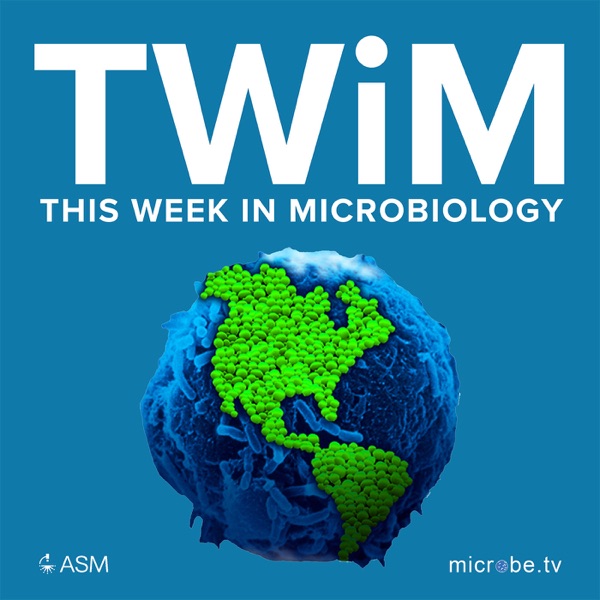
This Week in Microbiology
This Week in Microbiology is a podcast about unseen life on Earth hosted by Vincent Racaniello and friends. Following in the path of his successful shows 'This Week in Virology' (TWiV) and 'This Week in Parasitism' (TWiP), Racaniello and guests produce an informal yet informative conversation about microbes which is accessible to everyone, no matter what their science background.
- Life Sciences chart
- #21
- Episodes
- 367
- Releases
- Every two weeks
- Typical length
- 54 min
- On air since
- 2011
- Latest episode
- 1 week ago
Episodes
367 episodes, newest first
-
1 hr 7 min
Our Vanishing Ancient Gut Microbes
Episode 366
Show notes
TWiM explains a bacterial antiviral defense system that uses a noncoding RNA template to build tandem-repeat DNA through a mechanism that parallels how eukaryotic telomerase extends telomeres, and genome sequencing of the Tsimane of Bolivia and the Hadza of Tanzania which reveals over a thousand gut bacterial species shared between the two populations, many now vanishing from industrialized humans, suggesting they co-migrated with our ancestors out of Africa and into the Americas.
Become a patron of TWiM.
Links for this episode:
•
Antiviral immunity via telomerase-like reverse transcription in bacteria (Nature)
•
Prehistoric global migration of vanishing gut microbes with humans (Nature)
Music used on TWiM is composed and performed by Ronald Jenkees and used with permission.
Send your microbiology questions and comments to twim@microbe.tv
-
51 min
Bacteria Inside a Fungus Sabotage Plant Defenses
Episode 365
Show notes
TWiM explains how bacterial endosymbionts enhance fungal virulence by disrupting the protective rhizobiome, and the development of rationally engineered Salmonella typhimurium strains with enhanced safety and antitumor efficacy.
Become a patron of TWiM.
Links for this episode:
•
Plant, fungus, endosymbiont, and rhizobiome (PNAS)
•
Engineering S. typhimurium to kill tumors (mBio)
Music used on TWiM is composed and performed by Ronald Jenkees and used with permission.
Send your microbiology questions and comments to twim@microbe.tv
-
47 min
DNA Damage as Defense Against Bee Pathogens
Episode 364
Show notes
TWiM wonders why archaea are not pathogenic, and reveals how a colibactin produced by a honeybee gut symbiont defends against pathogens.
Become a patron of TWiM.
Links for this episode:
•
Why are archaea not pathogenic? (mBio)
•
Archaeal viruses (Archaea)
•
Colibactin made in honeybee gut (Nat Micro)
Music used on TWiM is composed and performed by Ronald Jenkees and used with permission.
Send your microbiology questions and comments to twim@microbe.tv
-
58 min
Why Vegetables Are Good for Your Heart
Episode 363
Show notes
TWiM explains the finding that Bunsen burners do not decrease deposition of microbe-containing particles, and how gut microbiota generate dinitrosyl iron complexes with cardiometabolic benefits.
Hosts: Vincent Racaniello and Michael Schmidt
Become a patron of TWiM.
Links for this episode:
•
Bunsen burners don't do what you thought they did (Micro Spectrum)
•
How does air circulate in passenger planes? | AFP
•
How germs travel on planes | Raymond Wang
•
Gut bacteria and cardiometabolic health (Cell)
Music used on TWiM is composed and performed by Ronald Jenkees and used with permission.
Send your microbiology questions and comments to twim@microbe.tv
-
52 min
When Gut Bacteria Share Chromosomes
Episode 362
Show notes
TWiM explains how movement of DNA among gut bacteria drive large-scale genome mosaicism, and validation of a method for detection of Cyclospora cayetanensis in outbreak-linked fresh produce.
Hosts: Vincent Racaniello, Michael Schmidt, Michele Swanson, and Petra Levin
Become a patron of TWiM.
Links for this episode:
•
Natural DNA transformation in the gut (ISME J)
•
The transformation factor (J Exp Med)
•
Validating cyclospora assay (J Food Prot)
•
Cyclosporiasis (CDC)
Music used on TWiM is composed and performed by Ronald Jenkees and used with permission.
Send your microbiology questions and comments to twim@microbe.tv
-
53 min
Bacteria and Colon Cancer Recurrence
Episode 361
Show notes
TWiM explains the discovery of an avirulent bacterial signature associated with the development of recurrence following colorectal cancer surgery, and phage-derived proteins and conjugates that induce pilus detachment.
Hosts: Vincent Racaniello, Michael Schmidt, and Petra Levin
Become a patron of TWiM.
Links for this episode:
•
Bacterial signature is associated with colon cancer recurrence (Nat Comm)
•
Phage-derived proteins induce pilus detachment (J Bact)
Music used on TWiM is composed and performed by Ronald Jenkees and used with permission.
Send your microbiology questions and comments to twim@microbe.tv
Take the TWiM Survey
-
56 min
Nitrogen Fixation Goes Eukaryotic
Episode 360
Show notes
TWiM explains major implications of the link between plastic pollution and antimicrobial resistance, and the discovery of a new organelle, the nitrogen-fixing nitroplast.
Hosts: Vincent Racaniello, Michael Schmidt, and Michele Swanson
Become a patron of TWiM.
Music used on TWiM is composed and performed by Ronald Jenkees and used with permission.
Links for this episode
• Plastic pollution and antimicrobial resistance (Appl Envir Micro)
• The great Pacific garbage patch (YouTube)
• Rumen microbiome (Nat Biotech)
• Nitrogen-fixing organelle in marine alga (Science)
• This cell just changed biology (YouTube)
• Take the TWiM Listener survey!Send your microbiology questions and comments (email or recorded audio) to twim@microbe.tv
-
48 min
Kin Killing and Metal Hunger
Episode 359
Show notes
TWiM explains how cannibalism shapes biofilm structure and composition in Bacillus subtilis, and the importance of manganese uptake in uropathogenic E. coli during urinary tract infection.
Become a patron of TWiM.
Links for this episode:
•
Cannibalism shapes biofilm structure (mBio)
•
Manganese and uropathogenic E. coli (mBio)
•
Regulation of Bacterial MntH Genes (NLM Bookshelf)
Music used on TWiM is composed and performed by Ronald Jenkees and used with permission.
Send your microbiology questions and comments to twim@microbe.tv
-
58 min
Gut Microbes and ALS
Episode 358
Show notes
TWiM explains the connection between inflammation caused by microbial glycogen in the gut and amyotrophic lateral sclerosis, and how disruption of cysteine metabolism leads to synthetic lethality and in vivo fitness impairment in Acinetobacter baumannii.
Become a patron of TWiM.
Links for this episode:
•
Myeloid cell gene prevents inflammatory response to microbial glycogen (Cell Rep)
•
Cysteine metabolism and fitness impairment in Acinetobacter baumannii (mBio)
Music used on TWiM is composed and performed by Ronald Jenkees and used with permission.
Send your microbiology questions and comments to twim@microbe.tv
-
56 min
Remembering Elio at Tufts
Episode 357
Show notes
TWiM visits Tufts University School of Medcine and are joined by John Coffin, Michael Malamy, and Verna Manni for a tribute to Elio Schaechter who was chair of Molecular Biology and Microbiology for 23 years.
Hosts: Vincent Racaniello, Michael Schmidt, Michele Swanson, and Petra Levin
Guests: John Coffin, Michael Malamy, and Verna Manni
Subscribe to TWiM (free) on Apple Podcasts, Stitcher, RSS, or by email.
Become a Patron of TWiM!
Music used on TWiM is by Ronald Jenkees.
Send your microbiology questions and comments to twim@microbe.tv
-
49 min
Nanopore to the bone
Episode 356
Show notes
TWiM explains how Streptococcus mitis bacteriocins drive contact-dependent lysis of S. pneumoniae facilitating transformation, and microbial dominance in diabetic foot osteomyelitis determined with nanopore sequencing.
Hosts: Vincent Racaniello, Michael Schmidt, and Michele Swanson
Subscribe to TWiM (free) on Apple Podcasts, Stitcher, RSS, or by email.
Links for this episode
• Streptococcus mitis bacteriocins drive contact-dependent lysis of S. pneumoniae (mBio)
• Microbial dominance in diabetic foot osteomyelitis determined with nanopore sequencing (J Inf Dis)
• Diabetic foot ulcer review (World J Clin Cases)
• How nanopore sequencing works (YouTube)Become a Patron of TWiM!
Music used on TWiM is by Ronald Jenkees.
Send your microbiology questions and comments to twim@microbe.tv
-
56 min
Bacteria Complete Your tRNA
Episode 355
Show notes
TWiM explains how an enhanced domestication method allows for growth of uncultured bacteria, and identification of the oncogene SLC35F2 as is a high-specificity transporter for the micronutrients queuine and queuosine.
Hosts: Vincent Racaniello, Michael Schmidt, and Michele Swanson. Guest: Mark O. Martin
Become a patron of TWiM.
Music used on TWiM is composed and performed by Ronald Jenkees and used with permission.
Links for this episode
• Domestication method for uncultured bacteria (ISME Comm)
• Transporter for the micronutrients queuine and queuosine (PNAS)
• How diet and microbiome can impact your health (UF blog)
• Take the TWiM Listener survey!Send your microbiology questions and comments (email or recorded audio) to twim@microbe.tv
-
59 min
How a Gut Microbe Worsens Heart Disease
Episode 354
Show notes
TWiM explains a candidate signature of health in the gut microbial community, and how an intestinal bacterium exacerbates cardiac ischemia/reperfusion injury.
Hosts: Vincent Racaniello, Michael Schmidt, Michele Swanson and Petra Levin.
Become a patron of TWiM.
Music used on TWiM is composed and performed by Ronald Jenkees and used with permission.
Links for this episode
• A candidate signature of health in the gut microbiome (Cell Host Microbe)
• 204,938 reference genomes from the human gut microbiome (Nat Biotech)
• A human gut metagenome-assembled genome catalogue spanning 41 countries (Nat Micro)
• A comprehensive ruminant microbial catalog (Gigascience)
• Bacteroides acidifaciens exacerbates cardiac ischemia/reperfusion injury (Cell Host Microbe)
• The Great Ozempic Experiment (NY Times, paywall)
• Take the TWiM Listener survey!Send your microbiology questions and comments (email or recorded audio) to twim@microbe.tv
-
47 min
Microbial Metabolism of Food Allergens
Episode 353
Show notes
TWiM explains how to use microbes to enhance maize yield and reduce corn rootworm damage, and how the human microbiota modulates IgE-mediated reactions to foods through allergen metabolism.
Hosts: Michael Schmidt, Petra Levin, and Michele Swanson.
Guest: Mark O. Martin
Become a patron of TWiM.
Music used on TWiM is composed and performed by Ronald Jenkees and used with permission.
Links for this episode
• Harnessing Microbes for Crop Production (Phytobiome J)
• Microbes take on corn rootworm (Science)
• Microbial metabolism of food allergens (Cell Host Microbe)
• Take the TWiM Listener survey!Send your microbiology questions and comments (email or recorded audio) to twim@microbe.tv
-
1 hr
Microbial Gut Biosensors
Episode 352
Show notes
TWiM reveals the archaeal roots of eukaryotic life, and a building a gut malabsorption biosensor with bacteria.
Become a patron of TWiM.
Music used on TWiM is composed and performed by Ronald Jenkees and used with permission.
Links for this episode
• The archaeal roots of eukaryotic life (PNAS)
• Building a malabsorption biosensor (Cell)
• Engineering gut biosensors with microbes (Nature)
• Take the TWiM Listener survey!Send your microbiology questions and comments (email or recorded audio) to twim@microbe.tv
-
59 min
Resistance Reboot
Episode 351
Show notes
TWiM discusses the use of bacteriophage-loaded microneedle patches for targeted and minimally disruptive foodborne pathogen decontamination, and a conjugal gene drive-like system that efficiently suppresses antibiotic resistance in bacteria.
Become a patron of TWiM.
Links for this episode:
•
Bacteriophage-loaded microneedle patches for food (Sci Adv)
•
Gene drive to suppress antibiotic resistance (npj antimicrob and resistance)
•
CRISPR gene drives (Syntego)
•
Bier laboratory
Music used on TWiM is composed and performed by Ronald Jenkees and used with permission.
Send your microbiology questions and comments to twim@microbe.tv
-
53 min
TWiM Goes to College
Episode 350
Show notes
Nancy and Maggie join TWiM to share how and why they created a freely available ebook of TWiM-based science literacy resources and classroom exercises that support teaching across key microbiology and molecular biology topics.
Become a patron of TWiM.
Links for this episode:
•
Podcast annotation and resources in microbiology (Iowa State U)
•
Curriculum guidelines for undergraduate microbiology (ASM)
Music used on TWiM is composed and performed by Ronald Jenkees and used with permission.
Send your microbiology questions and comments to twim@microbe.tv
-
59 min
Punctured to Death by Spikes
Episode 349
Show notes
TWiM explains how mechano-bactericidal surfaces made from diverse materials and patterned with spikes kill bacteria on contact, and virus-host evolution is reshaped by microgravity aboard the International Space Station.
Become a patron of TWiM.
Links for this episode:
•
Mechano-Bactericidal Surfaces (Adv Sci)
•
Piercing pathogens (ASM)
•
Natural bactericidal surfaces (Small)
•
Virus-host evolution in microgravity (PLoS Biol)
Music used on TWiM is composed and performed by Ronald Jenkees and used with permission.
Send your microbiology questions and comments to twim@microbe.tv
-
54 min
The Bark Side of the Microbiome
Episode 348
Show notes
TWiM explains the finding that owning a dog during adolescence alters the microbiota and improves mental health, and the molecular basis for multidrug efflux by an anaerobic-associated resistance-nodulation-cell division transporter.
Hosts: Vincent Racaniello, Michael Schmidt, Michele Swanson and Petra Levin.
Become a patron of TWiM.
Music used on TWiM is composed and performed by Ronald Jenkees and used with permission.
Links for this episode
• Dog ownership and the microbiome during adolescence (iScience)
• Molecular basis for multidrug efflux (Nat Comm)
• Take the TWiM Listener survey!Send your microbiology questions and comments (email or recorded audio) to twim@microbe.tv
-
55 min
At Wound's Edge
Episode 347
Show notes
TWiM explains how S. aureus pathogenicity is a dynamic, niche-specific choreography that constantly recalibrates in response to the host microenvironment, and short chain fatty acids produced by commensal microbiota reduces its competitive fitness.
Hosts: Michael Schmidt, Michele Swanson and Petra Levin.
Guest: Mark O. Martin
Become a patron of TWiM.
Links for this episode:
•
Niche-specific fitness of S. aureus at the wound edge (Nat Comm)
•
Commensal derived short chain fatty acids attenuate S. aureus (mBio)
•
Ditch the term pathogen (Nature)
Music used on TWiM is composed and performed by Ronald Jenkees and used with permission.
Send your microbiology questions and comments to twim@microbe.tv
Life Sciences lists
More Life Sciences shows picked out from the charts











More from American Society for Microbiology
All American Society for Microbiology podcasts

More in Life Sciences
Placed highest on Apple Podcasts' Life Sciences chart right now



