Podcast
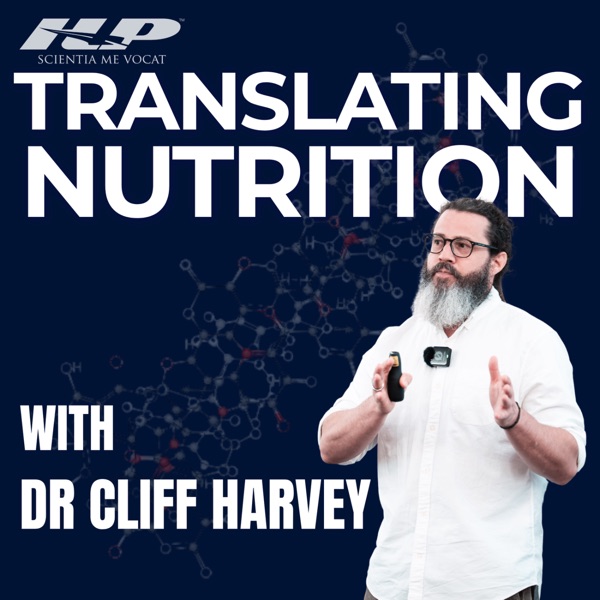
Translating Nutrition: Clinical Nutrition, Sports Nutrition, & Health Coaching with Dr Cliff Harvey
Powered by the Holistic Performance Institute.
We are living in an era of nutritional chaos. Between the "diet wars," social media influencers, and an endless stream of conflicting advice, the public is exhausted, and serious practitioners are frustrated.
Welcome to Nutrition Translated, the podcast that cuts through the noise to bring you the evidence-backed truth about what actually works for human health and performance.
Hosted by Dr Cliff Harvey, founder of the Holistic Performance Institute, this show opens our massive database of living research reviews to translate the world's most up-to-date nutritional science into real-world clinical applications.
Whether you are an aspiring Health Coach guiding clients through behaviour change, a Sports Nutritionist optimising elite athletic recovery, or a Clinical Nutritionist managing complex chronic conditions, this is your new required listening.
Every week, Dr Harvey is joined by the world-class HPI faculty, including industry heavyweights like Dr Eric Helms, Dr Mikki Williden, and Michelle Yandle, to go beyond abstract biochemical pathways and break down:
• Evidence-Based Protocols: The truth about metabolic flexibility, the gut-brain axis, chronic fatigue, muscle hypertrophy, and more.
• Clinical Application: Exactly how to safely and effectively implement the latest science with the client sitting in front of you.
• Industry Realities: Navigating your scope of practice, ethical boundaries, and how to build a highly successful, accredited nutrition career.
Stop guessing, drop the dogma, and step into the reality of evidence-based practice.
Free Resource: Download your free Evidence-Based Practitioner's Roadmap to discover your exact scope of practice and earning potential: https://www.holisticperformance.institute/pages/roadmap
Get Accredited: Learn more about our world-class vocational accreditations at
- Episodes
- 9
- Releases
- Weekly
- Typical length
- 1 hr 10 min
- On air since
- 2026
- Latest episode
- 2 days ago
Episodes
9 episodes, newest first
-
1 hr 29 min
Training After 40: Flatten the Decline, Don't Fight It | Darren Ellis
Show notes
Nobody gets stronger forever, yet most fitness advice acts as if we will. Cliff sits down with Darren "Daz" Ellis, founder of New Zealand's first CrossFit gym, former Masters CrossFit Games athlete and his co-author on Awesome After Forty, for an honest conversation about training when you're past your peak, short on time and carrying a few old injuries.
Read Awesome After Forty (Cliff Harvey and Darren Ellis): https://books2read.com/u/mBpNKR
In this episode we cover
• Why Daz now puts mobility under strength at the base of his training pyramid
• The "glide path": accepting decline and working to flatten the curve
• Residual activity, and why less training volume can also mean less mobility
• Why "good enough" form is good enough for most lifters
• Progressing without adding load: range, tempo, reps, density
• Choosing exercises that suit a busy season of life
• Sport as cardio, daily steps, zone 2 and where VO2max fits
• Why some ageing athletes get better results by doing less
• Talking about wear and tear without making it your identity
• What both would tell their 25-year-old selvesChapters
00:00 Intro
02:18 Training around family life
04:20 Seasons of life and the best time to train
08:33 Shorter, more focused sessions
09:24 How Daz has stayed fit into his 50s
14:23 The honest side: tendons, niggles and old injuries
17:08 The glider analogy: flattening the decline
17:37 The "age is just a number" myth
21:21 Mobility moves to the base of the pyramid
23:23 Residual activity and lost mobility
27:38 Form: good enough is good enough
31:09 Decline, comparison and the pull-up reel
36:31 Progression beyond adding load
37:53 Skewed strength standards online
41:15 Picking exercises for busy seasons
43:03 Autoregulation and training to failure
47:21 Cardio: sport, steps and zone 2
52:26 VO2max and Norwegian 4x4s
54:37 Cyclic cardio vs lifting
58:12 The optimisation fallacy: big rocks first
1:01:07 A 10 bpm drop in resting heart rate
1:04:03 Subtracting junk volume
1:06:27 Diminishing returns and athletic identity
1:11:42 You at 48 is not you at 24
1:13:12 Injuries, wear and tear, and identity
1:18:32 Reasons vs excuses: it's never too late
1:21:01 Advice to your 25-year-old self
1:25:47 Peaking early and youth specialisation
1:27:56 Where to find Daz
About Darren Ellis
Darren "Daz" Ellis (MSc Exercise Physiology) has coached for more than 20 years. He opened New Zealand's first CrossFit gym, qualified for the 2015 CrossFit Games Masters (40-44) division, and now coaches strength, mobility and movement for people over 40. He is Cliff's co-author on Awesome After Forty.
Links mentioned in this episode
• Darren Ellis Coaching: https://www.darrenellis.coach/
• Darren on Instagram: https://www.instagram.com/darrenellis.coach/
• Awesome After Forty (Cliff Harvey and Darren Ellis): https://books2read.com/u/mBpNKR
• Fiatarone et al. (1990), strength training in nonagenarians: https://pubmed.ncbi.nlm.nih.gov/2342214/
• Helgerud et al. (2007), the 4x4 interval study: https://pubmed.ncbi.nlm.nih.gov/17414804/Holistic Performance Institute
• Roadmap: https://www.holisticperformance.institute/pages/roadmap
• Podcast page: https://www.holisticperformance.institute/pages/podcast
• Instagram: https://www.instagram.com/holisticperformancenutrition/
• Facebook: https://www.facebook.com/HolisticPerformanceNutrition/
• LinkedIn: https://nz.linkedin.com/company/holistic-performance-institute
• YouTube: https://www.youtube.com/@holisticperformanceThinking about coaching people through this stage of life professionally? Grab the free Practitioners Roadmap above: scope of practice at each level, career pathways and what practitioners charge in NZ and Australia. If this episode helped, follow Translating Nutrition and share it with a mate who still trains like they're 25.
-
46 min
AI, Ethics and Client Data: What Health Practitioners Get Wrong | HPI Team
Show notes
Most practitioners now use AI somewhere in their practice, but few have stopped to ask where their clients' data goes, who is training on it, or what their software subscriptions are funding. In this HPI team episode, Dr Cliff Harvey, Luke Gabites and Choong Kwan talk honestly about the ethics of the tech we buy, how they each use AI with clients, and the mistakes they see colleagues making.
In this episode we cover
• Why the rise of AI pushed tech ethics onto practitioners' radar
• "We are the product": what free tools really cost
• Where client data actually goes in apps, AI tools and cloud workspaces
• De-identification and other practical privacy safeguards for AI use
• How Cliff uses AI for differential assessment and peer review, without handing over his clinical reasoning
• Hallucinated studies, people-pleasing answers and built-in bias
• How HPI audited its suppliers and moved to a more ethical tech stack (and saved money doing it)
• Progress over perfection: building your own ethos for business decisionsChapters
00:00 Intro
01:22 How AI put tech ethics on the radar
03:15 "We are the product": free tools and advertising
05:19 Client data in a world of vibe-coded apps
08:37 Privacy law, de-identification and where your data lives
11:43 Jurisdiction, subpoenas and European alternatives
13:45 HPI's procurement policy and why it started
16:06 Practitioners using free AI tools
17:59 AI as an extension of your brain
19:33 Data breaches and simple de-identification habits
23:00 AI makes good practitioners better and bad practitioners worse
28:06 If you build AI to replace you, it can
28:59 Hallucinations: invented studies and bad instructions
31:26 AI wants to please you: why you still need to study
33:41 How LLMs actually work, and their biases
36:28 Training data, IP and copyright
37:15 HPI's supplier audit and new tech stack
41:58 Progress over perfection
43:46 Finding your ethos and your big why
45:54 The Practitioner's Roadmap
About the hosts
Dr Cliff Harvey is a clinical nutritionist, researcher and founder of the Holistic Performance Institute: https://www.holisticperformance.institute/
Luke Gabites is a Registered Clinical Nutritionist and Sports Nutritionist at Planted Nutrition in Auckland.
Choong Kwan is a Registered Clinical Nutritionist, sports nutritionist and strength and conditioning coach based in Auckland. He helps time-poor parents and high performers build strong, healthy bodies without letting training and nutrition take over their lives. Find him at https://www.iamchoong.com/
Links mentioned in this episode
• NZ Privacy Commissioner guidance on AI: https://www.privacy.org.nz/resources-and-learning/a-z-topics/ai/
• OpenAI data controls (turning off model training): https://help.openai.com/en/articles/7730893-data-controls-faq
• ManageMyHealth breach inquiry (1News): https://www.1news.co.nz/2026/05/27/managemyhealth-warned-before-massive-data-breach-inquiry/
• HPI Vision for Equity (ethics and diversity policy): https://www.holisticperformance.institute/pages/ethics-and-diversity
• HPI's list of ethical providers: link coming soon!Connect with HPI
• Roadmap: https://www.holisticperformance.institute/pages/roadmap
• Podcast page: https://www.holisticperformance.institute/pages/podcast
• Instagram: https://www.instagram.com/holisticperformancenutrition/
• Facebook: https://www.facebook.com/HolisticPerformanceNutrition/
• LinkedIn: https://nz.linkedin.com/company/holistic-performance-institute
• YouTube: https://www.youtube.com/@holisticperformanceThinking about turning this into a career? Download the free Practitioner's Roadmap: what you can and can't do at each level of practice, the three career pathways, what practitioners charge in NZ and Australia, and which registration bodies recognise what. If you found this useful, follow Translating Nutrition and share it with a colleague who uses AI with clients.
-
1 hr 22 min
Are Women Small Men? | Dr Lauren Colenso-Semple
Show notes
Women are told to change their lifting, cardio, protein and even meal timing depending on their cycle phase. Dr Lauren Colenso-Semple has measured those hormones across many cycles in many women, and she has published some of the key research testing whether cycle phase changes how muscle responds to training. In this episode, she and Cliff look at what the evidence supports, what it doesn't, and why goal-led, individualised training beats a hormone calendar.
In this episode we cover
• Why "women are not small men" started as a call for better research and turned into rigid, fear-based rules
• How much research in women actually exists in weight loss, endurance and resistance training
• Why the textbook 28-day cycle with ovulation on day 14 rarely matches real life
• Why sex differences in strength and muscle gain shrink once people are trained
• How to auto-regulate training on a bad day without skipping the session
• Wearables, readiness scores and handing your judgement over to an app
• The luteal phase protein claim, and how it stacks one untested mechanism on another
• Fasted training, low-carb diets and the fragility narrative aimed at womenChapters
• 00:00 Intro
• 01:12 Catching up after the Austin conference
• 03:04 Are women just small men?
• 04:05 When empowerment becomes disempowering
• 05:37 Why it took so long to study women
• 08:45 How much research in women do we have?
• 11:00 Cycle syncing and the 28-day myth
• 14:21 Lean mass, training status and sex differences
• 17:23 Train for your goal, not your fibre type
• 18:16 Overcomplication and selling what you can't measure
• 20:55 Life stages, PCOS and lived experience
• 24:55 Do you need lived experience to be an expert?
• 30:10 Consistency beats optimisation
• 35:13 How to auto-regulate training
• 40:55 Objective vs subjective performance
• 43:18 Wearables, readiness scores and AI
• 48:00 Tracking your cycle as one variable among many
• 50:41 Dogma, branding and changing your mind
• 54:30 Cycle-specific nutrition: the luteal protein story
• 59:38 Fasted training and low energy availability
• 1:01:39 Should women fast or go low carb?
• 1:05:38 The optimisation fallacy
• 1:09:05 How adaptable humans are
• 1:13:37 When life gets in the way
• 1:17:12 "Don't do this" messaging: zone 2, HIIT and running
• 1:19:44 Lauren's take-home message
• 1:21:32 The Practitioner's RoadmapAbout Dr Lauren Colenso-Semple
Lauren is a muscle physiology researcher who completed her PhD at McMaster University, focused on exercise physiology, endocrinology and sex-based differences in muscle growth. She is co-owner of and a reviewer for the MASS Research Review and a regular voice on the Iron Culture podcast. Find her on Instagram at @drlaurencs1 and at MASS Research Review.
Links mentioned in this episode
• MASS Research Review: https://www.massresearchreview.com/
• Iron Culture podcast: https://ironculture.libsyn.com/
• Colenso-Semple et al. (2023), umbrella review on cycle phase and resistance training: https://doi.org/10.3389/fspor.2023.1054542
• Colenso-Semple et al. (2025), cycle phase and muscle protein synthesis: https://doi.org/10.1113/JP287342Holistic Performance Institute
• Roadmap: https://www.holisticperformance.institute/pages/roadmap
• Podcast page: https://www.holisticperformance.institute/pages/podcast
• Instagram: https://www.instagram.com/holisticperformancenutrition/
• Facebook: https://www.facebook.com/HolisticPerformanceNutrition/
• LinkedIn: https://nz.linkedin.com/company/holistic-performance-institute
• YouTube: https://www.youtube.com/@holisticperformanceWant to turn evidence like this into a career? Grab the free Practitioner's Roadmap at the link above. For the research behind each topic, see Nutripaedia, HPI's evidence reviews. If you got something from this episode, follow the show and leave a rating - it helps more practitioners find it.
-
43 min
Coffee and Cortisol: What the Research Actually Shows | HPI Team
Show notes
Social media says your morning coffee spikes cortisol, drives fat gain and wrecks your hormones. But most of those claims come from studies using doses of 3 to 6 mg of caffeine per kilo, or up to 800 mg in one hit. In this round table, Dr Cliff Harvey sits down with HPI nutritionists Luke Gabites and Choong Kwan to look at what the research actually shows, and how they use coffee/caffiene with their own clients.
In this episode we cover:
• Why "coffee spikes cortisol" is a surface-level read of the research
• The doses used in caffeine studies versus a normal couple of cups
• Habituation: why regular coffee drinkers show little cortisol response
• Adrenaline, adenosine and what actually makes you feel alert
• Cortisol, "cortisol belly" and fat gain: what the evidence supports
• When caffeine is a real problem: high-stress clients, energy drinks and sleep
• Practical guidelines: timing, cups per day, double shots and green tea
• Coffee and iron absorption for plant-based eatersChapters
00:00 Intro and the team
01:41 Coffee, cortisol and the social media claims
03:37 Fat gain, hormones and crashes: the claims
04:17 Why a cortisol rise is partly the point
06:16 What the research doses really are
10:11 Dose in the real world: 800 mg is eight cups
11:55 Adrenaline first, cortisol later, and habituation
15:23 Athletes versus high-stress type A clients
19:06 Energy drinks, exercise and the rugby study
22:07 Half-life, timing and hidden calories in coffee
24:08 The latte client: does cortisol cause fat gain?
26:51 Cortisol belly and stress eating
30:05 The bigger stressors in people's lives
33:31 Individual responses and the holistic view
35:33 Practical caffeine guidelines
41:03 Green tea, L-theanine and iron absorption
42:22 Wrap-up and Nutripaedia
About the team
Dr Cliff Harvey is a clinical nutritionist, researcher and founder of the Holistic Performance Institute. Choong Kwan is a Registered Clinical Nutritionist, sports nutritionist and strength and conditioning coach based in Auckland. He helps time-poor parents and high performers build strong, healthy bodies without letting training and nutrition take over their lives. Find him at https://www.iamchoong.com/. Luke Gabites is a Registered Clinical Nutritionist and Sports Nutritionist at Planted Nutrition in Auckland.
Mentioned in this episode
• Nutripaedia living review: Caffeine and Cortisol (HPI members) - https://holisticperformance.thinkific.com/courses/take/nutripaedia/audio/76943502-caffeine-cortisol
• Beaven et al. (2008), caffeine dose and cortisol in rugby league players: https://pubmed.ncbi.nlm.nih.gov/18458357/
• Dr Lauren Colenso-Semple on Instagram: https://www.instagram.com/drlaurencs1/
• Choong Kwan: https://www.iamchoong.com/
• Luke Gabites, Planted Nutrition: https://plantednutrition.nz/HPI links
• Roadmap: https://www.holisticperformance.institute/pages/roadmap
• Podcast page: https://www.holisticperformance.institute/pages/podcast
• Instagram: https://www.instagram.com/holisticperformancenutrition/
• Facebook: https://www.facebook.com/HolisticPerformanceNutrition/
• LinkedIn: https://nz.linkedin.com/company/holistic-performance-institute
• YouTube: https://www.youtube.com/@holisticperformanceGo further: want the full evidence on caffeine and cortisol, updated as new research lands? It's in Nutripaedia, our living evidence reviews for practitioners. Want to work in this space yourself? See the study pathways on the HPI Roadmap. If you got something from this episode, follow the show and leave a rating - it helps other practitioners find us.
-
1 hr 22 min
Is There a Safe Dose of Alcohol? | Dr Mikki Williden
Show notes
Is there a safe dose of alcohol? Headlines say no. The biggest meta-analysis on alcohol and death says something more nuanced. Dr Cliff Harvey sits down with longtime collaborator Dr Mikki Williden to separate "no healthy dose" from "no safe dose", and to work out what a sensible, evidence-based drinking pattern looks like for people who enjoy the odd drink.
In this episode we cover:
• Why alcohol is such a divisive topic, and why both apologists and absolutists get the evidence wrong
• What the Zhao et al. (2023) meta-analysis of 107 cohort studies found on all-cause mortality
• Why cancer risk is where the case for "no safe dose" is strongest
• Relative vs absolute risk, and how to read a 3% or 20% increase
• Abstainer bias: why non-drinkers once looked less healthy than light drinkers
• How diet, exercise and a Mediterranean-style drinking pattern change the picture
• Why zero-tolerance messaging can erode trust
• The practical take-home: a drinking pattern that sits well inside the risk thresholdsChapters:
• 00:00 Why alcohol is such a polarising health topic
• 01:25 Why Mikki is the right person to discuss the evidence
• 03:17 Tracking health metrics without obsession
• 07:39 Why steps and movement matter more than fitness dogma
• 09:02 Do strength training and jiu-jitsu count as cardio?
• 12:53 Why more carbs improved Mikki's running and recovery
• 15:47 Why low carb and high carb can both work
• 20:34 Horses for courses: matching diet to the goal and season
• 23:30 Why "what if they did even better?" is a weak argument
• 25:25 Back to alcohol and mortality
• 30:07 Why mortality is the right place to start
• 32:11 What the major meta-analysis found on all-cause mortality
• 35:09 Why cancer changes the conversation
• 38:01 How alcohol-related cancer risk is usually presented
• 40:19 Relative risk vs absolute risk explained
• 42:13 Why cancer studies often use broad intake categories
• 43:46 Drinking frequency and binge patterns
• 44:46 Abstainer bias: why non-drinkers looked worse
• 47:11 Residual confounding and why no study is perfect
• 49:07 How physical activity and Mediterranean habits reduce risk
• 50:43 No healthy dose, but maybe a safe dose
• 55:56 How drinking culture has shifted
• 58:16 Functional drinking and underestimated intake
• 1:02:36 Why zero-tolerance messaging erodes trust
• 1:04:51 Alcohol with food, and why culture affects outcomes
• 1:08:13 Personal tolerance, nickel sensitivity and congeners
• 1:10:11 Social lubrication, behaviour and context
• 1:12:07 The biggest health levers may not be alcohol
• 1:14:03 How mindfulness, sleep and behaviour ripple across health
• 1:15:31 The practical middle ground on alcohol
• 1:17:09 Where to find Mikki and the Holistic Performance InstituteAbout Dr Mikki Williden
Dr Mikki Williden is a New Zealand nutritionist with a PhD in nutrition, a former AUT lecturer, and host of the Mikkipedia podcast. She runs coaching and programmes for people who want evidence-based nutrition that fits real life, and is a long-term contributor to the Holistic Performance Institute.
Find Mikki: Website https://mikkiwilliden.com/ · Instagram https://www.instagram.com/mikkiwilliden/ · Facebook https://www.facebook.com/mikkiwillidennutrition · Mikkipedia https://podcast.mikkiwilliden.com/
Studies mentioned in this episode
• Zhao et al. (2023), daily alcohol intake and all-cause mortality, JAMA Network Open: https://doi.org/10.1001/jamanetworkopen.2023.6185
• Health effects associated with alcohol consumption: a Burden of Proof study (2026), Nature Health: https://www.nature.com/articles/s44360-026-00139-5
• Sarich et al. (2026), alcohol-attributable cancer risk in the 45 and Up Study, British Journal of Cancer: https://doi.org/10.1038/s41416-026-03403-3
• Perreault et al. (2017), physical activity and alcohol-related mortality, British Journal of Sports Medicine: https://doi.org/10.1136/bjsports-2016-096194
• Campanella et al. (2024), Mediterranean alcohol-drinking pattern, diet and mortality, Nutrients: https://doi.org/10.3390/nu16010059
• Kassaw et al. (2024), Mendelian randomisation of alcohol and mortality, International Journal of Epidemiology: https://academic.oup.com/ije/article/53/2/dyae046/7632292
• Nutripaedia living review: alcohol and mortality (link to add when live)HPI links
• Roadmap: https://www.holisticperformance.institute/pages/roadmap
• Podcast page: https://www.holisticperformance.institute/pages/podcast
• Instagram: https://www.instagram.com/holisticperformancenutrition/
• Facebook: https://www.facebook.com/HolisticPerformanceNutrition/
• LinkedIn: https://nz.linkedin.com/company/holistic-performance-institute
• YouTube: https://www.youtube.com/@holisticperformanceWant the full evidence review? Cliff's living review on alcohol and mortality is going up in Nutripaedia, HPI's database of evidence reviews. Thinking about a career in nutrition? Grab the free Practitioner's Roadmap: https://www.holisticperformance.institute/pages/roadmap.
If this episode was useful, follow Translating Nutrition and leave a rating, it helps other practitioners find the show.
-
1 hr 3 min
Plant-Based Pragmatism: When Diet Meets Ethics | Luke Gabites
Show notes
Plant-Based and Pragmatic: When Diet Meets Ethics | Luke Gabites
Most diet arguments online come down to rules: you either eat this way perfectly or you are out. Registered Clinical Nutritionist Luke Gabites spent years as an ethical vegan, and he joins Dr Cliff Harvey to talk about what happens when strict rules meet real life, real bodies and real clients. Both have plant-based roots, both have become more pragmatic, and neither is anti-vegan.
In this episode we cover
• How Luke and Cliff each came to plant-based eating, and why both have softened over time
• Why a vegan diet isn't medically suitable for everyone, including Cliff's systemic nickel allergy and Crohn's disease
• Whether a vegan diet always results in fewer lives lost, and where food systems and consumerism fit in
• Values vs rules: an acceptance and commitment therapy lens on how we eat
• Rigid diets, perfectionism and the link with disordered eating
• What the research on plant-based eating actually shows, and where it gets overstated
• Working with clients across the dietary spectrum without pushing your own ethics
• Luke's one universal principle: start with your values, then build a mostly whole-food pattern that lets you liveChapters
00:00 Intro 00:12 Cliff on pragmatism, veganism and dogma 03:49 Welcome Luke 05:05 Luke's path: migraines, student flatting and yoga in India 07:51 Holding values without rigidity 09:30 Cliff's story: hunting, Buddhism and going vegetarian 12:15 Crohn's disease, nickel allergy and eating meat again 15:36 Does a vegan diet always take fewer lives? 17:35 Food systems, gardening and killing slugs 19:20 Perfectionism in diet communities 20:04 Restrictive diets and disordered eating 22:00 Diet vs ethos: the vegan category problem 23:00 Values vs rules 26:28 Identity, performance and hypocrisy 27:39 Insects, puha and cats: where is the line? 30:17 Living in alignment and self-compassion 33:28 Backlash for changing your diet 36:58 Online criticism and when to block 39:45 Bioindividuality and lived experience 41:37 Reading nutrition research pragmatically 45:11 Working with clients of every diet 48:40 Who ends up in your clinic 53:44 Knowing when to refer on 56:47 One universal truth in nutrition 1:00:32 Coach-first practice 1:02:39 The Practitioner's Roadmap
About Luke Gabites
Luke Gabites is a Registered Clinical Nutritionist (Clinical Nutritionists Aotearoa) and Wellness Educator based in Tāmaki Makaurau Auckland, and the founder of Planted Nutrition. He graduated with first-class honours from the Institute of Holistic Nutrition, completed HPN 2 clinical nutrition training at HPI, and co-hosts the Thrive: Mind & Body podcast with psychologist Jane Gabites.
Find Luke: https://plantednutrition.nz/ | YouTube | Instagram
Links mentioned in this episode
• Harvey, C. (2026). Low-nickel diet in Crohn's disease: case report and narrative review. Journal of Metabolic Health
• EPIC-Oxford cohort: Tong et al. (2019), BMJ
• Kristin Neff on self-compassion: https://self-compassion.org/
• Thrive: Mind & Body podcast: Apple Podcasts
• HPI faculty and advisors (Dr Eric Helms, Dr Mikki Williden and team): Our peopleHPI links
• Practitioner's Roadmap: https://www.holisticperformance.institute/pages/roadmap
• Podcast page: https://www.holisticperformance.institute/pages/podcast
• Instagram: https://www.instagram.com/holisticperformancenutrition/
• Facebook: https://www.facebook.com/HolisticPerformanceNutrition/
• LinkedIn: https://nz.linkedin.com/company/holistic-performance-institute
• YouTube: https://www.youtube.com/@holisticperformanceWant to do this work yourself? Grab the free Practitioner's Roadmap: career pathways, scope at each level, what practitioners charge in NZ and Australia, and which registration bodies recognise what.
If helping people step out of rigid, rule-bound eating is your thing, look at HPI's Empowered Eating Coach certification. Follow Translating Nutrition so you don't miss an episode, and tell us where you land on this one.
-
58 min
How Much Protein Is Too Much? | Dr Eric Helms
Show notes
How much protein is too much?
For years, 1.6 g/kg has been treated as a hard ceiling for building muscle. Dr Eric Helms was a co-author on the 2018 Morton meta-analysis that produced that number - and in this episode he explains why he now considers it out of date. Cliff and Eric work through what the newer data shows, who needs more, and why the right protein target depends on the person in front of you.
In this episode we cover
• Why the 1.6 g/kg "limit" was never a hard limit, and why meta-analyses expire
• What the Tagawa (2021), Nunes (2022) and Refalo (2025) analyses add
• Protein targets for a new lifter, an advanced physique athlete and an older adult with sarcopenia
• How to set protein for larger bodies: fat-free mass and the height-in-centimetres heuristic
• Whether women need less protein than men
• Why lean people lose more muscle in a deficit, and what that means for protein
• Recomposition, energy balance and why the scale can mislead
• Is high protein dangerous? Kidneys, creatinine vs cystatin C, bone and longevity claimsChapters
00:00 Intro 01:13 Catching up with Eric 02:09 Is 1.6 g/kg a hard limit? 04:13 Why meta-analyses expire 06:24 Tagawa, Nunes and diminishing returns 08:08 What practitioners should take away 09:34 New lifter vs advanced athlete vs older adult 16:17 Protein in the context of the whole person 23:24 Protein for larger bodies 26:36 Medical conditions and anabolic resistance 27:22 Do women need less protein? 32:38 Leanness, dieting and muscle loss 36:32 Obesity, insulin resistance and muscle gain 40:52 Recomposition and energy balance 47:06 Is high protein dangerous? 51:02 Protein restriction, longevity and blue zones 53:43 The desert island question 56:22 Cliff's key takeaways
About Dr Eric Helms
Eric Helms, PhD, CSCS, AccredSpNut, is Co-director of the AUT Sport Performance Research Institute New Zealand (SPRINZ), co-founder of MASS Research Review, and Chief Science Officer at 3D Muscle Journey. He is a WNBF Pro natural bodybuilder and lead author of The Muscle and Strength Pyramids.
Find Eric: Instagram @helms3dmj · Linktree · 3D Muscle Journey · MASS Research Review
Links mentioned in this episode
• Morton et al. (2018) protein supplementation meta-analysis: https://doi.org/10.1136/bjsports-2017-097608
• Tagawa et al. (2021) dose-response meta-analysis: https://doi.org/10.1093/nutrit/nuaa104
• Nunes et al. (2022) protein and muscle mass meta-analysis: https://doi.org/10.1002/jcsm.12922
• Refalo, Trexler and Helms (2025) protein during energy restriction: https://doi.org/10.1519/SSC.0000000000000888
• Heymsfield et al. (2011) voluntary weight loss and body composition: https://doi.org/10.1111/j.1467-789X.2010.00767.x
• Greg Nuckols on protein and the 1.6 g/kg rule (Stronger by Science): https://www.strongerbyscience.com/protein-science/Holistic Performance Institute
• Practitioners Roadmap (free): https://www.holisticperformance.institute/pages/roadmap
• Podcast page: https://www.holisticperformance.institute/pages/podcast
• Instagram: https://www.instagram.com/holisticperformancenutrition/
• Facebook: https://www.facebook.com/HolisticPerformanceNutrition/
• LinkedIn: https://nz.linkedin.com/company/holistic-performance-institute
• YouTube: https://www.youtube.com/@holisticperformanceWant the research on protein kept current? Our Nutripaedia Living Reviews are updated several times a week, so you always see where the evidence sits today.
Follow Translating Nutrition wherever you listen, and leave a rating if this episode helped.
-
1 hr 16 min
Protein vs Fibre: Do You Have to Pick a Side? | Dr Carlene Starck
Show notes
Protein vs Fibre: Do You Have to Pick a Side? | Dr Carlene Starck
Social media has turned protein and fibre into rival camps - one side says we are all under-eating protein, the other says we are wrecking our guts by skipping fibre. So who is right? Dr Cliff Harvey sits down with protein biochemist and nutrition scientist Dr Carlene Starck to weigh the evidence and work out what should actually go on your plate.
In this episode we cover:
• What the fibre meta-analyses show, and why randomised trials of isolated fibre undercut the "it's just residual confounding" argument
• Why protein and fibre ended up pitted against each other
• Is fibre essential? What "non-essential" does and doesn't mean
• If you could only prioritise one, which would a protein scientist choose (and why)
• Protein vs fibre for satiety, and what a week on carnivore taught Carlene
• Why individual context, mental health and food culture matter more than dietary dogma
• Carlene's New Zealand and Australian research showing nutrient-dense diets can cost less
• A simple plate model, eating for colour, and the biggest myths about protein and fibreChapters
00:00 Intro 00:12 The protein vs fibre debate 01:35 What the fibre research shows 11:29 Meet Dr Carlene Starck 12:31 From myostatin to protein misfolding 16:53 Why protein and fibre got pitted against each other 20:13 Is fibre essential? 27:06 Protein or fibre: if you had to pick one 31:32 Satiety: protein vs fibre 33:45 A week on carnivore 35:27 Diet, mental health and individual response 40:29 The "second stomach" and enjoying food 44:21 Food, culture and community 47:20 Why dietary dogma doesn't serve people 48:54 Ayurveda and individual constitutions 51:21 Can nutrient-dense eating cost less? 56:41 A simple plate model: palms, fists and colour 58:20 Is there a fibre-to-carb target? 1:01:19 The Hadza, and why oral health matters 1:04:18 Myth busting: protein 1:05:37 Myth busting: fibre 1:07:44 When fibre supplements make sense 1:10:47 Finding the diet that works for you 1:13:39 Cliff's key takeaways 1:15:34 The Practitioner's Roadmap
About Dr Carlene Starck
Dr Carlene Starck is a protein biochemist and nutrition scientist with more than 20 years in nutrition research, protein and amino acid metabolism, and science communication. She holds a PhD in biochemistry from Massey University and is affiliated with the Riddet Institute. Through Starck Science she helps food and nutrition brands turn rigorous protein science into clear strategy.
Find Carlene: https://starckscience.com/ · Instagram · LinkedIn
Research and links mentioned
• Starck et al. (2021). Nutrient dense, low-cost foods can improve the affordability and quality of the New Zealand diet. https://doi.org/10.3390/ijerph18157950
• Blumfield et al. (2021). Diet and economic modelling to improve the quality and affordability of the Australian diet. https://doi.org/10.3390/ijerph18115771
• Blumfield et al. (2022). Should we 'eat a rainbow'? An umbrella review of colourful bioactive pigments. https://doi.org/10.3390/molecules27134061
• Reynolds et al. (2019). Carbohydrate quality and human health, The Lancet. https://doi.org/10.1016/S0140-6736(18)31809-9Holistic Performance Institute
• Free Practitioner's Roadmap: https://www.holisticperformance.institute/pages/roadmap
• Podcast page: https://www.holisticperformance.institute/pages/podcast
• Instagram: https://www.instagram.com/holisticperformancenutrition/
• Facebook: https://www.facebook.com/HolisticPerformanceNutrition/
• LinkedIn: https://nz.linkedin.com/company/holistic-performance-institute
• YouTube: https://www.youtube.com/@holisticperformanceWant the evidence behind the episodes? Our Nutripaedia living reviews track the research on protein, fibre and more, and our HPI courses turn it into practice.
Thinking about a career in nutrition? Grab the free Practitioner's Roadmap. If you got value from this episode, follow the show and leave a rating - it helps more people find evidence-led nutrition.
-
2 min
Translating Nutrition Trailer Trailer
Show notes
Dr. Cliff Harvey kicks off Translating Nutrition with a hard reset on the “one best diet” myth and shows why the right intervention depends on the individual sitting in front of you. Built from the clinical experience of the Holistic Performance Institute and its database of living reviews, this podcast is designed for practitioners who need evidence they can actually use, not abstract theory.
If you work as a health coach, sports nutritionist, clinical nutritionist, or any professional helping people make better nutrition decisions, Translating Nutrition will help change how you think about nutrition advice. You’ll discover why evidence-based nutrition is more than memorising studies, how to cut through conflicting advice, and why clinical context matters more than internet certainty.
If you’re tired of nutrition content that sounds smart but helps no one, this is your reset: less noise, more clarity, and better outcomes for the people you serve.
Courses lists
More Courses shows picked out from the charts







More in Courses
Placed highest on Apple Podcasts' Courses chart right now