Podcast
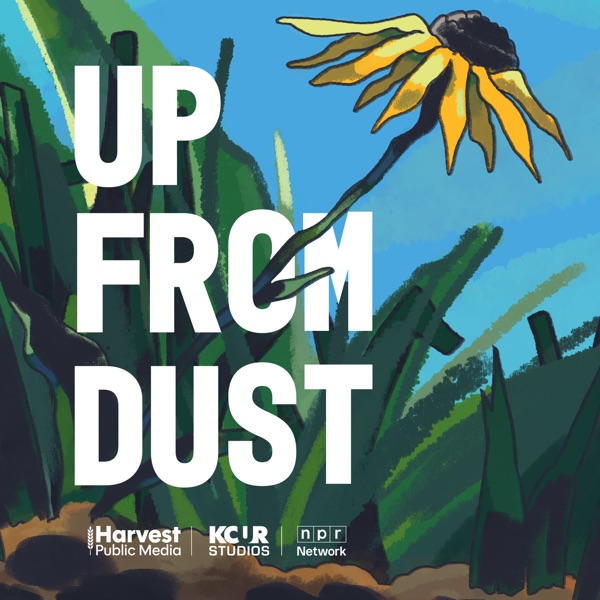
Up From Dust
Trees are swallowing prairies. Rivers are losing their fish. And stars are disappearing from view. Humans broke the environment — but we can heal some of the damage. Up From Dust is a podcast about the price of trying to shape the world around our needs, and how to live more sustainably. Host Celia Llopis-Jepsen brings you the stories of people across the Midwest and Great Plains who are working to fix our generational mistakes. From Harvest Public Media, KCUR Studios and the NPR Network.
- Nature chart
- #181
- Episodes
- 28
- Releases
- Monthly
- Typical length
- 29 min
- On air since
- 2024
- Latest episode
- 2 weeks ago
Episodes
28 episodes, newest first
-
34 min
The enemies of ticks are our friends
Season 1, Episode 28
Show notes
(Jessica Cornelison / KCUR 89.3)
Some parts of the U.S. have far more ticks than they used to, including species that can make us really sick. Humans have changed our landscapes in ways that made life easier for ticks — and harder for the animals that can keep their populations in check. But some creatures, like possums, have special tick-fighting powers.
Resources:
• Cary Institute of Ecosystem Studies article explaining biodiversity and the implications for ticks
• Mayo Clinic guide to different tick species and the diseases they carry
• Kansas State University research on mouse populations in prairiesThis episode was cohosted by Celia Llopis-Jepsen and Mackenzie Martin. It was reported by Llopis-Jepsen. Seth Jahraus mixed the episode. Editing by Martin and Shahla Farzan.
-
37 min
Your personal tick survival guide
Season 1, Episode 27
Show notes
(Jessica Cornelison / KCUR 89.3)
You know that moment of panic when you find a tick on yourself? Well, we assembled a crack team of tick scientists to tell us exactly what to do when that happens — and better yet, how to avoid it in the first place. We’ll learn what repellents to use, why clothes dryers are tick kryptonite, and (gulp) how to properly remove the pesky creatures.
Resources:
• EPA tool to search for EPA-regulated tick repellents
• Get help from University of Rhode Island identifying a tick by submitting a photo
• Properly remove a tick! Video by University of Rhode Island
• Which tick species live where in the U.S.? Here's a Mayo Clinic guide
• A tick field guide that shows what each tick looks like
• Interactive CDC case map for Lyme and other tick-borne diseases
• Alpha-gal case map
• KBIA's news series on alpha-gal syndrome
• The Ohio State Buckeye tick labThis episode was cohosted by Mackenzie Martin and Celia Llopis-Jepsen. It was reported by Llopis-Jepsen. Seth Jahraus mixed the episode and helped produce it. Editing by Martin and Shahla Farzan.
-
27 min
Getting more comfortable with 'sneks' and creepy-crawlies
Season 1, Episode 26
Show notes
(Jessica Cornelison / KCUR 89.3)
Justin was terrified of snakes – until he learned they’re scared of him, too. Tay’s fear was soothed after discovering the Internet’s affection for “nope ropes” and “danger noodles.” Can we ease our discomfort around critters by getting to know the animals? We spoke with psychologists, who offer their tips for overcoming phobias. This is part two of a two-part series on getting over the fears that spoil our outdoor fun.
Resources:
Video: Watch a cute jumping spider drinking from a cotton swab.This episode was cohosted by Mackenzie Martin and Celia Llopis-Jepsen. It was reported by Llopis-Jepsen and Seth Jahraus. Jahraus mixed the episode. Editing support from Shahla Farzan.
-
26 min
A nature lover confronts her fear of spiders
Season 1, Episode 25
Show notes
(Jessica Cornelison / KCUR 89.3)
How do you stop being so afraid? Tracy Twombly had such a strong phobia of spiders, it was messing with her life — stressing her out while she was working at her native plant nursery or hiking through the woods. So she embarked on a journey to make peace with her eight-legged neighbors (even the extra hairy ones). This is part one of a two-part series on getting over the fears that spoil our outdoor fun.
Links mentioned in the episode:
• Peacock spiders doing disco semaphore (sound on)
• Eight-legged Wonders by James O'HanlonThis episode was reported, produced and mixed by Celia Llopis-Jepsen. Up From Dust's editor is Mackenzie Martin.
-
21 min
Why you should kill your lawn
Season 1, Episode 24
Show notes
(Jessica Cornelison / KCUR 89.3)
All summer long, we run mowers over our lawns to keep them the perfect height — and run sprinklers to keep them emerald green. Add fertilizer and weedkillers into the mix, and it’s a real resource drain. But there’s something else about lawns: They’re inhospitable to most wildlife. Celia joins Marielle Segarra on NPR’s Life Kit to explain how to push back against American lawn culture by killing a small patch of grass and turning it into a wildlife friendly garden.
The episode was reported by Celia Llopis-Jepsen and Shahla Farzan, and hosted by Marielle Segarra. It was produced by Sylvie Douglis and edited by Shahla Farzan and Neela Banerjee.
-
29 min
Spying on box turtles
Season 1, Episode 23
Show notes
(Jessica Cornelison / KCUR 89.3)
Box turtles are cute and an absolute delight to spot while walking in the Midwest or Great Plains. But scientist Benjamin Reed wants us to know that these creatures are complex and widely misunderstood. Reed is a box turtle superspy, spending the last 13 years following the animals with radio equipment as they face daunting challenges like roads, lawnmowers, poachers and more. Reed has a laundry list of ways we can all help prairie turtles survive in a difficult world.
Resources mentioned in this episode:
• Washburn University turtle research program
• Watch an ornate box turtle spar with a prairie crayfish
• Our episode on making your first native plant gardenThis episode was written, reported, produced and mixed by Celia Llopis-Jepsen. Up From Dust's editor is Mackenzie Martin.
-
35 min
Between land and water: Tribal relocation and resistance
Season 1, Episode 22
Show notes
(Jessica Cornelison / KCUR 89.3)
Climate change is altering the land, and Indigenous communities are on the frontline. This episode takes you to Alaska, where rapid permafrost thaw is threatening the Native village of Nunapitchuk. Then, we head to Louisiana, where the Pointe-Au-Chien Indian Tribe is losing its land to rising sea levels. These tribes are forced to make a difficult decision between staying and adapting or leaving their ancestral homes. (This episode comes to us from the environmental podcast Sea Change.)
This episode was reported by Eva Tesfaye and Sage Smiley. It was edited by Eve Abrams with additional help from Carlyle Calhoun, Katie Basile, Garrett Hazelwood and Ryan Vasquez. Emily Jankowski did sound design.
-
29 min
The bat scientist and the pecan farmer
Season 1, Episode 21
Show notes
(Jessica Cornelison / KCUR 89.3)
A Texas pecan farmer spent years rethinking whether he needed so many chemicals to grow food. He cut back on things like weedkillers, but when it came to ditching insecticides, crop pests posed a challenge. That’s what brought him together with a famous bat scientist — who helped him build an insect-eating army of bats.
This episode was reported by Michael Marks and produced and mixed by Celia Llopis-Jepsen. Up From Dust's editor is Mackenzie Martin.
Resources:
• Michael Marks' reporting on the bats at Swift River Pecans
• Merlin Tuttle's Bat Conservation website -
21 min
Stargazers, unite for science!
Season 1, Episode 20
Show notes
(Jessica Cornelison / KCUR 89.3)
Astronomers need your help! And you don’t have to be an expert, because it’s as easy as stepping outside your home and taking a good look at a constellation like Orion. For 20 years, the citizen science project Globe At Night has helped advance our understanding of light pollution — as scientists figure out how fast stars are disappearing from our sky.
This episode was written, reported, produced and mixed by Celia Llopis-Jepsen. Up From Dust's editors are Mackenzie Martin and Stephen Koranda.
Resources:
• Globe At Night website
• Related Up From Dust episode: Say No To Skyglow
• Related reading: How to pick the right fixtures and bulbs for wildlife-friendly outdoor lighting at home
• Photo: "Earthrise," taken aboard Apollo 8 in 1968 -
19 min
Our changing Midwest
Season 1, Episode 19
Show notes
(Jessica Cornelison / KCUR 89.3)
As we embark on our third year of Up From Dust, we discuss why we started an environmental podcast in the Midwest — and what we’ve learned along the way. In 2026, stay tuned for stories about farmers, astronomers, turtles, bats and more. We’ll overcome fears and rethink how we grow food and build our cities. And we’ll meet the people in the Heartland who tackle the challenge of climate change with determination and resolve. Thanks for coming along with us.
Intern Lauren Textor produced this conversation between KCUR's Steve Kraske (of the talk show Up To Date) and Up From Dust host Celia Llopis-Jepsen. Up From Dust's editors are Mackenzie Martin and Stephen Koranda.
-
27 min
A river’s return from the brink of disaster
Season 1, Episode 18
Show notes
(Jessica Cornelison / KCUR 89.3)
In one long-polluted Ozark river, the little fish darting through the water and the rare mussels hiding on the pebbly bottom tell a story worth celebrating. They’re signs that the Spring River is benefitting from environmental cleanups after a century of mining pollution. A professor and his students are uncovering the evidence of recovery. But there’s a twist: They’ve also found a new environmental challenge unfolding farther upstream.
This episode was written, reported, produced and mixed by Celia Llopis-Jepsen. Up From Dust's editors are Mackenzie Martin and Stephen Koranda.
-
24 min
One man's quest for a rare shellfish
Season 1, Episode 17
Show notes
(Jessica Cornelison / KCUR 89.3)
Trevor Starks is on a mission. He wants to help the humble but powerful creatures that clean the waters of the Neosho River: freshwater mussels. For decades, their populations dwindled due to overharvesting, pollution and dam construction. To right the wrongs of the past, Trevor and his colleagues are releasing rare mussels by the hundreds. Now, the only thing left is to find out if it worked.
This episode was written, reported, produced and mixed by Celia Llopis-Jepsen. Up From Dust's editors are Mackenzie Martin and Stephen Koranda.
Resources:
• True Facts: A comedy video that explains mussel reproduction (contains adult language)
• Great Plains Nature Center Pocket Guides for identifying mussels, fish and more
• These fish, mussel and turtle species are the focus of Kansas' aquatic recovery program -
29 min
Prairie islands are popping up in a sea of corn and soybeans
Season 1, Episode 16
Show notes
(Jessica Cornelison / KCUR 89.3)
The Midwest has a reputation for vast fields of corn and soybeans that stretch to the horizon. But on some farms, strips of wildflowers and little bluestem now interrupt the crops, tiny glimpses of the prairie that once dominated the region. They’re an effort to hold back the fertilizer runoff that pollutes drinking water and then travels hundreds of miles downstream, where it fuels the Gulf of Mexico’s infamous Dead Zone.
Read Rachel Cramer's reporting on prairie strips and see photos of prairie strips.
This episode was reported by Rachel Cramer from Harvest Public Media and Iowa Public Radio. It was produced and mixed by Celia Llopis-Jepsen. Up From Dust's editors are Mackenzie Martin and Stephen Koranda.
-
30 min
Why a prairie scientist spent years photographing a single square meter of land
Season 1, Episode 15
Show notes
(Jessica Cornelison / KCUR 89.3)
Have you ever wondered how much life a tiny patch of land can hold? Nebraska scientist Chris Helzer photographed one square meter of prairie from every angle for two years, getting to know the creatures that call it home. By blending art and science, he hopes to open people's eyes to this underappreciated ecosystem on the Great Plains that’s shrinking more and more every year.
Mentioned in this episode:
• Chris Helzer's Square Meter Photography project
• The Nature Conservancy in NebraskaA few Nebraska hiking tips from Chris Helzer:
• Valentine National Wildlife Refuge
• Crescent Lake National Wildlife Refuge
• The Niobrara Valley Preserve
• Nebraska National Forests and Grasslands
• The Platte River Prairies
• Spring Creek PrairieThis episode was written, reported and mixed by Celia Llopis-Jepsen. Up From Dust's editors are Mackenzie Martin and Stephen Koranda.
-
19 min
A sticky solution for microplastics
Season 1, Episode 14
Show notes
(Jessica Cornelison / KCUR 89.3)
Microplastics are everywhere. They’re in the air we breathe, the clothes we wear, even the food we eat. Scientists are still trying to understand what these tiny particles are doing to the environment and our bodies. But an accidental discovery at the University of Michigan in 2019 – involving baby diapers and rubber tires – has broken ground on an idea for how to get them out of our water. (This episode comes to us from the podcast Points North at Interlochen Public Radio.)
This episode was produced by Michael Livingston, hosted by Dan Wanschura and edited by Morgan Springer, Ellie Katz, Ed Ronco, Peter Payette and Dan Wanschura.
-
28 min
Kayakers vs. river pollution
Season 1, Episode 13
Show notes
(Jessica Cornelison / KCUR 89.3)
For decades, the world’s longest prairie river was treated as a convenient dumping ground by cities and industries. Government regulation dramatically improved water quality here and around the country. Today the Kansas River is a place to scope out beavers and bald eagles. But decades-old garbage and other pollution still plague the river, so a motley crew of kayakers took it upon itself to dig out the trash.
Mentioned in this episode:
This episode was written, reported and mixed by Celia Llopis-Jepsen. Up From Dust's editors are Mackenzie Martin and Stephen Koranda.
-
29 min
Say no to skyglow: Smarter lighting can help save the stars
Season 1, Episode 12
Show notes
(Jessica Cornelison / KCUR 89.3)
We have inadvertently filled our world with poorly designed outdoor lighting. The price? We’re losing our starry skies, hurting our health, killing pollinators, wasting billions of dollars and releasing millions of tons of avoidable carbon dioxide. Now people in a Missouri college town and a state park are proving that picking the right bulbs and fixtures can curb light pollution and its harms.
Resources:
• Better outdoor lighting: Steps for reducing light pollution
• Examples of shielded light fixturesPlaces and organizations mentioned in this episode:
• Thousand Hills State Park and Truman State University in Kirksville, Missouri
• DarkSky Missouri and DarkSky InternationalThis episode of Up From Dust was written, reported and mixed by Celia Llopis-Jepsen, with editing by Mackenzie Martin and Stephen Koranda.
-
24 min
Less lawn, more wildlife! Here’s how to ditch turf for native plants
Season 1, Episode 11
Show notes
(Jessica Cornelison / KCUR 89.3)
So you’ve been thinking about getting rid of your lawn, or at least having less. You’ll attract birds and bees and you won’t have to mow as much. Nice! But where to start? Master gardener Paula Diaz gives us the scoop on how to kill grass, where to look for the right native plant species to replace it, and how to start laying out your flower beds. Come learn from someone who’s been winning over her neighbors to give native plants a shot.
Resources mentioned in this episode:
• Top 10 lists to help you pick the right native flowers, bushes and trees (Missouri Prairie Foundation)
• GrowNative.org index of Lower Midwest native plant retailers
• GrowNative.org sample flower bed layouts
• Regional native plant books
• Heather Holm's "soft landings" explainer
• Deep Roots KC's nature advisors and Sweet 16 plants
• Homegrown National Park
• Bringing Nature Home book
• Prairie Up: An Introduction to Natural Garden DesignThis episode of Up From Dust was written, reported and mixed by Celia Llopis-Jepsen, with editing by Mackenzie Martin and Stephen Koranda.
-
26 min
Those soil health products may be a waste of money
Season 1, Episode 10
Show notes
(Jessica Cornelison / KCUR 89.3)
Symbiotic fungi are all the rage right now. Farmers want them in their fields, gardeners want them in veggie patches and flowerbeds. The excitement has given rise to a billion-dollar mycorrhizae market, but many products don’t deliver on their promises. Come visit the world’s biggest collection of these fungi to learn what makes them so great — and why you should think twice before buying them.
Resources mentioned in this episode:
• News article: Soil health is big business, but KU researchers say many fungal products don't work as promised
• Scientific journal article: A.B. Frank and mycorrhizae
• The AM fungi collection at KU websiteThis episode of Up From Dust was written, reported and mixed by Celia Llopis-Jepsen, with editing by Mackenzie Martin and Stephen Koranda.
-
26 min
Can we save millions of migrating birds?
Season 1, Episode 9
Show notes
(Jessica Cornelison / KCUR 89.3)
In 1978, a young scientist “brazenly trespassed” around a Chicago building in search of dead birds. He unwittingly began a 40-year journey that could help save countless warblers, thrushes and more. Most of America’s 10 riskiest cities for migrating birds lie in the middle of the country. We’ll find out why — and how every resident from Texas to the Canadian border can help reduce the death toll.
This episode of Up From Dust was written, reported and mixed by Celia Llopis-Jepsen, with editing by Mackenzie Martin and Stephen Koranda.
Earth Sciences lists
More Earth Sciences shows picked out from the charts








More in Earth Sciences
Placed highest on Apple Podcasts' Earth Sciences chart right now