Podcast
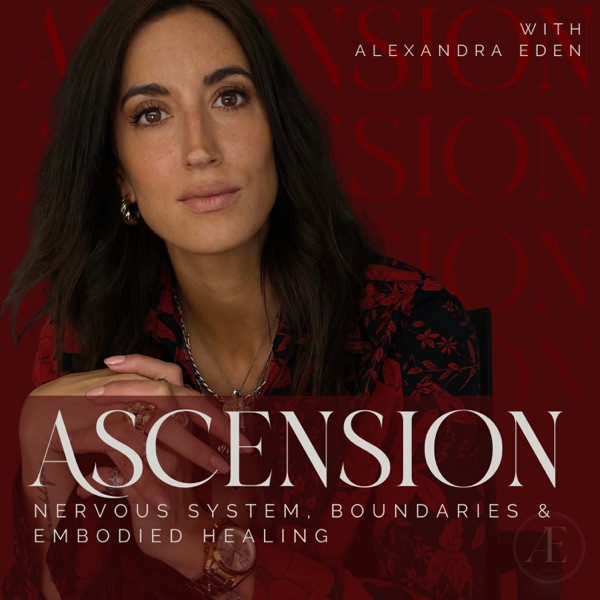
Ascension with Alexandra Eden | Nervous System, Boundaries & Embodied Healing
You know what you want to say. Then the moment comes, and the yes is out before you've decided anything.
For women who have done the reading and the therapy, and still lose themselves under pressure.
Somatic: the body as information, not obstacle. Science: nervous system research, explained plainly. Stoic: values-led action, practised through the body. Sacred: ritual, poetry and older ways of knowing.
People-pleasing. Stress. Boundaries. Motherhood. Identity.
Hosted by Alexandra Eden, somatic embodied coach. Educational, not therapy or medical advice.
- On air since
- 2026
- Episodes
- 7
- Releases · typical length
- Daily · 20 min
- Latest episode
- 1 week ago
Episodes
7 episodes, newest first
-
20 min
Silent Family Contracts, Silent Family Contracts, Christmas Boundaries, and Being Okay with Being Misunderstood
Show notes
Silent Family Contracts, Christmas Boundaries, and Being Okay with Being Misunderstood
I'm just back from visiting my family in Melbourne, and this one is personal: conditioning, boundaries, and the unspoken rules families run on. With Christmas coming, I want you to notice what happens in your body when you walk through your family's door.
In this episode:
- Boundaries as the way we love the world and ourselves at the same time
- How becoming a mum led me to look at my own conditioning
- Saying "yeah, okay" when my body said no
- Why a no can come from capacity, not the person or the request
- Why our systems read belonging as safety and isolation as danger
- Why you can feel healed 364 days a year and still feel 12 at your parents' door
- Silent contracts: don't make a scene, be nice, keep the peace
- Why I stayed away from Christmas for five years
Timestamps
0:00 - Back after Melbourne
0:49 - Asking my mum about her conditioning
1:33 - Boundaries as the cornerstone of embodied living
2:03 - The Two Kinds of No: where your no lives in your body
2:47 - How motherhood prompted a look at conditioning
3:22 - Saying yes when the body says no
4:14 - Capacity as the real reason behind a no
4:37 - Black Friday: everything 50% off
5:04 - Childhood, big feelings, and not belonging
6:14 - Why belonging equals safety
6:40 - My mum's good girl upbringing
7:28 - Why Christmas is volatile for many families
8:06 - Feeling 12 again at the door
8:28 - The free four-move guide and tarot phone backgrounds
9:37 - Why I stayed away from Christmas
10:03 - How family contracts form before we can speak
11:20 - "Be the bigger person" and biting your tongue
12:39 - The comment that shattered the contract
13:52 - Telling my mum I wouldn't come
14:42 - Her response, and holding the boundary
15:32 - "I am okay being misunderstood and disagreed with"
16:09 - Family rules are like learning football on the field
17:03 - Owning your part and living close to your truth
17:52 - Notice what happens when you walk in the door
18:41 - Black Friday early access
19:29 - Share your stories
Resources
- Guilt Trips Not Included (free): four somatic moves for the tough moments at Christmas. https://www.alexandraeden.com/guilt-trips
- The Two Kinds of No ($27): where your no lives in your body, and how to say it without guilt. Under 30 minutes. https://www.alexandraeden.com/two-kinds-of-no
- Black Friday: everything 50% off, plus a bonus if you want the whole shop. Join the mailing list for early access: https://www.alexandraeden.com/early-access
The statistic: NSW police-recorded domestic violence assaults are 78% higher on Christmas Day and 118% higher on New Year's Day than a typical day (BOCSAR, Bureau Brief 174, 2024).
If this brings something up, or you don't feel safe at home: 1800RESPECT (1800 737 732), 24/7. In an emergency, call 000.
"I am okay being misunderstood and disagreed with. It is liberating."
This Christmas, notice what happens in your body as you walk through the door.
Share your stories in the comments, including any lunches where you wanted to throw the pavlova. Questions: hello@alexandraeden.com
-
17 min
The Full Force of Woman: Healing, Anger and Coming Back to Yourself
Season 1, Episode 6
Show notes
Recorded in the rainforest, this is a heartfelt message for anyone coming out of a dark chapter. It covers letting the old version of yourself fall away, feeling what's yours to feel, and trusting that none of your path was wasted time. She shares her own story of leaving a toxic marriage and what helped her heal. She closes with a story about calling in the "sisterhood collective" the night she gave birth.
What you'll hear
• Standing in the liminal space between who you were and who you're becoming
• Reclaiming anger as a protector that knows your boundaries
• The idea that "self-abandonment is the highest form of devotion", and why it's worth unlearning
• Why none of your past was wasted time
• Widening your emotional spectrum: the deeper you can feel pain, the higher you can reach joy
• Sitting with your feelings, and when to get outside support (Ayurvedic practitioners, psychologists, somatic healers)
• Crying as a gift, since it releases emotion and brings oxytocin, so no more apologising for tears
• A birth story: staying with an adrenaline surge, and calling in healed ancestors and women around the worldKey quotes
• "Not one minute was wasted time."
• "Self-abandonment is the highest form of devotion. That's what we learned."
• "Don't ever apologise for your tears."
• "There is nothing that you can't survive… and there is nothing that you can't change." -
24 min
The Two Kinds of No: Why Your Body Says No Before Your Mind Does
Season 1, Episode 5
Show notes
You replay the conversation in the car. In the shower.
Why couldn't you just say what you meant?
Why did "yeah, sure, no worries" come out instead?There are two kinds of no. A values no, when someone crosses a real line. And a capacity no, when the request is completely fair and you simply have nothing left. Most boundary advice is written for the first. Most of us struggle with the second.
In this episode:
– Why so many of us call ourselves people pleasers, and why it feels like personality rather than conditioning
– What the research says about women, apologising and silencing the self
– Invisible loyalties: the unspoken family rules we learned before we could talk
– The window of tolerance, and why knowing your pattern isn't the same as changing it
– The two kinds of no, and why over-explaining turns your no into a request for permission
– Orient, felt sense, stay, complete: how I work with boundaries in the body
– Why we start small, and why the big cathartic release isn't the goalStart here with The Two Kinds of No: alexandraeden.com/two-kinds-of-no
Go deeper inside Embodied Boundaries: alexandraeden.com/embodied-boundaries
Next women's circle: [link]
Instagram: @alexandra.eden_This episode was recorded before the show was renamed, so you'll hear its previous name, The Eden Xperience.
00:00 Welcome
01:08 Science, Stoic, Somatic, Sacred
01:49 Back in circle, and dancing
03:41 This isn't about scripts
04:42 Healing isn't linear
05:27 You're not the only one
06:29 Why women apologise more
07:22 Silencing the self
09:00 Australian women and unpaid work
09:28 Invisible loyalties
10:38 Parentification
11:03 Loyalty isn't the problem
11:41 Why knowing isn't enough
12:47 The window of tolerance
13:46 Levine's five channels
15:44 The two kinds of no
16:25 The eleventh dinner invitation
17:46 Why over-explaining backfires
18:34 Resentment and the level-ten reaction
18:58 Orient, felt sense, stay, complete
20:37 Big releases versus small steps
21:36 The guilt and shame spiral
22:48 Where to startReferences
YouGov (2022). People-pleasing poll, June 18–21, 2022. https://yougov.com/en-us/articles/43486-people-pleasing-yougov-poll-june-18-21-2022
Schumann, K., & Ross, M. (2010). Why women apologize more than men: Gender differences in thresholds for perceiving offensive behavior. Psychological Science, 21(11), 1649–1655.
Jack, D. C. (1991). Silencing the Self: Women and Depression. Harvard University Press.
Jack, D. C., & Dill, D. (1992). The Silencing the Self Scale. Psychology of Women Quarterly, 16(1), 97–106.
Jakubowski, K. P., et al. (2022). Cardiovascular cost of silence: Relationships between self-silencing and carotid atherosclerosis in midlife women. Annals of Behavioral Medicine.
Australian Bureau of Statistics (2022). How Australians Use Their Time, 2020–21. https://www.abs.gov.au/statistics/people/people-and-communities/how-australians-use-their-time/2020-21
Boszormenyi-Nagy, I., & Spark, G. M. (1973). Invisible Loyalties. Harper & Row.
Hooper, L. M., et al. (2011). Characterizing the magnitude of the relation between self-reported childhood parentification and adult psychopathology: A meta-analysis. Journal of Clinical Psychology, 67(10).
Jankowski, P. J., et al. (2013). Parentification and mental health symptoms: Mediator effects of perceived unfairness and differentiation of self. Journal of Family Therapy, 35(1).
Siegel, D. J. (1999). The Developing Mind. Guilford Press.
Levine, P. A. (2010). In an Unspoken Voice. North Atlantic Books.
Gendlin, E. T. (1978). Focusing. Everest House.
"Sips, not gulps": Irene Lyon.The Somatic Stoic is educational content. It isn't therapy, counselling, or medical or psychological advice, and it doesn't replace care from a qualified health professional. In Australia, if you need support now, call Lifeline on 13 11 14, or 000 in an emergency.
-
15 min
The Good Girl Cage: Burnout, Boundaries and Asking for Help
Season 1, Episode 4
Show notes
Recorded in a rainforest, with my handmade kangaroo hide drum beside me and the birds behind me.
Twelve weeks postpartum.
A week of lessons I didn't plan on learning.
Burning out on work I love. Finding it hard to ask for help, even from my closest friends.In this episode:
– Why the thing you teach usually finds you first
– How burnout can happen even when you love what you do
– The good girl cage: how being "so easygoing" became an identity, and who you are without it
– The I-can-do-it-all cage, and why accepting help can feel so awkward
– Why people-pleasing is often about controlling how you're seen
– Saying "I can't do that right now," and letting the silence be
– What you loved as a little girl, and why it might matter nowStart here with The Two Kinds of No, my short boundaries course: alexandraeden.com/two-kinds-of-no
Go deeper inside Embodied Boundaries: alexandraeden.com/embodied-boundaries
The Stress Shift Kit: alexandraeden.com/the-stress-shift-kit
Instagram: @alexandra.eden_This episode was recorded before the show was renamed, so you'll hear its previous name, The Eden Xperience.
00:00 In the rainforest with my drum
01:02 Twelve weeks postpartum
01:56 The work you teach finds you first
02:10 Why I came to boundary work
02:47 Inside Embodied Boundaries
03:47 Burning out on work I love
04:21 Self-care is non-negotiable
05:24 The good girl cage
06:26 Who am I without it?
07:00 Fear is a mile wide and an inch deep
07:35 Fashion, and being too big for a box
08:20 What did you love as a little girl?
09:30 Asking for help
10:29 The I-can-do-it-all cage
11:54 Turning the volume down on your body
12:34 People-pleasing and control
13:03 "I can't do that right now"
13:26 Teaching from the arena
14:12 Let the drum hold you
14:40 Where to start
15:15 CloseThe Somatic Stoic is educational content. It isn't therapy, counselling, or medical or psychological advice, and it doesn't replace care from a qualified health professional. In Australia, if you need support now, call Lifeline on 13 11 14, or 000 in an emergency.
-
12 min
Why You Say Yes When You Mean No (Boundaries Are Bridges)
Show notes
It's time to un-f**k your boundaries.
Even strong, take-no-sh*t women still slip into appeasement, people-pleasing and martyrdom. I know, because I've done it.
Recorded with my 11-week-old son on one side and my 14-year-old dog on the other, this is a short, honest one about what boundaries actually are, and what happens when we don't have them.
In this episode:
– Why belonging can feel safer than your own needs
– Why boundaries are not walls, but bridges back to yourself and to the people you love
– How I disappeared in my first marriage, and how I found my way back
– What capacity is, and how low capacity shows up in small moments, like crying over a dropped pasta spoon
– Why I protect sacred time for myself, even now
– Doing this work in sips, not gulpsJoin the next Embodied Boundaries cohort: [link]
Practices and the Stress Shift Kit: alexandraeden.com
Instagram: @alexandra.eden_This episode was recorded before the show was renamed, so you'll hear its previous name, The Eden Xperience.
00:00 Why we need to un-f**k our boundaries
01:07 Wired for belonging
02:35 Boundaries are bridges, not walls
04:22 Disappearing, and finding my way back
05:26 Boundaries and capacity
06:16 The pasta spoon
07:23 Boundaries as self-love in action
08:18 Sips, not gulps
11:09 Doing this work togetherThe Somatic Stoic is educational content. It isn't therapy, counselling, or medical or psychological advice, and it doesn't replace care from a qualified health professional. In Australia, if you need support now, call Lifeline on 13 11 14, or 000 in an emergency.
Self-Improvement lists
More Self-Improvement shows picked out from the charts