Podcast
Fighting Crime
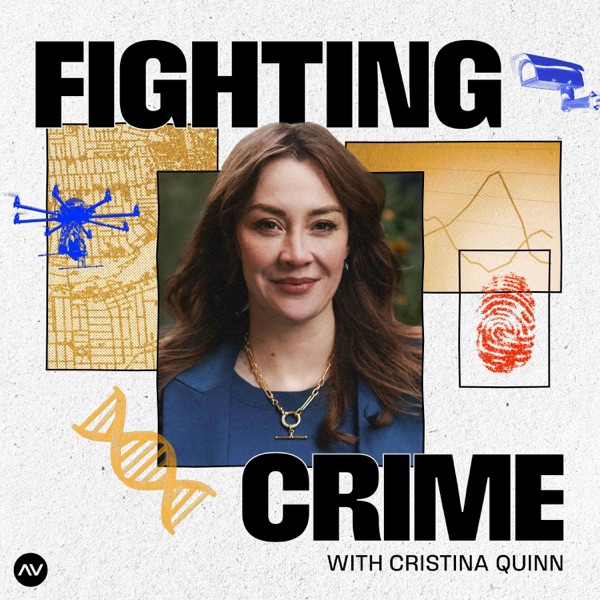
Fighting Crime dives into the world of crime to uncover the evidence of what actually works to improve public safety. Join journalist Cristina Quinn as she travels across the country - from prisons to universities, police chiefs to inmates - questioning everything we think we know about how to make America safer.
- Documentary chart
- #96
- Episodes
- 11
- Releases
- Every two weeks
- Typical length
- 42 min
- On air since
- 2026
- Latest episode
- 1 month ago
Episodes
11 episodes, newest first
-
47 min
Mental Illness: Providing the Best Support for All
Show notes
Mental illness does not mean that someone will resort to criminal
behaviour, but unfortunately it is over represented in prisons and
jails. Some criminal activity can in part due to difficult life
circumstances for people with mental illness and a lack of
treatment, and these individuals can be vulnerable to returning
back inside after release if they don’t have the care that they need.
At the same, jails and prisons aren’t the best places for someone
suffering from mental illness: the staff aren’t trained to provide this
care and incarceration can exacerbate some conditions, which
means it’s also expensive to take care of someone inside.
So how can we ensure people get the support they need so they
don’t end up in jail or prison, and to help keep them away upon
release? And which methods also have the best outcomes for us all
when it comes to budgets and public safety? Our host Cristina
Quinn speaks to experts to find out more.
This is the final episode of the first season of Fighting Crime. We
will be back with Season 2 soon. If you’d like to share ideas on
topics for us to cover, or anything else, contact us at
contact@fightingcrimepodcast.com
Guests:
David Phillips, Economist, University of Notre Dame
Vikki Wachino, Executive Director, HARP (Health and Reentry
Project)
Amy Watson, President, CIT International
John Wetzel, Pennsylvania Secretary of Corrections 2011 - 2021
Fighting Crime is an Indio Media Production for Arnold Ventures
© 2026 Arnold Ventures. All rights reserved.
-
43 min
Nursing Homes: the place for elderly prisoners
Show notes
America’s prison population is greying fast; it’s estimated that by 2030 up to a third will be geriatric prisoners. And with age often comes health issues and the need for specialist medical care. But prisons aren’t built to provide this nor are prison staff experts in giving this care. Which means that it can cost several times more to treat these individuals in prison than if they were released into specialist nursing facilities.
Before people worry about the threat to public safety of releasing elderly prisoners so they can get better and cheaper care in nursing homes, consider that people generally age out of crime, and recidivism rates for this group are far lower than for younger people who are released.
The situation is however made complicated by the fact that many nursing homes don’t accept people who are formerly incarcerated. Our host Cristina Quinn visits one of the nursing homes that does take in formerly incarcerated individuals, this being iCare’s 60 West facility in Rocky Hill, Connecticut, and finds out more about their work, and the potential benefits for us all of having elderly prisoners in such a place.
Guests
Thomas Picard, Resident, iCare’s 60 West facility
Mary Price, Senior Counsel, FAMM (Families Against Mandatory Minimums)
David Skoczulek, President of Business Development and Communication, iCare Health Network
Jess DeRing, Director of operations, MissionCare Health
Scott Semple, Commissioner of the Connecticut Department of Corrections 2014-19
Gary Bozette, Resident, iCare’s 60 West facility
-
43 min
Could GLP-1s cure addiction - and crime?
Show notes
Could the same drug curbing your appetite also curb crime? GLP-1s like Ozempic aren't just reshaping waistlines. Research suggests they could blunt cravings for alcohol, drugs, and even impulsive violence. We visit a halfway house running a pilot treatment program and meet the researchers hoping GLP-1s could transform how America fights addiction and crime...
Sources:
Glucagon-like peptide-1 receptor agonist use and violent crime among US adults; Daniel Semenza, George Thomas (2026)
GLP-1 Addiction Treatment Pilot Program; Open Doors and the Center for Addiction Science, Policy and Research (ongoing)
The potential role of GLP-1 receptor agonists in substance use disorders – a systematic review; K M Völker, B L H Prechtl, N L Bormann, D S Choi (2026)
Fighting Crime is an Indio Media Production for Arnold Ventures
© 2026 Arnold Ventures. All rights reserved.
-
41 min
Men Assaulting Women: How do we stop them?
Show notes
Around a fifth of American women report being raped in their
lifetimes, and figures for sexual assault are even higher. One
survey shows that a staggering 13.1% of college aged men say
they’ve committed rape. What drives men to sexually assault
women and how can we target men to prevent these crimes?
At the same time, convictions for these crimes are extremely low.
One reason for this is the reporting process can be traumatic, and
so around 80% of women never report their assault or rape.
However with little reporting crime experts also have less data to
understand who to target to reduce rape and assaults. So how can
we encourage more victims to report, and what are steps we can
take to combat these crimes and to keep women and girls safe?
If you have been a victim of sexual assault and would like support,
you can reach out to the National Sexual Assault Hotline at
RAINN.org.
Guests:
Jens Ludwig, Economist, University of Chicago
Jess Ladd, Co-founder of The Fund to Prevent Sexual Assault
Kennedy Johnston, Economics PhD student, Texas A&M
University
-
27 min
Burnout on the frontline of public safety
Show notes
Police officers across the country are reporting high levels of burn out, with many quitting the force after only a year or two. But when stress and fatigue are part of the nature of the job, what can those on the frontline of public safety do about it?
We hear how the power of human connection, sleep training and artificial intelligence are being used to try and make their shifts more manageable.
Sources:
Elizabeth Linos , Krista Ruffini, Stephanie Wilcoxen. Reducing Burnout and Resignations among Frontline Workers: A Field Experiment,, Journal of Public Administration Research and Theory, Volume 32, Issue 3, July 2022.
James, L., James, S., & Atherley, L. (2025). The Seattle Police Fatigue Training Experiment. Applied Police Briefings, 2(2), 25–27.
-
35 min
Crime is in the air
Show notes
Air quality has always been thought of as a public health problem,
but is it an issue for public safety. In this episode, we examine how
pollution can impact levels of violent crime. Plus, how poor air
quality in prisons creates a hostile environment for inmates and
corrections officers.
Guests:
Dr Anne Chappelle
Toxicologist, Trinity Consultants
Erich Muehlegger
Professor of Economics at University of California, Davis
Jeremy Tripp
Policy Director, One Voice United
Angela Hawken
Vice Dean for Research, Johns Hopkins University School of
Government and Policy
Sources:
Air Pollution and Criminal Activity: Evidence from Chicago Microdata
by Evan Hernstadt and Erich Muehlegger, 2015 .
On-going research into environmental factors and behavioral data at
a prison on the East Coast, Dr Angela Haken.
Mukherjee A, Sanders NJ. The causal effect of heat on violence:
social implications of unmitigated heat among the incarcerated.
National Bureau of Economic Research; 2021.
Extreme Heat and Suicide Watch Incidents Among Incarcerated
Men, David H Cloud, Emory University, Brie A Williams University of
California, San Francisco, Regine Haardörfer, Emory University,
Lauren Brinkley-Rubinstein, Vanderbilt University, 2023.
Impact of heat on all-cause and cause-specific mortality: A multi-city
study in Texas, Chunyu Guo University at Albany, State University of
New York, Kevin Lanza The University of Texas Health Science
Center at Houston, Dongying Li Texas A&M University, Yuyu Zhou
The University of Hong Kong, 2023.
Fighting Crime is an Indio Media Production for Arnold Ventures
© 2026 Arnold Ventures. All rights reserved.
-
36 min
How to Train a Cop
Season 1, Episode 4
Show notes
We all need the right training to do our jobs properly. So what do cops need so they can make better decisions in high-stakes and time-sensitive situations? In this episode we speak to economists about simple and effective training methods which help cops arrest the right people and keep us safer, which also cost next to nothing.
We’d love to hear from anyone in policing about interesting things you are trying: Contact us at: podcasts@arnoldventures.org
Guests:
Paul Noel, Chief of Police, Knoxville Police Department
Dr Emily Owens, University of California, Irvine
Dr Oeindrila Dube, University of Chicago
Sources:
Emily Owens, David Weisburd, Karen L. Amendola, Geoffrey P. Alpert, Can You Build a Better Cop? Experimental Evidence on Supervision, Training and Policing in the Community; Criminology and Public Policy, Volume 17, Issue 1 (2018)
Oeindrila Dube, Sandy Jo MacArthur, Anuj K. Shah, A Cognitive View of Policing; The Quarterly Journal of Economics, Volume 140, Issue 1, February 2025
Fighting Crime is an Indio Media Production for Arnold Ventures © 2026 Arnold Ventures.
All rights reserved.
-
44 min
Can a DNA cheek swab prevent crime?
Show notes
The use of DNA evidence has revolutionized crime investigations over the past 30 years, helping to catch criminals and keep us all safer. But are we fully using DNA’s potential to catch criminals? In this episode, a victim of sexual assault tells their powerful story of how DNA analysis led to justice, and how exactly DNA can be used to prevent crimes before they even happen. Guests:
Ashley Spence, Survivor, and Founder, DNA Justice Project Tiffany Roy, Professor of Forensic DNA Analysis David Rausch, Director, Tennessee Bureau of Investigation Max Isaacs, Director of Technology Law & Policy, The Policing Project Jennifer Doleac, Economist Sources:
Jennifer Doleac, Anne Sofie Anker and Rasmus Landersø, The Effects of DNA Databases on the Deterrence and Detection of Offenders; American Economic Journal: Applied Economics, Vol. 13, No. 4, October 2021 Fighting Crime is an Indio Media Production for Arnold Ventures © 2026 Arnold Ventures.
All rights reserved.
-
46 min
Little Scandinavia - An American Prison Experiment
Show notes
American prisons are not designed to be welcoming places. But what if the American prison experience was reimagined, to the benefit of corrections officers and inmates? In this episode, we head to an experimental prison housing unit in Pennsylvania, which is trying to do just that, by incorporating the ethos of a Scandinavian prison.
Guests:
Allison Murphy, Assistant to the SCI Chester Superintendent
Paige Devane, Corrections Officer, Little Scandinavia
Gina Clark, SCI Chester Superintendent Professor
Jordan Hyatt, Director of the Center for Public Policy, Drexel University
Bret Bucklen, Research Director, Pennsylvania Department of Corrections
Sources:
With thanks to John Stark and Swedish Television for the stills and footage from their documentary "Prison Project: Little Scandinavia" © Swedish Television SVT, 2023
Fighting Crime is an Indio Media Production for Arnold Ventures © 2026 Arnold Ventures.
All rights reserved.
-
36 min
Why don't people leaving prison get jobs?
Season 1, Episode 1
Show notes
Getting a good job after prison is one of the best ways to beat recidivism. But what does the evidence actually say about getting formerly incarcerated people back into work? In this episode, we discover some ideas that are helping and hindering people in getting jobs. The solutions are cheaper and simpler than you might expect.
Guests:
Coss Marte, founder of ConBody and ConBud
Dr Amanda Agan, Cornell University
Dr Zoe Cullen, Harvard Business School
Sources:
Amanda Agan, Sonja Starr, Ban the Box, Criminal Records, and Racial Discrimination: A Field Experiment; The Quarterly Journal of Economics, Volume 133, Issue 1, February (2018)
Zoe B. Cullen, Will S. Dobbie, and Mitchell Hoffman, Increasing the Demand for Workers with a Criminal Record, NBER Working Paper 29947 (2022)
Fighting Crime is an Indio Media Production for Arnold Ventures © 2026 Arnold Ventures.
All rights reserved.
-
2 min
Introducing... Fighting Crime Trailer
Show notes
There are a bunch of ways to improve public safety that no one is talking about. Launching May 28th, Fighting Crime will dive into the world of crime, policy, and economics, to uncover the evidence of what actually works to improve public safety. It’s not true crime - it’s the truth about crime.
Documentary lists
More Documentary shows picked out from the charts










More in Documentary
Placed highest on Apple Podcasts' Documentary chart right now