Podcast
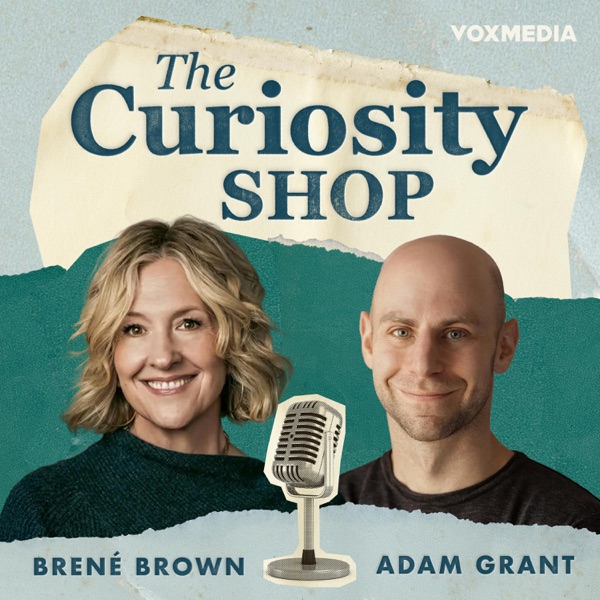
The Curiosity Shop with Brené Brown and Adam Grant
Research professor Brené Brown and organizational psychologist Adam Grant are partnering on a new weekly podcast grounded in an unflinching commitment to learning and unlearning. At a time when public discourse rewards certainty over inquiry, The Curiosity Shop features two of the world's most sought-after experts on connection, change, and leadership making the case for slowing down, asking better questions, and embracing informed complexity over easy answers. Bringing together their left and right brain sensibilities — she’s a qualitative researcher; he’s a quantitative researcher — they explore some of the defining questions of our time, unpack the research reshaping how we live, lead, and love, and dive deep into the ideas, evidence, and cultural moments intriguing them the most. New episodes drop every Thursday. Part of the Vox Media Podcast Network.
- Society & Culture chart
- #77
- Episodes
- 117
- Releases
- Weekly
- Typical length
- 1 hr 3 min
- On air since
- 2020
- Latest episode
- 3 weeks ago
Episodes
117 episodes, newest first
-
1 hr 3 min
The Four Kinds of Connections We Need
Show notes
In the final episode of The Curiosity Shop, Brené Brown and Adam Grant draw on Adam’s new book, Vibe (out October 13), to explore how recognizing the differences between associates, allies, pals, and companions can help us better understand our connections. They unpack the pressure we put on relationships, the importance of being clear about what we want from them, and why a great interaction doesn’t always need to become an ongoing relationship. They also explore the idea of being on the same wavelength and the concept of “sonder,” the recognition that we can never fully know another person’s inner world. Along the way, Brené and Adam reflect on their own relationship, what they’ve learned from working together, and how their connection has evolved throughout The Curiosity Shop.
Vibe – Adam Grant, 2026, adamgrant.net
Tiny Experiments: How to Live Freely in a Goal-Obsessed World – Anne-Laure Le Cunff, 2025, Ness Labs
How the Enneagram System Works – The Enneagram Institute, enneagraminstitute.com
Give and Take – Adam Grant, 2013, adamgrant.net
What I Got Wrong About Connection – Adam Grant, 2026, Granted (Substack)
How I Overcame the Fear of Public Speaking – Adam Grant, 2014, Psychology Today
The Grapes of Wrath – John Steinbeck, 1939, Penguin Random House
Friends – David Crane, 1994, NBC (IMDb)
Vibe Quiz – Adam Grant, adamgrant.net
DTR – Dictionary.com, 2018, Dictionary.com
Nicomachean Ethics, Book VIII – Aristotle, c. 350 BCE, The Internet Classics Archive (MIT)
Friendship – Bennett Helm, 2021, Stanford Encyclopedia of Philosophy
The Anatomy of Friendship – Robin Dunbar, 2018, Trends in Cognitive Sciences
Let's Rumble – Brené Brown, 2019, brenebrown.com
Similar Neural Responses Predict Friendship – Carolyn Parkinson, 2018, Nature Communications
Single-Serving Friends (Fight Club) – Uploader unknown, YouTube
Wharton Professor Adam Grant Knows How to Build Stronger Bonds at Work – Aman Kidwai, 2025, Newsweek
Mistakenly Seeking Solitude – Nicholas Epley, 2014, Journal of Experimental Psychology: General
Learning to Talk to Strangers – Gillian Sandstrom, 2022, SPSP Character & Context blog
Flow and Happiness – Joachim Krueger, 2015, Psychology Today
Brené and Adam on What They Will Never Agree On – Brené Brown, 2026, The Curiosity Shop (YoutTube)
Do Parasocial Relationships Fill a Loneliness Gap? – Heidi Godman, 2024, Harvard Health Publishing
Sonder – John Koenig, The Dictionary of Obscure Sorrows
Beautiful New Words to Describe Obscure Emotions – John Koenig, 2016, TEDxBerkeley
Atlas of the Heart – Brené Brown, 2021, brenebrown.com
Sonder Playlist - The Best of Sonder – Revive Music, YouTube
The Development of Children's Knowledge About Inner Speech – John Flavell, 1997, Child Development
9 Words for Types of Parenting – Merriam-Webster, Merriam-Webster Wordplay
VIBE Tour – Adam Grant, adamgrant.net
Adam Grant – Dallas – Dallas Museum of Art Arts & Letters Live – Etix, 2026, Etix
ReThinking with Adam Grant – Adam Grant, 2021, TED Audio Collective
Brian R. Little – Brian Little, brianrlittle.com
Nicomachean Ethics, Book VIII – Aristotle, c. 350 BCE, The Internet Classics Archive (MIT)
Learn more about your ad choices. Visit https://podcastchoices.com/adchoices
-
49 min
Resisting Influence in an Over-Influenced World
Show notes
Why are we so susceptible to persuasion? In this episode of The Curiosity Shop, Brené Brown and Adam Grant discuss a tip Brené picked up from Seventeen magazine in the ‘80s and end up exploring why we fall for misinformation and persuasive messaging. They examine how vulnerability makes us more receptive to fear-based messaging, how appeals to authority can sometimes stand in for real evidence, and why recognizing misinformation isn’t always enough to protect us from it. Brené and Adam also consider the role of belonging, including the ways our desire for connection, community, and shared identity can make certain ideas especially persuasive. Along the way, they develop a practical framework for resisting unwanted influence: recognize your vulnerability, build your persuasion literacy, and trace information back to its source.
Vibe: The Secrets of Strong Connections in a Lonely World - Adam Grant, 2026, Viking
MythBusters: Rinsing Your Hair In Cold Water - Into The Gloss, 2015
I Washed My Hair With Coca-Cola (and Other Teen-Magazine Beauty Experiments) - Seventeen
Made to Stick: Why Some Ideas Survive and Others Die - Chip Heath & Dan Heath, 2007, Random House
Jayne Modean - Wikipedia contributors, Wikipedia
Alzheimer's Association 24/7 Helpline, 800-272-3900 - Alzheimer's Association
Dr. Cialdini's Biography - Influence at Work
Dr. Jessica Knurick - Jessica Knurick
Jessica Knurick's Reaction Video - Jessica Knurick, Facebook
What's the Difference Between Physicians and Naturopaths? - American Medical Association, 2024
Appeal to Authority Fallacy: When Expertise Becomes a Logical Trap - Logically Fallacious, 2026
Evidence-Based Practice: Levels of Evidence - Memorial Sloan Kettering Cancer Center Library
Evidence-Based Management - Jeffrey Pfeffer & Robert Sutton, 2006, Harvard Business Review
The Mirror-Neuron System - Giacomo Rizzolatti & Laila Craighero, 2004, Annual Review of Neuroscience
The Confidence Game: Why We Fall for It . . . Every Time - Maria Konnikova, 2016, Viking
How to Know If You're Being Lied To - Khazan, 2016, The Atlantic
Recursive Self-Improvement and Agentic AI: Fear of the AI Singularity - HackerNoon, 2026
LinkedIn Post on Collective Vulnerability - Brené Brown, 2020, LinkedIn
Brené on FFTs - Brené Brown, 2020, Unlocking Us
The Group Polarization Phenomenon - David Myers & Helmut Lamm, 1976, Psychological Bulletin
Group Polarization - EBSCO Research Starters
How 'Prebunking' Misinformation Works - CBS News / 60 Minutes, YouTube
Bad News - Cambridge Social Decision-Making Lab, (Game that teaches manipulation tactics)
Lump: A Memoir in Ineloquent Reflections - Allison Sweet Grant, 2026, Little, Brown and Company
National Breast Cancer Foundation - National Breast Cancer Foundation
Learn more about your ad choices. Visit https://podcastchoices.com/adchoices
-
1 hr 4 min
Why Grit Isn’t Always Enough with Angela Duckworth
Show notes
What if grit isn’t the whole story behind success? Psychologist and author Angela Duckworth joins Brené Brown and Adam Grant to talk about her new book, Situated, and how the situations around us influence our behavior, motivation, creativity, and success. They unpack situational awareness, the paradox of self-control, and why willpower can be an unreliable tool for change. Angela also shares practical ways to shape your environment, reduce friction around your goals, and decide whether to keep going versus change course. Together, they explore how becoming more intentional about our surroundings, relationships, and support systems is often more powerful than simply trying harder.
Grit: The Power of Passion and Perseverance - Angela Duckworth, 2016, Scribner
LinkedIn post on situations - Angela Duckworth, 2025, social-media post, LinkedIn
Situated Scorecard Handout - Angela Duckworth, 2026, PDF handout, angeladuckworth.com
As You Like It, Act 2, Scene 7 - William Shakespeare, c. 1599, Folger Shakespeare Library
Wendy Wood – Publications - Wendy Wood, faculty web page, USC Dornsife
Asaf Mazar - Asaf Mazar, personal website
Alistair Brownlee | The Greatest to Ever Do It - World Triathlon, 2024, video, YouTube
Prepared Environment - Association Montessori Internationale, glossary entry, AMI glossary
The Myth of Self-Control - Resnick, 2016, Vox
The Power of Vulnerability - Brené Brown, 2010, TED Talk (video), TEDxHouston / TED
Hope (Psychology) - EBSCO, encyclopedia-style research overview, EBSCO Research Starters
Documenting Anne Lamott - SFGate / San Francisco Chronicle (no byline), SFGate
Genius of the AND - Jim Collins, concept page (with excerpts from Built to Last), JimCollins.com
Adam Grant on How to Reach New Heights - Wharton Magazine (no byline), 2023, Wharton Magazine
Learn more about your ad choices. Visit https://podcastchoices.com/adchoices
-
37 min
Rethinking Leadership, Work, and Human Connection in the Age of AI
Show notes
In this solo episode of The Curiosity Shop, Adam Grant answers questions about leadership, rethinking, careers, AI, and the future of work. He explores how leaders can make people feel heard without adopting every idea, why seeking feedback early can shape a transformational leader, and how to speak up in ways that actually create change. Adam also reflects on a hiring mistake that challenged his own thinking, explains why he’s changed his mind about tradition, and considers why political beliefs are so difficult to rethink. Along the way, he shares his perspective on the jobs most likely to preserve human connection in the age of AI, the benefits and limitations of remote and hybrid work, and how people can reshape and grow beyond their job descriptions. He also takes on a few lighter questions, sharing whether he still practices magic, his favorite food, and what he admires about Tom Brady.
Give and Take: A Revolutionary Approach to Success – Adam Grant, 2013, (book) Viking
I Have a Dream – Martin Luther King Jr., August 28, 1963, (speech video) Internet Archive
Martin Luther King Jr., Man of the Year – TIME, January 3, 1964, (magazine cover story) TIME
Feedback Seeking – Susan J. Ashford, (author research page) susanashford.com
Hidden Potential: The Science of Achieving Greater Things – Adam Grant, 2023, (book) Viking
Vibe: The Secrets of Strong Connections in a Lonely World – Adam Grant, 2026, (book) Viking
Jennifer A. Doudna – Biographical – The Nobel Prize, 2020, (autobiographical essay) NobelPrize.org
Tom Brady Improves 40-Yard Dash Time – NOBULL, September 19, 2024, (video) YouTube
Learn more about your ad choices. Visit https://podcastchoices.com/adchoices
-
1 hr 9 min
Can Conflict Actually Make Our Relationships Stronger? with Priya Parker
Show notes
Does conflict really have the power to bring us closer together? In this episode of The Curiosity Shop, facilitator and author Priya Parker joins Brené Brown and Adam Grant to rethink how we approach conflict. Drawing from her new book, The Art of Fighting, Priya explores why avoiding conflict can create distance in our relationships, how “healthy heat” differs from destructive conflict, and why practicing disagreement when the stakes are low can prepare us for the conversations that matter most. Together, they unpack toxic politeness and why meaningful relationships require us to embrace discomfort instead of avoiding it. They also explore how preparation and collective humanity can be powerful tools to de-escalate conflict. The conversation leads Brené and Adam to reflect on their own history and how some of their hardest conversations have ultimately deepened their friendship.
About Priya Parker | Her Story – Priya Parker, priyaparker.com (web page)
The Art of Gathering: How We Meet and Why It Matters – Priya Parker, 2018, Riverhead Books (book)
Group Life – Priya Parker, n.d., Substack (newsletter)
Prentis Hemphill – Prentis Hemphill, n.d., prentishemphill.com (personal website)
Clear Is Kind. Unclear Is Unkind. – Brené Brown, 2018, brenebrown.com (article)
Working at Canlis – Canlis, n.d., canlis.com (careers page)
Do I stay or do I go? – Priya Parker, 2026, Group Life (newsletter post, Substack)
Festivus: The Airing of Grievances – Seinfeld, “The Strike,” 1997, YouTube (video clip)
The Rituals Of Reality TV Reunions: An In-Depth Examination – Gibson Johns, 2024, Betches (article)
Resources – Conscious Leadership Group, conscious.is (resource library)
How to Use the Drama Triangle at Work – Conscious Leadership Group, n.d., conscious.is (blog post)
Martin B. Copenhaver – The Christian Century, christiancentury.org (contributor page)
Open and Affirming – UCC Open and Affirming Coalition, openandaffirming.org (organisation page)
Open and Affirming – United Church of Christ, n.d., ucc.org (denomination page)
Robert's Rules of Order – Henry M. Robert, 1876, Project Gutenberg (book)
The 12 New Books to Spice Up Your Fall – Adam Grant, 2026, Granted (newsletter post, Substack)
Learn more about your ad choices. Visit https://podcastchoices.com/adchoices
-
1 hr 26 min
What Chimpanzees Reveal About How We Connect and Divide with Aaron Sandel
Show notes
Primatologist Aaron Sandel has spent over a decade studying the Ngogo chimpanzees, witnessing one of the largest known chimp communities split into two factions. In this episode, Aaron joins Brené and Adam to explore what chimpanzees can teach us about friendship, conflict, belonging, and human nature. He shares what he learned from watching these chimps show affection, navigate dominance hierarchies, and face the effects of division within their own community. Aaron also reflects on what it was like to watch chimps he knew by name turn against one another, while exploring the surprising depth of bonds between chimpanzees. Together, they explore the parallels between chimpanzee behavior and the ways we harmonize, polarize, and build communities in our own lives.
Prof. Aaron Sandel – Aaron Sandel, aaron-sandel.com
The Ngogo Chimpanzee Project – Watts, D., et al., ngogochimpanzeeproject.org
Lethal Conflict After Group Fission in Wild Chimpanzees – Sandel, A., et al., 2026, Science
Chimp Empire | Mahershala Ali | Official Trailer – Netflix, March 22, 2023, YouTube (Video)
Which Chimp Is Which in Chimp Empire? – Netflix, April 26, 2023, Netflix Tudum
What Happened to the Chimps in ‘Chimp Empire?’ – Netflix Tudum, May 2, 2023, Netflix
Kibale National Park – Google, Google Maps (Map)
Kibale National Park – Kibale Chimpanzee Project, Harvard University
Uganda Wildlife Authority – Uganda Wildlife Authority, ugandawildlife.org
How Was Chimp Empire Made? – Netflix Tudum, May 2, 2023, Netflix
Male Chimpanzees Form Enduring and Equitable Social Bonds – Mitani, J., 2009, Animal Behaviour
My Life Among the Apes – Mitani, J., 2020, American Journal of Primatology
Rise of the Warrior Apes – James Reed (Director), 2017, KEO Films (Film - Prequel to Chimp Empire)
Are We Smart Enough to Know How Smart Animals Are? – Frans de Waal, 2016, W. W. Norton (Book)
Conservation – The Ngogo Chimpanzee Project, ngogochimpanzeeproject.org
Think Again: The Power of Knowing What You Don’t Know – Adam Grant, 2021, adamgrant.net (Book)
Brené Brown Says You’re Doing Feelings Wrong – Dan Harris, April 2022, Ten Percent Happier (Podcast)
Ancestral Diversity – Niedenthal Emotions Lab, University of Wisconsin–Madison
Learn more about your ad choices. Visit https://podcastchoices.com/adchoices
-
1 hr 3 min
Building Integrity in the Age of Normalized Cheating
Show notes
What happens to integrity when cheating becomes easier and the world seems to reward people for cutting corners? In this episode of The Curiosity Shop, Adam shares what happened when he discovered that students were planning to use AI to cheat on an exam. Brené and Adam move into a much larger conversation about honesty, character, and moral identity. Together, they explore when using AI is inherently cheating, why monitoring people isn’t enough to make them trustworthy, the difference between shame and adaptive guilt, and what research reveals about building a stronger moral compass. They also unpack why honor codes can sometimes backfire, how inconsistent accountability undermines trust, and what dimension of character we often overlook. Ultimately, Brené and Adam explore the difference between wanting to be seen as a good person and choosing to become the kind of person who does the right thing even when no one else is watching.
Cheating: Why Students Do It and How We Can Help Them Stop – Donald McCabe, 2001, American Educator
Brené Brown: The Rage Bucket Theory – Trevor Noah, June 4, 2026, What Now? with Trevor Noah
Pickleball Line Rules: Calling the Ball “In” or “Out” – PlayPickleball.com, July 31, 2024, YouTube
How Handwriting Trains the Brain – Gwendolyn Bounds, October 5, 2010, The Wall Street Journal
Moral Emotions and Moral Behavior – Tangney et al., 2007, Annual Review of Psychology
Shame and Guilt – Tangney & Dearing, 2002, Guilford Press
Shame v. Guilt – Brené Brown, January 14, 2013, brenebrown.com
The Honor Committee – University of Virginia, honor.virginia.edu
Bicentennial Analysis – UVA Honor Committee, 2019, University of Virginia
Trump Reports Over $1 Billion in Income From Crypto Ventures – TIME, June 30, 2026, TIME
Stop Trading on Congressional Knowledge Act of 2012 – U.S. Congress, 2012, Pub. L. No. 112-105
This Is Your Brain on Drugs – Partnership for a Drug-Free America, 1987, YouTube
Beyond Pleasure and Pain – Higgins, 1997, American Psychologist
Self-Discrepancy: A Theory Relating Self and Affect – Higgins, 1987, Psychological Review
Possible Selves – Markus & Nurius, 1986, American Psychologist
The BRAVING Inventory – Brené Brown, brenebrown.com
An Integrative Model of Organizational Trust – Mayer et al., 1995, Academy of Management Review
Integrity Is Choosing Courage Over Comfort – Brené Brown, brenebrown.com
Atomic Habits: An Easy & Proven Way to Build Good Habits & Break Bad Ones – James Clear, 2018, Avery
Learn more about your ad choices. Visit https://podcastchoices.com/adchoices
-
41 min
Brené Brown on Protecting our Attention, Time, and Humanity in a World that Won’t Slow Down
Show notes
In this solo episode of The Curiosity Shop, Brené Brown turns to questions and comments from her LinkedIn community to explore what it means to protect our humanity and attention in a world moving faster than ever. She digs into where AI can support our work without replacing human discernment, why "work slop" costs leaders real cognitive bandwidth, and how leaders can tell the difference between polished output and actual understanding. Brené also unpacks Aiko Bethea's idea that transformation requires grief, reflects on what her conversation with Rebecca Lowe revealed about preparation and presence, and explores how pausing and active listening are essential parts of meaningful conversation. Along the way, she explains why she wears two watches and shares the story of getting fired from a house-cleaning job… and the unexpected lesson it taught her about why shiny can never replace mastery.
Brené Brown — Brené Brown, LinkedIn (Profile)
Adam Grant — Adam Grant, LinkedIn (Profile)
On Death and Dying — Elisabeth Kübler-Ross, 1969, Macmillan (Book)
Multitasking: Switching Costs — American Psychological Association, 2006, APA
Center for Humane Technology — Center for Humane Technology, humanetech.com
Kairos: The Right Moment or Occasion — Barbara Baert, Institute for Advanced Study
The History of the Elgin National Watch Company — Times Ticking, timesticking.com
Aiko Bethea — Aiko Bethea, aikobethea.com
RARE Coaching & Consulting — Aiko Bethea, rarecoaching.net
Rebecca Lowe Bio & Career Accomplishments — FOX Sports, FOX Sports
Dare to Lead Hub — Brené Brown, brenebrown.com
The Curiosity Shop with Brené Brown and Adam Grant — YouTube (Channel)
Learn more about your ad choices. Visit https://podcastchoices.com/adchoices
-
57 min
Can We Build an “Us” Without a “Them”? with John Green
Show notes
Is it possible to build a community without a 'them'? Author, YouTuber, and podcaster John Green joins Brené Brown and Adam Grant for a wide-ranging conversation on belonging, friendship, and the systems that shape our lives. Together, they explore why sports can create such powerful communities, whether it’s possible to build an “us” without needing a “them,” and why shared projects can help relationships last for decades. John reflects on the challenges of young adulthood, what he learned from working as a hospital chaplain, and why supporting someone in pain sometimes means resisting the urge to fix it. The conversation also moves through why frictionless access, not just awareness, is essential to helping people get the care they need, the role coaches can play in athletes’ well-being, and John’s upcoming novel Hollywood, Ending.
Hollywood, Ending - John Green, September, 2026, hollywoodendingbook.com
CrashCourse - Hank Green & John Green, YouTube
Demonic males: Apes and the origins of human violence - Wrangham & Peterson, 1996, Houghton Mifflin.
The Descent of Man, and Selection in Relation to Sex - Charles Darwin, 1871/1999, Project Gutenberg
Roger Bennett – Men in Blazers Media Network
Developmental Sequence in Small Groups - Bruce W. Tuckman, 1965, Psychological Bulletin
Single-Session Interventions for Mental Health Problems and Service Engagement: Umbrella Review of Systematic Reviews and Meta-Analyses - Jessica Schleider et al., 2025, Annual Review of Clinical PsychologyAdministrative Burdens in the Social Safety Net - Herd and Moynihan, 2024, Journal of Economic Perspectives
The Inverse Care Law - Julian Tudor Hart, 1971, The Lancet
Rebooting Psychotherapy Research and Practice to Reduce the Burden of Mental Illness - Alan E. Kazdin & Stacey L. Blase, 2011, Perspectives on Psychological ScienceAre Mental Health Awareness Efforts Contributing to the Rise in Reported Mental Health Problems? A Call to Test the Prevalence Inflation Hypothesis - Lucy Foulkes & Jack L. Andrews, 2023, New Ideas in Psychology
Meet the Genius Behind America’s Best Roadside Attraction - Show and Tell, Atlas Obscura, YouTube
Kate Bowler - Kate Bowler, katebowler.com
Learn more about your ad choices. Visit https://podcastchoices.com/adchoices
-
1 hr 25 min
Leading Under Pressure with Rebecca Lowe
Show notes
What does it take to stay calm when millions are watching? Rebecca Lowe, the host of NBC’s Premier League coverage and Fox’s record-breaking 2026 World Cup broadcast, joins Brené Brown and Adam Grant to explore why preparation—not confidence—is her real superpower; the weight of being one of the only women in the room; and what it really means to lead when things get chaotic. Together, they unpack the difference between presence and preparedness, the “permission slip” moment that defines great leadership, and why the loudest person in the room isn’t always the one in charge. Along the way, Rebecca reflects on breaking barriers in a male-dominated industry, how she earns trust from personalities like Zlatan Ibrahimović, and the teachable habit she uses to keep her co-hosts focused on live TV.
The Return of Coach Lasso – NBC Sports, 2014, YouTube
Nessun Dorma, Rome 1990 – Luciano Pavarotti, 1990, YouTube
Double Standards for Competence – Martha Foschi, 2000, Annual Review of Sociology
"Executive Presence" Is Overrated – Adam Grant & Brené Brown, 2025, Instagram
Beyond Nine to Five – Lieke ten Brummelhuis, 2017, Academy of Management Discoveries
Can Your Employees Really Speak Freely? – James Detert, 2016, Harvard Business Review
Trailblazing Motivation and Marginalized Group Members – Karren Knowlton, 2025, Organization Science
Bullet Time Effect in "Sherlock" the BBC TV Series – Moffat & Gattiss, January 14, 2014, BBC/YouTube
Conversational Style – Deborah Tannen, 2005, Oxford University Press
Who Won't Shut Up in Meetings? – Adam Grant, 2021, The Washington Post
Dare to Lead read-along workbook (Permission Slips) – Brené Brown, 2021, Brené Brown, LLC
Tell Me What I Did Wrong – Stacey Finkelstein, 2012, Journal of Consumer Research
Emotional Contagion – Elaine Hatfield, 1993, Current Directions in Psychological Science
Huge If True – Cleo Abram, YouTube
Range – David Epstein, 2019, Riverhead Books
Hidden Potential – Adam Grant, 2023, Viking
What Being Sober Has Meant to Me – Brené Brown, 2019, brenebrown.com
The Gifts of Imperfection – Brené Brown, 2010, Hazelden Publishing
The Queen Bee Phenomenon – Belle Derks, 2016, The Leadership Quarterly
Learn more about your ad choices. Visit https://podcastchoices.com/adchoices
-
1 hr 13 min
Why Sports Matter Even When the Game Doesn’t with Roger Bennett
Show notes
Why do sports make us cry, unite strangers, and create memories that last a lifetime? In this episode, Men in Blazers founder and CEO Roger Bennett joins Brené Brown and Adam Grant fresh off a 39-day World Cup marathon to explore what the tournament revealed about identity, belonging, and the power of collective effervescence. Together, they unpack the difference between hero players and hero teams, what it means to be a true fan, the political complexities surrounding the World Cup, and how sports create shared experiences that shape our lives. Along the way, Roger shares stories from the road, reflects on the strange grief of “World Cup withdrawal,” and revisits some of the tournament’s most memorable stories, including Erling Haaland’s taxidermy shop detour, the Cape Verde goalkeeper who became a global icon overnight, the controversial red card reversal, and more.
Roger Bennett – Men in Blazers Media Network
The Kansas City fanwalk had us all like… – OnsOranje, Royal Dutch Football Association
The Numbers Game: Why Everything You Know About Football Is Wrong – Anderson & Sally, 2013, Penguin
Men in Blazers - “The Women’s Game” and “Vamos” (Platform links) – The Men in Blazers Media Network
Who Belongs? Football and the Reinvention of the Modern Nation – Josh Wilson, 2026, TIME
The definition of a true fan – Adam Grant, Instagram
Folarin Balogun's lifted suspension – Roger Bennett, CBS Morning News, Instagram
Human challenges in polar and space environments – Sandal et al., 2006, Springer
Learn more about your ad choices. Visit https://podcastchoices.com/adchoices
-
1 hr 4 min
The Framework for Leading With Both Care and Accountability
Show notes
This episode is a master class in coaching as Aiko Bethea, one of the most respected senior leadership coaches in the country, takes Brené through a current leadership conflict in real time, showing just how hard it is to slow down and lead from your values instead of your urgency. The coaching session is underpinned by Aiko's new "Anchored, Aligned, and Accountable" framework that focuses on why self-leadership is so critical in today's complex operating environment. Together, they dig into the difference between assuming good intent and believing someone is doing the best they can, and why that distinction changes what accountability actually looks like in practice. Aiko also introduces and models the powerful coaching practice of "three levels of listening" and how it's central to developing a coaching mindset.
Aiko Bethea — Aiko Bethea, aikobethea.com
Dare to Lead Hub — Brené Brown, brenebrown.com
Audre Lorde — Mariana Brandman, 2021, National Women's History Museum
bell hooks — Asami Robledo-Allen Yamamoto, 2025, National Women's History Museum
RARE Coaching | Aiko Bethea (@rare_coach) — Aiko Bethea, n.d., Instagram
This Is Our Reminder of What Courageous Leadership Looks Like — Brené Brown, 2026, LinkedIn
One of the Greatest Joys of My Career Has Been… — Brené Brown, 2026, LinkedIn
Futurist Amy Webb on What's Coming (and What's Here) — Brené Brown, 2024, Dare to Lead podcast
Rising Strong — Brené Brown, 2015, Random House
Post on Learning and Development (#learninganddevelopment) — Aiko Bethea, 2026, LinkedIn
Dare to Lead — Brené Brown, 2018, Random House
Learn more about your ad choices. Visit https://podcastchoices.com/adchoices
-
39 min
You Don't Get an A for Effort
Show notes
Previously released on Dare to Lead, this is part of a special six-part series with Adam Grant on Brené's book, Strong Ground. Brené and Adam unpack the difference between effort and excellence, why coaching matters more than judgment, and how unclear priorities can quietly derail even the hardest-working teams. From there the conversation moves further into prioritization, a consequential 2x2 decision-making framework, and how leaders inadvertently signal the wrong priorities through their emotional reactions. Circling back to effort, they also discuss why the first question leaders should ask when results fall short is whether they set their team up for success in the first place. Plus, Brené has a real-time realization that her own team may not be aligned on what's actually consequential.
Think Again: The Power of Knowing What You Don't Know – Adam Grant, 2021, Viking
No, You Don't Get an A for Effort – Adam Grant, 2024, The New York Times
Mindset: The New Psychology of Success – Carol Dweck, 2006, Random House
What Having a “Growth Mindset” Actually Means – Carol Dweck, 2016, Harvard Business Review
“Both/And” Leadership – Wendy Smith, 2016, Harvard Business Review
Genius of the AND – Jim Collins, n.d., JimCollins.com
Reversible and Irreversible Decisions – Shane Parrish, n.d., Farnam Street
Above/Below the Line Practice – Brené Brown, 2025, BrenéBrown.com
Fairy Tales and Script Drama Analysis – Stephen Karpman, 1968, Transactional Analysis Bulletin (Origin paper for the villain/rescuer/victim model of conflict)
Learn more about your ad choices. Visit https://podcastchoices.com/adchoices
-
38 min
Time Scarcity and Pocket Presence
Show notes
Previously released on Dare to Lead, this is part of a special six-part series with Adam Grant on Brené's book, Strong Ground. The conversation opens on time scarcity, the devaluation of future time, and whether hope is actually a strategy. From there they discuss how great leaders don't need all the right answers (just the right questions) and the difference between executive presence and pocket presence. While digging into how the five C's of delegation build the situational awareness and critical thinking that pocket presence requires, Adam has a breakthrough realization that pocket presence isn't just an individual skill, it's a collective capability. Executive presence, they agree, is "party of one."
Time for Happiness – Ashley Whillans, 2019, Harvard Business Review
The Will and the Ways – C. R. Snyder, 1991, Journal of Personality and Social Psychology
Hope Theory: Rainbows in the Mind – C. R. Snyder, 2002, Psychological Inquiry
Golden Eggs and Hyperbolic Discounting – David Laibson, 1997, The Quarterly Journal of Economics
Some Empirical Evidence on Dynamic Inconsistency – Richard Thaler, 1981, Economics Letters
The stranger within: Connecting with our future selves – Cynthia Lee
Stop Overdoing Your Strengths – Robert Kaplan, 2009, Harvard Business Review
Research: Vague Feedback Is Holding Women Back – Shelley Correll, 2016, Harvard Business Review
The New Rules of Executive Presence – Sylvia Ann Hewlett, 2024, Harvard Business Review
Pocket Presence (Video) – Emmanuel Acho, n.d., TikTok
Essential social work theories & models – Syracuse University, n.d., OnlineGrad@Syracuse
The 5 Cs of strategic thinking, decision making, and delegating – Brené Brown, n.d., brenebrown.com
Atomic Habits – James Clear, 2018, Avery
Learn more about your ad choices. Visit https://podcastchoices.com/adchoices
-
43 min
Sports as Leadership Theater and Recognizing Near Enemies
Show notes
Previously released on Dare to Lead, this is part of a special six-part series with Adam Grant on Brené's book, Strong Ground. They dig into the Buddhist concept of near and far enemies- and why the biggest threat to your values isn't the opposite of them, it's what masquerades as them. From there they move into discussion around the value of paradoxical thinking, why some tensions aren't meant to be resolved, and why sports are leadership theater. Plus a conversation about why future time is always undervalued.
The Near Enemies of the Heart – Jack Kornfield, n.d., jackkornfield.com
Almost Everything: Notes on Hope – Anne Lamott, 2018, Riverhead Books (Chapter 2: “Inside Job”)
12 truths I learned from life and writing – Anne Lamott, July 13, 2017, TED (Video)
Genius of the AND – Jim Collins, n.d., jimcollins.com
Exploration and Exploitation in Organizational Learning – James G. March, 1991, Organization Science
Putting Feelings Into Words – Lieberman et al., 2007, Psychological Science
How to Tame Reactive Emotions by Naming Them – Mitch Abblett, 2022, Psychology Today
Maker's Schedule, Manager's Schedule – Paul Graham, 2009, paulgraham.com
The Tush Push Explained – Kyle Brandt & Dr Neil DeGrasse Tyson, 2024, NFL (Video)
The Pre-Mortem Method – Gary Klein, 2021, Psychology Today
Golden Eggs and Hyperbolic Discounting – David Laibson, 1997, Quarterly Journal of Economics (PDF)
Learn more about your ad choices. Visit https://podcastchoices.com/adchoices
-
44 min
Courageous Leadership as a Daily Practice
Show notes
In this Re:Thinking podcast episode recorded at Authors@Wharton, Brené joined Adam to dig into her book, Strong Ground. They explore why courage now has to mean being a learner instead of a knower, and why values aren't just what you care about-- they're what you sacrifice for. The conversation moves through the four skill sets of courage, why a value that isn't operationalized into behavior is just a poster with an eagle on it, and how to use the "story I'm making up" framework for hard conversations. They also get into executive presence, vulnerability, care, and why fake courage is easy to spot.
Research – Brené Brown (n.d.).
The discovery of grounded theory – Glaser & Strauss, 1967, Aldine
Awareness of dying – Glaser & Strauss, 1965, Aldine
De-tabooing dying control – Thulesius et al., 2013, BMC Palliative Care
Never Split The Difference – Chris Voss, May 24, 2016, TEDx University of Nevada
Expectancy Theory (Victor Vroom) – The Decision Lab, (n.d.)
Dare to lead: List of values – Brené Brown, 2018
Dare to Lead Hub – Brené Brown
Brené Brown brings Dare to Lead program to UT – University of Texas at Austin, 2020, UT News
Neural processing of narratives – Jääskeläinen et al., 2020, Frontiers in Human Neuroscience
The New Rules of Executive Presence – Sylvia Ann Hewlett, Jan-Feb 2024, Harvard Business Review
Learn more about your ad choices. Visit https://podcastchoices.com/adchoices
-
1 hr 21 min
The Highest Performance Strategy is Caring About People ft. Simon Sinek
Show notes
In this episode of The Curiosity Shop, Brené Brown and Adam Grant sit down with their first-ever guest, Simon Sinek. Together, they explore the state of organizations globally, including the chaos hitting C-suites, the human cost of misaligned incentives, AI-driven layoffs, and leaders playing defense when they should be playing offense. They dig into what makes teams high-performing, why caring deeply about the people you lead isn't soft but essential, and what the military's culture of love and loyalty teaches us about business. The conversation also moves through nervous system regulation, shame and guilt in parenting and leadership, and what AI can or cannot replace about human connection. This episode is a reminder that the things we've been told to leave out of business, such as love, care, and human connection, may be the most important things we can bring to it.
The Old Order Is Dead. Do Not Resuscitate — Sven Beckert, November 4, 2025, The New York Times
A Friedman Doctrine — Milton Friedman, September 13, 1970, The New York Times Magazine
‘Take a simple idea and take it seriously’: Charlie Munger in his own words — Financial Times
The Inner Game of Tennis — W. Timothy Gallwey, 1974, Random House
Suppose We Took Groups Seriously… — Harold J. Leavitt, 1975, in Man and Work in Society
Dare to Lead: Brave Work. Tough Conversations. Whole Hearts — Brené Brown, 2018, Random House
Developing Brave Leaders and Courageous Cultures — Brené Brown, Dare to Lead hub
The Infinite Game — Simon Sinek, 2019, Portfolio/Penguin
Brené Brown: Focus on guilt instead of shame — 60 Minutes, March 29, 2020, YouTube
Learn more about your ad choices. Visit https://podcastchoices.com/adchoices
-
1 hr 23 min
AI, Commencement Speeches, and Why Human Thinking Still Matters | The Curiosity Shop
Show notes
In this episode of The Curiosity Shop, Brené Brown and Adam Grant use this year’s booed commencement speeches as a launching pad to explore the role of AI in our lives. They dig into what some of those commencement addresses were missing: moral imagination, emotional honesty, and real empathy for the graduates. Brené introduces the concept of being “smitten with what’s written,” the trap of polished AI output that looks good but fails to move anything forward, and unpacks why writing is a tool for thinking, not just communicating. Adam proposes that signing your name on AI-generated content is an integrity violation, and together they work through how to give feedback, set expectations, and stay human in the middle of a technological transformation.
Show Notes:
Don’t Be Afraid to Fall - Brené Brown, 2020 University of Texas at Austin (Commencement Address)
Be True to Yourself - Ellen DeGeneres, 2009 Tulane University (Commencement Address))
The Importance of Kindness - Steve Carell, 2025 Northwestern University (Commencement Address)
Make Failure Your Fuel - Abby Wambach, 2018 Barnard College (Commencement Address)
A Whole New Mind – Daniel Pink, 2005, Riverhead Books (source of 'Symphony')
The Biggest Tell That Something Was Written by AI – Eve Fairbanks, 2026, The Atlantic
Pilots and Passengers – BetterUp Labs & Stanford Social Media Lab 2025, BetterUp
Atlas of AI – Kate Crawford, 2021, Yale University Press
Learn more about your ad choices. Visit https://podcastchoices.com/adchoices
-
1 hr 9 min
Why Toughness and Kindness Need Each Other | The Curiosity Shop
Show notes
In this episode of The Curiosity Shop, Brené Brown and Adam Grant explore what happens when trust, vulnerability, grief, and performance collide. Using insights from the San Antonio Spurs and Gregg Popovich's leadership philosophy, they examine why caring deeply is an act of courage, how shame quietly undermines teams, families, and organizations, and how psychological safety fuels excellence. The conversation moves through ambition and rejection, miscarriage and loss, community, emotional intelligence and empathy, and the ways people show up for one another through life's hardest moments. This episode explores how strength and kindness are not opposites and why building cultures of trust may be one of the most important things we do.
Armored Versus Daring Leadership, Part 1 of 2 -
Brené Brown, 2021, Dare to Lead (Podcast)
Victor Wembanyama Emotional After Spurs Advance to the NBA Finals - 2026, Bleacher Report
Goals research summary - Gail Matthews, 2015, Dominican University of California
Ring Theory Helps Us Bring Comfort In
- Elena Sandler, 2025, Psychology Today
Atlas of the Heart - Brené Brown, 2021 (Book)
https://psycnet.apa.org/buy/1992-05357-001
The Making of an American – Jacob Riis, 1901, Macmillan
Bad Is Stronger Than Good – Roy Baumeister, 2001, Review of General Psychology
The evolution of shame and its display -
Moral Emotions and Moral Behavior – June Tangney, 2007, Annual Review of Psychology
Unlocking the Mysteries of our Brain - Chris Anderson with David Eagleman, 2022, The TED Interview
Learn more about your ad choices. Visit https://podcastchoices.com/adchoices
-
1 hr 18 min
Exploring the Paradoxes of Human Nature
Show notes
In this episode of The Curiosity Shop, Brené Brown and Adam Grant unpack the paradoxes that shape our lives, relationships, leadership, and decision-making. They explore the Abilene Paradox, the Stockdale Paradox, why groups often make decisions nobody actually wants, and how people balance gritty facts with gritty faith. The conversation moves through spirituality, teamwork, family dynamics, optimism, creativity, and even unexpected debates about Twilight and Pitch Perfect. Funny, thoughtful, and deeply human, this episode examines why two opposite truths can exist at the same time and why learning to live inside that tension may be one of the most important skills we have.
You can find The Curiosity Shop on YouTube and Instagram (@thecuriosityshop).
00:00 Intro: Paradoxes, Dad Jokes & Big Questions
04:20 What Is a Paradox?
10:15 The Grace Paradox
19:02 The Abilene Paradox
27:04 How to Avoid the Abilene Paradox
30:45 Guilty Pleasures: Twilight, Pitch Perfect & Eurovision
38:38 Aesthetic Chills & The Big Five
43:08 The Stockdale Paradox Explained
46:48 Gritty Facts vs. Gritty Faith
49:47 Why Leaders Need Paradoxical Thinking
51:04 MLK’s “I Have a Dream” Speech
55:39 Candor Over Consensus
57:32 Comfort vs. Courage
1:02:06 Jim Collins & The Genius of the And
1:06:48 Harvard's Anti-Grade Inflation Policy
1:09:21 How Brené Grades Group Projects
1:13:19 Building the Muscle to Hold Paradox
1:14:54 Personal Paradoxes & The Grace of Getting It Wrong
Lump - Allison Sweet Grant, September 2026, Little, Brown and Co. (Forthcoming book)
SmartLess (Guest: Stephen Colbert)- Arnett, Bateman & Hayes, SiriusXM/Wondery (Podcast)
The Abilene Paradox: The Management of Agreement - Harvey, 1974, Organizational Dynamics
Grease: "You're The One That I Want" - Kleiser, R. (Director) 1978, Paramount Pictures (Movie clip)
The Stockdale Paradox - Jim Collins, 2017, jimcollins.com
Dare to Lead: Brave Work. Tough Conversations. Whole Hearts - Brené Brown, 2018, Random House (Book)
https://www.feministlawprofessors.com/2008/07/nervous-nellie-was-not-a-woman/
An analysis of Dr. Martin Luther King Jr's "I Have a Dream" public speech - Duarte, 2011
Learn more about your ad choices. Visit https://podcastchoices.com/adchoices
Society & Culture lists
More Society & Culture shows picked out from the charts



More in Society & Culture
Placed highest on Apple Podcasts' Society & Culture chart right now